
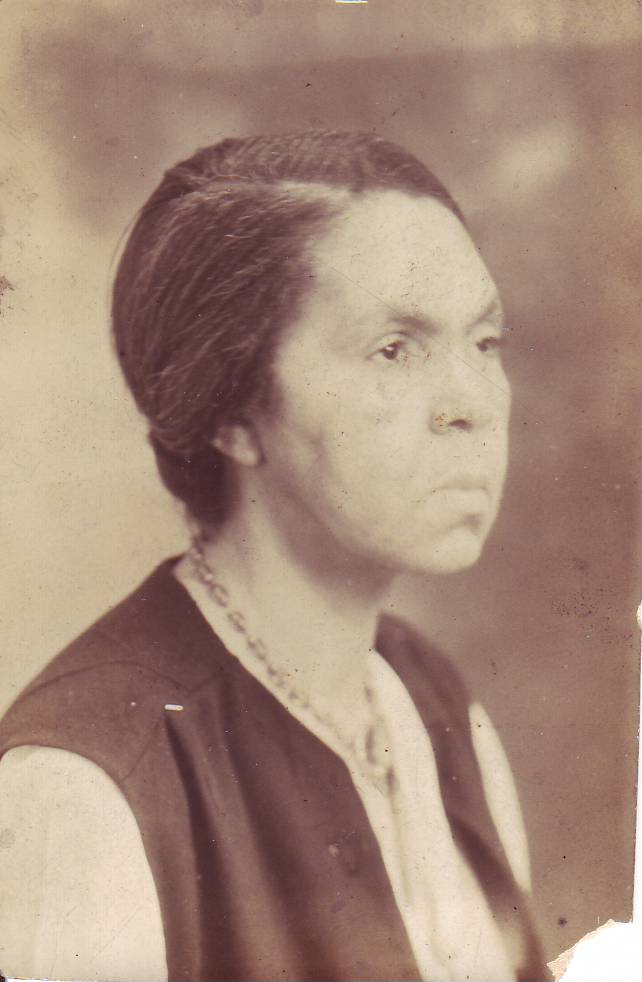
 My great-grandmother, my grandmother, my mother’s brother, and me.
Category Archives: DNA
DNAnigma, no. 10: Sold down the river.
We finally made our way to a theatre to see “12 Years a Slave” today. Throughout this gripping, gut-wrenching film, this ran through my head: “These are my cousins. These are my cousins. These are my cousins.”
My 23andme Relative Finder is filled with matches who know only that their families lived in Mississippi or Louisiana. All my African-American lines are upper South, rooted in Virginia and North Carolina. The link is obvious. My DNA matches are the descendants of the mothers and fathers, aunts, uncles, cousins, and siblings of my ancestors, sold down South in America’s domestic slave trade. The connections are nearly impossible to recreate, the names lost to time, but I take comfort in the fact that the bonds remain detectable in blood and bone.
DNA Definites, no. 9: Hagans.
23andme characterizes K.H. as my father’s first cousin (8.11% share) and my second (4.4% share). We are related via my Henderson and Aldridge lines, and much more closely in the latter. He is, in fact, my father’s first cousin, once removed. K.H.’s mother and my father’s grandfather were siblings.
K.H. shows a distant match with W.B., but not her daughter W.M. (My father and I show no match with either. Nor does E.H., who is K.H.’s nephew.) W.B. and W.M. are descended from Napoleon Hagans through his son William S. Hagans. Napoleon was the half-brother of Frances Seaberry Artis (my great-great-great-grandmother and K.H.’s great-grandmother.)
My father’s haplotypes.
Haplogroup H is the most common mtDNA haplogroup in Europe and is found in about 40% of Europeans. H3 – my father’s haplotype — is the second most common subclade of H. It is found more frequently in western than in eastern Europe and is thought to have arisen 9000-11,000 years ago.
On the other hand, Y-DNA haplotype J2b1 is now found mostly in the southern Balkans and Anatolia. Fewer than 2% of European men in the region of Europe from which my known ancestors came – the British Isles and northern Europe — belong to haplogroup J2b.
DNA Definites, no. 8: Casey.
In the olden days, you sat and waited. In some mimeographed newsletter or erratically published journal you’d run across an address to pin your hopes on, a descendant on the same track you’re plodding, a grande dame with access to caches you don’t. Or: you’d pressed your own address into the palm of a kind, but wary, librarian, hoping she would be able to crack the reserve of the stingy local historian. Either way, you sat and waited for the mail to arrive.
In late 1994, I reached in my mailbox to pull out a letter forwarded from my parents’ address in North Carolina. The writer was K.K., and she’d run across a query I’d posted in the North Carolina Genealogical Society Journal. K.K. is a descendant of Micajah Casey (1748-circa 1800) of Dobbs and Wayne County, whom I believed to be my great-great-great-great-great-great-grandfather. K.K. was living abroad at the time, and correspondence was slow and expensive, but we exchanged a few letters about Caseys, Herrings, Jernigans and Lewises before exhausting our mutually meager information and losing touch.
A few days ago, my cousin D. received her 23andme results. She is the granddaughter of my father’s first cousin, and I was interested in comparing her DNA matches to his and mine. As I scanned her nearly 1000 matches, a name leapt to my eye — K.K.! My father and I didn’t, but D.’s chromosomes retain a tiny piece of Casey that K.K. has held onto, too. I ripped off an excited message, and K.K. responded immediately. More then 20 years after her first letter arrived, our relationship is confirmed.
My mtDNA: haplotype L2d1a.
Mitochondrial (mt) DNA is passed down in a matrilineal line from mother to offspring of both sexes. Unlike Y-DNA (passed on the Y chromosome from father to son only), it mutates very rarely. MtDNA is classified into haplogroups. The L haplogroup is the oldest of all mtDNA haplogroups and originated in Africa. My haplotype is L2d1a, which is part of the L haplogroup. I inherited this from my mother’s mother’s mother’s mother and on back to an African maternal ancestor who lived many thousands of years ago.
Though each of us carries mtDNA, only a small group of my mother’s extended family shares my L2d1a haplotype. Of all of Martha Miller McNeely‘s daughters, only Carrie McNeely Colvert, Emma McNeely Houser and Janie McNeely Taylor passed L2d1a to female children. However, only Carrie’s daughters Louise, Margaret and Launie Mae passed it further. (Emma’s daughter Wardenur died childless, as did Janie’s daughters.) All of Louise, Margaret and Launie Mae’s children are L2d1a, but only six of their collective daughters passed it further. In my grandmother Margaret’s 2nd and 3rd generations, only I, my sister, my neice, and two first cousins carry it.

to
to

to

to
 [By the way: Harriet Nicholson Hart’s mtDNA line ended when her only daughter died childless. Also, there are no known carriers of Walker Colvert’s or Henry W. McNeely’s Y-DNA. ]
DNA Definites, no. 7: Price.
Just a couple of weeks after I discover the names of Polly Ann Price Martin‘s parents, I find a match with a Price descendant at Ancestry DNA. J.W. is a great-great-grandson of Polly’s sister Margaret “Peggy” Price Williams (1840-1920). Ancestry estimates that we are 5th-8th cousins. My calculation is 4th, once removed.
DNAnigma, no. 9: John Allen’s haplogroup.

John Allen resembled his mother Mary Brown Allen in the fullness of his face, in his heavy brow, and in the shape of his wide, straight mouth. Where her skin was a smooth walnut-brown, however, his was the creamy pale yellow of a pat of butter. Of his father, we know nothing at all except this: he was white. This conclusion, which has long rested on family lore, physical appearance and common-sense conjecture, has been confirmed in the Y-DNA haplogroup of his male descendants. The DNA of my uncle, son of John Allen’s son John Jr., yielded haplotype R1b1b2a1a1. R1b is the most common haplogroup in western Europe and is particularly prevalent in men whose ancestors lived in modern-day England, Ireland and France. Y-DNA is passed solely along the patrilineal line, from father to son. (In other words, my grandfather and his brothers, then their sons, then the sons of those sons, inherited. By my count, seven of my great-grandfather’s patrilineal descendants survive. Their ages range from 10 to 81.) It does not recombine, and thus Y-DNA changes only by chance mutation at each generation. For this reason, it is useful in making connections among the male descendants of a common ancestor. Additional testing may help solve the mystery of John Allen’s paternity. [Update here.]
Photograph in the collection of Lisa Y. Henderson.
DNAnigma, no. 8: the Quester.
I’ll call him “Eric.” He rides the top of my list at Ancestry DNA, and at 23andme is my closest match beyond those relatives I consider my immediate family. He is an adoptee, born out West in 1980. He tested to find clues to his parentage and to his ethnic background, and I was the first blood relative he’s ever “met.”
Ancestry estimated our relationship at 3rd cousins, and I encouraged him to test with 23andme, which posited 2nd to 3rd cousins (2.43% shared DNA across 6 segments.) More critically, 23andme revealed that my connection to Eric is through my father, with whom he is an estimated 1st to 2nd cousin, sharing 6.76% across 18 segments! (He and my sister share 3.3% across 7). A 1st or 2nd cousin of my dad, who is 79 years old? How in the world???
Common matches between Eric and my father allowed me to focus on my grandmother’s side as the link. My grandmother had one known sibling. (Well, maybe, two, as I’ve recently learned of a possible half-brother who’s only a few years older than I am. I’m not including him as a possibility for now.) Her half-sister M., with whom she shared a mother, was born in 1907. Full first cousins share, on average, 12.5% DNA, so my father and M.’s children would share about half that. In other words, those cousins would share with my father the approximate percentage of DNA that my father shares with Eric. The male cousins were too old to have been Eric’s father (and, if they were, Eric would share only about 3% with my father.) Thus, they are eliminated as Eric’s father or grandfather. And I can eliminate the female cousins on the ground that he does not share their haplogroup, which is H3.
Arriving at this point, I was momentarily stumped. And then I remembered that uncles and great-great-nephews also share roughly 6.25% DNA. (And constitute a relationship that makes more sense given Eric and my father’s relative ages.) This train of thought, I think — and without going into requisite detail — will ultimately lead us to the truth.
DNAnigma, no. 7: Locus, Eatmon, et al.
 Martin John Locus (1843-1926) and Delphia Taylor Locus (1850-1923). Martin was the son of Martin Locus and Eliza Brantley Locus of southeastern Nash and later western Wilson County. Delphia was the daughter of Dempsey Taylor and Eliza Pace Taylor of northern Nash County.
——
I knew Locuses (and Lucases, their later variant) growing up. There were a few who actually lived in Wilson, but most were from the western part of the county and Nash County. There is no tradition of Locus ancestry in my family history, and nothing I’ve documented suggests it. However, DNA testing has revealed too many matches with descendants of the Locuses (and related families, like Brantley and Eatman) to ignore. So far:
- R.B.W. is my father’s estimated 2nd-4th cousin. They match on chromosomes 5, 18, 20, 21 and 22, and she lists Blackwell, Eatman, Hawkins and Lucas among her surnames.
- M.F. is my father’s estimated 3rd to 5th cousin. She lists Locus/Lucas, Eatman, Brantley and Howard among her surnames.
- E.F. is author of Free in a Slave Society:The Locus/Lucas Family of Virginia and North Carolina, Tri-Racial, Black-Identified, over 250 Years of History, a compendium of research notes, charts and photographs chronicling one of the largest free colored families in the antebellum United States. He notes that the Locus/Lucases intermarried with several free colored families, including Deans, Wiggins, Pulley, Taylor, Wells, Blackwell, Colston, Richardson, Brantley, Howard, High, Williams, Hagans, Evans, Tayborne, Eatman, Vaughn, Strickland, Jones, Pridgen and Allen. E.F. matches my father on a tiny stretch of chromosome 19 (which I did not inherit); 23andme estimates that they are 3rd to distant cousins.
- T.W.is my estimated 4th-6th cousin per Ancestry DNA. Her father was born in Wilson County and is descended from Locus/Lucases and Evanses (another free family of color).
- T.J. is an adoptee whose birth mother is believed to be a Jones and Locus. She is an estimated 3rd to distant cousin to my father.
What’s the link? I know it’s on my father’s side. Common sense tells me that the most likely connections are:
- Leasy Hagans. Leasy Hagans appears in a Nash County census and may have originally lived north and west of where she settled in Wayne. It is not clear whether Hagans is her maiden or married name. Nor is the father of her children known. Was she, or he, a Locus? An Eatman? A Brantley?
- Tony Eatman. Willis Barnes‘ death certificate lists his parents as Tony Eatman and Annie Eatmon. Tony was born free about 1795 and is listed as a farmer in the household of white Theophilus Eatman in the 1850 census of Nash County. (He also is listed as the groom’s father on the marriage license of Jack Williamson and Hester Williamson in 1868.) One potential problem with Tony as my Locus link, though, was explained here. If Willis Barnes were Rachel Taylor’s stepfather, I am not descended from Tony Eatman at all.
- Green or Fereby Taylor. Delphia Taylor Locus was the daughter of Eliza Pace and Dempsey Taylor, a free man of color born circa 1820 in northern Nash County. His relationship to another Dempsey Taylor in the area is assumed, but has not been proven. One white Dempsey (there were several) was the son of Reuben Taylor and the brother of Kinchen Taylor, Green and Fereby’s owner. There is no tradition of white ancestry among the Taylors, but their Y-DNA haplogroup appears to be J2b1, which is European. Was Green — or Fereby, for that matter — descended from Kinchen Taylor or one of his relatives?
Photo courtesy of Europe Ahmad Farmer.
 Scuffalong: Genealogy.