Births Deaths Marriages, Education, Migration, Military, Newspaper Articles, Other Documents, Paternal Kin, Photographs

Col. Oscar Randall.

There were surely many more veterans than that, I thought, and I started poking around my files, looking for men and women I might have missed. Oscar Randall was a possible World War I veteran, but his draft card cast doubt — he claimed a service exemption on the basis that he was “rejected by recruiting officer.”

Image

Nonetheless, I Googled Randall and was stunned to find that not only did he serve, he led troops in battle in France during World War I, received a Purple Heart for wounds sustained in Italy during the Second World War, and achieved the rank of colonel. The most amazing find: two photos of Randall from the Chicago Sun-Times archives for sale on eBay!  I ordered them immediately, and they arrived in yesterday’s mail.

The first photo, taken after the First World War, depicts a smooth-faced, heavy-jowled man in officer’s uniform. Its reverse carries a scrap of newspaper article, as well as a note that the photo was copied from a portrait hanging in Randall’s living room.

O Randall 1921

The second photo, taken in 1982, shows a solemn-faced old man, silver hair swept back from his forehead, his eyes rheumy but mouth set firmly. Light from a window creates a dramatic chiaroscuro. On the back: a slightly longer clipping from the same article, detailing the colonel’s military achievements.

O Randall 1982

Back O Randall 1982

Oscar Randall was born 30 November 1896 in Washington DC, the first of George and Fannie Aldridge Randall‘s children born after their migration from Wayne County, North Carolina. After the War, he returned to college and received a Bachelor of Science in Civil Engineering from the University of Illinois. (He served as president of Tau chapter, Alpha Phi Alpha Fraternity, while there.) Randall taught mathematics at Chicago’s DuSable High School for many years and also worked as a civil engineer for the city’s sanitation department. In the 1950’s, he served as Chief of the U.S. Military Mission to Liberia, which advised that country’s military on training and defense. He married twice, but had no children.

Oscar Randall died three years after his Chicago Sun-Times interview. He was 88 years old.

A memorial service for Oscar Randall, 88, a civil engineer, will be held at 11 a.m. June 9 in St. Thomas Episcopal Church, 3301 S. Wabash Ave. Mr. Randall, of the South Side, died April 8 in Veterans Administration Lakeside Medical Center. A native of Washington, D.C., Mr. Randall graduated from the University of Illinois and worked for the Chicago Sanitary District for nine years. Mr. Randall also taught mathematics at Du Sable High School. In 1918 he joined the 8th Illinois infantry regiment, one of the nation’s first black-led military units. He also served in World War II. Survivors include his wife, Hilda; a stepdaughter, Vera Levy; two stepgrandchildren; two stepgreat-grandchildren; three sisters; and a brother.  

— Chicago Tribune, 23 May 1985.

——

[Sidenote: Pete Souza, who photographed Cousin Oscar, is now Chief Official White House photographer for President Barack Obama and Director of the White House Photography Office.]

Standard
Births Deaths Marriages, Education, Maternal Kin, North Carolina, Oral History, Photographs

There she is.

Image

There she is.  That’s one of those dresses that Mama made for her to come to Hampton.  She came to Hampton a summer.  She stayed more than six weeks.  Must have stayed around eight or ten.  But anyway, she came here, and the things that she learned!  Oh, you would not believe.  All kind of things – artwork she could do.  Making baskets.  Oh, I don’t know what all.  That’s a blue taffeta dress with a white collar.  And you know we had a supervisor [Mary Charlton Holliday] who came to Statesville, and she particularly liked Golar, and she was a Hampton graduate, and she wanted Golar to go to Hampton so she could learn all this stuff.  All this artwork and everything.  And when she got ready, when Golar got ready to go, Mama had bought – this is a navy taffeta dress with a white collar.  And Mama had made all these dresses for her.  She had – this was a dressy dress.  And she had a pink dress, and she just, Mama just made her so many pretty things, you know.  And the, two or three nights before she was to go, to leave to go to Hampton, she broke down and cried.  Mama said, “What’s wrong?”  Said, “We’re gonna be, we’re gonna have your things ready.  You’re gonna be ready to go.”  And she said, “That’s not why I’m crying.”  She said, “I’m crying because Papa and Grandmama went to the bank and took out all of your money.”  Mama had paid into her Christmas savings account, and the bank just gave the money to Grandma and Papa, and that’s how they got her things together.  And she told Mama.  Ooooo

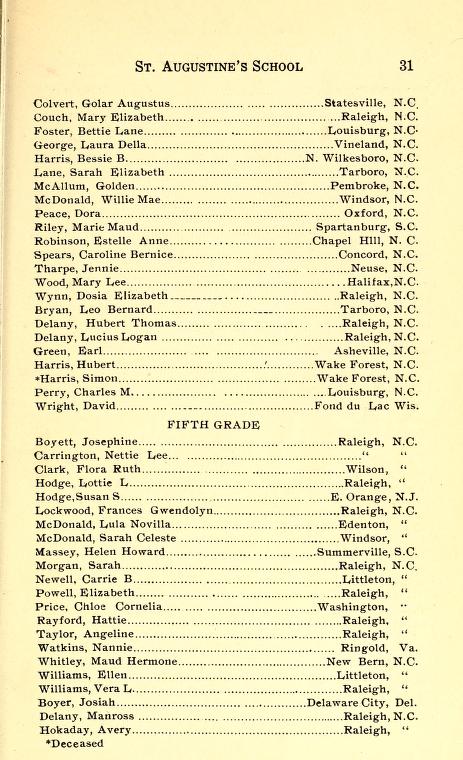
Golar Augusta Colvert was born in 1897 in Statesville, Iredell County, to Lon W. Colvert and his first wife, Josephine Dalton Colvert. She was about 9 years old when her widowed father married Carrie McNeely, and she grew close to her stepmother and adoring young half-siblings. When she was about 15, she enrolled at Saint Augustine’s College in Raleigh NC, where school catalogs show that she was a classmate of the Delany Sisters’ younger brothers.

annualcatalogueo18991914_0693

Annual Catalog of Saint Augustine’s School, 1913-1914.

In 1919, Golar married William Bradshaw, son of Guy and Josephine Bradshaw. Their son William Colvert Bradshaw was born in 1921 and daughter Frances Josephine in 1924. The little girl did not live to see two years. William worked in a furniture factory and Golar taught elementary school, and the family lived in a large frame house with a wrap-around porch on Washington Street in Statesville’s Wallacetown section.

In the summer of 1931, for reasons that are not at all clear, Golar traveled to Washington DC to undergo surgery.

Yeahhhh.  Went to Washington.  Had this operation and, ah, we got a letter from her.  Like, this afternoon, saying that she was all right, that they were gon take her stitches out, and she was coming home.  And she died that night.

GC Bradshaw 7 23 1931

Statesville Landmark, 23 July 1931.

Image

Statesville Landmark, 27 July 1931.

Interview of Margaret C. Allen by Lisa Y. Henderson; all rights reserved.

Standard
Births Deaths Marriages, Education, Free People of Color, North Carolina, Other Documents, Paternal Kin

John William Aldridge.

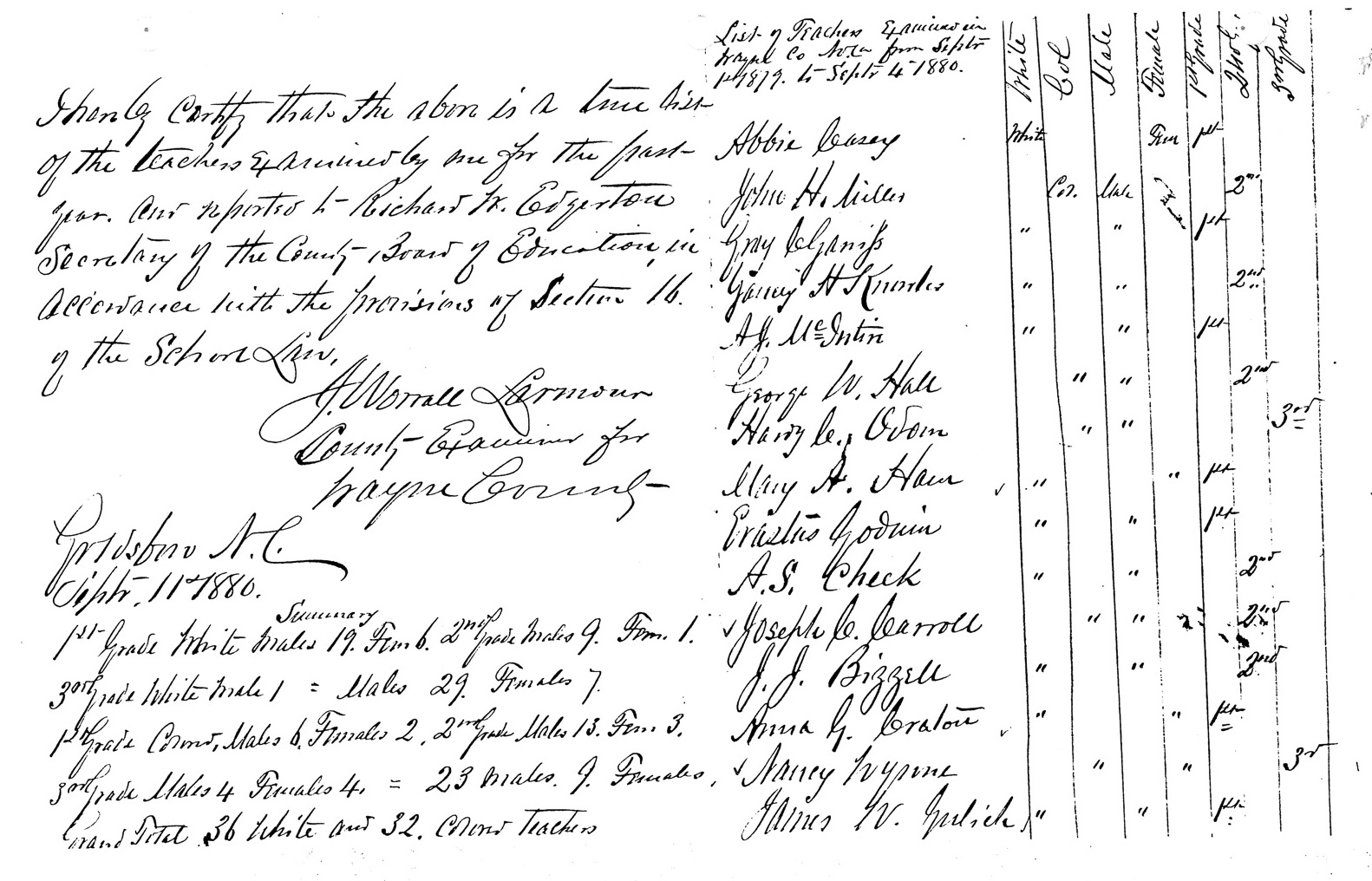
John Aldridge and his brothers George and Matthew Aldridge were hired to teach in Wayne County in the late 1870s. For reasons unknown, they were assigned to schools in the far north of the county, some 15 miles north of Dudley:


ALDRIDGE -- Aldridge_School Records

ALDRIDGE -- Aldridge_School Records 2 

From the same unsigned family history:

John Aldridge met Luvicie Artis at the school where he taught; she was one of his students. He built a 7 room house for her when they got married. John was a stout man with a reddish brown complexion and wavy black hair. He stopped teaching when he married Luvicie and started to farm and run a general store. The store was burned down in 1911. He sent his children to a private school. He died in 1910 of a congested chill. He was 58 years old when he died, and was worth about $30,000 at that time.

ALDRIDGE_--_John_Aldridge_Vicey_Artis_Marriage_License

If John was worth $30,000 when he died, it was all in realty. His personal estate was paltry:
JW Aldridge Estate Doc
Standard
Education, Maternal Kin, North Carolina

Morningside School.

Statesville’s Morningside School had its beginnings in the two-roomed Colored Free School, which opened in 1891. Maggie Sellars and Alma J. Carter shared teaching duties. The following year and additional room was added, and the instructional staff expanded to five. In 1915, a mysterious fire consumed the original building, and for the next six years children attended classes in nearby churches and fraternal halls. In 1921, a new eight-classroom facility on Green Street near Garfield opened, with Charles W. Foushee as principal. This building was known as Morningside School. Within two years, booming enrollment demanded expansion to seven elementary grades and two high school. Tenth and eleventh grades were added in 1928, and the school was accredited in 1930. After desegregation in 1965, Morningside became an elementary school and, in 1971, its name was changed to Alan D. Rutherford School.

Margaret at school 002

Margaret at school

These photographs were probably taken shortly before the Colored Free School burned down. In the first, my grandmother is second from right on the second row from the top. Her sister Launie Mae is first in the third row from the top. In the second photo, my grandmother is seated last on the third row from the top.

Text adapted from materials produced for Morningside Alumni Association — 2002 Reunion, Statesville NC, 31 August 2002. Photos in the collection of Lisa Y. Henderson.

Standard
Education, Maternal Kin, Religion, Virginia

Church home, no. 4: Zion Baptist, Newport News VA.

“The Zion Baptist Church was organized in the year 1896 under a cherry tree at its present location by a group of 13 baptized Christians who had migrated to Newport News from other areas of Virginia and the Carolinas and who had not affiliated with any local congregation.

In 1896, when the City of Newport News was in its infancy, a section of town now known as the East End was better known as “Blood Field” for its street violence. There were houses of prostitution, bars, dance halls, a saloon on every corner and gambling was a way of life.

It was after several meetings from house-to-house that the thirteen Christians concluded that there was a need for some type of religious worship in the immediate area and so 107 years later, Zion Baptist Church in the East End was set.

The first pastor called to lead the group was Rev. Moses Tynes and in 1897, the first tiny structure was built under his leadership. Most of the materials were donated by whites in the community and the labor was donated by men in the community.

In 1899, under the leadership of Rev. C. J. Crudup, the sanctuary was destroyed by fire. But despite this setback along with other difficulties, the congregation continued to grow. Rev. C. E. Jones was called to assume the responsibility of leadership in 1901 and for eleven years, Zion experienced tremendous growth, encouraging men and women to turn to Christ. Both Rev. and Mrs. Jones were actively involved in the work of the National Baptist Convention and the Lott Carey Foreign Mission Convention. In 1941, Rev. Jones’ pastorate ended as a result of a car accident after 39 years of leadership to the congregation. Rev. Joseph B. Reid became his successor and he served the church for fourteen years.”  Excerpt from “About Us,” http://www.zionbaptistonline.org/about.html

——

John C. Allen Sr. was illiterate when he arrived in Newport News about 1899.  Before long, he made his way to Zion Baptist where, under the tutelage of Rev. Charles E. Jones, he learned to read. John reared his children in the church, and his funeral service was held there in the first days of 1954.

He was a smart man, but he was not an educated man.  If he had had an education to go along with his wit, he would have been a bad boy.  I’m telling you, ‘cause he was just as smart as he could be. 

——

Interview of Margaret Colvert Allen by Lisa Y. Henderson, 8 August 1998; all rights reserved.

Standard
Births Deaths Marriages, Education, Maternal Kin, Oral History, Photographs, Virginia

Remembering Margaret Colvert Allen on her birthday.

Oh, yeah, I always liked that picture.  That was on Hampton’s administration steps.  That was a brand-new coat, child.  And it was real soft.  It was light – I don’t know what you would call it.  Light tan or something.  Anyway.  But it had a summer fur collar on it. … Who sent it to me?  Golar or Walker or some of those people sent it to me…

ImageMy grandmother would have been 105 today. When she passed away in February 2011, she was Hampton’s oldest living graduate. Her funeral service was held on a clear, cold day in the campus chapel, fitting in its reserved beauty.

—–

Interview of Margaret C. Allen by Lisa Y. Henderson, 4 November 2004; all rights reserved.

Standard
Education, Letters, Maternal Kin, Other Documents, Photographs, Virginia

The Keysville school.

Acts of the General Assembly of the Commonwealth of Virginia.  Chap. 91.  An Act to Incorporate the Keysville Bluestone mission industrial school.  Approved January 17, 1900.

Be it enacted by the General Assembly of Virginia, that Reverend Nelson Jordan, R.C. Yancey, George D. Wharton, P.E. Anderson, F.L. Hall, Jesse H. Wilson, Jordan Moseley, Whitfield Clark, L.N. Wilson, A.J. Goode, S.L. Johnson, N.C. Ragby and Miss Mary E. Wilson [are appointed] board of trustees [of an institution] by the name and style of the Keysville Bluestone mission industrial school for the purpose of keeping and conducting at Keysville, Charlotte County, Virginia, a boarding and day school of the above name, and of giving instruction to such colored persons, male and female, as may be committed to their care as pupils of said school. …

Image

——

Rev. Whitfield Clark’s sister Mary married my great-great-great-great-uncle Joseph R. Holmes, who was murdered on the steps of Charlotte County courthouse in 1869. As shown below, Joseph Holmes had been instrumental in securing support for the precursor to this school:

record-image-2

Joseph homes letter

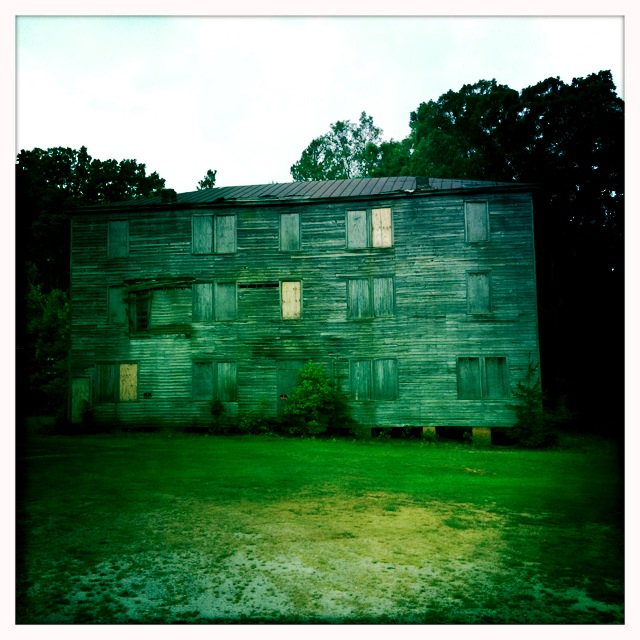
Photograph of Keysville Industrial School, Keysville, Virginia, by Lisa Y. Henderson, July 2012. Images of letters from Virginia Freedmen’s Bureau Letters of Correspondence 1865, 1872, www.familysearch.org (originals in Records of the Field Offices for the State of Virginia, Bureau of Refugees, Freedmen and Abandoned Lands 1865-1872, National Archives and Records Administration.)

Standard