Enslaved People, Letters, North Carolina, Paternal Kin

Some of that set.

“Dear Lisa,” he wrote. “I read with interest your letter of October 31….”

Image

I was new at research and utterly clueless about where to start looking for information about slave forebears when I reached out to the late, great Hugh B. Johnston, Wilson County’s pre-eminent historian and genealogist. I was thrilled to receive his prompt reply. The letter was brief, but encouraging, and though I’d hoped for a complete and annotated report that left no end loose, I was confident that a breakthrough loomed just around the bend.

Unfortunately, here I am, nearly 27 years later, with the same fundamental questions burning:

  1. Was Rachel Barnes the daughter of Willis Barnes, or his step-daughter as the 1880 census indicates?  If the latter, who was her father?
  2. Did Willis Barnes belong to Joshua Barnes?
  3. Was Toney Eatman, a free man of color from Nash County, Willis’ father? Was Annie Barnes Eatman his mother?
  4. Was Cherry Battle‘s first name actually Charity?
  5. Did she belong to Amos J. Battle?
Standard
Births Deaths Marriages, Enslaved People, Maternal Kin, North Carolina, Oral History

Millers & McConnaugheys.

Me:  Did you know any of your grandmother Martha’s people? The Millers?

My grandmother: No, I didn’t.

Me: Did you know any of his people? Henry’s?

Grandmother: No.

Me: It was a lot of them in Rowan — it was a lot of Millers anyway. In Rowan County.

Grandmother: Rowan County? I know they all came from there.

——

In the valuation of Rowan County slaves made by a Confederate tax assessor in 1863, John M. McConnaughey listed 19 slaves.  Among them were: George, 24, $1500; John, 2, $150; Edwin, 1, $100; Margaret, 42, $850; Caroline, 23, $1200; Mary Ann, 13, $1000; Grace, 10, $500; Martha, 7, $250; and Angeline, 7, $250.

Here is the case for these seven people as the family of my great-great-grandmother, Martha Miller McNeely:

1.  George Miller described John McConnaughey as his half-brother in the 1880 census of Rowan County. George’s death certificate lists his parents as Edward Miller and Margaret Miller.

2.  Caroline McConnaughey is listed in the household of her mother Margaret McConnaughey in the 1870 census of Rowan County.

3.  Adeline Miller is listed with her eight month-old son George in the household of Mary [McConnaughey] Miller in the 1870 census of Rowan County. Her marriage license lists her parents as Edward Miller and Margaret Miller. She gave her three children – George, Margaret and Mary Caroline – family names. In the 1880 and 1900 censuses, she and her family are listed next door to Mary Ann Miller and family. In 1888, she witnessed the marriage of John McConnaughey. Her death certificate lists her parents as Ed. and Marg. Miller.

4.  In the 1870 Rowan County census, the household of Mary Ann [McConnaughey] Miller and her husband Ransom Miller included Adeline Miller and John McConnaughey. Mary Anna Miller’s death certificate lists her father as Edward McConaughey, mother unknown.

5.  Martha Miller is listed in the household of her former owner, John Miller McConnaughey, in the 1870 census of Rowan County. (She is a farm laborer, but she also attends school.) Martha’s 1872 marriage license lists her parents as Edwin Miller and Margaret Miller. Her middle name was Margaret. She named her oldest daughter Margaret, her youngest son Edward, and two daughters Caroline (as a first and then a middle name.)

6.  John McConnaughey is listed twice in the 1870 census of Rowan County. First, with  Margaret McConnaughey and Angeline McConnaughey. Then, with Mary Miller. John married four times. Each license listed one parent, Margaret McConnaughey. “John McConeyhead” was a witness to the marriage of Adeline Miller Miller’s daughter Mary C. Miller in 1876. His death certificate lists his parents as Henry McConnaughey and Margaret McConnaughey.

7.  Edwin Miller (or McConnaughey) has not been found outside the 1863 tax list. I include him because of the similarity of his first name to that of Edward/Edwin Miller, father of the above, but there’s no real evidence that he was one of Margaret’s children.

Margaret McConnaughey appears in only one census, 1870, where she is listed as 55 years old. Edward or Edwin Miller has not been found, and the two did not register a cohabitation. Their children:

George W. Miller, born about 1836. He married Eliza Catherine Kerr, probably around 1857. They had three children, Baldy Alexander Miller (1858-1942), Maria Miller (1868-1925) and Onie Jane Miller Johnson (1879-1970). In 1868, George registered to vote with his brothers-in-law Ransom Miller, Green Miller and Henry McNeely. He died 15 March 1915.

Caroline McConnaughey, born about 1842. Her daughter Angeline was born in 1858. The child’s father was Robert Locke McConnaughey, nephew of Caroline’s former owner, John M. McConnaughey.  Caroline apparently died before the 1870 census was taken. She is listed as Caroline McConnaughey (and noted as deceased) on Angeline McConnaughey Reeves’ 1875 marriage license.

Mary Anna McConnaughey, born about 1847. She married Ransom Miller, son of Edmund and Malissa Miller in Rowan County on 27 December 1866. Their children were James Douglas Miller, Florence A. Miller, Ida L. Miller, Margaret E. Miller, Spencer Miller, Lina Miller, Hattie A. Miller, Thomas E. Miller, Richmond Miller.  In 1910, the family lived on Sherrills Ford Road in Steele township. Mary Anna died Christmas Eve 1940 in Boydens Quarters, Rowan County.

Grace Adeline Miller, born 25 June 1853. Her first child, George, was born in 1869. She married Green Miller, son of Edward and Melissa Miller, in 1871, and their children included Margaret Miller and Mary Caroline Miller Brown. She died 30 July 1918.

Martha Margaret Miller, born about 1857. She married Henry W. McNeely in 1872. Their children were Elizabeth McNeely Kilpatrick Long, John McNeely, William Luther McNeely, Emma McNeely Houser, Caroline McNeely Colvert, Addie McNeely Smith, Elethea McNeely Weaver, Minnie McNeely, Edward M. McNeely and Janie McNeely Taylor Manley. Martha and her family moved to Statesville, Iredell County before 1900. In the late 1920s, she moved to Bayonne NJ, where she died 16 June 1934.

John B. McConnaughey was born about 1861. His father likely was not Edward, but a white man. John married Minnie Barr, Romie Harris, Nora Barber and Jane Foster. He died 21 August 1931.

Standard
Births Deaths Marriages, Enslaved People, Free People of Color, North Carolina, Other Documents, Paternal Kin

Up from slavery.

artis-solomon-williams-estate-records-dragged

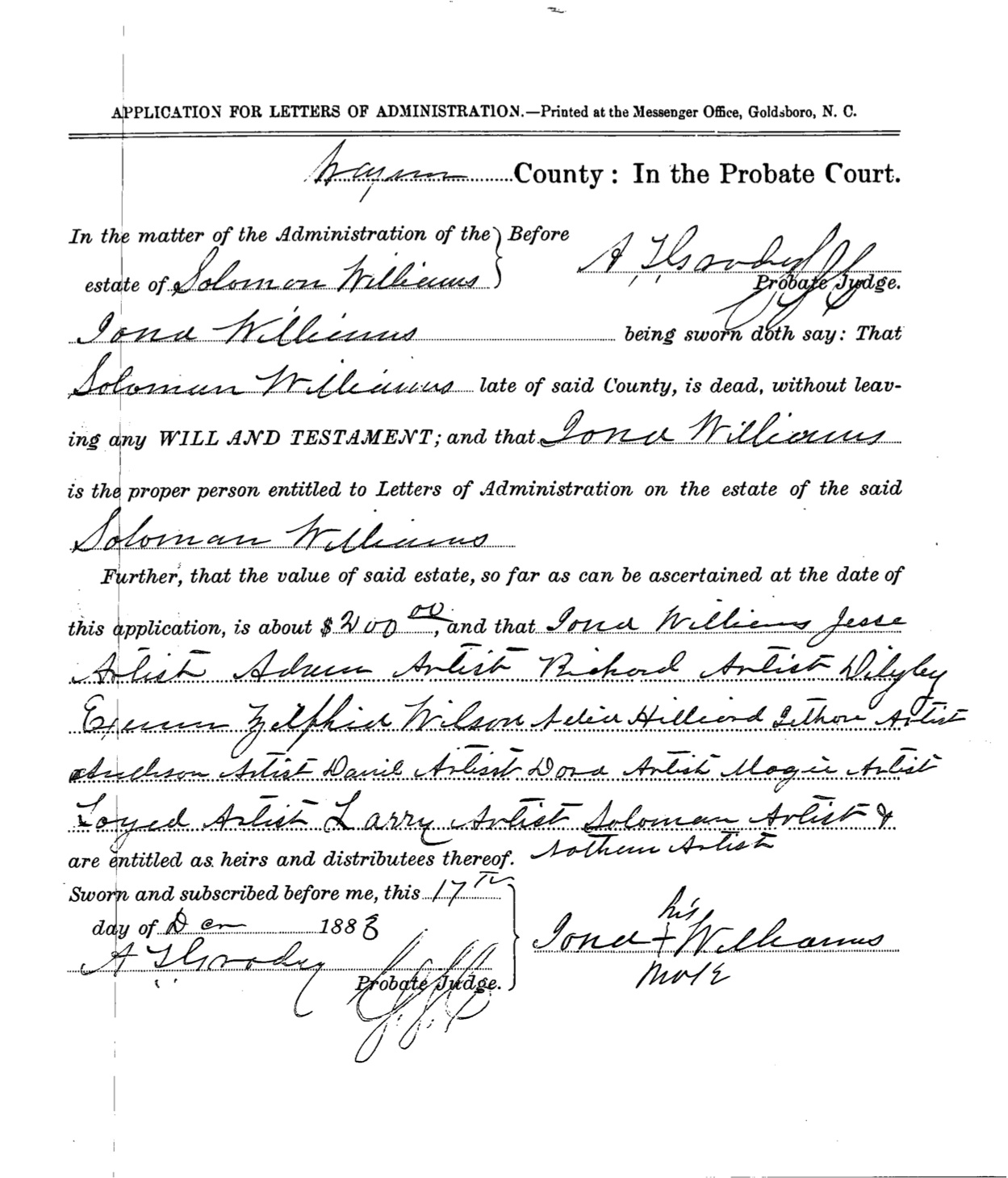
Vicey Artis, a free woman of color, and Solomon Williams, a slave, had eleven children together – Zilpha Artis Wilson, Adam Toussaint Artis, Jane Artis Artis, Loumiza Artis Artis, Charity Artis, Lewis Artis, Jonah Williams, Jethro Artis, Jesse Artis, Richard Artis and Delilah Williams Exum — before they were able to marry legally.  On 31 August 1866, they registered their 35-year cohabitation in Wayne County.  Vicey died soon after, but Solomon lived until 1883.  The document above, listing his and Vicey’s six surviving children and heirs of their deceased children, is found among his estate papers.

Standard
Enslaved People, Maternal Kin, North Carolina

Juda’s children.

As noted earlier, Elizabeth Kilpatrick’s will seems to establish that Juda, an enslaved woman born perhaps in the 1790s, was the mother of at least two children, the Dave and Lucinda specifically referred to in Kilpatrick’s will. Under its terms, Dave’s ownership passed to son Robert Kilpatrick and Lucinda’s to daughter Mary Kilpatrick. Elizabeth’s estate file shows that her administrator sold Negroes Juda ($50.00), Matthew ($425.00) and John ($200.00) on 29 August 1829 and “Negro Kesy” for $74.75 on 30 October 1830. (Their buyers are not listed.) Assuming that Kesy, Matthew and John are the “children not disposed of” in the will, Juda was the mother of at least five children.  Only Lucinda can be further accounted for.

In 1834, Mary Kilpatrick sold Lucinda and her children Alice, 3, and John, 1, to Samuel and John W. McNeely. John disappears from the record. However, Alice, known as “Allie,” bore at least one son, Joseph Archy, and probably several other children, including Alexander, Stanhope and Mary. All – save Alice, who perhaps had died – appear in J.W. McNeely’s Confederate tax assessment in 1863.

Lucinda herself gave birth to two more sons, Julius, about 1838, and Henry W., in 1841. Julius’ father is unknown, but appears to have been a black man. Henry’s father was John Wilson McNeely himself.

Standard
Agriculture, Enslaved People, Land

Visceral touches.

Although the Smithsonian’s National Museum of African American History and Culture, under construction in Washington, will exhibit slave quarters recovered from South Carolina, they will lack visceral touches like the Whitney Plantation’s relentless humid heat and distant trains.  — Eve M. Kahn, “A Restored Louisiana Plantation and Its Lifeblood,”  New York Times, July 26, 2013.

This is cute writing, but it is also truth. I stood shakily at the edge of a North Carolina tobacco field one July, the sun like a ball-peen hammer on the crown of my head, and wept when a horsefly ripped a divot from my forearm. It is humbling, and terrifying, to consider the everyday of the lives of my ancestors, and nothing quite drives the imagination like one’s own acute physical discomfort.

Standard
Enslaved People, Land, North Carolina, Paternal Kin, Photographs

A thousand acres between creek and swamp.

Kinchen Taylor’s estate papers include two plats. One laid off his widow Mary Blount Taylor’s dower. The second divided his remaining land into two large parcels:

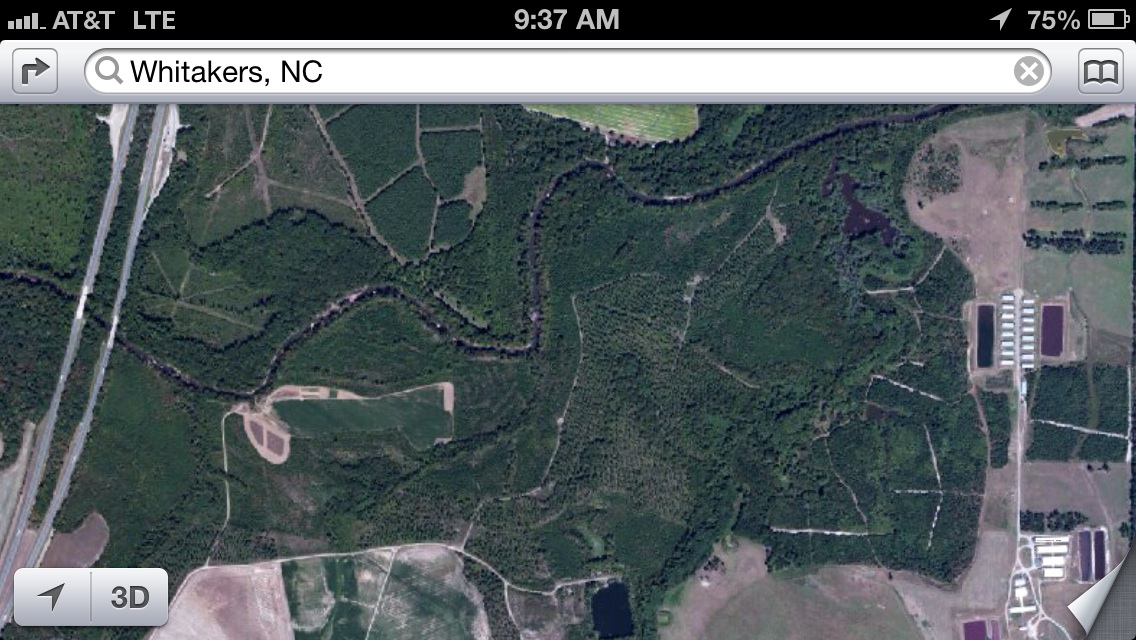
ImageIn some ways, Taylor’s old lands have not changed dramatically. Pine forest and tilled fields still predominate the landscape; far northern Nash County remains rural. Nonetheless, Taylor and enslaved workers like Green and Fereby, who walked and worked it intimately, might be pressed to recognize his property.

Image

I-95 — a far cry from the path shown in the plat — roars with traffic just west of Taylor’s acreage, hauling truckers and tourists from Maine to Florida. If you tilt your head sharply to the right, you’ll see that Fishing Creek, crawling across the top of the screen, still follows the same general course. Beaver Dam Swamp, however, has been dammed just below its confluence with the creek, forming a small body called Gum Lake. The watercourse of the swamp, probably largely drained, is barely detectable as an undulating line of taller vegetation angling southwest from the pond. Lost somewhere in its tangle of canes and catbrier is the Old Mill shown on the plat.

On the other side of Beaver Dam swamp, to the far right of the Google Map view, is an industrial hog farm, identifiable by the white structures with adjacent dark lozenges — barns holding up to 2500 hogs a piece and the lagoons that capture the stupendous quantities of waste they produce. This perhaps would have startled Kinchen Taylor most, as his hogs would have been free-range until time for fattening. (And it should startle you, too, as this is huge, nasty business.)

The file of Kinchen Taylor (1853), Nash County, North Carolina Estate Files 1663-1979, https://familysearch.org, original, North Carolina State Archives;

Standard
Enslaved People, Maternal Kin, North Carolina, Oral History

Henry W. McNeely.

My grandmother said he looked a bit like a poet. Or so she was told:

See, I never did know Grandpa Henry. I didn’t know him.  He died just as Louise was born. Mama had just had Louise, and it was real hot and all, and they told her she couldn’t go to the funeral because it was so warm and she would take cold.  But I didn’t know him. 

And:

Mama said he looked just like Walt Whitman.  You know, he was, his father was white. I don’t know who his mother was. I don’t know if she was mulatto or what.  But anyway, he was really light.  And he lived on the same farm as his daddy.  And he provided him, he provided for him as if he was his own child.

White child, that is.

Henry W. McNeely was 22 years old the year his father reported to the tax assessor that he was worth $1500. The tax list is his first named appearance in the record, and documentation of his life is relatively scarce thereafter. He registered to vote in Rowan County in 1868 and appears in his mother’s household in Atwell township, Rowan County, in the 1870 census.  (He was described as a schoolteacher. Had his father taught him to read while he was enslaved? Or was he a quick learner in a Reconstruction school?) In 1872, he married 18 year-old Martha Miller and, in a daring gesture, named Wilson McNeely as his father on the license. The register of deeds did not blink and dutifully noted that all parties, except Wilson, were colored.
Image

[Sidenote: “Louise” was Mary Louise Colvert Renwick, my grandmother’s sister, born in 1906. — LYH]

——

Interview of Margaret C. Allen by Lisa Y. Henderson; all rights reserved.

Standard
Births Deaths Marriages, Enslaved People, Maternal Kin, North Carolina, Other Documents

Cohabitation as man and wife.

COLVERT -- Walker Colvert Rebecca Parks CohabitationIn March 1866, in order to ratify marriages and legitimate children, the North Carolina General Assembly passed an Act directing Justices of the Peace to collect and record in the County Clerk’s office the cohabitations of former slaves. Freedmen who did not record their marriages by September, 1866, faced misdemeanor charges. Stragglers rushed the courthouse that August, and on the 25th Walker Colvert and Rebecca Parks traveled the 12 miles or so from Eagle Mills to stand in line. They declared that they had been together for 13 years and named three children, John, Elvira and Lovenia. (There should also have been a son Lewis, the youngest — and who in the world is Lovenia? I have found no trace of her.)

Walker, fifty-ish at the time, was my great-great-great-grandfather. He was born in Culpeper County, Virginia, then passed, like a bedframe or milk cow, from one Colvert to another and into Iredell County, North Carolina. Rebecca was not his first wife, and his age suggests earlier children, names and fates unknown. My grandmother, who died in 2010 at age 101, knew and remembered Rebecca. And, like that, a link across five generations.

Standard
Enslaved People, Maternal Kin, North Carolina, Other Documents

6 chisels, a hammer & square, a grain box, a sorrell mare, 10 hogs and …

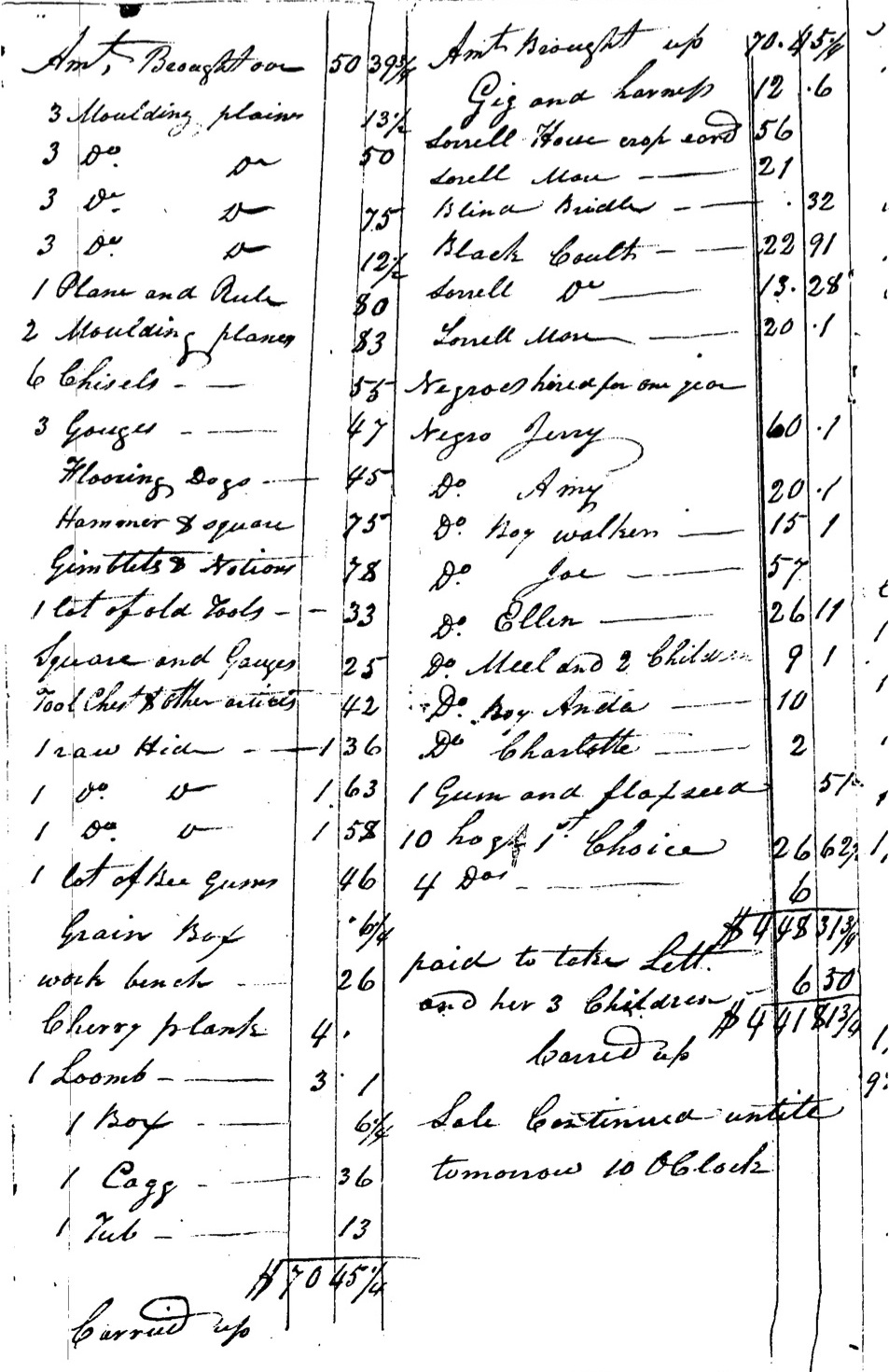
Inventory of the estate of John Alpheus Colvert, Iredell County, North Carolina, 1827.

ImageImage

On the second page, in the second column, are “Negroes hired for one year,” that is, slaves leased to neighbors to earn money for Colvert’s estate. “Boy Walker” was about eight years old. That he was listed without his mother suggests that he was an orphan, though he may have been kin to the others who appear in this list. Walker had arrived in North Carolina only two or three years before, passed to John Colvert from the estate of John’s father Samuel. When John’s died, his son William I. Colvert inherited Walker. William was even younger than his own slave, however, and Walker was likely hired out until the boy came of age.

Standard
Births Deaths Marriages, Enslaved People, Maternal Kin, Newspaper Articles, Virginia

Tragedy at Charlotte Court House.

I first heard a version of the story of Joseph Holmes’ assassination from my great-aunt, Julia Allen Maclin. Joseph Holmes was brother to her grandfather Jasper Holmes. I later found a few references to the murder in books about Virginia’s political history, but details conflicted widely. A few years ago, I found these digitized articles, which firmly established the date of the incident and seemed to offer better insight into what actually happened. Last summer I visited Charlotte County and, with the invaluable assistance of archaeologist Kathy Liston, began to explore the landscape of Joseph and Jasper’s lives and shine light on the aftermath of his assassination.

 Tragedy at Charlotte Court House – A Negro Shot by a White Man – Particulars of the Affair – Result of the Inquest – Order for the Arrest of Those Concerned.

Richmond, May 4, 1869.

A tragedy occurred at Charlotte Court House, Va., yesterday, in which Joseph Holmes, a negro member of the late Constitutional Convention, lost his life. A few weeks since John Marshall, a son of Judge Marshall, of that county, was fired at in the night while in his residence by some unknown person. Yesterday being court day, Mr. Marshall was at the village, and there recognized a negro whom he suspected of having attempted to assassinate him. Marshall charged the negro with the crime, and he at once fled into the woods and was pursued without avail. A few hours afterwards, Joseph Holmes, who was formerly body servant of Judge Marshall, encountered young Marshall and threatened to have him arrested. A fight thereupon ensued, and both parties having pistols, firing commenced – Marshall aided by his friends. Holmes was shot through the breast, and staggering to the Court House fell dead. An inquest was hold, the jury returning a verdict that the deceased came to his death from a gunshot wound at the hands of some person unknown. The affair creates the greatest excitement in the county, where Holmes was exceedingly popular among the negroes, having been elected to the convention by a 2,000 majority over a white candidate. An order has been issued for the arrest of Marshall and party, but they have not yet been apprehended. — New York Herald, Wednesday, 5 May 1869.

——

THE WRIT OF HABEAS CORPUS IN VIRGINIA. –

Soon after the shooting of Joseph Holmes by young Marshall, in Charlotte county, Virginia, a meeting of the republicans of the county was held, speeches were made by prominent members of the party, and among the speakers were John Watson, George Tucker and Ross Hamilton. These parties were arrested and committed to jail under an indictment which charges that they did, on the 20th May, “feloniously conspire one with another to incite the colored population of Charlotte to make war against the white population by acts of violence,” &c. A petition for a writ of habeas corpus was on Monday presented to Judge Morton of the Circuit Court of Henrico, at Richmond, wherein it is alleged that the parties are illegally detained in the custody of the Sheriff of Charlotte county, and they are innocent of the charge brought against them. This writ was granted and made returnable on Tuesday. In accordance therewith the prisoners were brought before Judge Morton on Tuesday afternoon and after discussion of certain points of law the prisoners were hailed for their appearance before the County Court of Charlotte, Va., to answer the indictment. — New York Herald, Friday, 25 June 1869.

Standard