Births Deaths Marriages, Free People of Color, Land, North Carolina, Paternal Kin, Photographs

Final resting place.

I wasn’t sure how I was going to get at it. GPS coordinates and satellite views showed the cemetery way back from the road on private property, without even a path to get to it. I took a chance, though, and pulled up in the driveway of the house closest to it. A wary, middle-aged white woman was settling an elderly woman into a car as I stepped out. I introduced myself and told her what I was looking for. “Goodness,” she said. “I remember a graveyard back up in the woods when I was child. You should ask my cousin J.”

Following her directions, I knocked on the house of a door perhaps a quarter-mile down Turner Swamp Road. J.S. answered with a quizzical, but friendly, greeting, and I repeated my quest. Minutes later, I was sitting in J.’s back room, waiting for him to change shoes and look for me some gloves and find the keys to his golf cart. We bounced along a farm path for several hundred yards, then followed the edge of the woods along a fallow field. Along the way, J. told me about his family’s long history on the land, and the small house and office, still standing, in which his forebears’ had lived. As we approached the final stretch, he cautioned me about the briers that we were going to have to fight through and pulled out some hand loppers to ease our path. The cemetery, he said, was there — in that bit of woods bulging out into the plowed-under field.

IMG_4797

When they were children, J. and his cousins roamed these woods at play. Though only a few markers were now visible, he recalled dozens of graves on this hillock. Turner Swamp runs just on the other side of the tree line nearby. Without too much difficulty, we cut our way in and angled toward the the single incongruity in this overgrown copse — a low iron fence surrounding a clutch of headstones. I made for the tallest one, a stone finger pointing heavenward through the brush. At its base:

IMG_4783

Elder Jonah Williams, brother of my great-great-great-grandfather Adam T. Artis.

IMG_4786

At his side, wife Pleasant Battle Williams. And his children Clarissa, J.W. and Willie nearby.

IMG_4789

In Glimpses of Wayne County, North Carolina: An Architectural History, authors Pezzoni and Smith note that the largely forgotten graveyard was believed to hold the remains of members of the Reid family. This is quite possibly true as Reids have lived in this area from the early 1800s to the present. As I followed J. through the brush and my eye grew accustomed to the contours of the ground beneath us, I could see evidence of thirty to forty graves, and there are likely many more. Had this been a church cemetery? Was Turner Swamp Baptist Church (or its predecessor) originally here, closer to the banks of the creek for which it is named? If this were once the Reid family’s graveyard — known 19th and early 20th century burial sites for this huge extended family are notably few — how had Jonah and his family come to be buried there?

IMG_4794

I am indebted to J.S. for the warmth and generosity shown to a stranger who showed up unannounced at his doorstep on a chilly December day, asking about graveyards. I have been at the receiving end of many acts of kindness in my genealogical sleuthings, but his offer of time and interest and knowledge — and golfcart — are unparalleled. He has invited me back anytime, and I intend to take him up on the offer.

Standard
DNA, Free People of Color, North Carolina, Paternal Kin

DNAnigma, no. 2.1: Another Armwood.

I seldom check FTDNA, but last night I moseyed on to study the new My Origins feature. A glance in the corner of the screen showed a  new high match, an estimated 2nd to 4th cousin whom I’ll call L.A. I emailed him, and he quickly responded. We immediately identified Sampson County, North Carolina, as a potential point of commonality, and I asked his grandparents’ names. I looked them up and found that one was the offspring of John Wesley Faircloth and Laura Wynn (or Simmons). A little further research — and consultation with Stephen Maynor, my point man for all things Sampson County — revealed that Wesley Faircloth, born about 1856, was the son of Nancy Armwood. Again with these Armwoods!

Nancy was the daughter of John and Susan Armwood, and her sister Louisa (or Eliza) was my great-great-great-great-grandfather James Henderson‘s second wife. Am I an Armwood though?

While refreshing my recollection about this family — which has always frustrated my efforts to track them properly — I discovered a previously unnoticed tangle of intermarriages between and among the Armwoods, Wynns, Simmonses and a few Hendersons in northern Sampson and Duplin Counties and southern Wayne County.

The base couples:

  • Major Armwood (~1798-??) and wife Eliza [last name unknown] Armwood (~1806-??).
  • Richard Armwood (1832-??) and wife Mary Faircloth Armwood.
  • John Armwood (~1800-??) and wife Susan [maiden name unknown] Armwood (~1820-??).
  • James Simmons (1798-1860) and wife Winnie Medlin Simmons (??-1902).
  • Gray Winn (~1815-1850) and wife Sarah Greenfield Winn (1816-1909).

And the marriages and other relationships that flowed therefrom:

And this is just a generation or two of intermarriage. I’ve asked A.G., my other Armwood match, to test with 23andme so I can compare our matches and see if she matches my known Hendersons. Stay tuned….

Standard
Births Deaths Marriages, Enslaved People, Free People of Color, Land, Newspaper Articles, Paternal Kin

Six acres on the south side of the road.

Goldsboro_Messenger_3_10_1884_Sol_Wms_estate_debtors_notice

Goldsboro Messenger, 10 March 1884.

 Gboro Messenger 9 11 1884 Wms v Artis

Goldsboro Messenger, 11 September 1884.

Solomon Williams‘ son (and estate administrator) Jonah Williams placed these notices in a local newspaper. Solomon’s six acres could not be meaningfully divided among the eight children that survived him. Ruffin Bridge is another name for Peacock’s Bridge, which spans Contentnea Creek on the Wilson-Greene Counties border. It is not at all clear to me, however, which road would have been regarded as the road from Goldsboro to the bridge.

Standard
Free People of Color, North Carolina, Paternal Kin

An action for seducing away two colored boys.

John Jones v. James Mills, 13 NC 540 (1830).

Jones sued Mills in Jones County Court for “seducing” two apprentices from him. Jones produced evidence of his indentures of the boys, and Mills countered with proof that Jones had not properly executed bond, as required by law, not to remove the apprentices out of the county. The trial judge charged the jury that Jones had indentured the boys and taken care of them, and Mills, a stranger, “could not avail himself of any irregularity or defect in the bond” as a defense to the suit. The jury returned a verdict for Mills, and Jones appealed. The North Carolina Supreme Court overturned the decision, opining that, even if the bond were defective, the apprentices had not been turned loose, “fit subjects to be seduced and employed by any stranger that thinks proper to interfere.

——

I first encountered this case many years ago when I was researching my master’s thesis, which examined the involuntary apprenticeship of free children of color. The published decision in Jones v. Mills is not terribly interesting. I was stunned, then, when I peeked into the case file, now stored at the North Carolina State Archives: “This was an action on the case for seducing away two colored boys Durant and Willis Henderson alias Dove claimed by the plaintiff as his apprentices by virtue of indentures with the County Court of Onslow.”

Durant and Willis Henderson — alias Dove?

I knew that my Hendersons originated in Onslow. I also had a good friend during my college years who was a Dove. A bit of research quickly established that L.D. was a descendant of Durant Dove, via his son Lewis James Dove. Further research, still ongoing, strongly suggests that Durant and Willis’ mother, Nancy Henderson alias Dove, was the sister of my great-great-great-great-great-grandmother, Patsey Henderson. Their father appears to have been Simon Dove, a free man of color from Craven County.

The case file also reveals that John Jones bound Durant and Willis in 1819 to serve as his apprentices and learn the art of farming. They remained with Jones until 1828, when Mills took them into Jones County, giving rise to this suit.


Standard
Births Deaths Marriages, Free People of Color, Letters, North Carolina, Paternal Kin, Photographs

Your friend and great-aunt by marriage.

After Rev. Joseph Silver died, my grandmother received a letter from his widow:

MC SIlver to H Henderson 2 2 1958_Page_1

MC SIlver to H Henderson 2 2 1958_Page_2

Martha C. Silver is a bit of a mystery. She was born about 1873 in Halifax County to William Hilliard Hawkins (born 1833 to Ambrose and China Harwell Hawkins) and his wife Mary E. Hulin Hawkins (born 1840 to Hilliard and Tabitha Locklear Hulin), both born free. I have found her with her birth family in the 1880 census of Enfield, Halifax County. I lose sight of her, though, until 5 August 1912 when she is listed as Cary Hawkins Henderson in her father’s Halifax County will and then until 16 December 1925, when as “Martha C. Henderson” she married Joseph Aldridge (born 1869), my great-great-great-grandfather John W. Aldridge‘s younger brother.  (I cannot find a marriage license for Martha and any Henderson (much less one related to me).) In the 1930 census of Goldsboro, Wayne County, “Carry” Aldridge is listed with Joseph and his children by his deceased first wife, Louberta Manley. Joseph died in 1934, and I lose Martha again until 8 September 1943 when she married Joseph Silver in Wayne County. He was 86 (and widowed five years previously by the death of my great-great-great-aunt Sarah Henderson Jacobs Silver), and she was 70. Martha returned to Halifax County and remained there at least until Rev. Silver died in 1958. Past that, though, I know little, for I have not found her death certificate.

Image

A few years ago, I obtained a copy of a photo of family group from someone who knew only that they were Aldridges. Last year, a cousin confirmed what I had suspected. Eight of the nine people pictured above are Joseph and Louberta M. Aldridge’s children. The ninth? Martha Cary Hawkins Henderson Aldridge Silver, with whom they remained close even after their father’s death. My cousin told me that Martha had children of her own when she married Joseph Aldridge and had gone to live with a son in Washington DC in her latter years. My cousin and her father, Joseph’s son George, visited her regularly until her death at age 100 or older. [Update: on 27 May 2014, Martha’s grandson contacted me and advised that, while she had a son named Charles who lived in New York, Martha had spent her final years with her daughter in DC.]

(By the way, the “Johnnie Aldridge of Dudley” referred to in the letter was Joseph’s nephew, and my great-great-uncle, John J. Aldridge. “Reka” was Reka Aldridge Ashford Morrisey, daughter of Joseph’s brother George W. Aldridge. Luke Morrisey was her husband.)

Hat tip to Patricia Aldridge Polack for her identification of William J.B. Aldridge, Milford Aldridge, Lillie Mae Aldridge, George Mitchell Aldridge and Joseph Leon Aldridge (top) and Daniel W. Aldridge, Allen Aldridge and Mary Eliza Aldridge Sawyer (below).

Standard
Births Deaths Marriages, Enslaved People, Free People of Color, Land, North Carolina, Paternal Kin, Photographs

Family cemeteries, no. 13: Artis Town.

We passed Edwards cemetery on the left, rounded the curve, and there, just where I suspected, was the turn-off onto a farm road leading to Artis Town cemetery. The graveyard is a rectangle of green amid bare spring fields, neatly mowed. A row of weedy trees bristles down one side, broken limbs scattered from recent storms. The oldest stones tilt sideways or sprawl toppled on their backs, but the cemetery is obviously cared for. It lies at the heart of what was once known as Artis Town, a hundred or more acres between Highway 58 and Speights Bridge Road on which lived and farmed Artises and Edwardses in every direction, descendants of Daniel Artis, who bought the land in the 1800s. There was even a racetrack here, said my cousin, where men would line up horses and buggies for weekend contests. As time went by, however, the land got “swindled down.”

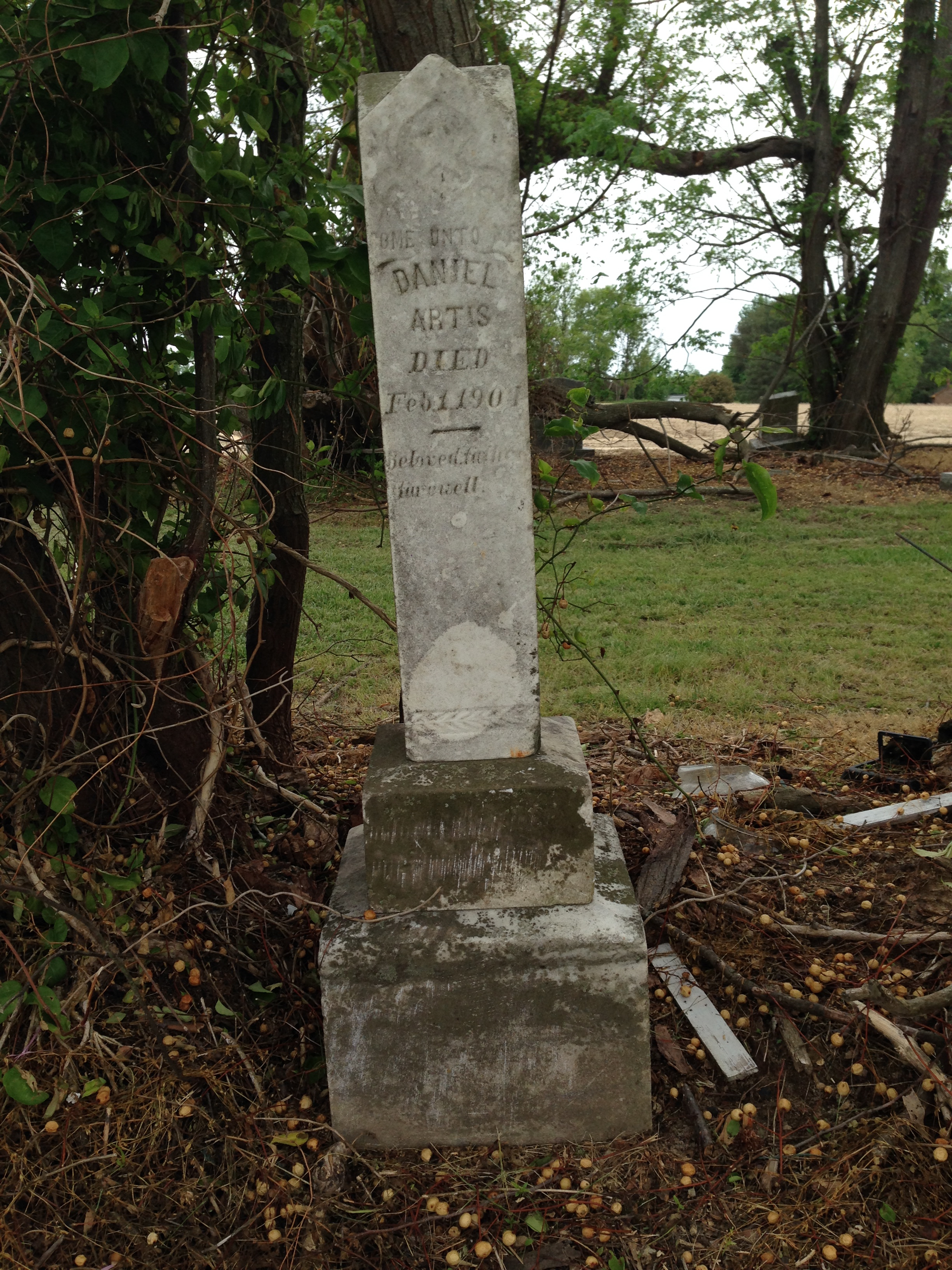
Daniel Artis’ headstone stands in a shadowy pocket underneath a chinaberry tree, the grave itself sprinkled with wrinkled yellow fruit. The small white marble obelisk is a testament to Daniel’s prosperity and the esteem in which his offspring held him.

IMG_5197

I did not locate stones for any of Daniel’s children in the graveyard, though surely some are buried there. (Daughter Clara Artis Edwards is buried in the nearby Edwards cemetery.) Many markers memorialize the deaths of descendants of Loderick Artis and Prior Ann Artis Sauls Thompson, including Loderick’s daughter Sarah Artis Speight:

IMG_5192

and son, Manceson Artis:

IMG_5210

and daughter Hannah Artis Mitchell, as well as Prior Ann’s daughter Mariah Sauls Edwards:

IMG_5195

and a host of other Saulses, Forbeses, Artises, Speights and Mitchells descended from Daniel Artis.

Photos taken by Lisa Y. Henderson, 2 May 2014.

Standard
Civil War, Enslaved People, Free People of Color, North Carolina, Oral History, Paternal Kin

Daniel was always spoken of with respect and love.

I recently received a comment from a reader in response to my posts on the Daniel Artis family. She was hesitant to contact me because her ancestor John Lane had owned slaves — quite possibly some of the people I’ve written about — but was anxious to share a story about Daniel that had been passed down in her family for 150 years. I was surprised and excited to read her message and encouraged her to get in touch. Here’s our April 28 exchange:

Hi, Tammi! Please forgive my excitement and inability to wait for your response. I’m traveling to NC next week to meet some of my newfound Sauls relatives — descendants of Daniel Artis. I’m just beside myself wondering about John Lane — whom I believe apprenticed several of Daniel’s sister Sylvania’s children and might have owned Sylvania’s husband, Guy Lane. I know you’re busy, but I hope you’ll be able to touch base soon. Thanks again!

——

Lisa, thank you for getting back to me! … Yes, apparently there were a few children apprenticed. I recall, I think, five or six on one census. The younger Daniel Artis was 17 years old on, I think, the 1860 census in my g-g-grandfather John Lane’s home. From my family’s handed down stories, the little Daniel was my g-g-g-uncle Christopher Lane’s body servant. Christopher was one of John’s sons and only about seven years older than little Daniel. So they kind of grew up together. The story is that when they both grew up Christopher went to War and Daniel was allowed to go with him as his servant because Christopher was an officer. Only officers could take a servant with them. Daniel was considered free before the war although an apprentice as you probably know. Well, Christopher was captured by the northern troops and taken to their POW camp at Fort Pulaski, Ga. He died there from dysentery. The thing that my family is grateful for is that Daniel went to the camp with Christopher and stayed with him until his death, never leaving his side. When he died, Daniel made his way back to Bull Head, NC to let Christopher’s family and his father John Lane know what happened to him. Daniel was always spoken of with respect and love for what he did for Christopher.

I thank you so much for replying to me, Lisa, because I’ve always wanted to thank his descendants for what Daniel did and for his devotion to our family in such a terrible time. I always wondered if the Daniel Artis next door who was older was related to little Daniel. I saw on the census that he owned property near John Lane, my relative. I hope this information helps some, and I wish all of his relatives happiness and blessings.

——

What a pleasure to hear from you! The Daniel you speak of was the older Daniel’s nephew. “Your” Daniel was the son of Sylvania Artis, a free woman of color, and Guy Lane, her enslaved husband. My direct ancestor, Vicey Artis, was the sister of Sylvania and Daniel the elder. Vicey also married a slave, Solomon Williams. Most of their children were apprenticed by Silas Bryant, a close neighbor of John Lane’s. Daniel the elder’s wife was enslaved, as were their children.

Thanks so much for sharing the story about Daniel the younger. I had no idea that he served in the War. I need to look in my files, but I don’t think I know much about him, though I recall that he married Eliza Faircloth. I do not know of any his descendants either. I grew up in Wilson NC, but with no knowledge of my Greene County links. During a visit home this weekend, I’m going down to Bull Head to meet some Saulses and visit Artis Town cemetery, which is where Daniel the elder was buried in 1905. I’ll keep you posted on anything I find about Daniel the younger.

If you are willing, I would love to share Daniel and Christopher’s story on my blog. I so appreciate your coming forth with this bit of history. Researching African-Americans is generally incredibly difficult, and so much lies locked away with other families. I always dream that someone will contact me just like you did!

Best wishes, keep in touch, and thanks again!

——

I’d be honored for you to use Daniel’s story, of course. I’ve also dreamed and wanted for years to find his relatives, as I mentioned, so I could thank all of them. To be honest, I don’t know if the younger Daniel was enlisted or just went along as an aide to Christopher. I’m only learning recently about the service of black troops both Confederate and Union. I don’t think Daniel was enlisted but I may be wrong. I’ve found the Saulses in many of my genealogy searches but not able to make a connection directly to the Lanes. I can’t remember if I mentioned but my genealogy research came to a brick wall with my g-g-grandfather John Lane. No one anywhere, not even Ancestry.com knows who his father was for sure. I have hints but nothing else. It’s all fascinating.

I can only imagine the difficulty there must be tracing African American genealogy, but I see DNA is being used which is great. It’s part of why I find Scuffalong so interesting. There’s so much information. I really love hearing about Vicey, Sylvania and the elder Daniel since their names have come up so often in my own research. And so happy to meet you, a descendant! Many of my Lane ancestors ended up in Wilson, NC after leaving Bull Head. I’m not sure why, but there were many there in my research including a great-grandmother of mine. Please pay my respects at the Artis Cemetery, to their memory, Lisa, when you visit it. Feel free to write me anytime, if you have any thoughts or questions or just to say hello!

——

CCLane Page 2

Christopher C. Lane enlisted in the 3rd North Carolina Infantry on 23 April 1861 at Snow Hill, Greene County. He was wounded at Gettysburg on September 1863, recuperated at home, then returned to war. He was captured 12 May 1864 at the Battle of the Wilderness, Virginia, and sent to Fort Delaware. In August, in retaliation for the Confederate Army’s imprisonment of Union officers as  human shields in Charleston, U.S. Secretary of War Edwin Stanton sent 600 Confederate officers to Morris Island, South Carolina, to serve as human shields. Lane was among them. After 45 days, the men were transferred to Fort Pulaski, Georgia, and imprisoned in dismal conditions. Christopher Lane died there on 8 December 1864.

I have found no record of Daniel Artis’ service to Christopher Lane during the Civil War, which is not surprising. He was not a soldier; he would not have enlisted. The role of body servants in the early days of the War is the subject of intense debate, and Artis’ status as a free man of color, rather than a slave, further complicates any assessment of his motives (or volition) in following Lane to war.

Many thanks to Tammi Lane for reaching out and sharing a part of Daniel Artis’ life that would otherwise be lost to his family.

——

Image found at http://www.fold3.com.

Standard
Agriculture, Free People of Color, Land, North Carolina, Rights

But for marl.

I don’t know if I’m an Armwood or not, but (1) my great-great-great-great-grandfather James Henderson’s second wife, Louisa, was Henry Armwood’s cousin, (2) I’ve got a DNA match with one of Henry Armwood’s descendants, and (3) Inez Armwood Watson always said we were kin. Either way, I claim him just on the strength of the moxie he displayed when he, a tenant farmer, fought back against the landowner who sought to cheat him of his cotton.

Herring v. Armwood, 130 NC 177 (1902).

B.W. Herring filed this suit in Duplin County, North Carolina, to recover from William Henry Armwood two bales of cotton worth $81 that he alleged belonged to him. Armwood responded that the cotton was worth much more than $81 and that it was not Herring’s. Further, countered Armwood, he rented the farm on which the cotton was raised under this contract: “I, B.W. Herring, do hereby agree to rent my farm to Henry Armwood for the year of 1899 for five bales of cotton of the first picking, weighing five hundred pounds, or the equivalent in money. I do also agree to dig marl to the amount of two thousand bushels, more or less, and Henry Armwood agrees to haul the same and scatter on the land.” Armwood was to use the marl in lieu of commercial fertilizers to improve the land and increase crop yield. However, Herring refused to dig the marl, and Armwood’s crops suffered.

At trial, Herring testified that Armwood paid only three of five bales of cotton he owed in rent. Armwood took two more bales raised on the rented land to Ruffin Cameron’s to be ginned and those bales were seized. Herring’s testimony is somewhat confusingly recounted in the opinion, but he seems to assert that he did not agree to dig any marl for the 1899 crop, but that he used it as an experiment in 1898 on about 16 of the 40 acres he rented to Armwood.  Armwood countered: “It was agreed that the two thousand bushels of marl shoul dbe hauled on the crop for 1899. I lived on the plaintiff’s land in 1898, and hauled marl for 15 or 16 acres. The crops were increased by the use of the marl 50 to 75 per cent. I hauled the marl from Mr. Dan Lee Flowers. He had the bed, and furnished Mr. Faison Hicks, Mr. Ab Herring, Andrew Barfield, and others in the neighborhood. My crop was decreased by the failure to use the marl at least 50 per cent.” Herring objected to this testimony on the grounds that it was too remote, and the trial judge sustained the objection. Though Dan Lee Flowers testified in support of Armwood, the judge rendered a verdict and judgment for Herring. Armwood appealed.

The North Carolina Supreme Court neatly framed the issue: “The sole question involved in this appeal, when stripped of its technical paraphernalia, is whether an action for damages will lie for a breach of contract in failing to furnish fertilizers, whereby the yield of the crop was decreased, because such damage or failure in the yield will be too remote.” And decided: “… the conclusion is irresistible that a lessening in the yield would be the natural result of a failure to use the marl, if marl be beneficial to the growth and development of the crops, and that the lessened yield would be incidental to such breach, and therefore plaintiff would be liable.” Further, everybody knows that fertilizers increase yield and marl can greatly increase production. “… [i]f damages be recoverable for a breach of contract which decreased the yield, they can also be recovered for a breach of contract whereby the yield was not increased.” Armwood had a right to present his proof to the jury. Error in the lower court, and a new trial awarded.

Standard
Free People of Color, Land, North Carolina, Other Documents, Paternal Kin

Either of us do promise to pay.

G Winn Note_Page_2

On demand the first day of January 1848 we or Either of us do promise to pay John Lewis the Admr for ayres of urban Lewis decd it being for the Sum of thirty dollars and fifty cents it for Rent of the land belonging to W. Husted lying on the East side of the Railroad Joining James Kelly this January 29th 1847   Gray X Winn, Levi Winn, Adam X Greenfield  Test Obed Brock

This promissory note is listed in John Lewis‘ inventory of his father Urban’s perishable and personal property. Via Joseph Buckner Martin, Urban Lewis of Wayne County is my great-great-great-great-great-great-grandfather. (He was Buck’s father Lewis Martin‘s mother Eliza Lewis Martin‘s father.) Gray Winn, Levi Winn and Adam Greenfield were prosperous free men of color and the ancestors of many of my Henderson cousins, though not my own.


Standard