Births Deaths Marriages, Business, Land, Maternal Kin, Other Documents

How the matter stands about the mill property.

From the Nicholson family file in the local history room at the Iredell County Public Library in Statesville, this letter:

Nicholson’s Mills N.C.

March 4th 1886

Wesley J. Smith & Mary J. Smith

Dear Children we received Your letter of the 4 of Feb and was much rejoiced to hear that You had another fine son and all was doing well, but alas the last mail brough us another letter that give us the painful news that you had met with the sad misfortune to loss the child well my dear children greav not for the child it is gone to a far better state of existance and altho You can not call it back You can go to it where parting will be no more for ever in the sweet groves of bliss.  You wished to know how the matter stands about the mill property I can only say that Anderson Obtained Judgement against me at the last Court at Statesville and it will not be sold in a Short time but I do not know when as he has not Advertised Yet but it will not be long if I do not raise the money and there does not seem to be any Chance to do that.  James A. Barnard has been trying to sell his property ever since las fall so that he could buy mine but he has not met with the chance to do it Yet and I fear he will not find any one to buy his and if he dose not mine will have to go and it will go for nearly nothing.  but I can not help it unless some one would come to my help.  Watsons & family are all well except bad colds Barnard & family are in tolerble health only the baba it is not well nor has not been since xhrismast Wesley’s folks were well when he heard last but that is a month ago.  Sandford Reeces children have the hoopen cough very bad and they have lost little Mattie she died last Sunday morning was a week and they buried her ar Flatrock on monday following Cynthia May had been sick about four months and she died the first of Feb.  Old Miles was sick about two weeks and died the last day of January Jacks wife died the day before christmast.  I am no better off with my rhumatisam but get more and more helpless all the time.  Mama is very poorly at this time with cold but the most of the time she is tolerbly stout for one of her age we can not tell when we can go to see you we are feeble and the weather & the roads are bad,  You must come and see us when You can.

Your Affectionat father & mother     T.A. Nicholson  R.C. Nicholson

——
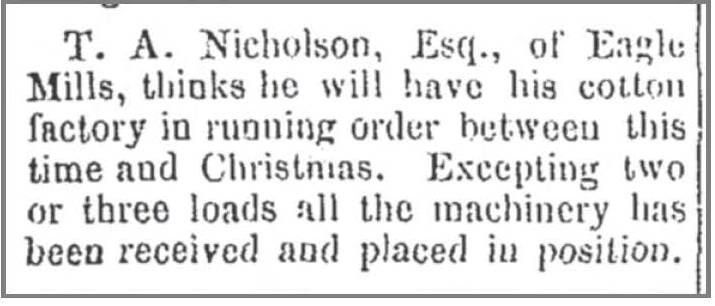
Two months later, Thomas Allison Nicholson was dead. The “mill property” — a cotton factory he had announced so confidently in newspapers —
Rec__amp__Landmark_11_25_1881_cotton_factory
Statesville Record & Landmark, 25 November 1881.
— had been in foreclosure for years.
Nicholson had tried to sell other property to raise cash:
Rec__amp__Lndmark_1_15_1884_Nich_Mill_land_sale
Statesville Record & Landmark, 15 January 1884.
And his creditors had tried repeatedly to unload the factory:
Rec_and_Landmark_4_17_1885_Nicholson_sale
Statesville Record & Landmark, 17 April 1885.
But nothing worked. Thomas Nicholson died with this burden, and soon after, his son’s father-in-law, William I. Colvert, administrator of the estate, announced the liquidation of the cotton factory’s machinery.
WS_Western_Sentinel_12_9_1886_T_Nicholson_sale
Winston-Salem Western Sentinel, 9 December 1886.
The loss of the mill property by no means impoverished the Nicholsons, despite the plaintive tone of Thomas’ letter. When his widow died in 1903, her estate included three large parcels of land on Hunting Creek.
Record_and_Landmark_11_17_1903_RC_Nicholson_sale
Statesville Record & Landmark, 17 November 1903.
Standard
Births Deaths Marriages, Civil War, Enslaved People, Maternal Kin, Virginia

The Allens.

My cousin is the fourth man in this family to bear his name, and those four generations of Johns are the exact measure of my Allen lineage. When Graham Allen married Mary Brown in Charles City County, Virginia, on 22 June 1876, she was six months pregnant with a white man’s child. We know nothing of the circumstances of conception, and nothing of the man’s identity beyond the Y-haplotype — R1b1b2a1a1 — that my uncles and cousins carry. [Update: I have identified John C. Allen‘s father.] Graham adopted Mary’s baby boy at birth, gave him his name, and reared him, as far as we know, with no distinction from their later children. So. We are Allens.

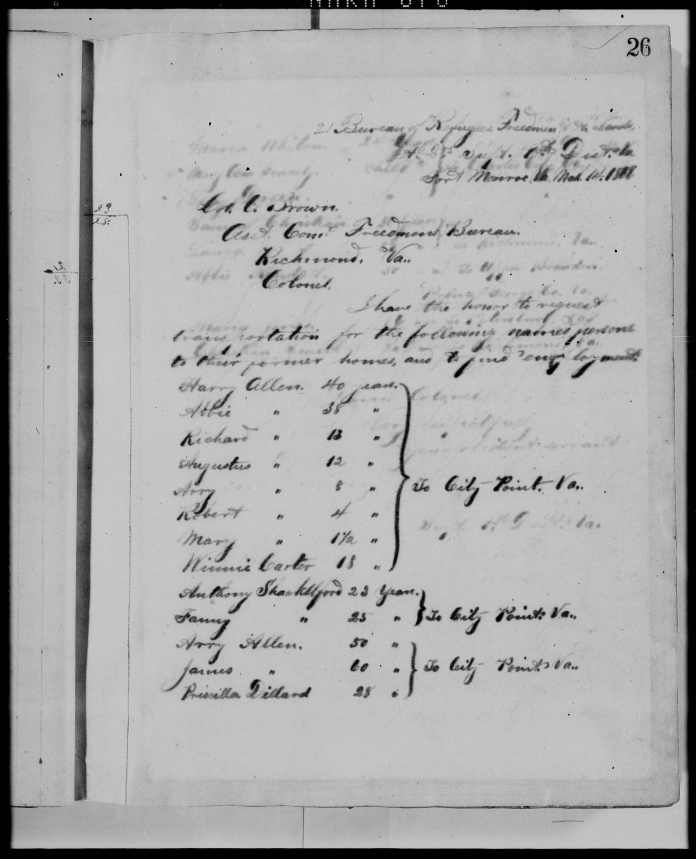
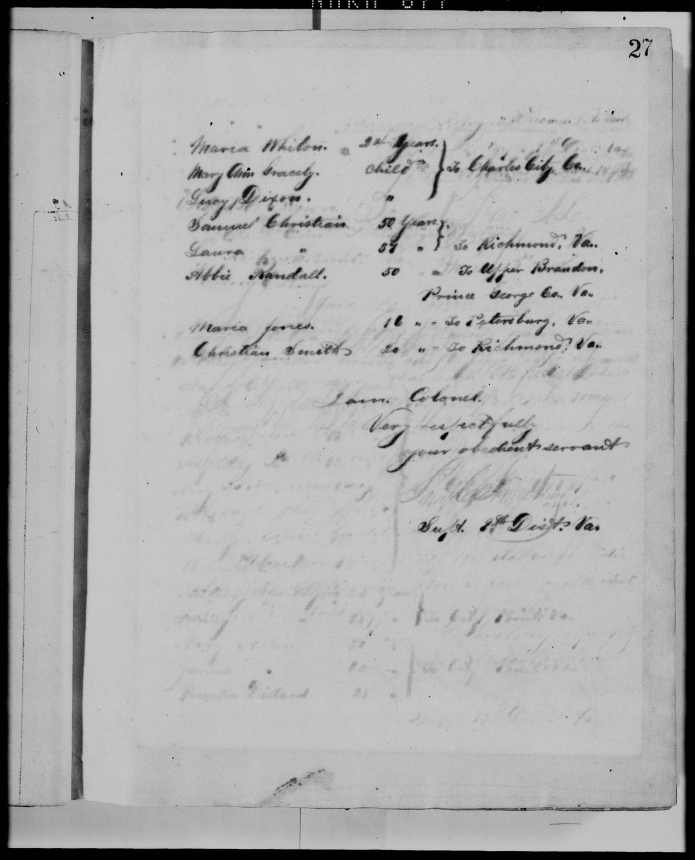
Graham Allen was born about 1852 in Prince George County, Virginia. His first marriage records lists his parents as Mansfield and Susan Allen. His second, as Edmund and Susan Allen. I have found no other trace of Edmund/Mansfield. However, in the 1870 census of Brandon, Prince George County, laundress Susan Allen, 50, and sons Alexander, 20, and Graham Allen, 17, appear in #14, the household of Anthony Shackleford, 26, farmer; wife Fannie, 24; and son Willie, 1. Also living in the house was Mary Hill, 23. I don’t know if the Allens, Shacklefords and Hill were related, or if they were related to two households of Allens listed nearby: #16, Harry Allen, 47, wife Abba, 43, Richard, 19, Augustin, 17, Assia, 13, Robert, 9, and Mary, 6; and #20, Joseph Allen, 42, wife Lucy, 37, and children Mildred, 8, Joseph, 6, and Willie, 1. However, an intriguing Freedmen’s Bureau document links those Allens and the Shacklefords:
record-image-22 copy

record-image-23 copy

“I have the honor to request transportation for the following named persons to their former homes, and to find employment,” wrote Samuel C. Armstrong, Superintendent of the Freedmen’s Bureau 1st District (and founder of Hampton Institute, which educated a dozen Allens between 1927 and the present.) Among those to be transported, Harry and Abbie Allen and their children and Anthony and Fanny Shackleford. City Point, in Prince George County, had been headquarters of the Union Army during the siege of Petersburg in the Civil War. The Allens and Shacklefords likely were refugees, so-called “contraband,” who fled their owners during the war to join a large camp near Fort Monroe. (For recent news of archaeological digs at the former Grand Contraband Camp in Hampton, see here.) Though none has surfaced to date, I will continue to look for links between these families and Edmund or Susan Allen.

Other than Graham and Mary’s marriage license, I have no other record of the family in the 1870s. (An Alexander Allen married Mary Wallace on 15 February 1872 in Charles City County. This Alexander was 30 years old and the son of James and Sophia Allen. Thus, he is not Graham’s brother.)

In the 1880 census of Harrison, Charles City County, 26 year-old farm laborer Gram Allen’s household includes wife Mary and children Nannie, 5, John, 3, and Emma, 1. I suspect that Nannie was Mary’s child by a previous relationship, but I don’t know. In the next few years, Mary gave birth to a son Willie, who died of burns in October 1885. (Graham Allen, who provided information, is listed on the boy’s death certificate as father, but the mother’s name is given as Sarah. A misunderstanding? A mistranscription? And “outside” child?) A month later, Mary gave birth to Alexander Allen.  Two years later, in December 1887, Graham Allen reported the death of Mary Allen, age 30. Graham’s relationship to the deceased was not stated, but this was not his wife. In 1892,  Mary Brown Allen gave birth to her last child, son Edward Noble Allen.  In 1896 and 1899, daughter Emma Allen gave birth to sons Milton and Junius Allen in Charles City County. I do not know their fathers.

On 18 Aug 1898, at Charles City County Courthouse, Graham Allen filed a deed for the purchase of two parcels on Hyde Road, one 12 acres and the other 2 3/4 acres, from A.H. Drewry et ux.  A plat filed with the deed shows a roughly trapezoidal lot 2 1/2 miles from Rolands Mill, surrounded by the land of Sarah Jones, Edward Jones, Frank Martin, and Peter Jefferson.

In the 1900 census of Harrison, Charles City County, Graham Allen is listed with wife Mary, sons Alexander and Edward, and grandsons Milton and Junius.  (I believe they were Emma Allen’s sons.) Mary was illiterate, but Graham could read and write.  Mary reported 4 of 8 children living. (John, Emma, Alex and Ed, living; Nannie, Willie and who, dead?) As detailed here, John had moved to the city by the late 1890s and married Mary Agnes Holmes in 1899.

On 3 Apr 1901, Emma Allen, 22, married widowed laborer Stephen Whorley [Whirley], 32, son of Stephen and Patsy Whorley.  W.E. Carter performed the ceremony at Graham Allen’s residence.

On 11 March 1902, at Charles City County Courthouse, Graham Allen filed a deed (book 17, page 437) for the purchase for $16 of 2 3/4 acres in the Grafton tract from Mary Harrison Drewry. The sale was made 27 Feb 1902, and the tract was located 4 miles northwest of Drewry’s Mill. Two years later, he filed a deed or the purchase of 4 1/2 acres in Turkey Trot from M.E. and W.E. Stagg and in 1909 filed another (book 20, page 165) for the purchase for $12 of 2 1/4 acres in the Bishops tract, west of Old Hyde Road in Turkey Trot, bordered on the east by Graham ‘s own land and True Reformers and on west by Peter, James B. and Elvina Jefferson and M.E. Stagg.

In the 1910 census of Harrison, Charles City County, on River Road, farmer Graham Allen is listed with wife Mary and son Edward. (Where were Milton and Junius?)  Mary reported 4 of 9 children living. (Eight children, or nine?) Also on River Road, farmer Steaven Whirley, wife Emma, and children Royal, John, Samuel, and Graham.  Royal and John were Stephen’s children by a previous wife, and the family lived next to Samuel and Mary E. Whirley, Stephen’s brother and sister-in-law. (River Road is now State Route 5, or John Tyler Memorial Highway.)

Mary Brown Allen died 1 Apr 1916, aged 67 in Harrison township, Charles City County.  Her death certificate reports that she was born in Amelia County, Virginia, to James Brown and Catherine Booker, both born in Virginia. She was buried 2 Apr 1916, and Junius Allen of Roxbury was informant for the certificate.

On 22 Nov 1917, in Roxbury, the widower Graham Allen, 58, widow, born Prince George County, resident of Charles City County, son of Edmund and Susan Allen, married Lenner Charles, 32, born Charles City County to William and Lucy Charles. The couple appear in the 1920 census of Harrison, Charles City County on Kemmiges Road with a five year-old daughter named Sallie. (Was she Graham’s child?)

John, Edward, Milton and Junius Allen registered for the World War I draft:

  • JOHN CHRISTFUL ALLEN.  Born 25 Dec 1876.  Resided 2107 Marshall Avenue, Newport News VA.  Laborer, Hampton Roads Stev. Co.  Nearest relative, Mary Holmes Allen (wife).  Medium height, stout build.  Brown eyes, grey hair.  (Signed “John Christful Allen” in the same hand as rest of the card.  A duplicate card shows the signature in a different hand, presumably John’s, as “John Christopher Allen.”)
  • EDWARD NOBLE ALLEN.  Born 17 May 1888, Charles City County VA.  Resided 6724 1/2 – 24th Street, Newport News VA.  Laborer, C&O Railway, Newport News.  Supports father.  Medium height and weight.  Brown eyes, black hair.  “Three fingers missing on right hand.”
  • MILTON ALLEN. Born 22 Nov 1895, Roxboro, Charles City County VA. Resides 318 N. 18th Street, Richmond VA. Laborer for Clarence Cosby, Richmond VA. Single. Signed Milton Allen. Registered 5 June 1917. Also,
  • MILTON ALLEN.  Born 20 Aug 1896, Richmond VA.  Resides 1011 N. Lafountaine, Kokomo, Ind.  Employed by Willis White, Kokomo, Ind., USA.  Nearest relative, Ed Allen, address “don’t know.”  Tall and stout.  Black eyes and hair.  Signed with an X.  Registered 5 June 1918. (Is this the same man who registered in Richmond the year before? If not, which is the right Milton?)
  • JUNIUS ALLEN.  Born 22 Feb 1899.  Resides 1752 Ivy Ave., Newport News, Warwick VA.  Carpenter, Boyle-Robertson Co., Newport News VA.  Nearest relative, wife Margaret Allen.  Medium height and weight.  Black eyes and hair.  (He was barely literate and signed his name something like ‘Juily Allen.’)

I have not found a card for Alexander and assume he died before the war. Edward actually served; I don’t know about Milton and Junius.

In the 1920 census of Harrison, Charles City County, on Kemmiges Road, Stephen Whirley, farmer, is listed with wife Emma and children Samuel, Graham, Matilda and Susie. John and his family remained in Newport News, as did “Junnus” Allen and his wife Margaret, with brother-in-law Samuel Johnson, at 1752 Ivy Avenue. Junius worked as a transfer drayman; Samuel as a bricklayer at the shipyard. Edward may have been living and working in Washington County, New York. Milton was definitely gone. In the 1920 census of Kokomo, Howard County, Indiana, at 1011 North LaFontaine Street, there is a listing for Virginia-born Milton Allen, single, age 21, living as a roomer in a household headed by Myrtle Harston.  Milton worked as a laborer in a stove factory.

On 10 January 1928, Graham Allen died of cerebral hemorrhage at the age of about 74.  According to informant William Webb, Graham was born in Charles City County to unknown parents and left a widow, Lena Charles. He was buried at New Vine Church on 14 January 1928.

In the 1930 census of Harrison, Charles City County: Emma Whirley and daughter Susie were listed “cook-private family” in household of Eugene A. Dietrich, a German-American grocery merchant. I have not found Edward, though I believe he was living in Charles City County. Nor can I locate Milton and Junius. (There is a Junius Allen listed in Newport News city directories in the 1940s, but I am not certain they are the same man. There is also a Junius Allen listed in the 1902 directory, which definitely is not Emma’s son, so I am cautious.) At least one of Emma’s children had gone North by this time and is found with her daughter in the 1930 census of Baltimore, Maryland, living with her half-brother.  At 1314 Mulberry Street, rented for $40, are listed John W. Whirley, 31, wife Susie, 28, sister Matilda, 20, boarder Sam Bradley, 30, and niece Dorothy Whirley, 1.  John worked as a laborer in a car shop; Matilda as a laundress in a laundry; and Sam as a hospital waiter.  All were born in Virginia except Susie, who was born in South Carolina. On 24 Dec 1930, in Charles City County, Graham Whirley, 22, laborer, son of Stephen Whirley and Emma Allen, residing Roxbury, married Arnether A. Harris, 20, daughter of John A. Harris and Mary Jefferson, residing in Providence Forge. I have not found Samuel Whirley in 1930.

Edward N. Allen died 25 Jan 1933 at the Marine Hospital in Norfolk, Virginia, of aortic aneurism and valvular heart disease.  Based on information he provided as a patient, Edward’s death certificate reported that he was born 17 May 1890 to Graham Allen and Mary Brown of Virginia and resided at RFD#2, Box 66, Roxbury, Virginia.  Edward was buried 30 Jan 1933 at Hampton National Cemetery, in section Fii, Site 6459-A.

In 1935, Samuel Whirley made a splash in Fredericksburg, Virginia, newspapers after being on the lam for a year on larceny and false pretense charges. It’s not clear whether this one-armed man was Emma Allen Whirley’s son, but an article noted that he had spent time in Baltimore while on the run.

In the 1940 census of Hopewell, Virginia, at 601 Maplewood Avenue, Graham Whirley, 25, a chemical plant laborer, is listed as a lodger with Andrew and Lena Joyner. There is no sign of his wife. On 21 January of that year, in Charles City County, his past behind him, Samuel Whirley, 37, born in Charles City County to Stephen Whirley and Emma Allen, residing Petersburg, married Alice Howard, 23, born Charles City County to Laura Howard. The rest of the Whirleys — Emma, Susan, Matilda — are nowhere to be found, though I know they were living. Similarly, of the Allens, I can only place John and his children.

I lose the thread of my great-grandfather’s extended family after 1940. I’ve written of my brief and unsatisfactory telephone conversation with Dorothy Whirley in 1996. She had no children, nor did Edward Allen, but it’s hard to believe that none of Graham’s sons, save John, or his grandchildren by his daughter Emma, have contemporary descendants.

Standard
Births Deaths Marriages, Maternal Kin, Virginia

The case for the Carters.

Were Walter “Wat” and Nancy Carter the step-father and mother of Joseph and Jasper Holmes? Here is the evidence:

  • Per my great-aunt, Julia Allen Maclin, her grandfather Jasper Holmes and Joseph R. Holmes were brothers.
  • According to historian Luther Porter Jackson, Joseph had a brother “Watt,” who was a shoemaker like Joseph.
  • Jasper Holmes and Joseph Holmes were born in Charlotte County, Virginia, circa 1838 and 1841.
  • In 1867, Watt Carter registered to vote at Clements’ in Charlotte Court House, as did Joseph Holmes.
  • About 1867, Jasper Holmes named a son Walter. (Another son, born in 1874, was named Joseph. And both Jasper and Joseph had sons named William.)
  • Joseph’s death certificate, issued in 1869 in Charlotte County, lists his parents as Payton and Nancy Holmes. Neither Payton Holmes nor Nancy Holmes have been found in the 1870 census or any other record.
  • In the 1870 census, Joseph Holmes’ children Payton, Louisa and Joseph, and possibly his widow, appear in the household of Wat and Nancy Carter in Charlotte County. Wat and Nancy have a son also named Wat.
  • In the 1870 census, Jasper Holmes and family are listed in Charles City County, some 100 miles east of Charlotte County. (Why Charles City County? What was the pull to that particular place?)
  • On 14 June 1873 in Charles City County, Lotsey Carter, age 22, born in Charlotte County to Walter Carter and a mother whose name is illegible, married Claiborne Booker, born in Chesterfield County and residing in New York.
  • On 10 January 1874, Lettie Booker opened account #6605 at the New York branch of the Freedmen’s Bank. She stated that she was 22 years old; born in Richmond, Virginia; and resided at 28 Cornelia Street. She was light brown in complexion; worked washing and ironing; and was married to Claiborne Booker. Her father was Watt Carter of Keysville [Charlotte County], Virginia; her mother was named Nancy; and her siblings were Watt, Eliza and Louisa.
  • In the 1880 census of Queens, Queens County, New York: living on premises, Claiborne Booker, 39, headwaiter in a hotel; wife Lettie, 28, laundress in hotel; and Walter Holmes, 12, “nephew.” All were born in Virginia.
  • On 23 October 1883 in Charles City County, Walter Carter, age 28, shoemaker, born in Charlotte County to Walter and Nancy Carter, married Alice Christian, 22, of Charles City County, at Shirley.
  • Watt Carter died 3 May 1885 in Charles City County at age 72. His death certificate states (probably erroneously) that he was born in Charles City County.
  • Nancy Carter, age 75, died 18 June 1884 in Charles City County. Her death certificate states that she was born in Charlotte County and was single (widowed?)
  • And possibly: “Claiborne Booker has been appointed guardian for the estate of the late Louisa McKie and in his custody her children, Wm. McKie and Clarence McKie, have been placed by the surrogate court of New York county.”  New York Age, 16 March 1905.

My conjecture: Nancy [last name unknown] married first Payton Holmes in Charlotte County and had at least two children, Joseph and Jasper. Nancy then married Walter “Wat” Carter in Charlotte County. Their children included Louisa, Lettie, Walter Jr. and Eliza. Between 1867 and 1870, perhaps in response to his brother’s murder, Jasper moved his family to Charles City County. Between 1870 and 1873, Wat and Nancy Carter and family also moved to Charles City County. Lettie Carter Booker married and settled in Queens with her husband. For some period, her nephew Walter Holmes, son of Jasper, lived with them. The fortuitous capturing of this stay in the 1880 census cements these relationships for me, as it is a direct connection between Jasper and his half-sister.

Sources: federal census records; Charlotte County VA death records; Charlotte County voter register; Charles City County VA birth, marriage and death records; Freedman’s Bank records.

Standard
Maternal Kin, North Carolina, Photographs

The reunion.

Reunion 1978 01My grandmother and her children: the first reunion.

It was in July. I’m sure of that, but not the actual date. The first Colvert-McNeely family reunion. We gathered in Statesville, of course, where my grandmother Margaret and her sisters Louise and Launie Mae were born and grew up. The reunion called not only their descendants, but those of their older half-sisters, Mattie and Golar, and their maternal McNeely kin. I was 14 that summer and not much interested in anyone more than three or four years older than I. Nor had I been seized with the unquenchable genealogical fervor that would light me up a decade later . So I lounged around the hotel pool and wasted opportunities that year, and subsequent, to winnow every broad hint and slender clue from the ever-waning recollections of my elders. My great-aunt Louise, who lived in Statesville all her life and probably knew the most. My great-great-aunt Min, last of the McNeely siblings. The “other” Colverts, cousins and children of my great-grandfather’s half-sisters — were they even there? I’d been surprised to learn later that some were living in 1978. (They were not much spoken of. Was there a rift?) Who was in Statesville that summer? Whom did I miss?

CM Reunion 1978

The last day. Or maybe the first. My uncle John’s wife Gladys, my mother, my grandmother (in curlers — she would not approve of this post), my uncle John, an unknown man (a Colvert? a McNeely? who?), my mother’s first cousin Donald, my aunt Lynne, my father. Statesville, 1978.


Standard
Births Deaths Marriages, Enslaved People, Maternal Kin

Jasper Holmes.

All this (much-deserved) shine on Joseph R. Holmes, but he is not my direct ancestor.  What do I know about Jasper Holmes?

  • Jasper Holmes was born about 1841 in Charlotte County, Virginia. He was probably the son of Payton and Nancy Holmes, who are listed on his brother Joseph’s death certificate. His step-father may have been Walter “Wat” Clark.
  • Circa 1862, presumably in Charlotte County, Jasper married a woman named Matilda, who is nearly a complete enigma. Though she is consistently named in census records, her children’s birth certificates call her Matilda, Mary and Ellen. I have never found her and Jasper’s marriage license, nor is her maiden name listed elsewhere. She died 26 July 1885 in Charles City County, Virginia, and her death certificate lists her place of birth of Charles City County, but this is doubtful.
  • Jasper and Matilda’s first child, Robert Holmes, was born about 1863, probably in Charlotte County.
  • Tax records filed in Charlotte Court House for 1866 list Jasper Holmes in District #2 (T.M. Jones, revenue commissioner) and paying one black poll tax.
  • Charlotte County tax records for 1867 show that Jasper had moved to District #1, Charles W. Harver, commissioner, and was living at J.A. Selden’s. He paid one black poll tax.
  • Second child Walter Holmes was born about 1867, probably in Charlotte County. He presumably was named after his step-grandfather.
  • Third child Angelina “Lina” Holmes was born about 1869, probably in Charles City County.
  • On 3 May 1869, Jasper’s brother Joseph R. Holmes was shot dead at Charlotte Court House while asserting the rights of a freedman against a former slaveowner. Around this time, whether in direct response to this terrible crime or not, Jasper and his family, as well as his mother and stepfather’s family, moved more than 100 miles east to Charles City County.
  • In the 1870 census of Harrison, Charles City County, Virginia: in Wilsons Landing post office district, Jasper Holmes, wife Matilda, and children Robert, 7, Walter, 3, and Angeline, 1, plus William Jones. (Was Jones a relative, perhaps of Matilda? Thomas and Louisa Jones and family lived next door.)
  • Fourth child William Holmes was born in 1872 in Charles City County.
  • On 4 Apr 1873, Jasper Holmes filed a deed (book 12, page 483) at Charles City County Courthouse for the purchase for $5 of 10 acres in the Mill Quarter tract from A.H. Drewry et ux.  The sale took place 18 Feb 1873.
  • Fifth child Joseph Holmes was born in 1874 in Charles City County. He was named after his uncle, Joseph R. Holmes.
  • On January 20 and 21, 1875, William and Joseph Holmes died of whooping cough.
  • Sixth child Emma V. Holmes was born about 1876 in Charles City County.
  • Seventh child Mary Agnes Holmes, my great-grandmother, was born 15 October 1877 in Charles City County. Her birth certificate notes that the family lived at R.L. Adams’ place.
  • On 20 Jan 1879, Jasper Holmes filed a deed (book 12, page 332) at Charles City County Courthouse for the purchase on 16 Oct 1878 of 9 acres from Robert L. Adams et ux.  The tract was bordered by William Rolands, Robert L. Adams, the old breastworks or fortifications, and the old ditch.
  • Eighth child Martha “Mattie” Holmes was born about 1879.
  • In the 1880 census of Harrison, Charles City County: Jasper Holmes, wife Matilda, and children Robt., 19, Walter, 13, Lena, 10, Emma, 4, Agness, 2, and Mattie Holmes, 1.
  • A ninth child, an unnamed male, was born in 1880 in Charles City County. On 18 November 1880, that child died.
  • Tenth child Julia Ellen Holmes was born on 1 July 1882 in Charlotte County. [A second birth registration lists her year of birth as 1872, but she is not listed in the 1880 census.]
  • An eleventh child, unnamed, was born 26 July 1885 and died 2 September 1885.
  • On 26 July 1885, Jasper registered a death certificate for wife Matilda Holmes, who died in childbirth.
  • On 4 June 1886 (or 1887, there are conflicting duplicate records), son Walter died of consumption.
  • On 8 November 1886 (or 1887, there are conflicting duplicate records), daughter Angelina died of consumption.
  • On 30 Dec 1890, Alonzo P. Patterson filed a deed of transfer at Charles City County Courthouse for the transfer of 10 acres from Jasper Holmes to him.
  • On 7 Aug 1897, Jasper Holmes filed a deed at Charles City County Courthouse for the purchase of two lots, one 6 acres, the other 1 3/4 acres from A.H. Drewry et ux.
  • On 30 Dec 1899, at Charles City County Courthouse, the estate of Jasper Holmes, dec’d, filed a deed of transfer for 10 acres to Mary H. Allen and John C. Allen, her husband (my great-grandparents), and Martha H. Smith and Jesse Smith, her husband, all of Newport News VA; and Julia E. Holmes, unmarried, of Charles City County VA, heirs at law of Jasper Holmes.
  • On 10 Jan 1910, at Charles City County Courthouse, Mary Allen of Newport News VA and Julia Holmes of the City of New York, children and only heirs of Jasper Holmes, dec’d, filed a deed of sale for the sale of 10-acre and 6 3/4-acre parcels to James Clark for $300.
Standard
Births Deaths Marriages, Enslaved People, Maternal Kin, Newspaper Articles, Politics, Virginia

Misinformation Monday, no. 8.

The eighth in a series of posts revealing the fallability of records (or, in this case, secondary sources.)

My great-aunt Julia Allen Maclin told me that her grandfather Jasper Holmes‘ brother, Joseph R. Holmes, a politician, was shot and killed at Charlotte Court House, Virginia. Before I found contemporaneous newspaper articles detailing the murder, I had only a couple of brief mentions in scholarly works to establish his death date. The accounts varied so widely as to be completely irreconcilable.

First, in Luther P. Jackson’s Negro Office-Holders in Virginia 1865-1895, published in 1945:

Joseph R. Holmes, Constitutional Convention, 1867-68, Charlotte and Halifax. SHOEMAKER. Born a slave in Charlotte County. Was hired out by his master to engage in shoemaking by traveling from plantation to plantation. Joseph R. Holmes’ brother Watt was likewise a shoemaker. Joseph learned to read and write and was very intelligent. After the war he received some training in law from his former master. About 1870 he met a tragic death by a gun shot on the grounds of the Charlotte County court house. According to one report his former owner shot him because of an offensive political speech; according to another report he was killed by mistake. During the period of his activity in politics, Holmes bought a farm home consisting of 8 1/2 acres.

Then, in Virginius Dabney’s Virginia: The New Dominion, published in 1971:

… In 1892, Joseph R. Holmes of Charlotte County, a black who had served in the Underwood convention more than two decades before, decided to run for the legislature. He was shot dead by a white man in the audience he was addressing.

Dabney’s account is so far off the mark as to boggle the mind. By 1892, Joseph Holmes had been dead more than 20 years. He never ran for any legislative seat and, while his murderer was certainly a white man, he was not giving a stump speech when he was shot.

Jackson’s version is much closer to the truth, though some the details of Holmes’ life cannot be confirmed and neither of the motives for his assassination are correct.

Here are newspaper accounts of the murder, which themselves vary a bit on the facts. However, based on comparisons with other sources, to be detailed soon, the New York Times‘ 8 May 1869 version of events (reprinted from the Richmond Dispatch, set forth below, seems closest to the truth:

The Recent Homicide at Charlotte Court-House, Virginia

From the Richmond Dispatch, May 5. From persons who were present at Charlotte Court-House on Monday we gather the following particulars of a most lamentable homicide which occurred there on that day, resulting in the death of JOE HOLMES, a colored man, well known to our readers as a member of the Virginia Constitutional Convention. Early in the morning, Mr. JOHN MARSHALL JR. met a colored man named MINNIL, who was formerly a slave of Captain GILLIAM, and asked him if he was the man who attempted his life some time ago. The negro, without making any reply to the question, immediately raised his bludgeon as if to strike MARSHALL, who drew his pistol. The negro then took to his heels, and was pursued by MARSHALL and some of his friends, and it was rumored during the day that he had been killed by them. Such, however, was not the fact, for he was alive and well and his work yesterday. About 2:30 o’clock on Monday, while the rumor was rife, the question of arresting MARSHALL was agitated, and HOLMES made himself very officious in regard to it. MARSHALL spoke to him about it, and he made some insulting reply, when Mr. BOYD, a friend of young MARSHALL, struck him with a stick. HOLMES then drew, or attempted to draw, his pistol, when he was fired at by some unknown party. HOLMES immediately retreated, and, when near the Court-house door, turned and fired at the young man, when several shots were fired at him, only one, however, taking effect. HOLMES had strength enough left to walk to the Court-house, and fell dead. The deceased was a prominent member of the late Constitutional Convention, prominent rather from the merriment he created on rising to speak rather than from any participation in the serious work of the body. He was good-natured, polite, and a great favourite with the reporters, to whom he was specially courteous, and whose daily appearance he always greeted with a broad laugh. The nearest we ever knew of him to come to a quarrel was a laughable row with Dr. BAYNE over the disputed ownership of a law book. JOE’s death will be regretted by all who knew him in the Convention, and by those who have laughed over him in the Humors of Reconstructions, where he figured as the “great fire-eater.”

To celebrate the sesquicentennial of the Emancipation Proclamation on January 1, 2013, Virginia’s Dr. Martin Luther King Jr. Memorial Commission created a roll call of the African-American men who were elected to the Virginia Constitutional Convention of 1867–1868 and to the Virginia House of Delegates and Senate during Reconstruction. Unfortunately, it picked up Virginius Dabney’s wildly inaccurate date:

Joseph R. Holmes, a native of Virginia, was a shoemaker and farmer who represented Charlotte and Halifax Counties at the Virginia Constitutional Convention of 1867-1868. He ran for a seat in the Senate of Virginia, but was killed in 1892.


Standard
Births Deaths Marriages, Maternal Kin, Photographs

Family cemeteries, no. 14: Pleasant Shade.

Cardinal direction can be difficult to gauge on a peninsula, but you leave my late grandmother’s house in Newport News headed west (I think) on 35th Street. After a couple of blocks, you’ll cross Chestnut Avenue, and the street becomes Shell Road. You are now in Hampton, and a cemetery is on your left. Don’t turn at the entry to the first part — that’s white. Go down a little further to the second — Pleasant Shade.

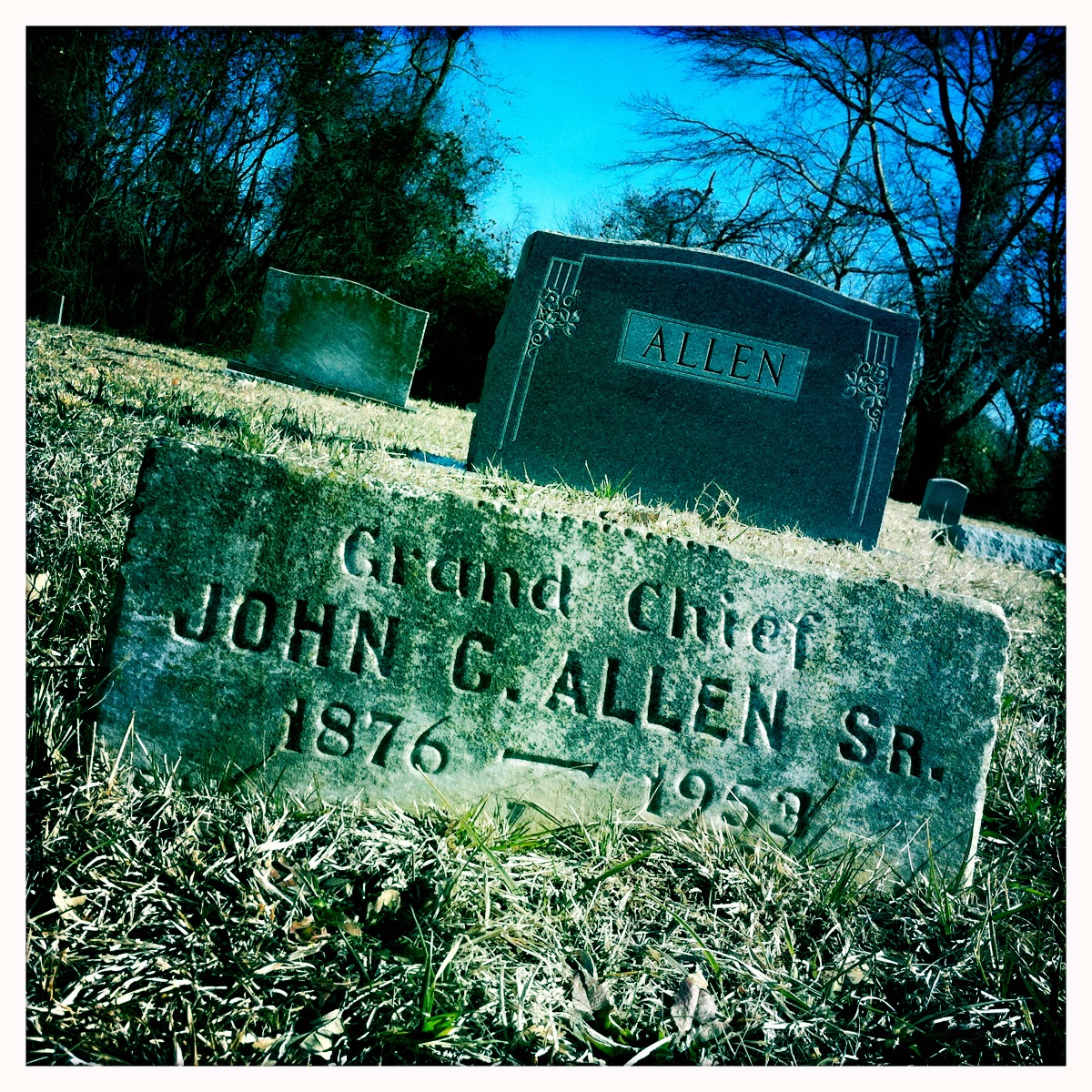
Pleasant Shade is, according to founder James East’s headstone, “the first cemetery to be operated and controlled by colored people in Tidewater Va.” My mother’s parents, John C. Allen jr. and Margaret Colvert Allen; her paternal grandparents, John C. Allen Sr. and Mary Holmes Allen; and her aunt Marion Allen Lomans are buried there.

I have never seen it looking wild (though it often feels desolate), but Pleasant Shade’s condition warranted the formation in 2011 of a restoration group. Its website mentions my great-grandfather John C. Allen Sr. among notable burials. Even had it not, I obviously need to contribute.

IMG_1275

IMG_1286

Photos by Lisa Y. Henderson, February 2011.

Standard
Business, Civil War, Enslaved People, Land, Maternal Kin, Newspaper Articles, North Carolina, Photographs

Eagle Mills.

An abstract from Heritage of Iredell County, Vol. I (1980) —

In 1846, peddlar Andrew Baggerly bought the old Francis Barnard mill tract on Hunting Creek in north Iredell County.  In 1849, he placed an ad in Salisbury’s Carolina Watchman: “Capital Wanted And If Not Obtained Then Valuable Property For Sale.”  He described the property as “the most valuable water power in the Southern Country … situated on Hunting Creek in Iredell County, twenty-eight miles west of Salisbury … [on] a never-failing stream, … remarkable for its purity, … [and] adapted to the manufacture of paper, to calico printing, to bleaching etc.”  Baggerly noted that there was a dam in place, an active sawmill, a grist mill soon to open, and a factory building about half-finished.

On 2 Mar 1850, Baggerly, James E.S. Morrison, William T. Gaither, William R. Feimster, William I. Colvert, G. Gaither Sr. and Andrew Morrison filed a deed for a 318 1/4-acre tract called the Eagle Mills place.  By 1852, the factory was operating with William I. Colvert as its agent.  It had 700 spindles and 12 looms and employed an overseer and 22 workers, 20 of whom were women. By 1854 the adjacent former Inscore Mill had been added to the works, and Baggerly claimed the “intrinsic and speculative value” of the complex was $2,700,000.  

In 1855, Baggerly advertised in Charlotte’s North Carolina Whig and in the Carolina Watchman, calling the complex “Eagle City, the Great Point of Attraction, Destined to be the great center of manufacturing interests in Western North Carolina and perhaps the United States.”  He deeded the president and Congress of the United States a ten-acre block in Eagle City called Eagle Square, located on Market Street.  

After Baggerly was forced to liquidate his assets during the Panic of 1857, William Colvert became the owner of his interest in Eagle Mills.  “According to tradition there was a tobacco factory, hotel, oil mill, and general store at Eagle Mills in addition to the grist mill and cotton factory.  A number of homes stood in the horseshoe bend above the mills and a church was eventually constructed on the edge of the settlement.”

In the spring of 1865, Stoneman’s raiders came upon Eagle Mills unexpectedly and burned it to the ground.  The mills were rebuilt, but Eagle Mills never recovered its former prosperity.  The cotton factory and grist mill operated until destroyed by fire in April 1894.  At that time, William I. Colvert, Robert S. Colvert, and James E.S. Morrison were the owners.  

The only remains at the site are gravestones in the church cemetery, traces of the main road to the mill, the grist mill’s foundation stones, and, a short distance upstream, remains of the stone supports where a covered bridge crossed the creek.

——

Sville_Record_and_Landmark_4_19_1894_Eagle_Mills

Statesville Record & Landmark, 19 April 1894.

——

When William I. Colvert took charge of Eagle Mills in 1852, my great-grandfather Walker Colvert was in his early 30s and father of a one year-old boy, John Walker Colvert. I don’t know exactly what kind of work Walker did for W.I., but they had grown up together, and Walker was an entrusted slave. Even if his primary labors were not at the cotton factory complex, I am certain that he spent considerable time in and around his master’s largest investment. So, too, would John Walker, who remained with W.I. after Emancipation. He is listed in W.I.’s household in the 1870 and 1880 censuses, and I suspect he stayed at Eagle Mills until the final fire closed down the works.

On a rainy December morning I cruised the backroads of northern Iredell County, drinking in the landscape that was home to my Colverts and Nicholsons for much of the 19th century. I made a left onto Eagle Mills Road, headed north. A sharp bend in the road and there, a bridge over Hunting Creek. I pulled over and, ignoring a No Trespassing sign, clambered down to the sandy bank. The waterway is too shallow and rocky to have been paddled or poled, but I imagine that Walker and John Walker knew its course very well. Hunting Creek powered Eagle Mills and was a direct link between W.I. Colvert’s lands and those of Thomas A. Nicholson, whose son James Lee married W.I.’s daughter and whose granddaughter, Harriet Nicholson, gave birth to John Walker Colvert’s first child.

IMG_4618

Photograph by Lisa Y. Henderson, December 2013.

Standard