
 On the occasion of the 107th anniversary of the marriage of Lon W. Colvert and Caroline M.M.F.V. McNeely, my great-grandparents.

[Sidenote: Grandma Carrie very definitely was not white.]
On the occasion of the 107th anniversary of the marriage of Lon W. Colvert and Caroline M.M.F.V. McNeely, my great-grandparents.
[Sidenote: Grandma Carrie very definitely was not white.]
I was stunned to learn that my grandmother had known her great-grandmother. “I didn’t know you knew her.” “Yes, indeed.”
She was a little, brown-skinned woman, had beautiful hair. She was short. Even shorter than I am. Tiny. And she used to keep us when Papa and Mama would go away, maybe for the day or overnight. She’d always come down and keep us. And, boy, we’d have a ball, ‘cause she’d let us do anything. Our mother used to have a closet full of canned goods, you know. Blackberries and dewberries and apples and all kinds of stuff. And, honey, Grandma Becky would let us go in there and eat up a whole jar of peaches. She just let us do anything. We were crazy about her.
Rebecca Parks Colvert was born about 1839, probably in Iredell County NC. Her death certificate reports her parents as Jerry and Lettie Gray — probably the Jerry and Lett listed in the 1827 inventory of John A. Colvert’s estate. Becky was about 14 when she married Walker Colvert, and the couple probably lived apart until Emancipation. The 1860 slave schedule of Iredell lists ten slaves belonging to Walker’s owner W.I. Colvert, but none appear to be Becky or her children. (Was she owned by a Parks, one of John A. Colvert’s kin?) She reared Walker’s son John, and her own children Elvira and Lovina and Lewis, and then Walker’s grandson Lon. After her husband’s death in 1905, she left their farm north of town in Union Grove township and moved into Statesville.
Becky Colvert died 26 May 1915 at the Harrison Street home of her stepson John W. Colvert. She was about 76 years old.
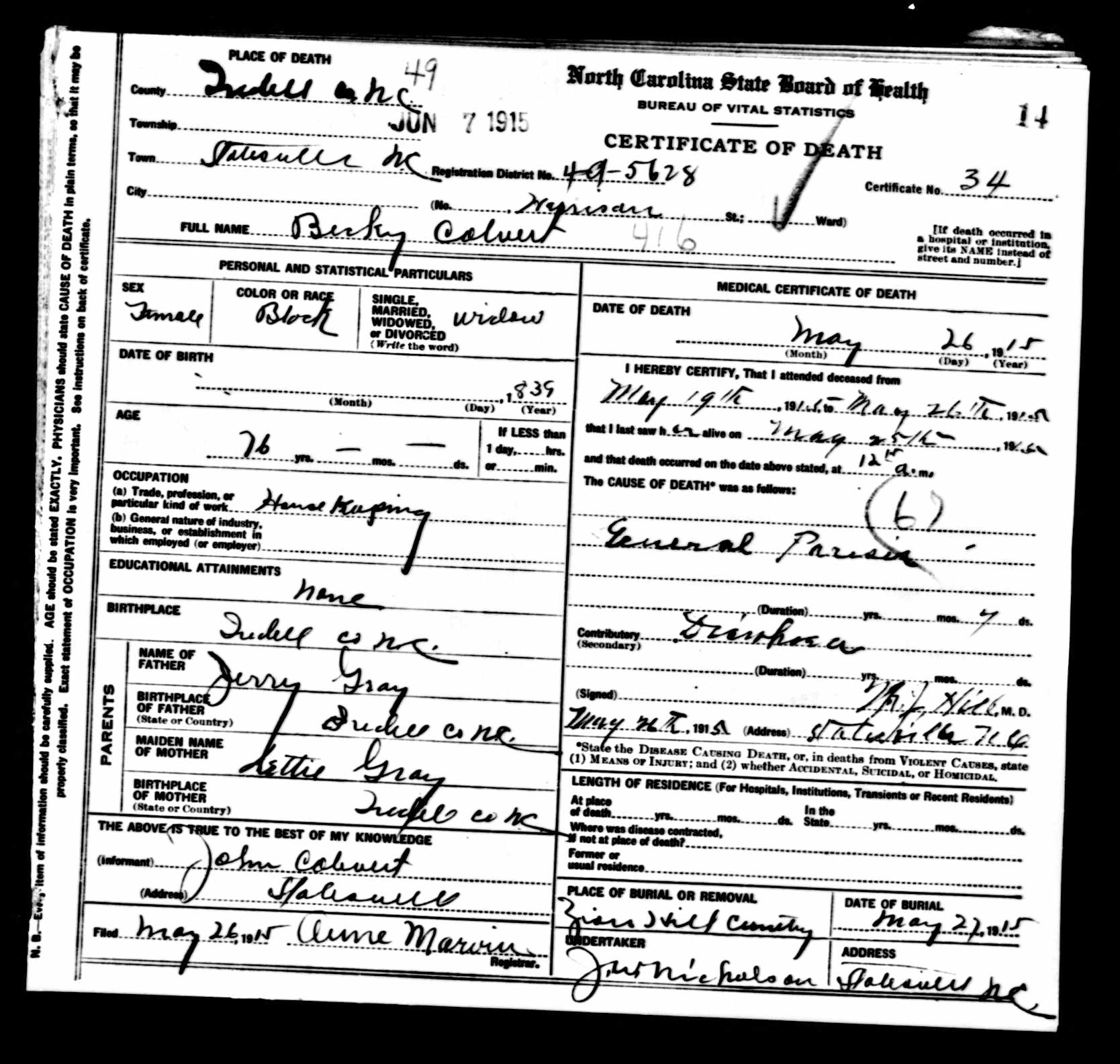
Interview with Margaret C. Allen by Lisa Y. Henderson; all rights reserved.
Me: Where did y’all go to church?
Margaret Colvert Allen: We were Episcopalians.
Me: What was — was the church in Statesville? What was it called?
MCA: Holy Cross Mission.
Me: It was a black church?
MCA: Mm-hmm.
Me: Oh, okay. And y’all participated —
MCA: Everybody but Papa.
My mother: What was Papa?
MCA: He was a late bloomer. [Laughs.] He didn’t join the church ’til he was about … oh, near 50, something like that. No, it wasn’t that late. About 40, I guess. Like all people who join church late like that, they are fanatics when they finally do, and that’s the way he was. But in the meantime, you see, we had been going with Mama to church. Went to Sunday school, we went to eleven o’clock service, then we went back again at four. And, when he joined church, he joined another church his mother belonged to. Which was an AME Zion church. And we had to go to that church, too.
Me: Plus the Episcopal church???
MCA: We had to go to his church at night. It was all right, ’cause we didn’t mind. That was an outlet.

“Trinity Episcopal Church was organized as The Chapel of the Cross in 1858. The congregation built a church on Walnut Street in 1875 to serve its 25 members and took the name Trinity Church. The Walnut Street church stands today and is the Quaker Meeting House. Holy Cross Church, Statesville’s African-American Episcopal congregation, was formed in 1887. The Holy Cross congregation held services on Washington Avenue in a building which is no longer standing. After nearly 100 years the congregations of these churches merged. Ground was broken on the plot of land on North Center Street at Henkel Road on June 18, 1967, beginning construction of the church building that is home to our parish today. The Blessing of Trinity Episcopal Church was held September 28, 1968.” — From “Parish History,” http://www.trinityepiscopalstatesville.org/church.html#history
Interview of Margaret C. Allen, 8 August 1999, Newport News VA; all rights reserved.
MILL BRIDGE, April 5.
Mr. Editor: — One day last week a well dressed gentleman of color, wearing a flashy, gold looking watch chain, with checks on the First National Bank of New York for $2500, put in his appearance at the house of Julius McNeely, one of our most trustworthy, hard-working darkies. Jule being of a hospitable nature did what he could to make his visitor comfortable. The said gentleman of color represented himself as Mr. Ed. Brown, a relative of Margaret (Jule’s wife), having left this country twenty-three years ago, that he had been in the U.S. Army and Navy, traveled over the world, made plenty of money and was now traveling in the interest of the Western Colored Emigration Society; he gave glorious descriptions of California and offered to furnish transportation free to all who would go with him to the land of milk and honey. Jule and Margaret listened with delight to the many wonderful stories he told of the outside world, and on last Friday morning prepared his breakfast and went to the field to work, leaving him reposing in bed. When lo! Upon returning they found he had skipped, taking with him Jule’s new double-barrel breach-loading shot gun that cost $25, a gold ring belonging to the school marm, worth $10, 50 cents in wash and a pint of Jule’s medicinal whiskey. He made his way to Cleveland, bought a ticket to Statesville with the stolen half dollar and boarded the 12 o’clock train with the gun and ring. Julius is sorrowing, and offers to pay $10 or any amount above that he can raise to anybody who will “cotch dat nigger devil.”
Said negro is of small stature, copper or ginger cake colored with a broad scar on the left side of his neck, a black spot on the upper part of his nose between his eyes and a mole on one of his cheeks. He is between 38 and 40 years of age and his hair is slightly mixed with gray. He was raised at Davidson College and came in the possession of Mrs. Kate Barnes, Dr. Kerr’s niece. He ran away from Charlotte, where his mother now lives, for stealing, and had been staying about Salisbury with Wylie Dodge and Harriet Brown previous to his coming out here. He left this neighborhood in 1866, at which time he was in the employ of a writer. He stole a gold watch from Mrs. Ray and sold it to William Stockton, of Salisbury. The watch was recovered, but Ed. Was not heard of since until he turned up at Julius McNeely’s, last week. He is a professional rogue, and the local papers will please hand him around. J.T. RAY.
The Carolina Watchman, Statesville, 11 April 1889.
As noted earlier, Elizabeth Kilpatrick’s will seems to establish that Juda, an enslaved woman born perhaps in the 1790s, was the mother of at least two children, the Dave and Lucinda specifically referred to in Kilpatrick’s will. Under its terms, Dave’s ownership passed to son Robert Kilpatrick and Lucinda’s to daughter Mary Kilpatrick. Elizabeth’s estate file shows that her administrator sold Negroes Juda ($50.00), Matthew ($425.00) and John ($200.00) on 29 August 1829 and “Negro Kesy” for $74.75 on 30 October 1830. (Their buyers are not listed.) Assuming that Kesy, Matthew and John are the “children not disposed of” in the will, Juda was the mother of at least five children. Only Lucinda can be further accounted for.
In 1834, Mary Kilpatrick sold Lucinda and her children Alice, 3, and John, 1, to Samuel and John W. McNeely. John disappears from the record. However, Alice, known as “Allie,” bore at least one son, Joseph Archy, and probably several other children, including Alexander, Stanhope and Mary. All – save Alice, who perhaps had died – appear in J.W. McNeely’s Confederate tax assessment in 1863.
Lucinda herself gave birth to two more sons, Julius, about 1838, and Henry W., in 1841. Julius’ father is unknown, but appears to have been a black man. Henry’s father was John Wilson McNeely himself.
Ten years or more ago, before repeated bad brushes with poison ivy wore me out, I was a member of the Georgia Native Plant Society. Atlanta’s economy was booming, subdivisions were sprouting like nutgrass, and GNPS was dashing across the city, rescuing ferns and trillium from the bulldozer’s scrape. I showed up for the last time at a site just southwest of the city, trailing plastic bags and a shovel. The owner of the parcel stopped by, and I stopped dead when I heard her name. “Simonton?” I said. “Your family wouldn’t be from Iredell County, North Carolina, would they?” She confirmed that they were, adding that they descended from a Theophilus Simonton. I laughed and exclaimed, “Hey! We’re probably distant cousins! I think I’m descended from him, too!” Small world, we agreed, and she went on her way.
A couple of months ago, my mother got a new match on 23andme — “M. Simonton.” Simonton! I contacted her and quickly established that she is descended from Theophilus Simonton of Ireland, then Lancaster County, Pennsylvania, then Iredell County NC. M. told me that her sister lived in Georgia and, on a hunch, I did a quick search of my Family Tree Maker tree. There — the very same M. Simonton and her sister S., who was indeed the woman whose family land I’d scoured for crane’s foot geraniums and astilbe.
——
My line of descent from Theophilus Simonton, who died in 1757: Magdelene Simonton > Theophilus Allison > Thomas Allison > Mary Allison > Thomas Nicholson > J. Lee Nicholson > Harriet Nicholson > Lon Colvert > Margaret Colvert > my mother. M. and S.’s line of descent from Theophilus: Robert Simonton > Adam Simonton > Abner Simonton > Albert Simonton > Adam Simonton > William Simonton > their father.
Mt. Ulla.
A meeting of the friends of prohibition was held at Wood Grove, Mt. Ulla Township, on the 4th instant. W.L. Kistler. Esq., was called to the chair and Rev. J. G. Murray, col. was elected secretary. The object of the meeting was explained by Dr. S.W. Eaton. The following resolution was offered by J.T. Ray and unanimously adopted after appropriate remarks from Rev. J.G. Murray and other.
Whereas, In consideration of the evil of Intemperance, caused by the sale and use of intoxicating liquors upon society, which promotes crime and other known vices, and thereby increasing taxation upon the citizens for the suppression, and also entailing injury in some or other upon all classes and conditions of our fellow men, Therefore
Resolved, That we do hereby heartily approve of the action of our County Commissioners in refusing to grant license for the retailing of intoxicating liquors to be used as a beverage in Rowan County.
Upon motion the chairman and secretary were requested to appoint a committee for permanent organization to meet on Saturday the 11th inst., at 3 o’clock, P.M.
The committee for permanent organization are as follows: White – S.A. Lowrance, D.M. Barrier, J.C. Gillespie, J.T. Ray, J.K. Goodman, S.C. Rankin, S.F. Cowan, J.M. Harrison, M.A. File, R. Lyerly, J.K. Graham, Esq. Colered – W.W. Kilpatrick, Ransom Miller, Henry McNeely, Andy Gillespie, Amos Foster, George Miller, R.A. Kerr, James Rankin, Julius McNeely, Silas Gillespie, Gabriel Kerr.
Upon motion the meeting adjourned to meet on Saturday the 11th inst., at 3 o’clock, P.M. W.L. KISTLER, Ch’m. J.G. MURRAY, Sec.
The Carolina Watchman, Salisbury NC, 9 June 1881.
 Wood Grove, Rowan County, Library of Congress Prints and Photographs Division.
——
Henry McNeely and his half-brother Julius McNeely were joined on the committee by Henry’s brother-in-law George Miller and his wife Martha’s brother-in-law Ransom Miller.
Acts of the General Assembly of the Commonwealth of Virginia. Chap. 91. An Act to Incorporate the Keysville Bluestone mission industrial school. Approved January 17, 1900.
Be it enacted by the General Assembly of Virginia, that Reverend Nelson Jordan, R.C. Yancey, George D. Wharton, P.E. Anderson, F.L. Hall, Jesse H. Wilson, Jordan Moseley, Whitfield Clark, L.N. Wilson, A.J. Goode, S.L. Johnson, N.C. Ragby and Miss Mary E. Wilson [are appointed] board of trustees [of an institution] by the name and style of the Keysville Bluestone mission industrial school for the purpose of keeping and conducting at Keysville, Charlotte County, Virginia, a boarding and day school of the above name, and of giving instruction to such colored persons, male and female, as may be committed to their care as pupils of said school. …
——
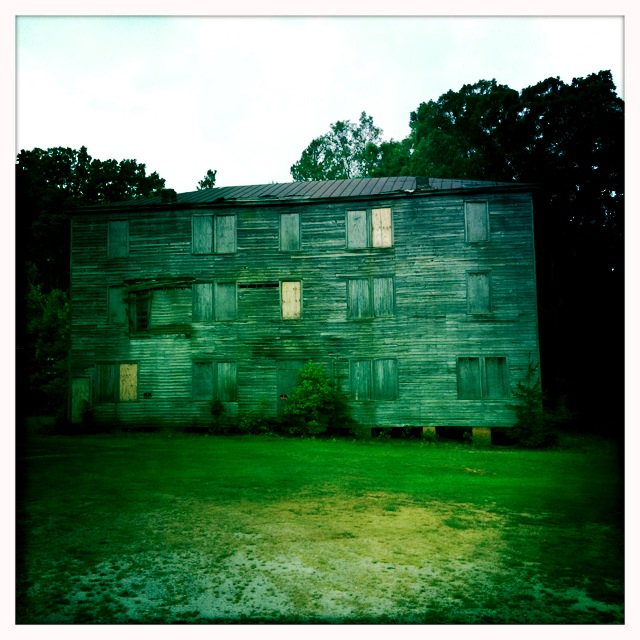
Rev. Whitfield Clark’s sister Mary married my great-great-great-great-uncle Joseph R. Holmes, who was murdered on the steps of Charlotte County courthouse in 1869. As shown below, Joseph Holmes had been instrumental in securing support for the precursor to this school:


Photograph of Keysville Industrial School, Keysville, Virginia, by Lisa Y. Henderson, July 2012. Images of letters from Virginia Freedmen’s Bureau Letters of Correspondence 1865, 1872, www.familysearch.org (originals in Records of the Field Offices for the State of Virginia, Bureau of Refugees, Freedmen and Abandoned Lands 1865-1872, National Archives and Records Administration.)
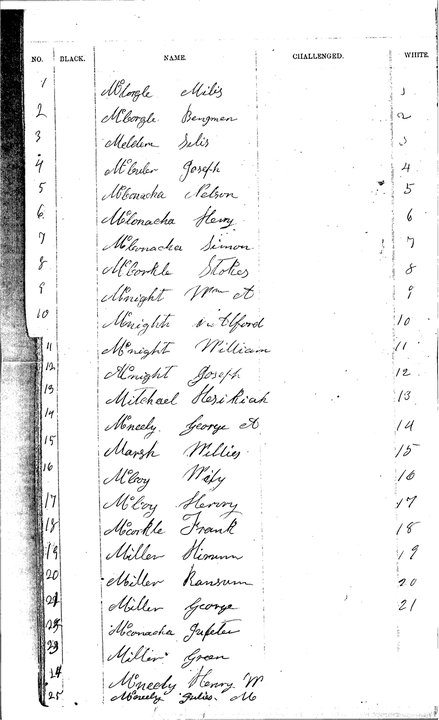
Rowan County, North Carolina, 1866. The war is over. The 14th and 15th Amendments have not yet passed, but the county’s hopeful freedmen have come out en masse to register to vote, perhaps under the auspices of the Freedmen’s Bureau. Among them, my great-great-grandfather Henry W. McNeely, his half-brother Julius McNeely, and his future in-laws Ransom, George and Green Miller. Henry’s father John W. McNeely, Confederate allegiance renounced and U.S. citizenship restored, was also there — his world upside down.
I called her cold, admittedly. Never could she have expected to pick up the phone to a call from her great-uncle’s great-granddaughter. Still, I’ve made lots of these kinds of calls in my life. Dorothy Whirley was decidedly more guarded than most and had a little edge in her voice that sounded almost irritated. She could not deny me though, for what slick stranger could pull names and dates out of Charles City County like that?
Dorothy was the daughter of Matilda Whirley and granddaughter of Emma Allen Whirley, my great-grandfather’s sister. Dorothy could not, or would not, tell me much, except to confirm that Emma, her husband and children had migrated to Baltimore, where she continued to live. Her mother, to whom she had been very close, had died not too many years before our connection, and she seemed somewhat estranged from her remaining kin. She knew of John Allen Sr., but had little more to say about him than that he held himself apart from — thought himself better than — his half-siblings because of his light skin. Our conversation foundered, and I hung up with a promise to send her a family tree. I never got around to it, and she died in 1999. I have not been able to track down any other living Whirleys, but have found small traces of Dorothy and her mother.
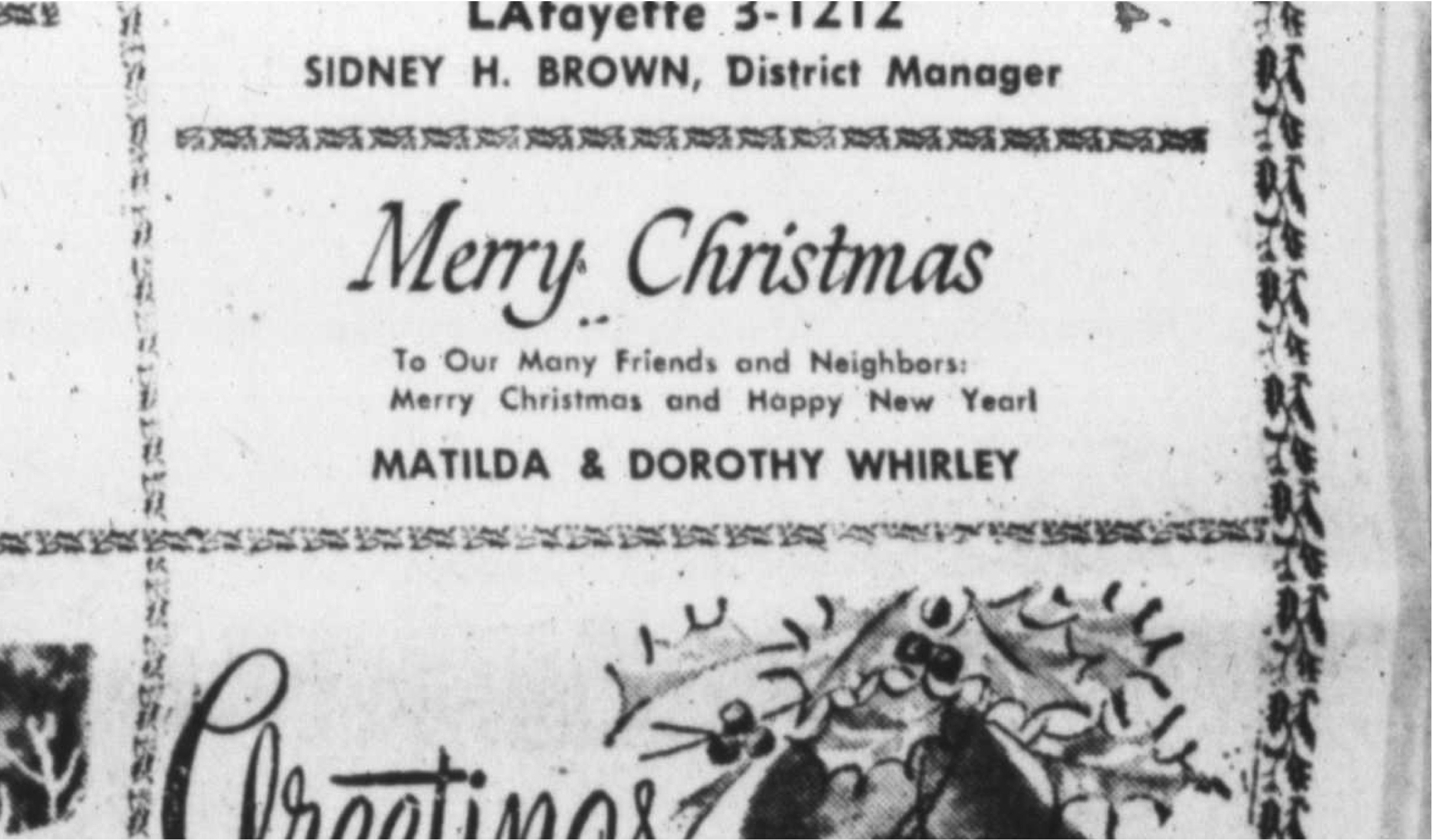 The Baltimore Afro-American, 26 December 1959.
 Scuffalong: Genealogy.