Land, Migration, North Carolina, Other Documents, Paternal Kin

Artis in Arkansas, follow-up.

Shortly after posting on the migration to Arkansas of Gus Artis and Eliza Artis Everett, I contacted the Lonoke County Museum.  After a brief and helpful phone conversation with a staff member named Sheryll, I sent a letter (and a donation) requesting any information about my Artises.  (Put your money where your mouth is with these little grassroots organizations, folks.)

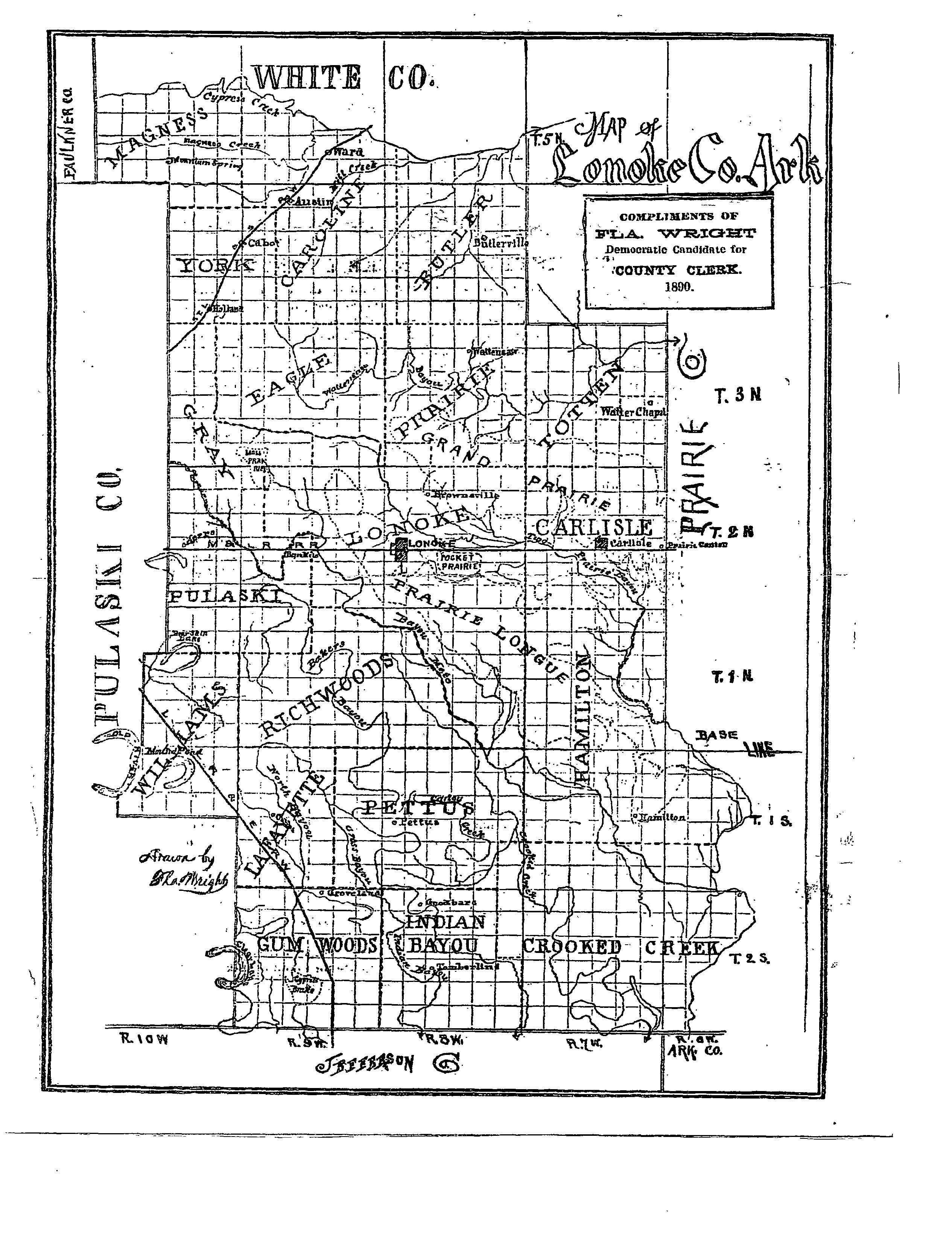
Yesterday, I received a slim packet in the mail, postmarked “Central Ar.” Inside, the fruits of Sheryll’s diligent search for my long-lost relations. Much of the information I already had, but two pieces were particularly helpful. First, an 1890 county map showing all the county’s townships. Williams, where Eliza and Haywood Everett lived, is a little bulge on the lower western flank of the county, sliced through by the now-defunct Little Rock & Eastern Railway. (U.S. 165 now tracks the line.) This corner of the county, pocked by horseshoe bends, lies within the rich alluvial plains of the Arkansas River.

Lonoke County Map

The second revelation came in a transcription of Lonoke County personal property tax registers. In my first blogpost, I wondered if Gus Artis had migrated to and settled temporarily in Lonoke County with the Everetts. The answer appears to be yes. Gus paid taxes on property in Williams township in 1890 and 1891. Haywood (Hayard, Hawood) Everett paid taxes in Williams in 1890 and 1891 and thereafter, as did his father Thomas Everett. With this information, my next step is to hunt down particulars of the land the Artises and Everetts were owned. 

Standard
Maternal Kin, Migration, Paternal Kin, Vocation

Punching the clock: factory workers and machine operators.

Hattie Artis Johnson, Norfolk VA — stemmer, tobacco factory, circa 1920; “bag maker,” circa 1930.

June Scott Artis, Stantonsburg NC – worked at box factory, circa 1910.

Henry J.B. Artis, Stantonsburg NC – worked at box factory, circa 1910.

Sylvester Watson, Wilson NC – tobacco worker, circa 1920.

Madie Taylor Barnes, New York NY – presser, dress factory, circa 1930.

Dorothy Barnes, New York NY – presser, dress factory, circa 1930.

Rachel Barnes, New York NY – presser, dress factory, circa 1930.

Mary Barnes Barnes Jones, Wilson NC – stemmer, tobacco factory, circa 1910.

Sylvester Barnes, Wilson NC – tobacco factory worker, circa 1936.

William I. Barnes, Wilson NC – husband of Madie Taylor Barnes; laborer, Export Leaf Tobacco Company, circa 1918.

William Bradshaw, Statesville NC – Statesville Furniture Factory worker, 1910s-1940s.

Aggie Colvert, Statesville NC — Statesville Furniture Factory worker, circa 1917; janitor, Statesville Flour Mills, 1920s-1930s.

James W. Cooper, Wilson NC – husband of Alberta Artis Cooper; fireman, Jas. I. Miller tobacco company.

Sarah Henderson Jacobs Silver, Wilson NC – occasional tobacco factory worker, 1920s.

Hattie Henderson Ricks, Wilson NC – tent factory, World War II.

Theodore Henderson, Goldsboro NC – laborer, Wayne Red Brick Company, circa 1917.

John Henderson, Goldsboro NC – factory hand, circa 1923.

William Henderson, Goldsboro NC – factory hand, circa 1923.

William H. Henderson, Mount Olive NC – Calypso Veneering Co., Calypso NC, 1940s.

James H. Henderson, Goldsboro NC – Kemp Specialty Furniture Ltd., 1940s.

Irving Houser, Bayonne NJ – husband of Emma McNeely Houser; oilworks fireman, circa 1920; machine operator, oil refinery, circa 1930.

Watt Kilpatrick, Winston-Salem NC – husband of Lizzie McNeely Kilpatrick; shape puller, R.J. Reynolds Tobacco Company, circa 1918.

Luther McNeely, Alexandria VA – laborer at Virginia Ship Building Corp, circa 1917.

John McNeely, Bayonne NJ – laborer at furniture factory, circa 1930.

Edward McNeely, Statesville NC – laborer, Statesville Furniture Factory, circa 1910.

Charles McNeely, New York NY – machine operator, mayonnaise factory, circa 1930.

Eugene Stockton, Statesville NC – husband of Ida Colvert Stockton; tobacco roller at tobacco factory, circa 1910.

Eliza T. Taylor, Wilson NC – tobacco factory worker.

Jordan T. Taylor, Wilson NC – husband of Eliza Taylor; tobacco warehouse worker.

The fifteenth in an occasional series exploring the ways in which my kinfolk made their livings in the 19th and early 20th centuries.


Standard
Births Deaths Marriages, Maternal Kin, Migration, Other Documents

Funeral Program Friday: Matilda Whirley.

Not exactly a funeral program, but close enough:

Morning Star Baptist Church of Christ/In Remembrance.

MATILDA WHIRLEY.  December 7, 1910-March 5, 1992.  Matilda “Tillie” Whirley, one of Stephen and Emma Whirley’s eight children, was born on December 7, 1910 in Charles County, Virginia. She was educated in the public schools of Charles County until moving to Baltimore, Maryland. There she completed her education by attending evening classes.  For nineteen years, Miss Whirley worked as a housekeeper in the Ashburton section of Baltimore. She subsequently obtained employment at the University of Maryland, School of Dentistry from which she retired after working there for seventeen years.  At an early age Tillie received Christ as her personal Savior and became an active member of the New Vine Baptist Church in Charles County, Virginia. She was guided in the work of the church by her God-fearing parents. Her mother instructed her in baking the bread for the Lord’s Supper each month and Tillie, believing this was her sacred duty, continued baking the bread until she left Charles County.  After relocating to Baltimore, Maryland, Miss Whirley became affiliated with the Morning Star Baptist Church, under the pastorate of the late Reverend George Jacob Garnett. Because of her strong background as a servant of God, she became a great servant of mankind. At Morning Star, Miss Whirley was a member of the Senior Usher Board, Missionary Society, Samuel Ray Revival Choir, Church School, Building Fund, Lottie Henry Nurses’ Unit, Flower Circle, Women’s Ministry and Board of Christian Education. She was also a member, and later president, of the Pastor’s Aid and a loyal supporter of the Girl Scouts, Fuel Fund, Elevator Fund and any other fund or organization which would benefit her church or community.  Miss Whirley was a devoted, loving, effectual, caring Christian woman and was a friend to all who needed her. She freely gave wise and timely counsel, based on her life experiences, as she sought to make life go a bit smoother for her family, friends, church members, neighbors and co-workers. Miss Whirley was counted upon to be an integral part of church and community activities and participated and served wherever she could. Her dedication and love of God was evident in all she did. Miss Whirley was a good example of one of God’s servants; because of that, we take time to remember her this month.

Source: http://www.msbcoc.org/star/remember/matilda-whirley.asp

Standard
Births Deaths Marriages, Free People of Color, Migration, North Carolina, Paternal Kin

Artis in Arkansas.

Surprisingly few of Adam Artis‘ 25+ children migrated out of North Carolina, perhaps because the family’s relative farming wealth and good standing in their community made life in North Carolina — even in the 19th century — attractive. Two who did strike out went West. Sort of. They went to Arkansas.

——

Augustus Kerney “Gus” Artis was born about 1857 to Adam and his wife Lucinda Jones. He was a mere toddler when his mother died, and he was reared primarily by Frances Seaberry Artis, whom Adam married in 1861. Gus inherited one-third of his mother’s share of the estate of her father Jacob Ing, a small nest egg that may nonetheless have represented the pinnacle of his wealth. In 1879, Gus married Rebecca Morgan in Wayne County. Though a 13 year-old girl is implausibly described as their daughter in the 1880 census, there is convincing evidence of a daughter Lena, born in 1882. What Gus did or where he was over the years after her birth is a mystery, for in 1893 he suddenly appears in the city directory of Little Rock, Arkansas, living at the corner of Allen and Elm in North Little Rock. (Which, by all accounts, was a swampy outpost known as Argenta at that time.) In 1898, Lena Artis married Charlie Hill in Pulaski County. By 1900, however, she was back in her parents’ house on Washington Avenue in North Little Rock.  Farm laborer Gustice Artis and wife Mary R. (presumably Rebecca), married 19 years, are listed with Lena, 18, born in North Carolina, and Mary, 13, an adopted daughter born in Arkansas. By 1910, both daughters had left the household, though Mary reported them living. Augustus, then in his early 50s, worked as a laborer in a greenhouse. Lena, described as a widow, was living and working as a “dining room girl” in a Scott Street boarding house. I’ve found none of the Artises in the 1920 census, though Gus and Mary were still alive. Gus didn’t last much longer though. He died of heart disease 2 June 1921 in Brandie township, Pulaski County, and was buried in the “fraternal cemetery.” His death certificate lists his final occupation as “scavenger.”

——

Twenty-five miles east of North Little Rock, Gus’ younger sister Eliza Artis Everett also built a life far from her home. She was the twin of my great-great-grandmother Louvicey Artis Aldridge; the girls were born in 1865 to Adam Artis and his second wife Frances. I have not found their marriage license, but around 1890, Eliza married Haywood Everett. By 1900, they had migrated to Williams township, Lonoke County, Arkansas, and joined a veritable colony of Wayne County migrants, including Haywood’s elderly parents. Families listed near them in the census carried such familiar surnames as Barnes, Best and Coley. In 1910, the Everetts appear in the Richwoods section of the county. In 1920 and 1930, they are in Walls township. They never had children. On 10 October, 1936, Eliza Everett died of pancreatic cancer. Her husband remarried before she was cold in her grave.

——

Did Gus and Mary Rebecca Artis and Haywood and Eliza Everett migrate together in the late 1880s/early 1890s? Why Arkansas? Did Gus and family originally settle among other Wayne County families in Williams township, Lonoke County, before moving closer to Little Rock? And then there’s this — the Lonoke County Race War of 1897-1898?!?!

Standard
Births Deaths Marriages, Maternal Kin, Migration, Newspaper Articles, North Carolina

Angeline McConnaughey Reeves; or, Charlotte and beyond.

Angeline McConnaughey‘s mother Caroline may have lived long enough to breathe the sweet air of freedom, but not deeply. By 1870, she was gone, and her only child is listed in the census that year with Caroline’s mother, Margaret McConnaughey. By 1875, Angeline had left the Mount Ulla countryside for the town of Salisbury and in February of that year she married Fletcher Reeves, the 21 year-old son of Henry and Phrina (or Fina) Overman Reeves. With unusual candor, Angeline named her father on her marriage license. He was Robert L. McConnaughey of Morganton, white and a relative of Angeline’s former owner, James M. McConnaughey.

Angeline Reeves gave birth to her first two children, Caroline R. (1875) and M. Ada (1878), in Salisbury. The Reeves had plans bigger than that town could hold, however, and shortly after 1880 the family settled at 409 East Eighth Street in Charlotte’s First Ward, a racially integrated, largely working-class neighborhood in the city’s center. Fletcher Reeves went to work as a hostler for John W. Wadsworth, who climbed to millionaire status with his livery stables even as Charlotte’s first electric streetcars were poised to dramatically transform the city’s landscape. In short order, three more children — Frank Charles (1882), Edna (1884) and John Henry (1888) — joined the household, and Angeline took in washing to supplement the family’s income.

Fletcher and Angeline’s combined incomes created a comfortable cushion for their children. On 1 March 1894, in an article snarkily titled “A Fashionable Wedding in Colored High Life,” the Charlotte Observer identified Carrie Reeves, accompanied by Cowan Graham, as a bridal attendant at the marriage of Hattie L. Henderson and Richard C. Graham, “one of the best and most popular waiters at the Buford Hotel.” The ceremony was held at Seventh Street Presbyterian Church and “‘owing to the prominence of the contracting parties,’ a number of white people were present.” Carrie herself was a bride eight months later when she married James Rufus Williams. Her sister Ada’s nuptials, in March 1895, were announced in the March 14 edition of the Observer: “Frank Eccles and Ada Reeves, colored, were married Tuesday night. The groom is Farrior’s man ‘Friday.’ He is a good citizen and deserves happiness and prosperity.”

By 1900, the Reeveses were renting a house at 413 East Eighth. Fletcher continued his work as a “horseler,” but Angeline reported no occupation, apparently having withdrawn from public work. Eighteen year-old son Frank worked as a porter, and youngest children Edna (15) and John (11) were at school. On 21 August 1902, Frank made an ill-starred marriage to Kate Smith. Two and a half years later, his sister Edna married William H. Kiner of Boston, Massachusetts.

When the censustaker returned in 1910, he found Fletcher and Angeline still living in the 400 block of East Eighth. All of their children had left the nest, and in their place was 7 year-old grandson Wilbur Reeves, who was probably Frank and Kate Reeves’ child. If the boy found comfort and stability in his grandparents’ home, however, it was not to last. On 4 September 1910, Fletcher succumbed to kidney disease. He was buried in Pinewood Cemetery, and Angeline went to live with her oldest daughter’s family.

In the 1900 census, Rufus and Carrie Williams and sons Worth (5) and Hugh J. (2) shared a house at 419 Caldwell Street with Frank and Ada Eccles and their son Harry. Rufus, who owned the house, worked as a hotel waiter and Frank as a day laborer. In 1906, Carrie posted a series of ads in the Charlotte News seeking customers for her sewing business.

pl_004272014_1452_35024_301.pdf_U_LP`

Charlotte News, 5 September 1900.

Rufus seems to have spent his free team pitching for a top local baseball team:

Char Obs 8 13 00 Quicksteps

Charlotte News, 13 August 1900.

Charl Obs 9 4 00 RWms Baseball

Charlotte News, 4 September 1900.

In the 1910 census, the family is listed at 212 West First Street. Rufus worked as a porter at a club and Carrie as a seamstress. Sons Worth (14) and Jennings (12) were students. Ada Eccles, already a widow, had migrated to Cambridge, Massachusetts, and is listed at 8 Rockwell Street with brother-in-law William H. Kiner, sister Edna E. and their children Addison F. (4) and Carroll M. (2), plus brother John H. Reeves. William worked as a clothes presser in a tailor shop, Ada as a servant, and John as a hotel waiter.  William was born in Virginia, all the others except Carroll in NC. (The Kiners also spent time in Oak Bluffs, on Martha’s Vineyard. Son Carroll Milton was born there in 1907; the birth register gave William’s occupation as theological student.) Frank is not found in the 1910, but the state of his marriage can be inferred from a newspaper article about his wife, passing for white in Hollywood.

 Charl News 5 15 10 schools J Wms

Charlotte News, 15 May 1910.

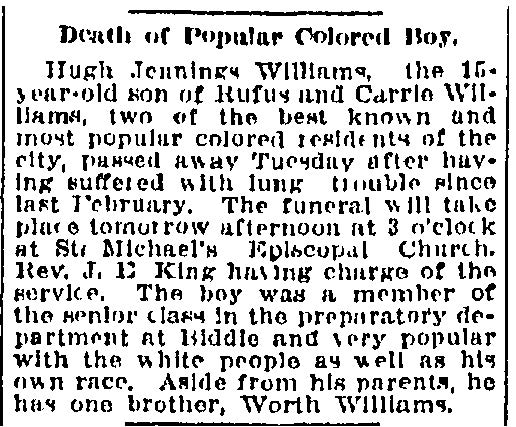
Hugh Jennings Williams died after a battle with tuberculosis in 1913, during his final year in Biddle University‘s preparatory division. (His older brother, Worth Armstead Williams, also attended Biddle for high school and college.) Jennings’ obituary paints a charming picture of the boy and makes clear his parents’ status in the eyes of white Charlotte. HJW obit
Charlotte News, 20 November 1913.

Just months later, more than 800 miles away in Cambridge, Jennings’ uncle John H. Reeves also contracted TB. He was dead by April 1915.

By 1920, the Williamses had moved a little ways out of the heart of the city to 826 South Church Street in the Ninth Ward. Widow Angeline Reeves was listed in the household with Rufus, Carrie, and 24 year-old Worth Williams.  Rufus was a porter at a club, Carrie was a dressmaker, and Worth a student at a dental college.  (Worth was only at home temporarily. He was enrolled at Howard University’s dental school.)Meanwhile, up in Cambridge, Massachusetts, the censustaker found William H. Kiner (a chipper at a shipyard), wife Edna E., and children Addison F., Carroll M. and Evelyn C. living at 8 Rockwell Street, and Ada Eccles and her son Harry at 65 Grigg Street.

Charl Obs 3 4 1917 R Williams

Rufus Williams continued to enjoy the esteem of his employer and patrons at the Southern Manufacturers Club — at what personal cost unknown. Waiting on the cream of the Queen City’s burgeoning manufacturing magnates was a path to economic security, but that path was strewn with daily indignity, both casual and intentional. Rufus, and his father before him, were what some fondly called “white man’s niggers,” but to acknowledge this is not to indict them. In a 1924 news article, note that Rufus’ speech honoring his benefactor, John C. McNeill, also shines a light on the fruit of his years as a servant — his “son, W.A. Williams, who is a surgeon dentist at New Bern.”

rufus Wms deskCharlotte News, 1 June 1924.

James Rufus Williams died 24 May 1947 in Charlotte. Six years later, on 25 March 1953, his mother-in-law Angeline McConnaughey Reeves passed away at the age of 94. Her mother and husband gone, Carrie Reeves Williams lived just six months more and died 28 September 1953. I have not found record of Frank Reeves’ death. His sisters Edna Reeves Kiner died in New York City in 1969 and Ada Reeves Eccles in Cambridge in 1979.

Standard
Births Deaths Marriages, Enslaved People, Migration, Newspaper Articles, North Carolina, Paternal Kin

Mother Ward.

None of us knows the details of the arrangements, or the impact on their willing and unwilling participants, but it is clear that Napoleon Hagans had a messy personal life. His oldest child, William Coley, was born about 1860 to Winnie Coley, an enslaved woman who lived on the nearby farm of John Coley. Winnie had several additional children, fathered by Coley himself and by Napoleon’s brother-in-law Adam T. Artis. Around 1867 — no license has been found — Napoleon married Apsilla “Appie” Ward, born in 1849 to Sarah Ward, an enslaved woman, and her owner, David G. W. Ward, a wealthy physician living in northwest Greene County. Napoleon poured his ambition and wealth into his and Appie’s sons, Henry Edward (born 1868) and William Scarlett (born 1869). Both attended Howard University and settled into comfortable, distinguished livelihoods in farming, education and real estate.

Though Napoleon’s youngest was denied these advantages, he was arguably the most successful of all the sons.  Joseph Henry Ward was born 4 August 1870 in Wilson, North Carolina. (Or Wilson County, in any case.) His mother, Mittie Roena Ward, was Appie Ward Hagans’ twin. (Identical, it is said.) And Napoleon Hagans’ sister-in-law. I know nothing at all of her early years. In 1879, Mitty Finch (Finch? why?) married Virginia native Algernon Vaughn in Wilson. In 1880, the family’s household included Mittie’s mother, Sarah Darden; her husband Algie, a farm laborer; Mittie, a cook; and children Joseph, 8, Sarah, 6, and Macinda, 5 months.

By 1890, Joseph had struck out on his own and for reasons unknown landed in Indianapolis, Indiana. There, he went to work for a physician who would set him on his own path to a medical degree. Joseph’s half-sister Sarah married William Moody in Wilson in 1892 and, by the dawn of the new century, the Moodys and Mittie Vaughn were living in Washington DC. Soon after Mittie joined Joe Ward in Indianapolis, reverted to her maiden name (though keeping the title “Mrs.”), and began a peripatetic life that saw her in and out of the households of her children.

The Indianapolis Recorder, an African-American news weekly, kept close tabs on the mother of one of the city’s most illustrious residents:

Mrs. Mittie Ward, mother of Dr. J.H. Ward will leave today for Washington, D.C., to spend the winter with her daughter, Mrs. Sarah Moody. Her youngest daughter will remain in the city with her brother Dr. Ward.  [12 December 1903]

Ward-Artis.  On Wednesday June 22, at high noon the wedding of Miss Minerva Ward, the daughter of Mrs. Mittie Ward and sister of one of our prominent physicians Dr. Joseph H. Ward, and Mr. Dillard Artis, of Marion, will be celebrated in the presence of the immediate family and a few intimate friends. Rev. Morris Lewis assisted by Rev. T.A. Smythe will perform the ceremony. They will leave at 5 p.m. for Marion, where a wedding reception will be given from 8 to 11 p.m., at 920 S. Boot street, the home of the groom. The bride is well and favorably known in our city’s best circles and is a favorite in the younger social set. The groom is a prominent cement contractor of Marion and a highly respected citizen, owning a great deal of property, which he has accumulated by his industry and business tact. They will be at home at 920 S. Boot street, Marion.  [18 June 1910]

Mrs. Minerva Ward Artis of Marion, spent the holidays with her mother, Mrs. Mittie Ward, of the city.  [31 December 1910]

Mrs. Dillard Artis of Marion, was in the city a few days this week. Mrs. Artis is visiting her brother, Dr. J.H. Ward and her mother, Mrs. Mittie Ward.  [18 February 1911]

Dr. J. Ward of Indianapolis and Master Joseph were guests of his mother Mrs. Mittie Ward and sister Mrs. S.D. Artis of S. Boots street Wednesday.  [19 August 1911]

Mrs. Mittie Ward of Indianapolis, who has been the guest of her daughter for the past week Mrs. S.D. Artis returned home Saturday and on December 5, will leave for Washington, D.C. to spend the winter with her daughter.   [2 December 1911]

Dr. J.H. Ward of Indianapolis was called to this city [Marion, Indiana] the first part of this week to attend the bedside of his mother, Mrs. Mittie Ward, who is ill at the home of her daughter, Mrs. S.D. Artis, in South Boots street.  [25 November 1916]

Mittie Ward died of stroke in Washington, DC, in 1924. She was visiting her elder daughter Sarah Ward Moody and planning to travel to see the younger.

Image

Pittsburgh Courier, 19 April 1924.

Standard
Free People of Color, Migration, Newspaper Articles

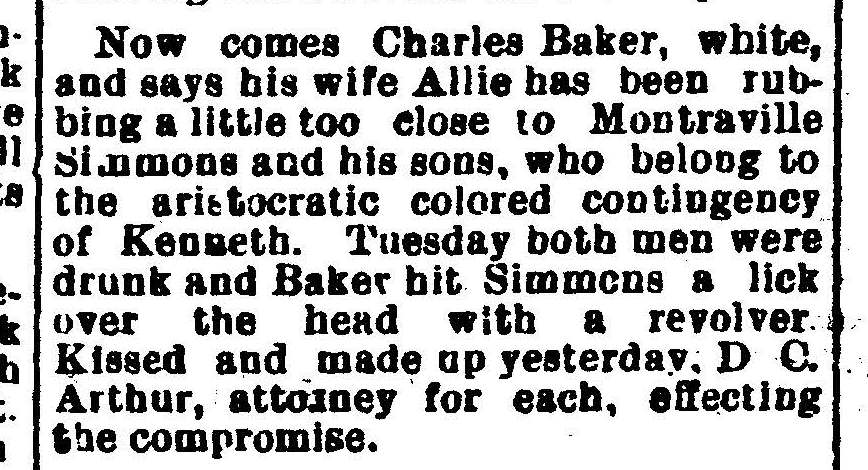
Rubbing a little too close.

1 9 03 Logansport Pharos Times

Logansport Pharos Times, 8 January 1903.

Montraville (or Montreville) Simmons was, of course, the irascible husband of Anna J. Henderson Simmons. After many years in Ontario, the family settled in rural Cass County, Indiana, near the community of Kenneth. Not far away was an African-American settlement dating back to the mid-1800s, when southern free people of color began migrating to the Midwest. The Bassett family, originally from North Carolina, anchored that community, and two of Annie and Montraville’s daughters married into the family.

Montraville, occasionally his sons Dock and Edward, Annie (once), and Montraville’s second wife Eliza (often and dramatically) popped up in the pages of nearby Logansport’s newspaper much more regularly than one might expect. He had a penchant for clashing with his neighbors, for lawsuits, and for violence, and local reporters gleefully recounted his mayhem and mishaps.

Standard
Births Deaths Marriages, Maternal Kin, Migration, North Carolina, Oral History, Photographs

Minnie Beulah McNeely Hargrove.

But there was Aunt Minnie, and then after Aunt Lethea died, Aunt Lethea told her to take care of me, and she just took me on, you know.  And she was always crazy about me.  The first percale sheets that I ever had Aunt Minnie sent them to me, and I never bought anything but percale sheets.  Boy, they were just so luxurious and so nice and everything.

Jay stayed with Aunt Min ‘cause Aunt Min reared him after Aunt Lethea died.  And he was at this same house with Aunt Minnie and Grandma.  Let’s see.  It was Aunt Min and Grandma and Uncle Luther and Jay and I.  We were all in the same house during the summer that I worked up there.

Ardeanur. And she had a brother named James.  And their mother died when they were little children, and Min reared them.  Reared the children.

——

Aunt Minnie, who had no children of her own, reared everyone’s. When her sister Addie McNeely Smith died in 1917, Minnie took responsibility for her children, Ardeanur and James. When sister Elethea McNeely Weaver died five years later, Minnie stepped in to care for her youngest boy, 11 year-old Irving “Jay” Weaver, and promised to keep an eye on Lethea’s favorite niece, my grandmother.

Aunt Min shared a home with her mother Martha Miller McNeely in Bayonne, New Jersey, and after her mother’s death, she and Ardeanur moved to Columbus, Ohio, to live near another sister, Janie McNeely Taylor. She was in her fifties when she defied her disapproving family and married John Hargrove. He did not live long to plague her, though, and in a reversal of roles, she spent her last years with Ardeanur.  Minnie Beulah McNeely Hargrove died 2 December 1982 in Columbus.  She was 93 years old.

Image

Above: Minnie hovering behind her flock. From left, a Murphy boy, Bertha Hart Murdock, Bertha’s cousin Alonzo Lord, Aunt Minnie, and Ardeanur Hart Smith, Statesville, circa 1920.

Image

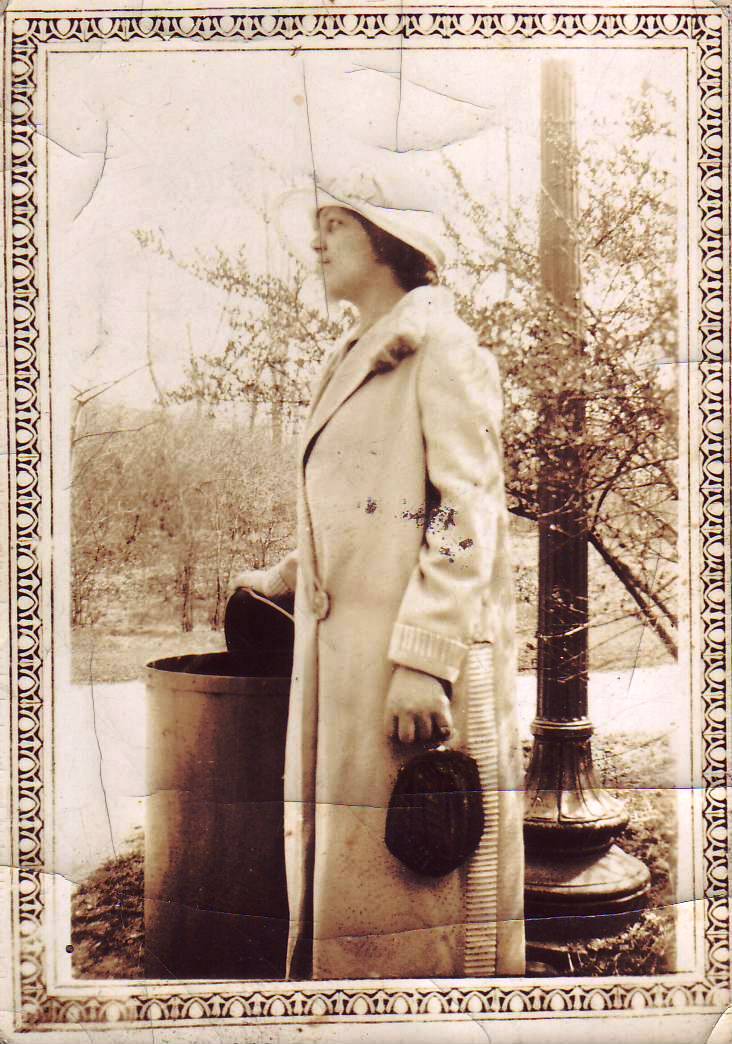
Minnie in Bayonne, perhaps the late 1920s.

Image

Minnie in later years, Columbus, Ohio.

Image

Aunt Min marries John Hargrove, Columbus, early 1950s.

Image

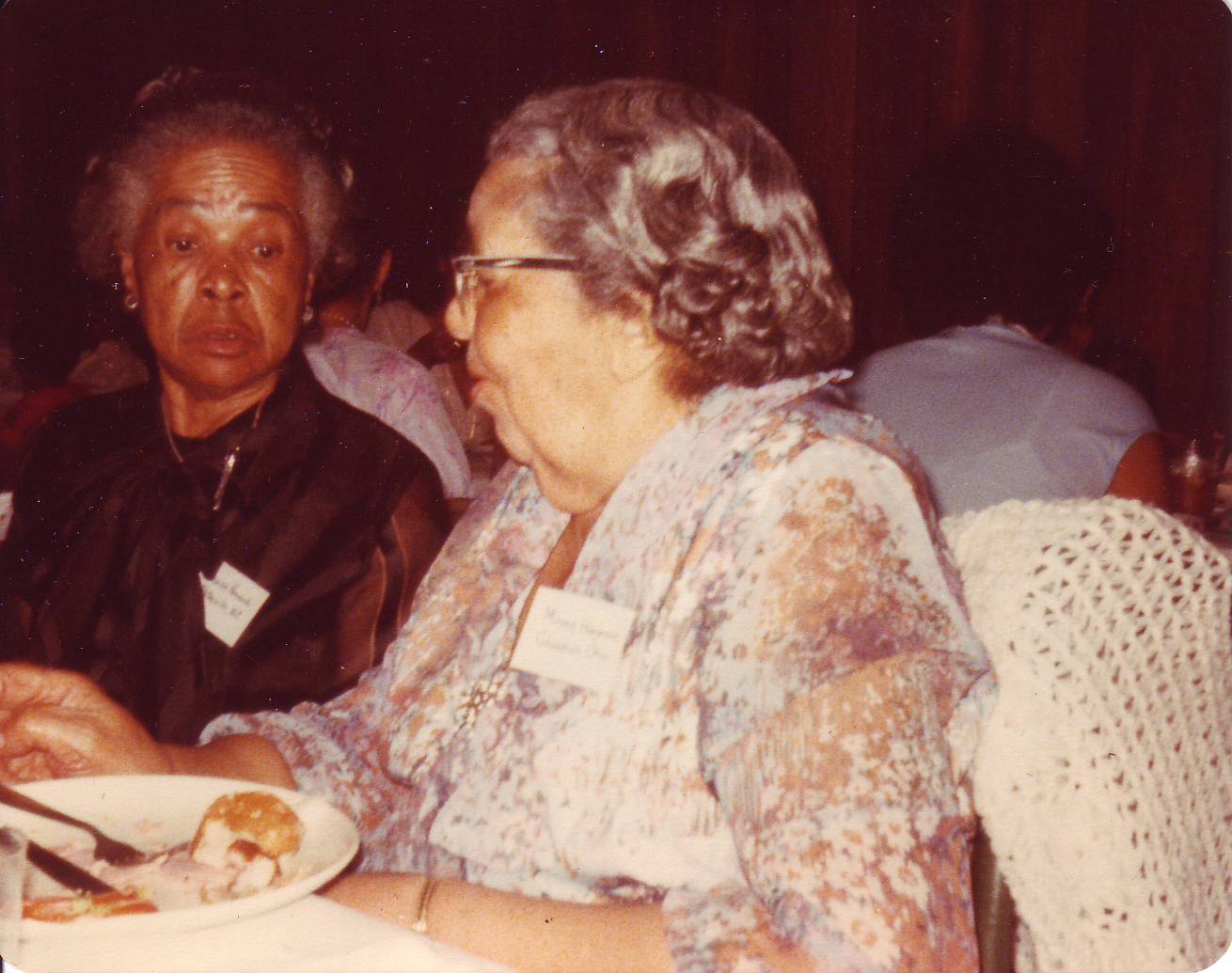
Minnie McNeely Hargrove at the 1980 Colvert-McNeely family reunion, Newport News, Virginia. I was not there. At the time, I was too callow to know what I was missing. Today, I kick myself. I never met her.

Interview of Margaret C. Allen by Lisa Y. Henderson; all rights reserved.

Standard
Births Deaths Marriages, Free People of Color, Migration, North Carolina, Other Documents, Paternal Kin

Misinformation Monday, no. 5.

The fifth in a series of posts revealing the fallability of records, even “official” ones.

——

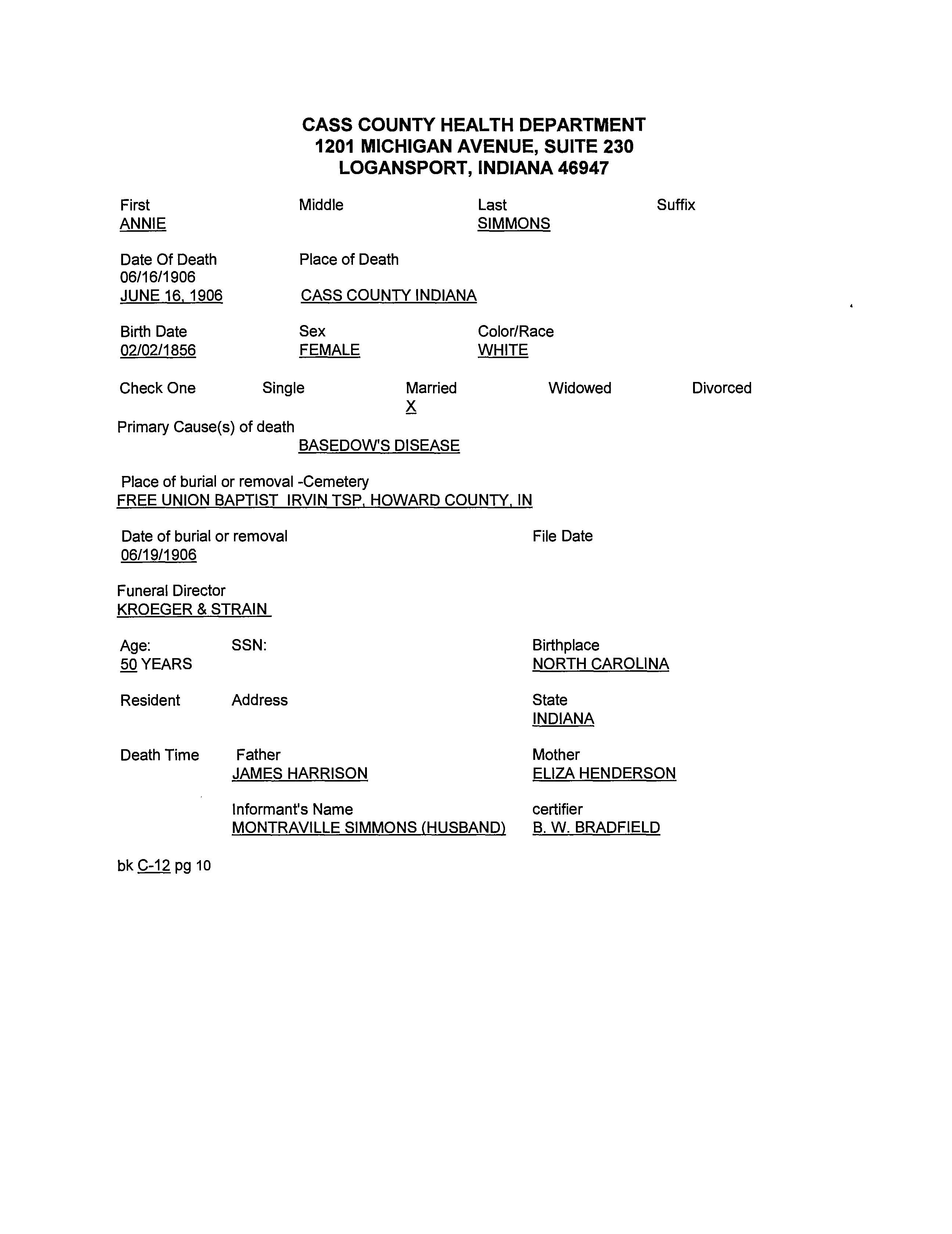
HENDERSON_--_Annie_Simmons_Death_Cert

What’s right with this death certificate? Annie Simmons‘ name — more or less, as she seems to have been called Anna in her youth. Presumably, her date and place of death. Her birthday may be right, though the birth year is probably three or four years late. She was certainly female.

But she was not white.

Annie Simmons was mixed-race, described as “mulatto” in early life and “colored” (and even “African”) thereafter. She is consistently classified in census records in two states (North Carolina and Indiana) and a province (Ontario), as well as her marriage license. The local newspaper avidly carried news of her husband Montraville Simmons’ antics and was quick to point out his non-white status.  (She was certainly married, if unhappily.)

(By the way, Basedow’s disease is more commonly known as Graves’ disease, or hyperthyroidism.)

Annie was probably 54, rather than 50, and she was certainly born in North Carolina, but not to “James Harrison” and “Eliza Henderson.” Rather, as is clearly set forth in her application for a marriage license in Duplin County NC, her parents were James Henderson and Eliza Armwood. Montraville Simmons probably had not seen his in-laws in more than 40 years when he gave this information. His errors are perhaps excusable, but there they are, enshrined as “fact” and forever leading researchers astray.

Standard
Maternal Kin, Migration, North Carolina, Oral History

Finally they just trickled on.

Me: When did your aunts and uncles that moved to Ohio — when did they move?  And who was the first one to go.  Why did they pick Ohio?

My grandmother: Well, Mama had a sister named Janie, and she had three children by this man.  And he didn’t even –

Me [unfortunately, interrupting *sigh*]: That was J.T. and Charles and —

My grandmother: No, no, no, no, no.  That was –

Me:  Oh, Willa and them.  Okay.  Yeah. 

My grandmother:  Mm-hmm.  And he went to Columbus, Ohio, and he would want them to come, but they didn’t ever go.  So finally my Aunt Min and my cousin moved to Ohio — Columbus.  And my Aunt Dot and her family just trickled on.

Me:  Okay. So Aunt Min and who? 

My grandmother:  Ardeanur. 

Me:  Ardeanur.  Okay.

My grandmother:  Ardeanur. And she had a brother named James. And their mother died when they were little children, and Min reared them. Reared the children. So anyway after they went to Ohio, after she went, after Aunt Dot went to Ohio, I think.  Ardeanur and Aunt Min lived in Jersey City. But they moved out there.

Me:  Okay. So that’s how everybody wound up in Columbus.

My grandmother:  Columbus, Ohio.

——

Janie C. “Dot” McNeely, born 1894, was the youngest of the McNeely sisters. I’m not sure who the man who moved to Ohio is, but he probably was James M. Taylor, whom she married in 1923 shortly before their son Carl was born. (They’d had a daughter, Willa Louise, in 1918 and had a second son in 1925. Janie and her children (including older daughters Sarah and Frances) appear in Statesville in the 1930 census without James Taylor.

It’s still not clear to me when the McNeelys moved to Ohio. My grandmother’s statements about who went first seem to conflict, but I am fairly certain that she meant to say that Janie and her children were there before Minnie and Ardeanur. Minnie and Ardeanur were in Bayonne, New Jersey, before 1930, when Janie was still in Statesville.  However, because all of them — wherever they were — seem to have been omitted from the 1940 census, it’s difficult to guess when the move to Ohio took place.

Unfortunately, the Ohio branch of the McNeelys is now largely unknown to my family. Janie’s daughter Willa may still be living, but last we heard was fighting Alzheimer’s. Few of Janie’s children had children, maybe only one, and links to them have been lost.
Standard