Agriculture, Free People of Color, Land, Newspaper Articles, North Carolina, Paternal Kin, Politics

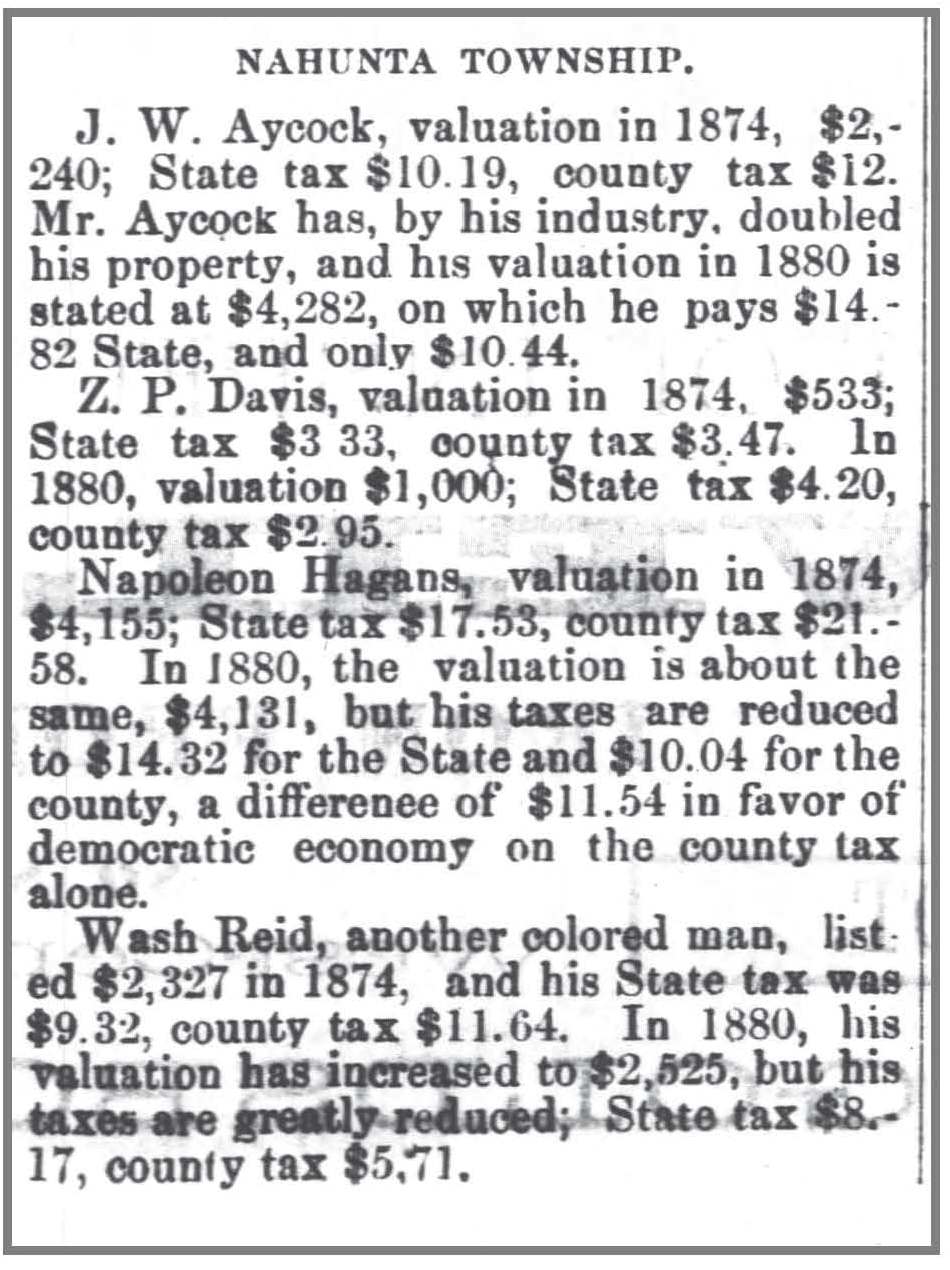
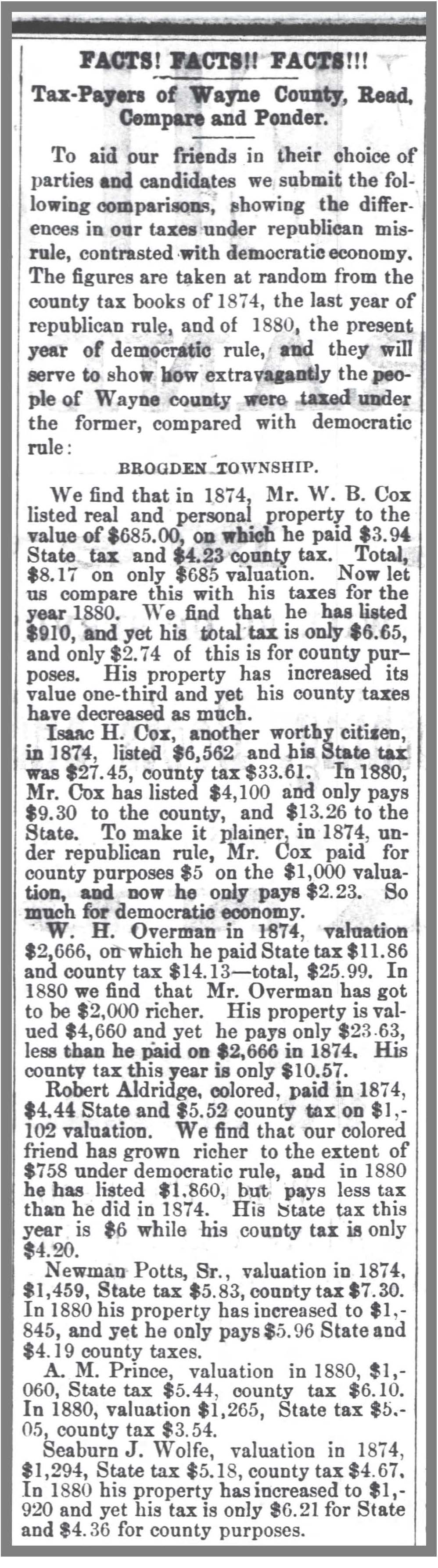
Our colored friend has grown richer.

Image

ImageGoldsboro Messenger, 21 October 1880.

These propaganda pieces are part of a single article published to demonstrate that the rising tide of Democratic rule had floated all boats as land values increased while taxes fell. (In other words, the end of Republican rule meant more money in the pocket, as well as a foot on the neck of African-Americans.)

Two of the “colored friends” noted were my kin — my great-great-great-grandfather Robert Aldridge and Napoleon Hagans, the brother of my great-great-great-grandmother Frances Seaberry Artis. (And Washington Reid’s nephews William and Henry Reid, sons of John Reid, married Adam Artis’ niece Elizabeth Wilson and daughter Cora Artis, respectively.) Aldridge, Hagans and Reid (as well as Artis, Frances’ father Aaron Seaberry and Betty’s father John Wilson) were all prosperous free-born farmers.

Standard
Business, Civil War, Enslaved People, Land, Maternal Kin, Newspaper Articles, North Carolina, Photographs

Eagle Mills.

An abstract from Heritage of Iredell County, Vol. I (1980) —

In 1846, peddlar Andrew Baggerly bought the old Francis Barnard mill tract on Hunting Creek in north Iredell County.  In 1849, he placed an ad in Salisbury’s Carolina Watchman: “Capital Wanted And If Not Obtained Then Valuable Property For Sale.”  He described the property as “the most valuable water power in the Southern Country … situated on Hunting Creek in Iredell County, twenty-eight miles west of Salisbury … [on] a never-failing stream, … remarkable for its purity, … [and] adapted to the manufacture of paper, to calico printing, to bleaching etc.”  Baggerly noted that there was a dam in place, an active sawmill, a grist mill soon to open, and a factory building about half-finished.

On 2 Mar 1850, Baggerly, James E.S. Morrison, William T. Gaither, William R. Feimster, William I. Colvert, G. Gaither Sr. and Andrew Morrison filed a deed for a 318 1/4-acre tract called the Eagle Mills place.  By 1852, the factory was operating with William I. Colvert as its agent.  It had 700 spindles and 12 looms and employed an overseer and 22 workers, 20 of whom were women. By 1854 the adjacent former Inscore Mill had been added to the works, and Baggerly claimed the “intrinsic and speculative value” of the complex was $2,700,000.  

In 1855, Baggerly advertised in Charlotte’s North Carolina Whig and in the Carolina Watchman, calling the complex “Eagle City, the Great Point of Attraction, Destined to be the great center of manufacturing interests in Western North Carolina and perhaps the United States.”  He deeded the president and Congress of the United States a ten-acre block in Eagle City called Eagle Square, located on Market Street.  

After Baggerly was forced to liquidate his assets during the Panic of 1857, William Colvert became the owner of his interest in Eagle Mills.  “According to tradition there was a tobacco factory, hotel, oil mill, and general store at Eagle Mills in addition to the grist mill and cotton factory.  A number of homes stood in the horseshoe bend above the mills and a church was eventually constructed on the edge of the settlement.”

In the spring of 1865, Stoneman’s raiders came upon Eagle Mills unexpectedly and burned it to the ground.  The mills were rebuilt, but Eagle Mills never recovered its former prosperity.  The cotton factory and grist mill operated until destroyed by fire in April 1894.  At that time, William I. Colvert, Robert S. Colvert, and James E.S. Morrison were the owners.  

The only remains at the site are gravestones in the church cemetery, traces of the main road to the mill, the grist mill’s foundation stones, and, a short distance upstream, remains of the stone supports where a covered bridge crossed the creek.

——

Sville_Record_and_Landmark_4_19_1894_Eagle_Mills

Statesville Record & Landmark, 19 April 1894.

——

When William I. Colvert took charge of Eagle Mills in 1852, my great-grandfather Walker Colvert was in his early 30s and father of a one year-old boy, John Walker Colvert. I don’t know exactly what kind of work Walker did for W.I., but they had grown up together, and Walker was an entrusted slave. Even if his primary labors were not at the cotton factory complex, I am certain that he spent considerable time in and around his master’s largest investment. So, too, would John Walker, who remained with W.I. after Emancipation. He is listed in W.I.’s household in the 1870 and 1880 censuses, and I suspect he stayed at Eagle Mills until the final fire closed down the works.

On a rainy December morning I cruised the backroads of northern Iredell County, drinking in the landscape that was home to my Colverts and Nicholsons for much of the 19th century. I made a left onto Eagle Mills Road, headed north. A sharp bend in the road and there, a bridge over Hunting Creek. I pulled over and, ignoring a No Trespassing sign, clambered down to the sandy bank. The waterway is too shallow and rocky to have been paddled or poled, but I imagine that Walker and John Walker knew its course very well. Hunting Creek powered Eagle Mills and was a direct link between W.I. Colvert’s lands and those of Thomas A. Nicholson, whose son James Lee married W.I.’s daughter and whose granddaughter, Harriet Nicholson, gave birth to John Walker Colvert’s first child.

IMG_4618

Photograph by Lisa Y. Henderson, December 2013.

Standard
Agriculture, Births Deaths Marriages, Free People of Color, Newspaper Articles, North Carolina, Paternal Kin

Well-to-do farmer — with lots of children.

An expanded version of the 47-children article that ran in the Statesville Landmark (and, indeed, all over North Carolina):

Image

Wilmington Messenger, 3 January 1906.

I still don’t know more than 25 or so of Adam Artis‘ children (which is gracious plenty) and don’t believe there were many more than that. But if he didn’t have 80+ grandchildren by 1906, he certainly had many, many more than that before all was said and done. (As always, I ignore the snark, but what is a “typical southern darkey”?)

Standard
Newspaper Articles, North Carolina, Paternal Kin

Best of all.

Cain D. Sauls, grocer, banker, farmer, also wrote a society column — “News Among the Colored People” — for a short-lived newspaper in Snow Hill, Greene County, North Carolina. The piece that ran on 11 February 1898 reveals some of Sauls’ additional interests — an investment in Coleman Mills in Concord, North Carolina,

Image

The Great Sunny South (Snow Hill NC), 11 February 1898.

and a position as justice of the peace, in which presided over the marriages of neighbors and friends.

Standard
Births Deaths Marriages, Newspaper Articles, North Carolina, Other Documents, Paternal Kin

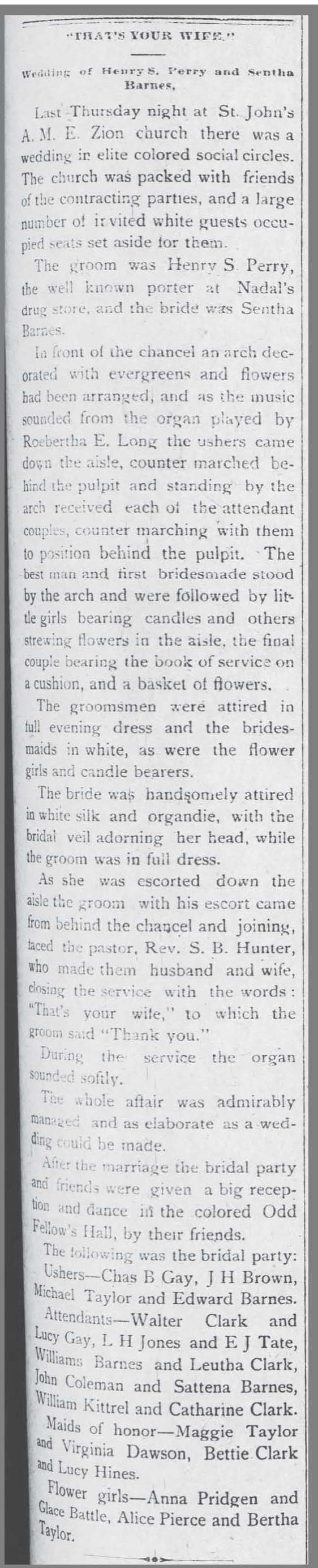
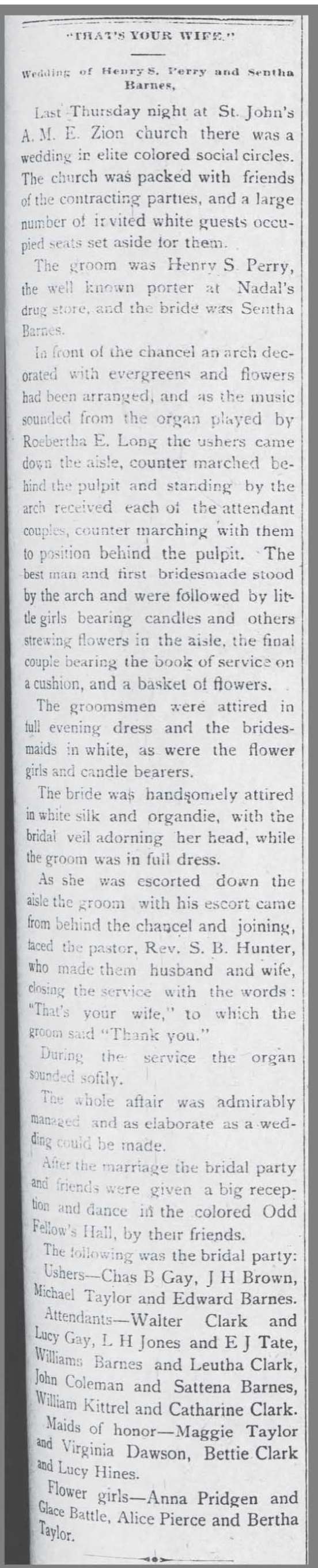
“That’s your wife.”; or, finding the Perrys.

Image

Wilson News, 21 September 1899.

(Ignore the snark, which was par for the course for newspapers covering African-American social and cultural events.)

I came across this article using my great-grandfather’s name as a search term. Mike Taylor was an usher at this wedding and, look, so was his brother-in-law Edward Barnes. Mike’s daughter Maggie Taylor, my grandfather’s sister, then about 13, was a maid of honor, and his daughter Bertha Taylor, 7, was a flower girl. The bride and groom were Henry Perry and Centha Barnes. Were either of them related to the Taylors?

“Perry” rang a little bell. In the 1910 census of Wilson, Wilson County, living along the A.C.L. Railroad: 42 year-old railroad laborer Pierce Barnes, wife Mary, 34, adopted son Robert Perry, 8, and Mary’s father Willis Barnes, 72.  Mary was my great-grandmother Rachel Barnes Taylor‘s sister. In the 1920 census of Wilson, Wilson County, at 114 Lee Street: Mike H. Taylor, cook at cafe, wife Rachel and their son Tom Perry, 12.

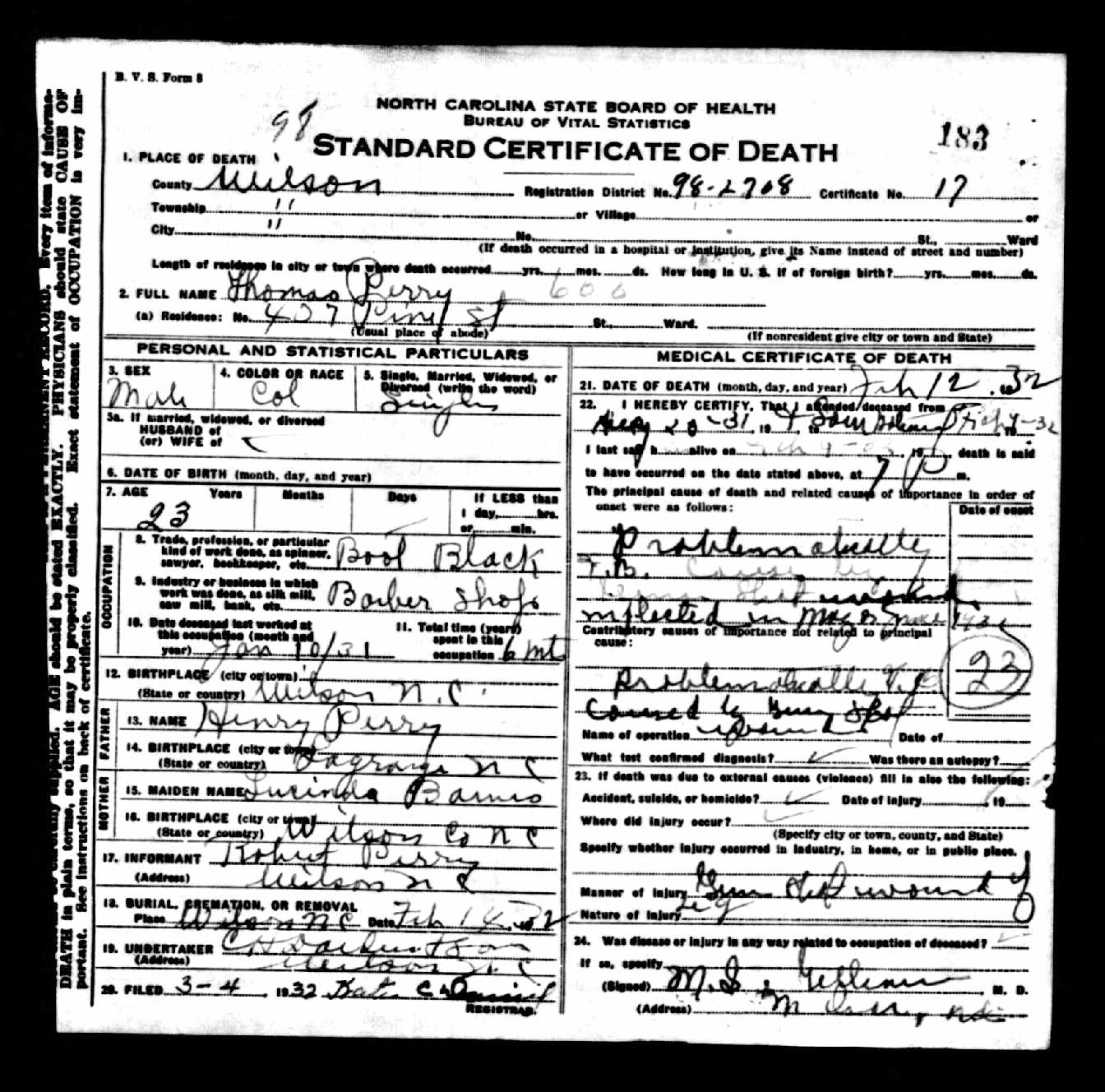
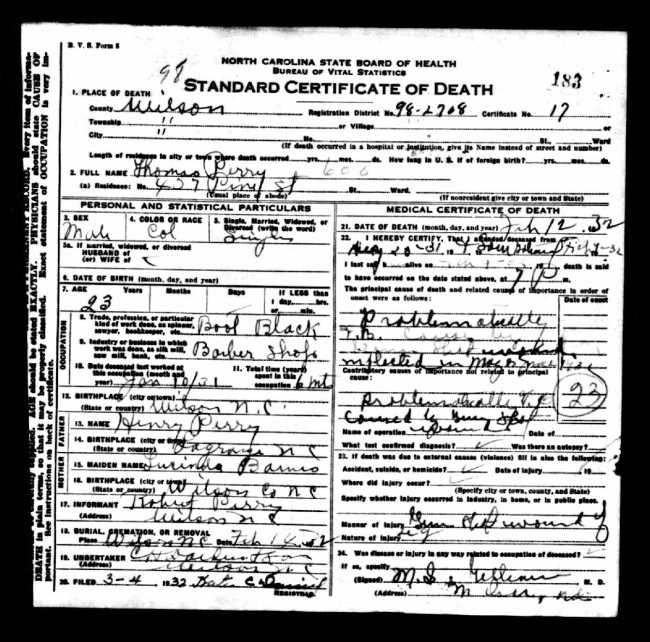
Then there was this death certificate:
Image

So Tom Perry was the son of the couple that married above. But what was Tom’s relationship to Robert Perry, who was adopted by Mary Barnes Barnes and served as informant for Tom’s death certificate? And how were the Perrys related to Mike Taylor or his wife Rachel Barnes Taylor?

I found Henry and Centha Barnes Perry’s 1899 marriage license. Henry was 24; Centha, 18. Both Henry’s parents were listed, but only her father, Willis Barnes, was.

In the 1880 census of Wilson township, Wilson County, Willis Barnes appears with his wife Cherry, six of their children (the youngest aged about 4) and a niece. By 1900, and probably long before, Cherry Battle Barnes was dead. Had she had one last child, Lucinda, called “Centha,” in 1881?

Let’s say Cherry died in or shortly after childbirth. Her oldest daughter Rachel, who married Mike Taylor in 1882, likely would have reared her baby sister with her own children. (The oldest, my grandfather, was born in 1883.) The 1890 census might have captured this family together, but those records were destroyed by fire. By 1900, Centha (“Sindie”) and her new husband Henry S. Perry were living together in Wilson, as yet childless. Ten years later, however, Henry was listed as a single man boarding at the New Briggs Hotel, where he worked as a bellboy.

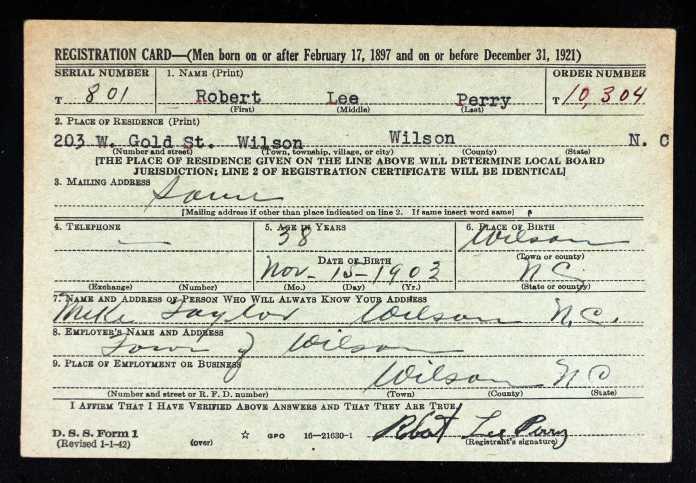
What happened in those ten years? The best guess is that Cintha, having given birth to at least two sons, Robert (1903) and Thomas (1908), died. Her children went to live with her mother’s relatives, just as she had done. The family, however, never quite recovered. Henry eventually remarried, but died in 1927 when his second set of children were still young. Tom, who worked as a boot black in a barbershop (perhaps the one in which my grandfather cut hair), was shot in the leg in the spring of 1931, then seems to have died of tuberculosis less than a year later. (Cause of death: “problematically T.B. caused by gun shot wound”? Wha?) Robert Perry worked as a grocery delivery boy for a while, then as a janitor for Carolina Telephone & Telegraph Company, but in 1930 was listed as a convict living at the Wilson County Stockade. He married a woman named Pauline, but it is not clear whether they had children. In 1942, he registered for the World War II draft:
TAYLOR -- RL Perry WW2 Draft Card

The back of the card notes that Robert Lee Perry was 5’11”, 155 lbs., had a scar under his left eye, and had brown eyes, black hair and a dark brown complexion. “Mike Taylor,” the person who would always know his address, was not the Mike Taylor who had been an usher at his parents’ wedding. Rather, he was that Mike’s son, Roderick “Mike” Taylor, Robert’s first cousin and my grandfather. Robert Perry died 15 May 1977. His death certificate lists no parents.

Standard
Business, Maternal Kin, Newspaper Articles, North Carolina

To look like new.

Mountain_Scout_Taylorsville_8_23_1916 Pressing Club

Mountain Scout (Taylorsville), 23 August 1916.

This ad appears several times in Taylorsville’s Mountain Scout in the latter half of 1916. Did Lon Colvert open a branch of his Statesville operation a few miles away in Alexander County?  Like barber shops, clothes cleaning and pressing businesses were frequently operated by African-Americans in the late 19th and early 20th-century South.

Standard
Births Deaths Marriages, Newspaper Articles, North Carolina, Paternal Kin, Politics, Rights

Remembering J. Frank Baker.

The myth goes something like this: John Frank Baker was the first black man elected to Congress from Wayne County. He never made it to Washington, assassinated as he attempted to board a train north for his swearing-in.

Something about this didn’t sit right with me.

Wayne County was part of the so-called Black Second, the Congressional district that encompassed most of northeast North Carolina’s majority-black counties during Reconstruction and into the early 20th century. The history of African-American political activity in the district is extensive and well-documented, and I couldn’t recall having read of Baker. A Google search quickly refreshed my recollection. North Carolina voters sent four black Congressmen to Washington in the nineteenth century: John Adams Hyman of Warren County (1875-1877), James Edward O’Hara of Enfield (1883-1887), Henry Plummer Cheatham of Littleton (1889-1893), and George Henry White of Tarboro (1897-1901). No Baker.

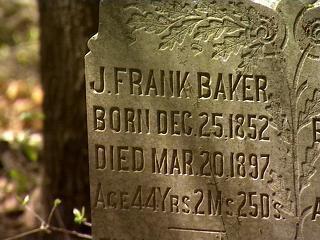
As his headstone reveals, J. Frank Baker died 20 March 1897, the same month that George H. White was sworn into the 55th Congress, having defeated white Democratic incumbent Frederick A. Woodard of Wilson. [Sidenote: My junior high school was named for Woodard.] Clearly, Frank Baker was never elected to Congress. Why, then, was he killed?

To call newspapers of the era racist is to say “the sky is blue.” Articles about African-Americans were condescending and mocking at best, derogatory and vicious most times. Objectivity was not a hallmark of journalism in the late 19th century in general, but if their names appeared in the local paper, African-Americans could generally expect the worst. Notwithstanding this general bleak picture, when consumed with a grain of salt, early newspapers can be an invaluable source of otherwise unrecorded information about black Americans.

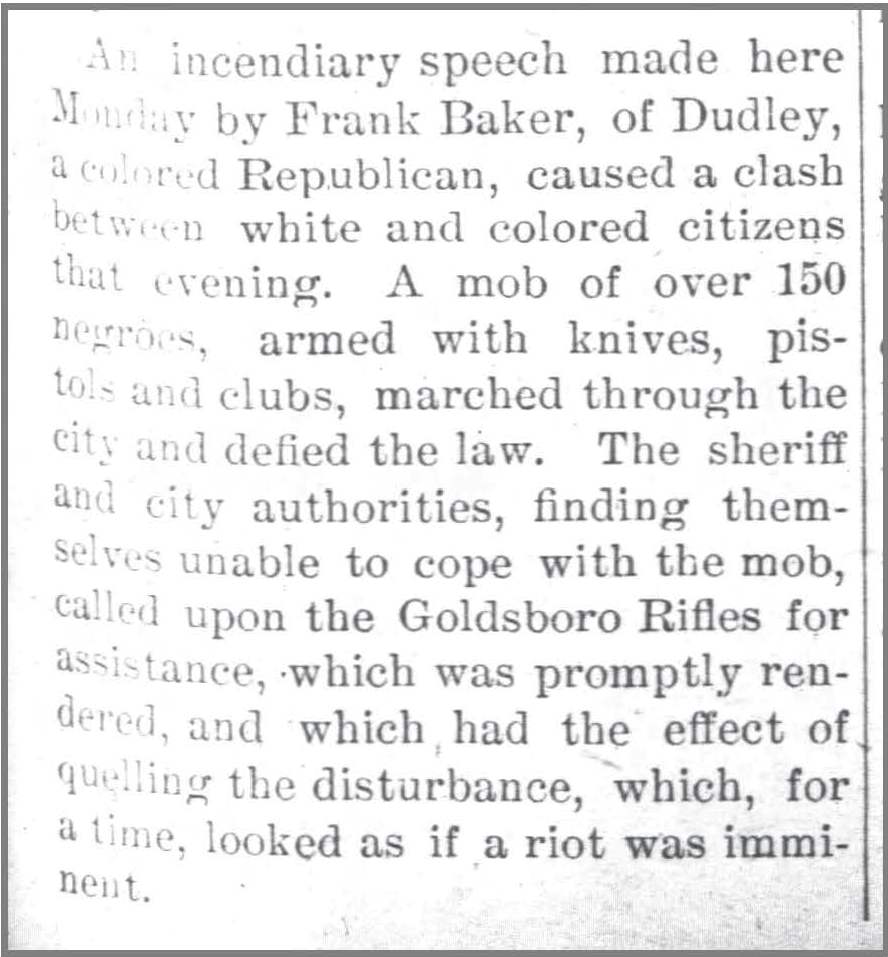
Frank Baker’s murder was covered in detail in the Goldsboro Headlight and the Weekly Argus, the rival newspapers operating in Wayne County at the time. Even before his death, however, his fiery advocacy seized the attention of the white community. This story was picked up by papers across the country:

Gboro_Headlight_11_5_1896_F_Baker

Goldsboro Headlight, 5 November 1896.

I don’t know what Baker was speaking about or why his words touched off such a response — if, in fact, “150 negroes” actually took the streets like this. It is clear, though, that he was a powerful and polarizing figure in Wayne County. And four months later he was dead. A Raleigh newspaper broke the story:

Raleigh_Daily_Trib_3_24_1897_F_Baker

Raleigh Daily Tribune, 24 March 1897.

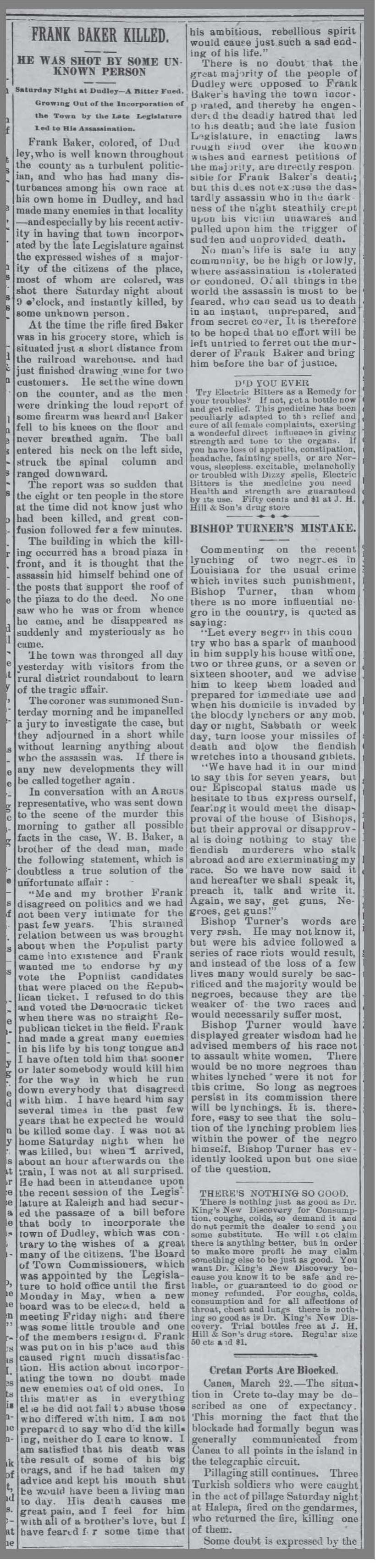
The tone set, the Goldsboro papers picked up the report:

Gboro_Weekly_Argus_3_25_1897_Frank_BakerGoldsboro Weekly Argus, 25 March 1897.

Assuming that the basic description of the murder is correct, we learn that Baker was not boarding a train when he was killed. Rather, he was minding customers at his grocery store, located near the railroad warehouse in Dudley. (The Headlight reported that the store belonged to Ira W. Hatch.) He was shot at fairly close range, but a room full of people saw nothing. Nonetheless, a wholly unbelievable statement attributed to his brother, W.B. Baker, placed the responsibility for Frank’s death on his own head. The reporter then emphasizes the “deadly hatred” that Baker engendered among his neighbors by insisting on legislation incorporating the town of Dudley. [Sidenote: don’t you have to love Bishop Henry McNeal Turner?]

Gboro_Weekly_Argus_4_29_1897__F_Baker_

Goldsboro Weekly Argus, 29 April 1897.

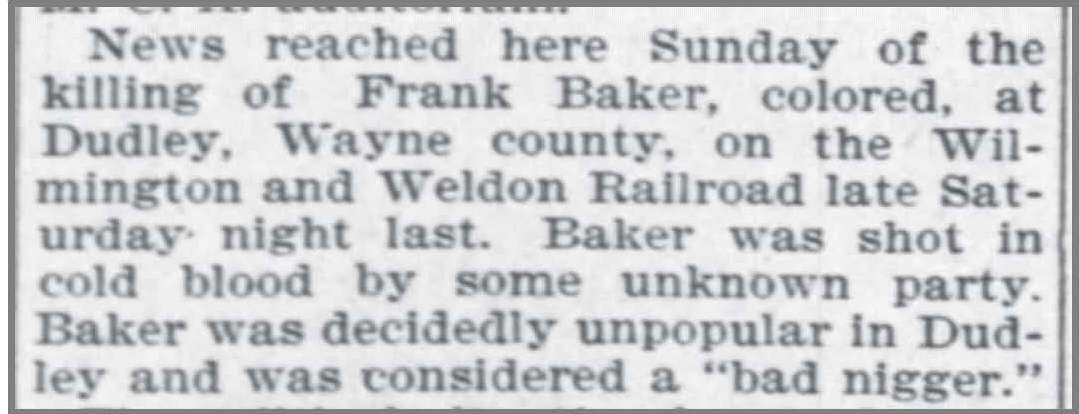
A month later, the wheels of justice were spinning uselessly, as newspapers indignantly proclaimed the innocence of two white men implicated — but not actually charged — in the crime. A week after W.B. Bowden’s good name was cleared, J. Will Grady was released when the “facts of his innocence were established.” On 27 May 1897, the Headlight tersely noted that the governor of North Carolina had offered a reward for the capture of Frank Baker’s killers. That’s the last I’ve found on the subject.

John Frank Baker was born about 1845. I don’t know much about his early life, but in 1879 he married Mary Ann Aldridge, daughter of J. Matthew and Catherine Boseman Aldridge, and likely first cousin to my great-great-grandfather John W. Aldridge. Frank Baker was not a Congressman. Nonetheless, he made his mark in Wayne County as an African-American politician capable of stirring the masses and willing to take on unpopular causes in an era in which even voicing opinions was a daring undertaking. He is not forgotten.

Image

——

Photo from Baker article posted at http://www.wral.com/news/local/story/116365/.

Standard