Maternal Kin, North Carolina, Other Documents, Photographs

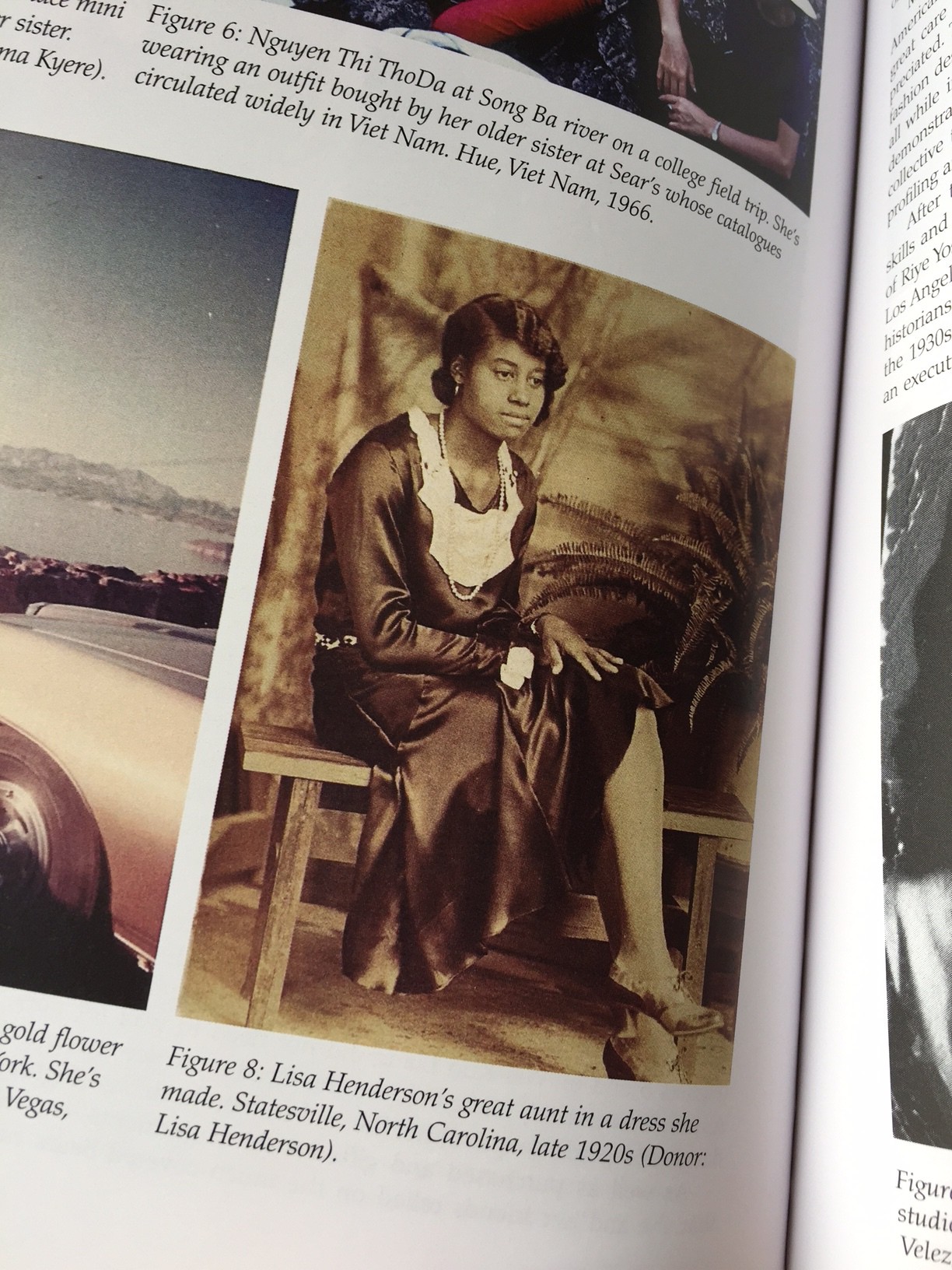
Aunt Golar makes fashion history.

I’m not sure how it is that I didn’t write this months ago. When I went home for Christmas, there was a manila envelope on my dresser, postmarked U.K. I was puzzled. Who would be sending something from England to my parents’ house? I ripped it open, and a slender paperback slid into my hand, a scholarly journal — Fashion, Style & Popular Culture, volume 2, number 1.

journal

I scanned the contents and suddenly remembered. Some years ago, I contributed photographs of my people to Min-Ha T. Pham’s Tumblr, Of Another Fashion. In the journal article, “Archival intimacies: Participatory media and the fashion histories of US women of colour,” Pham discusses “the critical and curatorial aims, materials and methods that underpin a digital fashion archive devoted to the histories of US women of colour ….” arguing for “the utility of participatory media in efforts to create not only new historical records of minoritized fashion histories but also new systems of record-keeping.” Among the photos illustrating the piece is one of my grandmother’s aunt, Golar Colvert Bradshaw.

Golar

Standard
Births Deaths Marriages, Maternal Kin, Newspaper Articles, North Carolina, Other Documents

Aunt Ida May revisited.

Ancestry.com’s North Carolina Marriages data collection is not through demystifying my kin. A previously unknown marriage license clarified a question I had my great-great-aunt Ida’s life. If Eugene Stockton were her husband, I wondered here, why was she a Stockton in the 1910 and 1920 censuses, but referred to as his sister-in-law? In gaining an answer, I also uncovered a terrible tragedy.

Ida May Colvert‘s first marriage license was so hard to find because she married under her mother’s maiden name, as Ida May Hampton. The license lists her parents as John and Adline Colvert, but they did not marry until 1905, just over a month after Ida married Dillard Stockton on 27 December 1904. (Ida’s age is listed as 21 on the license, which is almost surely too high. Her birth year as recorded in various documents varies widely, but averages about 1885.) Dillard’s parents were listed as Henry and Frances Stockton, which seems to indicate that Dillard and Ida’s second husband Eugene shared a father and were half-brothers. (Eugene’s mother was Alice Allison [or maybe McKee] Stockton.)

42091_334850-01124

Ida was a Stockton Stockton then. But what happened to her first husband, Dillard? A quick Newspapers.com search turned up the awful story:

Statesville_Record__amp__Landmark_3_12_1907_Dillard_Stockton_killed

Statesville Record & Landmark, 12 March 1907.

A little over two years after they married, Dillard Stockton and five other African-American men were crushed by a cascade of soil and scaffolding in a Statesville ditch. [Surely my grandmother knew this story?]

Race STreet

The stretch of Race Street in which the cave-in occurred.

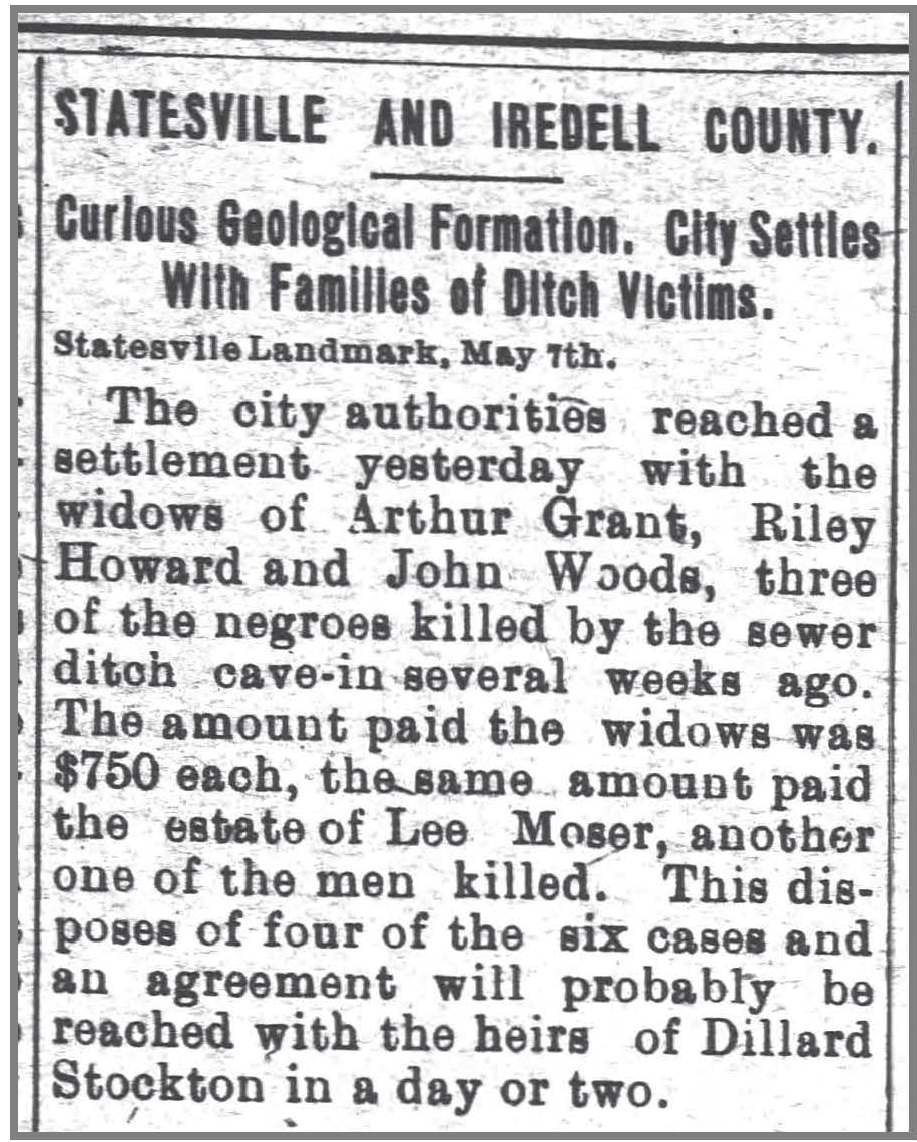
For all the breathless detail of the initial report of the tragedy, greater Statesville soon moved on. As reported in the local paper, within two months, the city had settled four of the deaths with payments of $750 (roughly $19,000 today) and were close to settling with the remaining survivors, including Ida May Colvert.

Carolina_Watchman_5_15_1907_Dillard_stockton_sett

Dillard Stockton is buried in Statesville’s Green Street/Union Grove cemetery. I snagged this photo from findagrave.com. I don’t recall seeing it during my recent visit and don’t know if it’s near the Colvert graves.

91759891_133944306122

A horrifying post script:

W_S_Union_Republican_5_12_1907_Harry_Stockton__039_s_death

Winston-Salem Union Republican, 12 May 1912.

Standard
Agriculture, Business, North Carolina, Paternal Kin

“They call me Tom Pig.”

The eighth in an occasional series excerpting testimony from the transcript of the trial in J.F. Coley v. Tom Artis, Wayne County Superior Court, November 1908.

Defendant introduces TOM ARTIS, who being duly sworn, testifies:

My name is Tom Artis. They call me Tom Pig. I own some land, 30 acres. (Plaintiff objects.) I have been living on the 30 acre tract of land 25 years, except one year. I mortgaged this land to Mr. Exum. (Plaintiff objects.) I don’t know about how long it was. About 25 or 30 years. (Plaintiff objects.) I don’t know what became of that mortgage. I got Hagans to take it up. (Plaintiff objects.) I don’t know who was present when I got Hagans to take it up. When Hagans agreed to take it up, Mrs. Exum, Hagans and myself were present. I own the 30 acre tract and lived on the the tract adjoining. After Hagans took up the papers, he told me that I could build on that place, or on the 24 acre piece. He said he thought it best for me to build on mine, he might die sometime, and there might be some trouble about me holding the house. I did so. He furnished the lumber, and I did the work. I decided to build on his side. After I built there I had been paying the 800 lb. of lint cotton year in and year out. (Plaintiff objects to each and every statement of the foregoing evidence.) The 800 lb. of cotton was to keep up the taxes and the interest of the money. (Plaintiff objects.) I have been paying this 800 lb. of cotton all the time. (Plaintiff objects.) I left that place one year. I left because my house got in such a bad fix, and I couldn’t stay there, and run my business like I wanted to, and I went over to Mr. Jones’. I rented the land. I rented it to Simon Exum. He gave me 950 lb. for the 30 acre place. I rented the Calv Place and the Adam Artis place. I moved back after one year at Mr. Jones’ place. I built on the Hagans place. Since then I built the piaza and shed room, to my own expense. Borrowed money from Hagans. I paid him back. He didn’t pay for the repairing of it. He furnished some shingles. Got 1/4 covered. I never asked W.S. Hagans to sell the 30 acre tract of land. I never said to Hagans in the presence of Reid or anybody else that I wanted im to sell it. I never asked anybody to buy the 30 acre tract of Hagans. Not the 30 acre tract. I had a conversation with Mr. Coley with reference to buying that land. I was talking about the Calv place. My land wasn’t brought in. The Calv place is the place I rented and lived on. That’s the land I spoke to Mr. Coley about buying from Hagans. He said if Mr. Cook and Hagans didn’t trade to send him a note. I told Hagans, he said tell him Coley, if his hands were not tied. I remember going over to Mr. Coley’s mill with Hagans. I didn’t hear any conversation bwteen Hagans and Coley with reference to buying this tract of land. They were off from me. I didn’t know what they were talking about. I heard them say when they came back to the buggy, Hagans said that he would see him again shortly. I don’t know if he said what day. Next I heard after that was that Hagans had sold it all to Mr. Coley, mine and all. I never rented the 30 acre tract of land. I know Jno. Rountree. I never asked him to go to Will Hagans and ask him to give me an opportunity of buying the 30 acre piece of land. I never said to Will Hgans, Jno. Rountree or Henry Reid, or anybody that I wanted Hagans to give me the opportunity of seeing my boys in Norfolk, so I could buy the 30 acrea piece. I asked Hagans what he would take for the acre back of my huose, of the Calv place. I told him I would buy that. His answer was, “Can you find a buyer for the other part of the Calv place.” I told him I didn’t know. He walked about his buggy house door. He said, “Uncle Tom” I can’t take what that mortgage calls for for your land, land is so much more valuable now than it was when yours was given. It passed off at that. Next I heard he had sold it to Coley.

To be continued.

——

N.B. Calvin “Calv Pig” Artis was Tom Pig Artis’ brother. He sold the Calv Pig place to Napoleon Hagans in 1879. (Tom and Calvin apparently derived their nicknames from their father Simon Pig Artis, who had been an enslaved man.)

Standard
Births Deaths Marriages, North Carolina

In memoriam: William S. Powell.

Renowned North Carolina historian William S. Powell died last week. He was 95.

I came into my deep interest in history late in my undergraduate career, and I never took a class in the history department at the University of North Carolina. I did have an encounter with Dr. Powell, though.

I had just encountered Walker Colvert on microfilm for the first time. The 1900 federal census of Iredell County, North Carolina, listed the 74 year-old former slave as Virginia-born, and I wondered how I might ever determine where he might have come from. Afloat in naivete, I called Dr. Powell’s office and asked for an appointment. I wanted to understand migration patterns into North Carolina’s western Piedmont, and I thought “who better to ask?” Dr. Powell was welcoming and patient and betrayed no sign that he did not entertain curious English majors everyday. I came away from my brief visit with a strong suggested-reading list and even a personal tip that he knew of Colverts from the Staunton, Virginia, area. Three years later, I was enrolled in the graduate program in American History at Columbia University.

Standard
Births Deaths Marriages, Free People of Color, North Carolina, Paternal Kin

The case for Vicey, Sylvania and Daniel Artis as siblings.

I thought I’d posted this earlier, but apparently not. Here is my case for Vicey Artis Williams, Sylvania Artis Lane and Daniel Artis as siblings.

  • Vicey Artis was born circa 1810; Sylvania Artis, circa 1820; and Daniel Artis, circa 1820.
  • None were listed in census records prior to 1850.
  • In the 1850 census, Vicey and her younger children were listed in a household between Silas Bryant and John Lane in Bull Head, Greene County.
  • In 1850, Sylvania and her younger children were listed in a household on the other side of John Lane in Bull Head.
  • In 1850, Daniel was not listed.
  • In 1853, Daniel Artis bought 125 acres of land from Silas Bryant adjacent to Bryant and John Lane.
  • In 1860, Vicey and Sylvania were listed next door to one another in Davis district, Wayne County. Six of Sylvania’s children were listed in the household of John Lane in Bull Head, Greene County, less than five miles away.
  • In 1860, Daniel was listed in the household of John Lane in Bull Head.
  • On 28 August 1866, Vicey Artis and Solomon Williams, Sylvania Artis and Guy Lane, and Daniel Artis and Eliza Faircloth registered their cohabitations before justice of the peace Henry J. Sauls, probably near present-day Eureka (then Sauls Crossroads.)
  • Vicey’s children include a daughter Jane.
  • Sylvania’s children include Jane, Daniel, and Mariah.
  • Daniel’s children include a daughter Mariah.
  • Sylvania’s oldest son Morrison Artis, born about 1837, married Vicey’s daughter Jane Artis, born about 1833, on 27 November 1862. Their children included a son Daniel.
Standard
Births Deaths Marriages, Maternal Kin, North Carolina, Other Documents

Elvira.

I knew Rebecca Colvert was my great-great-grandfather John W. Colvert‘s stepmother. Until now, though, I’d seen his mother Elvira Gray‘s name listed only on his death certificate.

On 30 January 1905, six days before his father Walker‘s death, John married Adeline Hampton, mother of his four daughters. I’d seen the marriage register entry for their union, but not the actual license. Here it is, and there is the second reference to Walker’s first wife.

42091_334850-01229

Standard
Births Deaths Marriages, North Carolina, Other Documents, Paternal Kin

28 August 1866.

I’ve seen these cohabitation registrations many times, but I just noticed today that Vicey Artis, Sylvania Artis and Daniel Artis, whom I believe to be siblings, and their spouses all registered their marriages on the same day before the same justice of the peace, Henry J. Sauls.

williams cohab

lane cohab

dartis cohab

Did the six travel to Sauls’ home together, walking or, perhaps, in a wagon? August 28 was a Tuesday during the relative lull before fall harvesting began. Did the families celebrate?

Standard
Births Deaths Marriages, Maternal Kin, North Carolina, Other Documents

Uncle John’s first wife?

I am clearly getting my whole life in these marriage records, but I have to wonder. What in the world have I been doing? Why have I missed so many of these records? Have I just assumed that what was on the shelf or on-line was all that was available? Fie.

Here’s another.

42091_334849-01098

Lots about this license says it relates to a previously unknown first marriage for my grandmother’s uncle, John McNeely. First, the parents are named correctly, and they were the only Henry and Martha McNeely in Iredell County at the time. Second, the church is right, as the McNeelys were Presbyterians. (Except when they were being Episcopalians.) Third, that middle name, Alexander — the first I’ve heard of one for John! — is a family name, borne first by Alexander “Sandy” McNeely, son of Henry McNeely’s sister Alice. In fact, the only thing that throws me is John’s age. Uncle John was 27 in 1899, not 21. That’s a curious error, but not critical enough to trump the other details. I’ll update my tree to include John’s middle name and his first wife.

McNEELY -- John McNeely young w cigarette

John A. McNeely as a young man. (I think. Even as I post this, something is worrying me about the timeframe of this photo….)

Standard
Births Deaths Marriages, Maternal Kin, North Carolina, Other Documents

William emerges.

As I discussed here, my great-great-grandmother Harriet Nicholson Tomlin Hart had two half-brothers named William. I discovered her mother’s son, William H. Nicholson, in the 1900 census. The newly widowed Harriet and her young son Golar — the only one of her Tomlin children to see the 20th century — were living in her brother’s household in Charlotte, Mecklenburg County, North Carolina. With this information, I found William’s 1909 death certificate. Harriet was the informant, and she listed his parents as Burwell Carson and Lucinda Nicholson. Other than a few city directory listings, this was the only documentation of William that I had until last night, when I found this:

42091_333002-01075

It’s hard to read, but it’s a Mecklenburg County marriage license for William H. Nicholson. On 3 April 1884, he married 38 year-old Lizzie King of Charlotte.

… William had a wife?

I went back to the 1900 census and examined it more closely. At 611 East Stonewall, William “Nickolson,” age 51, plasterer; Harriet Tomlin, 38, his sister; and Golda, 6, his niece. (Actually, his nephew.) Harriet was described as a widow, with only one child of ten living. (This is not quite right either, as her oldest child Lon was also alive, but 80% mortality versus 90% is meaningless.) William, in fact, is described as married, but there is no wife in the household. Where was Lizzie Nicholson?

I searched further. More city directories have been digitized since last I looked, and I quickly found several entries from the latter half of the first decade of the 1900s. Here’s one:

Screen Shot 2015-04-05 at 9.25.48 PMWalsh’s City Directory for Charlotte, North Carolina, 1907.

If there had been a rough patch around 1900, it was smoothed over within a few years. William’s 1909 death certificate describes him as married (though his sister came all the way from Statesville to provide information.) Lizzie died just a year later.

I went back further. I’d seen city directory listings for William Nicholson in Charlotte in 1890 and 1891, but last night I found a couple like this:

Screen Shot 2015-04-05 at 9.32.50 PMA Directory of the City of Charlotte, North Carolina for 1896 and 1897.

Same occupation, same address, same wife. This appears to be William using his middle name, Henry. I found others: in 1889, Henry Nicholson, brickmason, and Lizzie Nicholson, cook at the Central Hotel, living at 611 East Stonewall. In 1897, Henry H. Nicholson, laborer, and Lizzie Nicholson at the Stonewall address. The entry below: Nicholson & Allen (c) [for “colored”] (Lizzie Nicholson & Richard Allen), proprs Northern Rest, 220 East Trade.  In 1904: Henry Nicholson (Isabella), plasterer, 611 E Stonewall.

A Newspaper.com turned up nothing on William Henry, but there were several notices published in late 1910 and early 1911 regarding Lizzie Nicholson’s estate, and a delinquent property tax listing in 1894 that reveals that she was the owner of the Stonewall address. Levine Museum of the New South’s People of 1911 Charlotte project depicts the Sanborn drawing of this one-story house on an unpaved street and lists its owner at that time as Montgomery Caesar. The Second Ward street is no longer residential, and 611 is just a block from the NASCAR Hall of Fame. East Boundary Street, William and Lizzie’s other address, is gone. And 220 East Trade is now the Epicentre.

When Northern Restaurant was, though, a small but confident ad:

Charlotte_Observer_9_16_1896_Northern_Rest

Charlotte Observer, 16 September 1896.

Then, less charitably:

Charlotte_Observer_3_14_1897_Northern_Rest

Charlotte Observer, March , 1897.

Charlotte_Observer_10_8_1897_Northern_Rest

Charlotte Observer, 8 October 1897.

So, to update what I know about Harriet’s brother:

William Henry Nicholson was born between 1842 and 1848 to Lucinda Nicholson and Burwell Carson. His whereabouts in 1870 and 1880 are unknown. He was trained as a brickmason and plasterer and plied both trades in Charlotte. In 1884, he married Lizzie King (whose first name was possibly Isabella). It was at least her second marriage. (Her parents’ names on the license are nearly illegible, but they are not “King,” and she is referred to as Mrs. in the document.) Lizzie worked as a cook at a hotel, and then at her own establishment, Northern Restaurant, which she co-owned with Richard Allen. Perhaps before her marriage to William, Lizzie bought or inherited a house at 611 East Stonewall in Charlotte. For a brief period around 1900, William’s half-sister Harriet lived at the Stonewall house. By 1907, William and Lizzie had moved to 200 East Boundary, and each of them died in the house there. William died in December 1909, and Lizzie not quite two months later in February 1019.

Standard