Births Deaths Marriages, North Carolina, Paternal Kin, Photographs

52 Ancestors in 52 Weeks: 7. Love.

My parents celebrate 54 years of marriage in May, God willing. They have always been my model of deep and enduring love, and I have celebrated them here. For this week’s Ancestor Challenge, I’ve chosen to highlight a different kind of love.

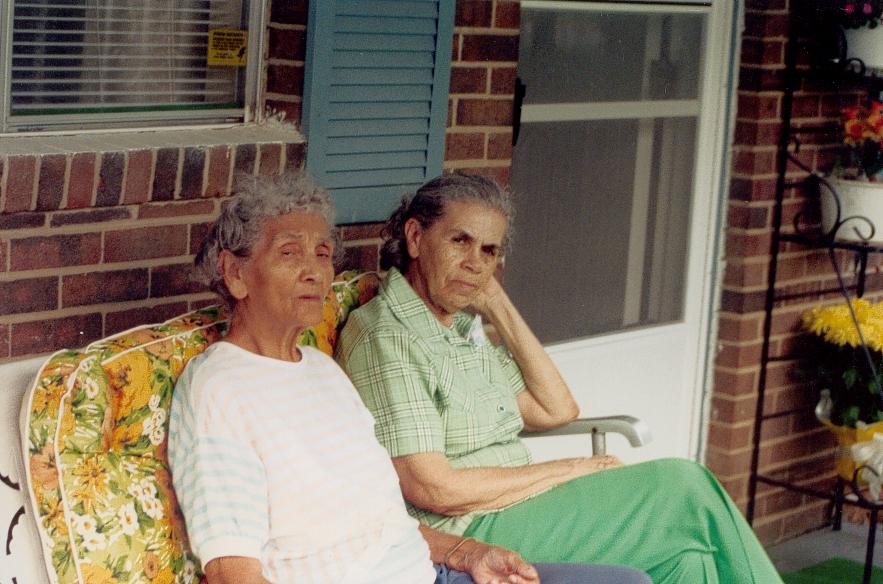
My grandmother, Hattie Mae Henderson Ricks, and her sister, Mamie Lee Henderson Holt, were born into difficult circumstances. Their mother Bessie Lee Henderson, teenaged and unmarried, had been orphaned as a toddler. When Bessie died months after Hattie’s birth, the family gathered to decide who would rear the girls. Mamie remained in Dudley with their aged great-grandparents, Lewis and Margaret Henderson, and Hattie went to Wilson to live with their grandmother’s sister, Sarah Henderson Jacobs. They were not reunited until Grandma Mag’s death, when Mamie was 8 and Hattie, 5. They separated again just 7 years later, when Mamie married a young man she met while visiting relatives in Greensboro. Nonetheless, despite the short time they lived together in childhood, my grandmother and her sister were devoted to one another. Their fierce sisterly bond defied the uncertainty of their earliest years and the emotional neglect of their years with Mama Sarah. It knit their children and grandchildren in a web that continues to hold. Even my grandmother’s move to Philadelphia in 1958 did not shake it. Every Christmas, she visited us and my aunt’s family in Wilson, then my father drove her to Greensboro to bring in the New Year with the Holts. Eventually, Alzheimer’s began to claim Aunt Mamie’s mind and memories, and travel became too difficult for my grandmother, but her attachment did not waver. Only when Aunt Mamie passed did my grandmother begin to let go. Nine months later, almost to the day, she was gone.

After my grandmother passed in 2001, I found a note she wrote about her early life: Heart Broken Mother – Bessie Died age Nineteen Leaving two out of wedlock Girls arounds 3 years and 8 months old. … My sister and I always felt very close to each other as we had no real parents It had been a hard life for both of us

This is the love I celebrate in this week’s challenge. The first love that comes with family. The love that, if we are fortunate, endures the entire arc of life.

Mamie&hattie 001

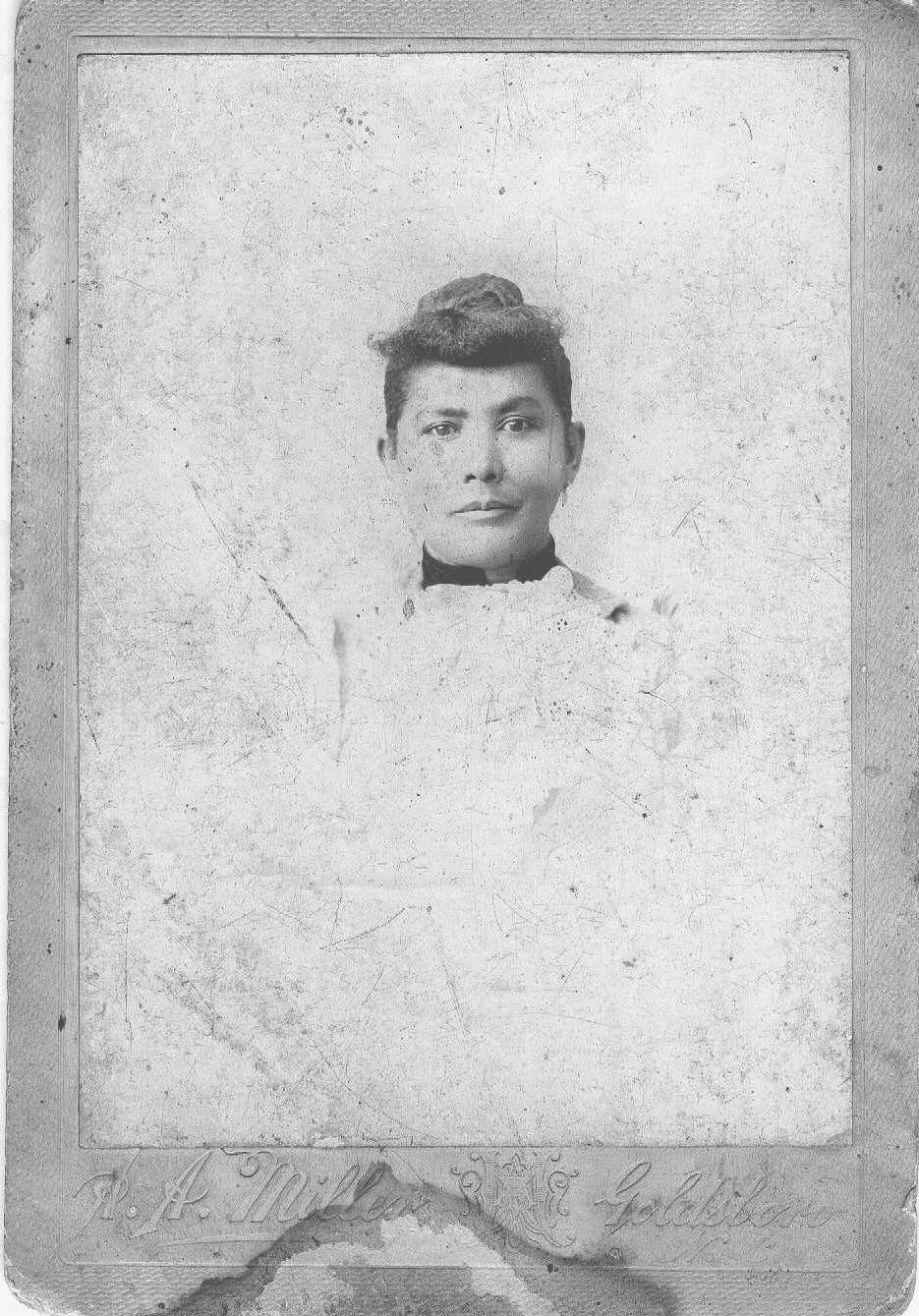
Mamie and Hattie Mae Henderson, circa 1920.

Mamie&Margaret 002

The sisters, probably in Greensboro, 1940s.
Willow Road

The sisters on Aunt Mamie’s porch in Greensboro, probably late 1980s.
Standard
Land, Maternal Kin, North Carolina

Roadtrip chronicles, no. 3: Eagle Mills ramble.

Monday afternoon came the highlight of the whole little road trip. I’d arranged to meet P.P. at a little cafeteria at the crossroads that is Harmony, North Carolina. I first spoke with her a little over a month ago, when she responded to my blog post about Walker Colvert’s will. P. is a distant cousin, another descendant of Thomas and Rebecca Nicholson Nicholson, and I was giddy with anticipation.

After lunch, at her direction, I headed north on Highway 21 toward Houstonsville. The sky was overcast, and a little drizzle had begun that would deepen into steady rain before long. I was undeterred. Over the next few hours, we traced the back roads of Eagle Mills and Union Grove townships, rolling through fallow fields, pastures, and woodlands, crossing and recrossing Hunting Creek and its tributaries. This was Colvert and Nicholson ground zero, and the highlights of our ramble warrant their own blogposts, soon to come.

My everlasting gratitude goes to Cousin P.P. for her generosity of time and knowledge.

Standard
Land, Maternal Kin, North Carolina, Other Documents

Roadtrip chronicles, no. 2: Iredell County records.

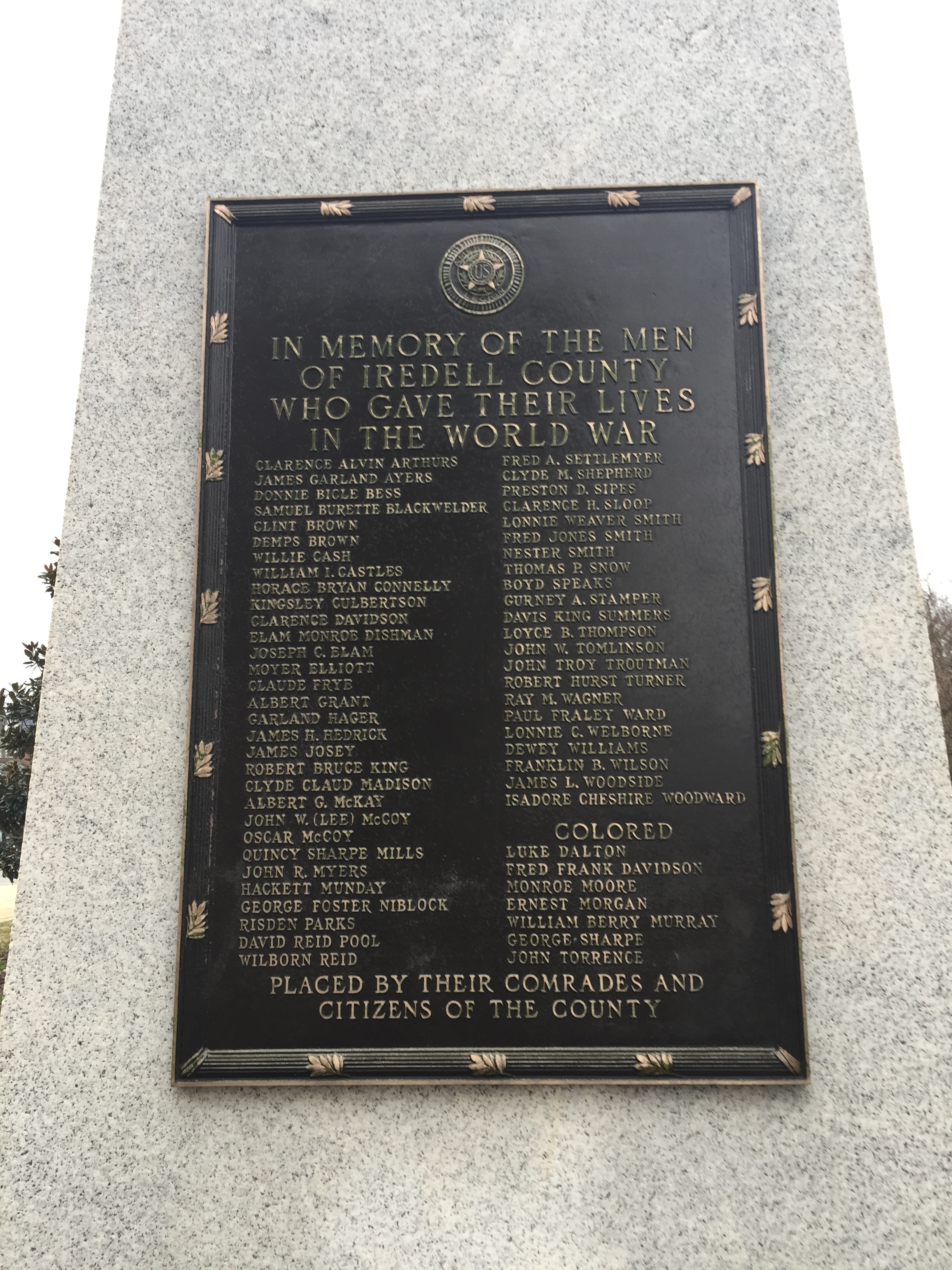
I was killing time in a way, but I wanted to do so usefully, so I arrived at the Register of Deeds office shortly after it opened at 8 A.M. I side-eyed this —

IMG_5993

— and headed into the search room. I had a few loose questions: did Walker Colvert in fact never file a deed for his acres in Union Grove? Did John W. Colvert file any deeds? Where did Abner and Harriet Nicholson Tomlin live?

I took these notes:

  • Who were the William and Lucy A. Dalton from whom Lon W. Colvert purchased his first property in 1906? What was their relationship, if any, with his first wife Josephine Dalton?
  • No recorded deeds for Walker Colvert.
  • No recorded deeds for John W. Colvert.
  • However, John’s wife Adeline Colvert bought two lots on Harrison Street in Statesville in 1912 for $472. Huh? John and Adeline married in 1905. As far as I know, they remained married until his death in 1921. So why was she purchasing property in her own right in 1912? The house built on the property sheltered John and Addie’s descendants as late as 1959, and probably later. There’s a plat filed at Book 33, page 398, for the section of Statesville in which the lots lay. I forgot to get a copy.
  • Abb Tomlin had one recorded deed — for the $40 purchase of an acre of land from William and Laura Pearson on 19 June 1891. The tract adjoined the AT&O Railroad and is probably the same one that Abb and Harriet Nicholson Tomlin‘s son and heir Harvey Golar Tomlin sold to Lon W. Colvert in 1906.
  • My grandmother believed T. Alonzo “T.L.” Hart to be a real estate lawyer. I haven’t found any evidence that he attended law school or practiced law, but there is no question that he knew his way around a land acquisition. Between 1887 and 1922, he recorded 14 deeds for purchases in or near Statesville totaling well over 200 acres. Three small purchases in 1911 and 1920 were from Andy King (1839-1919) and his heirs. King was a farmer and rock quarry laborer whose near neighbors were Logan and Laura Sherrill.
Standard
Births Deaths Marriages, Maternal Kin, Newspaper Articles, North Carolina, Photographs

Roadtrip Chronicles, no. 1: Statesville cemeteries.

I made it to Statesville in good time Sunday and drove straight to the only place I really know there — South Green Street. My great-aunt, Louise Colvert Renwick, had lived there for decades, across from the street from the Green Street cemetery. As I approached her house, my eye caught a small memorial just off the curb.

IMG_5958

Funny what you see when you’re looking. (And look closely at the plaque. Committee member Natalie Renwick is my first cousin, once removed.)

It seems odd to me that, when we were all gathered at Aunt Louise’s for the first Colvert-McNeely reunion, no one mentioned that Colverts and McNeelys were buried across the street. (Or maybe my 14 year-old self just paid no attention?) I’ve only found three graves — those of John Colvert, his wife Addie Hampton Colvert, and their daughter Selma — but there are certainly many more. Lon W. Colvert, for one. (Or was it? His death certificate indicates “Union Grove,” but why would he have been buried up there?*) And his son John W. Colvert II. And Addie McNeely Smith and Elethea McNeely Weaver and Irving McNeely Weaver, who was brought home from New Jersey for burial.

The cemetery looks like this though:

IMG_5971

And not because it’s empty. Though closed to burials for 50 or more years, it is probably nearly full of graves either unmarked or with lost or destroyed markers. Here’s one that’s nicely marked, however, and that would I recall before 24 hours had passed:

IMG_5972

From Green Street, I headed across town to Belmont, Statesville’s newer black cemetery. I knew Aunt Louise, her husband and son Lewis C. Renwick Sr. and Jr. were buried in Belmont, and I was looking for several McNeelys whose death certificates noted their burials here. I found Ida Mae Colvert Stockton‘s daughter Lillie Stockton Ramseur (1911-1980) and her husband Samuel S. Ramseur (1912-1989). Then Golar Colvert Bradshaw‘s husband William Bradshaw (1894-1955) and son William Colvert Bradshaw (1921-1988). (William was buried with his second wife. Golar, who died in 1937, presumably was interred at Green Street.) No McNeelys though. I expected to find both Lizzie McNeely Long and Edward McNeely, who had a double funeral in 1950, but their graves seem to be unmarked.

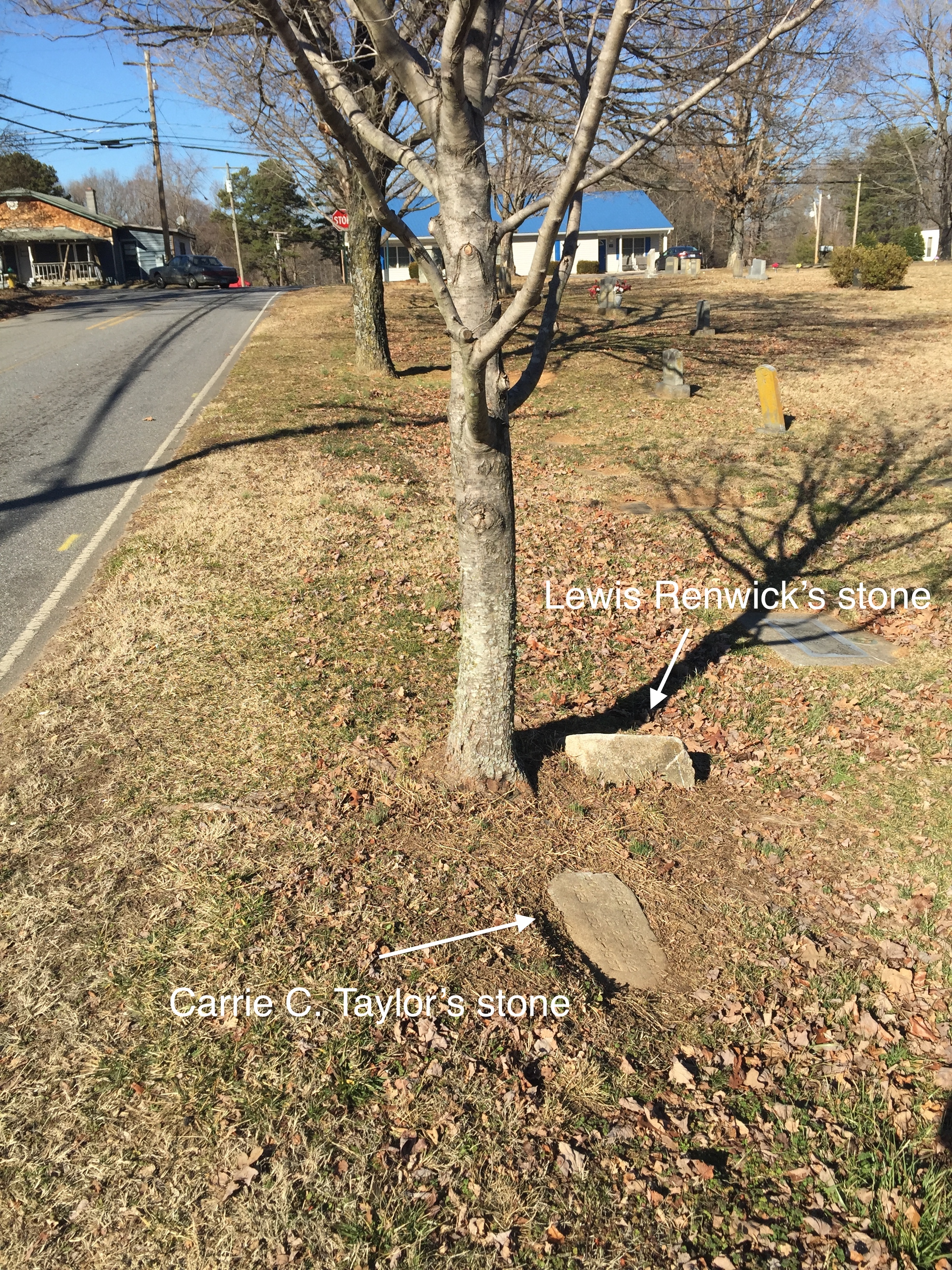
I was also looking for my great-grandmother, Carrie McNeely Colvert Taylor. The whole business was turning into a big disappointment. At street’s edge, I turned to head back to my car. And gasped. There, at my feet, wedged at the base of a tree:

IMG_5988

What in the world? This is clearly not a gravesite. And, on the other side of the tree, there’s an identical stamped concrete marker for Lewis C. Renwick Sr., who died almost exactly a year after Carrie. What’s odd, though, is that he has a granite marker a couple hundred feet away in another section of the cemetery with his wife (Carrie’s daughter Louise) and oldest son. Is Grandma Carrie actually buried in the Renwicks’ family plot? Were her and Lewis Renwick’s makeshift stones pulled up to be replaced by better markers? If so, where is Grandma Carrie’s? And why were both dumped at the edge of the cemetery?

IMG_5992

Here’s an overview of Belmont cemetery. (1) is the approximate location of Carrie M.C. Taylor’s broken marker. (2) is the approximate location of the Renwick plot.

IMG_6168

I’ll pose those questions to Statesville’s cemetery department. If Grandma Carrie has no permanent stone, she’ll get one.

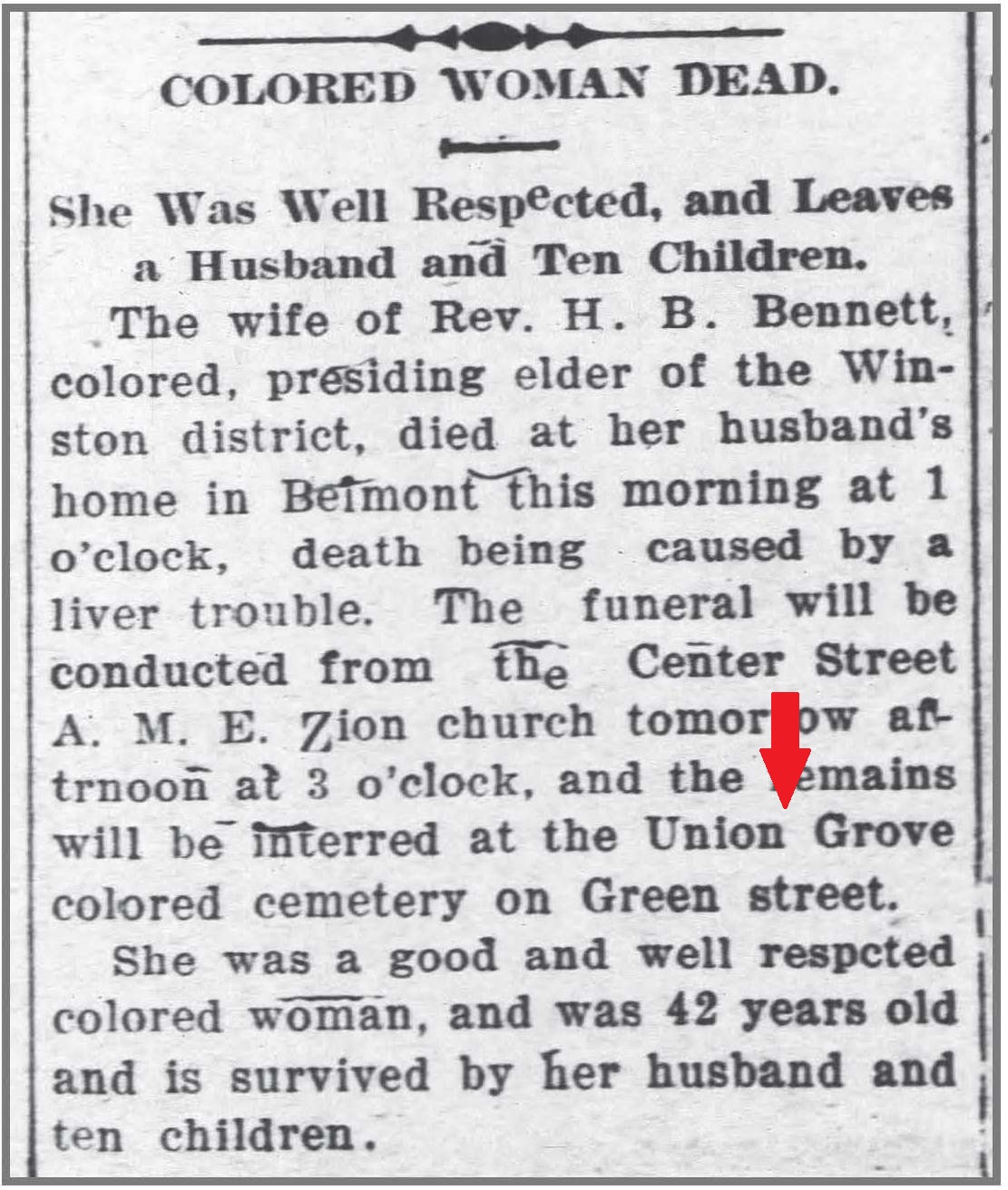
* After noticing that Irving Weaver’s obit also mentioned Union Grove cemetery, though the McNeelys had no ties to that township in northern Iredell County, I searched for clues in contemporary newspapers. Mystery cleared. Green Street cemetery is Union Grove cemetery:

Stville_Evening_Mascot_4_3_1909

The Evening Mascot (Statesville), 3 April 1909.

Standard
Agriculture, Land, Newspaper Articles, North Carolina

An educated colored man comments.

clipping_1703338

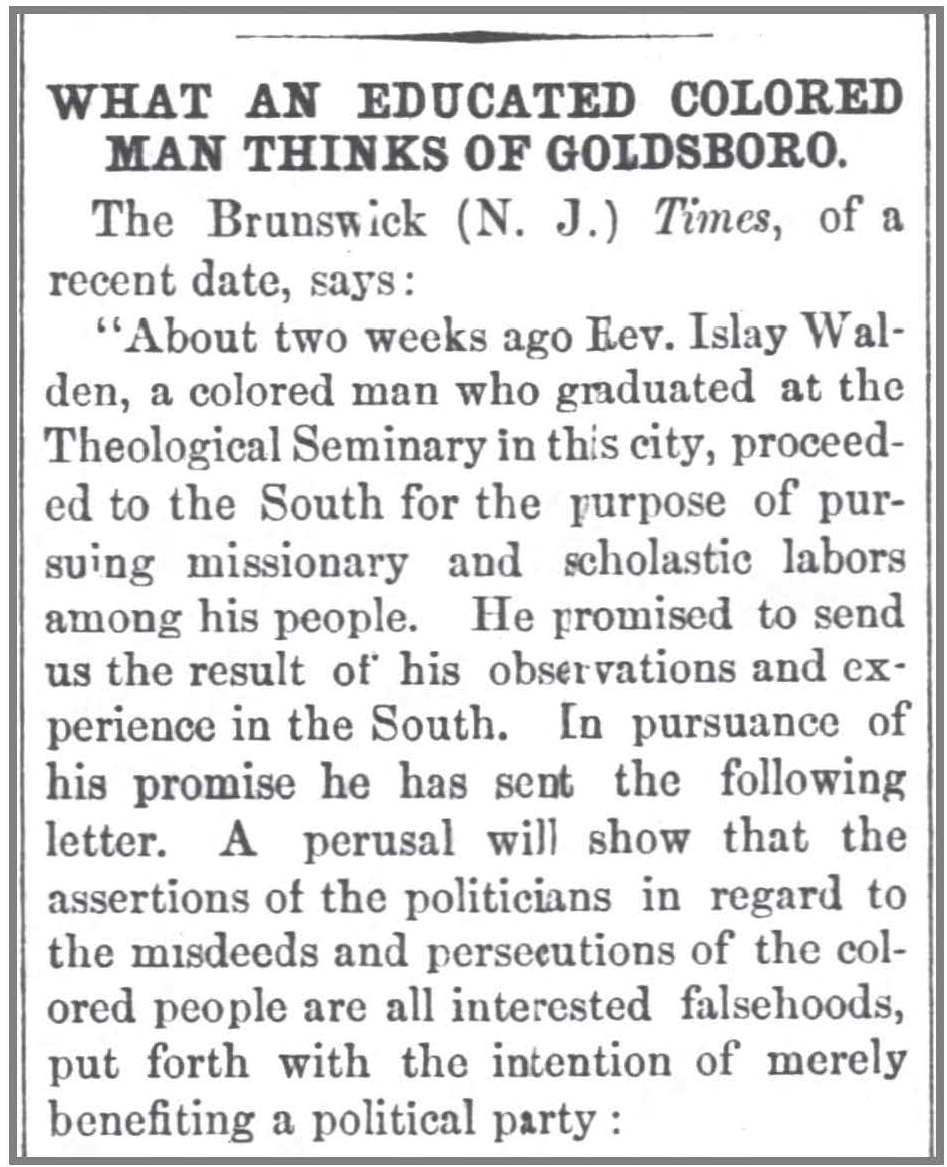
After a few observations about colored dockworkers in Norfolk and the spirit of brotherly love that enveloped black and white railroad workers, Alfred Islay Walden arrived in Wayne County. At Mount Olive, he asserted confidently that “nearly all the families own their homes and farms” and marveled at the reported wealth of “some men.” The former is not true, but the latter could have been a reference to the members of the Simmons and Wynn families, whose relative wealth dated back to their status as free skilled craftsmen and landowners in the antebellum era.

The week in Dudley is particularly interesting, as all of my paternal grandmother’s Henderson and Aldridge ancestors and relatives lived in this community in 1879, when Walden was perambulating. The “excellent school carried on by the American Missionary Society” was probably the school conducted at First Congregational Church, which my forebears founded and attended. The many who taught first and second grades in public schools included my great-great-grandfather John W. Aldridge and his brothers Matthew W. and George W. Aldridge. I’m not sure who owned the saw and shingle mills, but the landowners included the Aldridge brothers and their father Robert Aldridge, Lewis Henderson and his father James Henderson, Hillary B. Simmons’ father George W. Simmons, and other extended kin.

Gboro_Messenger_28_Aug_1879_Islay_Walden_letter

Goldsboro Messenger, 28 August 1879.

Standard
Enslaved People, Maternal Kin, North Carolina, Paternal Kin, Photographs, Virginia

Freedom’s faces.

Yesterday was the 150th anniversary of Congress’ passage of the Thirteenth Amendment, which abolished slavery in the United States. On Facebook, several friends posted links to sites featuring “never-before-seen” photographs of formerly enslaved Americans, most taken in the 1930s. As I clicked through these images, struck by the strength and endurance embodied, I had a sudden thought — I’ve got a few photos of former slaves, too. And they’re my own people.

——

McNEELY -- Martha M McNeely in blue dress

Martha Margaret Miller McNeely. Born about 1855 in Rowan County, North Carolina, to Margaret McConnaughey and Edward Miller. Enslaved by John M. McConnaughey. My matrilineal great-great-grandmother.

 NICHOLSON -- Harriet Nicholson 2

Harriet Nicholson Tomlin Hart. Born in 1861 in Iredell County, North Carolina, to Lucinda Cowles and James Lee Nicholson. Enslaved by Thomas A. Nicholson, her grandfather. My maternal great-great-grandmother.

Mary Brown Allen

Mary Brown Allen. Born about 1849 in Amelia County, Virginia, to Catherine Booker and James Brown. Owner unknown. Maternal great-great-grandmother.

Aspilla Ward Hagans

Apsilla “Appie” Ward Hagans. Born 1849 in Greene County, North Carolina, to Sarah Ward and Dr. David G.W. Ward, her owner. Wife of my great-great-great-great-uncle Napoleon Hagans.

Mittie_Ward

Mittie Ward Vaughn. Born 1849 in Greene County, North Carolina, to Sarah Ward and Dr. David G.W. Ward, her owner. Twin of Appie, above. Mother of son of my great-great-great-great uncle Napoleon Hagans.

——

In tribute to these and countless others, known and unknown, who walked through this country’s darkest days.

Standard
Births Deaths Marriages, Land, Newspaper Articles, North Carolina

Dr. Ward’s empire.

Wilson_Advance__8_22_1889_DGW_Ward_estate_land_sale

Wilson Advance, 22 August 1889.

The Civil War set Dr. David G.W. Ward back, but not for long. When he died in 1887, he stood possessed of more than 1900 acres in Wilson and Greene Counties.

[As an aside, Ward’s administrator, Frederick A. Woodard, was elected Democratic Congressman to the U.S. House of Representatives in 1892. He lost his bid for re-election to George H. White, a visionary African-American who was the last black Southerner elected to Congress until the post-Civil Rights era. I attended a middle school named for Woodard.]

[As another aside — literally — I think it’s safe to say that Sarah Ward’s children received nothing from the doctor’s estate.]

Standard
Enslaved People, Maternal Kin, North Carolina, Other Documents

Rules for patty rollers.

By an act of Assembly, passed in the year 1802, the County Court have power to establish Rules and Regulations for the government of the Patrollers in their respective counties;

In pursuance of the power thus granted, the County Court of Rowan, at August session, 1825, made and established the following regulations for the government of Patrols, to wit:

1st. Patrols shall be appointed, at least four in each Captain’s district.

2d. It shall be their duty, for two of their number, at least, to patrol their respective districts once in every week; in failure thereof, they shall be subject to the penalties prescribed by law.

3d. They shall have power to inflict corporal punishment, if two be present agreeing thereto.

4th. One patroller shall have power to seize any negro slave who behaves insolently to a patroller, or otherwise unlawfully or suspiciously; and hold such slave in custody until he can bring together a requisite number of Patrollers to act in the business.

5th. Previous to entering on their duties, Patrols shall call on some acting magistrate, and take the following oath, to wit:

“I, A. B. appointed one of the Patrol by the County Court of Rowan, for Captain B’s company, do hereby swear, that I will faithfully execute the duties of a Patroller, to the best of my ability, according to law and the regulations of the County Court.

Signed, A. B.”    “Witness, C. D. J. P.”

Whereupon, the officiating magistrate shall make out and deliver to him, or them, the following certificate, to wit:

“I, C. D. one of the acting magistrates of Rowan County, do hereby certify, that A. B. came before me, on this the _______ day of ______ A. D. 182__ and was duly sworn faithfully to execute the duties of a Patroller for this County, in Captain B’s company, according to law and the regulations of the County Court in such case made and provided.

Signed,   ____________ C. D. J. P.”

And no Patroller, without this certificate, shall be allowed the privileges and compensation otherwise extended to them.

6th. If any Patroller, while in the discharge of his duty, shall get drunk, or behave in a riotous or disorderly manner, he shall forfeit and pay the sum of five dollars, to be recovered in the name of the chairman of the County Court. He is also, by law, subject to indictment.

7th. The Sheriff of the county shall have the acts of Assembly relating to Patrols, together with these regulations, printed; and, in future, furnish each set of Patrols with a copy of the same; and he shall be allowed for the cost of printing, in his settlement with the county Trustee.

— from Patrol Regulations for the County of Rowan; Printed by Order of the County Court, at August Term, Anno Domini 1825, http://docsouth.unc.edu/nc/rowan/rowan.html  

Standard
Agriculture, Foodways, North Carolina, Oral History

52 Ancestors in 52 Weeks: 5. Plowing through.

Week 5 of the 52 Ancestors Challenge asks bloggers to consider “plowing through.” I immediately thought of two very different recollections by my grandmothers of gardens their families’ tended in their childhood.

——

Me: Did you grow all your vegetables and stuff, or was there a store?

My mother’s mother: Child, Papa would, every spring of the year, Papa would start out with this great big garden. Everybody would be out there hoeing and carrying on and planting and doing. And he wouldn’t go back out there anymore, and in a few weeks, the weeds would have taken over. [Laughs.] Oh, we might have some things that grew quickly first. Now, we always had potatoes, white potatoes. He would plant white potatoes, and what else would he plant? Green peas. You know, like snow peas. And I can see now, the cabbage with the worms eating that up. [Laughs.] That was no good. And what else did he have out there? Tomatoes. He’d have tomatoes. That was just about all. There’d be just those things that’d come early in the spring. And we wouldn’t have anything later. And then we had somebody who came in and – we lived on about an acre. It was just about an acre of land. And he would have all this cornfield, cornfield and pole beans. Ohhh, I can see those beans and great big ears of corn. I don’t think Mama ever canned any corn or anything like that, but we would eat corn, and all the neighbors would eat corn from that cornfield. And this old gentleman that I told you that helped Papa…. What was that man’s name? I can’t think of it, but anyway, he was the one who cultivated the land and did the planting.

——

My father’s mother: Yeah, they said he could use it and grow a little cotton. Old Man Price was in a house over on one corner, and the school over here. And while he was working, plowing that garden where was on the side, Professor [Charles L.] Coon[, superintendent of Wilson city schools] let him have whatever he put in it. He would buy all the stuff to go in the ground, if he would just work it. The part there where was to the children’s playground. But they had it barred off, the children didn’t actually go over in that part. So he’d plant that, and then he’d [inaudible] me and Mamie had to get up two o’clock in the morning, go down there and pick up potatoes. Light night. It’d be so bright you could see ‘em. He’d plow it up, turn that ground over, and all them old potatoes down there, put ’em in baskets, and what we couldn’t see ‘fore it got real daylight, we had to go out there and pick ‘em up when it got day.

Interviews of Margaret C. Allen and Hattie H. Ricks by Lisa Y. Henderson, all rights reserved.


Standard
Births Deaths Marriages, Enslaved People, Maternal Kin, Newspaper Articles, North Carolina, Other Documents

Lewis Colvert, son or stepson?

Something’s been bothering me about Lewis “Lou” Colvert. My grandmother knew his son Aggie (pronounced “Adgie”) Colvert as her cousin, but just whose son was Lewis?

The first irregularity: as shown here, when Walker Colvert and Rebecca Parks registered their 13-year cohabitation in 1866, they did not list six year-old Lewis among their three children. Why not?

In the 1870 census of Union Grove, Iredell County, he’s there: Walker Colvert, wife Rebecca and Lewis Colvert, 10.  I haven’t found him in the 1880 census, but a year later, on 13 October 1881, he married Laura Sharpe in Statesville. References to him over the next 30+ years though are few.

On 11 October 1895, the Statesville Landmark printed a short piece about Lou suffering a head injury after being thrown from a wagon.

The census taker again missed Lewis for the 1900 census, but found his wife Laura Colbert, born 1851, and son Aggie, born 1888, living on Valley Street in Asheville, Buncombe County. Laura worked as a cook and described herself as a widow. And though he eluded the enumerator, Lewis was still in Statesville, as this snippet from a court calendar report demonstrates:

Carolina_Mascot_Sville_2_8_1900

Carolina Mascot (Statesville), 8 February 1900.

(Lon was his nephew, my great-grandfather.)

Walker Colvert died in 1905. His will, made in 1901, directed that all his land and personal property go first to his wife Rebecca and, after her death, to his son John Walker Colvert. No mention of Lewis.

In 1910, Lewis again sidestepped the census taker. Laura remained in Asheville. Though she lived until 1926, and I’ve found no evidence of a divorce, in April 1913, Lewis married Quiller Ward in Statesville. The marriage was short-lived. Lewis “Lou” Colvert died 27 March 1915 in Statesville. Lon W. Colvert provided the information for his death certificate — mother, Rebecca Colvert; father, unknown.

Lew Colvert Death Cert

Unknown. Not Walker Colvert. Neither here nor anywhere else is there a claim that Walker was Lewis’ father.

Here is my speculation: Walker Colvert was born at 1815. He married Rebecca Parks about 1853. At that time, he had a two year-old son, John Walker, whose mother was named Elvira Gray. (At nearly 40, however, Walker surely had children older than John. If so, their identities may never be known.) Rebecca was 24 years Walker’s junior and almost certainly belonged to a different master. She was about 16 when she gave birth to her first child with Walker, a daughter named Elvira, and daughter Lovina followed. Then, in 1861, she bore Lewis. As with every enslaved woman, Rebecca’s body was not her own. Perhaps she willingly conceived a child outside her relationship with Walker. Just as likely, that relationship was not uniformly recognized, and she submitted to someone else’s will. Walker reared the boy with his own children and gave him his surname, but did not claim him as a son.


Standard