Business, Newspaper Articles, North Carolina, Other Documents, Paternal Kin

The colored people of Wilson have organized a bank.

In December 1920, five of Wilson, North Carolina’s leading African-American citizens executed a certificate of incorporation to establish the Commercial Bank of Wilson. The bank was necessary, they asserted, “to promote thrift and economy,” “to encourage agriculture and industrial enterprises,” and “to place in circulation money otherwise unavailable.” Farmer, realtor and businessman Samuel H. Vick; barber William H. Hines; school principal J. James D. Reid; funeral home operator and businessman Camillus L. Darden and physician Frank S. Hargraves — the unquestioned cream of east Wilson‘s crop — each invested in 100 shares of bank stock and, after filing the document, set about designating a president (Hines) and board of directors (J.R. Rosser, Isaac A. Shade, Cain D. Sauls, Charles S. Thomas, R.A. Worlds, John Lucas, C.S. McBrayer, J.O. Mitchell, Lee Pierce, Alfred Robinson and Judge D. Reid), and a cashier (G.W.C. Brown).

Attached to the filing are three pages listing the names of all the bank’s investors and providing information about their net worth and occupation.  Most of more than 150 shareholders — overwhelmingly African-American men — lived in Wilson or Wilson County, but adjoining counties like Wayne, Greene and Johnston were represented, as well as more far-flung cities like Durham and Elizabeth City, North Carolina.  They were farmers and contractors, merchants and ministers, teachers and barbers, with estimated worths ranging from $300 to $50,000.

Image

Image

Image

At least two of my relatives were among the bank’s investors. C.D. Sauls of Greene County, whose connection through Daniel Artis I chronicled here, was a bank officer, and his cousin Columbus E. Artis, who owned and operated a funeral business in Wilson, bought five shares.

ImageHill’s Directory of Wilson, North Carolina, 1922.

Newspapers reported the bank’s opening excitedly.

Wilm Morning Star 11 18 1920

Wilmington (NC) Morning Star, 18 November 1920.

The Independent Eliz City 2 25 1921

Elizabeth City The Independent, 25 February 1921.

E City Independent 3 4 1921Elizabeth City The Independent, 4 March 1921.

In the 1921-1922 issue of The Negro Year Book: An Annual Encyclopedia of the Negro, Monroe N. Work, editor, Commercial Bank of Wilson was listed as one of only eight black banks in the state of North Carolina, which trailed only Virginia (13) and Georgia (9) in the number of such institutions. [Sidenote: one of Virginia’s was Crown Savings Bank of Newport News, for which my great-grandfather John C. Allen served as board member.]

Alas, things fell apart. After a fire in the vault destroyed records, the State launched a criminal investigation that resulted in the closing of the bank on 4 September 1929 and the indictments of vice-president (and chief promoter) J.D. Reid and cashier H.S. Stanbank on charges of embezzlement, forgery and deceptive banking practices. As reported in the 22 February 1930 issue of the Pittsburgh Courier, the courtroom was daily packed with victimized depositors and shareholders, all of whom bore an “intense feeling of resentment against the accused….” Both were convicted and sentenced to five-year prison terms — at hard labor — but released after two years.

burlington Daily Times-News 12 22 1931

Burlington Daily Times-News, 22 December 1931.

Standard
Births Deaths Marriages, North Carolina, Paternal Kin, Photographs, Religion

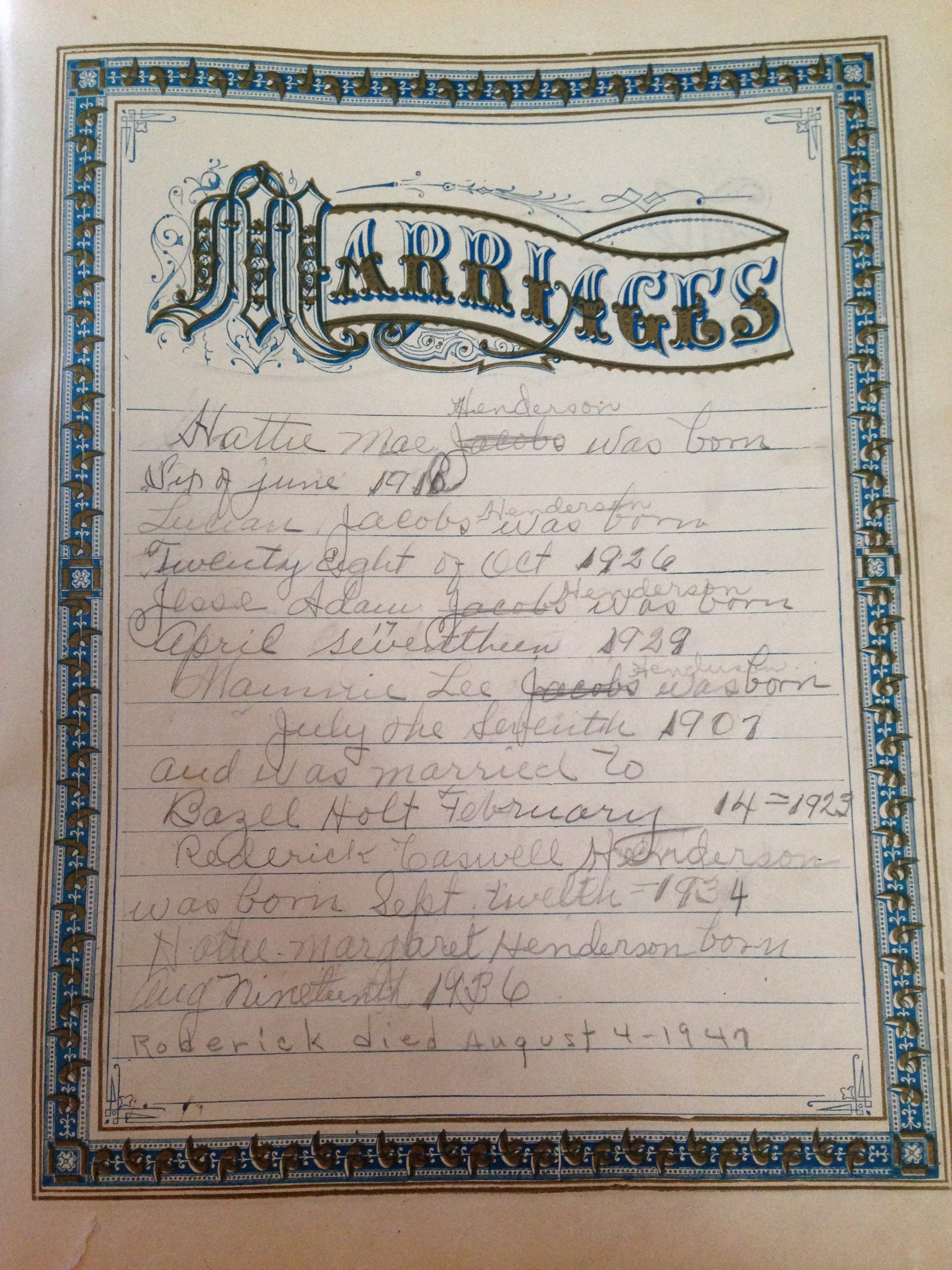
This Book was give to Sarah Jacobs.

Sarah Henderson Jacobs Silver left two Bibles. One, a gift from her second husband, Rev. Joseph Silver, had originally belonged to his first wife, Felicia Hawkins Silver. The other passed through several hands before arriving in mine.

There are three inscriptions inside the front cover. “This book was give to Sarah Jacobs from Ganny Caroline 1920 of Wilson NC” — that’s my grandmother’s handwriting. Then, faintly: “Present by Mrs Caroline Vick of Wilson N.C. present in May 18th year 1904.” Then: “Gladys OKelley book give to her by Charity Pitt keep as long as I live no one to take it a way from me year 1913 Dec 23.”

IMG_4928

Who are these folk?

Carolina Williamston Vick was born in Newton County, Georgia in 1844. How or why she came 425 miles north to settle in Wilson, North Carolina, may never be known, but a clue might lie in her maiden name. “Williamson” was a prominent southwest Wilson County family that included slaveholders. Did some migrate — or sell their slaves — South? In any case, Carolina was in Wilson by 1880 when she is listed in a household headed by 28 year-old Robert Vick. They are married and have three children, Alice, 18, Willie, 15, and Cora Vick, 3. (It appears that the older two were Robert’s step-children.) By 1900, Carolina was living in the 700 block of Green Street (around the corner from the Elba Street house) and spent the reminder of her life living with a rotating series of children, grandchildren, in-laws and lodgers and serving as a midwife to women in the community. “Granny Caroline” died in July 1925, when my grandmother was 15 years old.

carolina Vick

As for Gladys O’Kelly (or Gladys O. Kelly), the nine year-old that so vigorously assorted her ownership in 1913 — see below.

The Bible’s frontispiece introduces another owner:

IMG_4930

Unfortunately, her name is too common to begin to identify her.

As was custom in good quality Bibles of the era, the book’s text is halved by a shiny section of maps and illustrations and charts. My grandmother filled blank pages and the backs of leaves with the births and deaths and marriages of her family, her handwriting gradually shifting from a barely recognizable, youthful, curlicued version to the one I know so well.

IMG_4931

IMG_4932

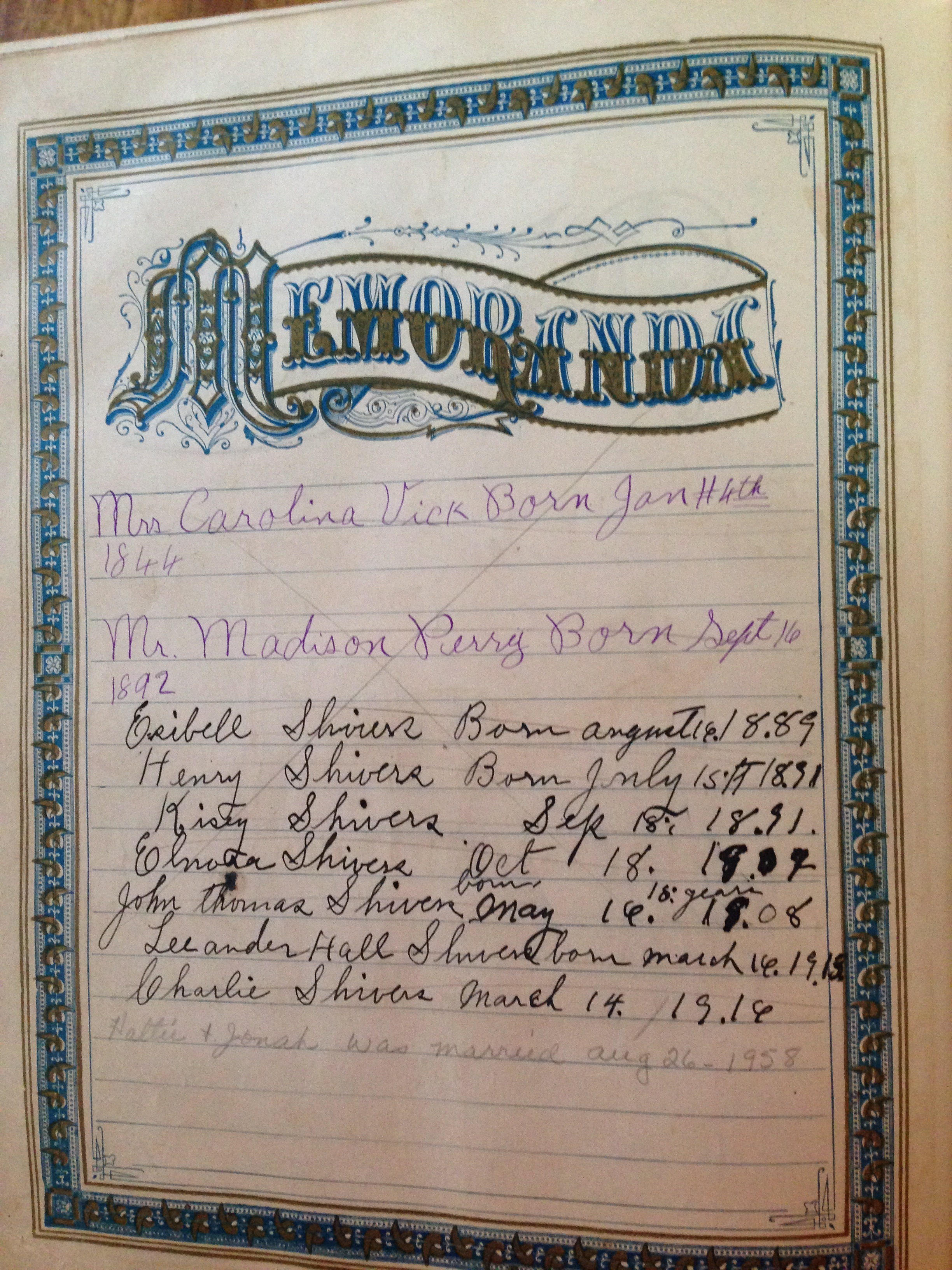
The “Births” page introduces another family. Or maybe families. Gladys O’Kelly is there, and there are two Carolina Vick entries.

IMG_4933

The others seem to be members of an extended family I found in the 1880 census of Hillsboro, Orange County, North Carolina: Yunk Strayhorn (45), his wife Patsey (36), son Isaac (18), son-in-law Louis Pitt (25) and daughter Charity Pitt (23), children Rose (24), Jane (17), Henry and Reuben (13), Sandy (23) and Clara (21), and grandchildren Richard (3), Adeline (12) and Margaret (9). (Lewis Pitt married Charity Strayhorn in Edgecombe County in 1872 and moved to Wilson.) Little Gladys O’Kelly? She seems to have been the daughter of Rose Strayhorn’s daughter Gatsey and her husband, Reubin O’Kelly, both of Orange County.

And then there are Madison Perry, son of Carolina Vick’s daughter Cora, who married Isham Perry, and the Shiverses:

IMG_4934

IMG_4935I’ve been unable to find all the Shiverses, and what I have found doesn’t align cleanly with the dates inscribed here (for example, John and Nicey Shivers, born about 1872 and 1880, are listed in the 1900 census with six-month-old daughter Kizzy), but this appears to be a family that lived in Greenville, Pitt County at the turn of the 20th century.

I don’t hope to be able to reconstruct how this Bible bounced all over eastern North Carolina like this before coming to rest with my family, which has had it nearly 100 years. I share it here in hopes that descendants of the other families who cherished it will find themselves in its pages.

Standard
Free People of Color, Land, North Carolina, Other Documents, Paternal Kin

100 acres on Watery Branch.

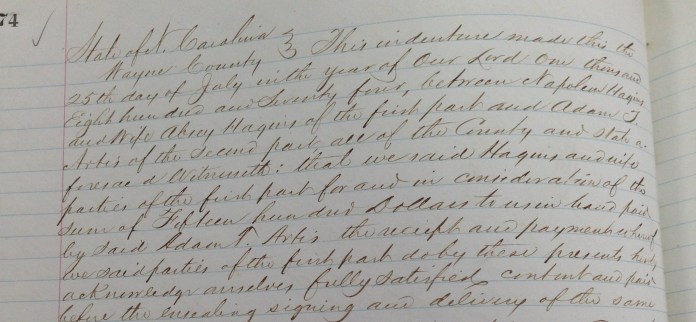
Fourteen years into their marriage, Adam and Frances Seaberry Artis purchased three tracts of land totaling about 109 acres from her half-brother, Napoleon Hagans. All three are on or near Watery Branch, an east-flowing tributary of Contentnea Creek. The first two documents are a mortgage deed and deed of sale for two tracts on the creek. The third is a deed of sale for an additional nine acres nearby. Notably, this last is land upon which Adam had lived in prior years, as it contained the graves of his first wife, Lucinda Jones Artis, and a child.

—–

North Carolina, Wayne County  }  This indenture made this the 25th day of July AD 1874, between Adam T. Artis and wife Frances of the first part, and Napoleon Hagans of the second part, and all of the County and State above written, Witnesseth that the said parties of the first part for and in consideration of the sum of one dollar in hand paid by the said party of the second part, have bargained and sold and by these presents do convey unto the said party of the second part, and his heirs two tracts or parcels situated in the County of Wayne, and bounded as follows: viz: the first tract begins at a pine on the New Road in Willie Moorings line and runs with his line North 136 poles to a stake on the main run of Watery Branch, then up and with the various courses of the branch to the mouth of a small branch, then up the various courses of said branch to a stake, then E 20 poles to said new road, then with the same to the beginning, containing Eighty eight acres, more or less: the other tract begins at a stake in Cullen West’s line, and runs South 28 ¼ poles to a stake in said line Charity Bailey’s corner, then with his line West 67 ¼ poles to a stake Wm Bailey’s corner, then with his line West, 67 ¼ poles to the beginning, containing twelve and one fourths acres more or less _

And the said parties of the first part do for themselves and their heirs forever warrant and defend title to the above land, to the said party of the second part his heirs and assigns

The condition of the above deed is such whereas the above named Adam T. Artis is indebted to the said Napoleon Hagins in the amount of Fifteen hundred dollars, purchase money for the land herein conveyed, and for which said sum the said Artis has given promissory notes for $375.00 each, and payable in the manner following viz: the first note will be due on the 1st day of January AD 1876: at the same day and date the interest on the whole amount of the purchase money ($1500.00) from Jany 1st 1875 to that date will be paid annually on the first day of January. The amount of principal paid thereon to be deducted; the second note will be due on January 1st 1877, the third on January 1st 1878; and the fourth on Jany 1st 1879, and all are subject to the conditions set forth as to the first note above mentioned.

Now if the said Artis shall pay the interest as above set forth as they come due according to their tenor, then this deed to be void otherwise to be of full force and effect.

And upon the failure of said Artis to pay said noted and interest as above set forth as they severally fall due, then it shall be in the power of said Hagins to sell the land herein described after twenty days advertisement at the Court House door in Goldsboro and four other places in Wayne County, and after deducting the whole amount due him & the expenses of sale shall pay the balance if any to the said Artis or his legal representatives.

In testimony whereof the said parties of the first part have hereunto set their hands and seals the day and date first above written.

Witness: /s/ W.T. Faircloth             Adam X Artis, Frances X Artis

[Wife’s consent omitted.]

Deed Book 37, page 72, Wayne County Register of Deeds office.

—–

State of N. Carolina, Wayne County  } This indenture made this the 25th day of July in the year of Our Lord One thousand Eight hundred and Seventy four, between Napoleon Hagins and wife Absey Hagins of the first part and Adam T. Artis of the second part, all of the County and State aforesaid Witnesseth: that we said Hagins and wife parties of the first part for and in consideration of the sum of Fifteen hundred Dollars to us in hand paid by said Adam T. Artis  the receipt and payment whereof we said parties of the first part do by these presents hereby acknowledge ourselves fully satisfied content and paid before the ensealing signing and delivery of the same have bargained sold delivered given up conveyed unto said Artis his heirs and assigns two certain pieces or parcels of land lying in said County of Wayne on the South side of Watery Branch, the first tract adjoining the lands of Wiley Moring Charity Bailey and others, bounded as follows:  Beginning at a pine on the New Road in Willie Moring’s line and runs with said line N. 136 poles to a stake on the main run of Watery Branch, then up the various courses of the run as it meanders to the mouth of a small branch, then up the run of said small branch its various courses to a stake, then East 20 poles to said New Road, then with the same to the beginning, containing Eighty eight acres, more or less:

Also one other tract purchased from Wm. Bailey and wife Celia, adjoining the lands of Charity Bailey Wm. Bailey Cullen West and others bounded as follows: Beginning at a stake in Cullen West’s line and runs South 28 ¼ poles to a stake in said line Charity Bailey’s corner, then with her line West 69 ½ poles to a stake in said West’s other line, then with said line  N 28 ¼ to a stake, Wm Bailey’s corner then with his line W 69 ½  poles to the beginning, containing 12 ¼  acres more or less _

And we said Hagans and wife Absey parties of the first part do by these presents bind ourselves our heirs executors admrs & assigns forever free claims or encumbrances whatsoever

In testimony whereof we the said Hagins and wife have hereunto set our hands and affixed our seals, the day and date first mentioned.

Witness: /s/ W.T. Faircloth             Napoleon X Hagans, Absey X Hagans

[Wife’s consent omitted.]

Deed Book 37, page 74, Wayne County Register of Deeds office.

—–

North Carolina, Wayne County  }

This Deed made this thirty first day of October 1874 by Adam Artis and his wife Frances of Wayne County, and State of North Carolina to Napoleon Hagans of Wayne County, and State of North Carolina, Witnesseth that said Adam Artis in consideration of Two hundred & seventy five /100 Dollars, to them paid by said Napoleon Hagans, the receipt of which is hereby acknowledged, have bargained and sold and by these presents do bargain, sell and convey to said Napoleon Hagans and his heirs a tract of land in Wayne County, State of N.C. , adjoining the lands Bryant Yelverton & Jesse Mincey, and others, bounded as follows: viz: — Beginning at a stake on road in Yelverton’s line and runs S. 59 E. 51 ½ poles to a light stake in Yelverton’s line then N. 61 poles to another stake on said road then S. 54 W. with said road to the beginning containing 9 ¼ acres more or less.

Reserving a graveyard on said land, now paled in in which the said Adam Artis’ first wife & one child were buried.

To have and to Hold the aforesaid tract of land and all privileges and appurtenances thereto belonging to the said Napoleon Hagans and his heirs and assigns to them only

And the said parties of the first part do for themselves and their heirs forever warrant and defend title to the above land, to the said party of the second part his heirs and assigns to their only use and behalf

And this the said Adam Artis & wife Frances, covenant that they are seized of said premises in fee and have right to convey the same in fee simple, that the same are free from all incumbrances, and that they will warrant and defend the said title to the same, against the claims of all persons whatsoever

In testimony whereof, the said Adam Artis & wife Frances have known to set their hands and seals, the day and year above written  Adam X Artis, Frances X Artis

[Wife’s consent omitted.]

Deed Book 37, page 220, Wayne County Register of Deeds office.
deed

Standard
Enslaved People, North Carolina, Paternal Kin, Photographs

Appie Ward Hagans.

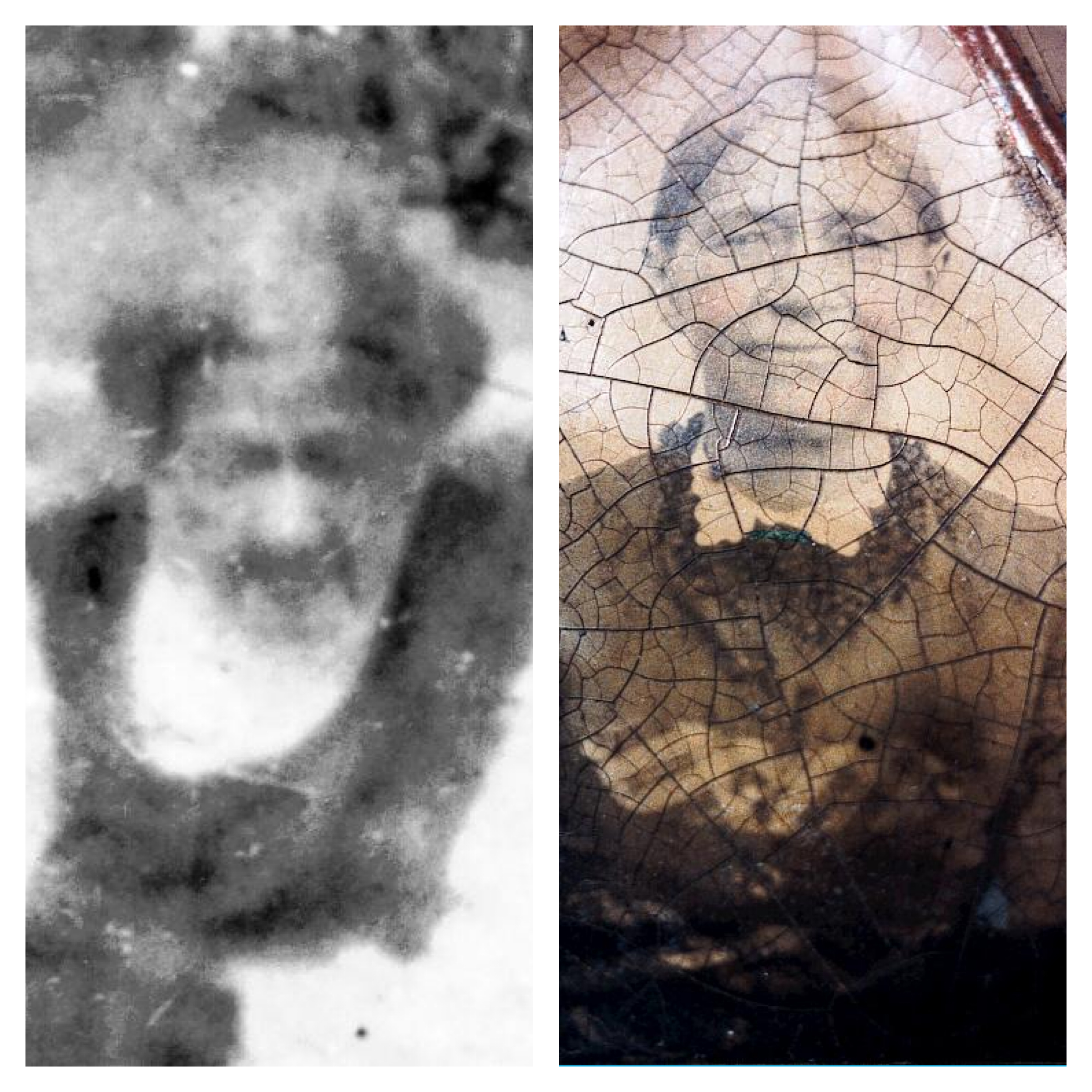
I’ve talked all around Apsilla (or, perhaps, Apsaline) “Appie” Ward Hagans here and here and here. So here she is:

Aspilla Ward Hagans

Appie and her twin Mittie Roena Ward were born 19 April 1849 near Stantonsburg, Wilson County, to David G.W. Ward and Sarah Ward, an enslaved woman. They likely spent their early years in and around this house. How and when Appie met her husband, Napoleon Hagans, who lived in northeast Wayne County perhaps 7 miles from the Ward plantation, is unknown. I have not located their marriage license. Appie and Napoleon had two sons, Henry Edward Hagans (1868-1926) and William Scarlett Hagans (1869-1946).

Appie left little trace in official records, appearing in two census enumerations and on a couple of deeds with her husband. She died 12 April 1895 and is buried near their home in northern Wayne County.

Photo courtesy of William E. Hagans.

Standard
DNA, North Carolina, Paternal Kin

DNAnigma, no. 15: Barnes?

Barnes is far and away the most common surname in Wilson County. It is the “Smith” of Wilson, so common that two Barneses who meet, without further reason, will not wonder if they are kin. It would not occur to them that they might be. My cousin has a Barnes maternal line, and a Barnes paternal line, and married a Barnes. None are connected. My Wilson County roots are neither wide nor deep, so I only have one Barnes line, and it’s a little iffy. Nonetheless, 23andme has matched my and my father’s chromosomes with W.B. and estimates that they are 3rd to 5th cousins, .58% share. (W.B. doesn’t match my cousin, despite her many Barnes lines.)

W.B.’s patrilineal line is traceable to John Barnes, born about 1860, probably in Wilson County. Shortly before 1880, John married Harriet Batts, daughter of Orange and Mary Batts. I have not found a death certificate for John, but census records indicate that he died before 1920. Is he the connection? If he is, the tie is in an earlier generation, as there is no John Barnes in my files.

W.B. also has an ancestor named Nancy Barnes Horne, daughter of Gray and Bunny Barnes and wife of Simon Horne Jr. Is she the connection? Is the connection a Barnes at all?

W.B. is a 3rd to 5th cousin to my father. I know all kinds of 3rd to 5th cousins. In real life. How can I have NO CLUE what our relationship is this one? 23andme and Ancestry DNA are wonderful tools that have been invaluable in confirming connections, but their deeper impact has been to drive home just how little I know.

Standard
Newspaper Articles, North Carolina, Paternal Kin

Cousin Mamie in the news.

As I’ve mentioned, for reasons unclear, my grandmother was close to her father’s first cousins, sisters Fannie Aldridge Randolph of Philadelphia, Pennsylvania, and Mamie Aldridge Abrams Rochelle of Union, South Carolina. Among my grandmother’s papers, I found cards and notes from Cousin Mamie, including this one sent in early 1980:

ALDRIDGE -- M Rochelle to H Ricks re Article

And here’s the article itself:

ALDRIDGE -- M Rochelle Article

Standard
Births Deaths Marriages, Maternal Kin, North Carolina

Family cemeteries, no. 10: Green Street.

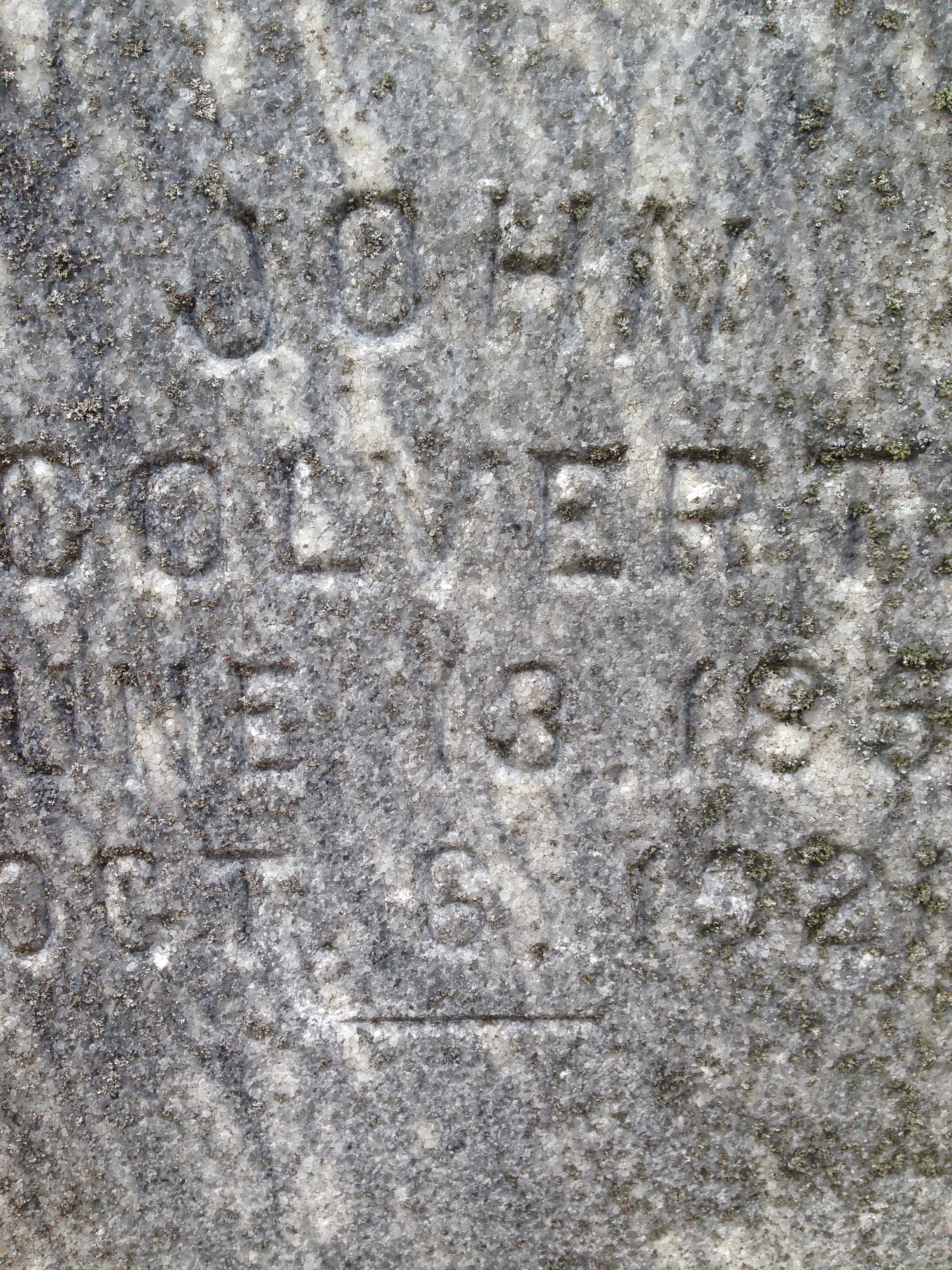
Green Street cemetery is a three-acre square smack in the middle of Statesville’s African-American southside. My great-aunt’s house faced the graveyard, but I don’t recall anyone ever talking about family members being buried there. Nonetheless, several years ago, I found three: my great-great-grandfather John W. Colvert, his wife Adaline Hampton Colvert (the double stone below) and their daughter Selma Eugenia Colvert, who is buried nearby. I suspect that others rest there, including John Colvert’s parents, his son Lon W. Colvert, Lon’s first wife Josephine Dalton Colvert, and his children Walker Colvert and Golar C. Bradshaw.

IMG_4585

IMG_4588

Standard
Enslaved People, Maternal Kin, North Carolina

McNeelys enumerated.

Perhaps he ticked them off on his fingers: “One female, aged 24 to 36. … One female, under ten years of age. … Three males, all under ten….” The enumerator for the 1840 federal census of Rowan County dutifully recorded the information that Samuel McNeely provided, inking in  small numerals in the appropriate column under “SLAVES.” The adult female was Lucinda. The female child was her daughter Alice, and two of the males were her sons John and Julius. It is likely that the third boy was also Lucinda’s, as Samuel was not likely to have purchased a small child and Alice was too young to bear children.

Samuel died in 1843 and, under the terms of his will, son John W. McNeely inherited slaves Lucinda and her offspring. In the 1850 slave schedule, John reported owning eight slaves: a 34 year-old black female [Lucinda]; a 19 year-old black female [Alice]; a 17 year-old black male [John]; a 14 year-old black male [the third boy above, name unknown]; a 12 year-old black male [Julius]; a 9 year-old mulatto male [Henry, Lucinda’s son by John W. McNeely]; a 2 year-old mulatto male [Joseph Archy, Alice’s son]; and a 1 year-old black female [probably Alice’s daughter Mary].

In 1860, John W. McNeely reported only seven slaves: a 44 year-old black female [Lucinda]; an 11 year-old black female [Mary]; a 22 year-old black male [Julius]; a 19 year-old mulatto male [Henry]; a 12 year-old mulatto male [Archy]; a 9 year-old black male [Alexander “Sandy,” who was probably Alice’s son]; and a 7 year-old black male [John Stanhope, who was probably Alice’s son.]  The same seven appear, by name finally, in the 1863 Confederate tax valuation. [A vexatious question: Where was John Rufus in 1860 and 1863? When he married in 1866, he reported John W. McNeely as his former owner. Had he in fact spent his final years of servitude under a different master?]

And then came freedom. In the 1870 census of Atwell township, Rowan County, at household #294: Lucinda McNeely, age 54, domestic servant; Henry McNeely, 29, school teacher; Joseph A. McNeely, 22, farm laborer; and Elizabeth McNeely, 13, “attends school.” [According to my grandmother, this Elizabeth was Henry’s daughter, abandoned by her mother at his doorstep.] At #295: Julius McNeely, 32, farm laborer; wife Mary McNeely, 25, “keeps house”; and nephews Alex’r McNeely, 17, farm laborer; and John S. McNeely, 18, farm laborer. [On the other side, at #292: John W. McNeely, 63, and wife Mary, 63, and at #293: Henry W. McNeely, 35; wife Nancy E., 24; and children Margaret, 3, and John W., 1. This Henry W. McNeely, son of James H. McNeely, was John W.’s cousin, though the exact relationship is unclear.]

Standard