Enslaved People, Maternal Kin, North Carolina

Where did they go?, no. 2.

Jacob, age 65, $450. Abraham, age 45, $1100. Charles, age 25, $1500. George, age 24, $1500. Douglas, age 21, $1500. John, age 2, $150. Cephas, age 1, $100. Edwin, age 1, $100. Willy, infant, $100. Hagar, age 70, age $100. Margaret, age 42, $850. Caroline, age 23, $1200. Lucianna, age 20, $1200. Eliza, age 17, $1200. Mary Ann, age 13, $1000. Grace, age 10, $500. Martha, age 7, $350. Angeline, age 7, $350. Mag, age 3, $200. 

These are the enslaved people — total value, $13,450 — that John M. McConnaughey reported to a Confederate tax assessor canvassing Rowan County, North Carolina, in 1863. Who were these 19 people? What were their links to one another?

Let’s start with the women. Hagar, at age 70, could have been the mother (or grandmother) of any or all of the McConnaughey slaves except Jacob. She was enumerated with McConnaughey in the 1850 slave schedule — 58 year-old mulatto female — and 1860 federal slave schedule — 68 year-old mulatto female. However, as detailed below, the composition of McConnaughey’s slaves changed extensively in the 1850s, and her relationship to others cannot be determined. In 1866, Hagar McConnaughey and David Litaker registered their 13-year cohabitation at the Rowan County courthouse, but she is not found in the 1870 census. Litaker appears as a single man, living in a household of white Litakers, and we can safely assume that Hagar had passed away. In 1867, when Benjamin McConnaughey married Adaline Gilliam, he listed his parents as March and Hagar McConnaughey. Here, perhaps, was Hagar’s first husband. Was he also owned by John M. McConnaughey?

Margaret was the mother or grandmother of at least six of McConnaughey’s slaves — George, Caroline, Mary Ann, Grace, Martha, Angeline and John — comprising a single extended family. Where was her husband? Among the small units of slaves like John McConnaughey’s (and the majority of other North Carolina slaveholders), husbands and wives rarely belonged to the same master or lived on the same farm. Death certificates and marriage records for several of Margaret’s children name Edward Miller as their father. (John’s father, however, is reputed to have been John McConnaughey himself.) The couple did not file their cohabitation, and Edward may have died before Emancipation.  He probably had belonged to and lived on one of several neighboring farms owned by white Millers.

There are two other young women, “Lucianna” and Eliza, who were of an age to have been Margaret’s children. Were they? When Louisiana McConnaughey and Hezekiah Mitchell registered their six-year cohabitation in Rowan County in 1866, Louisiana noted that John McConnaughey had been her master. Three year-old Mag may have been Louisiana and Hezekiah’s child.  If so, was she named for Margaret, possibly her grandmother? I haven’t found Louisiana, Hezekiah or Mag in the 1870 census or elsewhere, and have no evidence of their kinship to Margaret.

An Eliza McConnaughey appears in 1870 in the crazy-quilt household of John McConnaughey. McConnaughey never married and the only other white person reported under his roof was his nephew, Dr. Joseph L. McConnaughey, 34. The remainder of the household consisted of Peggy Ferran, 70 and blind; domestic servant/cook Eliza McConnaughey, 25, with her probable daughters, Alice, 7, and Rena, 4; 14 year-old Henry Ellis, a schoolboy; farm laborer Ed McConnaughey, 45; Dallas McConnaughey, 14; Harriet Barr, 40, also a domestic servant; and farm laborer-cum-schoolgirl (and my great-great-grandmother), Martha Miller, 14. Nearly all, it appears, were the former slaves of John McConnaughey (Martha and possibly Eliza) or of Joseph, who inherited them after his father James C. McConnaughey’s death in 1864 (Ed, Dallas, possibly Harriet, and possibly Eliza and her daughter Alice.)

Jacob did not register a cohabitation in Rowan County and does not appear under the surname McConnaughey in the 1870 census of the county.

In 1866 in Rowan County, Abram McConnaughey (the “Abraham” above) registered his six-year cohabitation with Eliza Barger. The family appears in the 1870 census of Mount Ulla, Rowan County: A. McConnaughey, 57, Eliza, 45, Peggy, 30, Francis, 14, Mitchel, 10, George, 4, and Charlotte McConnaughey, 1.  (They are listed next door to Margaret McConnaughey, her granddaughter Angeline and son John.)  In 1872, Abram married Phillis Cowan in Rowan County, and the license lists his parents as James Kerr and Esther McConnaughey. In 1893, he married again, to Jennie Rosebro, and gave his parents as James Kerr and Hester Ann Robinson. It is not clear who the parents are of the children listed in the household, and it seems possible that both Eliza and Peggy were, if not Abram’s wives, women by whom he had children. Two of Abram’s sons married in Rowan. William Giles McConnaughey, who married in 1867, listed his parents as Abram and Vina McConnaughey. The following year, James McConnaughey listed his parents as Abram and Phillis Lavina McConnaughey. In 1889, when Charlotte McConnaughey married Charles Brown in Rowan County, she listed her parents as Abram McConnaughey and Peggy Barber. (Is this the Peggy above?)

There are two Charles McConnaugheys in the 1870 census of Rowan County.  One is a 36 year-old listed in the household of John Barger.  Abram and Eliza McConnaughey’s cohabitation registration reveals that Eliza have been owned by John Barger (and her children with her.)  If the Charles in Barger’s household was a son of Abraham and Eliza, he would not have been the Charles listed above.  The other is a Charles McConnaughey, 40, listed with wife Phillis and ten children in Atwell township.  This Charles is a little old to be the same as the one listed in 1863 and may instead have been the Charles owned by James C. McConnaughey.

Margaret McConnaughey’s son George is found in all post-Emancipation records as “George Miller,” having adopted his father’s surname. I have assumed that his wife, Eliza Kerr, and oldest child, Baldy Alexander Miller, born 1858, had a different owner. However, the cohabitation registration for George Washington Miller and Eliza Catherine Kerr seems to indicate that both were the former slaves of John M. McConnaughey. There was in Eliza of the right age in the 1863 list, but no young Baldy or Alex.

In 1870, the McDowell County censustaker enumerated a railroad laborer named Douglas McConaughy in a camp in Old Fort township. [He appears to have been working on the Mountain Division of the Western Railroad, a project that extended the railroad over the continental divide and connected both ends of the state.]  Though his age is off by about six years, this may have been the Douglas listed among John M. McConnaughey’s slaves. Was Douglas also Margaret’s son? By age he could have been, but there is no evidence to prove so. (Of note, however: Mary Ann McConnaughey Miller named one of her sons James Douglas. For his uncle, perhaps?)

John McConnaughey was Margaret’s youngest son and is supposed to have been the son of John M. McConnaughey. He appears twice in the 1870 census, once with his mother and again in his sister Mary Ann Miller’s household.

Cephas, Edwin and Willy have not been found post-Emancipation.

Margaret McConnaughey’s six known children were born in 1835, 1840, 1847, 1853, 1855 and 1861. Given the gaps in their birth years, it is reasonable to assume that she bore additional children, perhaps Douglas (1842), Louisiana (1843) and Eliza (1846). (Though, of course, if Eliza were George Miller’s wife, she would not have been his sister.) Unfortunately, the available evidence is insufficient to establish these relationships or others among McConnaughey’s slaves.

Standard
Births Deaths Marriages, North Carolina, Paternal Kin

Adam Artis’ children, part 4: Amanda Aldridge.

When Frances Seaberry Artis died in 1878, Adam Artis was left with no fewer than 11 children under the age of 18. Despite this brood, his relative wealth made him an attractive widower. He soon remarried, and he didn’t have to go far to do it. In November 1880, less than a year after his daughter Louvicey wed John W. Aldridge, Adam Artis married John’s sister, Amanda A. Aldridge.

Adam and Amanda Aldridge Artis’ children included:

Louetta Artis, born 1881, seems to have died in young adulthood. No record of any marriage has been found.

Robert Elder Artis, born 1883, was probably named after his maternal grandfather, Robert Aldridge. He was farmer in the Pikeville area of northern Wayne County and married three times, to Christana Simmons, Malinda Applewhite and Amanda Long. His children included Eva Mae, Robert Arzell, Mabel Irene, Challie, Adam, Edgar Lee, Etta Christine, Georgia, Nora and Maggie Artis.

Columbus Estell Artis, born 1886, was called “C.E.” For 30 years, he operated a funeral home in Wilson NC and was counted among the most prosperous of the town’s African-American citizens. He married twice, to Ada Diana Adams and Ruby Barber, and had at least one child, Naomi.

Josephine Artis, born 1887, was the longest and last living of all of Adam’s children. She married Solomon Sherrod in 1907 and settled in Wilson in the 1920s. Their children were: Booker T. Sherrod, Alliner Sherrod Davis, Jarvis Estelle Sherrod, Doretta Elizabeth Sherrod Davis, Leonard Oscar Sherrod, Minnie Bell Sherrod Parker, Solomon Conton Sherrod Jr., Harriet Sherrod, Amanda Bell Sherrod, Flora Annie Lee Sherrod Simms, Beulah Olivia Sherrod Williams and Elmer Lee Sherrod.  Josephine Sherrod died 8 April 1988, a month before her 101st birthday.

June Scott Artis, born 1889, farmed in the Stantonsburg area of Wilson County, not far from his father’s lands near Eureka, Wayne County. He married Ethel Pearl Becton and had four children, James Brody Artis, Edgar Joel Artis, Amanda Bell Artis Jones, and Gladys L. Artis. June Scott died in June 1973, less than three months after his brother C.E.

Lillie Beatrice Artis, born 1891, married three times in her short life — to Celebus Thompson, McDaniel Whitley and Chester Pridgen. Her children included Genetta Thompson, Wheeler Thompson, Columbus Whitley, Sampson Whitley, Floyd Marvin Whitley, Walter Andrew Whitley, Robert Whitley, William Jessie Whitley, Wilhelmena Pridgen and Mildred Beatrice Pridgen.  Lillie died in 1935 of heart issues complicated by pregnancy.

Henry J.B. Artis, born 1894, married Laurina House. His father Adam is buried in a small plot on land still owned by J.B.’s descendants. His children were Lillie Odessa Artis Baker, Julius House Artis, Roosevelt Artis, Columbus Estelle Artis II, Henry J.B. Artis Jr., Esther Artis Bunch, Jesse C. Artis, Mae H. Artis, Dorena Artis, and James Lacey Artis.  J.B., too, died in 1973, a month before his brother C.E.

Annie Deliah Artis, born 1897, married Wiley Hodges, then William Sauls. She had no known children and died in 1957.

Amanda Aldridge Artis died a few days after the birth of daughter Amanda Alberta Artis in 1899. Josephine Artis Sherrod, then about 12, told me that she discovered her mother’s lifeless body. John and Louvicey Artis Aldridge — the child’s uncle in one direction and half-sister in another — took in the infant to rear with their large brood. Alberta married James W. Cooper and had several children. She died in Wilson NC in 1985.

Standard
North Carolina, Other Documents, Paternal Kin, Rights

The right to vote?

This soft-backed composition book, deposited at the North Carolina State Archives in Raleigh, records the names of “colored” residents of Nahunta township, Wayne County, who paid poll taxes in the late summer of 1912. Paying such taxes was a prerequisite to vote in North Carolina, but few of these men actually registered, and probably fewer voted.  (The women, of course, could not have voted under any circumstance.) The first two pages overflow with my kinsmen, Artises (including Adam T., his sons, grandsons, brothers and nephews) and a couple of Aldridges (both sons of George W. Aldridge.)

Pages from Colored_Poll_Tax_1912

Pages from Colored_Poll_Tax_1912-2Pages from Colored_Poll_Tax_1912-3

Standard
Land, North Carolina, Oral History, Other Documents, Paternal Kin

Where we lived: 114 West Lee Street.

My parents were skeptical.

Me: Well, what about where, up, like, Lee Street.  There were some black people that lived up that way.

My father: Where?

Me: On the other side of the tracks.  Lee Street.

My mother: There were?

My father: I don’t know.

Me: Uh-huh. That’s where your grandparents lived. That’s where their house was.

Him: Lee Street?

Me: Mm-hmm. Right. Like if you come up – what was the name of that restaurant that everybody used to talk about? Golden Leaf? The Golden something –

Him: Okay.

Me: If you take that street, and you cross over the track, and you go left, and then you can — you know how it kind of splits or something?

Him: Yeah. Wont no black folk in there.

Me: Yeah, it was.

Him: Where?

Me: That’s where the Taylors lived. There was a little section.

Him: Oh, that was when — you talking ‘bout way back in the day.

——

Back in the day, indeed. On 11 February 1896, for $550, George D. Green and his wife Ella sold Mike Taylor a lot in the town of Wilson. Situated on a corner, the parcel fronted 143 feet on Pine Street and 83 feet on Lee. In the 1900 census of the town of Wilson, Wilson County, neither streets nor house numbers are listed, but it’s reasonable to assume that the Taylors — Mike, a drayman; his wife Rachel, who did washing; and their children “Rodgrick,” Maggie, Mattie, Maddie, Bertha E., and Hennie G. — were living there, and the 1908-1909 Wilson city directory lists Taylor, a driver, at 114 West Lee.

The 1910 census of Wilson paints a clearer picture of the little enclave in which the Taylors lived. Though he did not note house numbers, the censustaker inked “Lee St” along the edge of Sheet 27A of his survey of Enumeration District 116. The page records 50 residents, of whom 30, living in five consecutive households, were black. With the Taylors were the families of Jim and Annie Parrott, John and Cora Norfleet, John and Pattie Lassiter, Sam and Maggie “Ennicks” [Ennis], and Frank and Lizzie Bullock. The men worked a variety of jobs: a blacksmith, two odd jobs laborers, a gardener, a drayman. The women were cooks or laundresses.

The censustaker’s path is not clear. The Taylors were on the corner at 114 West Lee. According to the 1908-09 directory, the Bullocks were in the next block at 202 West Lee. The Ennises — Maggie was Mike and Rachel’s daughter — lived in the small house built on the back of the Taylor lot at 409 North Pine. In the 1912-13 city directory, Pattie Lassiter is listed at 200 West Lee, but John Norfleet was at 306 E. Barnes, on the other side of downtown. The Parrotts are found in neither directory. In any case, it is clear that these families formed a tiny cluster, and this cluster was unique in its surroundings. On the enumeration sheets before and after that listing the Taylors and their neighbors, the residents are overwhelmingly white.

For most of the 20th century, Wilson maintained a well-defined residential segregation pattern, with black neighborhoods confined to the east side of the Atlantic Coast Line (later Seaboard Coast Line, now CSX) railroad. Daniel Hill, a mile or so west of downtown, was the notable exception. For first quarter of the century, however, African-Americans claimed another tiny toehold, now forgotten, just west of the tracks at Pine and Lee.

Image

Sanborn map of Wilson NC, September 1913.

The 1913 Sanborn map, the earliest detailing the neighborhood, reveals a relatively large one-story frame house with an L-shaped porch wrapping around its west front corner. By time the 1922 Sanborn map was drawn, the city’s street numbering system had changed, and the address was now 108 West Lee.  The Taylors had also added a small porch to the back of the house.

Rachel and Mike Taylor remained at 108 West Lee until their deaths in 1925 and 1927. The address is now a vacant lot.

Standard
Births Deaths Marriages, Maternal Kin, Migration, Newspaper Articles, North Carolina, Photographs

Sarah McNeely Green.

Image

There were three uncles, and some male cousins, but the McNeelys were basically a family of women.  My grandmother was the middle daughter of her mother’s three and grew up among six aunts who had many girls.

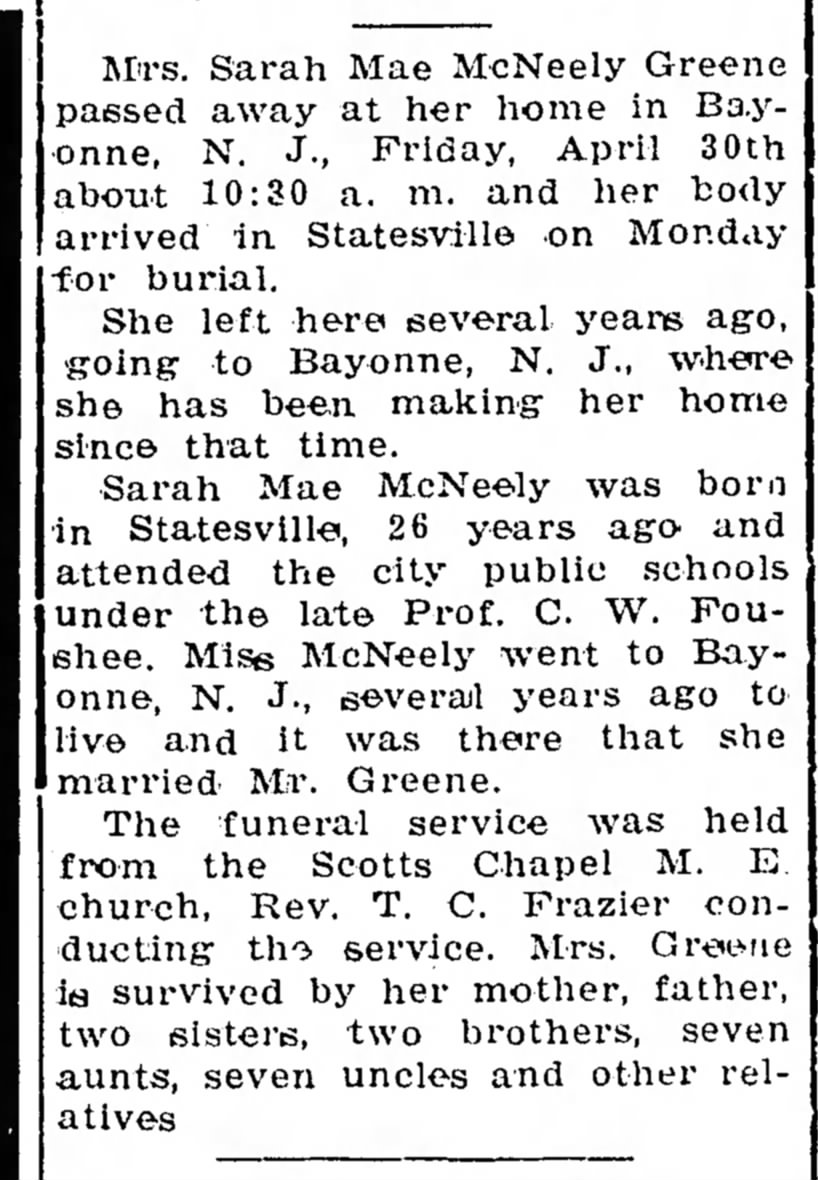
Janie McNeely, called “Dot,” was the youngest of Henry and Martha McNeely’s daughters.  Born in 1894, she worked as a laundress and reared her children in Statesville’s Rabbit Town section before migrating to Columbus, Ohio, in the 1940s.  Janie’s oldest child was Sarah Mae McNeely, born in 1911. She was followed by Frances V. McNeely (1913), Willa Louise McNeely (1918), Carl Graham Taylor (1923) and William Maurice McNeely (1925).

Sarah worked with her mother and sister at Statesville Laundry in the early 1930s. Soon after, she joined her grandmother, uncle John, aunt Emma and cousins in Bayonne, New Jersey, where she married a Mr. Green. (No one, including her obituary writer, seems to know his first name.)

Image

Statesville Landmark, 3 May 1937.

A few days later, in the Statesville Record‘s “News of Our Colored People”:

Image Statesville Record, 7 May 1937.

[Was Sarah survived by Mr. Green or not? Who was her father? And who were the extra aunt and all those uncles?]

Image

Photographs in the collection of Lisa Y. Henderson.

Standard
Births Deaths Marriages, Education, Maternal Kin, North Carolina, Oral History, Photographs

There she is.

Image

There she is.  That’s one of those dresses that Mama made for her to come to Hampton.  She came to Hampton a summer.  She stayed more than six weeks.  Must have stayed around eight or ten.  But anyway, she came here, and the things that she learned!  Oh, you would not believe.  All kind of things – artwork she could do.  Making baskets.  Oh, I don’t know what all.  That’s a blue taffeta dress with a white collar.  And you know we had a supervisor [Mary Charlton Holliday] who came to Statesville, and she particularly liked Golar, and she was a Hampton graduate, and she wanted Golar to go to Hampton so she could learn all this stuff.  All this artwork and everything.  And when she got ready, when Golar got ready to go, Mama had bought – this is a navy taffeta dress with a white collar.  And Mama had made all these dresses for her.  She had – this was a dressy dress.  And she had a pink dress, and she just, Mama just made her so many pretty things, you know.  And the, two or three nights before she was to go, to leave to go to Hampton, she broke down and cried.  Mama said, “What’s wrong?”  Said, “We’re gonna be, we’re gonna have your things ready.  You’re gonna be ready to go.”  And she said, “That’s not why I’m crying.”  She said, “I’m crying because Papa and Grandmama went to the bank and took out all of your money.”  Mama had paid into her Christmas savings account, and the bank just gave the money to Grandma and Papa, and that’s how they got her things together.  And she told Mama.  Ooooo

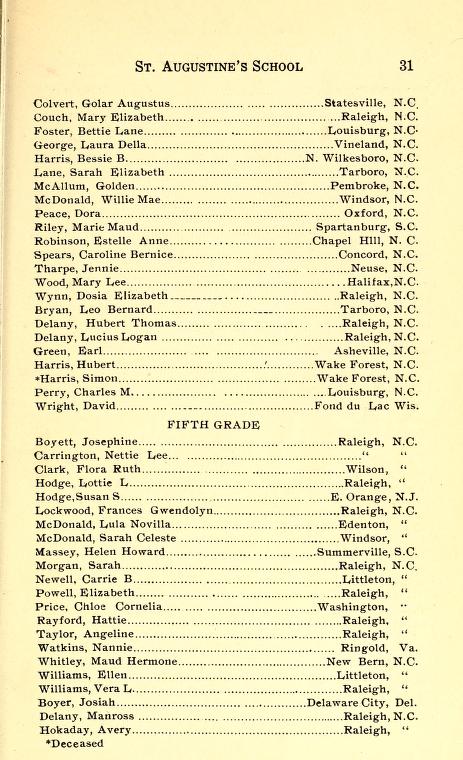
Golar Augusta Colvert was born in 1897 in Statesville, Iredell County, to Lon W. Colvert and his first wife, Josephine Dalton Colvert. She was about 9 years old when her widowed father married Carrie McNeely, and she grew close to her stepmother and adoring young half-siblings. When she was about 15, she enrolled at Saint Augustine’s College in Raleigh NC, where school catalogs show that she was a classmate of the Delany Sisters’ younger brothers.

annualcatalogueo18991914_0693

Annual Catalog of Saint Augustine’s School, 1913-1914.

In 1919, Golar married William Bradshaw, son of Guy and Josephine Bradshaw. Their son William Colvert Bradshaw was born in 1921 and daughter Frances Josephine in 1924. The little girl did not live to see two years. William worked in a furniture factory and Golar taught elementary school, and the family lived in a large frame house with a wrap-around porch on Washington Street in Statesville’s Wallacetown section.

In the summer of 1931, for reasons that are not at all clear, Golar traveled to Washington DC to undergo surgery.

Yeahhhh.  Went to Washington.  Had this operation and, ah, we got a letter from her.  Like, this afternoon, saying that she was all right, that they were gon take her stitches out, and she was coming home.  And she died that night.

GC Bradshaw 7 23 1931

Statesville Landmark, 23 July 1931.

Image

Statesville Landmark, 27 July 1931.

Interview of Margaret C. Allen by Lisa Y. Henderson; all rights reserved.

Standard
North Carolina, Oral History, Paternal Kin, Photographs

Going through the pea vines.

And David John, I don’t know what happened to him.  And his wife.  Well, now, David John come to Wilson and used to stay with us, and he worked in the factory.  So I don’t know whatever become of them folks down there.  And the girls that was all down there.  ‘Cause we went down there — me and Mamie went down there — and stayed with David John’s sister Estelle and worked in green tobacco.  And that’s where a mosquito bit me on my foot, and I scratched it, and, going through the pea vines, and the dew on ‘em, my foot swelled up so big I couldn’t walk on it.  And so Uncle ‘Lias, their daddy, brought me back home to Wilson.  Mamie stayed on down there, but I didn’t want to go back down there no more.

——

My grandmother’s reminiscences about Uncle ‘Lias (pronounced something like “LAH-iss”) were one of my early clues about the breadth of the Henderson family. I knew he was not her mother’s brother, or even her grandmother’s brother, and I was determined to find out exactly what the connection was. In fact, Elias Lewis Henderson was not an uncle at all, but a cousin. Born about 1880 in southern Wayne County, he was the oldest son of James Henry Henderson, who was the brother of my great-great-great-grandfather Lewis Henderson. (James Henry also named his youngest son Lewis Henderson after his brother.)Elias L Henderson

Elias married first Ella Moore. Their children were: David John (1901, married Amelia Artis), Mary Estelle (1903, married Theodore Rowe), twins Anna Bell (married Willie Johnson) and Mae Bell (1905), James Henry (1906, married Bessie Hagans), Myrtie Mae (1907), Olivia (1909, married James Raynor and [unknown] Whitaker), and Ira Junior (1911, married May Bell Bryant and Betty Ellis).  With his second wife, Sarah Edmundson, he had a son, Jazell Westly (1924, married Nancy).

Though my grandmother lost contact with David John and Mary Estelle, when she moved to Philadelphia in the late 1950s, she was reunited with their sister Anna Bell’s daughter Eunice Johnson Smith. Here, in the early ’60s, are Eunice’s daughter Wilma Smith, Eunice and my grandmother at a dinner at a Sheraton hotel in Philadelphia:

FB0068

Interview of Hattie H. Ricks by Lisa Y. Henderson, all rights reserved; photographs in the collection of Lisa Y. Henderson.

Standard
Births Deaths Marriages, North Carolina, Other Documents, Paternal Kin

No error.

I was tying up loose ends, so to speak, checking an online database for death certificates of cousins in distant lines. Several Artises married Reids, who were another free family of color from northeastern Wayne County, and a number settled in Wilson County in the early 20th century.

Allen T. Reid was a great-grandson of Zilpha Artis Wilson, sister of my great-great-great-grandfather Adam T. Artis. I started jotting notes from his death certificate — born 1919, married, World War II veteran — then pulled up short. Died 9 Dec 1949 at Central Prison in Raleigh? Of “asphyxiation by court order of the State of North Carolina”?  My cousin was executed?

I quickly found the decision of the North Carolina State Supreme Court in State v. Reid, 230 N.C. 561, 53 S.E.2d 849 (1949), an appeal from Allen Reid’s conviction for burglary with intent to rape (a white woman.) It’s longish, I know, but please read it:

——

Supreme Court of North Carolina

State v. Reid, No. 76, June 16, 1949.

Appeal from Superior Court, Wilson County.  W.H.S. Burgwyn, Special Judge.

Criminal prosecution tried upon indictment charging defendant with the crime of burglary in the first degree.

When the case was called for trial, and before the trial jury was chosen, sworn or impaneled, counsel for the defendant filed a motion challenging the array of petit jurors, upon the ground of disproportionate representation of Negroes on petit juries in Wilson County, and long, continuous and systematic exclusion of Negroes from petit juries solely and wholly on account of their race and color, contrary to the laws of the State of North Carolina and the United States.

The defendant offered evidence in an effort to sustain his challenge to the array of petit jurors. Upon the evidence produced by counsel for defendant, the Court found as a fact that the officers whose duty it was to prepare the jury list and draw the panels of veniremen to be summoned by the Sheriff of Wilson County ‘from which petit jurors were drawn, have not selected and summoned jurors for the December 6 Term, 1948, in violation of G.S. of 1943, Chapter 9, Sections 1, 2, 3 and/or 9, and the Constitution and Laws of the United States, with the unlawful and avowed purpose of discriminating against persons of the Negro race; and that there is no evidence before the Court to show that the said officers have been systematically and continuously, over a long period of years, excluding Negroes from said juries in said county solely on account of their race or color; to the contrary, it has been effectively shown that there are the names of Negroes in the jury boxes of Wilson County, and that one member of that race was drawn and served as a member of the Grand Jury which returned the Bill of Indictment in this case, and that four or five members of the colored race were drawn for the special venire and summoned for the purpose of the trial of this case.‘ Whereupon the Court overruled the motion, and the defendant excepted. Exception No. 15.

It is disclosed by the evidence that Mr. and Mrs. James Barnes, at the time the alleged crime was committed, were living in a ground floor apartment, at 204 Park Avenue, in the City of Wilson.

The night of the alleged crime Mr. Barnes was in Washington, D. C., and Mrs. Barnes retired in the early morning of 2 September, 1948; no other member of the family or guests being in the apartment at the time. About 2:30 a. m., she was awakened by someone placing a hand on her shoulder. She was on an antique bed about three and a half feet high. The person who touched her was on the far side of the bed and when she realized that the hand was on her shoulder, she immediately got off the bed away from the person. The person grabbed her wrists and ordered her to be quiet and not to scream. She asked the person who he was, and he replied, ‘Never mind who I am.‘ She asked him how he entered the room and he said, ‘That’s all right; I got in here.‘ The prosecuting witness managed to free her right wrist after several minutes. The person then ordered her to get back on the bed. She asked him what he wanted. He stated that he wanted to commit an act, which would have been, if accomplished, a crime against nature. He also said to her several times: ‘If you scream, you know what I have.‘ She told him to leave and he told her if she would just get back on the bed it wouldn’t take long. She would not get back on the bed and he began twisting her left wrist. She testified that she realized something had to be done, and she yelled for Mrs. Mayo, the lady in whose home the apartment is located. The person then jumped out the bedroom window, head first. Mrs. Barnes further testified she did not know who the party was, except her assailant was a male person; that when she went to bed the window in her bedroom was approximately two-thirds raised; that there was a screen in the window which hooked into the side of the window and it was in good condition when she retired.

Mrs. Sarah Mayo testified that when she heard Mrs. Barnes scream ‘Sarah,‘ she immediately got out of bed, called her son and went into Mrs. Barnes’ apartment, and found her at the telephone. She noticed that the screen was cut but did not see anyone leave the house.

A witness who lived next door to Mrs. Mayo testified she was reading in bed and heard Mrs. Barnes scream about 2:30 a.m.; that she looked but did not see anyone but heard ‘footsteps running.‘ She then heard a car start.

A member of the Police Department of the City of Wilson, in response to a call, went to the Barnes apartment. He examined the window and found that the screen outside the window had been cut all the way from the top to the bottom with some sharp instrument. He found two razor blades just underneath the window on the outside. The razor blades were ‘Treet‘ blades. He also found a paper wrapping that goes on razor blades. Shortly thereafter police officers found a wrecked Chevrolet car on the railroad track of the Norfolk & Southern Railroad, four blocks from the Barnes apartment. In the car the officers found a wrapping from a ‘Treet‘ razor blade, which was on the floorboard of the front seat. The wrecked car belonged to the father of the defendant. The father testified the defendant took the car on the night of September 1st, and said he wanted to go to a show; that he did not see the car any more until it was pulled in after the wreck. The husband of the prosecuting witness testified he had never used ‘Treet‘ blades, and had no such blades in his home.

Between 8:30 and 8:45 on the morning of 2 September, 1948, A. J. Hayes, Jr., the identification officer of the Wilson Police Department, who was found by the Court to be a fingerprint expert, went to the Barnes apartment and made an investigation for fingerprints. He testified that on the inside of the window through which the entrance to the Barnes apartment had been made, he found a fingerprint on the lower right-hand corner of the window sill and bottom section of the window; and he photographed the fingerprint. At the trial this witness, and two other witnesses who are with the State Bureau of Investigation and were qualified as fingerprint experts, compared the fingerprint found in the Barnes apartment with fingerprints of the defendant made after his arrest in Norfolk, Va., on 25 October, 1948, and each one of them testified that the fingerprint found on the window sill on the inside of the Barnes apartment was identical with the fingerprint of the right index finger of the defendant.

The defendant offered no evidence.

From a verdict of guilty of burglary and sentence of death by asphyxiation, the defendant appeals and assigns error.

Attorney General Harry M. McMullan and Assistant Attorneys General Ralph M. Moody and T. W. Bruton, for the State.

Herman L. Taylor, Raleigh, and C. J. Gates, Durham, for defendant. 

DENNY, Justice.

The exception to the failure of the Court to sustain defendant’s challenge to the entire array of petit jurors is not brought forward, as required by the Rules of this Court, Rule 28. However, the defendant discusses the exception at some length in his brief. Consequently, we have considered the exception and find it without merit.

His Honor’s findings of fact are supported by the evidence and are conclusive on appeal, since the exception presents no reviewable question of law. G.S. s 9-14; State v. Davenport, 227 N.C. 475, 42 S.E.2d 686; State v. Lord, 225 N.C. 354, 34 S.E.2d 205; State v. DeGraffenreid, 224 N.C. 517, 31 S.E.2d 523; State v. Wall, 211 N.C. 487, 191 S.E. 232; State v. Cooper, 205 N.C. 657, 172 S.E. 199; State v. Daniels, 134 N.C. 641, 46 S.E. 743. The question raised has been considered in a number of recent cases before this Court and no useful purpose would be served by a further discussion of the subject here. See State v. Speller, 230 N.C. 345, 53 S.E.2d 294; State v. Speller, 229 N.C. 67, 47 S.E.2d 537; State v. Brunson, 229 N.C. 37, 47 S.E.2d 478; State v. Koritz, 227 N.C. 552, 43 S.E.2d 77, certiorari denied 332 U.S. 768, 68 S.Ct. 80, 92 L.Ed. 354, and a rehearing denied 332 U.S. 812, 68 S.Ct. 106, 92 L.Ed. 390; and the cases cited.

Exception No. 16 is brought forward in the brief, but no argument is made or authority cited in support thereof, hence it will be considered as abandoned. Rules of Practice in the Supreme Court, Rule 28, 221 N.C. 546.

The defendant moved for judgment as of nonsuit at the close of the State’s evidence, on the ground that while the bill of indictment charges the defendant with burglarious entry with the felonious intent to ravish and carnally know Mrs. James Barnes, forcibly and against her will, the evidence he contends, tends to show only an intent to commit a crime against nature, condemned by G.S. s 14-177. 

The conduct of the defendant in breaking and entering the bedroom of the prosecutrix in the night-time, and under the circumstances disclosed by the evidence, indicates the extent to which he was willing to go to accomplish his purpose. He might have preferred and intended to commit a crime against nature, or his statement in that respect might not have been indicative of his actual intent. We think the evidence was sufficient to carry the case to the jury under the allegations contained in the bill of indictment, and it was for the jury to determine, under all the circumstances, whether or not the defendant had the ulterior criminal intent at the time of the breaking and entering, to commit the felony charged in the bill of indictment. State v. Allen, 186 N.C. 302, 119 S.E. 504; State v. Boon, 35 N.C. 244, 57 Am.Dec. 555. 

The trial judge charged the jury on the defendant’s contention in this respect, and instructed the jury to acquit the defendant if it found as a fact that the defendant entered the home of the prosecuting witness with the intent to commit a crime against nature and not with the intent to commit rape, as alleged by the State in the bill of indictment.

In State v. Boon, supra, Pearson, J., in speaking for the Court, said: ‘The evidence of the intent charged is certainly very slight, but we cannot say there is no evidence tending to prove it. The fact of the breaking and entering was strong evidence of some bad intent; going to the bed and touching the foot of one of the young ladies tended to indicate that the intent was to gratify lust. And the hasty retreat without any attempt at explanation, as soon as the lady screamed, was some evidence that the purpose of the prisoner, at the time he entered, was to gratify his lust by force. It was, therefore, no error to submit the question to the jury. Whether the evidence was sufficient to justify a verdict of guilty is a question about which the Court is not at liberty to express an opinion.‘

In the instant case, it is clear the defendant wanted the prosecutrix to know he would resort to other means if she screamed. Whether he had the intent to commit the crime of rape, as charged, or the intent to commit a crime against nature, at the time of breaking and entering, was a question of fact to be determined by the jury.

Evidence as to the conduct of the defendant after breaking and entering may be considered by the jury in ascertaining the intent of the accused at the time of the breaking and entering. But where there is a breaking and entering into a dwelling house of another, in the night-time, with the intent to commit a felony therein, the crime of burglary is consummated, even though the accused person by reason of unexpected resistance or the outcry of his intended victim, may abandon his intent to commit the felony. State v. Hooper, 227 N.C. 633, 44 S.E.2d 42; State v. Allen, supra; State v. McDaniel, 60 N.C. 245; State v. Boon, supra.

Exceptions 65 and 67 are directed to the refusal of the Court below to grant the defendant’s motion for judgment as of nonsuit, challenging the sufficiency of the evidence to warrant its submission to the jury.

The appellant is relying largely on the case of State v. Minton, 228 N.C. 518, 46 S.E.2d 296, where the defendant’s fingerprint was found upon broken glass from the front door of a store that had been unlawfully entered. That case is distinguishable from the present one. The defendant in the Minton case was lawfully in the store in the afternoon of the day on which the crime was committed, and he may have made the fingerprint at that time.

We must keep in mind that a motion for judgment as of nonsuit in a criminal prosecution is properly denied if there is any competent evidence to support the allegations of a bill of indictment; and all the evidence tending to sustain the allegations in the bill of indictment upon which a defendant is being tried, will be considered in a light most favorable to the State, and the State is entitled to every reasonable inference to be drawn therefrom.  State v. Braxton, 230 N.C. 312, 52 S.E.2d 895; State v. Gentry, 228 N.C. 643, 46 S.E.2d 863; State v. Webb, 228 N.C. 304, 45 S.E. 2d 345; State v. Hough, 227 N.C. 596, 42 S.E.2d 659; State v. Ewing, 227 N.C. 535, 42 S.E.2d 676; State v. McKinnon, 223 N.C. 160, 25 S.E.2d 606; State v. Brown, 218 N.C. 415, 11 S.E.2d 321. Here the defendant was never lawfully in the apartment of the prosecutrix, and the presence of his fingerprint on the inside of the window sill in the sleeping quarters of the prosecutrix, when considered with the other evidence, was sufficient to carry the case to the jury.

The defendant has abandoned the remaining sixty-seven exceptions set out in the record.

The exceptions brought forward and argued in the defendant’s brief fail to show any prejudicial error in the trial below.

No error.

——

A few comments:

(1) First degree burglary was a capital crime in North Carolina until 1974.

(2) And then there was this:
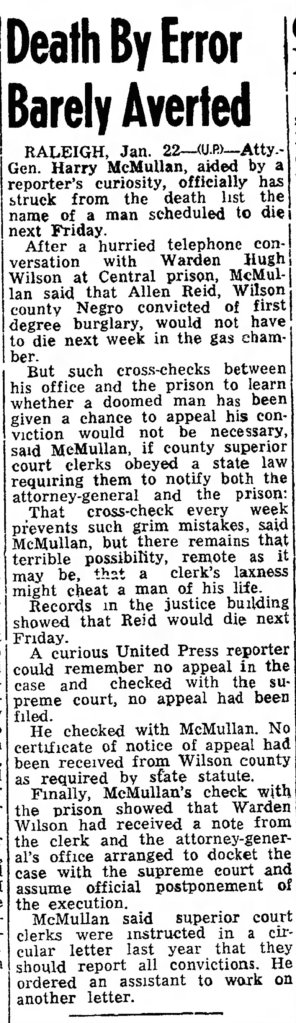
Stville Landmark 22 Jan 1949 Statesville Daily Record, 22 January 1949.

Allen Reid’s lawyers, Herman L. Taylor of Raleigh and C.J. Gates of Durham, were African-American. They appealed his case to the United States Supreme Court, which denied cert.

(3) In 1949, “death by asphyxiation” meant the gas chamber.  According to the Statesville Daily Record, on 9 December, Allen Reid, 30, entered the chamber with Audie Lee Brown, 27, convicted of murder. They were seated side-by-side, and “the deadly cyanide pellets dropped at 10:02 a.m. EST.” After the gas cleared, prison officials executed Monroe Medlin, 23. Reid took 13 minutes to die; Brown, a minute less; and Medlin, a minute less than that. The other men on death row moaned “Rock of Ages” as the three took their last walk.

(4) My father was 15 when Allen Reid was executed. He recalls that the belief on the east side of the tracks was that Reid was in a clandestine relationship with Mrs. James Barnes. I found this report, written by a Reid cousin of Allen Reid, online.  I haven’t figured out yet what was appended to. It confirms my father’s recollection and my hunch that Allen Reid’s service in World War II had some bearing on the situation in which he found himself. It also contains unsurprising commentary on North Carolina’s uneven application of the death penalty for this particular crime (and, of course, in general.)

Standard
Births Deaths Marriages, Maternal Kin, North Carolina

North Carolina death certificates: MILLER & McCONNAUGHEY.

Death certificates of Margaret McConnaughey‘s children and grandchildren:

George Miller and children —

George Miller.  Died 18 March 1915, Salisbury, Rowan County, of cerebral hemorrhage.  Black.  Widow.  Farmer.  Born March 1835, Rowan County, to Edward Miller and Marget Miller.  Buried “Oakelm” cemetery.  Informant, Margrett Miller.

Maria Miller.  Died 28 July 1925, Salisbury, Rowan County.  Born about 1879 to Geo. Miller and Eliza Scott, both of Rowan County.  Married to Robert Karr.  Buried Oakdale cemetery. Informant, Onie Miller.

Baldy Alexander Miller.  Died 16 Jan 1942, Mount Ulla, Rowan County, of carditis with decompensation.  Negro.  Married.  Tenant farmer.  Born 1 Jan 1858, Rowan County, to George Miller and Eliza Carr.

Onnie Miller.  Died 2 May 1970, Salisbury, Rowan County, of hypertensive cardiovascular disease. Widowed. Negro. Born 1 June 1870 to George Miller and Eliza Miller. Buried Oakwood cemetery. Informant, William F. Miller, Salisbury.

Child of Caroline McConnaughey —

Fletcher Reeves.  Died 4 Sep 1910 in Charlotte, Mecklenburg County, of Brights disease.  Resided 411 E. 8th St, Charlotte.  Born 5 July 1854, Salisbury NC to Henry Reeves and Fina Overman.  Married.  Hostler.  Buried Pinewood Cemetery, Charlotte.  Informant, Rufus Williams.

Angeline E. Reeves. Died 25 Mar 1953, aged 99, at 1120 Church Street, Charlotte NC.  Found dead in bed. Widow.  Born 3 Jun 1843 [sic] in Salisbury NC to Bob McConahey and Caroline [last name unknown]. Buried Pinewood Cemetery, Charlotte. Informant, Mrs. Carrie Williams, Charlotte.

Mary Anna McConnaughey Miller, husband and children — 

Ransom Miller.  Died 3 March 1917, Barber, Steele, Rowan County, of “heart condition.”  Black. Married. Farmer. Born 11 May 1843, Rowan County, to Edmund Miller and Malissa Miller. Buried Boyden graveyard. Informant, Richard Miller, Bear Poplar NC.

Hattie McCorkle.  Died 21 November 1919, China Grove, Atwell, Rowan County, of bronchial asthma. Married to Lee Roy McCorkle. Farmwork. Born 1891 near China Grove to Ransom Miller and Mary Miller.  Buried Oakland or Boyd cemetery, Rowan County. Informant, Sam McKee.

Ida Little.  Died 16 March 1931, Unity, Rowan County, of carditis (contributory cause: abscess teeth). Resided Cleveland, Rowan County. Negro. Married to G.B. Little.  Farmer.  Born 17 February 1883, Rowan County, to Ransom Miller and Mary Miller. Buried Oakland cemetery, Cleveland NC.  Informant, G.B. Little.

Ammie Miller. Died 28 May 1938, Cleveland, Rowan County of unknown causes. Negro. Married to Douglas Miller. Age 46. Born Rowan County to Henry Philips and Jennie McEmhord. Informant, Douglas Miller.

Mary Anna Miller.  Died 24 Dec 1940, 6:30 p.m., Boydens Quarters, Rowan County NC of senile degeneration.  Widow of Ransom Miller.  Born 14 May 1840, Rowan County, to Edward McConaughey and unknown mother.  Informant, W.K. Miller, Concord Rd., Box 320, Salisbury.  Buried Oakland Cemetery, Rowan County NC.

Richard Miller.  Died 8 June 1944, Mount Ulla, Rowan County, of cardial decompensation.  Negro. Married to Lockie Miller.  Farming.  Born 16 September 1876, Rowan County, to Ransom and Mary Ann Miller, both of Rowan County.  Buried Oakland cemetery, Rowan County.  Informant, Lockie Miller.

Florence A. White Knox.  Died 27 November 1950, Salisbury, Rowan County, of gastrointestinal hemorrhage. Resided Cleveland, Rowan County.  Colored.  Married.  Born 1888, Rowan County, to Ransom Miller and Mary Miller. Buried Cameron cemetery, Elmwood NC. Informant, Forrest White.

Lockie Miller.  Died 10 December 1957, Salisbury, Rowan County of coronary occlusion.  Born 8 May 1875, Mecklenburg County to unknown parents. Widow of Richard Miller.  Buried Oakland Pres. Cemetery. Informant, Mrs. Mary Leazer, Salisbury NC.

Lina Miller Neely.  Died 26 October 1969, Salisbury, Rowan County of broncho-pneumonia. Widowed. Born 18 February 1885 to Ranson Miller and Mary (last name unknown). Buried Oakland Church cemetery. Informant, Mrs. Ethel Miller.

Grace Adeline Miller Miller and children —

Grace Adeline Miller.  Born 25 Jun 1853, died 30 July 1918, daughter of Edward and Margaret Miller.  Informant: Mary Brown.

Green Miller. Died 12 January 1923, East Spencer, Rowan County, of influenza and bilateral bronchopneumonia. Resided 714 Shaver Street, East Spencer. Colored. Married. Farmer. Born 28 September 1845, Rowan County, to Edward Miller and Malissa Miller.  Buried Shady Grove. Informant, Mary Brown.

William Cass Brown.  Died 10 March 1933, Steele, Rowan County, of cerebral apoplexy. Negro. Married to Mary Caroline Brown.  Farmer.  Born 9 January 1871, Rowan County, to Thomas Brown and Ellen Brown.  Buried Millers Chapel cemetery.  Informant, W. Ray Brown, Salisbury.

Mary C. Brown.  Died 26 May 1951.  Resided RFD 6, Salisbury NC.  Negro.  Widow.  Born 18 July 1874 to Green Edward Miller and Adeline McConneighey.  Informant: Ray Brown.  Died of cerebral thrombosis. Buried 29 May 1951 at Miller’s Chapel cemetery, RFD 2, Salisbury.

Children of Martha Margaret Miller McNeely.

Lizzie Long.  Died 28 Sep 1950, Bingham Street, Statesville, Iredell County, of accidental burning.  (“Dwelling destroyed by fire due to heater exploding with kerosene.”)  Born 18 Jun 1896 in Rowan County NC to Henry McNeeley and unknown mother.  Housewife.  Informant, John Long.

Carrie Colbert Taylor.  Died 18 Dec 1957, Iredell Memorial Hospital, Statesville, Iredell County, of cerebral hemorrhage (1st CV accident in Oct 1957).  Resided 515 Fall Street, Statesville.  Born 22 Jun 1882, Rowan County NC to Henry McNeeley and Martha Miller.  Husband, Charles V. Taylor.  Informant, Louise Renwick.  Buried Belmont Cemetery, Statesville.

Eletha Weaver.  Died 19 Oct 1922, Statesville, Iredell County, of pulmonary tuberculosis.  Married to Archie Weaver.  Age 33 years, 10 months, 12 days.  Born Rowan County to Henry McNeely and Martha Miller of Rowan County.  Cook, S.L. Parks. Informant, Archie Weaver.

John B. McConnaughey.

John B. McConnaughey.  Died 21 Aug 1931, Steel, Rowan County, of nephritis and heart disease.  Farmer.  Age 72. Married to Jennie McConnaughey. Born Rowan County to unknown father and Margaret McConnaughey. Buried in Oakland Cemetery.  Informant, Jennie McConnaughey.


Standard
Births Deaths Marriages, Free People of Color, North Carolina, Paternal Kin

The Seaberrys.

Sometime around 1845, probably in northern Wayne County, Levisa Hagans married Aaron Seaberry. She brought a young son, Napoleon, to the marriage, and he possibly brought a teenaged daughter named Celia.

Aaron Seaberry belonged to a large free family of color whose antecedents are poorly documented and not well understood. Naming patterns, birth years, and geographic proximity suggest a set of siblings, but the exact relationships between the Seaberrys who appeared in Wayne County in the first quarter of the 19th century are not clear. Nor is there a certain relationship to Raleigh Seaberry, a white head of household in the 1810 census of Duplin County.  However, they are the only Seaberrys appearing in antebellum Wayne County records; all lived in the north-central section of the county; all were classified as mulatto; several were apprenticed to a single master; and they named their children after one another. (The extended family included three James Madisons, two Aarons, three Elizas, three Johns, two Melvinas, three Niceys, two Raleighs, amd two Rufuses.)

The first documented free colored Seaberry was 8 year-old Henry Seaberry, who was apprenticed to Simon Copeland in Wayne County on 19 May 1803.  In 1820, Henry Best apprenticed 6 year-old Rufus Seaberry and 8 year-old James Madison Seaberry. Four years later, Best apprenticed 7 year-old Melvina “Viney” Seaberry. What was these children’s exact relationship?

The nine earliest Seaberrys, who may have been siblings or cousins, are:

  • Theophilus Seaberry. Known as “Offie.” He was born about 1806 and married a woman named Rachel (possibly Smith.) The family lived in the Saulston area and included children Kenan (1833), Serena (1834, married Calvin Artis), Eliza (1835, married Lawrence Sampson), Aaron (1840), Litha (1842), Vicey (1843, possibly called Rebecca), Henry (1847), Theophilus jr. (1849), Milly (1850, married Rensnow Pace), John “Jack” (1851) and Rufus William (1853, married Della Mitchener). Offie probably died between 1860, when he appeared in the census, and 1862, when five of his children were apprenticed.
  • Nicey Seaberry was born about 1810. She headed a household in Wayne County in 1840 and 1850 and appeared in other county households in 1860 and 1870. Her children may have been Mancy (1833-1914), Angeline (1835, m. Mike Faithful), Exeline “Exey” (1840, m. William H. Hagans), Joseph (1842), Elizabeth (1846-1870), Mary (1855, m. Jordan D. Best).
  • James Madison Seaberry was born about 1812. He and his brother Rufus were apprenticed to Henry Best in 1820.
  • Rufus Seaberry was born about 1814 and married a woman named Dolly. The family moved from Wayne to Johnston County before 1860 and included children Nicy (1838), Willis (1839, married Nancy Powell), Susanna (1841), John (1843), Mary “Polly” (1845), Eliza (1848), Emelina (1851), Melvina (1855), Hannibal (1856, married Phelena Cox), Isabella (1863), and Charles (1867, married Lou Cogdell.)
  • Henry Seaberry was born about 1815. He was apprenticed twice: to Simon Copeland in 1822, and to John Alford in 1833.
  • Melvina Seaberry. Known as “Viney,” she was born about 1817 and was apprenticed to Henry Best in 1824. On 27 August 1866, under a law designed to legitimate slave relationships, she and Joseph Carroll, though both freeborn, registered their 21-year cohabitation. Their children: Hannah (1833), Daniel (1836), Joseph (1838), Charity (1840), Willis (1842, married Caroline Whitehurst), Nicy/Nancy (1844), Jin (1846), Melvina “Viney” (1849), Delilah (1850), Ruffin C. (1853), and Tamar (1857).
  • Aaron Seaberry was born about 1818.  Around 1844, he married Lovisa Hagans and became stepfather to her son Napoleon Hagans. He and Lovisa had one daughter, Frances, born 1845 (married Adam Artis).  Aaron died 1900-1910.
  • Raleigh Seaberry was born circa 1824, “six miles from Goldsboro,” as he testified to the Southern Claims Commission. He lived near Averasboro, Harnett County, during the far, and settled in Cumberland County after. He married Emeline Manuel circa 1846. Their children: James Madison (1848, married Marianna McNeill), Sarah E. (1850), Smithy Jane (1854, married James McNeill), Eliza (1857), Leah (1859), John M.F. (1860), Nicey (1863), Raleigh (1866), and Lemuel (1871).
  • Harriet Seaberry.
Standard