North Carolina, Politics, Rights

He will rise up some day and come again.

Today marks the 115th anniversary of George H. White’s Phoenix speech, delivered as the North Carolina representative bade farewell to Congress. The full text of the speech is available here, but here are his final ringing and prophetic words:

“This, Mr. Chairman, is perhaps the negroes’ temporary farewell to the American Congress; but let me say, Phoenix-like he will rise up some day and come again. These parting words are in behalf of an outraged, heart-broken, bruised, and bleeding, but God-fearing people, faithful, industrious, loyal people — rising people, full of potential force.

“Mr. Chairman, in the trial of Lord Bacon, when the court disturbed the counsel for the defendant, Sir Walter Raleigh raised himself up to his full height and, addressing the court, said:

“Sir, I am pleading for the life of a human being.

“The only apology that I have to make for the earnestness with which I have spoken is that I am pleading for the life, the liberty, the future happiness, and manhood suffrage for one-eighth of the entire population of the United States.”

My kinsmen Henry E. Hagans and William S. Hagans, brothers, served as secretaries to White during his terms in Washington.

Standard
Education, North Carolina, Paternal Kin

State Colored Normal School student.

I stumbled upon this catalog last night as I was researching for afamwilsonnc.com. As I scanned the list of students, I was stunned to see W.S. Hagans of Fremont, Wayne County. This is William S. Hagans, son of Napoleon and Appie Ward Hagans, and first cousin to my great-great-grandmother Louvicey Artis Aldridge (1865-1927.) William graduated from Howard University’s preparatory division in 1889 and went on to obtain bachelor’s and a law degree from Howard. Apparently, however, he spent at least a year of high school in Fayetteville, a little closer to home. A few months ago, I would have immediately picked up the phone to share this new information with my cousin Bill, William’s grandson. Bill is gone though, so I’ll just have to imagine his warm laugh and exclamations of surprise.

Screen Shot 2016-01-22 at 9.33.30 PM

WS Hagans Fayetteville.png

Catalogue found here.

Standard
Births Deaths Marriages, North Carolina, Paternal Kin

Born this day: 1 January.

Name — Susan Casey Lewis.

Birth — 1 January 1787, Wayne County, North Carolina.

Parents — Micajah Casey and Sarah Herring Casey.

Spouse — Urban Lewis.

Death — 10 October 1860, Wayne County, North Carolina.

Relationship to me — Paternal great-great-great-great-great-grandmother.

[Hat tip to Hollie Ann Henke, relativityitsallrelative.com.]

Standard
Agriculture, Newspaper Articles, North Carolina, Paternal Kin

Emancipation Day.

Gboro Daily Argus 12 31 1905 Emancipation Day

Goldsboro Daily Argus, 31 December 1905.

For decades, on January 1, African-American communities formally celebrated the anniversary of the Emancipation Proclamation. In 1905, under the leadership, in part, of William S. Hagans and Mack D. Coley, the “Educational, Agricultural and Industrial mass meeting” of Wayne County’s “colored citizens” issued an eight-point pledge:

(1) to be respectable;

(2) to endorse state policy to give all children, regardless of color, an education;

(3) to urge school attendance;

(4) to encourage teachers not only to teach, but to pay home visits and preach every manner of virtue and home improvement;

(5) to disapprove of shiftlessness;

(6) to condemn crime and encourage law-abiding conduct;

(7) to suggest that farmers carry insurance and to educate them; and

(8) to become more united as a race, to organize to buy land, and to help one another retire mortgages.

Standard
Business, Newspaper Articles, North Carolina, Paternal Kin

C.D. Sauls, influential colored man of Snow Hill, invests.

In 1897, cousin Cain D. Sauls was one of two African-American members of a five-man delegation that traveled eastern North Carolina advocating for the “Snow Hill Railroad.”

Goldsboro_Weekly_Argus__4_15_1897_CD_Sauls_Snow_Hill_RR (1)

Goldsboro Weekly Argus, 15 April 1897.

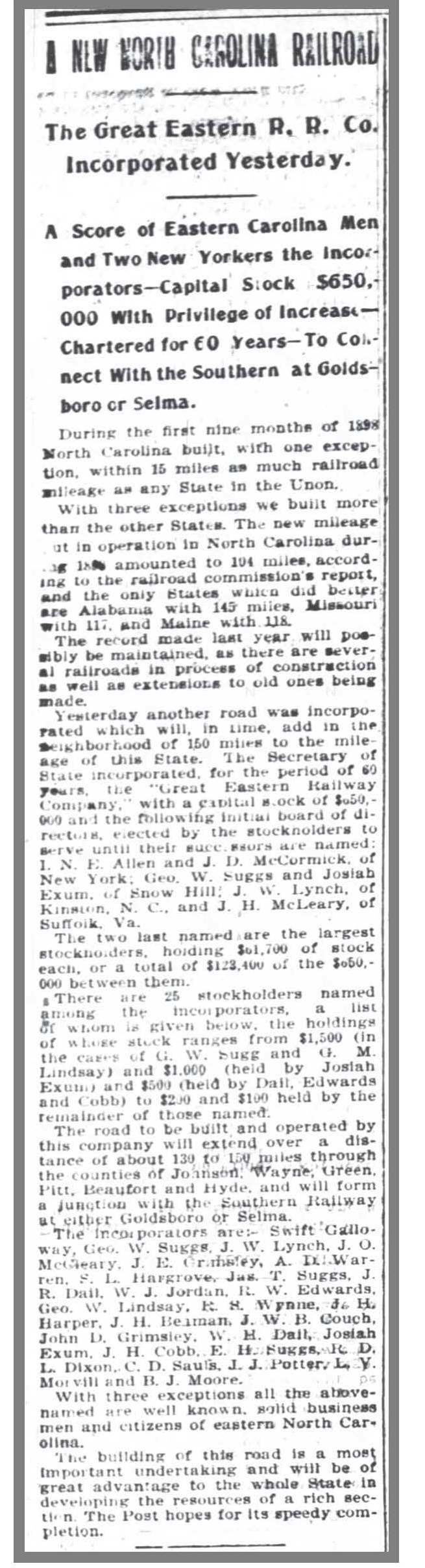
A little over a year later, North Carolina’s secretary of state approved the incorporation of the Great Eastern Railway Company, which planned to build and operate a 130+ mile railroad passing through Johnston, Wayne, Greene, Pitt, Beaufort and Hyde Counties. Among the 25 stockholders incorporating the railroad? C.D. Sauls!

Raleigh_Morning_Post_10_15_1898_Great_Eastern_RR

Raleigh Morning Post, 15 October 1898.

Standard
North Carolina, Other Documents, Paternal Kin, Photographs

Signature Saturday, no. 7: John Henry Henderson’s sons and grandsons.

John Henry Henderson (1861-1924) was the youngest of James Henderson‘s sons to reach adulthood. He married Sarah Simmons, daughter of Bryant and Elizabeth Wynn Simmons, in 1886 near Dudley, Wayne County. Census records suggest that Sarah gave birth to as many as twelve children, but only three survived — Frances “Frankie,” Charles Henry and John Henry. I have found no record of John H. Henderson’s signature, but here are those of his sons and grandsons.

John & Sarah Henderson Colorized

John and Sarah Simmons Henderson, perhaps the 1910s.

Charles H. Henderson, born about 1893, is something of a mystery. In 1900, he appears as “Charley” in the census of Dudley, Wayne County, with father John, mother Sarah and sister Frankie. There’s some uncertainty about the children’s identification, but this is a photo John and Sarah circa 1895. My best guess is that the image depicts Frankie and Charley.
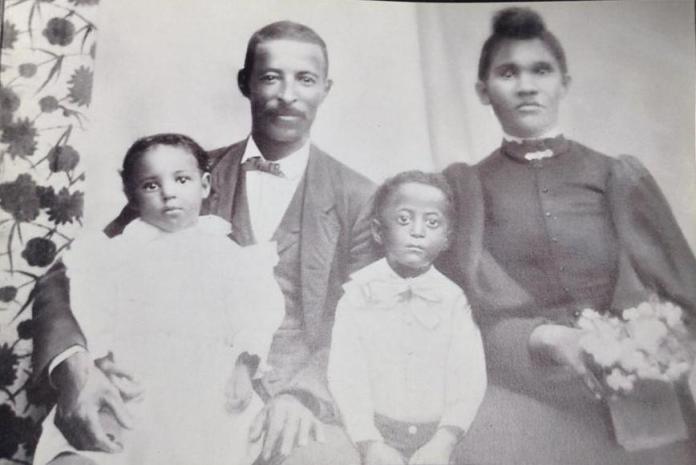
John Sarah Henderson family

Charles was not living in his parents’ home in 1910, however. Nor can I find him elsewhere. In 1917, however, he registered for the World War I draft in Richmond, Virginia. He reported that he was born 21 July 1893 in Dudley; resided at 114 E. Leigh Street, Richmond; and worked as a self-employed barber. He was of medium height with a slender build, brown hair and eyes and was slightly bald. (His signature is from this draft card.) In the 1920 census of Richmond, Henrico County, Virginia, at 614 Baker Street, in Lee Ward, Charles H. Henderson, 32, and wife Maria R., 32, with Maria’s parents Henry and Mary B. Stockes, sharing a household headed by Eddie Seigel.  Charles worked as a barber and was recorded as being born in Virginia. (This and his age — he was actually about 27 — are erroneous.) It’s the last record I have for Charles Henderson.
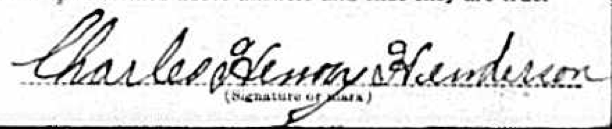
Charles H Henderson Sig

Eight years after Charles was born, Sarah Simmons Henderson gave birth to her last child, son Henry Lee (1901-1942). Henry married Christine Lenora Aldridge while both were still in their teens. I’ve written of their sons here, and samples of their signatures (all from World War II draft cards) are shown below Henry’s.
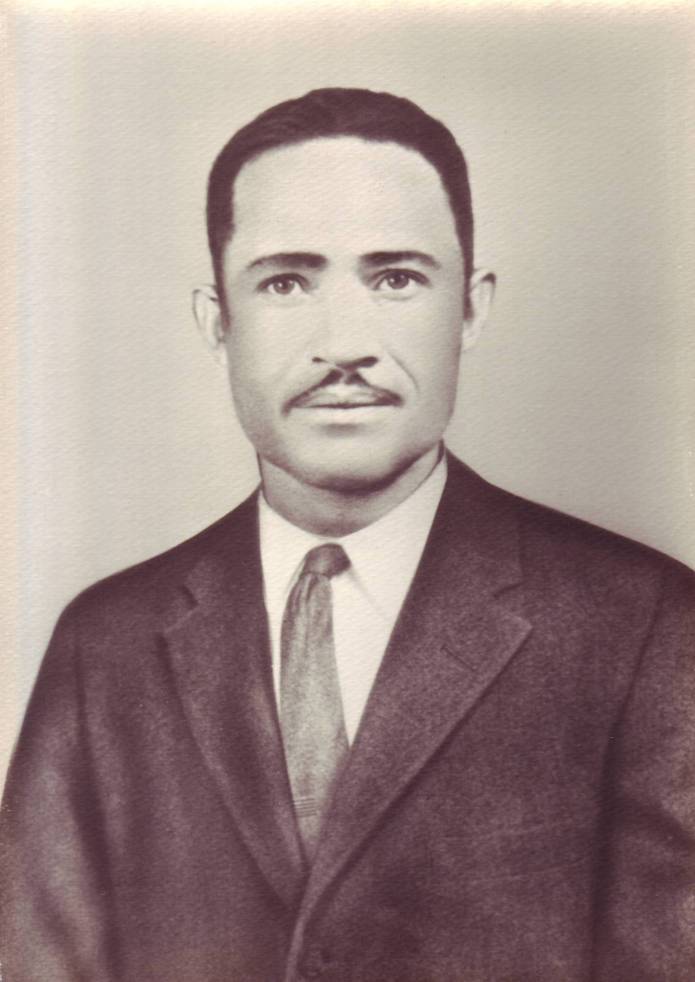
Henry Henderson

Henry Lee Henderson, perhaps the very early 1940s.

Henry L Henderson Sig

Horace B Henderson Sig

Aaron Henderson Sig

Johnnie D Henderson Sig

On Christmas Day 1911, Frances Ann “Frankie” Henderson (1891-1985) married her first cousin, Israel Henderson Wynn (1890-1967), son of Washington “Frank” and Hepsey Henderson Wynn. I have no sample of Frankie’s handwriting, and Israel was unable to read or write. (At least, as a young man.) He signed his World War I draft registration card with an X.
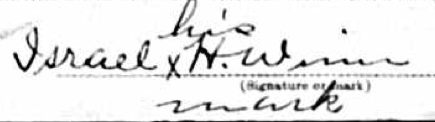
Screen Shot 2015-10-03 at 8.02.38 PM

Frankie and Israel (called “H”) had at least 11 children, including sons John Franklin (1915-1981), George Roosevelt (1918-1986), Henderson B. (1924-1981), and Lawrence (1925-??), whose World War II draft card marks or signatures are shown:

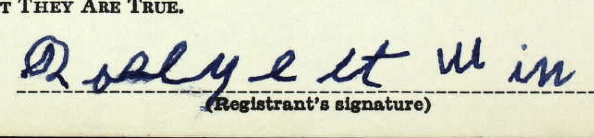
John F. Wynn DRaft

Roosevelt Wynn

HB Wynn

Lawrence Wynn

Standard
Newspaper Articles, North Carolina, Paternal Kin, Politics

Pre-election street fracas?

A “pre-election fracas”? What happened? And why did eight of black Goldsboro’s leading lights — including my great-great-great-uncle Matthew W. Aldridge and cousin William S. Hagans — feel compelled to take to the newspaper, hat in hand?

Goldsboro_Daily_Argus_11_18_1896_letter_re_fracas_Hagans_Aldridge

Goldsboro Daily Argus, 18 November 1896.

I didn’t find anything in the Goldsboro papers to which I have access, but two weeks before this letter was published, newspapers across the country ran a sensational story about Negroes “taking control” of Goldsboro after a “clash with whites.” The alleged cause? “An incendiary speech” made by none other than John Frank Baker, “a colored Republican of Dudley,” and husband of Mary Ann Aldridge Baker.

Independence_KS_Daily_Reporter_11_4_1896_Frank_Baker_clash

Independence Daily Reporter (Kansas), 4 November 1896.

Four months later, Frank Baker was assassinated, shot dead as he went about his work in a Dudley grocery.

Were Matthew Aldridge and William Hagans and their peers moved to pour oil on the waters because they feared the fallout from Baker’s outspokenness? (I have yet to find anything that touches on what he actually said.) Their letter is frustratingly vague about the events that gave rise to a “race riot” in Goldsboro, speaking only of the aftermath of a recent election. The message is difficult to digest, greased as it is with deferential supplications to the “better class of our white citizens” and anxious apologies for the “slight ripple upon the formally [sic] smooth surface” of race relations in Wayne County. Reading from a 21st century vantage point, it is easy to dismiss this letter as Uncle Tommery. There is an undoubted and substantial element of self-preservation and middle-class conservatism at work here, but their fear was surely real and well-placed.

——

  • Clarence Dillard (1862-1933), Howard University Theology ’83, came to Goldsboro as a Presbyterian minister and was principal of the colored graded school during this period. He was active in Republican politics and was co-editor of a short-lived African-American newspaper in Goldsboro, The Voice. Goldsboro’s first African-American high school was named for him.
  • A. Sasser was likely Arnold Sasser (1866-1939), who was listed as an undertaker in the 1900 census of Goldsboro.
  • A.M. Smith, I can’t identify.
  • William S. Hagans (1869-1947), son of a prominent farmer, moved between Goldsboro and Washington, where he would soon serve as secretary to African-American United States Congressman George H. White.
  • B.G. Hogans was likely Benjamin H. Hogans (1865-1926), a teacher, a trustee of Saint James AME Zion Church and, later, a mail carrier. He was born in Orange County, North Carolina, and came to Goldsboro as a child. [Hogans’ niece Annie Irene Hogans married Daniel Simmons, first cousin of my great-grandmother Bessie Henderson.]
  • Matthew W. Aldridge (1857-1920) was a grocer and erstwhile teacher who was active in city politics as alderman and poll-holder in the heyday of the Black Second era.
  • William E. Highsmith (1851-1930) was a farmer.
  • Henry Williams, like Hogans, was a pallbearer at the funeral of William Hagans’ father Napoleon Hagans, conducted in part by Clarence Dillard just ten weeks before this letter was published. Beyond that, I have not been able to identify Williams.

Standard
Free People of Color, North Carolina, Other Documents, Paternal Kin, Photographs

A reunion.

Screen Shot 2015-09-27 at 10.47.52 PM

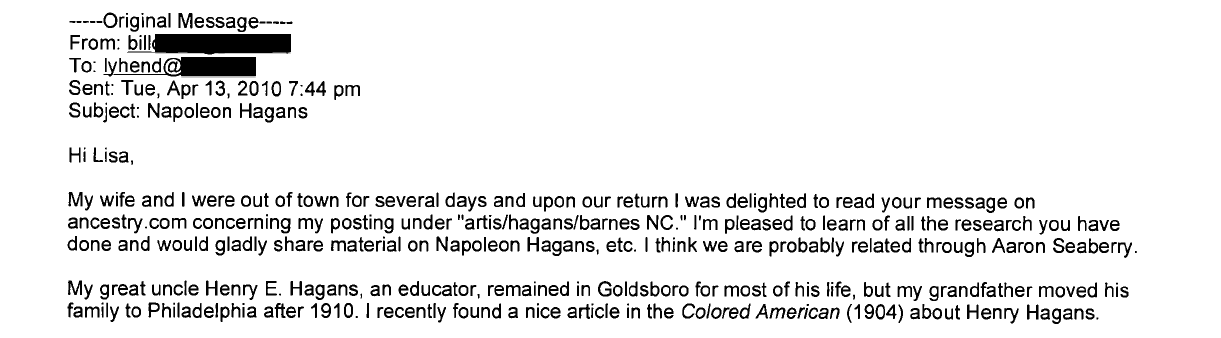
And with that introductory email began my fruitful and thoroughly enjoyable correspondence with B.H., my third cousin, twice removed. Our common ancestor was Levisa (or Eliza) Hagans Seaberry, mother of Napoleon Hagans (B.H.’s great-grandfather) and Frances Seaberry Artis (my great-great-great-grandmother). In the spring of 2010, B.H. and I entered into a mutually beneficial exchange of information about our shared family. I had little information about Napoleon beyond what I’d found in census records and deeds, I’d lost track of his sons Henry and William, and I was completely unaware of his son, the accomplished Dr. Joseph H. Ward. He cued me into William S. Hagans‘ post-migration life in Philadelphia, shared amazing photographs and documents, and lead me to “discover” Joseph Ward’s early years. In turn, I introduced B.H. to Wayne and Wilson Counties and the lives of the Haganses, Wards and Burnetts before they recreated themselves up North.

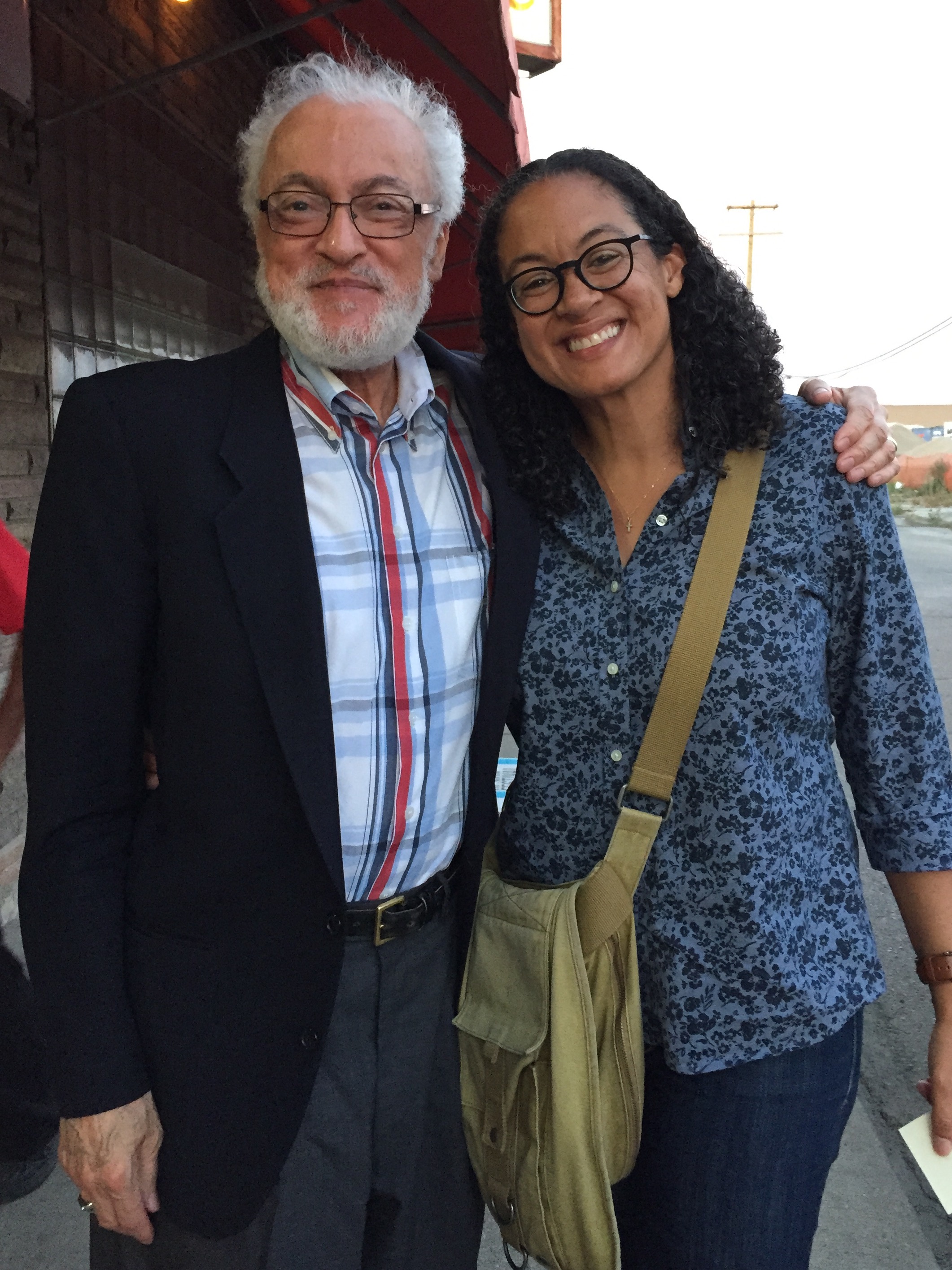
This past weekend, I traveled to Detroit for — astonishingly — the first time ever. Our primary purpose was to take in the city’s rich street art culture, but I added an item to the top of the agenda — meeting B.H. Friday night, he and his wife treated us to dinner at an old and storied restaurant near the city’s Eastern Market, and Levisa’s children came full circle.

me and Bill

Standard