Maternal Kin, North Carolina, Oral History, Photographs

Remembering Launie Mae Colvert Jones.

My maternal grandmother’s youngest sister, Launie Mae, would have turned 104 today.

Here she is, not long, I think, after she moved to Bayonne, New Jersey, around 1930. She met Georgia-born Isaiah James Jones, married, and reared seven children in Jersey City.

Launie Colvert 002

And here, a photo taken at the first Colvert-McNeely family reunion in 1978. Sweet and funny, this is how I best remember her.

Launie Colvert 001

Launie Colvert Jones (20 December 1910-2 August 1997)

Standard
Oral History

How have entire lives been so reduced?

“Written records are more reliable than oral tradition, by a disconcerting margin. You might think that each generation of children, knowing their parents as well as most children do, would listen to their detailed reminiscences and relay them to the next generation. Five generations on, a voluminous oral tradition should, one might think, have survived. I remember my four grandparents clearly, but of my eight great-grandparents I know a handful of fragmentary anecdotes. One great-grandfather habitually sang a certain nonsense rhyme (which I can sing), but only while lacing his boots. Another was greedy for cream, and would knock the chess board over when losing. A third was a country doctor. That is about my limit. How have eight entire lives been so reduced? How, when the chain of informants connecting us back to the eyewitnesses seems so short, and human conversation so rich, could all those thousands of personal details that made up the lifetimes of eight human individuals be so fast forgotten?”

— Richard Dawkins, The Ancestor’s Tale

Standard
Migration, North Carolina, Oral History, Paternal Kin

The bread was all mashed up.

I won’t say this one of my grandmother’s favorite stories. It was too painful to be favored. But it was a story she told me over and over, without prompting and with little variation. It tears me up to read it even now, nearly a hundred years after the events it memorializes. I imagine that frightened little girl, a near orphan, left with this relative and that, yearning for comfort from a great-aunt who generally offered little in the way of emotion, but who, to provide, went North for short stretches for the extra money she could make doing “day’s work” for white families. Theodore and the bread and the doorbell. My heart breaks.

——

And I went over to stay until – Mama was working. And so Edward, that was – Edward or Theodore? Theodore. It was Carrie’s, Papa’s daughter Carrie, like Annie Bell’s sister Carrie. That’s where I was staying, over to her house. And Mama was working and staying on the lot with the people, and I was supposed to stay with them while I was up there. Until Mama, I reckon ‘cause she was gon be making a little money to buy something with, but I don’t know what she said she wanted. So by her being one place and I was in another. And then when her son, Theodore – we went to the store to get a loaf of bread, and I went with him, I wanted to go with him. And he took me on down to the store, got the bread, then he give me the bread to hold, and there was a place in the sidewalk of dirt, where wasn’t paved, and he stopped there with some children and started shooting marbles in little space, that little square. So I walked on down the street, and we wont too far from the house, but I kept looking and trying to figure out what house we were in. They were all joined together. And I had seen him go up there and put a hand upside the thing, and I said, ‘Must be a bell up there.’ And I went up there and mashed that button, and the door didn’t come open. And so then I went back down the street to where Theodore was, and he was still shooting marbles. And so, I said, “You better come on, I’m tired of holding this bread.” And so he said, “Okay, okay.” And so then he stopped, and we come on up there, and the door was cracked open. The door was cracked open. So when we got there, I said, “The door was open. And you didn’t even have to mash the button up there.” Mash the button where was to the apartment where you live in? And they would mash the button back to open the door. But the door was already open. But I had mashed it, see? I didn’t know. So when Theodore and I went back up there, and we went in, and I had the bread, and the bread was all mashed up where I had held it so tight holding it. And so she fussed him out and whipped him on top of that, and I went to crying ‘cause I thought she was gon whip me, too, ‘cause it was both of us. And so I said, “I want to go home. I want to go to where Mama is.” They said, “Well, she’ll be over tomorrow.” And I don’t know if it was tomorrow or the next day or two after, but anyhow Mama come and got me, and I told her that I wanted to come home. And she said, “Well, I thought you was doing all right. What’s the matter with you and Carrie?” And I said, “She beat Theodore.” And I said we were at the store getting a loaf of bread, and so we stayed too long. He was shooting marbles, and I was holding the bread, and I had mashed the bread up, and I thought she was gon whip me ’cause I forgot about the bread, and I couldn’t get in the house to bring it to her. And when I mashed the button, the door didn’t come open. So then when Theodore and I came back, went on up there, and honey, she took her husband’s belt, one of his belts he had, and she whipped him, and I was crying, and I’m still crying. I said, I reckon that’s where I started crying ’cause every time I see somebody else cry …. So I told them I wanted to go home, and she said, “Well, Mama’s coming over tomorrow.” And so I stopped crying, but I thought Carrie was gon whip me, just like she whipped Theodore, and I was the one that mashed the bread. But I didn’t tell it. But she said we stayed out too long. Bread’s all mashed up, said, “Should have come on home.” She was fussing with him, and then she took the strap and hit him two or three licks with that, and I thought she was ton hit me, too. And so Mama came and got me and took me back over Frances’ house. So then she said she was going back South. And I was just happy to go back there.

——

They said, well, [inaudible] get some bread, went to the store. I didn’t know where the store was, but I was just going with him to the store, you know? I got the bread, he give me the bread to hold, while he was shooting marbles in that little space was out there. And come on back, and I went way to the house and mashed the button ‘cause I’d seen him mash it. Didn’t want to ask nobody nothing. I said, I didn’t know them peoples up there. So the door didn’t open, and I went on back to find him and get him to come home. And I had held that bread so much and turned it from one end to the other under my arm holding it, and mashed the bread up. So Carrie looked at him: “Well, where y’all been so long?” And then she got that strap, ‘bout this long and ‘bout this wide. And she hit him a lick or two with that, and said, “I sent you out there after some bread, and you went off and stayed and stayed and stayed.” And so when she was hitting him, I went crying. So I thought she was gon beat me, too. But she didn’t. She didn’t even try to chastise me or talk nice to me or nothing. It was just simply ‘cause I’d done mashed that bread up – I had the bread when I went up there, see. She wont thinking ‘bout me. But I didn’t think that, nothing about it until it was later. I said, ‘No wonder she was gon beat me.’ ‘Cause I had done mashed that bread all up holding it up in my arms and changing it from one arm to the other, waiting on him shooting marbles. But I didn’t tell on him. But she knew he was shooting marbles.

——

... Mama took me to New York and everywhere she’d go. I stayed with Frances and her husband and son, when Mama went up there to work. And so I stayed with Carrie first. That was Albert Gay’s mama’s sister. She had one son, Edward. And she sent us to the store to get a loaf of bread. I’ll never forget it. And in the sidewalk, it was a block out the sidewalk where was closed up. And it just had dirt in it, and we went to get that loaf of bread. He handed me the loaf of bread, and when we got to that block it was boys shooting marbles in that little square where it was dirt. And so I got tired of standing there waiting on him. And I went on up to the house. And had seen them where they go up there and pushed the button. And the door didn’t come open then, and I went on back to where Ed was. And stood there waiting ’til he come to go in the house. And when we got to the house, the door was open. So when we got upstairs to the apartment floor, Carrie commenced fussing with him about ‘Who’s that coming in there playing with that bell?’ and opening the door, or something, I started to say it was me, and then I — she talked so hateful, and she beat Theodore, ’cause he got the bread all mashed up, with the belt. So I went to crying. I cried and I cried. I wanted to go home. I wanted to go where Mama was, but Mama wasn’t supposed to come over there ’til the next day or a day or two after that. I don’t know where she was working. Except that she was doing some day’s work. ‘Cause day’s work was plentiful then. People would clean up. So Mama wanted [inaudible] carried me with her and left Mamie there with Papa and knowing, too, Papa didn’t like Mamie. So, anyway, I cried so, and Mama took me over to Frances’ house. That’s where Mama come, after they took me over to Frances.’ I don’t think either one of ’em had no phone at that time and … but anyway, she come on over and got me, and I told her I didn’t want to stay there no more, I wanted to go home. I said I wanted to go where she was. She said, “Well, you can’t go right now,” said, “I got a job to do.” She said, “Well, I’ll take you over to Frances’. So that’s when she took me over to Frances’ house, and Edward.

——

“Mama” Sarah Henderson Jacobs (1874-1938) reared my grandmother and her sister Mamie, her great-niece. Sarah’s husband, “Papa,” was Jesse A. Jacobs Jr. (1856-1926). Annie Bell Jacobs Gay and Carrie Jacobs Blackwell (1890-1963) were Jesse’s daughters by his first wife, and Theodore Blackwell (1908-??), not Edward, was Carrie’s son.  At the time this story took place, the Blackwells were probably living at 37 West 112th Street in Harlem, just north of Central Park. In 1920, this was an all-African-American, fifteen-family building in a block otherwise occupied by Russian Jewish immigrants. Frances Aldridge Cooper Newsome was my grandmother’s paternal aunt, sister of her father Thomas Aldridge. Edward Cooper was Frances’ son.

Interviews of Hattie H. Ricks by Lisa Y. Henderson; all rights reserved.

Standard
Maternal Kin, North Carolina, Oral History, Politics, Rights

When time came for women to vote.

In which my grandmother schools me on her grandmother and voting:

NICHOLSON -- Harriet Nicholson 1

Harriet Nicholson Tomlin Hart (1861-1926)

Me: How did she work that? How did Harriet get to be the first black woman to vote?

Grandma: Well, because her husband [T. Alonzo Hart] was a lawyer.

Me: Right.

Grandma: He was a, whatchacall – a real estate lawyer. And he taught her how to read and write and do everything after he married her. Or while he was marrying her. Or something. And when time came for women to vote, she was the first black – he carried her down to the polls, and she was the first black woman to vote. And then at that time, you know, they gave you a quiz.

Me: Right. Right. Right. For black people to vote. Yeah. ‘Cause did your parents – well, did your father vote?

Grandma: Oh, yeah. Papa voted. He voted. And the people in my home, Lisa, fought in the streets [Statesville, North Carolina]. It was dange – I mean, we could not go outside the house on election night. The people — “Who’d you vote for?” “I’m a Democrat.” “I’m a Republican.” Pam-a-lam-a-lam! [Swings fists, and I break into laughter.] People acted like they were crazy! Papa didn’t allow us out the house. “You better be getting on home!” ‘Cause they were terrible.

Me: And now you got to drag people out to vote. And then you hear people going: “I’m not gon vote now. What’s the point? I blah-blah-blah.”

Grandma: Yeah. When I came here [Newport News, Virginia] you had to pay poll tax.

Me: Yeah.

Grandma: It wasn’t a whole lot, but it was ridiculous.

Me: Yep.

[My grandmother cast her last ballot — at age 100 — for Barack Obama in 2008.]

——

Interview of Margaret C. Allen by Lisa Y. Henderson; all rights reserved.

Standard
Enslaved People, Maternal Kin, North Carolina, Oral History, Religion

Church home, no. 8: Back Creek Presbyterian Church, Rowan County NC.

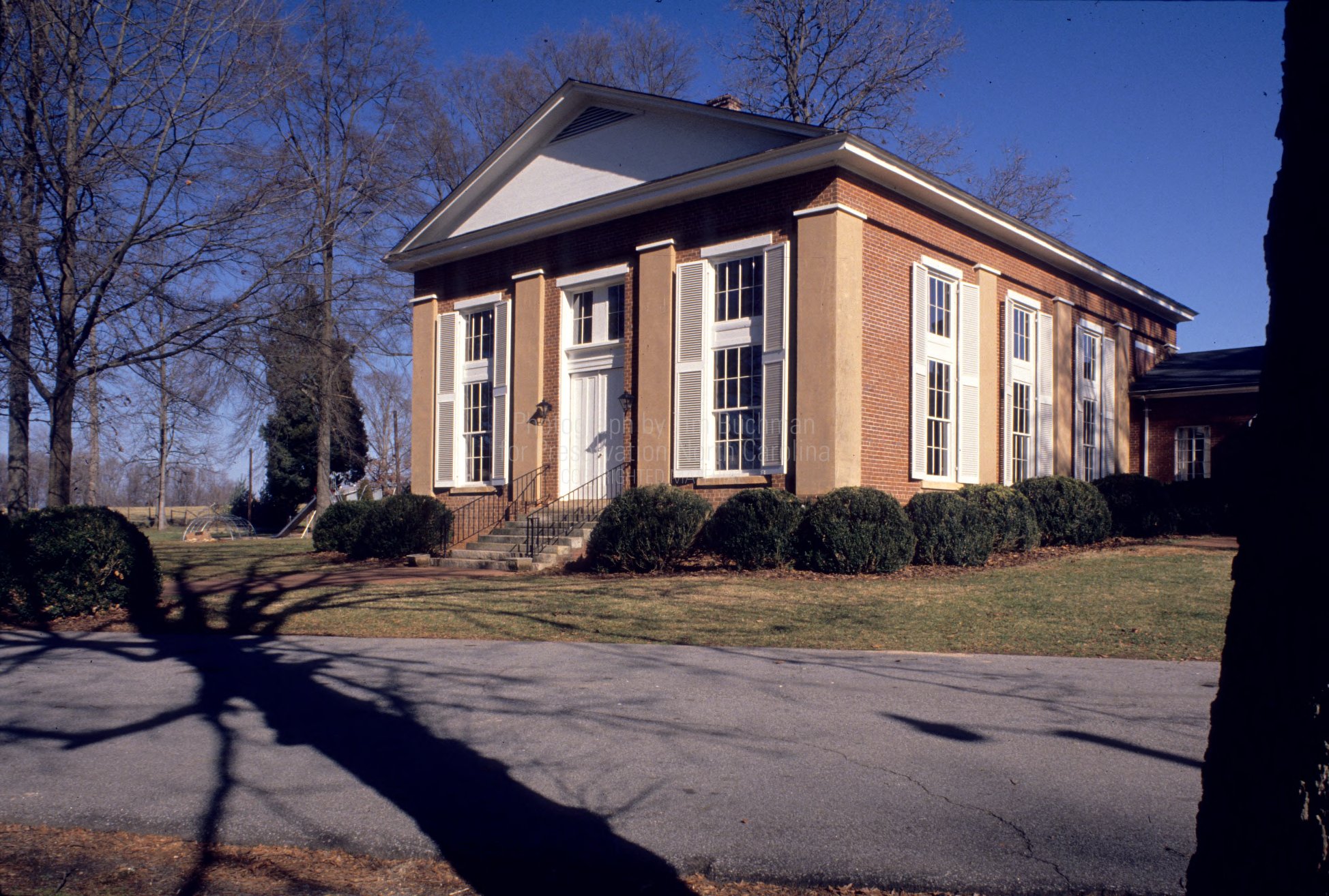
Founded in 1805, Back Creek Presbyterian Church is a historic church in Mount Ulla, North Carolina. In 1809, the congregation built a small log house of worship, which was replaced by the congregation’s present Greek Revival sanctuary in 1857. This building was added to the National Register of Historic Places in 1983.  — From http://en.wikipedia.org/wiki/Back_Creek_Presbyterian_Church_and_Cemetery

resolver

Back Creek was the church of my white McNeely forebears — John Wilson McNeely and his father Samuel.  In 1905, Rev. S.C. Alexander and John K. Goodman published History of Back Creek Presbyterian Church, Rowan County, N.C., for 100 Years. It is too much to call it a scintillating work, but its dramatic retelling of the church’s founding compels:

During the latter part of last century, infidelity spread like a contagion all over our country, from one end of it to the other. It gathered round the Church, and settled down upon it like a thick cloud of moral death Although far removed from the busy marts and thorough- fares of the world, this retired part of the Lord’s vineyard did not wholly escape the infection. A cold dead formality had well nigh chilled the vitals of true religion. But this state of things was not permitted to remain long. God heard and answered the prayers of his faithful servants. His life-giving spirit was sent forth with power, and breathed upon the valley of dry bones, and an army of living men stood up to praise Jehovah’s name. This was an important era in the history of our Church and country. It was a time when angels in heaven, and men on earth rejoiced together. It was a time when a most powerful and sudden death-stroke was given to the cause of infidelity. So that its hideous form has never since been reared so high in the majesty of its ugliness to pollute and annoy the Church Thyatira with her then widely extended limits, seemed to have been thoroughly aroused in those exciting times.

As in all communities, so in that venerable Church, there necessarily existed a great diversity of sentiment. The time had now come, when this diversity was to be fully manifested, The Revival of 1802, let it be remembered, was accompanied with many strange phenomena, such as “jerking,” “leaping,” “shouting,” “swooning,” and many such-like bodily exercises. Those who were possessed of more ardent zeal and strong affection, thought this a necessary part of the revival, and produced by the influence of the Spirit. While those of a more phlegmatic temperament, and less impulsive nature, looked upon it as dross around the precious metal; or rather, as the work of Satan trying to counterfeit and hinder the work of religion. Thus there were two parties formed, and each doubtless conscientiously thought they were right. Those who favored the “exercises” were called the “revival party,” as if they alone were desirous of promoting the cause of religion. While those who thought differently were called “opposers” or “anti-revivalists,” as if they wished to hold back the Gospel car. One party wished to have profound silence during public worship. It mattered not how eloquent the speaker was, or how powerful the movings of the Spirit, all must be quiet and still. The other party wished to give vent to their feelings in whatever way inclination might lead. If they felt happy they would shout aloud for joy, or if distressed they would cry out for mercy. The congregation ofttimes presenting the appearance of a Bochim-Babel.

Thus the matter went on for two or three years each party becoming more and more sensitive; and owing to the weakness of human nature, one seemed to exasperate the other, until it became evident to all that some final and decisive action should be taken for the welfare of the Church. A day of fasting and humiliation was appointed, that they might pray for wisdom to guide them in the path of duty, and that they might adopt some plan of action which would be for their peace and edification. The day was accordingly observed. At which meeting the Session was publicly charged with a neglect of their duty in permitting what was looked on by one party as disorder and confusion to exist in time of public worship. The Elders defended their conduct in a mild and Christian-like manner, but all to submit to the other. Thus the day seemed likely to close without having bettered their condition. But something must be done was the universal feeling. Whereupon, it was resolved unanimously, that all those who sympathized with the “Revival Party,” and acted under its influence, should be permitted to withdraw from the Congregation, and leave the other party in the quiet possession of their house and minister. This resolution was acted upon immediately, when about thirty families withdrew, including five Elders — all that Thyatira [Presbyterian Church] then had — men of whom the world might be proud. This was the birthday of Back Creek. The mother travailed with pain, and a noble daughter was born. —

Thus the infant colony, springing off from the western part of Thyatira principally, was left without a minister, and without a house in which to worship. But with zeal like theirs, with hearts so large, and hands so willing, all difficulties were soon removed, and their necessities met. They resolved to build a house in their midst, in which they could worship as their conscience dictated.

A year after Back Creek’s founding, my great-great-great-great-grandfather assumed a leadership role:

On the 27th of December, 1806, William Kilpatrick, Samuel McNeely, and George Andrew, were added to the list of Elders — men of whom we cannot speak too highly. Each was distinguished for his own excellency of character. When sitting in council about the welfare of the Church, it is said William Kilpatrick would devise ways and means for the prosperity of Zion. George Andrew would discourse on its practicability. He would present it in one aspect and then in another, in order that it might be weighed well, — while the venerable John Barr and Samuel McNeely who knew their Bible by heart, would decide whether it were right or not, or whether it would be for the general good. Thus each wheel in the machinery performed its part; and the consequence was, the Church like a healthy plant, grew and flourished, and became a praise in the land. In 1833, another addition was made to the Session by the election and ordination of William King, Thomas Mathews, John Houston, John M. Lowrance and Abner Adams. — Only two of this number are spared to be with us now. The other three have fallen asleep. They were men with whom you were all familiar. Their names are embalmed in your memories. Their excellencies are well known. — And you have long since mourned their loss.

Fifty years later, his son was elected deacon:

On August 10, 1856, the last public service, the last sermon was preached in the “Old Log Church,” built in 1811. The first Deacons in Back Creek Church were elected on May 22, 1858, viz:— Col. Alfred M. Goodman, Jno. F. Clodfelter, Jacob P. Goodman, Moses Lingle, James Miller and J. Wilson McNeely; and on the following June 27 they were regularly ordained and installed. Prior to this the financial,and temporal affairs of the Church were administered, (under the session) by a board of trustees elected by the Congregation, but not regularly ordained and installed into office as is now the more scriptural practice with Deacons.

Given the close association of the McNeelys with Back Creek, it is likely that their slaves also attended the church.

Before the emancipation of the Southern Negro he worshipped with his master in the same church, and enjoyed all the church privileges, consistent with the relations existing between the white and negro races; many of them being worthy members of the church. The gallery in this church was built for their express accommodation. Faithful attention was given to their moral and religious training. Frequently the minister in charge would preach a sermon specially to them; they leading and furnishing the music, of no inferior quality. And they were not forgotten in the Sabbath-School; separate classes were formed of them, taught by the whites. This relation and condition continued for some time after “freedom;” finally, they changed order of relation, and natural trend of events led to their separation from the church of the whites, and to their distinct organization; still, however, some reluctantly took this step.

I don’t know about the “natural trend” or the reluctance. In any case, my forebears remained in the larger fold for, as my grandmother put it, Henry W. McNeely, J. Wilson’s son and former slave — “when he moved to Statesville, when Mama’s daddy moved to Statesville, child, he ran that Presbyterian church.”

The early lists of church members do not determine the proportion of whites to colored.

In regard to the numerical strength of Back Creek, from time to time, complete records fail us. In 1829 the membership was 124, but it is not stated how many white.

In 1850 we numbered 136 white and 26 colored — total 162.

In 1864, 96 white and 74 colored — total 170.

In 1869, 58 white and 50 colored — total 108.

In 1880, 83 white and no colored — total 83.

In 1894, 77 white; in 1900, 90 white; and in 1905, 150 white.

Sometime after 1869, African-Americans left — or were put out of — Back Creek en masse. Hopefully, a little research will reveal their new church home.

Photograph at http://d.lib.ncsu.edu/collections/catalog/buch0494, all rights reserved.


Standard
Maternal Kin, Newspaper Articles, Oral History, Photographs, Virginia

Jasper Maxwell Allen.

My mother tells a story: the War was on, and her father had been sent overseas to serve. His older brother had come to Newport News for a visit, and the family gathered at her grandparents’ house. “We were in Grandma’s kitchen. I must have been about 5,” she says. “I remember it like yesterday. Of course, I knew he was a dentist, but to me he was just Uncle Mac. And I was telling everybody that I had a loose tooth, and he said, ‘Oh, let me see it.’ He put his hand by my mouth, and when he pulled it away, he opened his palm, and the tooth was in it! And I cried and I cried,” she says, laughing. “It didn’t hurt. I didn’t even feel it. But I guess I was so surprised!”

——

Jasper Maxwell Allen, the oldest son and second child of John C. and Mary Agnes Holmes Allen, was born in 1904 in Newport News, Virginia. Though he was named “Jasper” after his maternal grandfather, he was always known as “Maxwell” or “Mac.”

The 1910 census of Newport News shows the Allens at 748 21st Street.  John Allen, a painter at the shipyard, headed a household consisting of wife Mary and six children — Marion, Maxwell, Julia, John jr., Edith and Willie Allen — as well as an adopted son Jesse Jefferson (who was Agnes’ deceased sister Emma’s son.)

By the 1920 census, the family was living at 2107 Marshall Avenue in Newport News: John C. Allen, longshoreman on piers, with wife Mary, and children Marian, Maxwell, Julia, John, Willie, Edith and Nita.

Maxwell attended local elementary schools and graduated either John Marshall or Huntington High School in Newport News. He attended college at Virginia Theological Seminary and College.

In 1929, The Southern Workman, a journal published by Hampton Institute for more than 50 years, announced that on August 29 Lena P. Jeffress, who received a diploma in Education in ’28, married Mr. Maxwell Jasper Allen [sic]. Lena Poole Jeffress was the daughter of J. Murray and Lena Poole Jeffress of Charlotte Courthouse, Virginia. Presumably, Lena and Maxwell met during one of his visits home from school in Lynchburg.

A year later, the 1930 censustaker found the couple living in Washington, DC, at 3027 Sherman Avenue NW, where they boarded in the household of David Spencer.  Maxwell worked as a waiter in a restaurant and Lena as a clerk in an insurance office. It is likely that Maxwell had recently begun his studies at Howard University Dental College; he graduated in the Class of 1932.

On 2 June 1932, the Pittsburgh Courier‘s society page mentioned that a Danville couple had entertained members of a drama troupe from Virginia Theological Seminary and College. One of the performers in the play “A Servant in the House” was Maxwell Allen. [Is this the same Maxwell? I thought he was in dental school by then.]

On 16 June 1934, the Richmond Times-Dispatch reported that the Virginia State Board of Dental Examiners had announced that 34 candidates, including J. Maxwell Allen, had passed the examinations to practice dentistry in the state.

A 1934 issue of Howard’s The Dentoscope journal announced:

the-dentoscope-vol-14-sec-2

Allen’s arrival was heralded in the local newspaper : “Colored Dentist’s Office at Charlotte Courthouse.”

On 1 August 1937, the Richmond Times-Dispatch covered the 67th anniversary celebration of Morrison Grove Baptist Church, “The oldest church for Negroes in Charlotte County.” After a brief history of the church, the article noted that “[t]he Central Sunday School convention with convene at Morrison Grove Wednesday and Thursday. Member schools will have charge of the program Wednesday. Dr. J. Maxwell Allen will lead a discussion on “Training the Youths for Christian Services” and Rev. W.C. Currin will preach Wednesday night.”

On 22 August 1939, the Richmond Times-Dispatch ran a short article concerning the alleged disappearance of Maxwell Allen, “Negro dentist,” following a visit to his wife at Virginia Union University. He had been carrying a significant amount of money, and the family feared foul play. Apparently, Maxwell resurfaced without incident, and the brouhaha died down. (My mother has never heard anything about this.)

The 1940 census of Charlotte Court House lists doctor of dentistry Maxwell J. Allen, 35; wife Lena P., a public school teacher, 35; and sons Maxwell J., Jr., 8, and Cameron L., 2; as well as Margarette Brown, 8, niece. Apparently, however, Maxwell tried out a practice in Lynchburg for a few years during this stretch. In Stickley and Amowitz’ The Lynchburg Dental Society Presents One Hundred Forty-Three Years of Dentistry: 1820-1963, published in 1964: “Dr. J. Maxwell Allen was a graduate of Howard University School of Dentristry. He practiced in Lynchburg at 912 Fifth Street in 1940 and 1941, moving from here to Charlotte Court House, Virginia.”

Maxwell Sr. and Maxwell Jr.(1938) 001

 Uncle Maxwell and younger son, Cameron, circa 1939.

On 23 February 1950, in a column in the Charlotte Gazette called “News of Interest of Colored Readers”: In observance of Negro History Week, the Rev. F.L. Patterson, pastor of Morrison Grove Church, arranged a very interesting meeting. Miss Betty Smith presided. Mrs. Charles G. Blackwell spoke on “The Negro in Education.” Other speakers were Mr. G. H. Binford, on the subject “The Negro in Politics and Economics”; Rev. F.L. Patterson, on “The Negro in Religion”; Dr. J. Maxwell Allen, on “The Negro in Fraternals and Dentistry.”

On 18 Aug 1959, Newport News’ Daily Press reported: “Dr. J. Maxwell Allen Sr., Negro, a former resident of Newport News, died early Sunday in a Lynchburg hospital following a short illness.  He is the son of Mrs. Mary H. Allen and the late J.C. Allen Sr., of Newport News. Surviving, in addition to his mother, are his wife, Lena P. Allen of Charlotte Court House; two sons, Maxwell Allen Jr. and Cameron Allen of New York City; a brother, William J. Allen, Newport News; three sisters, Mrs. Julia A. Maclin, Newport News, Mrs. Edith A. Anderson, Jetersville, and Mrs. Nita A. Wilkerson, Washington; a foster brother, Jesse H. Jefferson of Baltimore; and several nieces and nephews.  Funeral arrangements are incomplete.”

Per his death certificate, Uncle Maxwell died of cancer after a twelve-day stay in a Lynchburg hospital. He would have turned 56 the day after his death.  He was buried in Charlotte Court House in Union Cemetery, just down the road from his house and office. His wife Lena joined him there in 1998.

Standard
Births Deaths Marriages, North Carolina, Oral History, Paternal Kin

“Your half-sister died.”

From one of my notebooks, circa 1987:

“LATE BREAKING NEWS — Daddy was at the cleaners when Mr. Barnes asked him if he knew his half-sister died. Half-sister? Yes. ‘Mike’ had a daughter who was an Adams.”

——

I don’t know how to even begin to follow this up or track her down. How old was she? Was Adams her maiden or married name? Did she live in Wilson? Did she die in Wilson?

Standard
Land, North Carolina, Oral History, Paternal Kin

Uncle Lucian’s house.

My grandmother has been gone more than 13 years, and there are still days that I think, “Gahh! Mother Dear would be so tickled to hear this!” Yesterday was one of them.

After my Carter collateral kin post last week, my cousin C.J. posted the photos of the Carter brothers on her Facebook page. (Her great-grandfather was Milford Carter Sr.) Her grandfather’s first cousin D.C. responded, mentioning that he is a son of Johnnie Carter. I pounced. After a couple of email exchanges last week, I called D.C. yesterday. I clarified for him who my grandmother was and what her relationship was to Lucian Henderson. Not only did D.C. know who Uncle Lucian and Aunt Susie were, he was born in their house! Presumably the Carters moved in after Lucian’s death in 1934, but Johnnie and his wife Atha cared for both Lucian and Susie in their declining years. Susie died around 1940, and four years later the family sold the house and moved a few miles southeast to Clinton. The house eventually burned down, but was rebuilt in the same spot in essentially the same form. My grandmother had loved visiting her great-uncle Lucian’s house, and her warm memories of her time there inspired the name of this blog.

Several years ago, the late Mae Brewington Marks of Dudley sent me a photo of a house near the intersection of Sleepy Creek Road and Emmaus Church Road that she believed to have been Lucian Henderson’s. (Where is that picture???) She was right. I’d been a little skeptical because it looks too new to have been Lucian and Susie Henderson’s home. D.C.’s explanation and confirmation made my day.

Standard
Free People of Color, North Carolina, Oral History, Paternal Kin, Photographs

Collateral Kin: the Carters.

One of the most rewarding results of my decades of genealogical sleuthing has been the development of a deep connection with many of my Carter cousins, descendants of Milford and Beulah Aldridge Carter. My grandmother talked often of the Carter family, to which she was connected both via the Aldridges and “Papa” Jesse Jacobs, who was Milford Carter’s uncle.

The Carters looked ‘bout like white folks. I didn’t really know all of  ‘em. I think it was nine of them boys. The three I knew was Milford and Johnnie and Harold, I think. They used to come to Wilson, but the older one [Willoughby] didn’t come up. But Milford, Harold — the two youngest ones come over and stayed with Annie Bell [Jacobs Gay, Papa’s daughter.] Johnnie – and Freddie, too.   When I’d go to Uncle Lucian’s, they lived not too far from there. But I never went to their house. I think Harold was the youngest one. ‘Cause that’s the one came to Wilson, and Albert, Annie Bell’s husband, got him a job down to the station driving a cab. And he got his own car, and he was down there for a long time. Harold. He’s the youngest one. Carter. All of them was great big.

There were indeed nine Carter brothers — Willoughby (1880), Ammie (1881), Freddie (1890), Milford (1893), Granger (1895), Lippman (1898), John Wesley (1899), Harold (1903) and Richard (1906) — plus a sister Florence (1887). (Florence’s son William Homer Camp Jr. married Onra L. Henderson, Beulah A. Carter’s niece and my grandmother’s double cousin.) The brothers were born in Sampson and Wayne Counties to Archie Marshall (or Marshall Archie) Carter and Margaret Frances Jacobs, sister of Jesse A. Jacobs Jr. Marshall Carter (1860-1926) was the son of William and Mary Cox Carter of Sampson County. (My grandmother also spoke of Marshall’s sister, Virginia Ann “Annie” Carter, who married Hardy Cox and was a close friend of “Mama” Sarah Henderson Jacobs Silver.) William Cox (1833- ca. 1875) was the son of Michael Carter (ca. 1805-ca. 1875) and his wife, Patience.

As attached as Papa was to my grandmother, he did not take her with him on visits home to Dudley, very likely in deference to the feelings of his nephew’s wife Beulah, who had little use for the child her brother Tom fathered out of wedlock.

When Papa was living, he used to go to Dudley down there to the mill where they ground corn and all down there.   They’d carry him around down there on horse and buggy, wagon, whatever it was. He was their uncle. Their mama’s brother. He’d go there every once in a while. But he didn’t never say nothing ‘bout taking me down there with him. I guess ‘cause Beulah, Milford’s wife, was my daddy’s sister, but she was kind of cool toward me. And he know he wasn’t gon carry Mamie.  So we didn’t never get to go down there with him. 

Early in their marriage, Beulah and Milford Carter lived in Wilson in a small house on Green Street whose yard touched those of Milford’s uncle and first cousin Annie Bell. The Carters’ second child, son Dewey Belvin, who died before his second birthday, was born during their short stay there.

Beulah stayed in Cora Miller’s house there on Green Street. A little house down there ‘cross from where we were staying, first house behind the church, near ‘bout on the corner there. And she and Milford were there.

After a few years shifting between Wayne to Duplin Counties, Milford moved his family north to Coatesville, Pennsylvania, and then New York City — first Brooklyn, then Queens — where he pursued a long career as a chef.

OLYMPUS DIGITAL CAMERA

Milford E. Carter, during his time as a chef at H. Hicks & Son, 30 West 57th Street, New York City.

Freddie, Freddie was the one that went to Atlanta for a year and day. Moonshine. And Johnnie was fat. And rosy. Like, you know, like if somebody say like, seeing a baby and say that it was “oh so fat, look like you pinch they cheek the blood pop out?” And just fair, and just that red look.

Johnnie Carter was also the brother that cared for my grandmother’s great-uncle, J. Lucian Henderson, and his wife Susan Henderson in their final infirmity. In June 1934, John W. Carter was named administrator and sole legatee of Lucian’s estate. Johnnie and his family lived near Lucian just west of Dudley, but I am not sure of the genesis of their close relationship.

The Carter boys was always nice. They come up here, come to stay with Annie Bell, Papa’s youngest daughter. They wasn’t here at the same time. They was driving cabs. So they used to come over all the time. I went with Harold down to Dudley once ‘cause he was going and coming back that same day. See, Uncle Lucian was sick, so I went down with him and come back.

1780668_10151973289313527_579699652_n

1911665_10151973293123527_1534360898_n

Top: John, Ammie, Wesley (a cousin), Richard, Granger, Richard Jr. and Harold Carter; bottom: Milford, John and Harold Carter; both 1955. Copies of photos courtesy of Dorothy Carter Blackman and Daniel M. Carter.

Interview of Hattie H. Ricks by Lisa Y. Henderson; all rights reserved.

Standard
Births Deaths Marriages, North Carolina, Oral History, Paternal Kin, Photographs

Mother Dear remembers.

The last time I saw my grandmother was on her 90th birthday. It was a bittersweet visit to Philadelphia that I talked about here. In happier times, though, I spent hours recording her recollections, especially those of her childhood. This is one of my favorite stories:

Papa told me to go in the house, and ask ‘em for some water, a pitcher. Talking ‘bout my daddy wanted some water. And the first time I ever seen a grapefruit was there. I said I’d never forget that. ‘Cause I went in that house and asked for some water, and I said “Daddy said” – I called him Papa. Anyway, he wanted to know if he could have some water. And the lady [school superintendent Charles L. Coon’s wife] said, “Yeah,” and she got a pitcher and a glass. And I took it on out there. So Papa stopped and drinked him some water, and I was just standing there while they was fixing the water, and I looked on that table, and all ‘round the table there by the plate they had a salt cellar and half a grapefruit and a cherry sitting in the middle. And that thing just looked so pretty, looked so good. And I said, “Unh, that’s a BIG orange!” I said, “Well, next time I go to the store I’m gon get me one, too.” And sho’ nuff, I asked Papa, when we left – I don’t remember whether it was, it wont that particular time, but we come out, and were on our way to Edmundson’s store, and he wanted me to go in and get a plug of tobacco. Part of a plug. And tell Old Man Edmundson to put it on the bill. So he waited, he was out there on a wagon, he had a little horse, and I went in and told Mr. Edmundson Papa wanted a, whatever amount it was, he didn’t get a whole plug, ‘cause I think it was three or four sections to a plug of tobacco, and for him to put it on the bill, and I said, “He said I could have a orange. And put that on the bill.” And it was boxes sitting up – I’ll never forget it – the boxes sitting up with all the oranges sitting up in there. And I got the biggest one out of the group. The one that wasn’t even orange. I made sure I was gon get me a big orange! I got that and come on back out there and got on the wagon and coming from Five Points to almost home, I was peeling that thing and peeling it ‘til I got it off, and it was SOUR, “Ugh, that’s a sour orange!” I never SEEN a orange that sour. From then on I didn’t want no big orange. And I never even said nothing ‘bout it. And I said, “Now, that didn’t look like, that’s a light-complected, yellow,” it’s not a dark orange, like a orange, and it was so big. And now I always get little oranges. TODAY. I don’t buy no big orange. ‘Cause the little ones is sweeter than the big ones. But, honey, that was a GRAPEFRUIT, and that was the first I’d ever known it was a grapefruit. We ain’t never had no grapefruit. And so, I told Mama that was a, ugh, sour orange. And I told her ‘bout what the Coons had on there when I went up there. And she said, “Well, that was a grapefruit.” “A grapefruit?” I said, “Well, what’s a grapefruit?” And she said, “It’s like a big orange. But you have to put sugar on it most time. It’s a little sour. It’s got a little twang to it.” She said, “But your daddy didn’t never like none, so I don’t care that much about it.” And I said, “A grapefruit? I got myself a grapefruit.” But, anyway, it was sour, but I learned the taste, you put a little sugar on it, makes a little bit sweeter. I swear, Lord, I think about those things that I did when I was little.

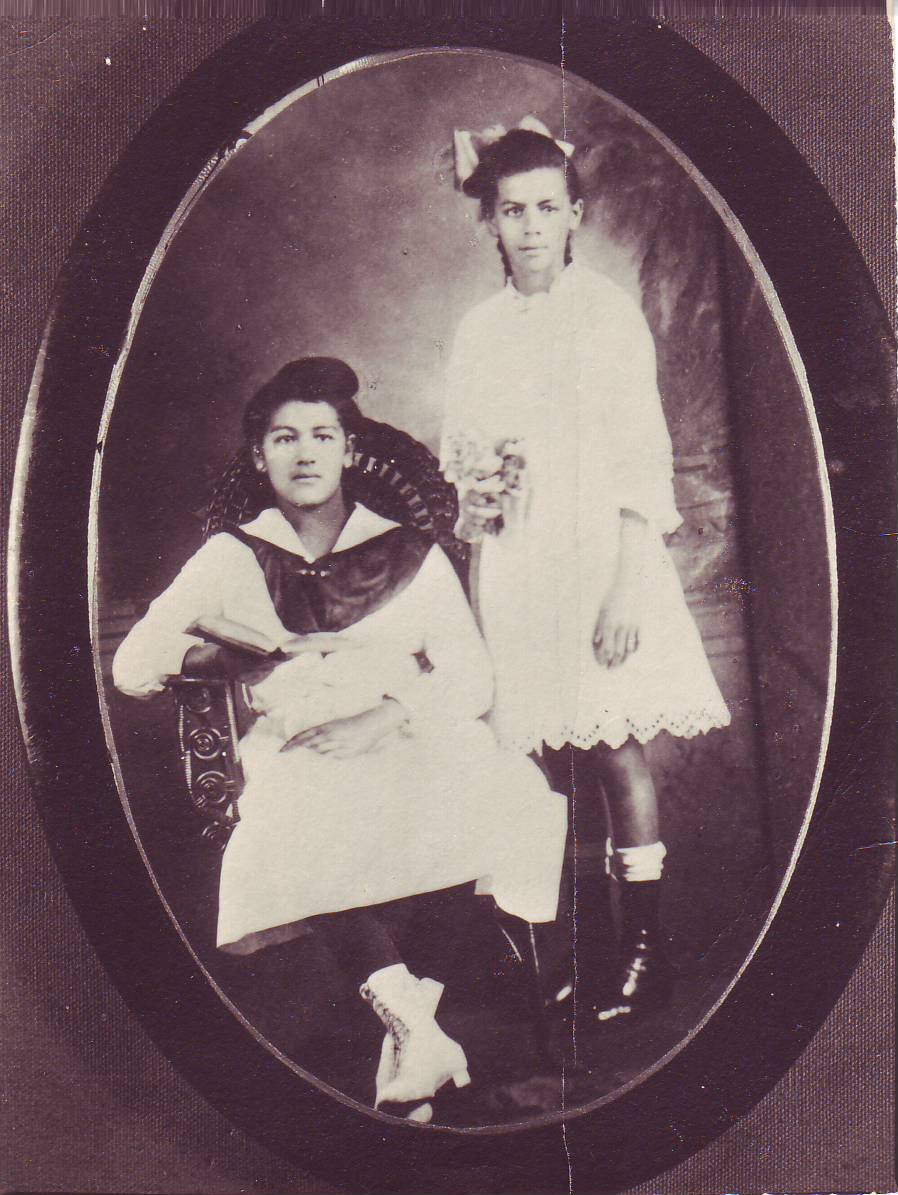
And here’s the only photo of her, little. She was about 10 years old, and her sister Mamie was 13:

Image

Mama made our little skirts and gathered skirts and blouses and every kind of thing, and sometimes Papa might buy one. But she measured your arms, see ‘bout what the sleeve is. I said, Lord, I’m glad them days gone. ‘Cause you couldn’t do nothing to suit … I don’t know, you couldn’t do nothing to suit the older people in them days, ‘cause they, what you ask, you didn’t have but so much, and every once in a while when you get a new piece of change, and you’d get something and you was glad ‘cause it was new, but not ‘cause it was fitting.   And that picture where me and Mamie, Mamie was sitting in the chair and I was standing up by it with that white dress on. Mamie sitting in the chair with her feet crossed …. Well, she had on a middy blouse, dress. It was all, it had a collar on it where had the tape running down there with the square collar and [inaudible]. And Mama made me that dress I had on out of her petticoat! She had, she used to sew a bit, and at that time embroidery wide pieces of cloth that come up, and the bottom part be all embroideried and scalloped all the way around there. Well, that dress I had on had all that scallop on there where Mama took her – she was wearing them hip underskirts, and where she was gathered up here, that had a band on it under there, and then this here was the whole yoke from halfway up to make this part, and she took that part and made me a dress.

Remembering my Mother Dear, Hattie Mae Henderson Ricks (6 June 1910-15 January 2001.)

——

Interview of Hattie H. Ricks by Lisa Y. Henderson; all rights reserved. Photos from collection of Lisa Y. Henderson.

Standard