Twenty-five years ago today, I submitted the first draft of my master’s essay prospectus to Professor Barbara J. Fields of Columbia University. The thesis itself took another year-and-a-half to complete. In between, I submerged myself in the North Carolina State Archives and the literature of free people of color and forged an unwavering fascination with their time and place in Southern antebellum history. Though I found frustratingly little direct evidence of my own ancestors’ apprenticeship, I gained a depth of understanding of their circumstances and community that has served my genealogical research well.
Category Archives: Other Documents
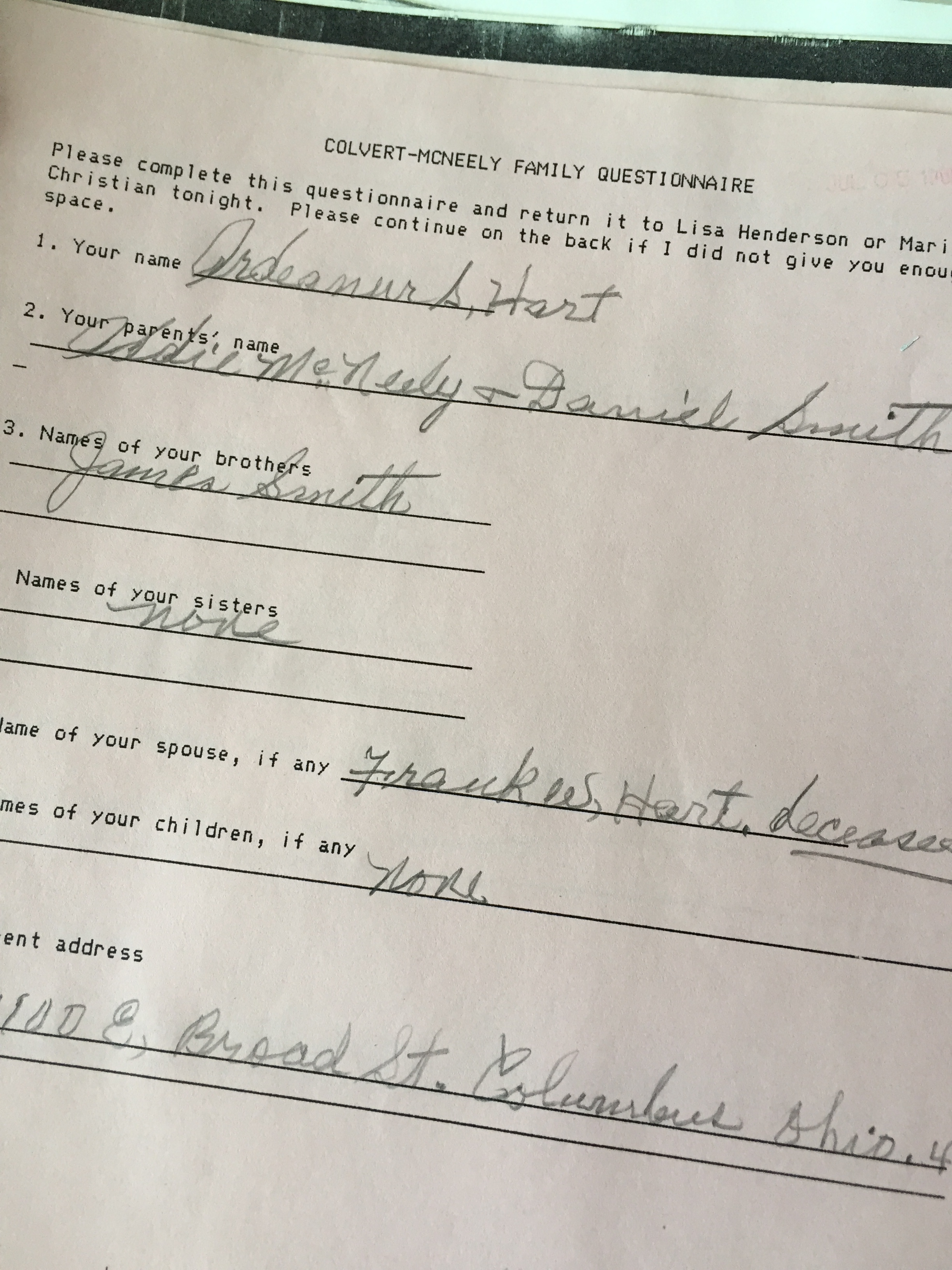
Name of your spouse, if any.
The new tenant wants access to the shed, so I trudged over to clean it out this morning. On the floor, behind a bicycle and some galvanized pails, I found two dusty three-ring binders. The papers in them were beginning to yellow and were foxing on the outer leaves, but basically in good shape. One contained notes and articles related to my graduate thesis — fodder for http://www.ncfpc.net — and the other contained copies of some of my earliest genealogical research, stuff I’d long thought lost.
Among other things, there was a stack of the questionnaires distributed at the 1986 Colvert-McNeely family reunion in Statesville. That was the reunion at which I snapped this photo of Cousin Ardeanur S. Hart. Had she …?
Ha! Yes, she had:
And just like that, her husband’s name — Frank W. Hart.
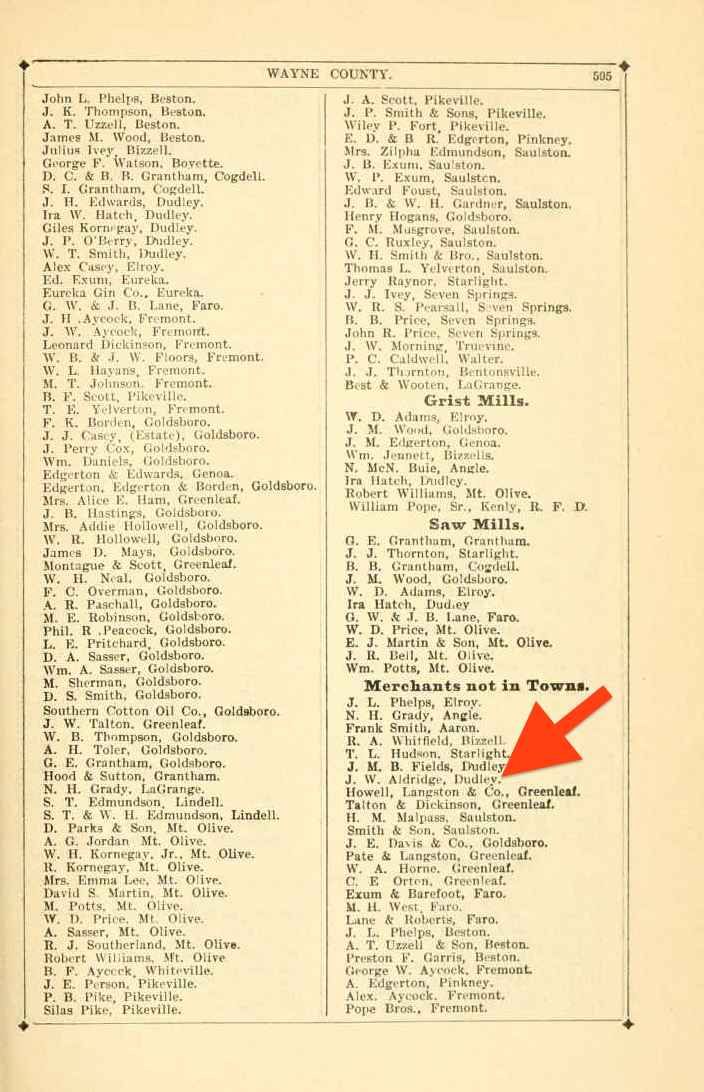
Merchant brothers.
From the Wayne County section of the North Carolina Year Book and Business Directory, published by the News and Observer, Raleigh, 1904:
John W. Aldridge‘s brother Mathew “M.W.” Aldridge was listed under the merchant heading in the town of Goldsboro.
One lovely blog? Why, thank you!
In recent days, I’ve been twice nominated for a One Lovely Blog Award. Many thanks to Maryann Barnes and Tiffiny for their thoughtfulness and kind words. It’s always nice to know that one is not only heard, but appreciated.
The “rules” for the award:
- Thank the person who nominated you and link to that blog.
- Share seven things about yourself.
- Nominate 15 bloggers you admire (or as many as you can think of!)
- Contact your bloggers to let them know that you’ve tagged them for the One Lovely Blog Award.
Seven things:
- I was born in a segregated hospital in Wilson, North Carolina.
- I drew my first family tree in a fifth grade school project.
- In a chance conversation in the spring of 1985, I learned that census records were on microfilm at my university library. I knew my great-grandmother’s name; I looked for it. When I found her living with her grandparents in 1910, I nearly passed out. I’ve been researching ever since.
- My master’s thesis examined the involuntary apprenticeship of free children of color in Wayne County, North Carolina.
- I descend from members of nearly every strata of antebellum North Carolina society – enslaved people, free people of color, Native Americans, white yeomanry, the white planter class. (I blog about free people of color at http://www.ncfpc.net.)
- Since at least the Revolutionary War, all my ancestors have been born in either North Carolina or Virginia.
- I have a Sankofa tattoo.
Blogs I admire (at the moment — the list changes):
He was faithful in all his houses.
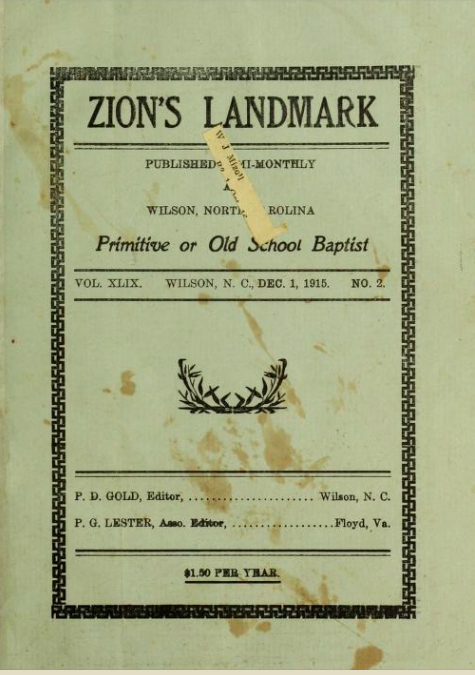
The Wilson Daily Times was an afternoon paper in my day. It was lying in the driveway when I arrived home from school, and I could read it first if I put it back like it was — pages squared and neatly folded. (Even today, I shudder at a sloppy newspaper, flipped inside out and pages sprawling.) The Daily Times‘ roots are in Zion’s Landmark, a semi-monthly newsletter begun in 1867 by Pleasant Daniel Gold. Elder Gold (1833-1920), pastor of Wilson Primitive Baptist Church, filled the periodical with sermons and homilies, ads for homeopathic remedies, testimonials, altar calls and, most enduringly, obituaries of Primitive Baptists throughout eastern North Carolina.
African-Americans did not often make it into the pages of the Landmark, but P.D. Gold held Jonah Williams in considerable esteem. Gold preached my great-great-great-great-uncle’s funeral and published in the Landmark a lengthy obituary by Brother Henry S. Reid, clerk at Turner Swamp Primitive Baptist Church:
And what does this piece add to what I already know about Jonah Williams?
- A marriage date for him and Pleasant Battle — 4 January 1867.
- Some confusion about their children. I knew Pleasant had a slew of children from a previous marriage to Blount Battle. However, I had four children for Jonah and Pleasant — Clarissa (the surviving daughter referred to in the obit), Willie F. (1872-1895), Vicey (1874-1890), and J.W., whom I know only from a stone in the Williams’ cemetery plot. I’m thinking now that this is a foot marker, rather than a headstone, and I’ll revise my notes.
- Jonah joined Aycock Primitive Baptist Church, part of the Black Creek Association, around 1875.
- Around 1895, he and others were permitted to leave Aycock and form Turner Swamp Primitive Baptist Church, the first “organized colored” P.B. church in the area. The Black Creek Association ordained Jonah when he was called to serve at Turner Swamp.
- Elder P.D. Gold preached Jonah Williams’ funeral.
Text found at https://archive.org/details/zionslandmarkse4919unse_0
Eureka! … Not.
I was flipping through an old notebook and came across this abstract of entries in the 1912-1913 city directory of Wilson, North Carolina:
Taylor, Bertha, laundress, h 114 w Lee
Taylor, Greenman, h Stantonsburg rd nr Rountree av
Taylor, Hennie, dom, h 114 w Lee
Taylor, Jordan, lab, h Stantonsburg rd nr Rountree av
Taylor, Mack, driver, h 114 w Lee
Taylor, Mattie, laundress, h 114 w Lee
Taylor, Robert, barber, h 114 w Lee
Taylor, Roderick, barber Paragon Shaving Parlor, h 114 w Lee
The house at 114 West Lee Street belonged to my great-grandfather Michael (“Mike,” not “Mack”) Taylor. Bertha, Hennie, and Mattie were his younger daughters. Roderick was his only son. Jordan and Greeman, over on Stantonsburg Road, were Mike’s niece Eliza’s husband and son. But who in the world was Robert Taylor?
Robert … Robert … An epiphany! Of course! This was Robert Perry, son of Mike’s wife Rachel‘s sister Centha Barnes Perry! The boy grew up in Mike and Rachel’s household and quite naturally he was sometimes known as Robert Taylor! … Right?
Well, perhaps, but this is not him. Robert Perry was only 9 years old in 1912. Not only would a child not have been plying a trade at that age, he would not be counted among the adults included in a city directory. (Even Rachel was omitted, as “dependent” homemakers did not make the cut either.)
So, who was this Robert Taylor who both lived in Mike Taylor’s house and worked in the same trade as Mike’s son Roderick?
Census records do not show an African-American Robert Taylor in all of Wilson County in the 1900 or 1910 censuses. In 1920, however, there is Robert Taylor, age 36, a laborer, with wife Mary G., age 29, living at 611 Green Street. Now this is really puzzling.
Two years earlier, when Roderick Taylor registered for the World War I draft, he stated his birth year as 1883, his occupation as barber, and his address as 611 East Green Street. There is no “Roderick Taylor” listed in the 1920 census, but in 1930, at 610 [sic, house numbers shifted in the early 1920s] Green Street, there is barber Roderick Taylor, 45, wife Mary J., 39, and three children.
While it is conceivable that there were both a Robert Taylor and Roderick Taylor of the same age, living in the same houses, with wives of the same name and age, and working in the same profession, it seems unlikely. Rather, in an era in which “Roderick” was rare name, an inattentive census taker or canvasser might easily have heard “Robert” when making his inquiries. Absent further independent evidence that a Robert Taylor existed, I conclude that Roderick’s doppelgänger is a figment of error.
B.S. Civil Engineering.
Oscar Randall, son of George and Frances “Fannie” Aldridge Randall, appeared in The Crisis‘ annual round-up of recent college graduates.
“Civil Engineer, Oscar Randall, whose scholastic average is 87% for the 4 year term,” p. 140.
Allison, M.G., “The Year in Negro Education,” The Crisis, July 1920, volume 20, number 3.
Collateral kin: Barnes & Ellis.
My uncles migrated North. My father and his sister stayed put. (Since the late 1970s, they have lived across the street from one another and, during my childhood, within a couple of blocks.) My father graduated high school in 1952, and in his class was the man my aunt would marry, Theodore Roosevelt Ellis Jr.
Theodore Roosevelt Ellis, Jr., 1950s.
Uncle Roosevelt, who had startlingly hazel eyes and smooth, nut-brown skin, had deep Wilson County roots, and I have written of my bond with his family here. Today would have been his 80th birthday and, in his honor, I highlight his people.
We called Uncle Roosevelt’s mother “Miss Edie Bell.” Miss Edie Bell’s earliest known paternal ancestor was Benjamin Barnes, born about 1819, probably in southern Edgecombe County or northern Wayne County (areas that later became Wilson County.) Circumstantial evidence, largely in the form of naming patterns and proximity, suggest that Benjamin had at least two brothers, Redmond Barnes, born about 1823, and Andrew Barnes, born perhaps 1815. On 21 April 1866, Benjamin Barnes and Violet Barnes, born about 1817, registered their long cohabitation at the Wilson County Courthouse. Their only certain child was Calvin Barnes, born about 1836, though they probably had several more. In the 1870 census of Saratoga, Wilson County, Violet is described as a midwife, and three young girls, Elvy (1859), Ailcy (1862) and Spicy (1863), live with them. Given Violet’s age, it seems likely that these are granddaughters. Violet Barnes died sometime before 13 November 1879, when Benjamin was married a second time to Mary Bynum in Wilson County. [The Benjamin Barnes, son of Isaac and Judia Bynum, who married Lucy Barnes in 1872 in Wilson County is a different man.] Benjamin and Mary’s appearance in the 1880 census of Saratoga is their first and last. Benjamin listed his father’s birthplace as Virginia, but provided no additional information. He died before 1900.
Calvin Barnes and “Sealie” Barnes registered their five-year cohabitation in Wilson County on 17 July 1866. Celia’s parents are unknown. Nor do I know whether Calvin and Celia belonged to the same master prior to emancipation. In the 1870 census of Saratoga, Wilson County, Calvin and family are living next door to his parents Benjamin and Violet. Calvin and Celia’s children are Benjamin (1864), Spicy (1865), Jesse (1866), and Peter (1869). Also in the household are 20 year-old Dora Ebon (Calvin’s sister?) and her likely children Louisa (1866) and Mary E. (1869). In 1880, in Saratoga, Calvin heads a household that includes wife Celie and children Peter, Drue, Redman, Lizzie B., and William. In 1900, the family was listed in Stantonsburg township. Calvin was farming, and Celie reported 10 of 13 children living. Only four — William, Mary S., Laura and Celie, plus Mary’s daughter Dora — were at home. Son Peter was nearby with his wife Jane and children John R., General, Annie and Sallie, as was son Redmond with wife “Genett” and their first child Dora. Celia died prior to 1909, when Calvin married Cherry Brown Tart. The marriage was her third, and the 1910 census found them living in the town of Wilson on Stantonsburg Street. Ten years later, they are living at 610 Stantonsburg Street and both employed in a private home. Calvin died 21 February 1923 in Wilson.
Calvin and Celia’s son Redmond Barnes was born 3 May 1873 near Saratoga or Stantonsburg. In 1898, Redmond married Jennette Best on W.H. Applewhite’s farm, where the Barneses were either sharecroppers or tenant farmers. (Applewhite’s grandson, James, is a celebrated poet whose writing often draws on the world of his childhood in Wilson County.) Edith Barnes Ellis’ siblings included Dora Barnes Weaver Ward (1899-1994), Fred Barnes (1901), Mary Estelle Barnes (1903-1989), Minnie B. Barnes Barnes (1905-1985), Edith Bell Barnes Ellis (1907-1984), Betty Lee Barnes Bullock (1909-1992), Nora Lee Barnes (1911), Alice Jennette Barnes Smith (1913), Lula Mae Barnes Speight (1916), Redmond Barnes Jr. (1918-1989), John Harvey Barnes (1920), and Jennette Barnes, who died in infancy.
Redmond Barnes’ brother Peter Barnes (1869-??) married Jane Ruffin in 1891 in Wilson County. Their children included John Redmond (1892), General (1895), Annie (1897), Sallie (1899), and Albert (1900-1924). Redmond’s brother Andrew “Drew” Barnes (1871-1945) married Estella “Stella” Williams in 1892 in Wilson County. [Not to be confused with Andrew Barnes, son of Andrew and Amy Williford Barnes — probably Calvin Barnes’ first cousin — who married Stella Battle in 1870.] Their children included John (1890), Wade (1894), Frank (1895), James (1897), Lula (1898), and Andrew Jr. (1900). Redmond’s sister Elizabeth “Betty” Barnes (1873-??) married W.T. Sherrod Ellis, son of Reuben and Clarky Ellis. Their children: Willie (1892), Robert (1895), Mary E. (1896), Maggie D. (1899), Sallie (1900), Joseph (1904) and Mamie (1906). Redmond’s sister Mollie Barnes married Floyd Ellis. Their children included Floyd Theodore (1907-1981), Columbus (1909), John Adam (1916-1965), Mary Rebeckah (1919) and Leathie Charlotte (1922).
Jennette Best was born about 1880 near Stantonsburg. Her marriage licenses lists her parents as Sam Best and Edy Strickland. However, in the 1870 census of Stantonsburg, Wilson County, “Edy Strickland” appears as Edith Winstead, age 10, in the household of Isaac Winstead, 52, and wife Jane, 35, whose other children were Robert, 7, Amanda, 3, and Aneliza, 1. Then, the 1880 census of Stantonsburg, shows “Ada Best” in a household with her stepfather Isaac Winstead, mother Jane, half-siblings Manda, Ann, Charlie, Major, Lucy and Levi, brother Rob Farmer, and likely children Sam, 3, and Mary Best, 1. Sam Best is not listed in the county and may have died or have deserted his family just before Jenette was born. I have not found him in any census or vital record. Nor have I found any other mention of Edith Best or Strickland.
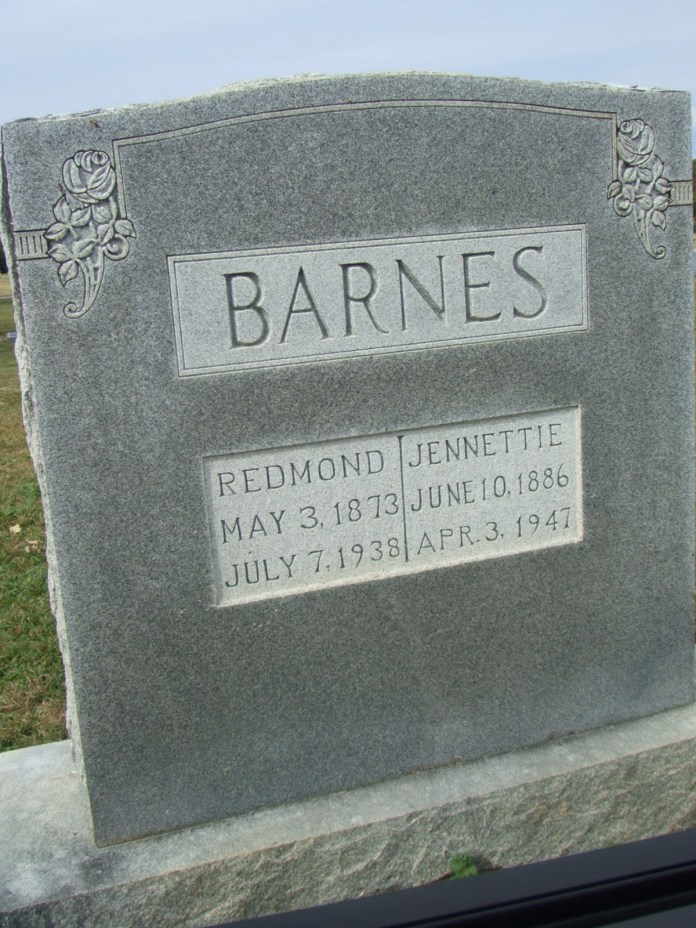
Rest Haven cemetery, Wilson, N.C.
On 7 June, 1933, Edith Barnes married Theodore R. “Tobe” Ellis. (We called her “Miss” Edie Bell, and him “Uncle” Tobe, which I can’t explain.) Theodore Ellis’ furthest known paternal ancestors were Isom Ellis and Patience Bynum.
Isom (or Isham) Ellis was born about 1807 in southern Edgecombe County. The will of William Ellis, proved in Edgecombe in 1813, declared in part, “I leave unto my said wife Unity Ellis, the following negroes, To wit, Arthur, Jonas, Isom, Belford, Lisle, Pat, Minnah, and Tesary & Hester.” It seems probable that this listing is a reference to Uncle Tobe’s great-grandfather.
On 24 July 1866, Isom Bynum and Patience Bynum registered their 40-year cohabitation in Wilson County. Several other men — Guilford, Robert, Jackson and Lewis — also registered as Bynums, but are listed with the surname Ellis in the 1870 census. For this and other reasons, including proximity and naming patterns, I believe these men were all sons, or close relatives, of Isom Ellis. Lewis Ellis, born circa 1834, first married Dossie Best, by whom he had one son, John (1853). He then married Millie Thompson (1832-??) — they registered their cohabitation — who gave birth to Daniel (1860-1938), Mary (1863), Adeline “Addie” (1865), Martha (1868), Cora (1870) and James Ellis (1874). Neither Lewis nor Millie appears in the 1900 census.
Lewis and Milly’s son Daniel Ellis first married Rosa Barnes, by whom he had a daughter, Lena (1890-1928). He then married Celia Lewis (1872-1912), daughter of Furney and Eliza Lewis on 29 August 1893 in Wilson County. Their children were William (1894), Maeliza (1897), Samson (1898-1918), Harry (1900-1988), Jackson (1901-1918), Robert (1904-1968), Louetta (1906), Orran (1910-1918) and Theodore Roosevelt Ellis (1912-1979). After Celia’s death in or just after childbirth, Daniel married Maggie Woodard in 1914. Their children were Mack (1916), John Henry (1919-1963), Mattie (1922) and Jem (1925). Daniel Ellis died 10 October 1938.
Celia Lewis’ family was from Wayne County. In the 1870 census of Goldsborough, Wayne County, Furney Lewis, 40, and wife Eliza, 26, shared a house with Missouri, 11, Furney, 9, Lewis, 4, and Winnie, 5 months. Ten years later the family appears in Stoney Creek township, Wayne County: Furney Lewis, 58, wife Liza, 35, and children Lewis, 17, Winia, 9, Henry, 7, Cealy, 5, Mary, Caroline, 3, and Furney, 1, plus Furney Sr.’s sister Mary Lewis, 54. Eliza Lewis likely died before 1894, when 71 year-old Furney Lewis remarried. However, he is not found in the 1900 census.
——
Top, Fannie Hardy Ward, Theodore R. Ellis and Edith Barnes Ellis. Bottom, Eloise Ward and T. Roosevelt Ellis Jr., probably near Stantonsburg, Wilson County, circa 1939.
Thanks to Monica Ellis Barnes and Tracey Ellis Leon for use of family photographs. Photograph of headstone taken in March 2013.
Daniel Artis, Union soldier?
Daniel Artis’ pension file arrived today, and I was puzzled. Was this either of “my” Daniels?
As detailed here, Daniel Artis, allegedly went to war as a body servant for Confederate officer Christopher C. Lane. There are two Daniel Artises. One was born about 1820 and would have been well into middle age when he trudged off to battle. On the other hand, his nephew Daniel Artis, Sylvania’s son, was born about 1843, and was in his prime when the Civil War erupted.
What does the file tell us? It’s a slim one, as pension application files go. Daniel’s request for assistance was rejected summarily, so there was no need to interview his neighbors and kin to corroborate his claims. Still, it is useful.
On 2 December 1901, the Board of Review received an application from DANIEL ARTIES, G 14 USCHA, and assigned it claim number 1277226. Milo B. Stevens & Company of Washington, D.C., a firm of attorneys specializing in pension claims, represented the old soldier. Daniel gave his address as P.O. Box 5, Greenville, Pitt Co., NC, and stated that he had enrolled in the Army in an unknown date in 1865 and been discharged on 11 December of the same year. Despite the Pitt County address, Artis granted Stevens power of attorney on a form sworn to in Wayne County — specifically, Eureka — in the presence of W.M. Exum and Philip Forte. I’m not clear on Exum’s identity, but Forte was a prominent African-American in the neighbor and himself a Union veteran. Further, Forte’s daughter Hannah married Daniel’s cousin Walter S. Artis, son of Adam and Frances Seaberry Artis. Simon S. Strother, the notary public who stamped Daniel’s application, was executor of Adam T. Artis’ estate.) At some point, a commissioner requested “personal description and name of owner” from Artis, but the response — which would have included an assertion of his freeborn status — is not found.
Daniel’s supporting declaration for invalid pension stated that he was 68 years old, that he had been discharged at Fort Macon, and that he was unable to support himself by manual labor due to “rheumatism in back and hip and piles and affected in the breast.” Daniel signed the document with an X.
And then the downer: “Rejection on the ground that the soldiers name is not borne on the rolls of Co G, 14th U.S.Col.H.A., as alleged, as shown by the report from the War Department.”
So, which Daniel is this? Several clues help eliminate Daniel the elder. First, he was born circa 1820, well before Daniel the applicant. Second, Daniel the elder owned significant property in Greene County and is not known to have lived in either Wayne or Pitt Counties. Last, and this applies to either, if Daniel served Christopher C. Lane during his time as an officer in Company A, 3rd North Carolina Artillery from about 1861 till his death in 1864, is it likely that he would have trudged home from Georgia, turned around, gone to New Bern, and enlisted in the Colored Troops in 1865?
My money is on Daniel, son of Sylvania Artis and Guy Lane. Here’s the little I know about him:
In the 1850 census of Greene County, next to white farmer John Lane, Silvany Artess is listed with her children Daniel, Mitchell, Meriah, Gui, and Penny Artess. Ten years later, John Lane’s household included Dannel, Mike, Penney, Dyner, Juley, and Washington Artis, who probably were his apprentices. Next door was 40 year-old Dannel Artis, the children’s uncle. On the other side, their mother Sylvania Artis.
Around 1861, Daniel went to war with John Lane’s son Christopher and returned home in 1864. Surely it is he, and not his 45 year-old uncle Daniel, that enlisted in the Union Army in 1865. His service was short-lived, and he apparently returned to Greene County after.
Guy Lane and Sylvania Artis formalized their marriage a year after he was emancipated, and by 1870 the family had moved several miles west into Nahunta district, Wayne County. There, Guy Lane and wife Silvania are shown in the census with children Daniel, Mike [Mitchell], Mariah, Guy, Penny, Dinah, Julie, Washington, and Alford.
In the 1880 census in Bull Doze [Bull Head] township, Greene County, Daniel Artis appears with his wife Eliza and children Emma D. and James W. I cannot find him in any census thereafter. However, if he is the Daniel Artis who applied for a Civil War pension, he was living in Wayne or Pitt County from 1900 until at least 1904. The notice below also seems to indicate that he was alive as late as 1905, when Dunk Lane and “Miss Dickerson” used his house as a place of assignation. This is the last evidence I have of Daniel Artis’ life.
Goldsboro Weekly Argus, 1 August 1907.
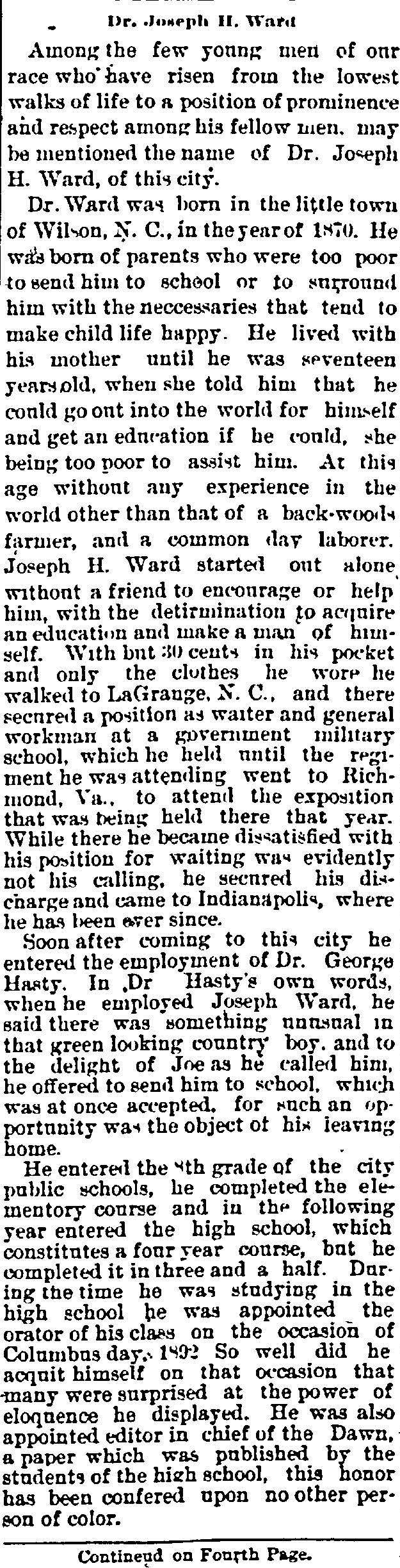
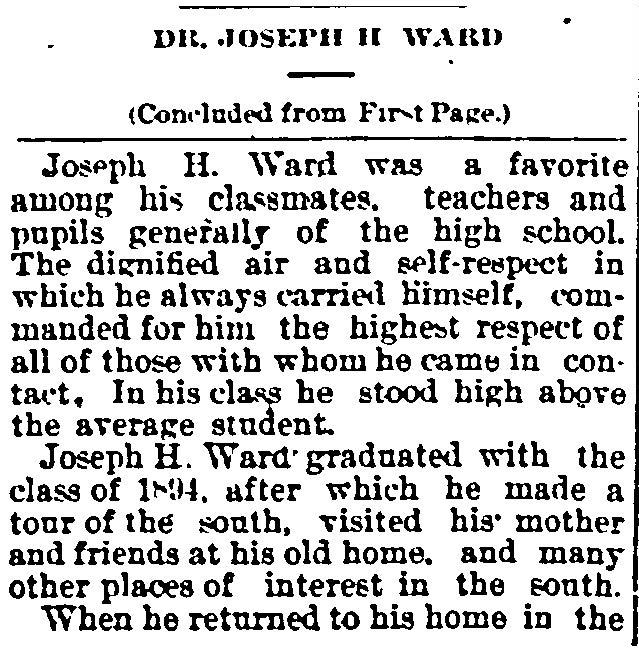
The rise of the Grand Chancellor; or “There was something unusual in that green looking country boy.”
In which the Indianapolis Freeman enlightens us regarding Joseph H. Ward‘s journey from Wilson, North Carolina, to Naptown:
Indianapolis Freeman, 22 July 1899.
A few notes:
- Joseph Ward’s mother might have been too poor to send him to school, but his father Napoleon Hagans, had he chosen to acknowledge him, certainly could have, as he sent his “legitimate” sons to Howard University.
- The school in LaGrange at which he worked was most likely Davis Military Academy: “By 1880 a second school for boys … Davis Military Academy, was founded by Colonel Adam C. Davis. “School Town” became La Grange’s nickname as the military school would eventually have an enrollment of 300 students from every state and even some foreign countries. The school also had a band, the only cadet orchestra in the country during that time. The school prospered, but an outbreak of meningitis closed it in 1889.”
- Dr. George Hasty was a founder of the Physio-Medical College of Indianapolis, which Joseph Ward later attended.
- Joseph graduated from High School No. 1, later known as Shortridge, an integrated institution.
- A “tour of the south”? Really?
- Do student records exist from the Physio-Medical College? The school closed in 1909.
- Joseph’s first wife was Mamie I. Brown, an Indiana-born teacher. The 20 October 1900 issue of the Indianapolis Recorder reported: “Mrs. Mamie Ward, through her attorney O.V. Royal, was granted a divorce from her husband, Dr. J.H. Ward, in the Superior Court no. 1, and her maiden name was restored. Both parties are well known in society circles.” Four years later, Joseph married Zella Locklear.