Business, Newspaper Articles, North Carolina, Other Documents, Paternal Kin

The colored people of Wilson have organized a bank.

In December 1920, five of Wilson, North Carolina’s leading African-American citizens executed a certificate of incorporation to establish the Commercial Bank of Wilson. The bank was necessary, they asserted, “to promote thrift and economy,” “to encourage agriculture and industrial enterprises,” and “to place in circulation money otherwise unavailable.” Farmer, realtor and businessman Samuel H. Vick; barber William H. Hines; school principal J. James D. Reid; funeral home operator and businessman Camillus L. Darden and physician Frank S. Hargraves — the unquestioned cream of east Wilson‘s crop — each invested in 100 shares of bank stock and, after filing the document, set about designating a president (Hines) and board of directors (J.R. Rosser, Isaac A. Shade, Cain D. Sauls, Charles S. Thomas, R.A. Worlds, John Lucas, C.S. McBrayer, J.O. Mitchell, Lee Pierce, Alfred Robinson and Judge D. Reid), and a cashier (G.W.C. Brown).

Attached to the filing are three pages listing the names of all the bank’s investors and providing information about their net worth and occupation.  Most of more than 150 shareholders — overwhelmingly African-American men — lived in Wilson or Wilson County, but adjoining counties like Wayne, Greene and Johnston were represented, as well as more far-flung cities like Durham and Elizabeth City, North Carolina.  They were farmers and contractors, merchants and ministers, teachers and barbers, with estimated worths ranging from $300 to $50,000.

Image

Image

Image

At least two of my relatives were among the bank’s investors. C.D. Sauls of Greene County, whose connection through Daniel Artis I chronicled here, was a bank officer, and his cousin Columbus E. Artis, who owned and operated a funeral business in Wilson, bought five shares.

ImageHill’s Directory of Wilson, North Carolina, 1922.

Newspapers reported the bank’s opening excitedly.

Wilm Morning Star 11 18 1920

Wilmington (NC) Morning Star, 18 November 1920.

The Independent Eliz City 2 25 1921

Elizabeth City The Independent, 25 February 1921.

E City Independent 3 4 1921Elizabeth City The Independent, 4 March 1921.

In the 1921-1922 issue of The Negro Year Book: An Annual Encyclopedia of the Negro, Monroe N. Work, editor, Commercial Bank of Wilson was listed as one of only eight black banks in the state of North Carolina, which trailed only Virginia (13) and Georgia (9) in the number of such institutions. [Sidenote: one of Virginia’s was Crown Savings Bank of Newport News, for which my great-grandfather John C. Allen served as board member.]

Alas, things fell apart. After a fire in the vault destroyed records, the State launched a criminal investigation that resulted in the closing of the bank on 4 September 1929 and the indictments of vice-president (and chief promoter) J.D. Reid and cashier H.S. Stanbank on charges of embezzlement, forgery and deceptive banking practices. As reported in the 22 February 1930 issue of the Pittsburgh Courier, the courtroom was daily packed with victimized depositors and shareholders, all of whom bore an “intense feeling of resentment against the accused….” Both were convicted and sentenced to five-year prison terms — at hard labor — but released after two years.

burlington Daily Times-News 12 22 1931

Burlington Daily Times-News, 22 December 1931.

Standard
Free People of Color, Land, North Carolina, Other Documents, Paternal Kin

100 acres on Watery Branch.

Fourteen years into their marriage, Adam and Frances Seaberry Artis purchased three tracts of land totaling about 109 acres from her half-brother, Napoleon Hagans. All three are on or near Watery Branch, an east-flowing tributary of Contentnea Creek. The first two documents are a mortgage deed and deed of sale for two tracts on the creek. The third is a deed of sale for an additional nine acres nearby. Notably, this last is land upon which Adam had lived in prior years, as it contained the graves of his first wife, Lucinda Jones Artis, and a child.

—–

North Carolina, Wayne County  }  This indenture made this the 25th day of July AD 1874, between Adam T. Artis and wife Frances of the first part, and Napoleon Hagans of the second part, and all of the County and State above written, Witnesseth that the said parties of the first part for and in consideration of the sum of one dollar in hand paid by the said party of the second part, have bargained and sold and by these presents do convey unto the said party of the second part, and his heirs two tracts or parcels situated in the County of Wayne, and bounded as follows: viz: the first tract begins at a pine on the New Road in Willie Moorings line and runs with his line North 136 poles to a stake on the main run of Watery Branch, then up and with the various courses of the branch to the mouth of a small branch, then up the various courses of said branch to a stake, then E 20 poles to said new road, then with the same to the beginning, containing Eighty eight acres, more or less: the other tract begins at a stake in Cullen West’s line, and runs South 28 ¼ poles to a stake in said line Charity Bailey’s corner, then with his line West 67 ¼ poles to a stake Wm Bailey’s corner, then with his line West, 67 ¼ poles to the beginning, containing twelve and one fourths acres more or less _

And the said parties of the first part do for themselves and their heirs forever warrant and defend title to the above land, to the said party of the second part his heirs and assigns

The condition of the above deed is such whereas the above named Adam T. Artis is indebted to the said Napoleon Hagins in the amount of Fifteen hundred dollars, purchase money for the land herein conveyed, and for which said sum the said Artis has given promissory notes for $375.00 each, and payable in the manner following viz: the first note will be due on the 1st day of January AD 1876: at the same day and date the interest on the whole amount of the purchase money ($1500.00) from Jany 1st 1875 to that date will be paid annually on the first day of January. The amount of principal paid thereon to be deducted; the second note will be due on January 1st 1877, the third on January 1st 1878; and the fourth on Jany 1st 1879, and all are subject to the conditions set forth as to the first note above mentioned.

Now if the said Artis shall pay the interest as above set forth as they come due according to their tenor, then this deed to be void otherwise to be of full force and effect.

And upon the failure of said Artis to pay said noted and interest as above set forth as they severally fall due, then it shall be in the power of said Hagins to sell the land herein described after twenty days advertisement at the Court House door in Goldsboro and four other places in Wayne County, and after deducting the whole amount due him & the expenses of sale shall pay the balance if any to the said Artis or his legal representatives.

In testimony whereof the said parties of the first part have hereunto set their hands and seals the day and date first above written.

Witness: /s/ W.T. Faircloth             Adam X Artis, Frances X Artis

[Wife’s consent omitted.]

Deed Book 37, page 72, Wayne County Register of Deeds office.

—–

State of N. Carolina, Wayne County  } This indenture made this the 25th day of July in the year of Our Lord One thousand Eight hundred and Seventy four, between Napoleon Hagins and wife Absey Hagins of the first part and Adam T. Artis of the second part, all of the County and State aforesaid Witnesseth: that we said Hagins and wife parties of the first part for and in consideration of the sum of Fifteen hundred Dollars to us in hand paid by said Adam T. Artis  the receipt and payment whereof we said parties of the first part do by these presents hereby acknowledge ourselves fully satisfied content and paid before the ensealing signing and delivery of the same have bargained sold delivered given up conveyed unto said Artis his heirs and assigns two certain pieces or parcels of land lying in said County of Wayne on the South side of Watery Branch, the first tract adjoining the lands of Wiley Moring Charity Bailey and others, bounded as follows:  Beginning at a pine on the New Road in Willie Moring’s line and runs with said line N. 136 poles to a stake on the main run of Watery Branch, then up the various courses of the run as it meanders to the mouth of a small branch, then up the run of said small branch its various courses to a stake, then East 20 poles to said New Road, then with the same to the beginning, containing Eighty eight acres, more or less:

Also one other tract purchased from Wm. Bailey and wife Celia, adjoining the lands of Charity Bailey Wm. Bailey Cullen West and others bounded as follows: Beginning at a stake in Cullen West’s line and runs South 28 ¼ poles to a stake in said line Charity Bailey’s corner, then with her line West 69 ½ poles to a stake in said West’s other line, then with said line  N 28 ¼ to a stake, Wm Bailey’s corner then with his line W 69 ½  poles to the beginning, containing 12 ¼  acres more or less _

And we said Hagans and wife Absey parties of the first part do by these presents bind ourselves our heirs executors admrs & assigns forever free claims or encumbrances whatsoever

In testimony whereof we the said Hagins and wife have hereunto set our hands and affixed our seals, the day and date first mentioned.

Witness: /s/ W.T. Faircloth             Napoleon X Hagans, Absey X Hagans

[Wife’s consent omitted.]

Deed Book 37, page 74, Wayne County Register of Deeds office.

—–

North Carolina, Wayne County  }

This Deed made this thirty first day of October 1874 by Adam Artis and his wife Frances of Wayne County, and State of North Carolina to Napoleon Hagans of Wayne County, and State of North Carolina, Witnesseth that said Adam Artis in consideration of Two hundred & seventy five /100 Dollars, to them paid by said Napoleon Hagans, the receipt of which is hereby acknowledged, have bargained and sold and by these presents do bargain, sell and convey to said Napoleon Hagans and his heirs a tract of land in Wayne County, State of N.C. , adjoining the lands Bryant Yelverton & Jesse Mincey, and others, bounded as follows: viz: — Beginning at a stake on road in Yelverton’s line and runs S. 59 E. 51 ½ poles to a light stake in Yelverton’s line then N. 61 poles to another stake on said road then S. 54 W. with said road to the beginning containing 9 ¼ acres more or less.

Reserving a graveyard on said land, now paled in in which the said Adam Artis’ first wife & one child were buried.

To have and to Hold the aforesaid tract of land and all privileges and appurtenances thereto belonging to the said Napoleon Hagans and his heirs and assigns to them only

And the said parties of the first part do for themselves and their heirs forever warrant and defend title to the above land, to the said party of the second part his heirs and assigns to their only use and behalf

And this the said Adam Artis & wife Frances, covenant that they are seized of said premises in fee and have right to convey the same in fee simple, that the same are free from all incumbrances, and that they will warrant and defend the said title to the same, against the claims of all persons whatsoever

In testimony whereof, the said Adam Artis & wife Frances have known to set their hands and seals, the day and year above written  Adam X Artis, Frances X Artis

[Wife’s consent omitted.]

Deed Book 37, page 220, Wayne County Register of Deeds office.

deed

Standard
Free People of Color, North Carolina, Other Documents, Paternal Kin, Photographs, Rights

Jurors and judges of election.

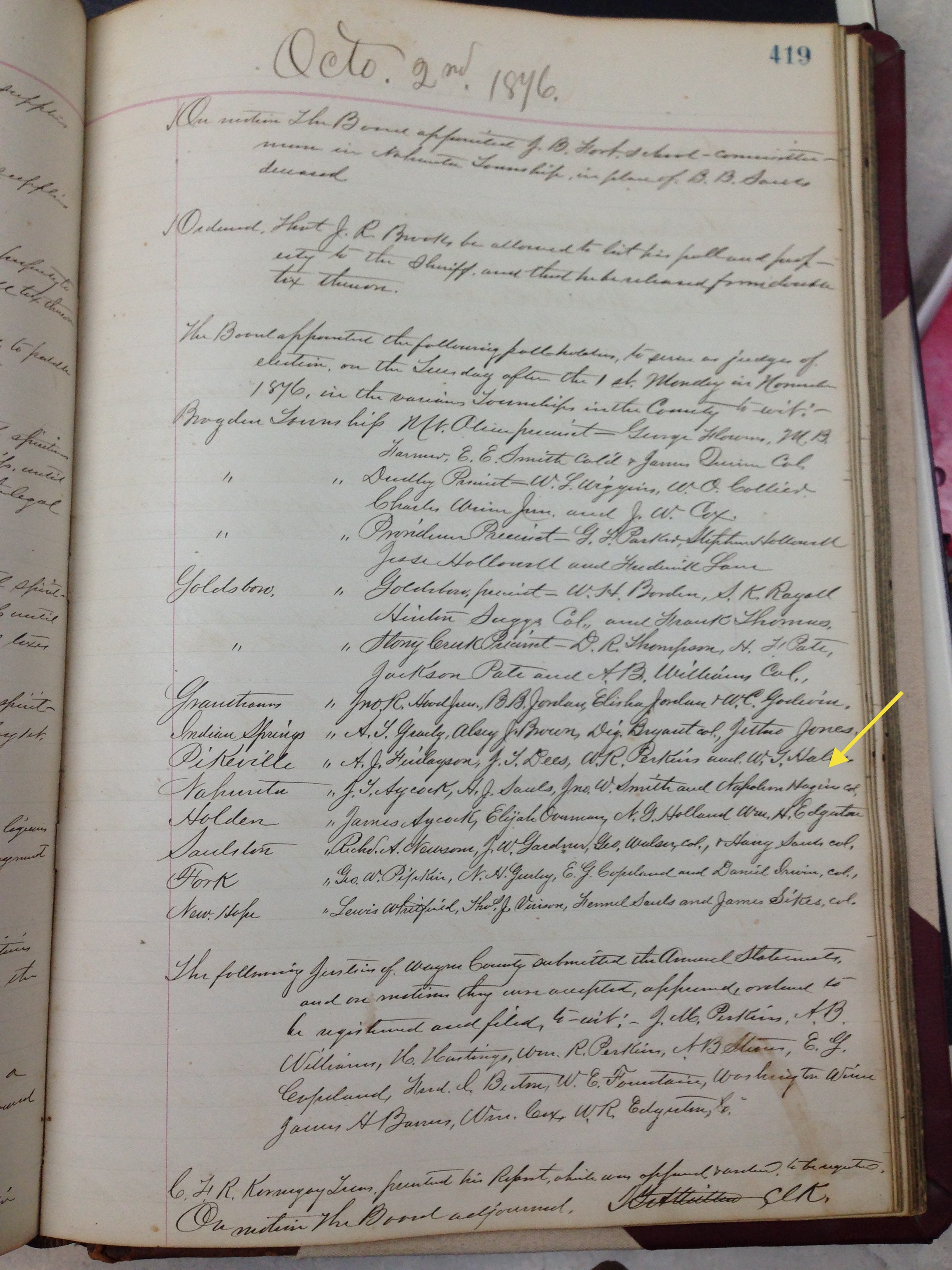
As tax-paying landowners, many African-American men in Wayne County, North Carolina, in the 1870s were called alongside white men to fulfill their civic duties. Here are two entries from Superior Court Minute Book 2:

ImageNapoleon Hagans of Nahunta township was appointed a judge of elections.

ImageMy great-great-great-grandfather Lewis Henderson drew jury duty for the first week of the next term of the superior court.

Superior Court Minute Book 2, Wayne County Register of Deeds Office, Goldsboro, North Carolina.

Standard
Enslaved People, Land, North Carolina, Other Documents, Photographs

Dr. Ward’s house. And me.

After my recent rediscovery of a Confederate map that revealed the locations of several plantations significant to my genealogical research, I began searching for more information about John Lane, Silas Bryant and David G.W. Ward‘s landholdings. Pretty quickly, I found a link to a copy of a nomination form for the National Register of Historic Places Inventory, submitted for the Ward-Applewhite-Thompson house near Stantonsburg, North Carolina. This Greek Revival house, dating back to about 1859, was owned and occupied by several of the area’s leading planters — including “country doctor” D.G.W. Ward, who purchased it in 1857 — and it and its outbuildings are little changed from their antebellum forms.

As I read the detailed architectural description of the house and its setting, a tiny kernel of recognition began to form in the back of my mind. A big, white, two-story house? Set well back from the road? Just outside Stantonsburg? Could it …?

I scoured the maps attached to the nomination form, trying to lay them over the current topography. State Road 1539 … that would be Sand Pit Road today …  just east of a fork in the road and just north of the Norfolk & Southern Railroad (which was not there in Ward’s time) … and there it is, just like I remember.

sand pit road

Yes. Like I remember.

I’ve BEEN in this house. Many times, though long ago.

Growing up, my sister and I were very close to my father’s sister’s daughters. Our local family was quite small, but my cousin’s father came from a big family with deep Wilson County roots. Her grandmother had nearly a dozen siblings — whom we also called “aunt” and “uncle” — and we were often invited to attend their family gatherings. I remember best the delectable Easter, Thanksgiving and Christmas dinners gathered around tables groaning with food, but there were also the annual 4th of July family reunions at Aunt Minnie’s out in the country near Stantonsburg. The Barneses were tenant farmers for an absentee landowner and rented his large two-story house. We’d pull off the road into a sandy circular drive and park under the trees alongside cars with New York and New Jersey plates. I vividly remember my cousin’s great-uncles and cousins tending a barbecue pit in which a split pig roasted, chickens strutting among them.  A screened side porch protected platter after platter of home-grown, home-cooked goodness.  My memories of the interior of the house are vague: a central staircase, two large front rooms, the kitchen in back. (The staircase I remember mostly because, carefully tending a tall glass of lemonade, I missed a riser and slid down their length, smacking my ribcage against the steps and knocking the wind out of myself.)

I couldn’t believe it. It is exciting enough to identify D.G.W. Ward’s house and find that it is still standing, but to realize that I knew the house at which Appie and Mittie Ward had lived and worked as the enslaved children of their own father was uncanny.

IMG_4960Ward-Applewhite-Thompson House today.

Photo taken by Lisa Y. Henderson, February 2014.

Standard
Enslaved People, Free People of Color, Land, North Carolina, Other Documents, Paternal Kin

Confederate map tells all.

Years ago — 10? 15? — I ordered copies of two Confederate field maps from the fine folks at Wilson County Genealogical Society. (The originals are held at North Carolina State Archives.) The maps feature not only geographic markers, such as creeks and towns, but the names of landowners throughout the region. I remember intently scanning the area around modern-day Eureka, hunting for signs of my Artises and finding none. (Celia Artis is on one of the maps, but she’s not “mine.”) Disappointed, I folded them away in a box.

A couple of days ago, I stumbled across the maps while reorganizing some files. I let my eyes drift a little further afield and

SILAS BRYANT! JOHN LANE! DR. WARD!

jumped off the page.

Just like that, the locations of the farms on which Vicey Artis‘ children, including Adam, were apprenticed; Sylvania Artischildren were apprenticed; and Mittie Ward and Apsilla Ward Hagans were enslaved (by their father.) Not only that — with a little extrapolation from the 1860 census, I can determine approximately where my people were living during the War.

Here’s the first map (with my annotations in unfortunate grayscale, click to enlarge):

Confederate_Field_Map_2 annotated

The left edge of the map is defined by the Wilmington & Weldon Railroad. (2) Nahunta, bottom left and now the town of Fremont, is exactly halfway between Wilson, seat of Wilson County, and Goldsboro, seat of Wayne County. Follow the road east out of Nahunta on what is now NC 222, and you’ll see (3) Martinsville, now Eureka. Angle southeast from Eureka on what is now Faro Road, then veer right at the fork onto what is now Lindell Road. (See “B. Mooring”? Frances Seaberry and her family are listed near his household in the 1860 census.) After crossing a north-south road, pre-Lindell takes a sharp turn north. Drag your finger straight across from the bend and you’ll touch two squared names — Silas Bryant and John Lane.

Here is Bryant’s household in the 1850 census of Greene County:

silas bryant 1850

And on the next page:

john lane 1860

As reflected on the map, Silas Bryant and John Lane lived in close proximity, and, on their land, sisters Sylvania and Vicey Artis, who owned no property. My great-great-great-grandfather Adam Artis and his sisters Charity and Jane are listed in Bryant’s household, which suggests that they served him as involuntary apprentices under North Carolina’s laws governing the labor of the children of unmarried free women of color. (Both Sylvania and Vicey were married, of course, but to enslaved men — relationships that were not recognized under the law.) The 1860 census suggests that John Lane also had apprentices, Sylvania’s younger children. Lane may also have owned their father, Guy, who adopted the surname Lane after emancipation.

[And remember this?: “On 20 Aug 1853, in Greene County NC, Silas Bryant sold Daniel Artis for $325 120 acres adjacent to the mouth of a lane at the dividing line between said Bryant and John Lane, the Bull Branch, and the mouth of Sellers Branch.” I think Daniel was Vicey and Sylvania’s brother.]

Where is this now? Just inside the Greene County line, dotted at left, Highway 58 crosses over Speights Bridge Road. The second road on the left is the same one shown on the field map and is still called Lane Road. (9) marks the approximate location of Silas Bryant’s home and (10), John Lane’s.

Screen shot 2014-02-12 at 10.56.56 AM

Due north of Lane and Bryant, across Contentnea Creek is another boxed name, Dr. Ward. This was David George Washington Ward, physician, wealthy planter, and owner of twin daughters, Mittie and Appie, whose mother was an enslaved woman named Sarah. (More about the Wards elsewhere.)

Just inside the Greene County line, a few miles southeast of Stantonsburg in Wilson County, (11) marks the approximate location of Dr. Ward’s house today. [Update: Actually, it’s the approximate location of Dr. Ward’s name on the map. His house was, and is, in Wilson County close to Stantonsburg.]

Screen shot 2014-02-12 at 10.55.30 AM

Back on pre-NC 222, about a third of the way between Martinsville/Eureka and Stantonsburg, a road leads off to the east toward Watery Branch Church. (It still does — and is called Watery Branch Road.) Barely legible is the name of one of the few free people of color marked on the map: Celia Artis. Though not related by blood, at least in any immediate way, Adam Artis and his family are listed next to her in the 1860 census, and their descendants intermarried. (And share a cemetery that lies next to the road about where the C is in Celia.) Here, then, is the approximate location of Adam Artis’ earliest farmland. He later accumulated property all along the highway.

Other landmarks on the field map: (4) Toisnot Swamp (marked Creek here), a tributary of the Contentnea that flows down from Wilson County; (5) Contentnea Creek itself; (6) Black Creek, another Wilson County tributary; (7) Aycock Swamp, another tributary, upon whose banks Adam Artis’ brother-in-law and Appie Ward’s husband Napoleon Hagans built his house; and (8) Turner Swamp.

Standard
Births Deaths Marriages, Enslaved People, Maternal Kin, North Carolina, Other Documents

Where did they go?, no. 3: more McConnaugheys.

Simon, 57, $200 (rheumatism). Ceasar, 54, $400 (“crip.”). Perry, 45, $300 (“bad rupt.”). Isaac, 36, $1400. Charles, 32, $1450. Nelson, 32, $1450. Edward, 32, $1450. George, 31, $1450. Ellick, 26, $1500. Henry, 17, $1500. Thom, 14, $1200. Giles, 14, $1200. Dallas, 7, $400. Alfred, 4, $300. John, 25, $1500. Juber, 24, $1500. Nancy, 36, $1000. Ritta, 32, $1100. Harried, 23, $1200. Liza, 23, $1200. Laura, 11, $650. Louisa, 8, $400. Jennie, 4, $250. Ellen, 5 mo., $100. Allice, 3 mo., $200.

As did his brother John M. McConnaughey, James C. McConnaughey was required to pay taxes on the slaves enumerated by a Confederate tax assessor canvassing Rowan County, North Carolina, in 1863. James reported owning the 25 people listed above, whose total value was just over $23,000.  What were their links to one another? What were their links to John M. McConnaughey’s slaves?

Cohabitation records shed some light. In 1866, North Carolina afforded freedmen the right to legalize marriages made during slavery by appearing before county justices of the peace to register their relationships. Rowan County cohabitation registers not only record the names of the parties and the length of their marriage, but the former owners of each party. Listed below are registrants who named one of the McConnaugheys (John, James, or James’ son Joseph) as an owner:

George Hall (Dr. Joseph McConnaughey) and Mary Cowan (N.N. Nixon). 3 years.

Simon Hall (James C. McConnaughey) and Nancy McConnaughey (James C. McConnaughey). 20 years.

David Litaker (Elizabeth Litaker) and Hagar McConnaughey (John M. McConnaughey). 13 years.

Abram McConnaughey (John M. McConnaughey) and Eliza Barger (John Barger). 6 years.

Charles McConnaughey (James C. McConnaughey) and Lucinda Kerr (Dr. [illegible] Kerr). 15 years.

Edward McConnaughey (James C. McConnaughey) and Loretta McConnaughey (James C. McConnaughey). 4 years.

Nelson McConnaughey (James C. McConnaughey) and Martha Graham (James C. McConnaughey). 11 years.

Isaac McCorkle (Dr. Joseph McConnaughey) and Ann Kerr (George C. Barnes). 14 years.

George Washington Miller (John M. McConnaughey) and Eliza Catherine Kerr (John M. McConnaughey). 9 years.

Hezekiah Mitchell (Lueco Mitchell) and Louisiana McConnaughey (John M. McConnaughey). 6 years.

Except Martha Graham, the seven freedmen and women who named James C. McConnaughey as their former master are readily identifiable in his 1863 tax assessment. The two who named Joseph (George Hall and Isaac McCorkle) also appear to have been listed with James’ slaves in 1863. (There was no tax listing for Joseph McConnaughey, who did not inherit slaves from his father until 1864.)

Later Rowan County marriage records also disclose family relationships among McConnaughey’s bondsmen. These documents reveal that Simon Hall (who also used the name McConnaughey) and Nancy McConnaughey’s children included the 17 year-old Henry, 14 year-old Giles, 8 year-old Louisa, and probably 4 year-old Jennie listed in 1863. Further, when Jupiter “Juber” McConnaughey married in 1870, he listed his parents as Simon Hall and Cynthia McConnaughey. The age gap between Simon and Nancy suggests that she was his second wife, and Cynthia McConnaughey may have been first.

Perry McConnaughey was named on a marriage license as the father of Thomas McConnaughey, perhaps 14 year-old Thom above. If so, where was Thomas’ mother Rockey, who was also named as the mother of Alexander “Ellick” McConnaughey on an 1883 marriage license?  (Alexander gave his father as Toby McConnaughey.) Perry himself named his parents as John Henderson and Pricilla McConnaughey when he married in 1867. Alex and his first wife Judy share a household — no children — in the 1870 census of Atwell township, Rowan County.

Isaac appears twice in the 1870 census — once as Isaac McConeehugh, age 45, with wife Ann, 35, and sons Thomas, 4, and Edmon, 2, then a few households later as Isaac McCorcle, 45, with wife Ann, 42, and son Thomas, 4. (A reminder of the vagaries of the United States federal census.) Neither boy was born at the time of the 1863 tax list. Isaac and Ann married about 1852. Were there older children? Are they among those name in the tax list?

Both John M. McConnaughey and James C. McConnaughey owned slaves named Charles. The whereabouts of the Charles McConnaughey who formerly belonged to John are discussed here. The Charles in the 1863 list above would appear to be the Charles McConnaughey, 40, listed with wife Phillis and ten children in the 1870 census. Who, then, is the Charles who reported a 15-year marriage to Lucinda Kerr in 1866? Is Phillis Lucinda? If so, I have not found any other reference to her by that name, though there are plenty of references to “Phillis.”

Dallas McConnaughey named Edward and Ritta McConnaughey as his parents when he married in 1876, ten years after they registered their cohabitation. Sadly, Loretta “Ritta” may not have enjoyed freedom long. She does not appear with her husband and son in the 1870 census, when they are listed in the household of John M. McConnaughey in Mount Ulla, Rowan County.

Though Nelson and Martha McConnaughey’s cohabitation certificate seems to indicate that both were enslaved by James C. McConnaughey, evidence suggests that in fact, Martha and their children had a different owner. Neither Martha nor their oldest children David, born about 1859, and Maria, born about 1861, are  listed among James’ human property. (As an aside: Abram McConnaughey presided over the marriage of Nelson and Martha’s son David McConnaughey in 1879. Was he a relative?)

Harriet McConnaughey appears in the 1870 census of Locke township, Rowan County, with R. McConnaughey, a 55 year-old male, Mary McConnaughey, 35, and Hiram McConnaughey, 4. Harriet’s age is consistent with the “Harried” listed in 1863, but the other adults do not appear on that list, and relationships among them are indeterminate.

There’s a seven year-old Alice McConnaughey listed in John M. McConnaughey’s household in the 1870 census among an assortment of his and James’ former slaves. She is listed under Eliza McConnaughey’s name, as if her daughter. (This Eliza appears, at 23, too young to be the Eliza listed above, but in 1880 is listed as 39, so….)

In summary: in 1863, James C. McConnaughey’s 25 enslaved laborers comprised at least two intact families (Simon, his wife Nancy, their children, and his son; Edward and Ritta and their son); a father and son (Perry and Thom); at least three men married to women who were enslaved elsewhere (Isaac, Charles, Nelson); two apparently unmarried women (Harriet and Eliza); three possibly unmarried men (Caesar, George and John); and three or four children whose relationship to the others cannot be determined (Alfred, Laura, Ellen and Alice.)

Standard
Land, North Carolina, Other Documents, Paternal Kin

68 acres on Turner Swamp.

At first glance, the document raises eyebrows. Brothers Walter and William Artis, successful farmers in their own right, were sharecroppers for William S. Hagans, their first cousin?

HAGANS -- Artis Cropper Contract (2)

A second document sheds some light:

HAGANS_--_William_Hagans_to_William_Artis_Deed

Three days before he signed the cropper agreement, William M. Artis and his brother’s wife Hannah Forte Artis signed an agreement for the purchase of the same 68 acres. (Why Hannah and not Walter??? He was very much alive.) The land was more explicitly described as: (1) a tract on Turner Swamp, known as the Jonah Reid place, that Hagans inherited from his father Napoleon Hagans; (2) a tract, known as the Daniel Reid place, that William Hagans purchased from J.D. Reid and was once part of the lands of Washington Reid, deceased; and (3) a lot of “mud land” on Spring Branch for marl (a lime-rich mud used to condition or de-acidify soil.) The purchase price? A seemingly extravagant $5000 — $300 due at signing, $700 in a year’s time, and the remaining $4000 in two notes payable at 6% interest in 1918 and 1919. (Five thousand dollars in 1916 adjusts to about $106,000 today. That’s considerable change.) It appears then that, per the cropper agreement, during the first year of the purchase agreement the Artis brothers agreed to pay $300 worth of any crops they produced on the land to Hagans. (In addition to the $300 paid him in January?)

Napoleon Hagans built his house on a tract of land straddling Aycock Swamp, the next tributary over from Turner Swamp. (Both flow into Contentnea Creek.) Washington Reid’s mother Rhoda Reid was a well-t0-do free woman of color who owned considerable farmland in extreme northwestern Wayne County, perhaps the land that William Hagans eventually bought. The entire course of Turner Swamp runs only a few miles, the last stretch beyond Wayne’s borders into Wilson County. I am beginning to consider this area ground zero for the Reids. (Future project: a dig in the deeds.)

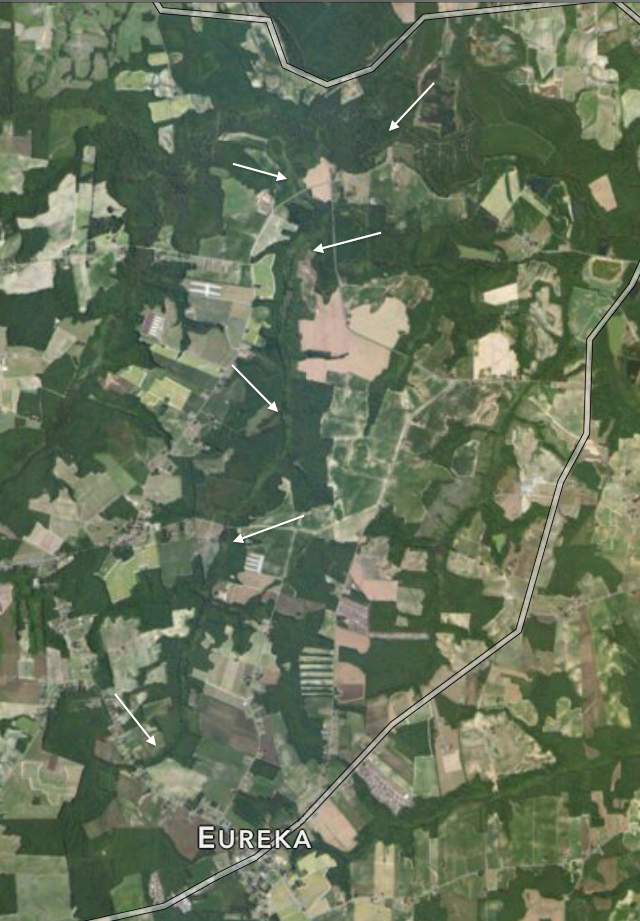
Turner_Swamp-1

A little hard to see, but the arrows point out the course of Turner Swamp. The green curve just below the lowest arrow marks the rise of the waterway, and the top arrow points out its approximate mouth just below Woodbridge Road in Wilson County. (And “swamp” it is. The soil of eastern North Carolina is flat and sandy or clay-ey, and the little branches off major creeks don’t so much flow as they do stand, with the barest perceptible current. Getting to their banks often requires boots — and a stout stick to beat back the cane and catbrier.)

Standard
Births Deaths Marriages, Free People of Color, North Carolina, Other Documents, Paternal Kin

Volte-face, no. 1; or 52 Ancestors: Daniel Artis.

[Though my format only infrequently focus on individuals, I’ve taken up the 52 Ancestors in 52 Weeks challenge. This is week 4, so I have some catching up to do. We’ll see.]

I had an inkling, didn’t I? Here’s what I wrote in my notes when I found Mariah Artis Swinson’s death certificate:

MARIAH SWINSON.  Died 6 Feb 1955, 500 Creech Street, Goldsboro NC, arteriosclerosis.  Born 14 Feb 1849 to Daniel Artis and unknown. Informant, Mrs. Mary Swinson.  Buried 9 Feb 1955, Elmwood cemetery, Goldsboro NC.  [Daniel Artis?  Is this an error or was Mariah Silvania’s niece rather than her daughter?  I conjectured that Daniel Artis was a brother of Silvania and Vicey Artis.]

Up to then, I had firmly believed that Mariah Artis Swinson, wife of Jesse Swinson, was the daughter of Guy Lane and Sylvania Artis, so I was thrown when her death certificate listed her father as Daniel. I had a Daniel Artis in my file with a question mark behind his name — was he Sylvania and Vicey Artis’ brother? He appears sparingly in records, and here’s all I knew about him:

On 20 Aug 1853, in Greene County NC, Silas Bryant sold Daniel Artis for $325 120 acres adjacent to the mouth of a lane at the dividing line between said Bryant and John Lane, the Bull Branch, and the mouth of Sellers Branch.  Henry Martin witnessed.  The deed was registered 7 Jun 1882.  [Silas Bryant apprenticed the children of Vicey Artis, who may have been Daniel’s sister.  John Lane apprenticed the children of Vicey’s sister Sylvania and probably owned her husband, Guy Lane.]  

and

In the 1860 census, Bull Head, Greene County NC, 40 year-old free man of color Dannel Artis, a ditcher, is listed next door to the household of white farmer John Lane, who reported $10000 personal property and $25000 real property, included Dannel, Mike, Penney, Dyner, Juley, and Washington Artis, who were Silvania’s children.

I have not found Daniel in earlier censuses. However, a few days ago, following up a request for assistance by a descendant of a Daniel Artis from Greene County, I examined the will and probate records of a Daniel Artis who died in early 1905.  The will, in black and white, stated that Mariah Swinson, wife of Jesse Swinson, was this Daniel Artis’ daughter, not Sylvania Artis’.

So, is Daniel Artis the will-maker the Daniel Artis that I believe to have been a brother of Vicey Artis Williams and Sylvania Artis Lane?

What does his will tell us?

There were two, in fact. The first, dated 15 January 1905, was recorded at the Greene County Courthouse in Will Book 1 at page 514; the second, dated two days later, at page 524.  The legatees are the same, but the gifts packaged differently, so I present both:

Item 1. Page 514 — to daughter Clary Edwards, wife of Henry Edwards, his interest valued at $172 in the tract of land on which Clary and Henry live. The tract was purchased from Debro Cobb with money advanced from Henry Artis. If $172 is more than the other’s children’s share, Clary is to make them even, and vice versa.  Page 524 — to daughter Clara Edwards, wife of Henry Edwards, his interest valued at $172 in the tract of land purchased from Debro Cobb. His agreement with Henry Edwards has not been recorded.

Item 2. Page 514 — to son Henry Artis, 1/4 interest in his real estate.  Page 524 — to son Henry Artis, 40 acres, including the house in which Daniel then lived.

Item 3. Page 514 — to the children of his son Lodrick Artis (Anna Randolph, Frank Artis, Lula Forbes, Madison Artis, Marcellus Artis, Ernest Artis, Dicey Batts and Hannah Artis) 1/4 of his estate.  Page 524 — to the children of Lodrick Artis and his wife Mandy, 40 acres (land Lodrick resided on at the time of his death) and all buildings thereon.

Item 4. Page 514 — to the children of his daughter Prior An Thompson (Isaac Sauls, C.D. Sauls, Maria Edwards and Clara Lane), 1/4 of his estate.  Page 524 — to Prior An Thompson’s children and their heirs, 40 acres that Willis Thompson lives on.

Item 5. Page 514 — $50 to daughter Mariah Swinson, wife of Jesse Swinson, to be paid from the shares of the others in the amount of $12.50 each.  Page 524 — A committee to be appointed to assess value of shares and make Clara Edwards’ share equal to the others, difference to be paid within seven years.

Item 6. Page 514 — none.  Page 524 — Each lot to be taxed $12.50 to pay daughter Mariah Swinson, wife of Jesse Swinson.

Grandson Isaac Sauls was appointed executor in both, Daniel Artis signed each with an X, and both were proved on 21 March 1905.

Whatever his intent at clarification, things did not go well with Daniel’s estate. A Notice of Sale ran four weeks from December 1923-January 1924 in the Greene County weekly The Standard-Laconic announcing the sale of “a certain tract or parcel of land devised to Henry Artis by Daniel Artis by his last will and testament, … containing 40 acres.” The sale was advertised pursuant to a judgment in Greene County Superior Court in the matter of Frances Hall; Bennett Hall; Bessie Woodard, infant; and Alice Woodard, infant, by their next friend Amos Woodard v. J. Settle Artis and Roumania Artis. Settle Artis, who was Henry Artis’ son, had purchased the parcel at a courthouse sale the previous July. Frances and Bennett Hall were Settle’s sister and brother-in-law, and Amos Woodard was another brother-in-law, widower of Settle’s sister Dillie.

I don’t know what Hall et al. v. Artis was about, but the allegations of the next suit over Daniel’s estate — filed in 1930 — are clear. The case caption alone is daunting: Isaac Sauls; Walter Sauls; Luby Sauls; Edward Sauls; Hattie Speight and her husband Walter Speight; Mariah Thompson; Lillie May Sauls, minor, George Sauls, minor, Sarah Sauls, minor, Lillie Lee Sauls, minor, Walter Sauls, minor, appearing by their next friend, Luby Sauls; and Nettie Sauls; Henry B. Lane; Lillie Maud Best and her husband Alex Best; John H. Lane and Carrie D. Lane, a minor, children and heirs at law of Clara Thompson; Penny Edwards, Silas Edwards, Prior Edwards and the Henry Pettaway children as follows: Hadie Pettaway, minor, Willie Harrison Pettaway, Georgia May Pettaway, minor, Minnie Clyde Pettaway, minor, grandchildren of Mariah Edwards, by their next friend Henry Pettaway  v. C.D. Sauls and Duffrey Edwards. In other words, a fight among the heirs of Daniel’s daughter Prior Ann Artis Sauls Thompson.  The crux of the matter is set out in paragraph 10:

10. That the plaintiffs, heirs at law of Isaac Sauls, Mariah Edwards and Clara Thompson are the owners of three fifths of the land devised by Daniel Artis in Item 4 of his will to the children of his daughter Prior Ann and are entitled to have the defendant Cain D. Sauls declared to have the same held in trust for them and are entitled to an accounting of the rents and profits of the same from the date of his purchase in 1908.

Instead, they alleged, C.D. Sauls had been keeping hundreds of dollars of rent for himself and, in 1928, had sold the parcel to Duffrey Edwards for $3000, with full knowledge by Edwards that Sauls was trustee for his relatives. C.D. denied all, of course. In 1937, his daughter and son-in-law, Willie Sauls Burgess and W.D. Burgess, were added as defendants after C.D. and his wife Ada allegedly tried to fraudulently transfer the disputed property to her.  In 1939, the clerk of court entered a non-suit judgment noting that the parties had reached an amicable settlement. No details were included. The matter was over.

So back to my original line of inquiry: who was this Daniel Artis?

Though he often managed to slip censustakers, the enumerator of the 1880 census found Daniel, his children Henry, Clara, Mariah, Prior Ann, and Lodrick, and their children living in a cluster in Bullhead district.  (There was a marker for “Artis Town” at a spot in the road in Greene County. I think it’s in this area.) At #260, Henry Artis, 30, wife Mary, 27, and children Frances, 16, Didida, 8, Missouri, 7, Settle, 3, and Henry, 2. At #261, Henry Edwards, 40, wife Clara, 45, and children Thomas, 19, Wright, 18, Scott, 15, Eliza, 13, George, 11, Henry, 9, Daniel, 7, and William, 5. #264, Jessee Swinson, 23, wife Maria, 20, and son Charles, 1.  #267, Willis Thompson, 28, wife Prior, 32, and his stepsons Isaac Sauls, 19, Cain Sauls, 18, and Richard Sauls, 15.  #268, Timothy Edwards, 22, wife Maria, 21, and children Mony, 2, and Lilly, 7 months, niece Alice Wood, 15, and grandmother Maria Sauls, 60. #269, Lodrick Artis, 35, wife Amanda, 30, and children Hannah, 12, Frank, 10, Lula, 8, Sarah, 4, Monsey, 2, Lodrick, 1 month, and Marcellus, 1. #270, Daniel Artis Sr., 65, wife Eliza, 60, and granddaughter Ida, 9.

This Daniel is roughly the right age to be the one listed in the 1860 census and certainly old enough to have purchased property in 1853.  [A future project: hunt for a plat or metes and bounds to compare that purchase with the land devides in 1905.]  Daniel Artis and Eliza Faircloth registered their two-year cohabitation just over the county line in Wayne County. If they were, in fact, married in 1864, she was not the mother of his children, who were born circa 1835-1860. Like Eliza, though, their mother — or mothers — probably  was enslaved, as were they. If Daniel was the brother of Silvania and Vicey, he followed in their footsteps by looking beyond the free colored community to find a spouse. (It is possible that the Daniel who married Eliza Faircloth was Daniel Artis, born in 1843 to Silvania Artis Lane. He and his wife Eliza appear in the 1880 census of Greene County with children Emma and James.)

It is time, I think, to adjust my files. Unlink Mariah Artis from Silvania and move her to Daniel, then enter all the new names I have for his descendants. The evidence is sparse and circumstantial, but sufficient to make a tentative determination that Daniel, Vicey and Silvania were siblings. They were born within about a ten-year span; they live in close proximity in Bull Head district, Greene County; they are the only Artises in the area (and among few in the county); they all had connections with Silas Bryant and/or John Lane; and there are some commonalities among the given names of their offspring (Silvania had a son Daniel; Silvania and Daniel had daughters named Mariah; and Vicey and Daniel had grandsons named Cain.)

Standard