I was tying up loose ends, so to speak, checking an online database for death certificates of cousins in distant lines. Several Artises married Reids, who were another free family of color from northeastern Wayne County, and a number settled in Wilson County in the early 20th century.
Allen T. Reid was a great-grandson of Zilpha Artis Wilson, sister of my great-great-great-grandfather Adam T. Artis. I started jotting notes from his death certificate — born 1919, married, World War II veteran — then pulled up short. Died 9 Dec 1949 at Central Prison in Raleigh? Of “asphyxiation by court order of the State of North Carolina”? My cousin was executed?
I quickly found the decision of the North Carolina State Supreme Court in State v. Reid, 230 N.C. 561, 53 S.E.2d 849 (1949), an appeal from Allen Reid’s conviction for burglary with intent to rape (a white woman.) It’s longish, I know, but please read it:
——
Supreme Court of North Carolina
State v. Reid, No. 76, June 16, 1949.
Appeal from Superior Court, Wilson County. W.H.S. Burgwyn, Special Judge.
Criminal prosecution tried upon indictment charging defendant with the crime of burglary in the first degree.
When the case was called for trial, and before the trial jury was chosen, sworn or impaneled, counsel for the defendant filed a motion challenging the array of petit jurors, upon the ground of disproportionate representation of Negroes on petit juries in Wilson County, and long, continuous and systematic exclusion of Negroes from petit juries solely and wholly on account of their race and color, contrary to the laws of the State of North Carolina and the United States.
The defendant offered evidence in an effort to sustain his challenge to the array of petit jurors. Upon the evidence produced by counsel for defendant, the Court found as a fact that the officers whose duty it was to prepare the jury list and draw the panels of veniremen to be summoned by the Sheriff of Wilson County ‘from which petit jurors were drawn, have not selected and summoned jurors for the December 6 Term, 1948, in violation of G.S. of 1943, Chapter 9, Sections 1, 2, 3 and/or 9, and the Constitution and Laws of the United States, with the unlawful and avowed purpose of discriminating against persons of the Negro race; and that there is no evidence before the Court to show that the said officers have been systematically and continuously, over a long period of years, excluding Negroes from said juries in said county solely on account of their race or color; to the contrary, it has been effectively shown that there are the names of Negroes in the jury boxes of Wilson County, and that one member of that race was drawn and served as a member of the Grand Jury which returned the Bill of Indictment in this case, and that four or five members of the colored race were drawn for the special venire and summoned for the purpose of the trial of this case.‘ Whereupon the Court overruled the motion, and the defendant excepted. Exception No. 15.
It is disclosed by the evidence that Mr. and Mrs. James Barnes, at the time the alleged crime was committed, were living in a ground floor apartment, at 204 Park Avenue, in the City of Wilson.
The night of the alleged crime Mr. Barnes was in Washington, D. C., and Mrs. Barnes retired in the early morning of 2 September, 1948; no other member of the family or guests being in the apartment at the time. About 2:30 a. m., she was awakened by someone placing a hand on her shoulder. She was on an antique bed about three and a half feet high. The person who touched her was on the far side of the bed and when she realized that the hand was on her shoulder, she immediately got off the bed away from the person. The person grabbed her wrists and ordered her to be quiet and not to scream. She asked the person who he was, and he replied, ‘Never mind who I am.‘ She asked him how he entered the room and he said, ‘That’s all right; I got in here.‘ The prosecuting witness managed to free her right wrist after several minutes. The person then ordered her to get back on the bed. She asked him what he wanted. He stated that he wanted to commit an act, which would have been, if accomplished, a crime against nature. He also said to her several times: ‘If you scream, you know what I have.‘ She told him to leave and he told her if she would just get back on the bed it wouldn’t take long. She would not get back on the bed and he began twisting her left wrist. She testified that she realized something had to be done, and she yelled for Mrs. Mayo, the lady in whose home the apartment is located. The person then jumped out the bedroom window, head first. Mrs. Barnes further testified she did not know who the party was, except her assailant was a male person; that when she went to bed the window in her bedroom was approximately two-thirds raised; that there was a screen in the window which hooked into the side of the window and it was in good condition when she retired.
Mrs. Sarah Mayo testified that when she heard Mrs. Barnes scream ‘Sarah,‘ she immediately got out of bed, called her son and went into Mrs. Barnes’ apartment, and found her at the telephone. She noticed that the screen was cut but did not see anyone leave the house.
A witness who lived next door to Mrs. Mayo testified she was reading in bed and heard Mrs. Barnes scream about 2:30 a.m.; that she looked but did not see anyone but heard ‘footsteps running.‘ She then heard a car start.
A member of the Police Department of the City of Wilson, in response to a call, went to the Barnes apartment. He examined the window and found that the screen outside the window had been cut all the way from the top to the bottom with some sharp instrument. He found two razor blades just underneath the window on the outside. The razor blades were ‘Treet‘ blades. He also found a paper wrapping that goes on razor blades. Shortly thereafter police officers found a wrecked Chevrolet car on the railroad track of the Norfolk & Southern Railroad, four blocks from the Barnes apartment. In the car the officers found a wrapping from a ‘Treet‘ razor blade, which was on the floorboard of the front seat. The wrecked car belonged to the father of the defendant. The father testified the defendant took the car on the night of September 1st, and said he wanted to go to a show; that he did not see the car any more until it was pulled in after the wreck. The husband of the prosecuting witness testified he had never used ‘Treet‘ blades, and had no such blades in his home.
Between 8:30 and 8:45 on the morning of 2 September, 1948, A. J. Hayes, Jr., the identification officer of the Wilson Police Department, who was found by the Court to be a fingerprint expert, went to the Barnes apartment and made an investigation for fingerprints. He testified that on the inside of the window through which the entrance to the Barnes apartment had been made, he found a fingerprint on the lower right-hand corner of the window sill and bottom section of the window; and he photographed the fingerprint. At the trial this witness, and two other witnesses who are with the State Bureau of Investigation and were qualified as fingerprint experts, compared the fingerprint found in the Barnes apartment with fingerprints of the defendant made after his arrest in Norfolk, Va., on 25 October, 1948, and each one of them testified that the fingerprint found on the window sill on the inside of the Barnes apartment was identical with the fingerprint of the right index finger of the defendant.
The defendant offered no evidence.
From a verdict of guilty of burglary and sentence of death by asphyxiation, the defendant appeals and assigns error.
Attorney General Harry M. McMullan and Assistant Attorneys General Ralph M. Moody and T. W. Bruton, for the State.
Herman L. Taylor, Raleigh, and C. J. Gates, Durham, for defendant.
DENNY, Justice.
The exception to the failure of the Court to sustain defendant’s challenge to the entire array of petit jurors is not brought forward, as required by the Rules of this Court, Rule 28. However, the defendant discusses the exception at some length in his brief. Consequently, we have considered the exception and find it without merit.
His Honor’s findings of fact are supported by the evidence and are conclusive on appeal, since the exception presents no reviewable question of law. G.S. s 9-14; State v. Davenport, 227 N.C. 475, 42 S.E.2d 686; State v. Lord, 225 N.C. 354, 34 S.E.2d 205; State v. DeGraffenreid, 224 N.C. 517, 31 S.E.2d 523; State v. Wall, 211 N.C. 487, 191 S.E. 232; State v. Cooper, 205 N.C. 657, 172 S.E. 199; State v. Daniels, 134 N.C. 641, 46 S.E. 743. The question raised has been considered in a number of recent cases before this Court and no useful purpose would be served by a further discussion of the subject here. See State v. Speller, 230 N.C. 345, 53 S.E.2d 294; State v. Speller, 229 N.C. 67, 47 S.E.2d 537; State v. Brunson, 229 N.C. 37, 47 S.E.2d 478; State v. Koritz, 227 N.C. 552, 43 S.E.2d 77, certiorari denied 332 U.S. 768, 68 S.Ct. 80, 92 L.Ed. 354, and a rehearing denied 332 U.S. 812, 68 S.Ct. 106, 92 L.Ed. 390; and the cases cited.
Exception No. 16 is brought forward in the brief, but no argument is made or authority cited in support thereof, hence it will be considered as abandoned. Rules of Practice in the Supreme Court, Rule 28, 221 N.C. 546.
The defendant moved for judgment as of nonsuit at the close of the State’s evidence, on the ground that while the bill of indictment charges the defendant with burglarious entry with the felonious intent to ravish and carnally know Mrs. James Barnes, forcibly and against her will, the evidence he contends, tends to show only an intent to commit a crime against nature, condemned by G.S. s 14-177.
The conduct of the defendant in breaking and entering the bedroom of the prosecutrix in the night-time, and under the circumstances disclosed by the evidence, indicates the extent to which he was willing to go to accomplish his purpose. He might have preferred and intended to commit a crime against nature, or his statement in that respect might not have been indicative of his actual intent. We think the evidence was sufficient to carry the case to the jury under the allegations contained in the bill of indictment, and it was for the jury to determine, under all the circumstances, whether or not the defendant had the ulterior criminal intent at the time of the breaking and entering, to commit the felony charged in the bill of indictment. State v. Allen, 186 N.C. 302, 119 S.E. 504; State v. Boon, 35 N.C. 244, 57 Am.Dec. 555.
The trial judge charged the jury on the defendant’s contention in this respect, and instructed the jury to acquit the defendant if it found as a fact that the defendant entered the home of the prosecuting witness with the intent to commit a crime against nature and not with the intent to commit rape, as alleged by the State in the bill of indictment.
In State v. Boon, supra, Pearson, J., in speaking for the Court, said: ‘The evidence of the intent charged is certainly very slight, but we cannot say there is no evidence tending to prove it. The fact of the breaking and entering was strong evidence of some bad intent; going to the bed and touching the foot of one of the young ladies tended to indicate that the intent was to gratify lust. And the hasty retreat without any attempt at explanation, as soon as the lady screamed, was some evidence that the purpose of the prisoner, at the time he entered, was to gratify his lust by force. It was, therefore, no error to submit the question to the jury. Whether the evidence was sufficient to justify a verdict of guilty is a question about which the Court is not at liberty to express an opinion.‘
In the instant case, it is clear the defendant wanted the prosecutrix to know he would resort to other means if she screamed. Whether he had the intent to commit the crime of rape, as charged, or the intent to commit a crime against nature, at the time of breaking and entering, was a question of fact to be determined by the jury.
Evidence as to the conduct of the defendant after breaking and entering may be considered by the jury in ascertaining the intent of the accused at the time of the breaking and entering. But where there is a breaking and entering into a dwelling house of another, in the night-time, with the intent to commit a felony therein, the crime of burglary is consummated, even though the accused person by reason of unexpected resistance or the outcry of his intended victim, may abandon his intent to commit the felony. State v. Hooper, 227 N.C. 633, 44 S.E.2d 42; State v. Allen, supra; State v. McDaniel, 60 N.C. 245; State v. Boon, supra.
Exceptions 65 and 67 are directed to the refusal of the Court below to grant the defendant’s motion for judgment as of nonsuit, challenging the sufficiency of the evidence to warrant its submission to the jury.
The appellant is relying largely on the case of State v. Minton, 228 N.C. 518, 46 S.E.2d 296, where the defendant’s fingerprint was found upon broken glass from the front door of a store that had been unlawfully entered. That case is distinguishable from the present one. The defendant in the Minton case was lawfully in the store in the afternoon of the day on which the crime was committed, and he may have made the fingerprint at that time.
We must keep in mind that a motion for judgment as of nonsuit in a criminal prosecution is properly denied if there is any competent evidence to support the allegations of a bill of indictment; and all the evidence tending to sustain the allegations in the bill of indictment upon which a defendant is being tried, will be considered in a light most favorable to the State, and the State is entitled to every reasonable inference to be drawn therefrom. State v. Braxton, 230 N.C. 312, 52 S.E.2d 895; State v. Gentry, 228 N.C. 643, 46 S.E.2d 863; State v. Webb, 228 N.C. 304, 45 S.E. 2d 345; State v. Hough, 227 N.C. 596, 42 S.E.2d 659; State v. Ewing, 227 N.C. 535, 42 S.E.2d 676; State v. McKinnon, 223 N.C. 160, 25 S.E.2d 606; State v. Brown, 218 N.C. 415, 11 S.E.2d 321. Here the defendant was never lawfully in the apartment of the prosecutrix, and the presence of his fingerprint on the inside of the window sill in the sleeping quarters of the prosecutrix, when considered with the other evidence, was sufficient to carry the case to the jury.
The defendant has abandoned the remaining sixty-seven exceptions set out in the record.
The exceptions brought forward and argued in the defendant’s brief fail to show any prejudicial error in the trial below.
No error.
——
A few comments:
(1) First degree burglary was a capital crime in North Carolina until 1974.
(2) And then there was this:
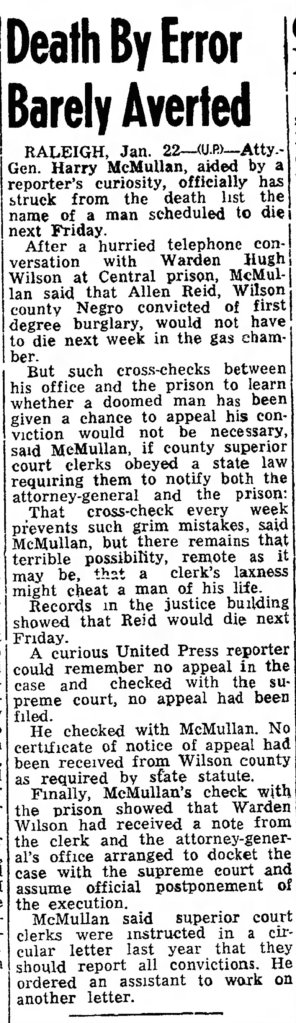 Statesville Daily Record, 22 January 1949.
Allen Reid’s lawyers, Herman L. Taylor of Raleigh and C.J. Gates of Durham, were African-American. They appealed his case to the United States Supreme Court, which denied cert.
(3) In 1949, “death by asphyxiation” meant the gas chamber. According to the Statesville Daily Record, on 9 December, Allen Reid, 30, entered the chamber with Audie Lee Brown, 27, convicted of murder. They were seated side-by-side, and “the deadly cyanide pellets dropped at 10:02 a.m. EST.” After the gas cleared, prison officials executed Monroe Medlin, 23. Reid took 13 minutes to die; Brown, a minute less; and Medlin, a minute less than that. The other men on death row moaned “Rock of Ages” as the three took their last walk.
(4) My father was 15 when Allen Reid was executed. He recalls that the belief on the east side of the tracks was that Reid was in a clandestine relationship with Mrs. James Barnes. I found this report, written by a Reid cousin of Allen Reid, online. I haven’t figured out yet what was appended to. It confirms my father’s recollection and my hunch that Allen Reid’s service in World War II had some bearing on the situation in which he found himself. It also contains unsurprising commentary on North Carolina’s uneven application of the death penalty for this particular crime (and, of course, in general.)






 Scuffalong: Genealogy.