Other Documents, Photographs

52 Ancestors in 52 Weeks: 6. So far away.

I thought first about this week’s challenge in a spatial sense. Who was so far away? My grandmother in Philadelphia, to whose home we voyaged every summer from North Carolina? My New York relatives? My Chicago cousins? And then I remembered this, an “autobiography” I wrote as a class assignment in fifth grade. Forty years ago. So far away indeed.

——

THE AUTOBIOGRAPHY OF LISA HENDERSON

by Lisa Henderson 

This Autobiography is dedicated to: my parents for providing me with memories

Table of Contents:

Preface i Autobiography 1 Time Line 7 Family Tree 8 Book List 9

Preface

This autobiography was written by me as a project. I hope it will be a success to me.

The Autobiography of Lisa Henderson

I guess I have a good sense of timing. June 26 in the late [meaning ‘upper,’ as in temperature] 90’s was when I was born. Just in time for a tan. I was born at 4:50 P.M. at Mercy Hospital. I weighed 7 pounds 10 ounces and was 22 inches long. When I was about six months old, I came down with bronchitis. It was one of my few very serious childhood diseases. I moved from 706 Ward Boulevard to 1401 Carolina St., at about 8½ months. I lived on Carolina St. until a little more than a year ago when I moved again. At 14 months I started walking. I was at my Uncle J____’s house. I took my first steps at home though. From ages 1½ to 3 years I stayed with Mrs. Speight while my parents worked. I played with my cousin M____. We had wood blocks to play with. Sometimes we went on walks with A____ and B____ her two [grand]sons. Once, going to her house I fell in the street and busted my knee. I know I had a fit. We went to the Philadelphia and I went to the Philadelphia Zoo for the first time when I was about two. When I was three my sister was born. Mama and Daddy named her K____. She got meningitis when she was about 6 months old and stayed in the hospital 21 days. At age four I entered nursery school at Kiddie Kollege of Knowledge. Most of my immediate friends and cousins in Wilson who were of age were there, too. My teachers were Mrs. H___ and Mrs. P___. At 4½ I broke my fingernail in half in a 2-inch door. I was taken to the emergency room at the clinic. I got it all plastered up. T____ and I used to slide off the cast and look at my black, blue, purple and green finger. When I was five I entered kindergarten at Kiddie Kollege of Knowledge. All my friends and cousins except four people were gone to the first grade. Kindergarten wasn’t very exciting. I guess the most exciting thing was graduation. At graduation I got a Timex Cinderella watch. During the summer between kindergarten and first grade I got my [smallpox] vaccination. I got it on my back because in order to please complainers they were putting it back there instead of on your arm. In that same summer I got cellulitis. A mosquito bit me and I scratched it and scratched it and scratched it, until it got infected and ate my first layer of cells. I came back to Wilson from Virginia and went to the doctor. He said I had to go to the hospital. I stayed there 6 days. I went to B.O. Barnes School when I was in first grade. My teacher’s name was Mrs. B____. It was in the first grade that I met V___ and J____. She came from Mrs. H____’s room. In the second grade I met another good friend J____ and B____. I was in Mrs. M____s room. In January we had Mrs. F___ because Mrs. M____ had to go to the hospital. I got my first dog when I was in the second grade. His name was Tiger. When he got run over I had a fit. Also, when I was in the second grade my father had an accident. He was playing volleyball when a boy threw the ball and hit his finger. The ball flew with such force that the finger was broken. He said he could see the bone and flesh when it happened. Were it healed is still a big knot. Upon entering third grade I realized something. Of all my three years in elementary school I had been in the same homeroom as B____ and M____. I was named secretary of the class by my teacher, Mrs. P____. In fourth grade I went to Vinson-Bynum from B.O. Barnes. My teacher was Mrs. E____. In fourth grade I rode a bus to school for the first time. It was Bus 73. In the later part of fourth grade I moved to 2___ Bel Air Avenue. I rode Bus 70 when I moved to Bel-Air. I met W____ in the 4th grade.

——

And, yes, that’s The End. I don’t know what else to say about this pithy summary of my first 10 years, except I seemed to have lots of fits and had a very narrow notion of what aspects of life and people in it warranted memorialization.  I got an A, though. And that family tree in the table of contents? It marks the first time I ever asked questions about my ancestors.

Lisa 5th grade

1974-75.

Standard
Enslaved People, Maternal Kin, North Carolina, Other Documents

Rules for patty rollers.

By an act of Assembly, passed in the year 1802, the County Court have power to establish Rules and Regulations for the government of the Patrollers in their respective counties;

In pursuance of the power thus granted, the County Court of Rowan, at August session, 1825, made and established the following regulations for the government of Patrols, to wit:

1st. Patrols shall be appointed, at least four in each Captain’s district.

2d. It shall be their duty, for two of their number, at least, to patrol their respective districts once in every week; in failure thereof, they shall be subject to the penalties prescribed by law.

3d. They shall have power to inflict corporal punishment, if two be present agreeing thereto.

4th. One patroller shall have power to seize any negro slave who behaves insolently to a patroller, or otherwise unlawfully or suspiciously; and hold such slave in custody until he can bring together a requisite number of Patrollers to act in the business.

5th. Previous to entering on their duties, Patrols shall call on some acting magistrate, and take the following oath, to wit:

“I, A. B. appointed one of the Patrol by the County Court of Rowan, for Captain B’s company, do hereby swear, that I will faithfully execute the duties of a Patroller, to the best of my ability, according to law and the regulations of the County Court.

Signed, A. B.”    “Witness, C. D. J. P.”

Whereupon, the officiating magistrate shall make out and deliver to him, or them, the following certificate, to wit:

“I, C. D. one of the acting magistrates of Rowan County, do hereby certify, that A. B. came before me, on this the _______ day of ______ A. D. 182__ and was duly sworn faithfully to execute the duties of a Patroller for this County, in Captain B’s company, according to law and the regulations of the County Court in such case made and provided.

Signed,   ____________ C. D. J. P.”

And no Patroller, without this certificate, shall be allowed the privileges and compensation otherwise extended to them.

6th. If any Patroller, while in the discharge of his duty, shall get drunk, or behave in a riotous or disorderly manner, he shall forfeit and pay the sum of five dollars, to be recovered in the name of the chairman of the County Court. He is also, by law, subject to indictment.

7th. The Sheriff of the county shall have the acts of Assembly relating to Patrols, together with these regulations, printed; and, in future, furnish each set of Patrols with a copy of the same; and he shall be allowed for the cost of printing, in his settlement with the county Trustee.

— from Patrol Regulations for the County of Rowan; Printed by Order of the County Court, at August Term, Anno Domini 1825, http://docsouth.unc.edu/nc/rowan/rowan.html  

Standard
Other Documents, Paternal Kin

Signature Saturday, no. 3: Aldridge.

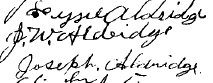
Elizabeth “Lizzie” Aldridge (1864-??), John William Aldridge (1853-1910), and Joseph Aldridge (1869-1934):

Screen Shot 2014-12-05 at 9.47.27 PM

Robert Aldridge Jr.

Screen Shot 2014-12-05 at 9.48.05 PM

John J. Aldridge (1885-1964), son of John W. Aldridge.

Screen Shot 2014-12-04 at 10.27.59 PM

James Thomas Aldridge (1886-1968), son of John W. Aldridge.

Screen Shot 2014-12-04 at 10.29.12 PM

Prince Albert Aldridge (1888-1953), son of George W. Aldridge.

Screen Shot 2014-12-04 at 10.28.21 PM

Blancher K. Aldridge (1894-1965), son of George W. Aldridge.

Screen Shot 2014-12-04 at 10.28.45 PM

Standard
Births Deaths Marriages, Enslaved People, Maternal Kin, Newspaper Articles, North Carolina, Other Documents

Lewis Colvert, son or stepson?

Something’s been bothering me about Lewis “Lou” Colvert. My grandmother knew his son Aggie (pronounced “Adgie”) Colvert as her cousin, but just whose son was Lewis?

The first irregularity: as shown here, when Walker Colvert and Rebecca Parks registered their 13-year cohabitation in 1866, they did not list six year-old Lewis among their three children. Why not?

In the 1870 census of Union Grove, Iredell County, he’s there: Walker Colvert, wife Rebecca and Lewis Colvert, 10.  I haven’t found him in the 1880 census, but a year later, on 13 October 1881, he married Laura Sharpe in Statesville. References to him over the next 30+ years though are few.

On 11 October 1895, the Statesville Landmark printed a short piece about Lou suffering a head injury after being thrown from a wagon.

The census taker again missed Lewis for the 1900 census, but found his wife Laura Colbert, born 1851, and son Aggie, born 1888, living on Valley Street in Asheville, Buncombe County. Laura worked as a cook and described herself as a widow. And though he eluded the enumerator, Lewis was still in Statesville, as this snippet from a court calendar report demonstrates:

Carolina_Mascot_Sville_2_8_1900

Carolina Mascot (Statesville), 8 February 1900.

(Lon was his nephew, my great-grandfather.)

Walker Colvert died in 1905. His will, made in 1901, directed that all his land and personal property go first to his wife Rebecca and, after her death, to his son John Walker Colvert. No mention of Lewis.

In 1910, Lewis again sidestepped the census taker. Laura remained in Asheville. Though she lived until 1926, and I’ve found no evidence of a divorce, in April 1913, Lewis married Quiller Ward in Statesville. The marriage was short-lived. Lewis “Lou” Colvert died 27 March 1915 in Statesville. Lon W. Colvert provided the information for his death certificate — mother, Rebecca Colvert; father, unknown.

Lew Colvert Death Cert

Unknown. Not Walker Colvert. Neither here nor anywhere else is there a claim that Walker was Lewis’ father.

Here is my speculation: Walker Colvert was born at 1815. He married Rebecca Parks about 1853. At that time, he had a two year-old son, John Walker, whose mother was named Elvira Gray. (At nearly 40, however, Walker surely had children older than John. If so, their identities may never be known.) Rebecca was 24 years Walker’s junior and almost certainly belonged to a different master. She was about 16 when she gave birth to her first child with Walker, a daughter named Elvira, and daughter Lovina followed. Then, in 1861, she bore Lewis. As with every enslaved woman, Rebecca’s body was not her own. Perhaps she willingly conceived a child outside her relationship with Walker. Just as likely, that relationship was not uniformly recognized, and she submitted to someone else’s will. Walker reared the boy with his own children and gave him his surname, but did not claim him as a son.


Standard
Enslaved People, Maternal Kin, North Carolina, Other Documents, Paternal Kin, Virginia

Book of Negroes.

An ongoing memorial to my enslaved ancestors and the communities in which they lived.

THE ENSLAVED

Juda, her children LucindaDave, Matthew, John and Kezy, Rowan County, North Carolina. Enslaved by Elizabeth Kilpatrick. Under terms of Elizabeth Kilpatrick’s will, Juda, Matthew, John and Kezy were sold; Dave enslaved by her son Robert; and Lucinda by her daughter Mary (see below).

Matilda (ca. 1845-1885), Charles City County and Charlotte County, Virginia. Enslaved by John A. Selden at Westover plantation, Charles City County, and Bon Air plantation, Charlotte County. May have been the daughter of Anthony Jones. Married Jasper Holmes circa 1862 in Charlotte County.

Graham Allen (1852-1928), Prince George County, Virginia. Son of Edmund (or Mansfield) and Susan Allen, husband of Mary Brown Allen, adoptive father of John C. Allen Sr. Owner unknown.

Mary Brown Allen (1849-1916), Amelia County, Virginia. Daughter of Catherine Booker and James Brown. Owner unknown.

Clara Artis Edwards, Henry Artis, Lodrick Artis, Prior Ann Artis Sauls Thompson, and Mariah Artis Swinson, Greene County, North Carolina. Children of Daniel Artis and an unknown enslaved woman. Owner unknown.

Cain Artis (1851-1917) and Caroline Coley (1854-??), Wayne County, North Carolina. Children of Winnie Coley, an enslaved woman, and Adam T. Artis, a free man of color. Owned by W.W. Lewis and possibly John Coley.

Willis Barnes (1841-1914). Nash, Wilson and possibly Edgecombe Counties, North Carolina. Son of Annie Eatman and (possibly free-born) Toney Eatman. Owner unknown.

Cherry Battle (1842-ca. 1890) and children Rachel Battle/Barnes and Wesley Barnes. (Younger children born in freedom.) Wilson County and possibly Edgecombe County NC. Wife of Willis Barnes. Possibly enslaved by Margaret Parker Battle.

Pleasant Battle Battle Williams (1842-1912) and children John (1857), George (1858), Ida (1859), Richard (1860) and Cora Battle (1865). Edgecombe County. Daughter of Bunyard and Pleasant Battle. First husband, Blount Battle, was an enslaved man. Married second husband, free-born Jonah Williams, after Emancipation.

Walter Carter (ca. 1813-1885), Charlotte County, Virginia. Husband (probably second) of Nancy, mother of Joseph, and probably Jasper, Holmes. Owner unknown.

Walker Colvert (1815-1905), Culpeper County, Virginia, and Iredell County, North Carolina. Enslaved by Samuel Colvert, then John A. Colvert, then William I. Colvert.

John Walker Colvert (1851-1921) and his mother Elvira Gray. Iredell County. John was the son of Walker Colvert. Owner probably William I. Colvert, but possibly Susan Colvert Gray, sister of William I. Colvert.

Lucinda Cowles (??-bef. 1870?) and her daughter Harriet Nicholson (1861-1926). Lucinda was owned by James Nicholson, then his son Thomas A. Nicholson. Harriet was owned by Thomas A. Nicholson.

Simon Exum (1842-1915), Wayne County, North Carolina. Son of John and Sophronia Exum. Husband of free-born Delilah Williams. Owner unknown, but probably one of the white Exums who lived in Nahunta area of Wayne County.

Lewis Harper (ca. 1844-after 1904), Greene County, North Carolina. Brother of Loderick Artis. Owner unknown.

Nancy Holmes Carter (ca. 1809-1884) and children Louisa Carter, Lettie Carter, Walter Carter Jr., and Eliza Carter, Charlotte County, Virginia. Married first Payton Holmes, then Walter “Wat” Carter. Owner unknown.

Joseph R. Holmes (1838-1869), Charlotte County, Virginia. Son of Peyton Holmes and Nancy (last name unknown.) Probably enslaved by Hunter Holmes Marshall.

Jasper Holmes (1840-ca. 1899), Charlotte County, Virginia. Brother of Joseph R. Holmes. Possibly enslaved by Hunter Holmes Marshall.

Margaret Kerr McNeely (ca. 1840-?), Rowan County. Wife of Julius McNeely. Owner possibly Dr. Samuel E. Kerr.

Eliza Catherine Kerr Miller (1843-1907) and son Baldy Alexander Miller (1858-1942), Rowan County. Wife of George Miller. Owner unknown.

Guy Lane (ca. 1798-ca. 1875), Greene County, North Carolina. Husband of Sylvania Artis. Almost certainly enslaved by John Lane (see below.)

Margaret McConnaughey and her children George W. Miller, Caroline McConnaughey (and daughter Angeline McConnaughey Reeves), Mary Ann McConnaughey Miller, Grace Adeline Miller Miller, Martha Miller McNeely and John B. McConnaughey, Rowan County, North Carolina. Enslaved by John M. McConnaughey.

Lucinda McNeely (1816-ca. 1890) and her children Alice (and her children Joseph Archy, Mary, Alexander and John Stanhope); John Rufus; Julius and Henry W. McNeely, Rowan County, North Carolina. Lucinda, Alice and John enslaved by Mary Kilpatrick. All enslaved by Samuel McNeely, then John W. McNeely.

Edwin (or Edward) Miller, Rowan County, North Carolina. Father of most of Margaret McConnaughey’s children. Owner unknown.

Green Miller (1848-1923), Rowan County, North Carolina. Son of Edward and Malissa Miller. Married Grace Adeline Miller. Owner unknown.

Ransom Miller (1845-1917), Rowan County, North Carolina. Son of Samuel and Malissa Miller. Married Mary Ann McConnaughey. Owner unknown.

William H. Nicholson (1842-1909), Iredell County, North Carolina. Son of Lucinda Cowles and Burwell Carson. Probably owned by Thomas A. Nicholson.

Rebecca Parks (1839-1915) and son Lewis Colvert (1861-1915), Iredell County, North Carolina. Rebecca was the daughter of Jerry Gray and Lettie Gray, who were probably owned by John A. Colvert. Second (?) wife of Walker Colvert. Owner possibly Susan Colvert Parks, sister of William I. Colvert.

Frank Reeves (1854-1910), Rowan County, North Carolina. Son of Henry and Fina Overman Reeves. Married Caroline McConnaughey. Owner unknown.

Hannah Sauls Speight, Greene County, North Carolina. Daughter of Shephard Sauls and Rosetta Sauls. “Born on Appletree Swamp near the town of Stauntonburg, Greene County, N.C. and was a slave” belonging to Lawrence Brown. Married Bailham Speight.

Bailham Speight alias Edwards, Greene County, North Carolina. Son of Reddin Speight. Brother of Lafayette “Fate” Edwards, who was enslaved by Ap. Edwards. Enslaved by Jim Edwards, “Orfa” (probably Theophilus) Edwards, and Elizabeth “Betsy” Edwards. Married to Jennie Suggs during slavery. She died in New Bern, North Carolina, near the end of the Civil War. Married Hannah Sauls after.

Green Taylor (1817-ca. 1890), wife Fereby Taylor (1825-ca. 1890), and children Peter, Henrietta, Dallas, Christiana, McKenzie, and Henry Michael Taylor, Nash County and possibly Edgecombe County. Green, Fereby, and oldest three children enslaved by Kinchen Taylor until about 1856, then distributed to his heirs.

Abner Tomlin (1855-ca. 1900), Iredell County, North Carolina. Son of Milas and Lucinda Tomlin. First husband of Harriet Nicholson. Owner unknown.

Sarah Ward Darden (ca. 1823-ca. 1890) and children Mittie Ward Vaughn (ca. 1857-1924), Appie Ward Hagans (ca. 1857-1895), and Henry Ward, Greene and Wilson Counties, North Carolina. Owned by David G.W. Ward.

Solomon Williams (ca. 1800-1884), Wayne and possibly Greene Counties, North Carolina. Owner unknown.

THE ENSLAVERS

1793, 22 June — Will of James Neill, Iredell County, North Carolina.

  • To wife, “my negro wench Luce.”

1793, 25 November — Will of Thomas Allison, Iredell County, North Carolina.

  • To wife Madeline, “negroe wench” Jude and use of two negro fellows, Pomp and Bob.

1793, 25 November — Will of Madeline Allison, Iredell County, North Carolina.

  • To son Thomas Allison, Pomp; to son Richard Allison, Bob; to daughter Ann Allison, “Negroe Jude.”

1800, 22 February — Will of John McNeely, Rowan County, North Carolina.

  • To son Alexander, “a negro wench named Esther.”

1805, 17 November — Will of Theophilus Simonton, Iredell County, North Carolina.

  • To wife, “my Negro Woman named Soose and her child Esther,” “the rest of my negroes” to remain on the plantation or be sold as executors think necessary.

1819, 3 September – Will of Elizabeth Kilpatrick, Iredell County, North Carolina.

  • To son Robert Kilpatrick, “my negro boy Dave”; to daughter Mary Kilpatrick “my negro girl named Lucinda”; “my negro woman Juda and all her children not disposed of” to be sold.

1823 – Estate of Samuel Colvert, Culpeper County, Virginia.

  • Amelia; Anthony; Caroline; Charles; Daniel; Eliza; Frank, his wife Charlotte and their children Townsend, Jere, Little Frank, Lewis and Ellen; George; Harry; Jane; Mary; Little Mary; Patty; Rachel; Robert and his wife Milly and their children Easter, Jack, Reuben, Edmund and Rachel; Sarah; Siller; and Winny.

1824, 30 December — Will of James McConnaughey, Rowan County, North Carolina. Fathe

1827, 10 and 11 DecemberInventory of John A. Colvert’s estate, Iredell County, North Carolina.

  • Negroes hired for one year: Jerry, Amy, Walker, Joe, Ellen, “Meel & two children,” Anda, Charlotte, “Lett & three children.”

1829, [date illegible] — Estate of Elizabeth Kilpatrick, Rowan County, North Carolina.

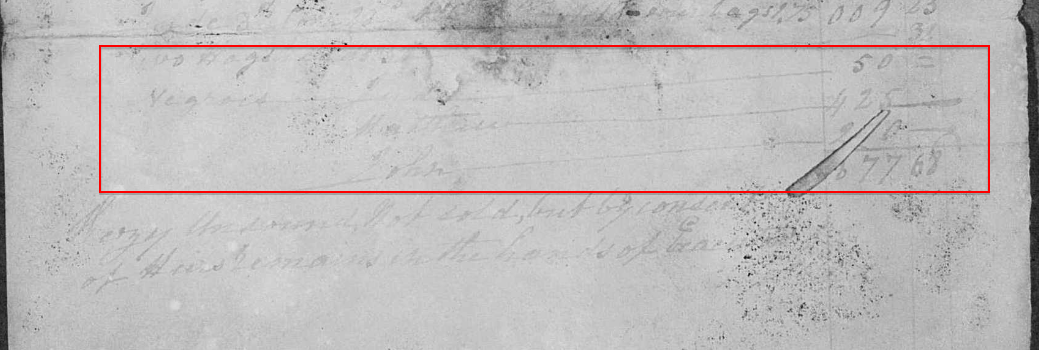
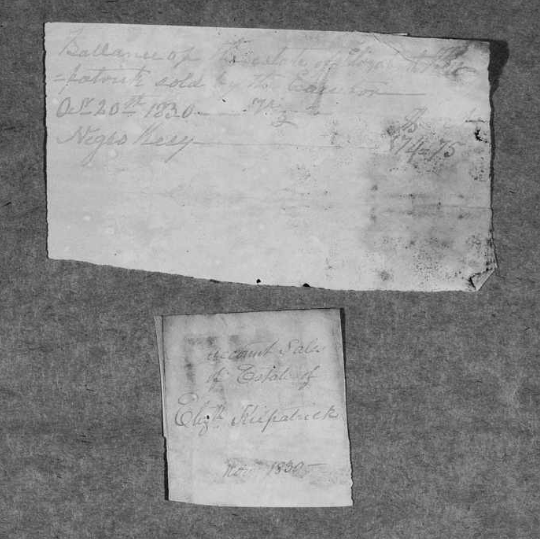
  • Juda, Matthew and John sold for $50, $ and $200. Kezy, described as “unsound,” sold for $74.75 on 20 October 1830.
Screen Shot 2015-01-20 at 10.30.15 PM

1829, 13 April — will of Ann [Robison] McConnaughey, Rowan County, North Carolina. Mother of John M. McConnaughey, who owned my great-great-great-grandmother Martha McConnaughey and her children.

  • to son John McConnaughey, negro fellows March and Squire.

1834, 29 December – deed of sale, Mary Kilpatrick to Samuel and John McNeely, Rowan County, North Carolina.

  • “One negro woman named Lucinda aged about twenty years one negro child named Alice aged three years and one negro child named John aged between one and two years” sold.

1843, 29 May – will of Samuel McNeely, Rowan County, North Carolina.

  • “a negro woman named Lucinda and all her offspring” to son John W. McNeely.

1845, 1 Mayrunaway slave ad placed by Kinchen Taylor, Tarboro’ Press.

  • $100 reward for the apprehension of “my fellow Lewis.”

1850 — federal slave schedule, John Lane, Greene County, North Carolina.

  • 8 females; 13 males.

1850 — federal slave schedule, John M. McConnaughey, Rowan County, North Carolina.

  • Black female, age 58; black male, age 53; black male, age 32; black female, age 26; black male, age 12; mulatto male, age 12; mulatto female, age 8; mulatto male, age 6; black female, age 4; mulatto female, age 2; mulatto male, age 3 months.

1850federal slave schedule, John W. McNeely, Rowan County, North Carolina.

  • Black female, age 34; black female, age 19; black male, age 17; black male, age 14; black male, age 12; mulatto male, age 9; mulatto male, age 2; mulatto female, age 1.

1850 — federal slave schedule, James Nicholson, Iredell County, North Carolina.

  • Female, age 40; male, age 33; male age, 23; male, age 15, male, age 12; male, age 11; male, age 6; male, age 4; male, age 8; male, age 4; female, age 4; male, age 1; male, age 4 months.

1850 — federal slave schedule, Thomas Nicholson, Iredell County, North Carolina.

  • Male, age 45; male, age 18; male, age 21; female, age 20; male, age 4.

1850 — federal slave schedule, Silas Bryan, Greene County, North Carolina.

  • Female, age 45; male, age 32; male, age 28; female, age 8; male, age 2.

1850 — federal slave schedule, Kinchen Taylor, Nash County, North Carolina.

  • 30 females, 47 males.

1850 — federal slave schedule, David G.W. Ward, Greene County, North Carolina.

1851, 3 February — will of Kinchen Taylor, Nash County, North Carolina.

  • To wife Mary Taylor, negroes Big Tom, Little Tom, Clary, Lucinda, Jane, Washington and Ellen; to daughter Wineford Rosser, wife of William Rosser, negroes Sam, Cassa, Harriet, Rosetta, Berry and Daniel; son Kinchen C. Taylor, negroes Isham, Fanny and child, Sandy and Simon; to daughter Carolina Knight, wife of William H. Knight, Haley, Hasty, Amy and Glascow, Alfred and Susan; the remaining estate, including slaves, to be divided among all children.

1851, 17 November — will of James Nicholson, Iredell County, North Carolina.

  • To wife, slaves Milas, Dinah, Jack, Liza and Peter.  To son Thomas, slaves Carlos, Nelson, Lucinda and Joe.  To son John, slaves Manoe, Armstrong, Manless, Calvin and Soffie.

1856, February — inventory of slaves of Kinchen Taylor, Nash County, North Carolina.

  • Dred, Long Henry, Kinchen, Cooper Henry, Doctor, Tom, Simon, Jack, Jim Sr., Chapman, Yel. Henry, Tom Jr., Isaac, Bill, Allen Jr., Arnol, Bob, Seasar, Washington, Cato, John Sr., Tony, Allen Jr., Ned, Amanuel, Sam, Nick, Ellick, Edmon, Wm. Henry, Virgil, Green, Jeffrey, Cane, Handy, John Jr., Big Lewis, Carter, Amy, Patience, Isabella, Henryetta, Lucy, Joe, Mol, Martha, Lucy Jr., Turner, Francis, Della, Carter, George, Lucinda, Elah, Olive, Angeline, Hilly, Hasty, Amy, Glasgo, Darson, Susan, Albert, Penny, Carter Sr., Mary, George, Levinia, Thad, Frank, Betsy, Evline, Wiley, Caroline, Isham, Fanny, Margaret, Lucy, Leah, Jolly, Matilda, Calvin, Elvira, Joe, Faulcon, Ann, Jim Jr., Ferribee, Dallas, Peter, Henryetta, Margaret, Ida, Pink, Emily, July Ann, Mariah, Eliza, Jane, Ella, Mourning, Clary, Cherry, Anna, Hanah, and Elizabeth.

1860 — federal slave schedule, William I. Colvert, Iredell County, North Carolina.

  • Black male, age 42; black female, age 34; black female, age 34; black female, age 15; black male, age 13; black female, age 11; black male, age 10; black female, age 8; black male, age 4; black male, age 1.

1860federal slave schedule, J.W. McNeely, Rowan County, North Carolina.

  • Black female, age 44; black male, age 22; mulatto male, age 19; mulatto male, age 12; black female, age 11; black male, age 9; and black male, age 7.

1860 — federal slave schedule, John McConnaughey, Rowan County, North Carolina.

  • Mulatto female, age 68; black male, age 61; black male, age 48; mulatto female, age 40; black male, age 22; mulatto male, age 21; mulatto female, age 20; black female, age 16; mulatto male, age 15; mulatto male, age 14; mulatto female, age 10; mulatto female, age 7; mulatto female, age 5; mulatto female, age 3; mulatto female, age 1.

1860 — federal slave schedule, Silas Bryan, Greene County.

  • Black female, age 55; black male, age 43; black female, age 18; black male, age 12; black male, 10.

1860 — federal slave schedule, John Lane, Greene County.

  • 13 females; 11 males.

1863 — John Coley for W.W. Lewis, Wayne County, North Carolina, tax assessment.

  • Winney, 29, Cane, 9, Caroline, 7.

1863 — J. M. McConnaughey, Rowan County, North Carolina, tax assessment.

  • George, age 24, $1500; John, age 2, $150; Edwin, age 1, $100; Margaret, age 42, $850; Caroline, age 23, $1200; Mary Ann, age 13, $1000; Grace, age 10, $500; Martha, age 7, $250; Angeline, age 7, $250.

1863 — J.C. McConnaughey, Rowan County, North Carolina, tax assessment.

  • Simon, age 57, $200; Ceasar, age 54, $400; Perry, age 45, $300; Isaac, age 36, $1400; Charles, age 32, $1450; Nelson, age 32, $1450; Edward, age 32, $1450; George, age 31, $1450; Ellick, age 26, $1500; Henry, age 17, $1500; Thom, age 14, $1200; Giles, age 14, $1200; Dallas, age 7, $400; Alfred, age 4, $300; John, age 25, $1500; Juber, age 14, $1500; Nancy, age 36, $1000; Ritta, age 32, $1100; Harried, age 23, $1200; Liza, age 23, $1200; Laura, age 11, $650; Louisa, age 8, $400; Jennie, age 4, $250; Ellen, age 5 months, $100; Allice, age 3 months, $200.

1863 — J.W. McNeely, Rowan County, North Carolina, tax assessment.

  • Lucinda, age 47, value $750. Julius, 25, $1500. Henry, 22, $1500. Archy, 14, $1200. Mary, 13, $1000. Stanhope, 11, $900. Sandy, 12, $950.
Standard
Enslaved People, Other Documents

Recommended, no. 2.

Eric Foner’s Gateway to Freedom.

Actually, I don’t recommend this book. The New York Times does. I haven’t read it yet. But I will because (1) Eric Foner admitted me to the graduate program in history at Columbia (and I’ve forgiven him for losing my only copy of Joseph R. Holmes’ photograph), and (2) in the 1930s, Ardeanur Hart worked for a descendant of Sidney Howard Gay at the family’s Staten Island house, formerly an Underground Railroad station.


Standard
Enslaved People, Maternal Kin, North Carolina, Other Documents

52 Ancestors in 52 Weeks: 3. Strong Woman.

I’ve been working on my Book of Negroes post, digging in my Family Tree Maker files and through scanned documents, cross-referencing and making notes. At the top of the list of enslaved ancestors is Juda, a woman named in the 1819 will of Elizabeth Kilpatrick of Rowan County, North Carolina. Kilpatrick left her “negro boy Dave” to her son Robert Kilpatrick, her “negro girl named Lucinda” to her daughter Mary Kilpatrick, and directed that her executors sell her “negro woman Juda and all her children (not disposed of).” There are gut-punches all through this document — Lucinda was my great-great-great-grandmother — but that last one always tears me all to pieces. Put it all together, and you see that Kilpatrick owned one family of slaves — Juda and her children — and she directed that that family be ripped apart upon her death.

Elizabeth Kilpatrick’s will was devastating enough. And then I found her 1829 estate records. There, in faded script is the last sighting of Juda and her not-disposed-of children, Matthew, John, and Kezy. It’s damnably hard to read, but if you peer closely: Negroes Juda $50 Matthew $425 John $2[illegible]0. And below, a notation: Kezy Unsound Not sold by consent of Heirs Remains in the hands of [illegible]. (Another note in the file records a change of heart — on 20 October 1830, Kezy was, in fact, sold for $74.75.) I don’t know how old Juda was when she was sold away from her children in 1829, nor Matthew, John, Kezy, or Dave, but Lucinda was about 13.

And, so, without the need to explain further, the “strong woman” to whom I dedicate this edition of 52 Ancestors in 52 Weeks is my great-great-great-great-grandmother Juda.

Screen Shot 2015-01-20 at 10.29.29 PM

 Estate of Elizabeth Kilpatrick (1829), North Carolina Estate Files 1663-1979, http://www.familysearch.org

Standard
Enslaved People, Maternal Kin, North Carolina, Other Documents

Requiem for Peter and Flora.

Working on my DNA Definites Neill piece sparked an idea for a running post. Sort of my own Book of Negroes. A list of (1) enslaved family members and (2) the enslaved people owned by my family members. I thought briefly about who might make the list, then relegated the idea to “to do.” And then last night —

Well, Illbedamn.

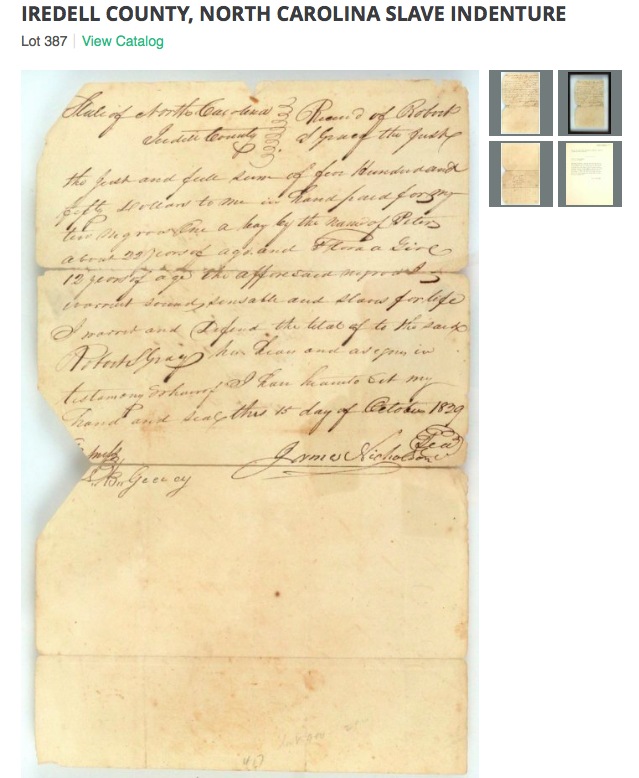
I ran an idle Google search for “Iredell County slavery.” At the top of the third page of results, I ran up on this: a bill of sale for two slaves, Peter, aged 22, and Flora, aged 12, sold by my great-great-great-great-great-grandfather James Nicholson to Robert S. Gray on 15 October 1829.

Screen Shot 2015-01-18 at 8.55.30 PM

Lot 387. Yes. This document was included in a list of items in an on-line estate auction conducted November 16, 2014. I am two months too late. The bill of sale sold. And probably for more than Robert Gray paid for Peter and Flora.

And so I got up this morning and started my Book of Negroes. The format is eluding me, but I’m compiling the entries. The ancestors have called, and I’m answering.

Image posted by Butterscotch Auction Gallery, Bedford, New York, liveauctioneers.com.


Standard
Land, North Carolina, Other Documents, Paternal Kin

He was rejoicing at the opportunity.

The sixth in an occasional series excerpting testimony from the transcript of the trial in J.F. Coley v. Tom Artis, Wayne County Superior Court, November 1908.

Defendant introduces JONAH WILLIAMS:

I have had a conversation about this land. All I know is what Hagans and Tom told me. The first talk was with Napoleon Hagans. (Defendant objects.) Best I remember I went to him to borrow some money to open my brick yard in the Spring. He referred to this deal and some other deal. Tom wanted to take up some papers, and had done so, and I remarked to Hagans how much better off than he was before. He said he was rejoicing at the opportunity. He promised to give 800 lb. of cotton until he could work a advance to him. He said if Tom did that he would never disturb him his life time. I asked Hagans to have it in a written contract, that his heirs might dissent from it. He replied that 800 lb. was a good interest on his money, and his heirs would probably be satisfied. I had a conversation with Tom. I saw him two or three weeks after that. (Plaintiff objects.) I spoke to him about Hagans taking up the Exum paper. He told me Hagans had ***** to take that up. Hagans had given him a chance to pay the debt off. Whenever he paid anything on the principle, he would not have to pay the 800 lb., but simply a lawful interest on the money. I advised Tom to do his best and pay some in on his principal.

CROSS EXAMINED.

He said that he had taken up the mortgage; had it transferred. He said Claim, I might have said mortgage. I don’t say ‘Pole Hagans told me all his business, but I knew about as much as anybody. Said he was going to let him, (Tom) pay 800 lb. of cotton until he could pay the principle. Mortgage given in 1881 to Mrs. Exum. This conversation about 12 or maybe 14 years ago. Don’t know whether it was as late as 1890. Began brick business in 1893. I can’t tell whether it was in 1880 or ’90. ‘Pole Hagans died about two or three years before this took place.  Tom married my sister. He is not a member of my church. I turned him out. He is a Primitive Baptist. I preached Napoleon Hagans’ funeral.

 ——

Elder Jonah Williams was a brother of my great-great-great-grandfather, Adam T. Artis. Adam Artis married Napoleon Hagans‘ half-sister Frances Seaberry. Tom Artis married Jonah and Adam’s sister Loumiza Artis.

Standard
Free People of Color, North Carolina, Other Documents, Paternal Kin, Religion

Jonah Williams and the Turner Swamp Primitive Baptist Association.

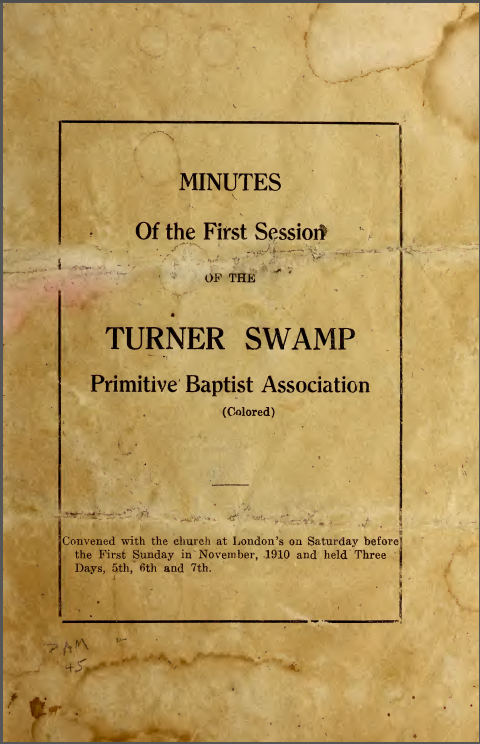
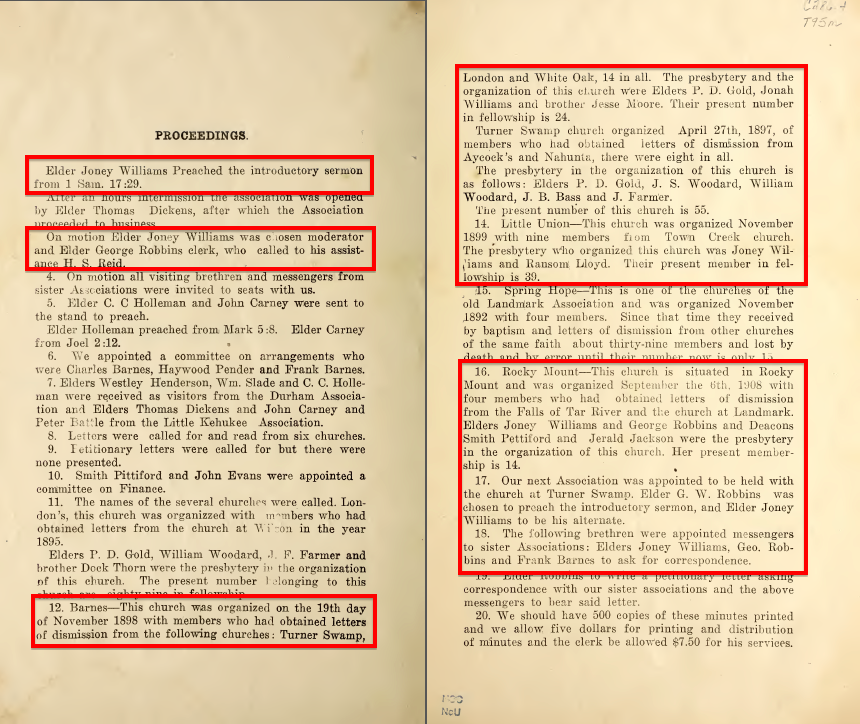
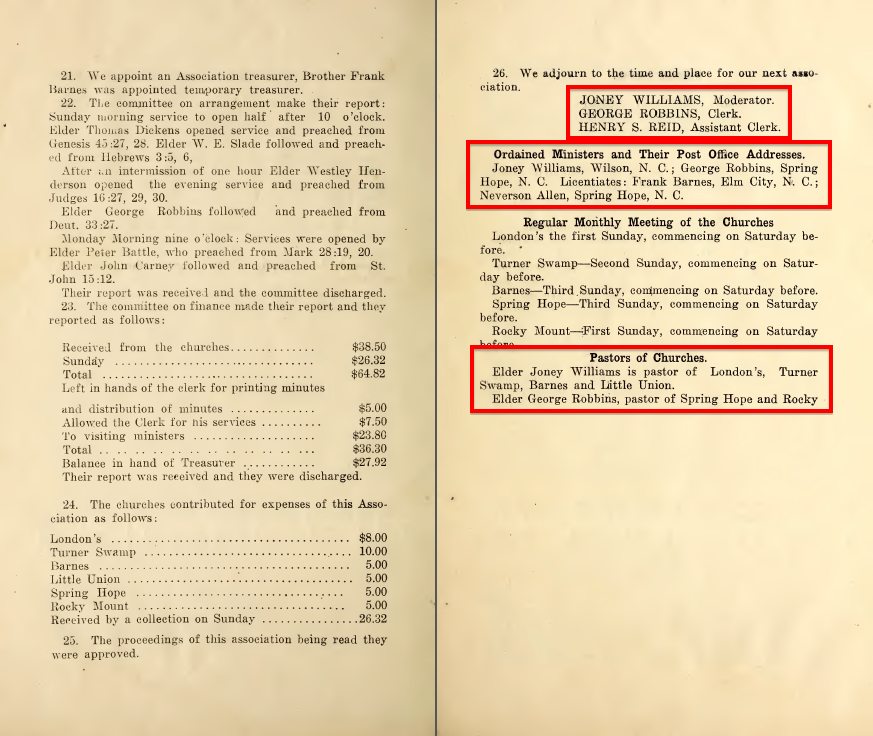
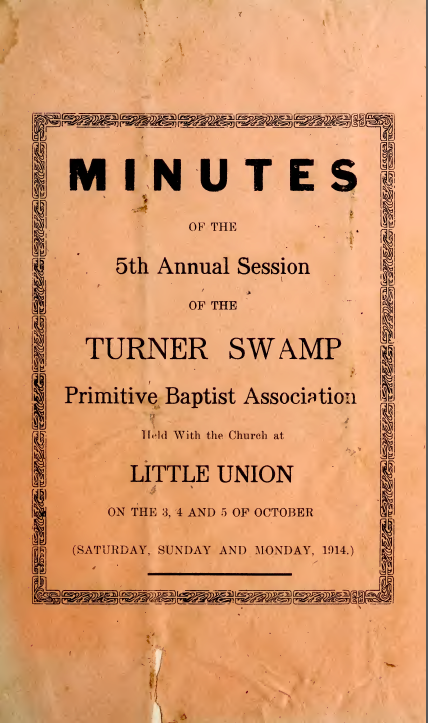
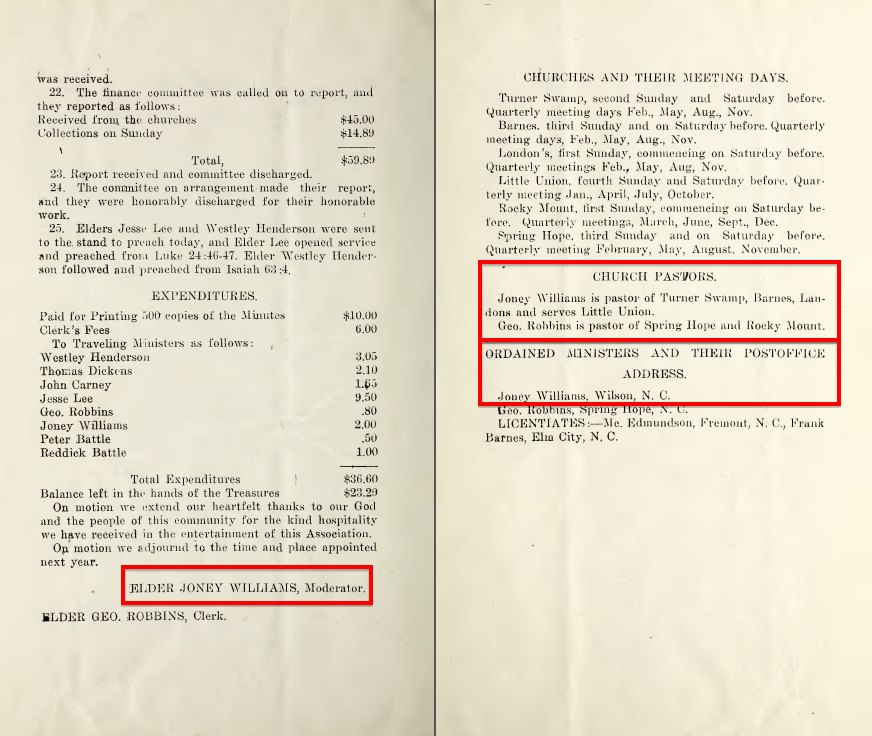
I’ve blogged often about Jonah Williams, prominent farmer, respected preacher, and brother of my great-great-great-grandfather Adam T. Artis. I was pleased, then, to find copies of the minutes of the early annual sessions of the Turner Swamp Primitive Baptist Association, which oversaw several churches that Jonah helped establish and/or lead. Jonah participated in five sessions before his death in 1915, and the minutes of two survive. I’ve extracted pages from those documents here.

JWms Turner Swamp 1

London’s Church was just north of the town of Wilson (in what would now be inside city limits.) The church is most closely associated with London Woodard, an enslaved man who was purchased by his free-born wife, Penny Lassiter. Just after the Civil War, London founded an African-American Baptist church, which seems to have been the precursor to the London’s Church organized under the Primitive Baptist umbrella in 1897.

As shown below, Jonah was involved in the establishment of nearly every church in the Turner Swamp Association, including Turner Swamp (1897), Barnes (1898), Little Union (1899), and Rocky Mount (1908). Turner Swamp still meets at or near its original location just north of Eureka in Wayne County. Barnes is likely Barnes’ Chapel Church, now located at 1004 Railroad Street in Wilson. [CORRECTION: Barnes Chapel was close to Stantonsburg, in southwest Wilson County.] I had never heard of Little Union church, but a Google search turned up a list of churches within 15 miles of “Bel-Air Forest (subdivision), North Carolina,” Little Union among them. (Which is a little spooky because that’s the neighborhood in which I grew up and I didn’t input that reference point.) Unfortunately, the site’s map is blank. However, another search disclosed a recent obituary that referred to the decedent’s efforts to rebuild Little Union Primitive Baptist Church in Town Creek, North Carolina. I have not been able to find current references to Rocky Mount Primitive Baptist Church.

Screen Shot 2015-01-06 at 6.37.15 PM

Screen Shot 2015-01-06 at 6.37.53 PM

Jonah moved from the Eureka area about 10 miles north to Wilson in the late 1890s. Though I knew of his association with Turner Swamp, I was not aware until finding this document that he had also been pastor at London, much less two other churches.

Screen Shot 2015-01-06 at 6.38.53 PM

Screen Shot 2015-01-06 at 6.39.13 PM

Romans 7:4 — Wherefore, my brethren, ye also are become dead to the law by the body of Christ; that ye should be married to another, even to him who is raised from the dead, that we should bring forth fruit unto God.

Screen Shot 2015-01-06 at 6.40.05 PM

Screen Shot 2015-01-06 at 6.40.21 PM

The approximate locations of the churches in Turner Swamp Primitive Baptist Association. Top to bottom: Rocky Mount, Little Union, London’s, Barnes’ and Turner Swamp. As the crow flies, the distance from Rocky Mount to Eureka, where Turner Swamp is located, is about 30 miles.

TS Ass map

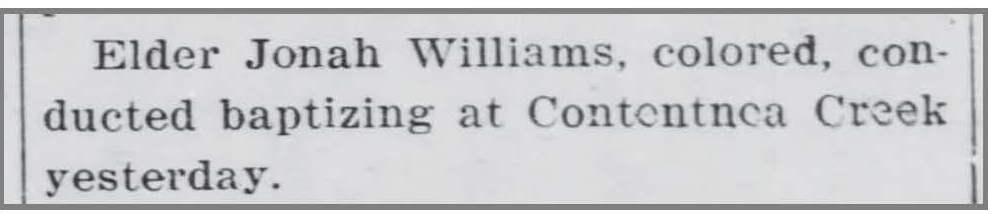
This news brief probably made reference to baptisms Jonah conducted at London Church, which stood a few miles from the south bank of Contentnea Creek.

WDT_6_6_1911_J_Williams_baptizing_at_Contentnea_Creek

Wilson Daily Times, 6 June 1911.

Standard