Births Deaths Marriages, Newspaper Articles, Paternal Kin

Young Joseph.

While Americans fought in Europe, a war with influenza raged at home.

Indy News 19 Oct 1918 Joseph Ward Jr death

Indianapolis News, 19 October 1918.

Dr. Joseph H. Ward returned to Indianapolis eight months later to find his wife Zella and daughter Mary Roena recovered, but his beloved son gone. The boy was nine years old.

——

Coda

My grandmother Mary Ward Roberts, whom we called Mur, would cry remembering when Buddy was taken away. She and her mother couldn’t follow the hearse because they were still sick. The purple cloth they put outside of the door to let people know that the house was infected with Spanish Influenza. Mur said that Buddy pointed his finger upward and said goodbye. Her father went into a deep depression in France and was hospitalized. When he returned from France, he had Buddy’s body exhumed to say a final farewell. Can you imagine?         — Z.P., great-granddaughter of Joseph H. Ward

Standard
Newspaper Articles, North Carolina, Paternal Kin, Politics

Pre-election street fracas?

A “pre-election fracas”? What happened? And why did eight of black Goldsboro’s leading lights — including my great-great-great-uncle Matthew W. Aldridge and cousin William S. Hagans — feel compelled to take to the newspaper, hat in hand?

Goldsboro_Daily_Argus_11_18_1896_letter_re_fracas_Hagans_Aldridge

Goldsboro Daily Argus, 18 November 1896.

I didn’t find anything in the Goldsboro papers to which I have access, but two weeks before this letter was published, newspapers across the country ran a sensational story about Negroes “taking control” of Goldsboro after a “clash with whites.” The alleged cause? “An incendiary speech” made by none other than John Frank Baker, “a colored Republican of Dudley,” and husband of Mary Ann Aldridge Baker.

Independence_KS_Daily_Reporter_11_4_1896_Frank_Baker_clash

Independence Daily Reporter (Kansas), 4 November 1896.

Four months later, Frank Baker was assassinated, shot dead as he went about his work in a Dudley grocery.

Were Matthew Aldridge and William Hagans and their peers moved to pour oil on the waters because they feared the fallout from Baker’s outspokenness? (I have yet to find anything that touches on what he actually said.) Their letter is frustratingly vague about the events that gave rise to a “race riot” in Goldsboro, speaking only of the aftermath of a recent election. The message is difficult to digest, greased as it is with deferential supplications to the “better class of our white citizens” and anxious apologies for the “slight ripple upon the formally [sic] smooth surface” of race relations in Wayne County. Reading from a 21st century vantage point, it is easy to dismiss this letter as Uncle Tommery. There is an undoubted and substantial element of self-preservation and middle-class conservatism at work here, but their fear was surely real and well-placed.

——

  • Clarence Dillard (1862-1933), Howard University Theology ’83, came to Goldsboro as a Presbyterian minister and was principal of the colored graded school during this period. He was active in Republican politics and was co-editor of a short-lived African-American newspaper in Goldsboro, The Voice. Goldsboro’s first African-American high school was named for him.
  • A. Sasser was likely Arnold Sasser (1866-1939), who was listed as an undertaker in the 1900 census of Goldsboro.
  • A.M. Smith, I can’t identify.
  • William S. Hagans (1869-1947), son of a prominent farmer, moved between Goldsboro and Washington, where he would soon serve as secretary to African-American United States Congressman George H. White.
  • B.G. Hogans was likely Benjamin H. Hogans (1865-1926), a teacher, a trustee of Saint James AME Zion Church and, later, a mail carrier. He was born in Orange County, North Carolina, and came to Goldsboro as a child. [Hogans’ niece Annie Irene Hogans married Daniel Simmons, first cousin of my great-grandmother Bessie Henderson.]
  • Matthew W. Aldridge (1857-1920) was a grocer and erstwhile teacher who was active in city politics as alderman and poll-holder in the heyday of the Black Second era.
  • William E. Highsmith (1851-1930) was a farmer.
  • Henry Williams, like Hogans, was a pallbearer at the funeral of William Hagans’ father Napoleon Hagans, conducted in part by Clarence Dillard just ten weeks before this letter was published. Beyond that, I have not been able to identify Williams.

Standard
Free People of Color, North Carolina, Other Documents, Paternal Kin, Photographs

A reunion.

Screen Shot 2015-09-27 at 10.47.52 PM

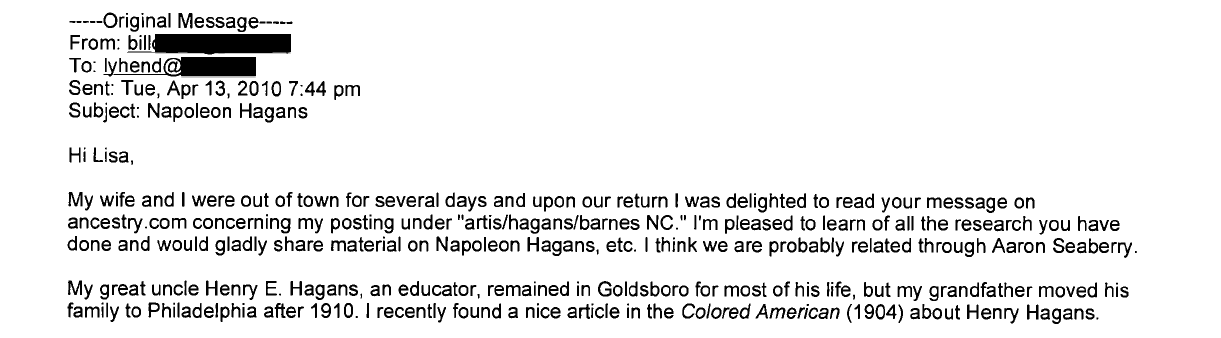
And with that introductory email began my fruitful and thoroughly enjoyable correspondence with B.H., my third cousin, twice removed. Our common ancestor was Levisa (or Eliza) Hagans Seaberry, mother of Napoleon Hagans (B.H.’s great-grandfather) and Frances Seaberry Artis (my great-great-great-grandmother). In the spring of 2010, B.H. and I entered into a mutually beneficial exchange of information about our shared family. I had little information about Napoleon beyond what I’d found in census records and deeds, I’d lost track of his sons Henry and William, and I was completely unaware of his son, the accomplished Dr. Joseph H. Ward. He cued me into William S. Hagans‘ post-migration life in Philadelphia, shared amazing photographs and documents, and lead me to “discover” Joseph Ward’s early years. In turn, I introduced B.H. to Wayne and Wilson Counties and the lives of the Haganses, Wards and Burnetts before they recreated themselves up North.

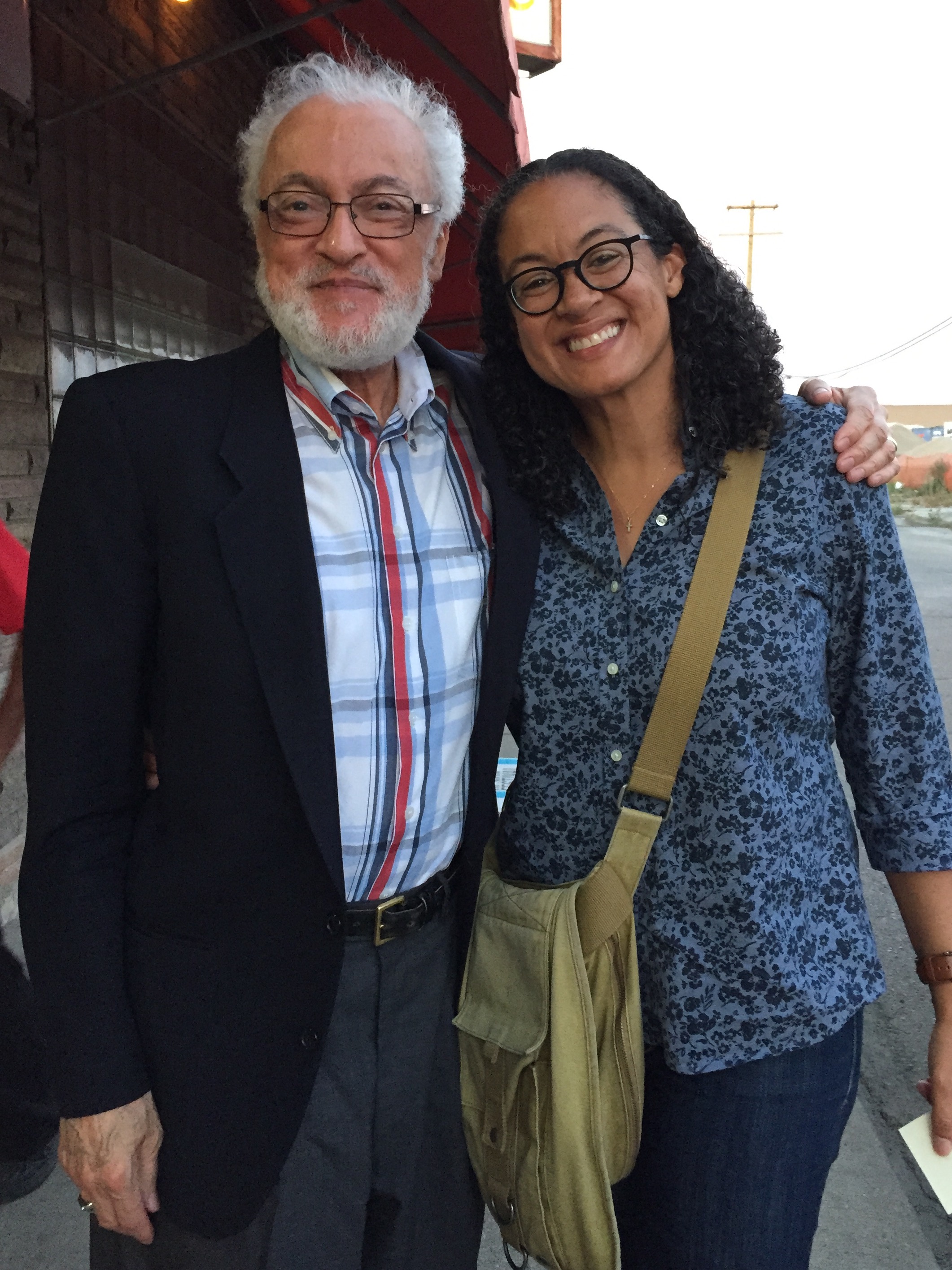
This past weekend, I traveled to Detroit for — astonishingly — the first time ever. Our primary purpose was to take in the city’s rich street art culture, but I added an item to the top of the agenda — meeting B.H. Friday night, he and his wife treated us to dinner at an old and storied restaurant near the city’s Eastern Market, and Levisa’s children came full circle.

me and Bill

Standard
Births Deaths Marriages, Free People of Color, Migration, Newspaper Articles, North Carolina, Paternal Kin

Anna J. Henderson Simmons.

Something brings me back to Anna J. Henderson Simmons. At no more than 20 years old, she left all the family she knew to follow her new husband 800 miles to Canada, where his Wayne County family had settled decades earlier.   It is hard to get a sense of Anna’s life. Her husband Montreville Simmons achieved a measure of success as a farmer in central Indiana, but evidence suggests that he was a difficult man to live with. Did she ever see her birth family again? Probably not, and evidence suggests that her children had an uncertain grasp on the facts of her early years.

Here’s what I know of my great-great-great-grandfather Lewis Henderson‘s sister:

In the 1860 census of Westbrooks, Sampson County, North Carolina, appear James Henderson, mulatto carpenter; wife Eliza; and four children, Anna J., Susan, Hepsie, and Alexander. Eliza (or Louisa) Armwood, daughter of John and Susan Armwood, was James’ second wife.

Ten years later, the family had moved about 20 miles east-southeast and appear in the 1870 census of Faisons, Duplin County: James Henderson, 52, mulatto farmer; wife Eliza; and children Ann, 17, Susan, 16, Hepsey, 14, Aleck, 13, John H., 11, Nancy, 6, and Betty, 3, plus James’ son James, 27, and boarders James Ammons and Thomas Cox. (Were the latter two relatives of either James or, more likely, Eliza/Louisa?)

The following spring, on 3 March 1871, Anna Henderson married Montraville Simmons, 19, son of Calvin and Hepsie Whitley Simmons, in Duplin County. The license lists Anna’s parents as James Henderson and Louisa Armwood. Montraville had been born in Wayne or Duplin County and migrated to Chatham, Kent County, Ontario, Canada with his family in the 1850s. After the death of his first wife, Victoria Brown, whom he married in Chatham in 1865, Montraville returned to North Carolina for a new spouse. (There’s a suspicious marriage on 16 April 1848 in Oakland, Michigan, between 23 year-old Montreville Simmons of North Carolina and Harriet Lucas of Richmond, Ohio. Was this yet another early marriage for Anna’s Montraville?)

Henderson Simmons

Duplin County, North Carolina, Marriage Register.

The family was captured in the 1881 census of Chatham, Kent County, Ontario, Canada: Montreville Simmons, 40, farmer; wife Annie, 29; and children Elizabeth, 8, Doctor T., 7, Susan M., 4, and Montreville, 2. All were born in the United States except Doctor and Montreville jr., who were born in Ontario, and all were Baptist. [Where in the U.S. was Susan born? Had Anna gone back to North Carolina? Or had the family lived some short period across the nearby border?]

Sometime in the next twenty years, the Simmonses cast their lot permanently as Americans. For reasons unknown, they settled near Logansport, Indiana, in rural Cass County north of Indianapolis. In the 1900 census of Eel township, on Park Avenue in Logansport, the census taker recorded farmer “Montville” Simmons, born April 1850, wife Anna, born March 1861, and sons James R., December 1879, Montville, June 1882, and Dock, December 1879. Montville and Anna were recorded as born in North Carolina; their sons in Canada. Montraville and Anna had been married 28 years and reported five of five children living. The family was described as black. [The evidence concerning the Simmons children is confusing. Census records name Elizabeth (born circa 1872), Doctor/Dock (born circa 1874), Susan M. (born circa 1877), James R. (born circa 1879), Montraville Jr. (born circa 1880) and Edward (born 1881.) However, records in Indiana indicate another daughter, Moncy, who died in 1942.]

Montraville Simmons was a successful farmer, but a life of material (if heavily mortgaged) comfort did not necessarily spell ease for Anna. Montraville’s name peppered the local paper regularly, as Pharos-Tribune reporters gleefully chronicled his clashes with neighbors and his personal peccadilloes.

Anna herself managed to stay out of print until 1905, when the ailing woman parachuted into a spat between her husband and his creditors. Headlines blared her surprising intervention, and it’s hard not to see Montraville’s hand as a puppet master in this 11th hour shenanigan.

fde18e1441d94fe6af87424a4a2b890e_crop

Logansport Pharos Tribune, 22 December 1905. 

Sadly (she was only about 50 years old) but perhaps mercifully, within six months, Anna Henderson Simmons was dead. Her death certificate, which contains some curious errors, reported that Annie Simmons, married, died 16 Jun 1906 in Cass County, of Basedow’s disease [now known as Graves’, a disease of the thyroid]. She was born 2 February 1856 in North Carolina and was buried at Free Union Baptist in Irvin township, Howard County, Indiana, by Kroeger & Strain, funeral directors. The informant for the certificate was Montraville Simmons. The father or the son? I don’t know, but it’s hard to believe that either reported Anna as white, though that’s what the certificate notes. It’s less hard to believe that Montraville Jr. might have misreported his mother’s parents as James Harrison and Eliza Henderson. He, after all, had surely never met them. (And when he married Jessie Winslow in Cass County in 1903, he cited his mother’s maiden name as Anna Harrison.)

On 18 June, the Pharos Tribune ran a brief obituary:
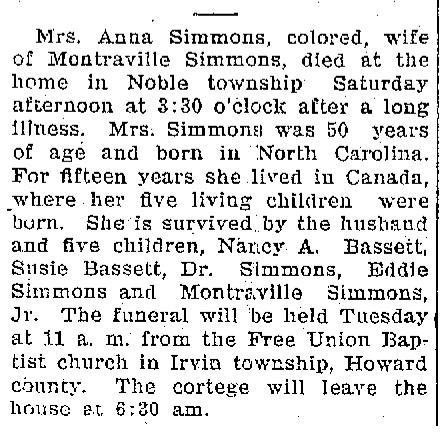
oigt6072OI83632774

——

Who were Anna Henderson Simmons’ legacies? Is there a lost branch of Hendersons in middle Indiana?

  • Elizabeth Simmons (circa 1872-??) probably died before adulthood. Or she is the same person as Moncy Simmons.
  • Moncy A. Simmons (1872-1942) married first Daniel Bassett, then Newton Palmer; no known children.
  • Doctor R. Simmons (27 November 1874-after 1951) married Fannie Gibson; no children.
  • Susan M. Simmons (circa 1877-1937) married Britton Bassett; two children, who died in infancy. She helped rear her brother Montraville’s son Harold.
  • James R. Simmons (circa 1879-aft. 1900) probably did in young adulthood; no children. Or, he is the same person as Edward Simmons.
  • Montraville Simmons Jr. (circa 1880-31 March 1910) married Jessie Winslow in 1903. His son Harold Simmons was born about 1904. On 7 October 1911, Jessie gave birth to Helen Elizabeth Simmons in Chicago and listed Montraville on Helen’s birth certificate, but he could not have been the child’s father. Similarly, in the 1920 census, Jessie Winslow Simmons, remarried to Earnest W. Griggs, attributes by inference two additional children to Montraville Jr., Frances (born 1913) and Alma (born 1916). Neither were his. Harold is mentioned in his aunt Moncy’s obituary, but does not regularly appear in census records.
  • Edward Simmons (24 November 1883-1936) married only after his parents’ deaths, but married four times in 20 years. He had no children.

In other words, improbable as it seems, Anna’s seven children produced a single grandchild, and he seems not to have any children. There are not, it seems, any Kokomo cousins.

Standard
Newspaper Articles, North Carolina, Paternal Kin

Case continued ….

Ummmm….

Screen Shot 2015-09-18 at 3.40.39 PM

I have so, so many questions about this little blurb from the 1 April 1890 edition of the Raleigh State Chronicle.

Number one: were these men the David, Robert Jr., and Joseph Aldridgeborn 1858, 1866 and 1869, who were the younger sons of Robert and Mary Eliza Balkcum Aldridge? (One and a half: if not, who were they?)

Two: Croatan Indians? (This is the name by which today’s Coharie Indians were known at the end of the nineteenth century.) The Aldridges?

Three: Voodooism?!?!! (For that matter, tramping and vagrancy? What were these Wayne County farmers doing in Wake County?)

Four: Can I find out what happened? I’ll need to get into Wake Superior Court records at the North Carolina State Archives.

Standard
Business, Newspaper Articles, Paternal Kin, Photographs

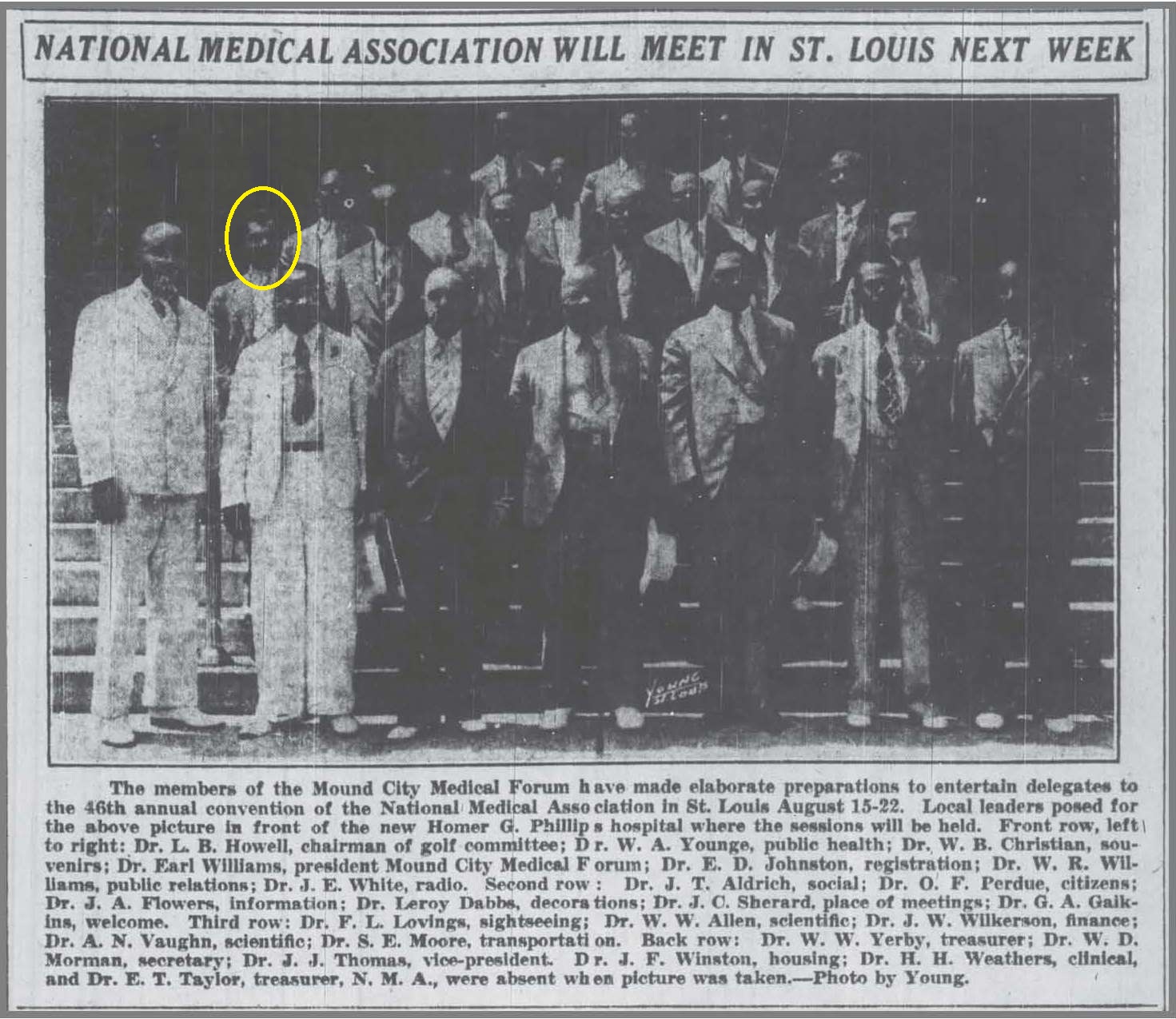
Mound City Medical Forum gets ready.

Speaking of Tom Aldridge

Pittsburgh_Courier_Mound_City_Doctors__8_14_1937 highlighted

Pittsburgh Courier, 14 August 1937.

This is the earliest photograph I have seen of my great-grandfather, and he was 51 years old here. His hair, fallen over his forehead, seems thicker than in later studio portraits. Otherwise, disappointingly little detail can be seen. Twenty-four years later, he would be elected president of the National Medical Association.

Standard
Military, Other Documents, Paternal Kin

Pvt. Aldrich.

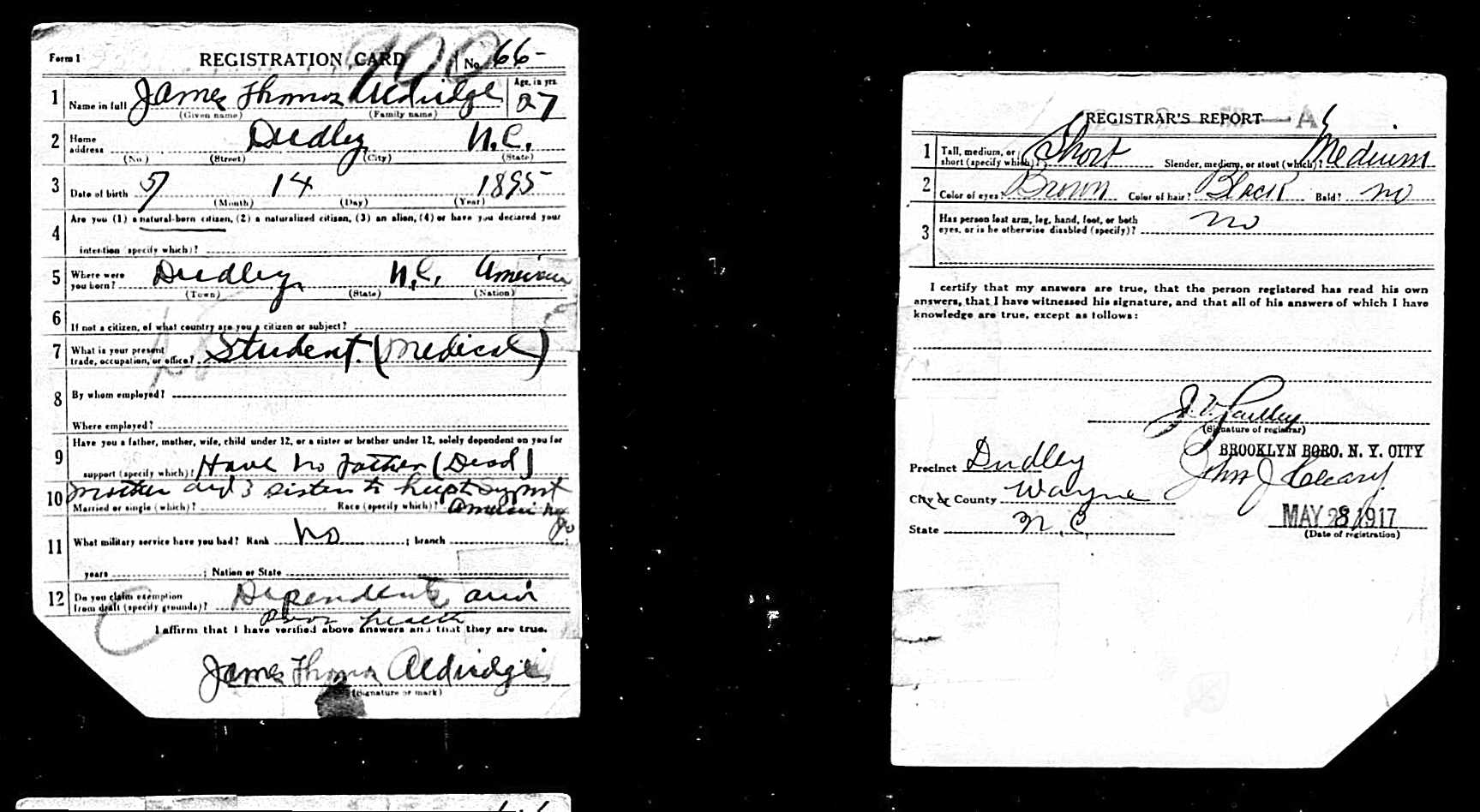
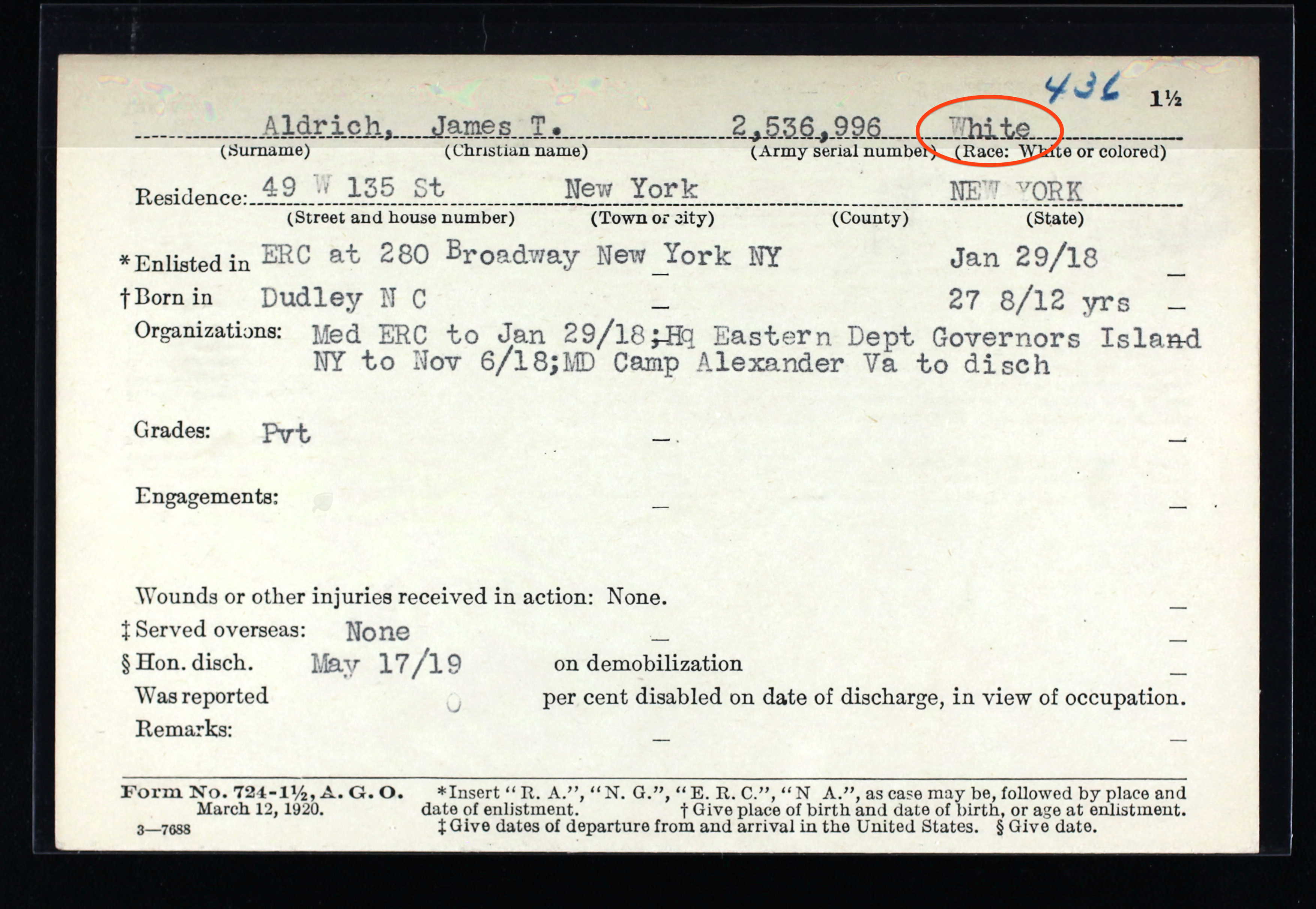
On 28 May 1917, James Thomas Aldridge appeared before a registrar in Brooklyn, New York. I imagine Tom dragging his feet, and his reluctance to serve shows through his notably exaggerated response to Question 9 — “Have no father (dead) Mother and three sisters to help to support” — and the basis for his claim for an exemption — “Dependents and poor health.” Tom described himself as a “student (medical),” and evidence demonstrates that he had entered medical school in the fall of 1916. (He may have done his first year at Leonard Medical School, then transferred to Meharry, from which he graduated in 1920. But what was he doing in Brooklyn? He wasn’t a resident, as demonstrated by the home address and precinct listed on the card.) Tom also gave his birth date as 14 May 1895, which would have made him 22. His age, however, is listed as 27. Neither is correct. He was born in 1886, and was 31 in 1917, but always fudged heavily on his age, possibly to disguise the long years that passed between finishing eighth grade in Dudley’s local school and entering high school at Shaw. Either way, he was called up.

005152198_04713

Until a couple of days ago, my knowledge of my great-grandfather’s World War I service was limited to brief mentions in his obits that he had been in the Medical Corps. While looking for something else, though, I ran across an Ancestry.com database, “New York Abstracts of World War I Military Service 1917-1919.” And there, under his preferred spelling — more about that later — was James T. Aldrich.

Serial number 2,546,996. White.

Huh? How ever did Tom pull that off?

In any case, there it is — his World War I record. Service did not take him far from his home in East Harlem. (Maybe his health was poorish, after all?) Enlistment in the Medical Reserve Corps on Broadway in January 1918. Then about nine months at the Army base that Governors Island once was. (On 8 October 1918, just before leaving Governors Island, he married Athalia Freeman.) Then on to Camp Alexander in Newport News, Virginia, for six months until his discharge in May 1919. Camp Alexander, established in 1918, served as an embarkation and debarkation camp for African-American troops.

40808_1120704930_0015-01040 copy

Standard
Letters, Other Documents, Paternal Kin

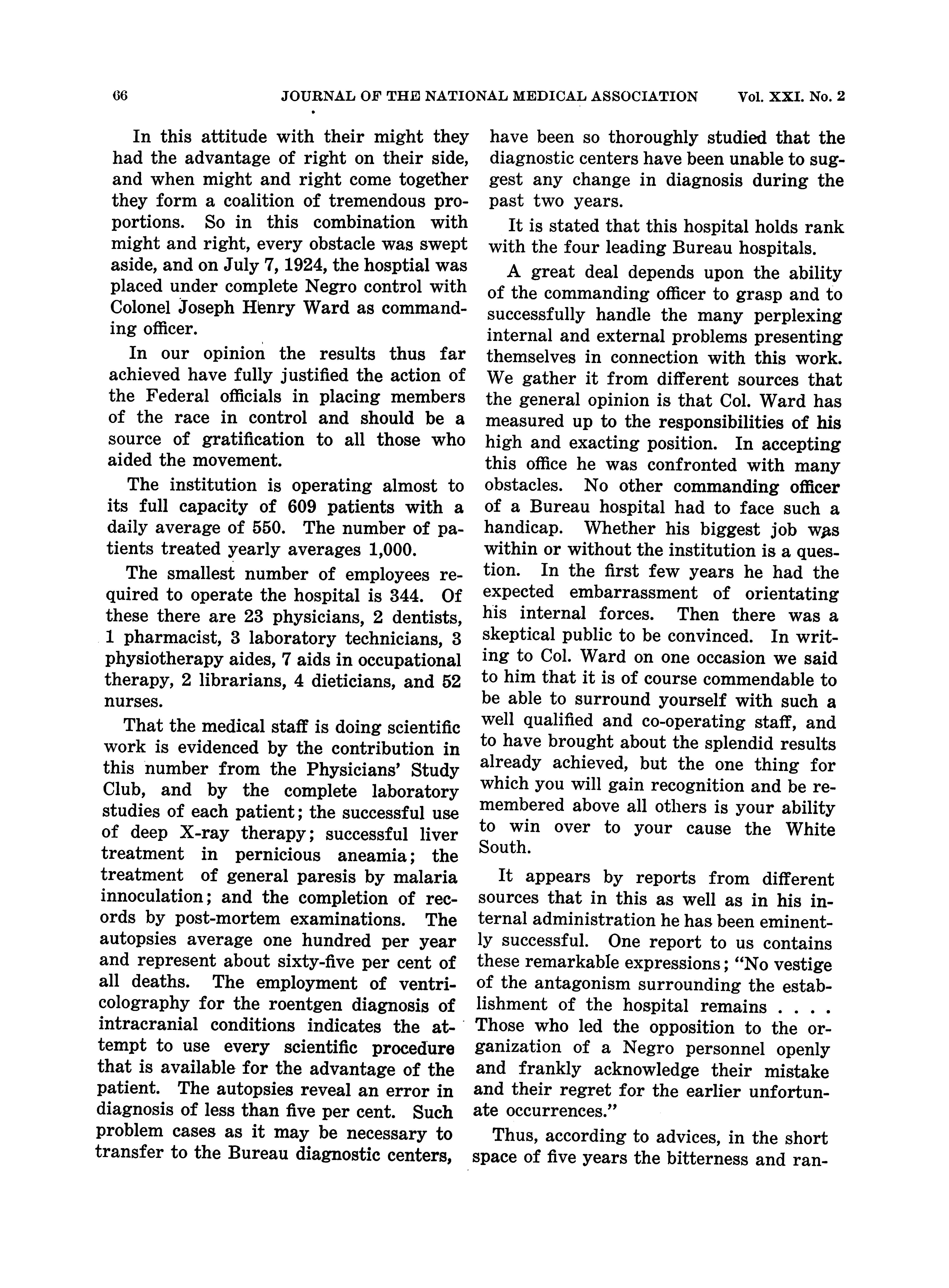
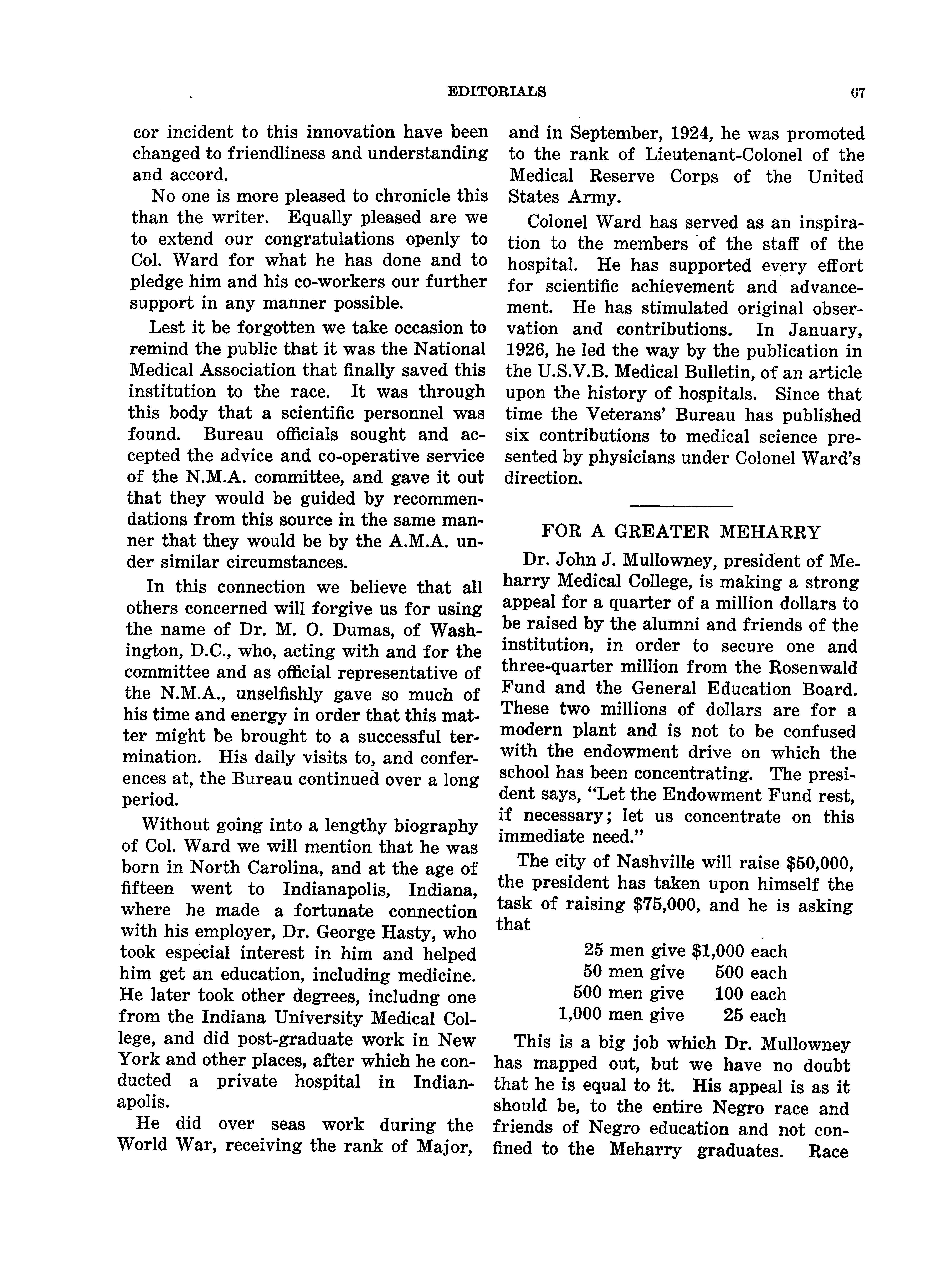
By all means Ward should have the Spingarn Medal.

DuBois Ward Spingarn

Du Bois, W. E. B. (William Edward Burghardt), 1868-1963. Memorandum from W. E. B. Du Bois to Spingarn Medal Award Committee, January 2, 1933. W. E. B. Du Bois Papers (MS 312). Special Collections and University Archives, University of Massachusetts Amherst Libraries.

Uncle Joe Ward

Iconic photograph of Major (later Colonel) Joseph H. Ward during his World War I service, from Emmett J. Scott’s The American Negro in the World War (1919).

WARD_--_JNMA_Article_re_Tuskegee_Page_1

WARD_--_JNMA_Article_re_Tuskegee_Page_2

WARD_--_JNMA_Article_re_Tuskegee_Page_3

Journal of the National Medical Association, volume 21, April-June 1929.

Though it’s hard to imagine a more resounding endorsement than one emanating from Dr. W.E.B. DuBois (himself a winner), the NAACP’s 1933 Spingarn Medal in fact went to YMCA secretary Max Yergan for his missionary work in South Africa.

[For a earlier bit of correspondence from Dr. DuBois to the Wards, see here.]

Hat tip to cousin A.W.P., Dr. Joseph H. Ward‘s granddaughter, who alerted me to this document.

Standard
North Carolina, Other Documents, Paternal Kin

Betty and Edward Henderson.

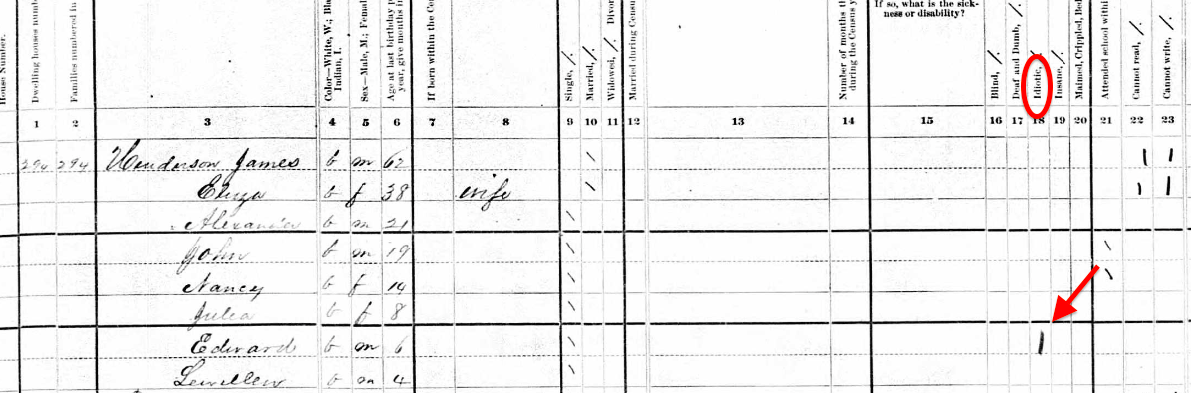
How have I missed this??? Betty and Edward Henderson were two of great-great-great-great-grandfather James Henderson‘s younger children. Each appeared in a single census record — Betty as a three year-old in 1870, and Eddie as a six year-old in 1880.

Screen Shot 2015-08-08 at 12.49.30 PM

1870 federal population schedule, Faison, Duplin County, North Carolina.

Screen Shot 2015-08-22 at 9.28.39 PM

1880 federal population schedule, Faison, Duplin County, North Carolina.

I have just noticed that both were described, in the unfortunate parlance of the day, as “idiotic.” The word did not mean then, as it connotes today, “stupid” or “foolish.” Rather, it was a medical term designating a person with severe intellectual disabilities. What condition affected these children? A congenital defect? An environmental deficiency?

It is impossible to know. Neither Betty nor Edward seems to have lived to adulthood, and I honor their brief lives here.

Standard