

Goldsboro Messenger, 30 January 1879.
Ann Elizabeth Henderson was the daughter of Lewis and Margaret Balkcum Henderson.
Goldsboro Messenger, 30 January 1879.
Ann Elizabeth Henderson was the daughter of Lewis and Margaret Balkcum Henderson.
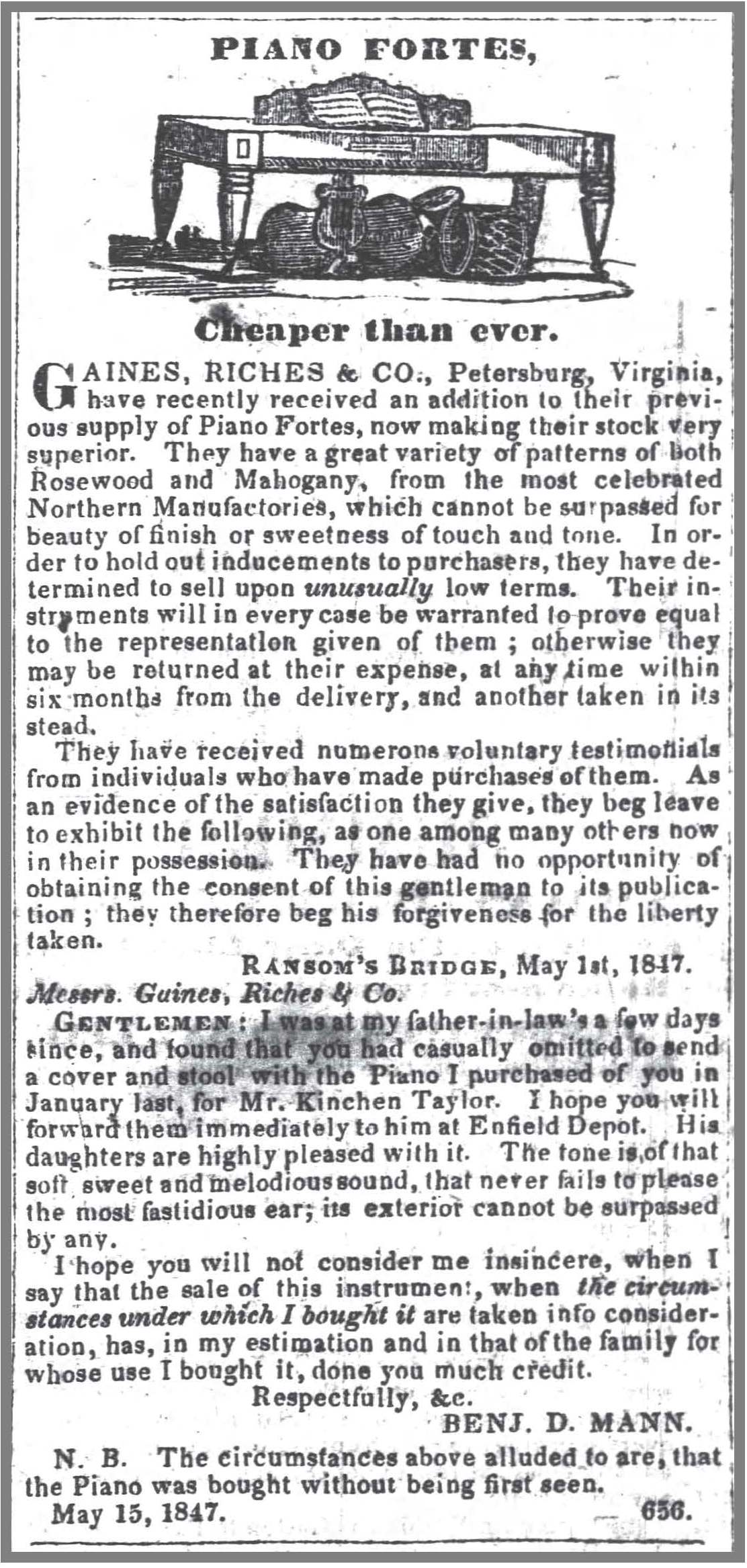
Raleigh Weekly Standard, 9 June 1847.
In addition to 100+ enslaved humans, Kinchen Taylor owned a very superior piano forte.
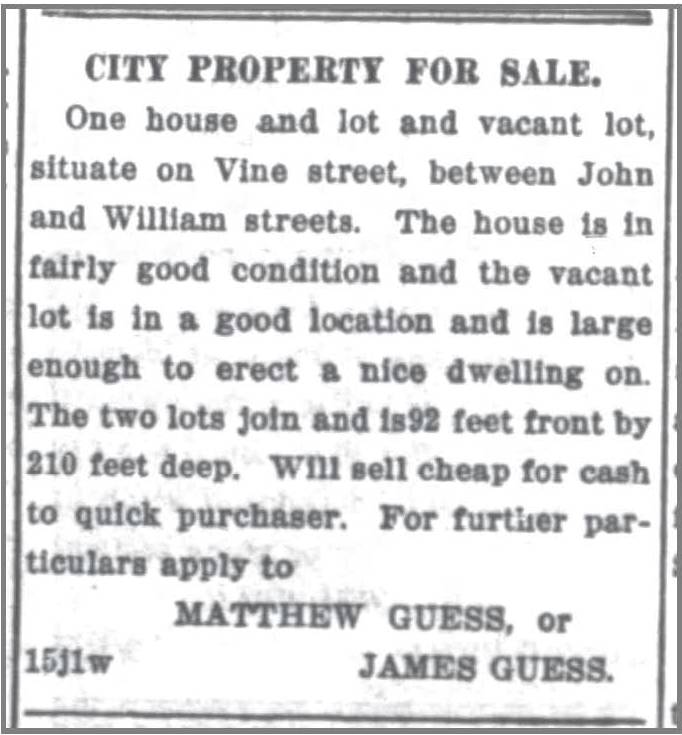
Goldsboro Daily Argus, 23 January 1918.
Along with barbering and undertaking businesses, James Guess and his father Matthew apparently engaged in a little real estate speculation.
Another rare glimpse of David Sloan Aldridge, son of Robert and Eliza Balkcum Aldridge, who “disappears” from records after 1904:

Goldsboro Daily Argus, 28 April 1904.
I felt sure that Napoleon Hagans‘ death had merited more than the brief mention I’d seen in the Goldsboro Headlight, and last night I found it:
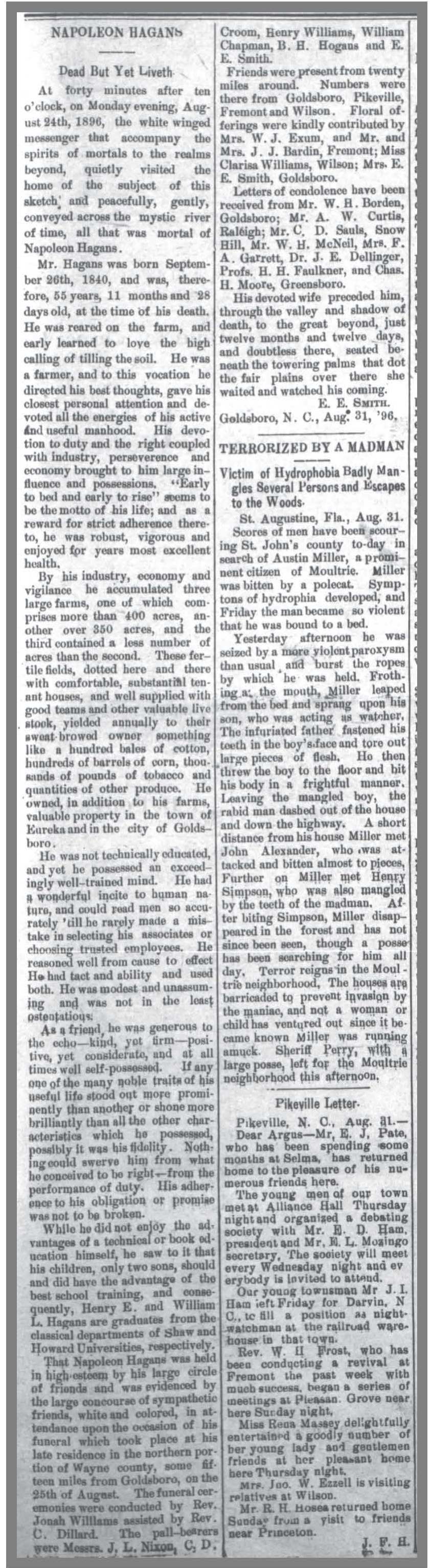
Goldsboro Daily Argus, 1 September 1896.
This shining eulogy was penned by Ezekiel Ezra “E.E.” Smith (1852-1933), college president, recent United States Ambassador to Liberia, and arguably the most accomplished of Wayne County’s 19th-century African American citizens. (Smith was born free in Duplin County, just to the south, but moved to Goldsboro as a young man, married a cousin of Napoleon’s daughter-in-law Lizzie Burnett Hagans, and was principal for a time of Goldsboro’s colored school.) Side-stepping the indelicate issue of Napoleon’s parentage, E.E. painted a glowing portrait of his friend’s virtues — his hard work, his astuteness, his self-built wealth, his determination to give his children what he lacked. Napoleon’s business acumen and successes won relationships across color lines and among North Carolina’s colored elite, and E.E. listed those who took part in the funeral or had taken the time to reach out to pay respects:
Among the supplies the Wayne County Commissioners bought in 1884 to feed residents of the county poorhouse was $22 worth of corn from Napoleon Hagans.

Goldsboro Messenger, 14 August 1884.

Tarboro’ Press, 1 March 1845.
I first thought that the Kinchen Taylor in this ad was one of other Kinchen Taylors in Nash County in the antebellum period. However, a bit of research revealed that Kinchen Taylor of Fishing Creek had a son, Josiah, who died in late 1846 or early 1847. Josiah Taylor’s modest estate, administered by his brother-in-law Benjamin D. Mann, included no slaves. Nonetheless, it appears here that Josiah sold at least one slave who actually belonged to his father. Was this Lewis related to the “Big Lewis” listed in Kinchen’s estate in 1853? Was he ever captured? How many other Lewises were sold away from Kinchen’s plantation, their links to their families permanently sundered? (And their perplexed descendants, known to each other only via mysterious DNA matches, left to ponder lost connections.)
When the call came, Hester Balkcum‘s grandsons answered. And paid.
——
James Lucian Balkcum, born about 1839, son of Mariah Balkcum and William L. Robinson. Lucian was a Sampson County farmer when he enlisted as a private on 9 May 1861 in Company F, 20th North Carolina Infantry. He was captured 20 July 1864 at Stephenson’s Depot, Virginia, and confined at Camp Chase, Columbus, Ohio, where he died of variola on 4 Jan 1865. He is buried in the Confederate Cemetery in Columbus.
Josiah Johnson, born about 1844, son of William and Mariah Balkcum Johnson of Sampson County. Josiah enlisted as a private on the same day and in the same company as his half-brother Lucian Balkcum. He received a disability discharge on 6 May 1862, but re-enlisted 2 Jan 1864. Josiah died from wounds on 9 Nov 1864 at Mount Jackson, Virginia.
Harman Balkcum, born about 1822 to Nancy Balkcum and an unknown father. A 5’6″ farmer, he enlisted 4 Jan 1862 in Duplin County as a private in Company A, Wilmington & Weldon Railroad Guards (later Company D, 13th Battalion, North Carolina Infantry.) A month later, records note that he missed duty for five days due to parotitis. He died 8 April 1863, probably of illness.
William James Balkcum, born 1841 to Lemuel and Jemima Rackley Balkcum of Sampson County. W.J. enlisted on 10 Sept 1862 in the same company as Lucian Balkcum and Josiah Johnson. He was wounded 1 July 1863 at Gettysburg, and his left arm amputated. He was captured as prisoner of war on 5 July 1863 and paroled circa 25 Sept 1867. He arrived for prisoner exchange 27 Sept 1863 at City Point, Virginia, and transferred to Company F, 20th Infantry on 16 Apr 1864. Nancy’s great-grandson was the only Balkcum to come home.
Lemuel Balkcum, born about 1823. He was named as a grandson in Hester Balkcum’s will and was probably the son of Nancy Balkcum. In the early 1840s, Lemuel Balkcum married Jemima Rackley. They had at least eleven children — the youngest just months old — before his enlistment on 2 September 1863 as a private in Company E, 30th North Carolina Infantry at Camp Holmes, Raleigh NC. Lemuel died of typhoid fever on 26 Dec 1863 in a Richmond, Virginia, hospital and is buried in Hollywood cemetery, Richmond.
Surprisingly few of Adam Artis‘ 25+ children migrated out of North Carolina, perhaps because the family’s relative farming wealth and good standing in their community made life in North Carolina — even in the 19th century — attractive. Two who did strike out went West. Sort of. They went to Arkansas.
——
Augustus Kerney “Gus” Artis was born about 1857 to Adam and his wife Lucinda Jones. He was a mere toddler when his mother died, and he was reared primarily by Frances Seaberry Artis, whom Adam married in 1861. Gus inherited one-third of his mother’s share of the estate of her father Jacob Ing, a small nest egg that may nonetheless have represented the pinnacle of his wealth. In 1879, Gus married Rebecca Morgan in Wayne County. Though a 13 year-old girl is implausibly described as their daughter in the 1880 census, there is convincing evidence of a daughter Lena, born in 1882. What Gus did or where he was over the years after her birth is a mystery, for in 1893 he suddenly appears in the city directory of Little Rock, Arkansas, living at the corner of Allen and Elm in North Little Rock. (Which, by all accounts, was a swampy outpost known as Argenta at that time.) In 1898, Lena Artis married Charlie Hill in Pulaski County. By 1900, however, she was back in her parents’ house on Washington Avenue in North Little Rock. Farm laborer Gustice Artis and wife Mary R. (presumably Rebecca), married 19 years, are listed with Lena, 18, born in North Carolina, and Mary, 13, an adopted daughter born in Arkansas. By 1910, both daughters had left the household, though Mary reported them living. Augustus, then in his early 50s, worked as a laborer in a greenhouse. Lena, described as a widow, was living and working as a “dining room girl” in a Scott Street boarding house. I’ve found none of the Artises in the 1920 census, though Gus and Mary were still alive. Gus didn’t last much longer though. He died of heart disease 2 June 1921 in Brandie township, Pulaski County, and was buried in the “fraternal cemetery.” His death certificate lists his final occupation as “scavenger.”
——
Twenty-five miles east of North Little Rock, Gus’ younger sister Eliza Artis Everett also built a life far from her home. She was the twin of my great-great-grandmother Louvicey Artis Aldridge; the girls were born in 1865 to Adam Artis and his second wife Frances. I have not found their marriage license, but around 1890, Eliza married Haywood Everett. By 1900, they had migrated to Williams township, Lonoke County, Arkansas, and joined a veritable colony of Wayne County migrants, including Haywood’s elderly parents. Families listed near them in the census carried such familiar surnames as Barnes, Best and Coley. In 1910, the Everetts appear in the Richwoods section of the county. In 1920 and 1930, they are in Walls township. They never had children. On 10 October, 1936, Eliza Everett died of pancreatic cancer. Her husband remarried before she was cold in her grave.
——
Did Gus and Mary Rebecca Artis and Haywood and Eliza Everett migrate together in the late 1880s/early 1890s? Why Arkansas? Did Gus and family originally settle among other Wayne County families in Williams township, Lonoke County, before moving closer to Little Rock? And then there’s this — the Lonoke County Race War of 1897-1898?!?!
 Scuffalong: Genealogy.