Free People of Color, North Carolina, Other Documents, Paternal Kin, Photographs, Rights

Jurors and judges of election.

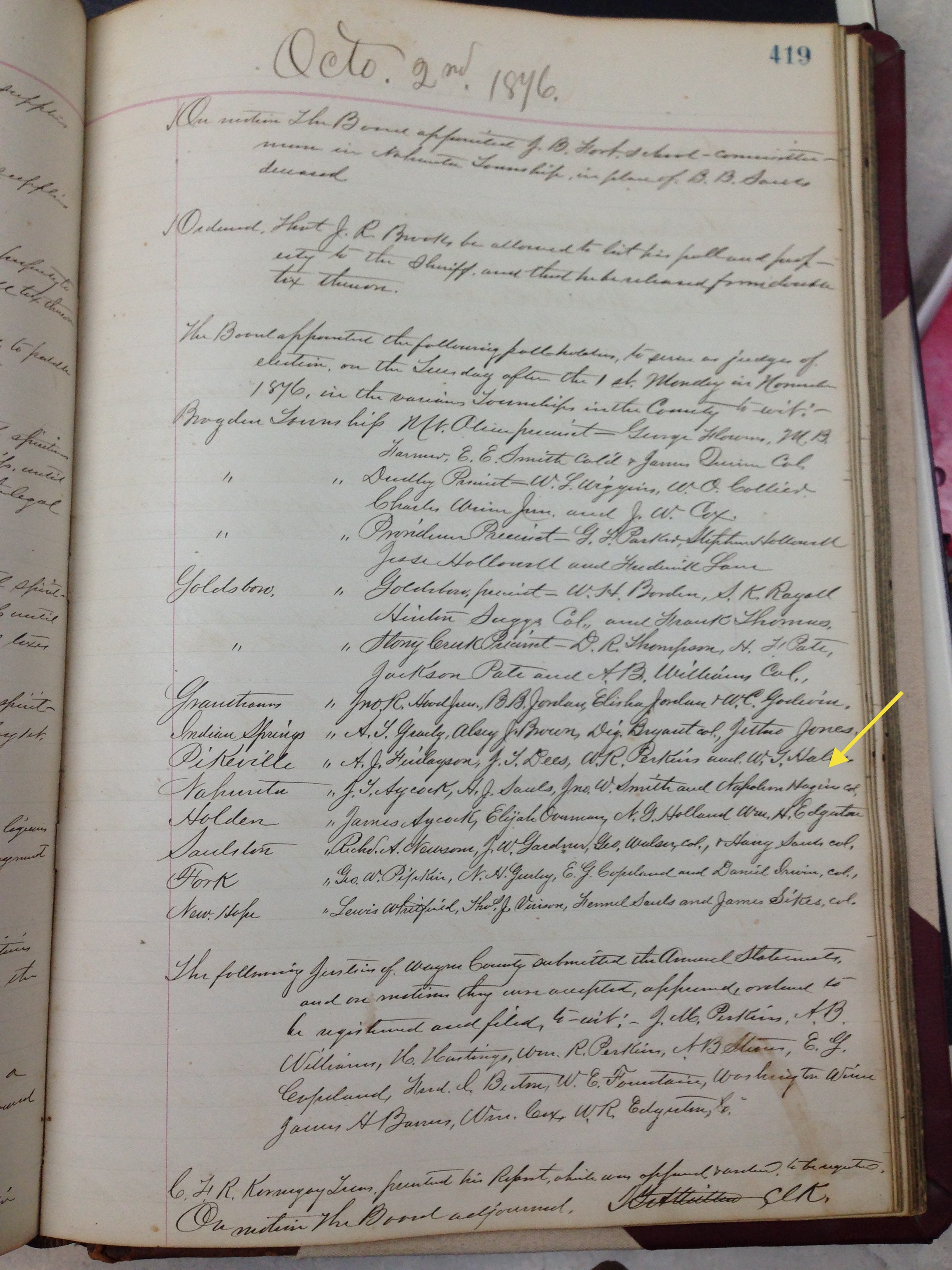
As tax-paying landowners, many African-American men in Wayne County, North Carolina, in the 1870s were called alongside white men to fulfill their civic duties. Here are two entries from Superior Court Minute Book 2:

ImageNapoleon Hagans of Nahunta township was appointed a judge of elections.

ImageMy great-great-great-grandfather Lewis Henderson drew jury duty for the first week of the next term of the superior court.

Superior Court Minute Book 2, Wayne County Register of Deeds Office, Goldsboro, North Carolina.

Standard
Births Deaths Marriages, Enslaved People, Free People of Color, North Carolina, Paternal Kin, Photographs

Family cemeteries, no. 9: Daniel Artis’ Edwardses.

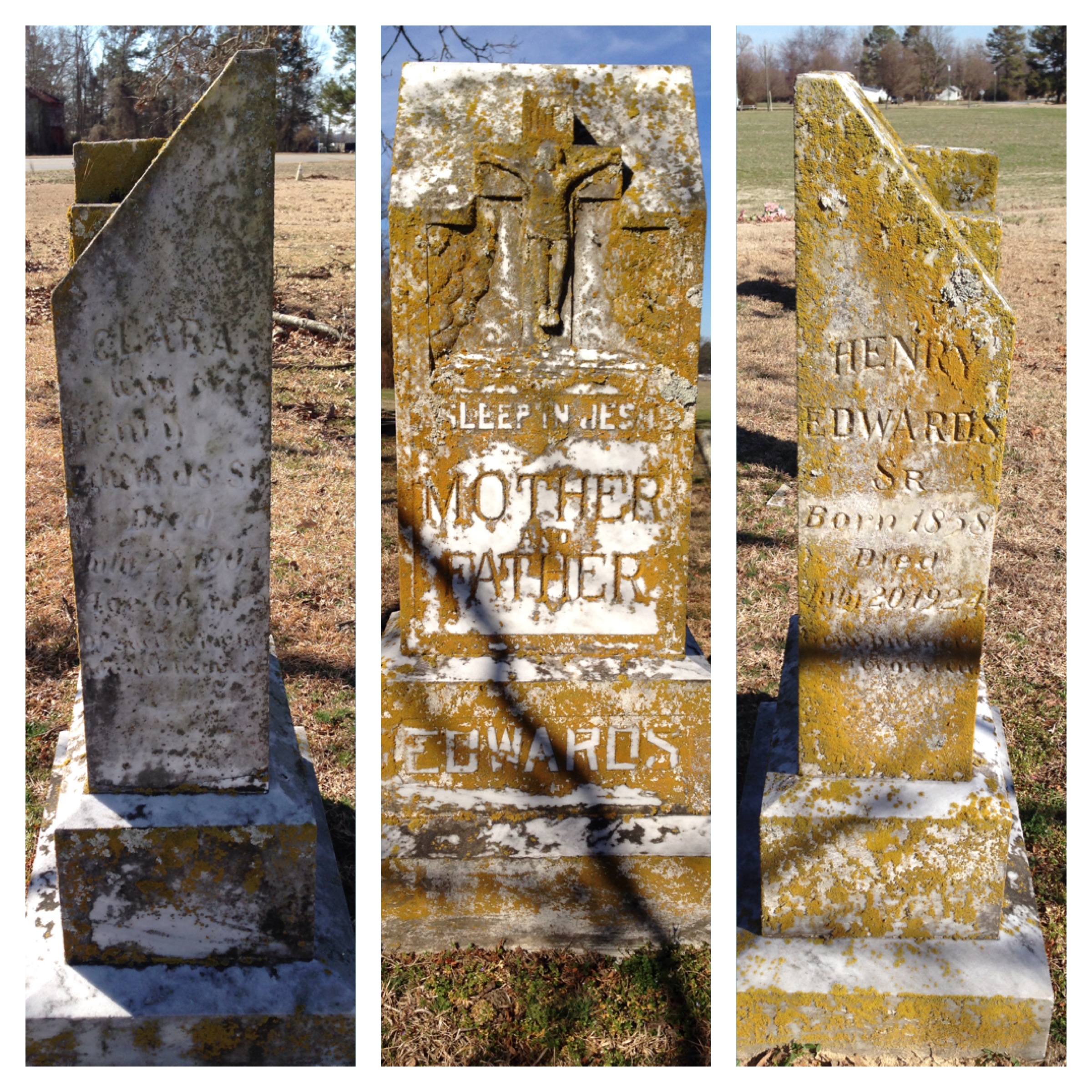
A right turn out of my parents’ neighborhood puts me onto Highway 58. Head southeast, cross the edge of Stantonsburg, over Contentnea Creek and the Greene County line, and, 13 miles from home, you reach Lane Road. Turn left, round the curve, and there, neatly marked and kept, is the Edwards cemetery. Here are buried Daniel Artis‘ daughter Clara, her husband Henry Edwards, and their descendants.

Image

Photo taken today, Lisa Y. Henderson.

Standard
Free People of Color, Newspaper Articles, North Carolina, Paternal Kin, Politics

Alderman and poll holder.

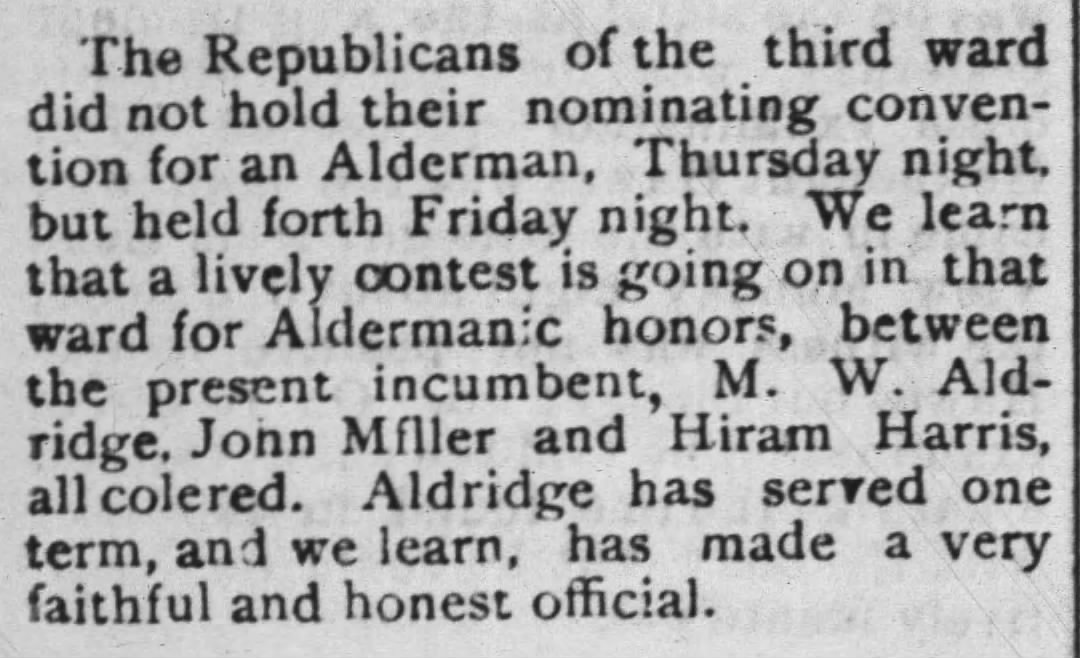
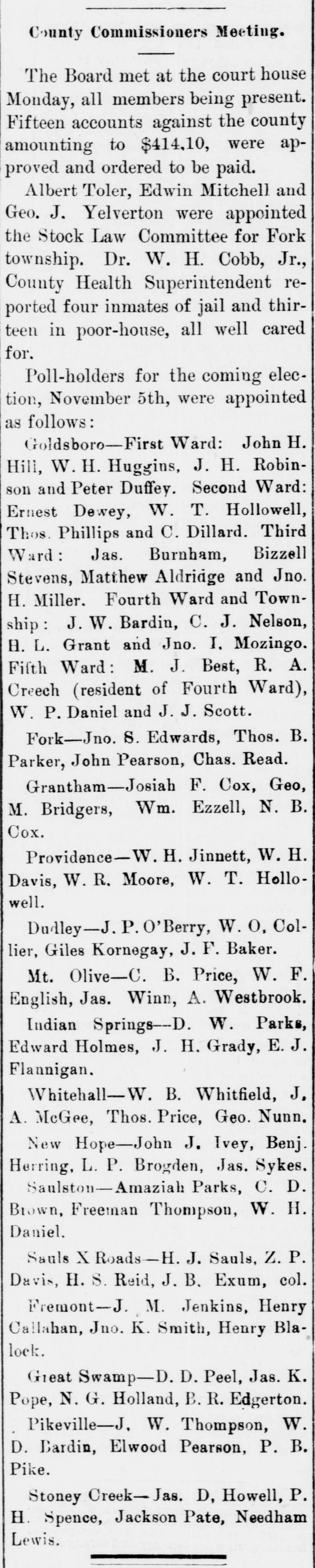
Despite the collapse of Reconstruction, African-Americans continued to participate in Wayne County’s political life through the end of the 19th century. Mathew W. Aldridge, in particular, was active in local governance, as announced in eastern North Carolina newspapers:

Wilm Msgr 4 27 1889

Wilmington Messenger, 27 April 1889.

Image

Goldsboro Headlight, 1 May 1889.

Image

Goldsboro Headlight, 8 May 1889.

Wilm Msgr 5 8 1889

Wilmington Messenger, 8 May 1889.

Image

Goldsboro Headlight, 8 October 1890.

Other notables: C[larence] Dillard (Presbyterian minister who arrived in Goldsboro in 1884, later principal of “colored school”); Bizzell Stevens (also a minister; like William S. Hagans, married into the Burnett family, a prominent free family of color in the antebellum era; later a postal clerk at Goldsboro post office); John Frank “J.F.” Baker (postmaster at the Dudley post office; married Mary Ann Aldridge, daughter of J. Matthew Aldridge; murdered); James Winn; and Henry S. “H.S.” Reid (son of Washington and Penninah Reid; member of large prominent free family of color.)

Standard
Maternal Kin, Paternal Kin, Vocation

Where we worked: hewers and builders.

Adam T. Artis, near Eureka NC – carpenter, 1850s-circa 1900.

Adam T. Artis Jr., Washington DC – hod carrier, circa 1910.

Isham Smith, Goldsboro NC – husband of Nancy Henderson Smith, blacksmith, 1880s?-1914.

Junius Allen, Newport News VA – carpenter, circa 1917.

Prince A. Aldridge, Wilson NC – plasterer, circa 1940.

Van Smith – husband of Mattie Taylor Smith; bricklayer, Pool & Whitehead, Smithfield NC, 1917; Wilson NC, circa 1920.

Jesse Artis, Norfolk VA – laborer, house builder, circa 1920.

Dock Simmons, Logansport IN – owned and operated hauling and excavating company, circa 1924.

John C. Allen Jr., Newport News VA – carpenter, construction contractor, 1920s-1948.

Benjamin A. Harris, Wilson NC – husband of Pauline Artis Harris; brickmason, 1930s-1950s.

Daniel Simmons, Philadelphia PA – construction laborer, circa 1930.

Johnnie Smith, Goldsboro NC – carpenter, circa 1930.

Eugene Stockton, Statesville NC – husband of Ida Colvert Stockton; brickmason, circa 1930.

Ira Henderson, Mount Olive NC – carpenter, circa 1940.

Ned Barnes, Wilson NC — building carpenter, circa 1930.

Richard G. Wynn, Wilmington NC – brickmason, 1950s.

The eleventh in an occasional series exploring the ways in which my kinfolk made their livings in the 19th and early 20th centuries.

Standard
Births Deaths Marriages, Enslaved People, North Carolina, Paternal Kin

Finding the Wards.

This is what we knew:  Joseph Henry Ward, born circa 1870 in or near Wilson, North Carolina, was the son of Napoleon Hagans and a sister of Napoleon’s wife, Apsilla Ward Hagans.  I couldn’t find him in the 1870 or 1880 censuses, but by 1900 he was listed in Indianapolis, Indiana, working as a physician.

The hunt for Joe Ward’s people thus began.

In the 1910 census of Indianapolis, a nephew, Augustus Moody, born about 1893, is listed in the Ward household. I searched for Augustus in 1900 and found him in Washington DC in this household: William Moody (born 1872), wife Sarah S. (1876) and children Augustus (June 1894) and Crist (1896), plus sister-in-law Minerva Vaughn (1890), mother-in-law Mittie Vaughn (1854), and mother Fannie Harris (1854) — all born in North Carolina.  Soooo …  Augustus’ mother was Sarah S. Moody, and Sarah’s mother was Mittie Vaughn.  Okay, and how was Joe Ward related to these folks?

I went back to the 1880 census of Wilson County and found: Sarah Darden (57, mother), Algia Vaughn (23, son-in-law), Mittie (22, daughter), Joseph (8), Sarah (6), and Macinda (5 mos.), the last three Sarah’s grandchildren.  From this I deduced that Mittie Vaughn, daughter of Sarah Darden, had at least two children, Joseph and Sarah, before 1880.  I then located young Sarah’s marriage license to William Moody, which listed her maiden name as Ward.  So Joseph and Sarah were listed in the 1880 census in their stepfather’s name, not their mother’s, and “Joseph Vaughn,” son of Mittie Vaughn, is in fact the Joseph Ward I was looking for.

How did I know Algernon was a stepfather? He was only 22 years old when he married Mitty Finch,  27, in Wilson on May 6, 1879.  (Finch?!?!?! That’s an as-yet unexplained anomaly.) I also found a cohabitation registration for grandmother Sarah Ward and Sam Darden, dated 12 July 1866. This registration, which formalized the marriages of ex-slaves, noted that they had been married five years, well after the births of Sarah’s children Mittie and Appie. If Sam was not their father, who was?

The first clue: in 1902, when William S. Hagans (son of Napoleon and Appie Ward Hagans) registered to vote in Wayne County, North Carolina, under the state’s grandfather clause, he named “Dr. Ward” as his qualifying ancestor. I didn’t know what to make of that — I couldn’t find a Dr. Ward in Wayne County — so I laid it to the side for a bit.

Then I found a reference to Appie and Mittie’s previously unknown brother. On 16 June 1870, Henry Ward, son of D.G.W. Ward and Sarah Darden, married Sarah Forbes in Wilson, North Carolina.  If we assume that Henry, Appie and Mittie had the same father, who is this D.G.W. Ward? Was he the “Dr. Ward” that William claimed as his qualifying ancestor under the grandfather clause?

In the 1860 census, D.G.W. Ward (45) and wife Adline (19) appear in Speights district, Greene County, which borders Wilson County to the southeast. Ward reported owning $26,500 in real property and a whopping $112,000 in personal property! (As the 1860 slave census shows, this wealth largely consisted of 54 slaves.) He was one of the, if not the, wealthiest men in the county. And he was a physician. Here, indeed, was Dr. Ward.

David George Washington Ward was married twice — perhaps circa 1840 to Mariah H. Vines, who died after having one child; then to Emily Adeline Moye in 1859. Between those marriages, he fathered at least three children with Sarah, an enslaved woman.

Standard
Enslaved People, Free People of Color, Land, North Carolina, Other Documents, Paternal Kin

Confederate map tells all.

Years ago — 10? 15? — I ordered copies of two Confederate field maps from the fine folks at Wilson County Genealogical Society. (The originals are held at North Carolina State Archives.) The maps feature not only geographic markers, such as creeks and towns, but the names of landowners throughout the region. I remember intently scanning the area around modern-day Eureka, hunting for signs of my Artises and finding none. (Celia Artis is on one of the maps, but she’s not “mine.”) Disappointed, I folded them away in a box.

A couple of days ago, I stumbled across the maps while reorganizing some files. I let my eyes drift a little further afield and

SILAS BRYANT! JOHN LANE! DR. WARD!

jumped off the page.

Just like that, the locations of the farms on which Vicey Artis‘ children, including Adam, were apprenticed; Sylvania Artischildren were apprenticed; and Mittie Ward and Apsilla Ward Hagans were enslaved (by their father.) Not only that — with a little extrapolation from the 1860 census, I can determine approximately where my people were living during the War.

Here’s the first map (with my annotations in unfortunate grayscale, click to enlarge):

Confederate_Field_Map_2 annotated

The left edge of the map is defined by the Wilmington & Weldon Railroad. (2) Nahunta, bottom left and now the town of Fremont, is exactly halfway between Wilson, seat of Wilson County, and Goldsboro, seat of Wayne County. Follow the road east out of Nahunta on what is now NC 222, and you’ll see (3) Martinsville, now Eureka. Angle southeast from Eureka on what is now Faro Road, then veer right at the fork onto what is now Lindell Road. (See “B. Mooring”? Frances Seaberry and her family are listed near his household in the 1860 census.) After crossing a north-south road, pre-Lindell takes a sharp turn north. Drag your finger straight across from the bend and you’ll touch two squared names — Silas Bryant and John Lane.

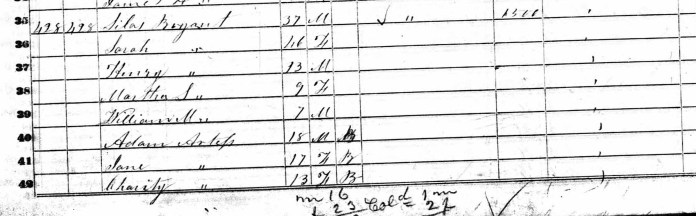
Here is Bryant’s household in the 1850 census of Greene County:
silas bryant 1850

And on the next page:

john lane 1860

As reflected on the map, Silas Bryant and John Lane lived in close proximity, and, on their land, sisters Sylvania and Vicey Artis, who owned no property. My great-great-great-grandfather Adam Artis and his sisters Charity and Jane are listed in Bryant’s household, which suggests that they served him as involuntary apprentices under North Carolina’s laws governing the labor of the children of unmarried free women of color. (Both Sylvania and Vicey were married, of course, but to enslaved men — relationships that were not recognized under the law.) The 1860 census suggests that John Lane also had apprentices, Sylvania’s younger children. Lane may also have owned their father, Guy, who adopted the surname Lane after emancipation.

[And remember this?: “On 20 Aug 1853, in Greene County NC, Silas Bryant sold Daniel Artis for $325 120 acres adjacent to the mouth of a lane at the dividing line between said Bryant and John Lane, the Bull Branch, and the mouth of Sellers Branch.” I think Daniel was Vicey and Sylvania’s brother.]

Where is this now? Just inside the Greene County line, dotted at left, Highway 58 crosses over Speights Bridge Road. The second road on the left is the same one shown on the field map and is still called Lane Road. (9) marks the approximate location of Silas Bryant’s home and (10), John Lane’s.

Screen shot 2014-02-12 at 10.56.56 AM

Due north of Lane and Bryant, across Contentnea Creek is another boxed name, Dr. Ward. This was David George Washington Ward, physician, wealthy planter, and owner of twin daughters, Mittie and Appie, whose mother was an enslaved woman named Sarah. (More about the Wards elsewhere.)

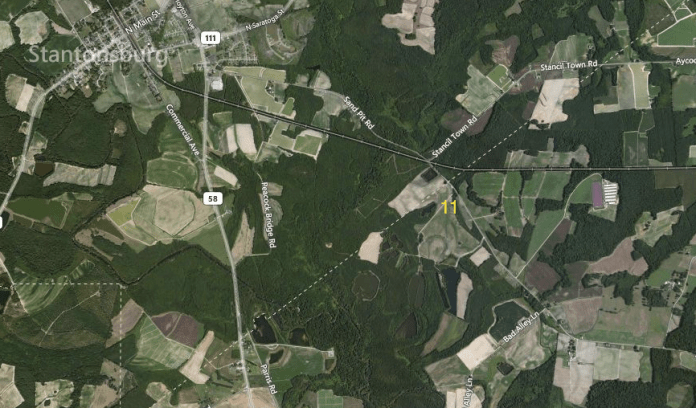
Just inside the Greene County line, a few miles southeast of Stantonsburg in Wilson County, (11) marks the approximate location of Dr. Ward’s house today. [Update: Actually, it’s the approximate location of Dr. Ward’s name on the map. His house was, and is, in Wilson County close to Stantonsburg.]
Screen shot 2014-02-12 at 10.55.30 AM

Back on pre-NC 222, about a third of the way between Martinsville/Eureka and Stantonsburg, a road leads off to the east toward Watery Branch Church. (It still does — and is called Watery Branch Road.) Barely legible is the name of one of the few free people of color marked on the map: Celia Artis. Though not related by blood, at least in any immediate way, Adam Artis and his family are listed next to her in the 1860 census, and their descendants intermarried. (And share a cemetery that lies next to the road about where the C is in Celia.) Here, then, is the approximate location of Adam Artis’ earliest farmland. He later accumulated property all along the highway.

Other landmarks on the field map: (4) Toisnot Swamp (marked Creek here), a tributary of the Contentnea that flows down from Wilson County; (5) Contentnea Creek itself; (6) Black Creek, another Wilson County tributary; (7) Aycock Swamp, another tributary, upon whose banks Adam Artis’ brother-in-law and Appie Ward’s husband Napoleon Hagans built his house; and (8) Turner Swamp.

Standard
Land, North Carolina, Other Documents, Paternal Kin

68 acres on Turner Swamp.

At first glance, the document raises eyebrows. Brothers Walter and William Artis, successful farmers in their own right, were sharecroppers for William S. Hagans, their first cousin?

HAGANS -- Artis Cropper Contract (2)

A second document sheds some light:

HAGANS_--_William_Hagans_to_William_Artis_Deed

Three days before he signed the cropper agreement, William M. Artis and his brother’s wife Hannah Forte Artis signed an agreement for the purchase of the same 68 acres. (Why Hannah and not Walter??? He was very much alive.) The land was more explicitly described as: (1) a tract on Turner Swamp, known as the Jonah Reid place, that Hagans inherited from his father Napoleon Hagans; (2) a tract, known as the Daniel Reid place, that William Hagans purchased from J.D. Reid and was once part of the lands of Washington Reid, deceased; and (3) a lot of “mud land” on Spring Branch for marl (a lime-rich mud used to condition or de-acidify soil.) The purchase price? A seemingly extravagant $5000 — $300 due at signing, $700 in a year’s time, and the remaining $4000 in two notes payable at 6% interest in 1918 and 1919. (Five thousand dollars in 1916 adjusts to about $106,000 today. That’s considerable change.) It appears then that, per the cropper agreement, during the first year of the purchase agreement the Artis brothers agreed to pay $300 worth of any crops they produced on the land to Hagans. (In addition to the $300 paid him in January?)

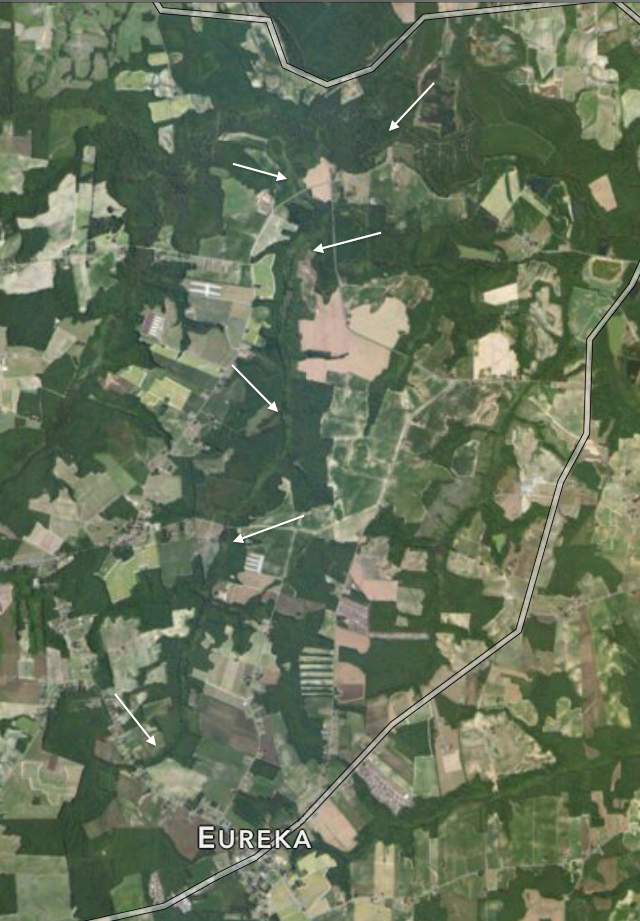
Napoleon Hagans built his house on a tract of land straddling Aycock Swamp, the next tributary over from Turner Swamp. (Both flow into Contentnea Creek.) Washington Reid’s mother Rhoda Reid was a well-t0-do free woman of color who owned considerable farmland in extreme northwestern Wayne County, perhaps the land that William Hagans eventually bought. The entire course of Turner Swamp runs only a few miles, the last stretch beyond Wayne’s borders into Wilson County. I am beginning to consider this area ground zero for the Reids. (Future project: a dig in the deeds.)

Turner_Swamp-1

A little hard to see, but the arrows point out the course of Turner Swamp. The green curve just below the lowest arrow marks the rise of the waterway, and the top arrow points out its approximate mouth just below Woodbridge Road in Wilson County. (And “swamp” it is. The soil of eastern North Carolina is flat and sandy or clay-ey, and the little branches off major creeks don’t so much flow as they do stand, with the barest perceptible current. Getting to their banks often requires boots — and a stout stick to beat back the cane and catbrier.)

Standard
Free People of Color, Land, North Carolina, Paternal Kin

Intersection.

Image

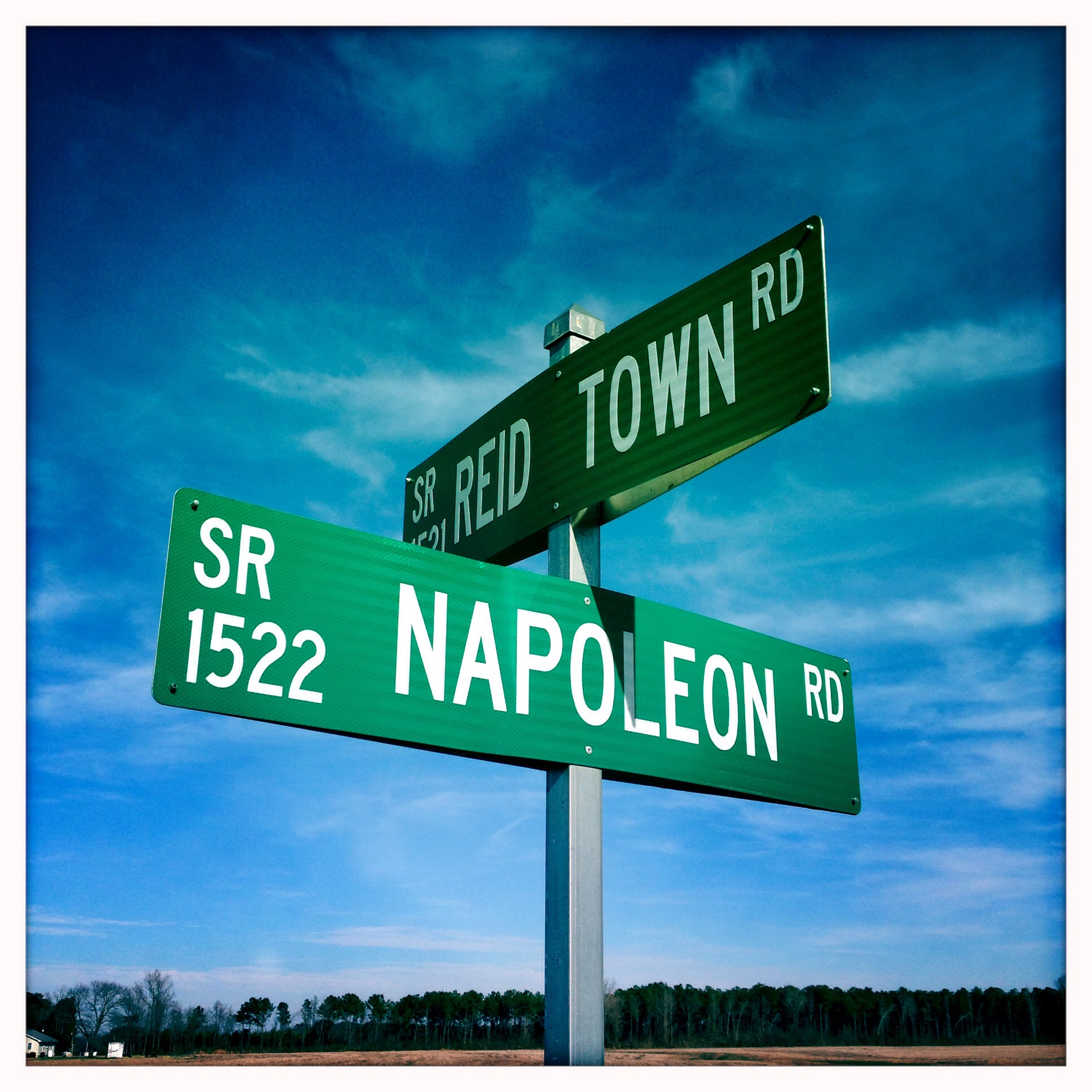
Napoleon Road is a bent elbow of a dirt lane running north west of Eureka in Wayne County. At its southern end, it debouches into Reidtown Road, so named for the free colored Reid family who lived in the area as early as the 1830s.  Napoleon Road is no longer than a mile or so, and there is one house on it. Napoleon Hagans built that house.

Rural roads did not have formal names until the county implemented its 911 system perhaps 20 years ago.  It is a testament to Napoleon Hagans’ stature that, nearly one hundred years after his death and three-quarters of a century after his descendants left the state, the majority landowner along what had been his road chose to memorialize him permanently.

Standard
DNA, Free People of Color, North Carolina, Paternal Kin

DNA definites, no. 11: Artis & Aldridge.

  • I am descended from John W. Aldridge and his wife, Louvicey Artis Aldridge, via son J. Thomas Aldridge. Louvicey Artis’ parents were Adam Artis and Frances Seaberry Artis.
  • K.H. is also descended from John W. Aldridge and Louvicey Artis Aldridge, via daughter Nora Aldridge Henderson. At 23andme, K.H. and I show a 4.4% match, estimated as second cousins. In fact, we are first cousins, twice removed. (Calculated on the Aldridge side. We are also Henderson cousins, but much more distantly.)
  • W.H. is also descended from John W. Aldridge and Louvicey Artis Aldridge, via daughter Nora Aldridge Henderson. Ancestry estimates that we are 3rd-4th cousins; 23andme estimates 2nd cousins (2.51% match). In fact, we are second cousins, once removed. (We are also distant Henderson cousins.)
  • E.H. is also descended from John W. Aldridge and Louvicey Artis Aldridge, via daughter Nora Aldridge Henderson. At 23andme, E.H. and I show a 1.75% match, estimated as 2nd-3rd cousins. In fact, we are second cousins, once removed. (Ditto re the Henderson relationship.)
  • S.D. is also descended from John W. Aldridge and Louvicey Artis Aldridge, via daughter Nora Aldridge Henderson. Ancestry estimates that S.D. and I are 4th-6th cousins. In fact, we are third cousins. (Ditto re the Henderson relationship.)
  • G.J. is also descended from John W. Aldridge and Louvicey Artis Aldridge, via daughter Correna Aldridge Newsome. Ancestry.com estimates that we are 4th-6th cousins. (Ancestry does not provide percentage shared.)  In fact, we are 3rd cousins, once removed.
  • B.L. is descended from Josephine Artis Sherrod, daughter of Adam Artis and Amanda Aldridge Artis. Amanda Aldridge was a sister of John W. Aldridge. B.L. and I are estimated at 2nd-3rd cousins and share 1.28% on 23andme. In fact, we are 3rd cousins, once removed, on the Aldridge side, and 2nd cousins, twice removed, on the Artis.
  • A.S. is also descended from Josephine Artis Sherrod. Ancestry estimates our relationship as 4th-6th cousins. In fact, we are 3rd cousins, once removed on the Artis side, and 4th cousins on the Aldridge side.
  • H.B. is descended from Henry J.B. Artis, son of Adam Artis and Amanda Aldridge Artis. Amanda was the sister of John W. Aldridge. Ancestry.com estimates our relationship as 4th-6th cousins. In fact, we are 2nd cousins, twice removed.
  • B.J. is descended from Mattie Brewington Braswell, daughter of Joshua Brewington and Amelia Aldridge Brewington. Amelia was a sister of John W. and Amanda Aldridge. B.J. and I estimated at 3rd-5th cousins and share .37%. In fact, we are 4th cousins. B.J. also matches G.J. at Ancestry, but not S.D.
  • R.M. is descended from Mathew W. Aldridge, who was John W. Aldridge’s brother. 23andme estimated that R.M. and I are 3rd to distant cousins and share .21%. In fact, we are 4th cousins. R.M. matches all the other Aldridge-Balkcum descendants on 23andme. She also matches D.D. at .46, 3rd-5th cousins.  This is particularly interesting because the father of D.D.’s great-grandmother was said to be Jesse F. Baker, son of John Frank Baker and Mary Ann Aldridge. Mary Ann Aldridge was the daughter of John Mathew Aldridge, who I believe to have been the brother of Robert Aldridge. Assuming this to be the connection between R.M. and D.D. are, in fact, 5th cousins. (Also: D.D.’s great-grandmother and my grandmother were daughters of Bessie Lee Henderson, so she matches me, my father, sister and 1st cousin on 23andme, as well as K.H.)
  • H.A. is descended from Mary Jane Artis Artis, daughter of Adam and Lucinda Jones Artis. At 23andme, H.A. and I show a .15% match, estimated at 3rd to distant cousins. We are, in fact, 4th cousins. H.A. also matches K.H. and B.L.
Standard
DNA, North Carolina, Paternal Kin

DNA Definites, no. 10: A windfall.

The end of last week brought three significant new 23andme.com matches. I’d been waiting impatiently for the results to post for all of them, and I wasn’t disappointed. In summary:

  • M.B. is my paternal first cousin. We show a 10.5% share across 31 segments. She matches, of course, my father and sister, but also our mysterious adoptee cousin S.A., and several more distant known relatives. Most exciting: she has a match that none of the rest of us has to a D.D., who’s descended from a Sampson County Balcum-Johnson marriage. That’s the first Balkcum DNA link I’ve found.
  • B.J. has been a close collaborator in my Aldridge research for several years. She’s descended from the sister of my great-great-grandfather John W. Aldridge, and 23andme correctly estimated our relationship as in the 3rd-5th range.
  • B.L. is from my hometown. I didn’t discover that we were related until I was in my 20s and had started researching my family. (My grandmother knew, of course, but wasn’t sure of the exact connection.) Her grandmother was the last of my great-great-great-grandfather Adam T. Artis’ children to pass away — in 1988, at age 101. There are some promising matches in her list that seem to be unique, too, including one to a Locus-Artis from the Nahunta area of Wayne County. 23andme predicted that we are in the 2nd-3rd cousin range, which is correct whether calculated from the Aldridge or Artis side.
Standard