Births Deaths Marriages, Free People of Color, North Carolina, Other Documents, Paternal Kin

Chears and bee gums.

Per the “Account of the Sale of the property of Matthew Aldridg Deceased sold by Joseph Hollowell Adm. on a credit of six months, Nov 20th 1868,” his widow, Catherine Boseman (or Simmons) Aldridge, purchased five “chears”, cart wheels and an axle, two tables (one small), two beds and furniture, “one cubbard & contents,” a clock, a gun, “3 Bee Gumes & work bench,” a tub dipper, kitchen furniture, a blind mare and two beehives. Green Simmons, George Simmons and David Winn purchased tools, and “Robbert Aldridg,” who likely was Matthew Aldridge’s brother, bought the fourth and fifth beehive choices.  A note on William Carter for a $27.50 debt, due 1 January 1869, was described as doubtful.  The Application for Letters of Administration in the file notes that Aldridge’s heirs were John Henry AldridgeWm. AldridgeFrances Aldridge, Della AldridgeMary Ann AldridgeJoanna Aldridge, and James Thomas Aldridge.

William Aldridge was one of the founders of the First Congregational Church of Dudley, and Frances Aldridge Wynn and Mary Ann Aldridge Baker’s descendants were prominent members of the church for several generations. John H. Aldridge had a daughter, Nina Frances Faison Hardy, who played an important role in my grandmother’s young life. More about Aunt Nina later.

Standard
Births Deaths Marriages, Land, North Carolina, Paternal Kin

Coley v. Artis.

At the heart of Wayne County Superior Court proceedings stemming from the suit in J.F. Coley v. Tom Artis (1908) was a dispute over 30 acres of land. Thomas “Tom Pig” Artis began renting the property in 1881 from W.J. Exum.  In 1892, Exum’s widow Mary sold it to Napoleon “Pole” Hagans.  In 1896, after Napoleon’s death, the land passed to his sons Henry and William S. Hagans, and in 1899 Henry sold his interest to his brother.  In 1908, William S. Hagans sold the 30 acres to J.F. Coley.  Coley filed suit when Tom Artis laid claim to it, arguing that Napoleon had sold it to him.  Tom claimed that the 800 lbs. of cotton he tendered to Napoleon Hagans (and later, his son William) was interest on a mortgage, but William Hagans and other witnesses maintained that the payment was rent.

The trial transcript is replete with testimony revealing the personal relationships among witnesses. Tom Artis testified that he rented the “Adam Artis place.” William Hagans testified that his father was in feeble health in 1896 when he called him and Henry together “under the cart shelter” to tell them he would not live long and did not know to whom the land would fall.  William testified that Pole asked them to let “Pig” stay on as long as he paid rent, and they promised to do so.  Tom Franks testified that “Pole was a first-rate business man.” Jonah Williams, Adam Artis’ brother, testified that he borrowed money from Napoleon to open a brickyard in the spring of 1893 and had preached his funeral.  He also noted that “Tom married my sister [Loumiza Williams Artis, who was deceased by time of this trial].  He is not a member of my church.  I turned him out.  He is a Primitive Baptist.  I preached Napoleon Hagans’ funeral.”  Jesse Artis, another of Adam Artis’ brothers, testified that he had worked on Hagans’ property as a carpenter for 18 years and noted, “I don’t know that Tom and I are any kin, just by marriage.”   John Rountree testified that he was a tenant renting from Hagans on thirds.  Simon Exum, Delilah Artis‘ husband, testified: “I am no kin to Tom [Artis] as far as I know, except by Adam.  His first wife was my wife’s sister.”  H.S. Reid testified that he was Tom Artis’ son-in-law.

The court found for Coley and against Artis.

——

Thomas Artis was a son of a free woman of color, Celia Artis, and her enslaved husband, Simon Pig. Though, ultimately, nearly all free colored Artises are descended from a common ancestor in southside Virginia, by the late 1800s knowledge of these remote links had faded. There were dozens of Artis families in Wayne County during the antebellum period, and the relationships between them are unknown. Celia Artis was a close neighbor of Adam Artis, but the families apparently did not regards themselves as kin.  Still, they were inextricably intertwined.  The Artises, Haganses and Reids had been neighbors in the Eureka area for generations. Celia Artis and Henry S. Reid’s grandmother Rhoda Reid were the wealthiest free women of color in the county. Adam Artis married Napoleon Hagans’ half-sister Frances Seaberry. Adam’s sister Loumiza married Tom Artis, as noted above. Henry S. Reid, son of Washington and Penninah Reid, married Tom Artis’ daughter. Henry’s first cousin Henry Reid, son of John and Mozana Hall Reid, married Adam Artis’ daughter Georgianna Artis. Adam Artis’ son William Marshall Artis and grandson Leslie Artis married Tom Artis’ nieces, Etta and Minnie Diggs. And on and on.

Documents found in file of the Estate of Thomas Artis (1911), Wayne County, North Carolina Estate Files, 1663-1979, familysearch.org

Standard
Enslaved People, North Carolina, Paternal Kin

The disappearing Taylors.

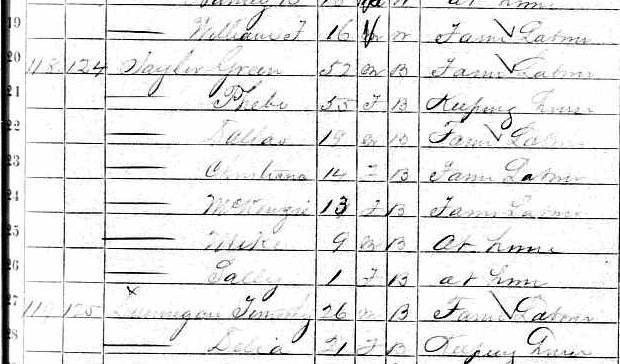
TAYLOR -- Green Taylor 1870 census

Sometime between the dissolution of their former master’s estate in 1856 and the arrival of the census taker in the early summer of 1870, Green and Fereby Taylor found their way to Lower Town Creek township (now the Pinetops area), Edgecombe County.  In that year, their household included four children – Dallas, 19; Christiana, 14; Mckenzie, 13; Mike, 9; and Sally Taylor, 1. There is no sign of the older children – Peter and Henrietta – who had been listed with Fereby in the division of Kinchen Taylor’s slaves.  Ten years later, Dallas and Mike had left, but Christiana, Kinsey and Sarah, as well grandchildren Nannie, 5, Carrie, 1, Lizzie, 8, Louisa, 5, and Isaiah Taylor, 2, remained at home.  Of all these folk, only Mike Taylor has been found post-1880.

[Update: see this.]

Standard
Maternal Kin, Other Documents, Paternal Kin

Early going.

Image

My best guess is that I drafted this little chart in the late 1980s, the era in which I was seeking refuge from law school studies in dim microfilm reader rooms.  I am struck by several things. Most depressingly: I have identified exactly THREE additional ancestors since I laid this chart aside in favor of genealogy software sometime in the early ‘90s. (And have lost two — both of my grandmothers – which is the most genuinely distressing observation.) The other: the mistakes and missing info.

On the green side:

(1) Lewis Henderson’s mother was Patsey Henderson;

(2) Lewis’ wife was Margaret Balkcum and my current thinking on her mother’s name is Nancy Balkcum;

(3) Frances Seaberry was indeed a Seaberry, and her mother was Levisa Hagans;

(4) Mary Eliza Balkcum’s mother’s name was Nancy Balkcum;

(5) Bessie Henderson’s father was not William D. Martin, but his brother Joseph Buckner “Buck” Martin; and

(6) Robert Aldridge died circa 1899;

(7) Mike Taylor’s name was Henry Michael (or Michael Henry) Taylor;

(8) Mike Taylor’s mother was named Fereby Taylor.

On the red:

(1) Mary Brown’s parents were James Brown and Catherine Booker;

(2) Jasper Holmes died around 1898;

(3) Walker Colvert died in 1905;

(4) James Lee Nicholson’s mother was Rebecca Clampett Nicholson Nicholson – she married her first cousin;

(5) Harriet Nicholson’s mother was Lucinda Cowles; and

(6) Henry McNeely died in 1906 and his wife Martha Miller McNeely in 1934.

Standard
Births Deaths Marriages, North Carolina, Oral History, Paternal Kin

Her story.

Bessie Henderson has died, and her children remain.

Mamie Lee was the first child, and my grandmother was the second. And the second Hattie Mae.  The first was Sarah Henderson Jacobs’ daughter.

That’s who they named me after.  I asked them why they named me Hattie after a dead person.  “What?  You don’t like Hattie?  Well, I just thought ’twas nice.”  And after I looked at her picture, I said, “Well, she was pretty.”  Since Jack knew her, and he wanted her picture, when I come up to Philadelphia, I give him the picture.  ‘Cause they grew up together.  And his children thought she was white, wanted to know what old white girl was that.  Mama never talked about her.  But A’nt Nina, she would tell everything.  Mama got mad with her, said, “You always bringing up something.  You don’t know what you talking ’bout.”  And she never did say – well, if she said, I wouldn’t have known him, but I never did ask her – who Hattie’s daddy was.  I figured he was white.  Because she looked — her hair and features, you know, white.

Jack Henderson told my grandmother that he remembered “when she was got,” that he was nearby when it was happening, that Tom had Bessie over a barrel, literally.  Bookish and soft, James Thomas Aldridge tended his mother and younger sisters and his ailing father’s dry goods store while dreaming of a bigger and better world faraway.  He would have been a nerd if they’d had them then.  Bessie’s pregnancy changed his life:

‘Cause his mama didn’t want her son to get married.  ‘Cause he wanted to be a doctor, and so she was gon help him be one.  And if he got married and started having children, he couldn’t be a doctor.  And down there in a little town like Dudley, you had to go away from there ‘cause it wont no more than ‘bout sixth, seventh grade.  And you had to go to a larger place if you wanted to go to school. 

So the pregnancy stirred him, thrust him out toward his reveries, away from Dudley and the grey-eyed baby whose mother was soon to die.  Tom, already 24 years old but claiming to be much younger, fled to Raleigh, where he entered Shaw University’s preparatory division and exited its college eight years later on his way to Meharry Medical School.  He would become a doctor, indeed, a big-time, money-making, Cadillac-driving Saint Louis doctor, elected president of the National Medical Association in 1961.  But it’s his daughter’s story we’re telling right now, the daughter who never got past sixth grade, who never met her father ‘til she was good and grown.

Let me back up.  Sometime around 1905, Mama Sarah and her husband, a good man named Jesse A. Jacobs Jr., moved 40 miles north of Dudley to Wilson, a tobacco market bursting with new golden-leaf millionaires.  Colored folks from all over coastal Carolina, drawn to the town’s bustling opportunity, built a vibrant community on the southeast side of the railroad that cleaved the town in two. Sarah took in washing and ironing, did seasonal work at tobacco factories, and reared Jesse’s brood, who turned out largely ungrateful.  Her own daughter died in 1908, aged 14, and nobody knows why.

Meanwhile, down in Dudley, Lewis and Mag Henderson faded in their iron bedstead with only their teenaged granddaughter Bessie to manage the household.  Lucian Henderson likely farmed his parents’ reduced acreage with his own, but it was left to Bessie to cook and clean and sew and launder and do all the other relentless drudgery that needed doing.  Her mother was long dead, and there were no other close relatives nearby upon whom to rely.  Did she resent her responsibilities?   Did she chafe under the grind of pot-stirring and water-fetching and skillet-scouring and jar-slopping?  What did she want?  She was a chancey girl, a risk-taker, one who took her pleasure where she found it, even when it clamped the lid tighter on her trap.  She was a beautiful girl, but nearly unmarriageable, as she dragged her heavy belly through the spring of 1910.

Bessie gave birth to my Hattie Mae on June 6, very likely attended by the child’s grandmother, a midwife named Louvicey Artis Aldridge.  Though Vicey had forbidden a marriage between this girl and her special boy Tom, she was not altogether unmoved by her grandbaby, who looked much more Aldridge than Henderson. Vicey and her daughters played small intermittent roles in my grandmother’s early life, but there is no doubt: Sarah Henderson Jacobs was the family’s matriarch and matrix, though no children of her own lived even to adulthood. She reared Bessie’s children and kept them clothed and fed and sheltered, if not exactly loved.

Standard
Civil War, Free People of Color, North Carolina, Paternal Kin

$573.00 allowed.

Under an act of Congress approved March 3, 1871, a three-member commissioners Southern Claims Commission received, examined, and considered the claims of “those citizens who remained loyal adherents to the cause and the Government of the United States during the war, for stores or supplies taken or furnished during the rebellion for the use of the Army of the United States in States proclaimed as in insurrection against the United States.” The commissioners’ principal duties were to satisfy themselves of each claimant’s loyalty and certify the amount, nature, and value of the property taken or furnished.

The files of claimants under this act are rich with personal details, including age and place of birth; residence during the Civil War; occupation; names and ages of family members; names of neighbors; and types of crops grown and animals raised. For free people of color, these records are especially valuable, as there seldom are other sources for this type of information.

Robert Aldridge is my only known direct ancestor to file with the SCC. Indexes show that his claim was assigned number 14,758; that he asserted losses of $832.00; and that, in 1873, he was allowed $573.00 in compensation.

Some years ago, while in Washington DC, I made a beeline up Pennsylvania Avenue to the National Archives to get a look at Robert’s folder. I sat in the research room, a faint smile on my lips, heart rate slightly elevated, alert. And then: “I’m sorry. That file is missing.” Gone. And has been for years, for it was never microfilmed, and even indexes leave blank the summary of its contents.

To think of this still makes me nauseous, as Robert Aldridge is an elusive figure with murky antecedents and obscure dealings. Few of his deeds were recorded, and the extent of his landholdings is unclear. A statement to the SCC — in his own words, precious in and of itself — would have been a goldmine of information.

Standard
Births Deaths Marriages, North Carolina, Paternal Kin, Photographs

John H. & Sarah Simmons Henderson.

Image

John Henry Henderson, son of James and Louisa Armwood Henderson, married Sarah Elizabeth Simmons, daughter of Bryant and Elizabeth Wynn Simmons, in about 1886. The couple remained in the Dudley area their entire lives and reared three children — Frances, Charles Henry and Henry Lee — to adulthood.  John died of pulmonary tuberculosis in 1924.

Standard
Agriculture, Free People of Color, Land, North Carolina, Other Documents, Paternal Kin, Politics, Rights, Vocation

I worked for it.

TESTIMONY OF NAPOLEON HIGGINS.

NAPOLEON HIGGINS, colored, sworn and examined.

By Senator VANCE:

Question. Where do you reside?  Answer. Near Goldsborough. I don’t stay in Goldsborough, but it is my county seat. I live fifteen miles from town.

Q. What is your occupation?  A. I am farming.

Q. Do you farm your own land?  A. Yes, sir.

Q. How much do you own?  A. Four hundred and eighty-five acres.

Q. How did you get it?  A. I worked for it.

Q. Were you formerly a slave?  A. No, sir; I was a free man before the war.

Q. You say you worked for it?  A. Yes, sir; I worked for it, and got it since the war.

Q. What is it worth per acre?  A. I don’t know, sir, what it is worth now. I know what I paid for it.

Q. What did you pay for it?  A. I believe I paid $5,500, and then I have got a little town lot there that I don’t count, but I think it is worth about $500.

Q. Then you have made all that since the war?  A. Yes, sir.

Q. How much cotton do you raise?  A. I don’t raise as much as I ought to. I only raised fifty-eight bales last year.

Q. What is that worth?  A. I think I got $55 a bale.

Q. How many hands do you work yourself?  A. I generally rent my land. I only worked four last year, and paid the best hand, who fed the mules and tended around the house, ten dollars; and the others I paid ten, and eight and seven.

Q. That was last year?  A. Yes, sir.

Q. What did you give them besides their pay?  A. I gave them rations; and to a man with a family I gave a garden patch and a house, and a place to raise potatoes.

Q. What about the rate of wages in your section of the country; does that represent them?  A. Yes, sir; of course a no account hand don’t get much, and a smart one gets good wages.

Q. Have you made any contracts for this year?  A. Yes, sir; but I am only hiring two hands this year.

Q. What do your tenants pay you for the use of your land?  A. Some of the tenants give me a third of the corn and a third of the cotton. Then I have got some more land that I rent out to white men, and they give me a fourth of the cotton, and another gives me a thousand pounds of lint cotton for twenty acres.

Q. Does anybody interfere with your right to vote down there?  A. No, sir.

Q. Or with any of the rights of your race?  A. No, sir; we vote freely down there. Of course, if one man can persuade you to vote with him, that is all right. But you can vote as you please.

Q. What are your politics? A. I am a republican, and that is the way my township generally votes.

Q. You say there is no interference with the rights of your race there?  A. Not that I know of.

Q. There has been something said here about the landlord and tenant act. Do you think that does anybody any harm? A. I think it is a good law.

Q. The object of it is to give you a lien on everything your tenant has until your rent is paid?  A. Yes, sir; and I think I am entitled to that.

Q. These white tenants can’t run off any of your cotton until you are paid?  A. No, sir; I am five or six miles from them, and they can’t run it off. They might do it and I not see them if I did not have the law to back me; and they are just as apt to run it off as not when they start.

Q. Then you think it is a good protection to you in your rights?  A. Yes, sir; I do.

Q. Do you have any schools down there?  A. Yes, sir.

Q. How is the money raised for them? Most of it is by a property tax, is it not?  A. Yes, sir.

Q. And the poll tax all goes to education except twenty-five cents on the dollar?  A. Yes, sir.

Q. Do you know how much land your race has acquired in that county?  A. I reckon they have got fifteen hundred acres in our township; but I could not tell how much in the county.

Q. Is there any distinction made between the whites and the blacks down there in the renting of lands?  A. None that I know of.

Q. Both are paid the same wages?  A. Yes, sir; unless a man wants to hire some man to lock his doors and look after and keep his keys; then they pay him more. And if it is a colored man that he has confidence in, they pay him the same.

Q. Is there any distinction there to take all white men as tenants?  A. No, sir; in our township they take them without regard to color. If a man is a smart man, he gets in just the same as a white man. Colored men rent from white men, and white men from colored men.

Q. Did you ever have any talk with any of those people who went to Indiana?  A. No, sir; I never saw one who went.

Q. Did you ever hear any of the speeches of any of these men who were stirring up these men?  A. No, sir.

Q. Did you see any of their circulars?  A. No, sir.

Q. Nor hear of any inducements offered to them? A. No, sir.

Q. Did you get any letters from any of them who went out there?  A. No, sir; I wasn’t acquainted with any who went. I learned more of it at Goldsborough last Monday night, when I was coming on here, than I ever knew before.

Q. Are there any complaints among your people to discriminations in the courts, between the whites and blacks?  A. Yes, sir; I have heard them say that the same evidence that will convict a colored man for stealing won’t convict a white man.

Q. When they are convicted, are they punished alike? Yes, sir; in the same cases. I have spoke to them and told them, lots of times, that of course they would be convicted many times where a white man would get out, and the only way to avoid that was to quit stealing. I told them, a white man has got more sense and more money to pay lawyers and knows better how to hid his rascality, and the best way for the colored man to keep out of the penitentiary was to quit stealing.

By Senator WINDOM:

Q. Is it the general impression among colored people down there that they don’t get justice?  A. Yes, sir; when two or three colored men get convicted they think so. But there are more black men convicted because there are more of them tried.

Q. You say they have not got sense enough to get out of it when they get in; they have attorneys, do they not? A. Yes, sir; but very often they have not got the money to feed up an attorney; and, you know, they more you pay a lawyer the more he sticks with you.

Q. Is there not discrimination there in the employment of mechanics? A. No, sir; I never heard of it.

By Senator VOORHEES:

Q. Do you know of any of these people, white and black, who have been convicted that you thought were convicted wrongfully?  A. No, sir.

Q. You thought they were rightfully convicted?  A. Yes, sir.

Q. You have been on juries yourself; did you ever make any difference between them?  A. No, sir; I have sat on juries there many times, and sat on a case of a white man who was tried for his life.

Q. Was there any other colored man on that jury? A. No, sir; I was the only one on that one; but I have been on others.

Q. You have sat on juries when white men’s cases were being tried, both on the criminal and on the civil sides of the court?  A. Yes, sir.

Q. Did any white man object to you sitting on them?  A. No, sir.

Q.Then most of this talk about discrimination and injustice is by men who have been disappointed in the results of their suits?  A. Yes, sir.

Q. You see no cause for it yourself?  A. No, sir.

Q. You have heard white men complain just as bitterly?  A. Yes, sir; of course. I suppose they are like I am.  I always try to beat the case.

By Senator WINDOM:

Q. You say you think this land and tenant act a good thing; do you think the renter is in favor of it?  A. I don’t know; they never say anything to me about it. I am on the other side of that question.

Q. Does not the fact that you own 285 [sic] acres of land give you a little better standing in the community than most of your colored friends?  A. Of course; I suppose it does.

Q. How did you start it?  A. I rented a farm and started on two government horses. I went to the tightest man I know and got him to help me. I rented from Mr. Exum out there.

Q. Are there others who have succeeded as well as you?  A. Yes, sir; there are. One or two men who have succeeded better than me. There are several of them in good circumstances there in our township. I think, altogether, they own 1,500 acres there.

Q. How many colored people own this?  A. I reckon 150.

Q. The 1,500 acres is divided up among 150 people?  A. No, sir; a good many of them have got none.

Q. This is what I asked you: How many own this 1,500 acres, all put together?  A. I reckon a dozen. It might not be more than eight. It is from eight to a dozen, anyhow. But there are a number who own some little lots of land of four or five acres that I have not mentioned.

This, of course, was Napoleon Hagans (not Higgins)’ testimony before a Senate Select Committee investigating the migration of hundreds of African-Americans from the South to Kansas Indiana in the late 1870s, allegedly because of “denial or abridgment of their personal and political rights and privileges.”  Hagans’ testimony about the source of his relative wealth, as well his opinions about the political and judicial climate for colored men in his part of North Carolina, were well-received by the committee, which concluded that all was well in Dixie. Nonetheless, it is perhaps possible — if one suppresses natural feeling and attempts to stand in Napoleon’s shoes — to detect a very subtle undercurrent of resistance here and there in the essential conservatism of his words.

Transcript in Senate Report 693, 2nd Session, 46th Congress: Proceedings of the Select Committee of the United States Senate to Investigate the Causes of the Removal of the Negroes from the Southern States to the Northern States, Washington DC, beginning Tuesday, 9 March 1880.

Standard
Births Deaths Marriages, Free People of Color, North Carolina, Paternal Kin

Robert Aldridge.

Again from “The Adam Artis Family History“:

Robert Aldridge was born in 1819, in or near Savannah, Georgia. He owned about 700 acres of land in Dudley. He ran a brick kiln, where he employed a lot of extra hands to make bricks. He was taken ill in the woods opossum hunting and never recovered. He died in 1871 at the age of 52. He had 7 or 8 brothers and sisters.

Sentence by sentence:

(1) I suppose that it is remotely possible that Robert Aldridge was born in or near Savannah, but it seems highly unlikely. More probably, as reported in the 1850 census, he was born in Duplin County NC and was the free colored son of a white woman.  An extended family of white Aldridges lived in the Duplin/Greene/Lenoir County area and at least one, Winnie Aldridge, had children of color during the right timeframe.

(2) At his death, Robert owned just under 600 acres of land near Dudley, as his estate division attests.

(3) His brick kiln was located on present-day Durham Lake Road, near the lake, which is a dammed stretch of Yellow Marsh Branch.

(4) Interesting.

(5) Actually, he died about 1899.

(6) If he did, who were they???  I am reasonably sure that John Matthew Aldridge was a brother, but that’s it.

Standard