Enslaved People, Land, North Carolina, Paternal Kin, Photographs

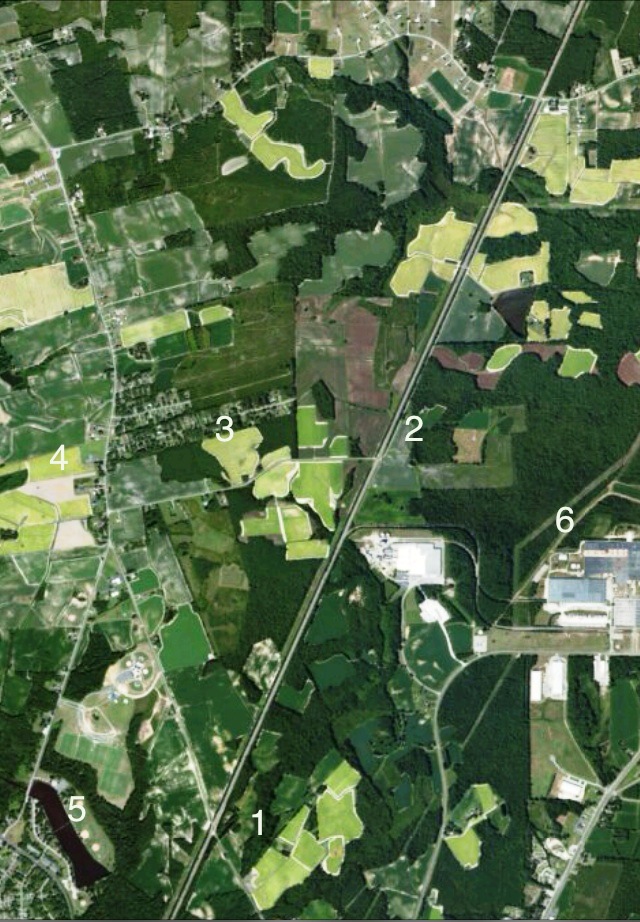
Where we lived: north of Wilson, near the railroad.

Thanks to Marion “Monk” Moore and Joan Howell Waddell, I’ve been able to identify the approximate locations of several of the white farmer-landowners listed near Willis and Cherry Battle Barnes in the 1870 census.  If the family remained in the general area in which they had been enslaved, Hugh B. Johnston’s speculation is correct.

toisnot

Toisnot Reservoir, a dammed stretch of Toisnot Swamp, today lies on the northern edge of the city of Wilson.  Joshua Barnes, Alpheus Branch, Ceborn Farmer, Isaac Farmer and Jesse Farmer’s farms all lay north of the swamp and south of present-day Elm City in a corridor now defined by London Church Road, the CSX Railroad (then the Wilmington & Weldon) and US Highway 301. The Barneses lived somewhere in this area. In the photo above, the diagonal running top to bottom is the railroad, London Church Road bows to the left, and numbers mark the approximate locations of farms and modern landmarks: (1) Isaac Farmer land; (2) Seborn Farmer land; (3) Alpheus Branch land; (4) Joshua Barnes land; (5) Toisnot Reservoir; and (6) the Bridgestone-Firestone tire plant.

——

In a letter dated 11 January 2007, Waddell included a map of Wilson County with the above properties marked. Many thanks to her and Monk Moore.

——

Update, 23 June 2015: Joshua Barnes’ house is not only still standing, it’s been continuously occupied since the 1840s and was on the market just a few years ago. It’s located at 3415 London Church Road.

Screen Shot 2015-06-22 at 10.17.53 PM

Standard
Land, North Carolina, Oral History, Paternal Kin, Photographs

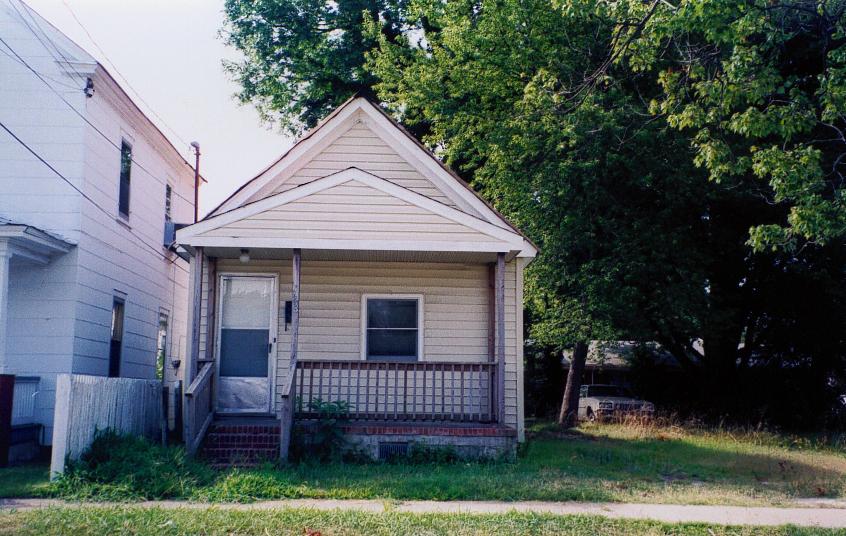
Where we lived: 303 Elba Street.

Image

The windows were broken and the front door gaped wide open, and I stood in the middle of Elba Street, uncomprehending. An aged neighbor paused on her porch, and I marched over: “Good morning. ’Scuse me. How long has next door been empty?” “Andrews & Andrews …,” she began, and – wait, she think I want to RENT? – I up my decibels, “No, how long has it been empty?” She shrugged, “A good while. They might gon demolish it.” … Demolish?

This was my grandmother’s house. Sort of. Her great-aunt and -uncle — Sarah and Jesse Jacobs — had bought it nearly new in 1908, and my grandmother arrived as an infant three years later when her mother died. She grew up on Elba Street, and her children were – literally – born there, and there they remained until 1938, when Mama Sarah died, and several truths were revealed. One, in 1923, Papa and Mama Sarah had sold the house to his children. Second, contrary to promise and belief, my grandmother never been formally adopted. Papa’s daughters ruthlessly drove this last point home by ordering her and her children out. My father was a small boy, but remembers moving – his hat blew off as he rode away in the back of a truck. Despite the eviction, my grandmother was not done with Elba. One of Papa’s sons sold her his share in exchange for a train ticket back to New York, and the sisters were forced to pay her from the house’s sale.

This place has been gone from my family for 75 years, and yet, for me, it’s Mother Dear’s house. The stories I recorded cemented its place in my imagination – the mantel clock that struck as she rallied from pneumonia, the chiggers that had to be scalded from the walls, the little stable for Papa’s horse, the hoodoo’d peach tree….

“I’ve always wanted to see inside,” I tell the neighbor. “I’m going in.” A glance up and down to check for unwanted notice, a halloo at the threshold, and I stepped through into a small center hall, which surprised me.  To either side, multi-function front rooms and, behind, a third room, a bath, and a kitchen under a shed roof, all strewn with the detritus of squatters. Of these last three rooms, only the kitchen was there in my grandmother’s day, and the only obviously original features were the mantels in the front rooms and the heart-pine floors under worn linoleum.

Soon this house will go the way of so much of abandoned east Wilson, which has never recovered from the ravages of the crack epidemic that scoured the neighborhood early and hard. There was nothing much left at 303 Elba to speak to me, but I’m glad I peeked in.  It will give shape to my listening to my grandmother’s words, and that’s a gift.

 
Standard
DNA, Free People of Color, North Carolina, Paternal Kin, Photographs

DNAnigma, no. 7: Locus, Eatmon, et al.

ImageMartin John Locus (1843-1926) and Delphia Taylor Locus (1850-1923). Martin was the son of Martin Locus and Eliza Brantley Locus of southeastern Nash and later western Wilson County. Delphia was the daughter of Dempsey Taylor and Eliza Pace Taylor of northern Nash County.

——

I knew Locuses (and Lucases, their later variant) growing up. There were a few who actually lived in Wilson, but most were from the western part of the county and Nash County.  There is no tradition of Locus ancestry in my family history, and nothing I’ve documented suggests it. However, DNA testing has revealed too many matches with descendants of the Locuses (and related families, like Brantley and Eatman) to ignore.  So far:

  • R.B.W. is my father’s estimated 2nd-4th cousin. They match on chromosomes 5, 18, 20, 21 and 22, and she lists Blackwell, Eatman, Hawkins and Lucas among her surnames.
  • M.F. is my father’s estimated 3rd to 5th cousin. She lists Locus/Lucas, Eatman, Brantley and Howard among her surnames.
  • E.F. is author of Free in a Slave Society:The Locus/Lucas Family of Virginia and North Carolina, Tri-Racial, Black-Identified, over 250 Years of History, a compendium of research notes, charts and photographs chronicling one of the largest free colored families in the antebellum United States. He notes that the Locus/Lucases intermarried with several free colored families, including Deans, Wiggins, Pulley, Taylor, Wells, Blackwell, Colston, Richardson, Brantley, Howard, High, Williams, Hagans, Evans, Tayborne, Eatman, Vaughn, Strickland, Jones, Pridgen and Allen. E.F. matches my father on a tiny stretch of chromosome 19 (which I did not inherit); 23andme estimates that they are 3rd to distant cousins.
  • T.W.is my estimated 4th-6th cousin per Ancestry DNA. Her father was born in Wilson County and is descended from Locus/Lucases and Evanses (another free family of color).
  • T.J. is an adoptee whose birth mother is believed to be a Jones and Locus. She is an estimated 3rd to distant cousin to my father.

What’s the link? I know it’s on my father’s side. Common sense tells me that the most likely connections are:

  • Leasy Hagans. Leasy Hagans appears in a Nash County census and may have originally lived north and west of where she settled in Wayne. It is not clear whether Hagans is her maiden or married name.  Nor is the father of her children known. Was she, or he, a Locus? An Eatman? A Brantley?
  • Tony Eatman. Willis Barnes‘ death certificate lists his parents as Tony Eatman and Annie Eatmon. Tony was born free about 1795 and is listed as a farmer in the household of white Theophilus Eatman in the 1850 census of Nash County. (He also is listed as the groom’s father on the marriage license of Jack Williamson and Hester Williamson in 1868.) One potential problem with Tony as my Locus link, though, was explained here. If Willis Barnes were Rachel Taylor’s stepfather, I am not descended from Tony Eatman at all.
  • Green or Fereby Taylor. Delphia Taylor Locus was the daughter of Eliza Pace and Dempsey Taylor, a free man of color born circa 1820 in northern Nash County. His relationship to another Dempsey Taylor in the area is assumed, but has not been proven. One white Dempsey (there were several) was the son of Reuben Taylor and the brother of Kinchen Taylor, Green and Fereby’s owner. There is no tradition of white ancestry among the Taylors, but their Y-DNA haplogroup appears to be J2b1, which is European. Was Green — or Fereby, for that matter — descended from Kinchen Taylor or one of his relatives?

Photo courtesy of Europe Ahmad Farmer.

 
Standard
Maternal Kin, North Carolina, Oral History, Photographs

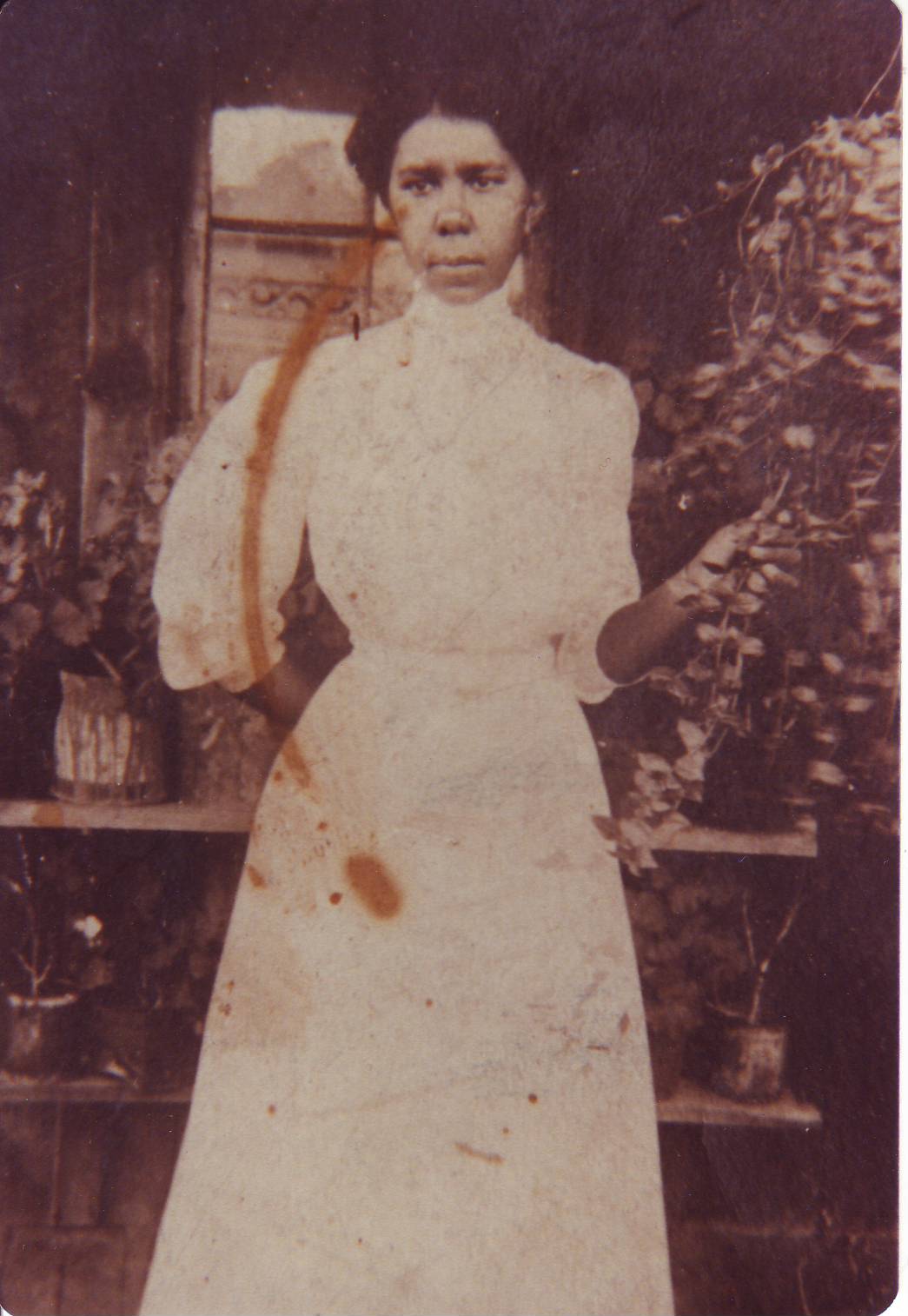
Emma McNeely Houser.

Image

Aunt Emma was so pretty.  And I never heard her raise her voice.  Not ever.  And she was she was so sedate and so pretty.  We’d go to her house, and we’d eat, and everybody would get up and start – “Oh, goodness!  Leave the dishes alone,” she’d say, and we’d all go in the living room and sit down, and then she finally would let us get up and go clean up the kitchen. 

——

Photograph of Emma M. Houser in the possession of Lisa Y. Henderson; interview of Margaret C. Allen by Lisa Y. Henderson, all rights reserved.

Standard
Land, Maternal Kin, Oral History, Photographs, Virginia

Where we lived: 748-21st Street.

My uncle: That’s where I was born and where John was born.

Me: At 748?

My uncle: That’s it.

My cousin: This crib right here?

My uncle: That’s where I was born

Me: [Laughing.] Wow.

Image

Tax records show that this tiny house — less than 800 square feet — was built around 1910. It now has two bedrooms and one bath, but the bath was undoubtedly a late addition. John C. Allen may have been the first to move a family into the dwelling; the Allens are shown there in the 1910 census of Newport News. John, who worked as a shipyard painter, reported that he owned the house subject to mortgage.

Image

By 1920, the Allens had moved just around the corner to 2107 Marshall Avenue, the house I knew in childhood as my great-aunt Julia‘s. John Allen kept 748 and rented it out until his middle son married. John C. Allen Jr. and his wife Margaret Colvert Allen lived there until their fourth child, my mother, was two weeks old.

My grandmother: I lived I don’t know how many years in Mr. Allen’s house without any electricity. And just as soon as I moved out –

Me: He had it wired?

My grandmother: He had it wired.  And one of the neighbors said she went out there in the street and laid him out.  Said, that child over there with those children, washing and ironing and working herself to death, and you wait until she leaves out of your house, your son’s house?  She said she laid him out.

——

Photograph by Lisa Y. Henderson, 2002; interviews of C. Allen and Margaret C. Allen by Lisa Y. Henderson, all rights reserved.

Standard
Free People of Color, Land, North Carolina, Photographs

Napoleon Hagans’ house.

Image

Around the time he testified before the US Senate, Napoleon Hagans had this house built below the south bank of Aycock Swamp, near Fremont in northern Wayne County. It remains occupied and is featured in J. Daniel Pezzoni and Penne Smith’s Glimpses of Wayne County, North Carolina: An Architectural History (1998):

“The house, a single-pile center-hall-plan dwelling, has retained much of its charming original hip-roofed front porch, now supported by replacement square columns. Windows are surmounted by moulded peaked arch surrounds. … One original single-shouldered exterior end chimney was plastered; the other was replaced by a concrete-block flue. …”

A stone monument marking the graves of Napoleon and his wife Apsilla Ward Hagans stands in a cornfield about one hundred yards west of the house.

Photo by Lisa Y. Henderson, December 2010.

Standard
Births Deaths Marriages, North Carolina, Paternal Kin, Photographs

John H. & Sarah Simmons Henderson.

Image

John Henry Henderson, son of James and Louisa Armwood Henderson, married Sarah Elizabeth Simmons, daughter of Bryant and Elizabeth Wynn Simmons, in about 1886. The couple remained in the Dudley area their entire lives and reared three children — Frances, Charles Henry and Henry Lee — to adulthood.  John died of pulmonary tuberculosis in 1924.

Standard
Births Deaths Marriages, North Carolina, Oral History, Paternal Kin, Photographs

Bessie Lee Henderson.

Bessie Henderson is the fulcrum.  Or Bessie’s death anyway. The point at which my Hendersons diverged from the line, left Dudley’s track, frayed the thread that bound to them to their people. Her death launched my grandmother out of Wayne County and away from what could have been.  Given all that happened later, the ways things turned out, it is not hard not to see why my grandmother cast the first few months of her life as the glory days.   She was with her own mother and surely cherished.
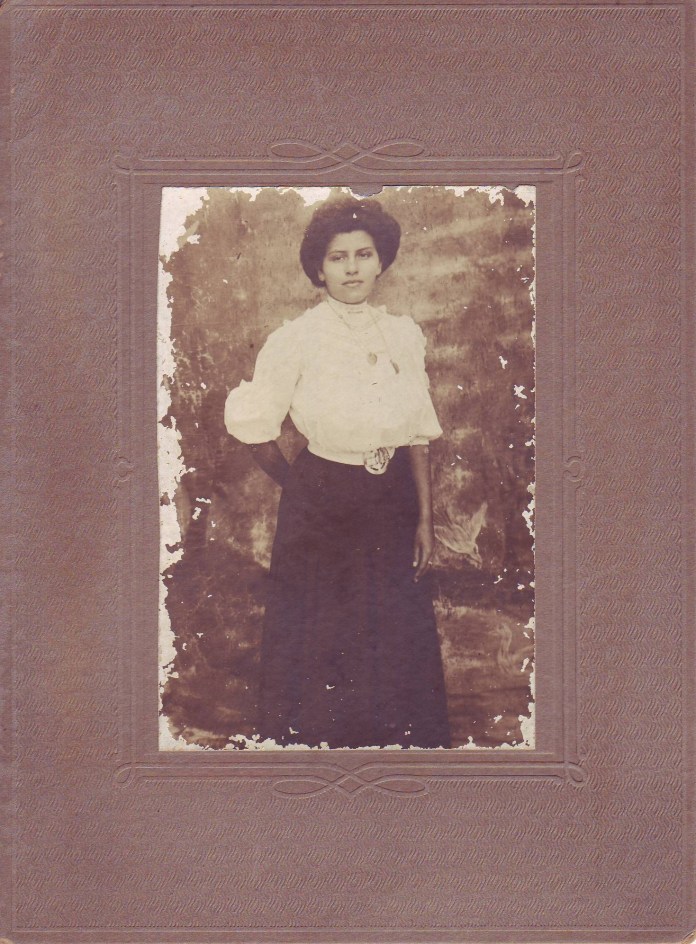
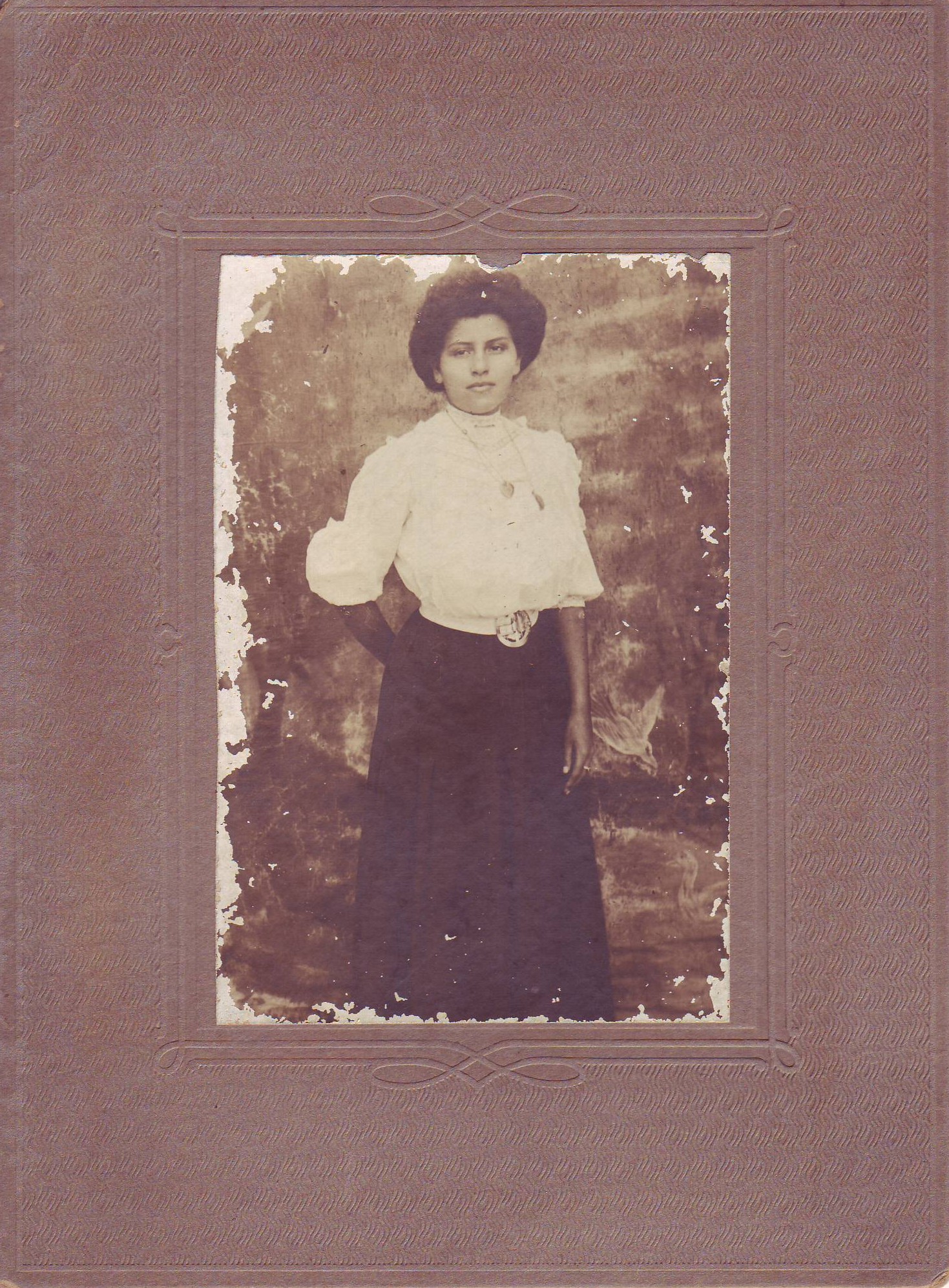
Bessie Henderson 001

Let’s look at her.  At the only photo we have.  Probably the only one there ever was.

She is a broad-faced, heavy-lidded beauty, the barest hint of a smile playing on her lips, a high-yellow Mona Lisa.  Thick dark hair pulled up a la Gibson Girl; a hint of widow’s peak; a straight-bridged nose; a full bottom lip.  The fat lobes of her ears depend from the nest of her hair.  I recognize them as my grandmother’s.

What was the occasion?  Why the first photograph of her life?  It was surely taken in Goldsboro, or maybe Mount Olive, the small town and smaller town that bracketed Dudley, the crossroads at which she passed her entire  short life.  There are no props.  The painted backdrop is mottled and indistinct, save a white bird swooping downward, a wingtip brushing her left hand.  The portrait is three-quarter length, and it is hard to gauge her size.  She was surely of no great height, perhaps an inch or two over five feet, and slim, but with a hint of hippiness.  Her daughter and nieces were narrow-shouldered, but she seems not to have been so.

One arm, folded behind, rests on her hip.  The other hangs loosely at her side, a slender hand brushing her thigh.  I do not recognize the fingers; they are not my grandmother’s.  Her arms, exposed below the elbows of her ruffled white blouse, are much, much browner than her face, evidence of her time in her grandfather’s fields, straw hat shielding her brow.  There is a ring on her left middle finger.  There are also two lockets hanging from her neck.  She barely knew her mother; her father was a kind but distant white man; she never married.  Who then gave her these trinkets?  What became of them?  What tiny images hid in the clefts of the lockets?  Who loved her?

Like her own mother before her, Bessie was just nineteen when she died.  She looks older here.  A little weary maybe.  A little sad.  A second child born out of wedlock would get her drummed out of the church that her grandfather had helped found.  The baby’s daddy joined church weeks later.  Within months, Bessie was cold in her grave.

My grandmother tells it this way:

I thought of many times I wondered what my mama looked like.  Bessie.  And how old was she, or whatever.  See, she was helping Grandpa Lewis.  The pig got out of the pasture and, instead of going all the way down to where the gate opened, she run him back in there, to try to coax him in there.  And when they picked him up and put him over the fence, she had the heavy part, I reckon, or something, and she felt a pain, a sharp pain, and so then she started spitting blood.  Down in the country, they ain’t had no doctor or nothing, they just thought she was gon be all right.  And I don’t think they even took her to the doctor.  Well, she would have had to go to Goldsboro or Mount Olive, one, and doctors was scarce at that time, too, even if it was where you had to go a long ways to get them.  And so she died.  She didn’t never get over it.  I don’t remember ever staying down there.  ‘Cause they brought me up to Wilson to live with Mama and Papa.  I stayed with them after Bessie died.  My sister says she does, but I don’t remember Bessie. You never know what you’ll come to. 

——

Photo in the collection of Lisa Y. Henderson. Interview of Hattie Henderson Ricks by Lisa Y. Henderson, all rights reserved.

Standard
Births Deaths Marriages, North Carolina, Oral History, Other Documents, Paternal Kin, Photographs, Religion

When your pilgrimage is over.

… Self life that might hender and draw you to earthly thing it inpels you on in to Godlines Paul sed I die dailey to the things of this world yeal your life dailey and hold your life in submision to the will of God and live by his word that you may grow unto the fulles measure of the staturs of Chris the one that lives wright is the ones who will a bide bide with him the day of his coming and stand when he a …

… Come by your God like impression God will take care of you no matter where you are cax aside all fear and put your trust in God and you are save.  Then when your pulgrimage is over and you are call from labor to reward you will be greeted with that holy welcome that is delivered to all true missionaries come in the blessed of my father …

My grandmother had a large, dusty black Bible that had belonged to her “mama,” Sarah Henderson Jacobs Silver.  (The Bible’s original owner was Carolina Vick, a midwife in east Wilson — her family’s birth and death dates are inscribed in its leaves.)  When I first thumbed through the Book in the early 1990s, I found two scraps of paper stuck deep in its chapters. Pencilled in a square, unsophisticated hand were these bits of Sarah’s sermons. She had left the Congregationalism of her upbringing and joined the Holiness movement sweeping the country in the early 1900s.  My grandmother was not impressed:

I was just thinking ‘bout that today, ‘bout how we used to do.  Mama’d make us go to Holiness Church and stay down there and run a revival two weeks.  And we’d go down there every night and lay back down there on the bench and go to sleep.  Then they’d get us up, and then we didn’t have sense enough to do nothing but go to sleep and get up. 

Mama’d go every night.  And they’d be shouting, holy and sanctified, jumping and shouting.  I don’t know, that put me out with the Holiness church.  And sanctified people.  I know Mama wont doing right.

Evangelist Sarah spent night after night jumping and shouting, leaving my adolescent grandmother to wash and iron the endless loads of laundry they took in from white customers. Sarah apparently met her second husband, Rev. Joseph Silver, founder of one of the earliest Holiness churches in eastern North Carolina, on the revival circuit. They married in 1933 and divided the five years before her death between Wilson and his home in Halifax County.

Evangelist

Sarah H. Jacobs and her Bible, with my uncle Lucian J. Henderson in the background, taken in Wilson NC circa 1930. (I have the Bible, but some time between when I first saw — and transcribed — the sermon scraps and when I took possession after my grandmother’s death in 2001, the pieces of paper were lost.)

Photo of Sarah Henderson Jacobs Silver in the collection of Lisa Y. Henderson. Interview of Hattie Henderson Ricks by Lisa Y. Henderson; all rights reserved.

Standard