Enslaved People, Land, North Carolina, Paternal Kin, Photographs

A thousand acres between creek and swamp.

Kinchen Taylor’s estate papers include two plats. One laid off his widow Mary Blount Taylor’s dower. The second divided his remaining land into two large parcels:

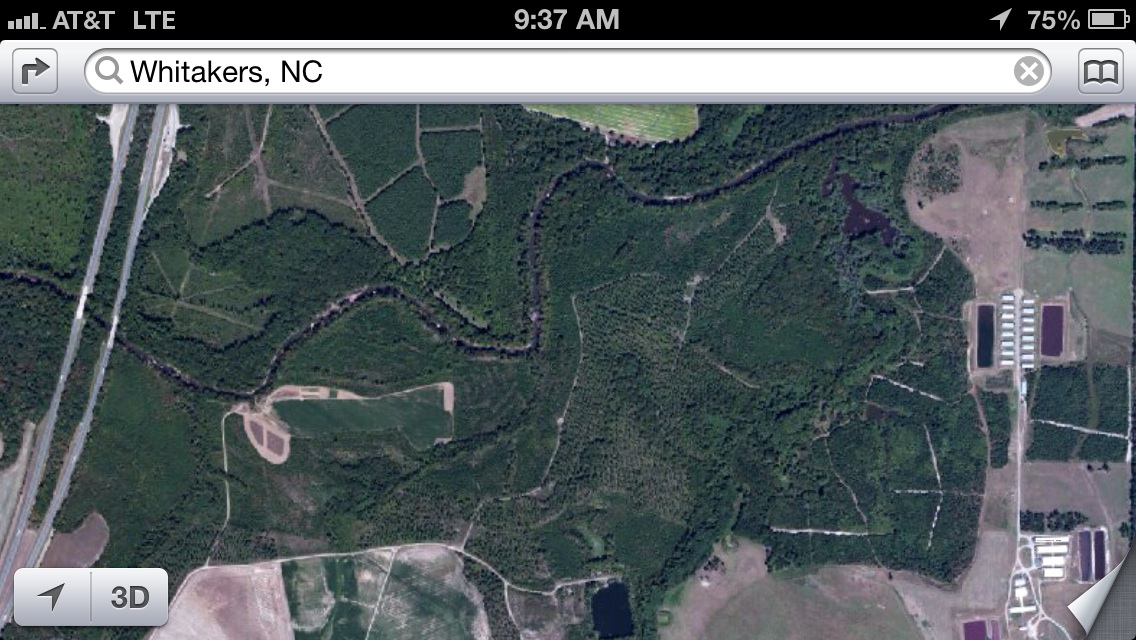
ImageIn some ways, Taylor’s old lands have not changed dramatically. Pine forest and tilled fields still predominate the landscape; far northern Nash County remains rural. Nonetheless, Taylor and enslaved workers like Green and Fereby, who walked and worked it intimately, might be pressed to recognize his property.

Image

I-95 — a far cry from the path shown in the plat — roars with traffic just west of Taylor’s acreage, hauling truckers and tourists from Maine to Florida. If you tilt your head sharply to the right, you’ll see that Fishing Creek, crawling across the top of the screen, still follows the same general course. Beaver Dam Swamp, however, has been dammed just below its confluence with the creek, forming a small body called Gum Lake. The watercourse of the swamp, probably largely drained, is barely detectable as an undulating line of taller vegetation angling southwest from the pond. Lost somewhere in its tangle of canes and catbrier is the Old Mill shown on the plat.

On the other side of Beaver Dam swamp, to the far right of the Google Map view, is an industrial hog farm, identifiable by the white structures with adjacent dark lozenges — barns holding up to 2500 hogs a piece and the lagoons that capture the stupendous quantities of waste they produce. This perhaps would have startled Kinchen Taylor most, as his hogs would have been free-range until time for fattening. (And it should startle you, too, as this is huge, nasty business.)

The file of Kinchen Taylor (1853), Nash County, North Carolina Estate Files 1663-1979, https://familysearch.org, original, North Carolina State Archives;

Standard
Education, Letters, Maternal Kin, Other Documents, Photographs, Virginia

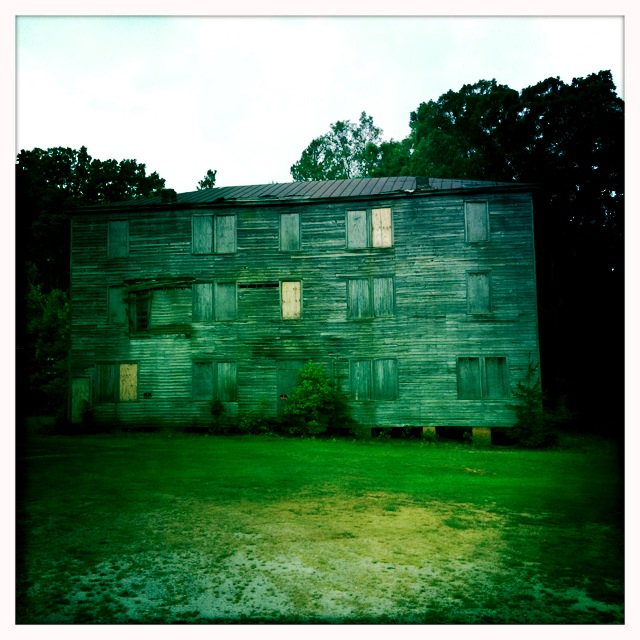
The Keysville school.

Acts of the General Assembly of the Commonwealth of Virginia.  Chap. 91.  An Act to Incorporate the Keysville Bluestone mission industrial school.  Approved January 17, 1900.

Be it enacted by the General Assembly of Virginia, that Reverend Nelson Jordan, R.C. Yancey, George D. Wharton, P.E. Anderson, F.L. Hall, Jesse H. Wilson, Jordan Moseley, Whitfield Clark, L.N. Wilson, A.J. Goode, S.L. Johnson, N.C. Ragby and Miss Mary E. Wilson [are appointed] board of trustees [of an institution] by the name and style of the Keysville Bluestone mission industrial school for the purpose of keeping and conducting at Keysville, Charlotte County, Virginia, a boarding and day school of the above name, and of giving instruction to such colored persons, male and female, as may be committed to their care as pupils of said school. …

Image

——

Rev. Whitfield Clark’s sister Mary married my great-great-great-great-uncle Joseph R. Holmes, who was murdered on the steps of Charlotte County courthouse in 1869. As shown below, Joseph Holmes had been instrumental in securing support for the precursor to this school:

record-image-2

Joseph homes letter

Photograph of Keysville Industrial School, Keysville, Virginia, by Lisa Y. Henderson, July 2012. Images of letters from Virginia Freedmen’s Bureau Letters of Correspondence 1865, 1872, www.familysearch.org (originals in Records of the Field Offices for the State of Virginia, Bureau of Refugees, Freedmen and Abandoned Lands 1865-1872, National Archives and Records Administration.)

Standard
Births Deaths Marriages, Maternal Kin, Other Documents, Photographs, Virginia

Mary Brown Allen.

There’s a Mary Brown, age 20, listed in the 1870 census of Amelia County, Virginia. She worked as a laborer and shared her home with a 24 year-old man named Grief Bratcher. This is probably my great-great-grandmother.

Mary Brown Allen

Six years later, Mary Brown was in Charles City County, perhaps with a young daughter Nannie, and certainly pregnant. By a white man. A rape? A convenience? Love? We may never know. We do know, however, that just a few months into the pregnancy she married Graham Allen, a 24 year-old laborer from the other side of the James River in Prince George County. When she bore a son on Christmas, 1876, he was named John Christopher Allen. Over the next 40 years, Mary reared four children to adulthood (another four or five died), as well as some grandsons, while Graham farmed the small parcels of land he painstakingly accumulated and led a flock at New Vine Baptist Church. She never learned to read or write and left scant trace in the public record. Mary Brown Allen died April 1, 1916.

ImagePhotograph from the collection of Lisa Y. Henderson.

[UPDATE, 27 July 2015: As detailed here and here, DNA testing has led to the discovery of the father of Mary’s oldest son, John C. Allen, Sr. He was Edward C. Harrison of Charles City County.]

Standard
DNA, Free People of Color, North Carolina, Paternal Kin, Photographs

DNAnigma, no. 2: Armwood????

There was a woman at home whom we called Cousin Inez. She had been born down in Dudley a few years after my grandmother, and we thought that connection was what motivated her insistence that we were kin. When I began my genealogical sleuthing, I discovered that Cousin Inez had been born an Armwood — another link, though not a blood one. The second wife of my great-great-great-great-grandfather James Henderson had been Louisa Armwood. I am not descended from her, but many of my cousins are. So, cousin-ish, but not actually kin.

Then, a couple of months ago, Ancestry.com pegged me as a  4th-6th cousin to a woman I’ll call A.G. This surprised me on two counts. (1) I’d recently “met” A.G. on a cousin’s family page on Facebook. A.G. and my cousin D. are related via the Simmonses, a free family of color centered in southern Wayne County. I’m not a Simmons – that I know of – but D. and I are 3rd cousins and some change via Lewis Henderson. (2) A.G. is an Armwood! Her ancestor William Armwood, son of Major and Eliza Armwood and born about 1835, married Martha “Matta” Simmons, daughter of William and Penny Winn Simmons, in Sampson County. This is William:

william-armwoodSo, what are the possibilities? What do we know?

  • A 4th to 6th cousin relationship suggests a common ancestor in the early 1800s. (Ancestry estimates very conservatively, so we may be closer.)
  • The relationship is almost certainly on my father’s side.
  • All of A.G.’s mother’s lines, back to the mid-1800s, were in the Wayne/Duplin/Sampson County area.
  • I have focused on her Armwood and Simmons lines because they are most familiar and intersect mine indirectly, but I may be making unwarranted assumptions.
  • A.G.’s Simmons line includes Wynn/Winn and Medlin lines. And I don’t know the maiden name of Major Armwood’s wife.
  • My Hendersons did not arrive in the area until the 1850s. I’ll eliminate them.
  • For the time being, I’ll eliminate my Euro-descended lines.
  • My Hagans line was probably from Nash County. I’ll eliminate them, too.
  • A.G. has a Yelverton line from northern Wayne County. Perhaps an Artis or Seaberry connection?
  • My Aldridge and Balkcum lines began with white women who bore children by black or mixed-race men circa 1820-1830 in Duplin and Sampson County. Is one of these unknown fathers the link to A.G.?


Standard
Births Deaths Marriages, Maternal Kin, North Carolina, Photographs, Vocation

Mercy me.

ImageThe hospital was on East Green Street, right around the corner from Jackson Chapel and Saint John AMEZ and Calvary Presbyterian. That last Sunday in June, two days after her first delivery, my mother lay perspiring in an iron bed, smiling uncomfortably as she accepted congratulations from church ladies making their post-service rounds. (The first reports went out: the Hendersons had a jowly yellow girl with a slick cap of black hair, a “Chink” baby, as one later indelicately put it.) She was desperate to be discharged, but had to wait for an all-clear from the pediatrician. It was not as if he were right down the ward. Dr. Pope was white, and as his black patients were forbidden to come to him, making his rounds meant driving across the tracks to them, laid up in sweltering Mercy Hospital. He arrived Sunday evening, turned me this way and that, pronounced himself satisfied, and granted us a release for the next morning. A few months later, when federal law mandated that Wilson’s new hospital open as an integrated facility, Mercy closed.

Founded in 1913 as the Wilson Hospital and Tubercular Home, Mercy was one of a handful early African-American hospitals in North Carolina and the only one in the northeast quadrant of the state. Though it struggled financially throughout its 50 years of operation, the hospital provided critical care to thousands who otherwise lacked access to treatment. A small cadre of black nurses assisted the attendant physician. One was Henrietta Colvert, shown below at far left, my great-grandfather’s sister. Henrietta was born in 1893 in Statesville, Iredell County, and received training at Saint Agnes School of Nursing in Raleigh. How she came to Wilson is unknown. This photograph suggests that she cared for Mercy’s patients in its earliest days. (The man seated in the middle is Dr. Frank S. Hargrave, a founder of the hospital, and he left for New Jersey in the early 1920s.)  My father’s mother recalled that Henrietta also worked as a visiting nurse for Metropolitan Insurance Company in the 1930s and attended her children for two weeks after they were born.  My great-great-aunt was still at Mercy in the 1940s, but had left Wilson by time my mother married my father and moved there in 1961, and my family had long lost contact with her when she died in 1980 in Roanoke, Virginia.

Image

Photograph of Mercy Hospital taken in June 2013 by Lisa Y. Henderson. Photo of Mercy’s staff courtesy of the Freeman Round House Museum, Wilson NC.

Standard
North Carolina, Paternal Kin, Photographs

Conviction?

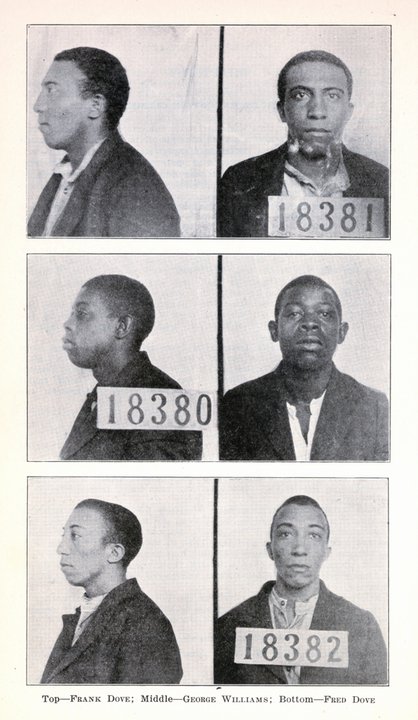
These men were convicted of the August 1922 murder of mail carrier Cyrus Jones in Swansboro, NC, largely on the testimony of another man, Willie Hardison, who was tried separately for the murder. Hardison later confessed that he had made up their involvement under the threat of being lynched. The state electrocuted Hardison in 1923, but both the trial judge and the prosecutor wrote letters requesting executive clemency for George Williams and the brothers Frank and Fred Dove. After almost six years on death row, the three were given full pardons in March 1928 by Governor A.W. McLean.

Image

Sidenote:  My people are from Onslow County, just west of Swansboro.  My furthest traceable Henderson ancestor was a free woman of color named Patsey Henderson, born about 1800.  Patsey’s sister Nancy married (or perhaps didn’t) a free man named Simon Dove.  The Onslow County Doves, including Fred and Frank, are descended from their son Durant Henderson, alias Durant Dove.

Image from “Capital Punishment in North Carolina,” Special Bulletin from the North Carolina State Board of Charities and Public Welfare, Raleigh, N.C. (1929). Copy courtesy of the North Carolina Collection, Wilson Library, University of North Carolina at Chapel Hill.

Standard
Free People of Color, North Carolina, Paternal Kin, Photographs

The case for Margaret Henderson as daughter of Nancy Balkcum.

The case for Margaret Henderson as the daughter of Nancy Balkcum (and sister of Mary Eliza Balkcum Aldridge) —

1. Margaret was born 1833-1836, probably in Sampson County NC. Mary Eliza was born in 1829 in Duplin or Sampson County.

2. Her photo clearly indicates that she was mixed race, as was Mary Eliza. Mary Eliza Balkcum’s mother Nancy Balkcum was white.

3. Margaret is not listed in the 1850 census, and neither is Nancy Balkcum.

4. Nancy Balkcum’s will makes reference to a daughter Margaret Balkcum, as well as a daughter Eliza Balkcum.  The will was probated in 1854 in Sampson County, prior to Margaret Balkcum Henderson’s marriage circa 1855. Margaret Balkcum purchased a number of small items from her mother’s estate.

5. Margaret named her second son James Lucian Henderson in 1857.  Compare: James Lucien Balkcum, born 1838, son of Nancy Balkcum’s daughter Mariah Balkcum Johnston.

6. Margaret named her first daughter Isabella circa 1860.  Compare: Isabella Johnson, born 1858, daughter of Mariah Balkcum Johnson.

7. Margaret named her second daughter Ann Elizabeth circa 1866.  Compare: Ann Eliza Balkcum, born circa 1840, daughter of Nancy Balkcum’s son John Balkcum.

8. Margaret named her third daughter Mary Susan circa 1868.  Compare: Mary Susan Balkcum, born 1844 to John Balkcum, and Susan Johnson, born 1844 to Mariah Balkcum Johnson.

9. Between 1860 and 1870, Margaret and her husband Lewis Henderson and Eliza and her husband Robert Aldridge migrated to the Dudley area of southern Wayne County.  The families are listed side by side in the 1870 census.

10. Caswell C. Henderson’s November 1907 marriage license, issued in New York City, reports his mother’s name as Margaret Balkcum.

11. Matrilineal descendants of Margaret Henderson have mtDNA haplotype H3. Descendants of Mary Eliza Aldridge have mtDNA haplotype H3.

12. Certain descendants of Margaret Henderson share significant autosomal cM totals with descendants of Mary Eliza Aldridge, but have no other known lines of common descent.

Problematic points:

1. Margaret’s death certificate lists her mother as Margaret Bowkin, not Nancy.  Informant was her son Lucian Henderson.  (I have seen instances in which an informant listed his own mother’s name, instead of the decedent’s mother’s name. Is this the case here?)

2. Margaret’s son Lucian’s June 1934 death certificate lists his mother’s maiden name as Hill.

3. Margaret’s daughter Sarah’s January 1938 death certificate lists her mother’s maiden name as Carter.  Informant was Hattie Mae Henderson, Sarah’s great-niece, who told me 60 years later that she did not recall giving this information and did not believe it was correct.

4.  Perhaps most puzzlingly, there is absolutely no tradition of kinship between the two families. Hattie Mae Henderson was reared by her great-aunt (Lewis and Margaret’s daughter) Sarah Henderson Jacobs. If Sarah had been first cousin to Robert and Eliza Aldridge’s children, it seems that there would have been some acknowledgement of the relationship passed down — not only to Hattie (my grandmother), but to others descended from the free colored families in this small community. They (Simmonses, Winns, Jacobses, Hendersons, Aldridges, etc.) intermarried freely, so consanguinity would not have been shameful. The one exception: Hattie Henderson reported visiting with Sarah a “Cousin Tilithia” in Norfolk as a child. This was Tilithia Brewington King Godbolt Dabney, daughter of Robert and Eliza’s daughter Amelia Aldridge Brewington. Did Sarah call Tilithia “cousin” because they themselves were related, or because Hattie was related to Tilithia (through J. Thomas Aldridge, her father and Tilithia’s first cousin)?  A point to consider: all but one of Lewis and Margaret’s children (son Lucian, who himself had no children who lived to adulthood) had died or migrated from Dudley by about 1905. The “lack of tradition” I perceive may simply be a function of a gap in familiarity between those people who knew Lewis and Mag’s family and those I was able to interview 80-90 years later.

Image

 Photo of Margaret Henderson in collection of Lisa Y. Henderson.

Standard
Births Deaths Marriages, Free People of Color, North Carolina, Paternal Kin, Photographs

On the Stoney Run Branch and Wilmington & Weldon Railroad.

On 4 July 1902, dower laid off and partition made of Robert Aldridge‘s land as follows:

Dower — Eliza Aldridge received 53 acres on a run of Stoney Run Branch.

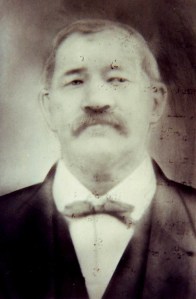
Lot No. 1 — Mathew W. Aldridge received 100 acres on Stoney Run and Hurricane Branches, excluding the Agustus Church and free school house lots.  An interest Mathew had bought from his father was included in the described tract and the residue was valued at $200.
matthew-aldridge

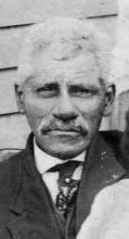
Lot No. 2 — George W. Aldridge received 42 acres on Stoney Run and the county road valued at $200.
george-aldridge

Lot No. 3 — Joseph Aldridge received 53 acres on Stoney Run and the county road valued at $200.

Lot No. 4 — David Aldridge received 80 acres on Stoney Run and the county road valued at $200.

Lot No. 5 — Robert Aldridge received 41 acres on a prong of Stoney Run and the Spring Road valued at $200.

Lot No. 6 — John W. Aldridge received 50 acres on Stoney Run Branch below the mineral spring and the Spring Road valued at $285.

Lot No. 7 — Frances Locust received 33 acres on Stoney Run and the Spring Road valued at $200.

fannie-a-randall

Lot No. 8 — Talitha Brewington, Hattie Brewington, Elijah Brewington, Mattie Brewington, Lundy Brewington, and Toney Brewington jointly and subject to the life estate of Joshua Brewington, received 33 acres on W&W Railroad valued at $193.

Lot No. 9 — Louetta Aldridge received 32 acres on Stoney Run Branch valued at $193.

Lot No. 10 — Lizzie Aldridge received 32 acres on the W&W Railroad and Stoney Run Branch valued at $193.

Lot No. 11 — Louetta Artis, Robert Artis, Columbus Artis, Josephine Artis, J. Scott Artis, J.B. Artis, Lillie Artis, Annie Artis and Elberta Artis, jointly and subject to the life estate of Adam Artis, received 32 acres at the mouth of a ditch on the run of Stoney Run and the railroad valued at $193.

Submitted by Sam C. Casey, Walter C. O’Berry, Ira W. Hatch.

The margins of this document contain notations and signatures acknowledging receipt of moneys due to balance the lot values, including signatures of Lizzie Aldridge, Tilithia King, J.W. Aldridge, Joseph Aldridge, Hattie Brewington, Columbus Artis, Elijah Brewington, Tony C. Brewington, Robert Aldridge, Lundia Brewington, and June Scott Artis, and Eliza Artis’ mark.

John Aldridge, owner of Lot No. 6, paid $7 each to the owners of Lots 8-11, and $57 to the Clerk of Superior Court for costs of the division.

Louetta Aldridge’s share was divided among her siblings “the owner of said amount now being dead this day Aug 22=1904.”

——

Robert Aldridge, my great-great-great-grandfather, was born circa 1819, probably in Duplin County NC, and died about 1899. He appears as a hireling in the 1850 census in Sampson County in the household of Calvin Simmons. By 1860, he and his wife Mary Eliza Balkcum Aldridge were living in southern Wayne County with their youngest children. His accumulation of property is something of a mystery, as his recorded deeds do not yield the acreage distributed in his estate.  Bits of the land remain in family hands.

There is a Stoney Run in Wayne County today, but it courses several miles northwest of the area in which Robert Aldridge is known to have owned land. I suspect that the waterway referred to above is now known as Yellow Marsh Branch, which has been dammed to form Durhams Lake. Robert owned a brickyard in the vicinity. “Agustus Church” is now Augustus Chapel Missionary Baptist Church, and the current edifice stands on the original land as what is now 599 Durham Lake Road, Dudley. The church celebrated its 145th anniversary in 2012. The Wilmington & Weldon Railroad is now owned by Atlantic Coast Line. My best guess for the “county road” is the road now known as the Old Mount Olive Highway, which runs alongside the railroad.

Abstract of document in the file of Robert Aldridge, Estate Records, Wayne County Records, North Carolina State Archives.

Photos of Mathew Aldridge, George Aldridge and Frances “Fannie” Aldridge Locust, alias Fannie Randall, in the collection of Lisa Y. Henderson.

Standard
Free People of Color, North Carolina, Oral History, Paternal Kin, Photographs

Introducing Lewis & Mag Henderson.

Though his brother Bryant disappeared from the record after apprenticeship, James Henderson achieved adulthood and shows up in the 1850 census as a mechanic and the father of four children whose last name was Skipp.  The children too were apprentices, which tells us that their mother, like James’ own, was unmarried. “Skipp” was an uncommon name in the area.  I know nothing else about her, and she apparently was dead by time the censustaker rode through their corner of Onslow County.  When James wandered 50 miles northeast to Sampson County to a tiny community of free people of color north of present-day Clinton, his sons Lewis and James Henry and daughter Eliza went with him. By this time, they had assumed their father’s last name.  Lewis Henderson, born about 1836, was my great-great-great-grandfather. There are no photographs of Lewis, but there is one of his brother James Henry, who was blue-eyed and bushy-bearded and generally indistinguishable from his Anglo-Saxon neighbors.

Image

Sometime around 1856 Lewis married a woman much like himself, free-born and colored and of uncertain antecedents.  Her first name was Margaret, and her last name seems to have been Balkcum.  And we do know what Grandma Mag looked like.  My great-aunt Mamie showed me the battered tintype; I was 21 years old and nearly lost consciousness.  Mag was born in 1836, too.  She was perhaps middle-aged when she sat for her portrait — her age, like her racial stock, is indeterminate.  But she had straight iron-gray hair parted down the middle and pulled back severely; high, broad cheekbones; and thin lips marking an ultra-wide mouth.  A handsome woman, if not a pretty one.  She seems to be smiling; there is a twinkle in her gray eyes.

Image

My grandmother remembered her like this:

We used to go down to Dudley to see Grandma Mag – we called her Mag, but her name was Margaret – before she died.  I remember her being alive, but she was in bed sick.  She was always in the bed.  Her hair looked like white, and she had it parted right in the middle and all carried back, don’t even look like she had none.  Couldn’t tell how much she had ‘cause she was laying on it, what I saw of it.  I don’t ever remember her getting up and down.  I remember ‘cause I wanted to know why she was in the bed all the time.  And I don’t remember seeing her walk but one time.  She stayed sitting around so much until she couldn’t hardly half walk – but she didn’t have nair stick with her.  She’d just hold on to different things.  I don’t know, I wouldn’t never ask a person, ask ‘em, “What’s wrong with your legs?” or “What’s the matter with you.  How come you can’t walk no better?”  But Mamie stayed with Grandma Mag and them until Grandpa Lewis died.  The house they was staying in where was up by the railroad, was just about to fall down.  So Mama Sarah built them a house.  

——

Photos of James H. Henderson and Margaret Henderson in the collection of Lisa Y. Henderson.

Standard
Maternal Kin, Photographs, Virginia

John C. Allen Jr.

Image

If he were living, he would be 107. I never knew him. My mother barely did; he died when she was 10; he is a mythological figure. His children speak of him reverentially, wistfully, with smiles. His widow sometimes spoke of him with a tinge of anger, a sense of abandonment that simmered low. He is a wraith made more so by her timeless solidity at our family’s core. Her light had only just begun to dim when she left us in 2010; she was 101. He was 41– younger than the youngest of his grandchilden. Frozen in 1948 — a slight, brown-skinned man with swayback legs and a small smile. My little ears are his. The tiny flaps at the inner corners of my eyes. The flare-ups of inner darkness. Who was he? Why?

Standard