

Goldsboro Messenger, 20 June 1878.
Goldsboro Messenger, 20 June 1878.

Wilmington Messenger, 3 April 1889.
John W. Aldridge was born in northern Sampson County and grew up near Dudley in southern Wayne County. In the late 1870s, he and his brother George taught at a school near Fremont, in northern Wayne County, where John met and married his wife Louvicey Artis in 1879. I had always assumed that the couple immediately returned to Dudley to raise their family and establish a farm and later a general store. However, this announcement clearly shows that John Aldridge was a firmly entrenched resident of the Fremont district as late as 1889. (In hindsight, this would explain why the Aldridges do not appear in Congregational Church records in the 1880s and 1890s.) When did the family return to Dudley? John and his brothers George and Matthew purchased land together in the 1870s. I’ve never looked at these deeds in detail, but clearly need to do so. Are there other traces of John Aldridge’s tenure in north Wayne?
As tax-paying landowners, many African-American men in Wayne County, North Carolina, in the 1870s were called alongside white men to fulfill their civic duties. Here are two entries from Superior Court Minute Book 2:
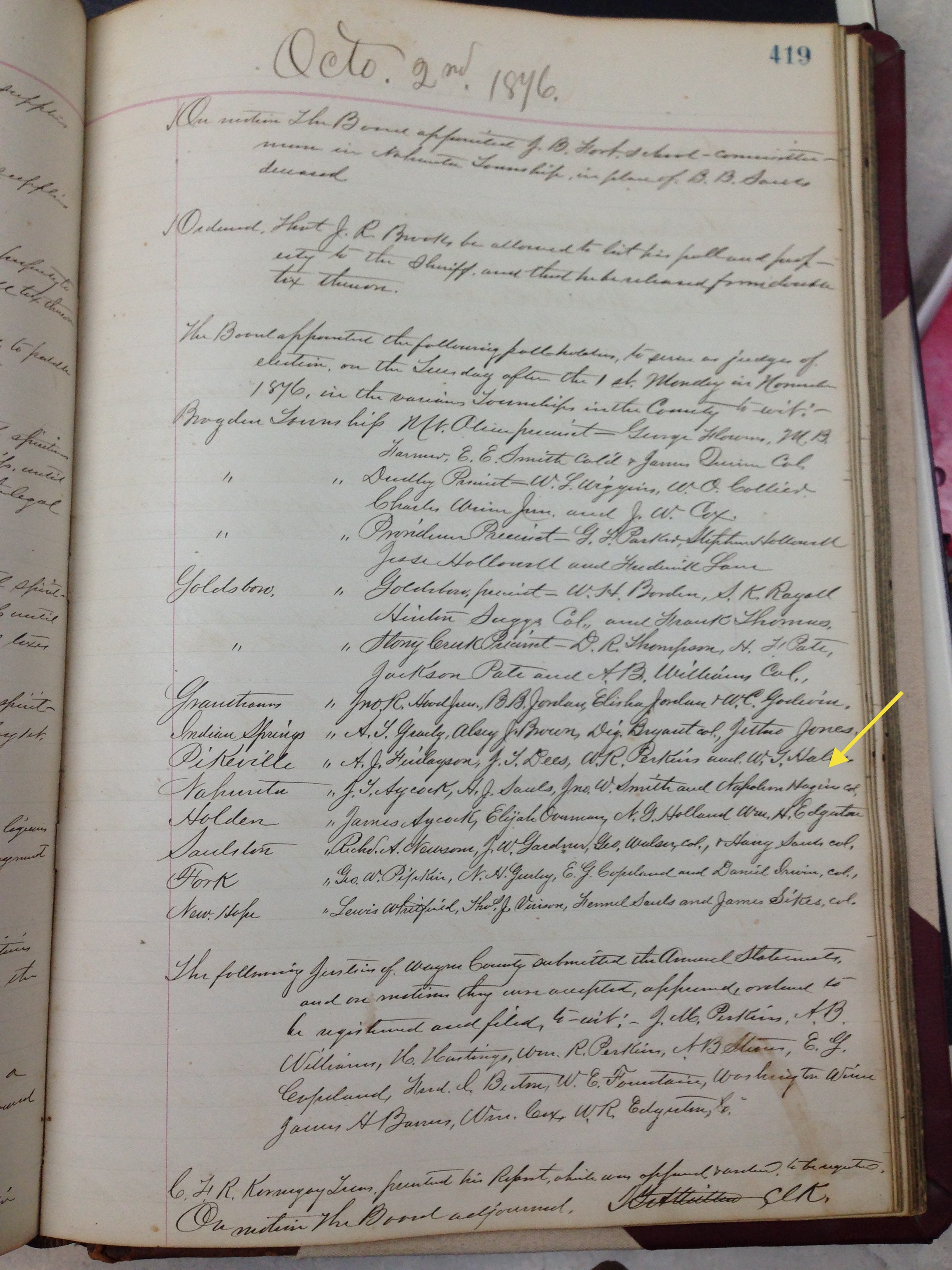 Napoleon Hagans of Nahunta township was appointed a judge of elections.
 My great-great-great-grandfather Lewis Henderson drew jury duty for the first week of the next term of the superior court.
Superior Court Minute Book 2, Wayne County Register of Deeds Office, Goldsboro, North Carolina.

Goldsboro Headlight, 5 March 1890.
I don’t know why Matthew W. Aldridge sued Calvin Foy, but I’ll try to find out next time I’m in Raleigh. “Little Washington” was a black neighborhood south of Pine Street and west of Virginia Street, just outside Goldsboro city limits. The community was largely lost to urban renewal projects.
In case you’re interested, here’s the text of the Supreme Court’s decision regarding Bertha Hart Murdock’s land. Property law is not my strong suit, especially as it applies to inheritance, so I will not attempt an explication.
——
This is an action for a declaratory judgment construing the last will and testament of T. L. Hart, deceased, and adjudging that by virtue of said last will and testament the feme plaintiff is the owner of an indefeasible estate in fee simple in certain lands described in the complaint, and has the power, with the joinder of her husband, to convey the same in accordance with her contract with the defendant.
The facts admitted in the pleadings are as follows:
T. L. Hart died in Iredell county, N. C., during the year 1930, having first made and published his last will and testament, which was duly probated by the clerk of the superior court of Iredell county, and recorded in the office of said clerk on June 4, 1930.
By his last will and testament, the said T. L. Hart devised his home place in Iredell county “to my daughter, Bertha May Hart and her bodily heirs, forever, never to be sold, and if she dies without bodily heirs, then it must be in trust for my sisters’ heirs, to hold but never to sell the same.”
By a codicil to his said last will and testament, the said T. L. Hart devised to his daughter, Bertha Mae Hart, a tract of land in Iredell county, containing forty-five acres, and described in the complaint by metes and bounds.
At his death, T. L. Hart left surviving as his only heir at law his daughter, Bertha Mae Hart, who has since intermarried with the plaintiff W. J. Murdock. He also left surviving five sisters, three of whom are married. Each of these sisters has children. Neither of his two unmarried sisters has children. Both are now over fifty years of age.
On April 1, 1935, the plaintiffs and the defendant entered into a contract in writing, by which the plaintiffs agreed to convey to the defendant a fee-simple estate, free and clear of all liens or incumbrances, in two tracts of land, one tract containing twelve acres, and being a part of the home place of T. L. Hart, deceased, which was devised to the feme plaintiff by the said T. L. Hart in his last will and testament, and the other tract containing forty-five acres and being the tract which was devised to the feme plaintiff by T. L. Hart, deceased, by the codicil to his last will and testament. By said contract, the defendant agreed to pay to the plaintiffs the sum of $1,000, upon the execution and delivery to him by the plaintiffs of a deed conveying both said tracts of land to the defendant, in fee simple, in accordance with said contract.
The defendant has refused to accept the deed tendered to him by the plaintiffs, and has declined to pay the plaintiffs the sum of $1,000, in accordance with said contract, on the ground that the feme plaintiff is not the owner of an indefeasible estate in fee simple in said tracts of land, and for that reason the plaintiffs cannot convey to him such an estate in said lands, in accordance with their contract.
On these facts the court was of opinion and so held that the feme plaintiff is the owner of an indefeasible estate in fee simple in the forty-five-acre tract, but that she is not the owner of such an estate in the twelve-acre tract.
It was accordingly ordered, considered, and adjudged that plaintiffs are not entitled to the specific performance by the defendant of the contract set up in the complaint, and that the defendant recover of the plaintiffs the costs of the action. The plaintiffs appealed to the Supreme Court, assigning as error the holding of the court that the feme plaintiff is not the owner of an indefeasible estate in fee simple in the twelve-acre tract described in the complaint.
Opinion
CONNOR, Justice.
There is no error in the judgment in this action. By virtue of the last will and testament of her father, T. L. Hart, deceased, and under the statute, C. S. § 1734, the feme plaintiff is the owner of an estate in fee simple in the twelve-acre tract described in the complaint. This estate, however, is defeasible upon the death of the feme plaintiff without bodily heirs. Whitfield v. Garris, 131 N. C. 148, 42 S. E. 568, and Id., 134 N. C. 24, 45 S. E. 904. It is clear that the words “bodily heirs,” used by the testator, must be construed as meaning children or issue; otherwise the limitation over to the heirs of the sisters of the testator would be meaningless. Rollins v. Keel, 115 N. C. 68, 20 S. E. 209. See Pugh v. Allen, 179 N. C. 307, 102 S. E. 394.
The limitation over to the heirs of the sisters of the testator, upon the death of the feme plaintiff, without bodily heirs or issue, is not void. The provision in the will that the home place of the testator, which includes the twelve-acre tract described in the complaint, shall not be sold by either the feme plaintiff or the remaindermen is void as against public policy. This provision, however, does not affect the validity of the devise either to the plaintiff or to the remaindermen. See Lee v. Oates, 171 N. C. 717, 88 S. E. 889, Ann. Cas. 1917A, 514.
There is nothing in the codicil which affects the estate in the home place of the testator devised in the will to the feme plaintiff.
The judgment is affirmed.
Napoleon Hagans and other “colored” men remained on Wayne County’s voter rolls through Reconstruction and beyond. As a result, at least until the 1890s, they were called to serve as jurors alongside their white male neighbors.
 Goldsboro Headlight, 5 February 1890.
Ring the Court House bell at 10 o’clock every night and at all other times when necessary to alarm the citizens.
Arrest all slaves absent from home after the bell rings and after the calaboose is finished lock them up till day light. Give them 15 lashes and inform the magistrate of their names and owners.
Accept no pass unless the place or places where the slave is permitted to go is written in the same and arrest the slave if found off a direct line or road from one place to another.
Arrest all slaves engaged in a disturbance either with or without a pass.
A pass allowing a slave to visit his wife is good for one month and then must be taken up and another given or he will be arrested.
Iredell County slave ordinances, undated. North Carolina State Archives.
This soft-backed composition book, deposited at the North Carolina State Archives in Raleigh, records the names of “colored” residents of Nahunta township, Wayne County, who paid poll taxes in the late summer of 1912. Paying such taxes was a prerequisite to vote in North Carolina, but few of these men actually registered, and probably fewer voted. (The women, of course, could not have voted under any circumstance.) The first two pages overflow with my kinsmen, Artises (including Adam T., his sons, grandsons, brothers and nephews) and a couple of Aldridges (both sons of George W. Aldridge.)


TESTIMONY OF NAPOLEON HIGGINS.
NAPOLEON HIGGINS, colored, sworn and examined.
By Senator VANCE:
Question. Where do you reside? Answer. Near Goldsborough. I don’t stay in Goldsborough, but it is my county seat. I live fifteen miles from town.
Q. What is your occupation? A. I am farming.
Q. Do you farm your own land? A. Yes, sir.
Q. How much do you own? A. Four hundred and eighty-five acres.
Q. How did you get it? A. I worked for it.
Q. Were you formerly a slave? A. No, sir; I was a free man before the war.
Q. You say you worked for it? A. Yes, sir; I worked for it, and got it since the war.
Q. What is it worth per acre? A. I don’t know, sir, what it is worth now. I know what I paid for it.
Q. What did you pay for it? A. I believe I paid $5,500, and then I have got a little town lot there that I don’t count, but I think it is worth about $500.
Q. Then you have made all that since the war? A. Yes, sir.
Q. How much cotton do you raise? A. I don’t raise as much as I ought to. I only raised fifty-eight bales last year.
Q. What is that worth? A. I think I got $55 a bale.
Q. How many hands do you work yourself? A. I generally rent my land. I only worked four last year, and paid the best hand, who fed the mules and tended around the house, ten dollars; and the others I paid ten, and eight and seven.
Q. That was last year? A. Yes, sir.
Q. What did you give them besides their pay? A. I gave them rations; and to a man with a family I gave a garden patch and a house, and a place to raise potatoes.
Q. What about the rate of wages in your section of the country; does that represent them? A. Yes, sir; of course a no account hand don’t get much, and a smart one gets good wages.
Q. Have you made any contracts for this year? A. Yes, sir; but I am only hiring two hands this year.
Q. What do your tenants pay you for the use of your land? A. Some of the tenants give me a third of the corn and a third of the cotton. Then I have got some more land that I rent out to white men, and they give me a fourth of the cotton, and another gives me a thousand pounds of lint cotton for twenty acres.
Q. Does anybody interfere with your right to vote down there? A. No, sir.
Q. Or with any of the rights of your race? A. No, sir; we vote freely down there. Of course, if one man can persuade you to vote with him, that is all right. But you can vote as you please.
Q. What are your politics? A. I am a republican, and that is the way my township generally votes.
Q. You say there is no interference with the rights of your race there? A. Not that I know of.
Q. There has been something said here about the landlord and tenant act. Do you think that does anybody any harm? A. I think it is a good law.
Q. The object of it is to give you a lien on everything your tenant has until your rent is paid? A. Yes, sir; and I think I am entitled to that.
Q. These white tenants can’t run off any of your cotton until you are paid? A. No, sir; I am five or six miles from them, and they can’t run it off. They might do it and I not see them if I did not have the law to back me; and they are just as apt to run it off as not when they start.
Q. Then you think it is a good protection to you in your rights? A. Yes, sir; I do.
Q. Do you have any schools down there? A. Yes, sir.
Q. How is the money raised for them? Most of it is by a property tax, is it not? A. Yes, sir.
Q. And the poll tax all goes to education except twenty-five cents on the dollar? A. Yes, sir.
Q. Do you know how much land your race has acquired in that county? A. I reckon they have got fifteen hundred acres in our township; but I could not tell how much in the county.
Q. Is there any distinction made between the whites and the blacks down there in the renting of lands? A. None that I know of.
Q. Both are paid the same wages? A. Yes, sir; unless a man wants to hire some man to lock his doors and look after and keep his keys; then they pay him more. And if it is a colored man that he has confidence in, they pay him the same.
Q. Is there any distinction there to take all white men as tenants? A. No, sir; in our township they take them without regard to color. If a man is a smart man, he gets in just the same as a white man. Colored men rent from white men, and white men from colored men.
Q. Did you ever have any talk with any of those people who went to Indiana? A. No, sir; I never saw one who went.
Q. Did you ever hear any of the speeches of any of these men who were stirring up these men? A. No, sir.
Q. Did you see any of their circulars? A. No, sir.
Q. Nor hear of any inducements offered to them? A. No, sir.
Q. Did you get any letters from any of them who went out there? A. No, sir; I wasn’t acquainted with any who went. I learned more of it at Goldsborough last Monday night, when I was coming on here, than I ever knew before.
Q. Are there any complaints among your people to discriminations in the courts, between the whites and blacks? A. Yes, sir; I have heard them say that the same evidence that will convict a colored man for stealing won’t convict a white man.
Q. When they are convicted, are they punished alike? Yes, sir; in the same cases. I have spoke to them and told them, lots of times, that of course they would be convicted many times where a white man would get out, and the only way to avoid that was to quit stealing. I told them, a white man has got more sense and more money to pay lawyers and knows better how to hid his rascality, and the best way for the colored man to keep out of the penitentiary was to quit stealing.
By Senator WINDOM:
Q. Is it the general impression among colored people down there that they don’t get justice? A. Yes, sir; when two or three colored men get convicted they think so. But there are more black men convicted because there are more of them tried.
Q. You say they have not got sense enough to get out of it when they get in; they have attorneys, do they not? A. Yes, sir; but very often they have not got the money to feed up an attorney; and, you know, they more you pay a lawyer the more he sticks with you.
Q. Is there not discrimination there in the employment of mechanics? A. No, sir; I never heard of it.
By Senator VOORHEES:
Q. Do you know of any of these people, white and black, who have been convicted that you thought were convicted wrongfully? A. No, sir.
Q. You thought they were rightfully convicted? A. Yes, sir.
Q. You have been on juries yourself; did you ever make any difference between them? A. No, sir; I have sat on juries there many times, and sat on a case of a white man who was tried for his life.
Q. Was there any other colored man on that jury? A. No, sir; I was the only one on that one; but I have been on others.
Q. You have sat on juries when white men’s cases were being tried, both on the criminal and on the civil sides of the court? A. Yes, sir.
Q. Did any white man object to you sitting on them? A. No, sir.
Q.Then most of this talk about discrimination and injustice is by men who have been disappointed in the results of their suits? A. Yes, sir.
Q. You see no cause for it yourself? A. No, sir.
Q. You have heard white men complain just as bitterly? A. Yes, sir; of course. I suppose they are like I am. I always try to beat the case.
By Senator WINDOM:
Q. You say you think this land and tenant act a good thing; do you think the renter is in favor of it? A. I don’t know; they never say anything to me about it. I am on the other side of that question.
Q. Does not the fact that you own 285 [sic] acres of land give you a little better standing in the community than most of your colored friends? A. Of course; I suppose it does.
Q. How did you start it? A. I rented a farm and started on two government horses. I went to the tightest man I know and got him to help me. I rented from Mr. Exum out there.
Q. Are there others who have succeeded as well as you? A. Yes, sir; there are. One or two men who have succeeded better than me. There are several of them in good circumstances there in our township. I think, altogether, they own 1,500 acres there.
Q. How many colored people own this? A. I reckon 150.
Q. The 1,500 acres is divided up among 150 people? A. No, sir; a good many of them have got none.
Q. This is what I asked you: How many own this 1,500 acres, all put together? A. I reckon a dozen. It might not be more than eight. It is from eight to a dozen, anyhow. But there are a number who own some little lots of land of four or five acres that I have not mentioned.
This, of course, was Napoleon Hagans (not Higgins)’ testimony before a Senate Select Committee investigating the migration of hundreds of African-Americans from the South to Kansas Indiana in the late 1870s, allegedly because of “denial or abridgment of their personal and political rights and privileges.” Hagans’ testimony about the source of his relative wealth, as well his opinions about the political and judicial climate for colored men in his part of North Carolina, were well-received by the committee, which concluded that all was well in Dixie. Nonetheless, it is perhaps possible — if one suppresses natural feeling and attempts to stand in Napoleon’s shoes — to detect a very subtle undercurrent of resistance here and there in the essential conservatism of his words.
Transcript in Senate Report 693, 2nd Session, 46th Congress: Proceedings of the Select Committee of the United States Senate to Investigate the Causes of the Removal of the Negroes from the Southern States to the Northern States, Washington DC, beginning Tuesday, 9 March 1880.

Colored American, Washington DC, 20 June 1903.
——
(1) Who knew Caswell C. Henderson was “one of the best known Republicans in the County of New York”?
(2) Uncle Caswell worked at the United States Custom House, where positions were highly sought-after. In other words, they were patronage jobs. Now I understand the path the farmer’s son from North Carolina took to get one.
(3) It appears that Caswell wasn’t a white man at work after all. He was merely one when below the Mason-Dixon line.
 Scuffalong: Genealogy.