
First my grandfather on the 14th, then Aunt Julia on the 23rd, Papa Allen on the 24th, and finally Aunt Tee on Christmas Day. Here she is circa 1910.
 Remembering Edith Christine Allen Lomans on her birthday.
First my grandfather on the 14th, then Aunt Julia on the 23rd, Papa Allen on the 24th, and finally Aunt Tee on Christmas Day. Here she is circa 1910.
Remembering Edith Christine Allen Lomans on her birthday.

Remembering my great-grandfather, John C. Allen Sr., on the eve of his birthday.
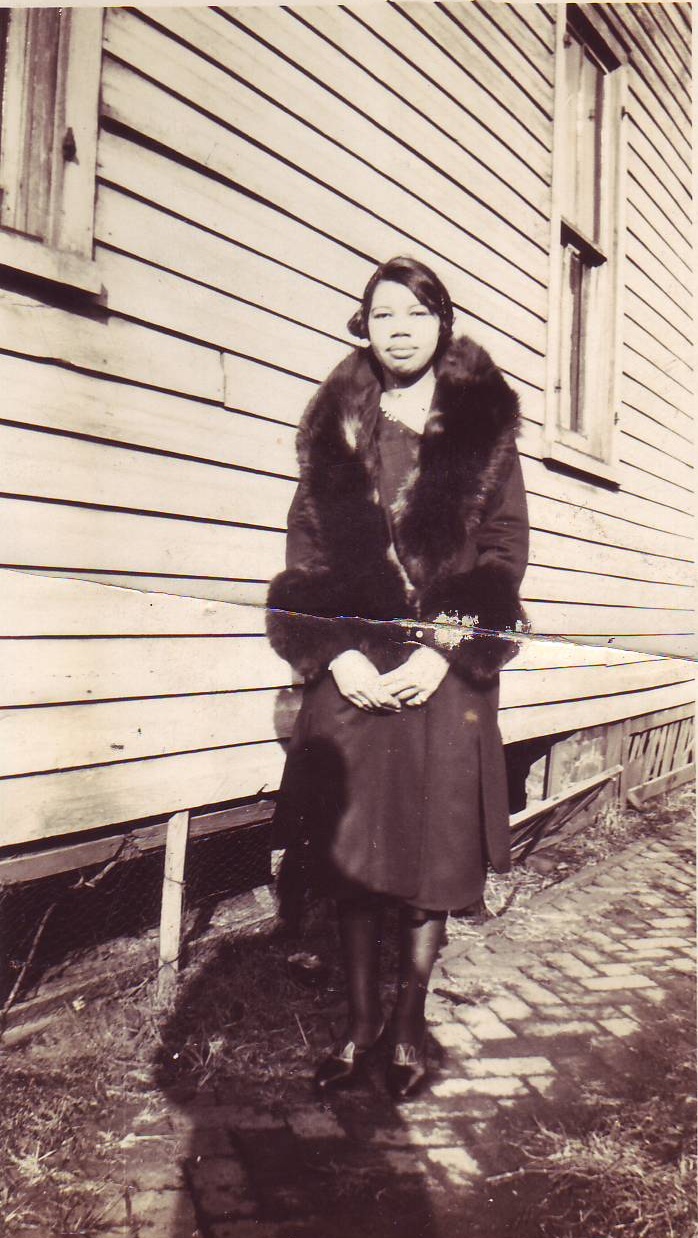
Remembering Julia Elmira Allen Maclin (23 December 1904-24 March 1999) on her birthday.
Mary Brown, born about 1849 in Amelia County, Virginia, married Graham Allen in Charles City County in 1876. She and Graham and their children appear together in the 1880, 1900 and 1910 censuses. Mary Allen, born in Amelia County to James Brown and Catherine Booker, died 1 April 1916 in Charles City County. Who, then, was the 30 year-old Mary Allen whose death Graham Allen reported on 8 December 1887 in Charles City County?
About ten years ago, when we were all in Newport News for a family reunion, I asked my uncle to take us on a tour of houses our grandfather built.
——
He designed every house he built. And there were a couple he designed that he didn’t build. I’ll show you those, too. One of them, he really hated to lose. That was a, Dr. Woodard was a dentist. I mean, a pharmacist. And so, he – that was one of the lots that Daddy had sold, and so I think Daddy was a little ticked with the guy. He sold him the lot and designed the house, then the man went to another contractor. But you know what was interesting at that time? There were about five or six good general contractors around, you know, that did small buildings. And Daddy was one of those, but these guys were pretty competitive. They had a decent market. Daddy built an average of about a house a year, I guess. The war cut him off, you know. He had to get reestablished after the war. But he had a friend named Buster Reynolds. And Buster Reynolds was reputed to have made his money in the numbers, and so when the numbers were getting real hot and heavy, when it was reputed that the Mafia was trying to take the numbers over, Buster got out. And he built this service station, and he had a Texaco franchise, and he had Daddy to build the station. And Texaco liked the work so much that Daddy built two more stations for Texaco. And both of the stations that were built in the black community are still up. They’re not gas stations anymore, but the buildings are still up. And the one that was built Overtown is gone. But even the station that was in the white community Texaco had him to build that one, too. And with the money Daddy bought – I’ll never forget – he bought an International truck, great big truck, to carry his materials around.

——
… the churches that he used to do expansions and modernizations on all the time, but I know one of ‘em is gone, and I don’t know where the other one is. I know the one – he used to take me down to that one from time to time. But I don’t know where they are now. The thing he did throughout all of these communities – he had a strong maintenance clientele, but Daddy was a – you see these cabinet shops now? Well, Daddy used to make, put in new cabinet work in people’s kitchens for them. And, so, that’s what carried him through the winter. ‘Cause he would also do designs and drawings for other contractors. Like Jimmy’s daddy. Mr. Scott. He used to do most of their design work, he’d sit there and draw those drawings for them. But that’s what got him through the winter. That and he used to do a lot of maintenance. Put in new windows, cabinet work, doors. Put little small additions to houses. But that was generally for a white clientele. He used to do a lot of work for the shipyard management people up in North Huntington Heights.
——
This house Daddy was building when he died. He was building it for a family named Kramer. A white family. See the one with the little entrance and the white wrought iron?

1316 – 22nd Street
——
The 800 block of Hampton Avenue, this is where Daddy owned those lots. Slow down … this house right here. This tan house. 855. This house was built at that time for the Tynes family, which owned a very nice house and property up in the next block.

855 Hampton Avenue
But the Tynes family ran into some – I guess it was financial difficulty. Anyway, that house was sold to Wendell Walker, who was a lawyer and a part of the Walker family. You know his father was a lawyer, who was William. And his son William jr. is Howard Walker’s father, who was my classmate. And then there were, like, four sons and a daughter, I believe it was. Three of ‘em were lawyers, and then Wendell and Phillip were lawyers. The son William was an engineer, but when he came back home, he was manager of Aberdeen. He went into real estate and insurance. Daddy sold him the lot, designed and built the house.
——

819 Hampton Avenue
Let me tell you about this house right here. This house was the undoing. This house was built for his friend Leroy Ridley. And there were, I think, four lots – four or three lots. Leroy Ridley was the son of John Ridley, who founded Crown Savings Bank with Pa Pa Allen. Okay? But he became – one of the Ridley sons, he became the one who took over the bank. And the man turned out to be not the most moral and forthright businessman. He talked into Daddy into $5000 worth of extras in this house, which was almost the same size as the house. And then when it came time to close the deal, he refused to pay Daddy because he said Daddy had not duly executed the extensions in the contract to do that. And not only that – Daddy had borrowed money from his bank. The long and short of the story is the last of that was paid when Pa Pa’s estate was executed [in 1961, 13 years after John Allen’s death.] We told Mother to pay that loan off ‘cause she still owed a thousand dollars. But this house turned out to be what kept Daddy from building Mama her house. ‘Cause he was gon build it on another lot. See? But when he got caught in that deal, then he couldn’t. So then he had to sell off all the lots that he had for houses, okay? So that’s when he sold this lot – the Woodard lot. And designed that house for Dr. Woodard.
Me: This incredible – this house right here?
My uncle: Yes. That’s Daddy’s design.
My cousin, J: Wow!
Me: Sheeze. Oh, my God.
He did not do it. He designed it. Okay. See, this was an extra lot. This is another one of the large lots he had. You see what I’m saying? And this house was across the street, that was his pride and joy. That was a Cape Cod. But I’m saying, the Ridley house was a fantastic house. I mean, you know, the design was great, but anyway, so this was done for his buddy Picott. Mr. Picott. He was president — well, he wasn’t president – yes, well, he was, of Virginia Education Association, which was the black unit of the National Education Association. He was one of the guys who lost their jobs over the equal rights fight with Mr. Palmer for black teachers to have equal pay. And he left and moved to Richmond, and that’s when he sold his house. But that was a beautiful home. Solid oak floors, cabinetry that Daddy built. All of that, that house. But that’s the thing that – she won’t talk about it too much – but that’s the thing that really embittered Mother, was when she lost the opportunity to build her house because of that deal.

816 Hampton Avenue
——

2107 Marshall Avenue, my great-grandparents’ house.
You know, he did all that for his father. He put the addition – designed that addition to go on the back. Right behind the bathroom window. Okay, that’s where the bathroom was. And then Daddy designed and started that addition for the house. And that’s when he went to the Army. And they put that addition up there so – so the bottom addition was the barbershop, remember? You remember the beauty shop? Yeah, the bottom addition was the beauty shop, and the upper addition was the bedroom for Aunt Nita for the war. Pa Pa did that for his children.
——

3105 [I didn’t note the street name]
On the corner here, similar to the Kramer house. Designed it and built it. That was done for Dr. Fultz, who was a dentist. Actually, he was the school dentist. He built 3015. This at that time was a predominantly white neighborhood. Yeah, that’s the house. See that little carpentry he did? Those little arched doorways? That’s the original wood. That’s Daddy’s work.
——
Remembering John Christopher Allen, Jr., carpenter, draftsman, builder, contractor, father of five, grandfather of eight, great-grandfather of six, born 107 years ago today.
—–
Interview by Lisa Y. Henderson; all rights reserved. Photos taken by Lisa Y. Henderson, 2002.
I was thinking about Cousin Tilithia when I was a little girl. She had a restaurant large enough to work in and serve patrons. It wasn’t real big, but they were serving patrons, and Mama carried me up there, and we spent the night there. And whenever she’d come to Wilson she’d stay with us.
Tilithia Godbold, she lived in Norfolk, and she married this man. That wasn’t her children’s daddy. King was her children’s daddy. Godbold was the man she married later. He lived over in Rocky Mount, and he worked in the roundhouse or something. I think he fixed the train, but he wasn’t the one on the train. And Godbold, Tilithia’s husband, he stayed there in Rocky Mount. ‘Cause Tilithia lived in Norfolk. Her and her five or six girls or whatever it was, and she was running what they call the Strand Café. And it was down on the first floor, and they lived up over it. Go out there, and it was a sleeping compartment. I was over there one time, and I remember it. I think I was about seven or eight years old. Went with Mama over there. We was just running all over the place. She had us waiting tables. I wanted to wait tables. I was wondering, I asked Mama, “Well, why come we couldn’t have a place like that?” And all that food! Look like whatever the food was – I didn’t even know what it was ‘cause we ain’t never had none. It was a whole lot of stuff, look like they had, I didn’t want it, but then I know it looked good, and we ate down there in the café.
And another time Mama took me over there on the train to see her. And it was right down in South Philadelphia where we went to their house. Where they was staying. And when I moved up here, her sister, she was telling me ‘bout how the children were there in Norfolk, her sister and all them. I said, well, I could remember some of them, but I don’t remember what – and I asked where some of the girls was. Some of them in Norfolk and some of ‘em, one’s dead. [Inaudible] the family. We got strayed apart.
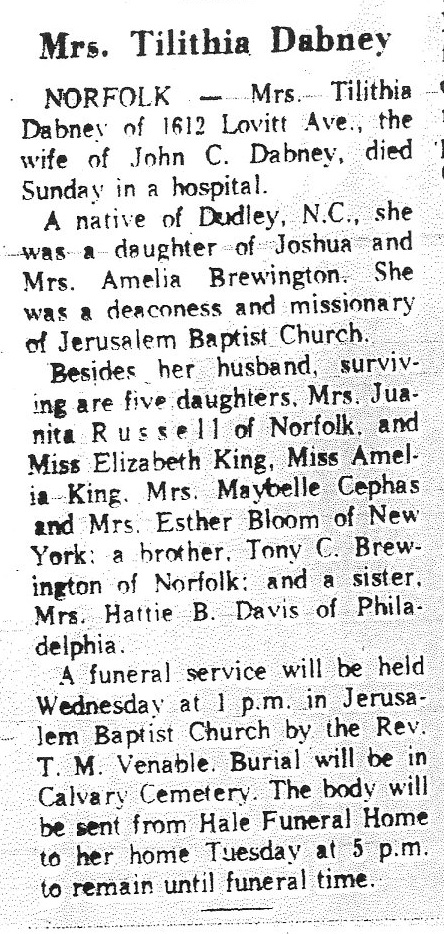 Virginian Pilot, 22 November 1965.
Interview of Hattie H. Ricks by Lisa Y. Henderson; all rights reserved.
She was the aunt for whom my aunt was named. She was a teacher. She married late and had no children. And she died when my mother was small. That was about all I knew about my grandfather’s oldest sister, Marion Ellen Allen Lomans.
My uncle let me copy a scarred and badly tinted photo:

She looked like an Allen sister, but I was no less mystified. (Frankly, other than Aunt Julia, they were all a bit mysterious — how did I never meet Aunt Edith? Or Aunt Nita until I was an adult? Or even Uncle Buster, who lived right in Newport News?)
And then M., my mother’s first cousin, sent this picture, which charmed me to no end — Aunt Marion and her students at John Marshall School:

And then I found her obituary:

Virginian Pilot, 15 November 1942.
And so I learned a few more things: that, despite her marriage to Mr. Lomans, a World War I veteran whom she had married “recently” and whose Christian names were actually Gillespie Garland, she was still living at home at the time of her death. That she was a member of the United Order of Tents (a secretive charitable organization founded by black women in the mid-19th century) and the Good Samaritans (another?). That she taught for only six years. That Aunt Tee — that’s Edith — was unmarried and living in New York City when Marion died. That Marion died at Whittaker Memorial Hospital, an institution that her father served as a board member. That she was buried from Zion Baptist, the church that nurtured her father. Still, who was she?
In 1909, ten years after their father’s death, sole surviving heirs Mary Agnes Holmes Allen and Julia Holmes sold two parcels that Jasper Holmes had purchased in 1873 and 1879. “This figure represents a piece of land lying in Cha City Co, near Westover Church” wrote the surveyor who laid off the land and prepared this plat:
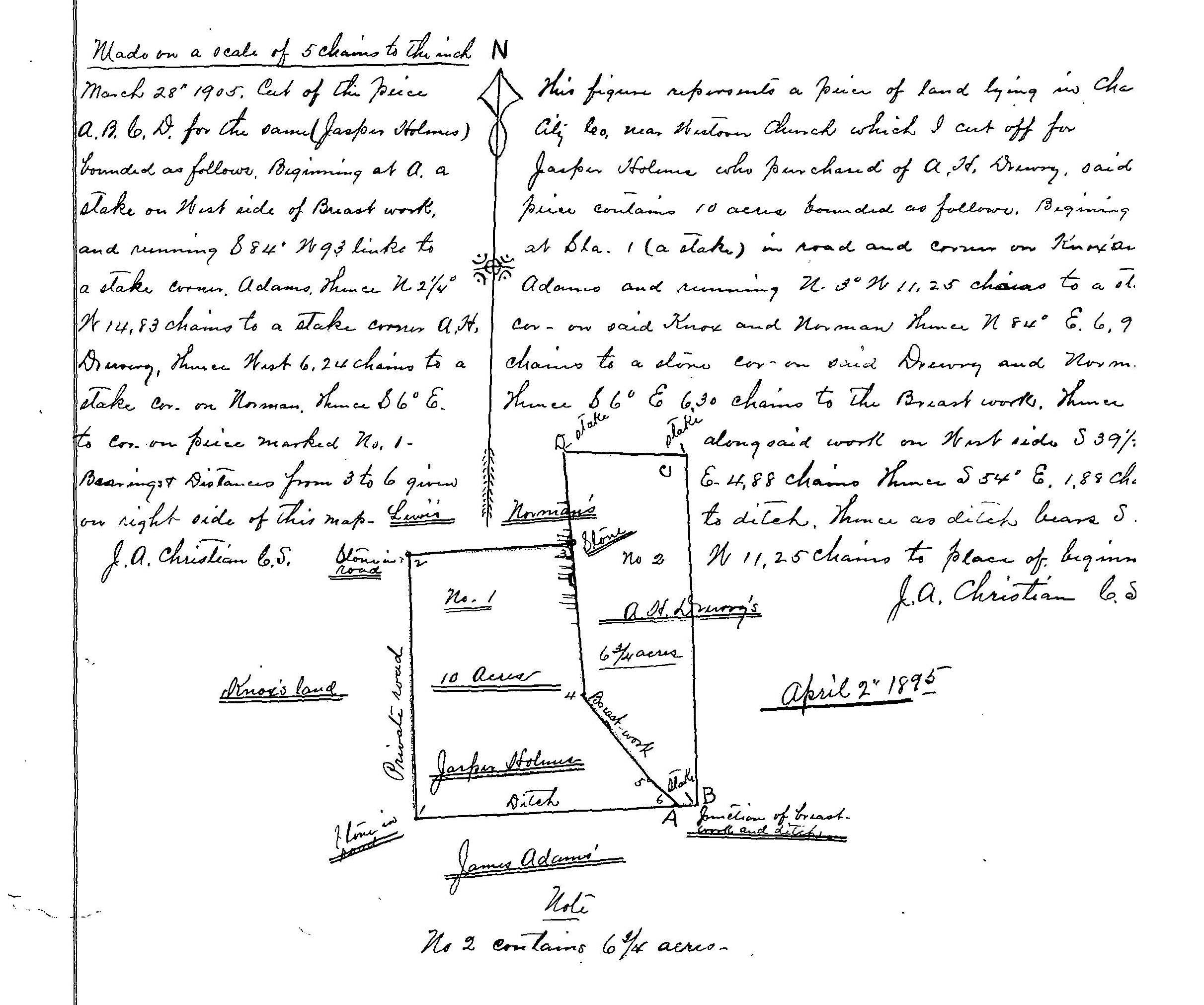
Westover, dating back nearly 400 years, is one of the oldest Episcopal parishes in Virginia. The current church was built in 1631 and remains active. Confederate breastworks running between the church and Evelynton plantation, on the south side of John Tyler Memorial Highway, are still visible.
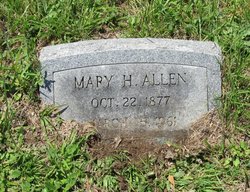
Her headstone is wrong. Mary Agnes Holmes was born October 15, 1877 — not October 22 — on the R.L. Adams’ plantation in Charles City County, Virginia. Her parents were tenant farmers there, and Agnes was one of a handful of Jasper and Matilda Holmes‘ children to survive to adulthood.
Agnes’ mother died when she was about 8 years old, and her father apparently did not remarry. Jasper Holmes was an ambitious man and managed to purchase several small plots of farmland upon which he supported his family in a degree of comfort. The Holmeses may have attended New Vine Baptist Church and, if so, that is likely where Agnes met John C. Allen.
There is an ugly story told about their marriage: John had quickly established himself as an eligible bachelor in Newport News’ East End, and his appeal was heightened — in the standards of the day — by his light skin and wavy hair. When he brought his new bride home shortly after Christmas 1900, his neighbors, peeking through curtains, were shocked to see a plain, broad-featured, brown-skinned woman step from the carriage. (Agnes herself was not immune to such prejudices, and her color-struck notions would reverberate among her offspring.)

During the early years of her marriage, Agnes did “day’s work” as a housemaid. I did not know this. I had assumed that she was always a housewife, which is a reflection of my failure to understand just how my great-grandparents were able to achieve the middle-class respectability that marked their lives by the middle of the 20th century. (Not to mention how they maintained their dignity on the climb.)
Me: Now, his mama didn’t ever work, did she?
My grandmother: Who? Indeed, she did work.
Me: Like, outside the home?
My grandmother: Yeah, during the late years, she didn’t, but she worked outside the home ‘cause she told me one time she walked across the bridge, ‘cross 25th Street bridge, and said it was snowing and ice, and the ice froze on the front of her coat. And I never shall forget, she worked for a lady, and this lady had a small child. And she asked her would she wash the child’s sweaters. Sweaters that the baby had. And she took and said, “Asking me to do all kinds of extra work like that,” and said, “You know what I did?” Said, “I washed the sweater in hot water, and then I put it in cold water. When I got through with it, it was ‘bout big as my fist.” I said, “How can [whispering, inaudible.]” And she knew it –
Cousin N: Was gon shrink up.
My grandmother: And I said, “Oh, my God, that is awful!” And it was. Anyway, she told me that. She said, “I washed it all right for her, and I put it in hot water, as hot as I could find, and then put it in cold water. When I got through with it, couldn’t nothing wear it.”
By the time my mother and her siblings were children, Mary Agnes Allen had assumed the domestic role I’d always imagined her in — at home on Marshall Avenue, among Tiffany lamps and lace antimacassars, preparing roast beef to serve on Blue Willow china to a husband just home from this board meeting or that union affair. Her grandchildren speak of her ambivalently, aware of the casually cruel distinctions she drew among them, but unable to name any particular misdeed.
Me: Well, was Mary Agnes mean to y’all or what?
My mother: She was not to me, that I remember. I don’t know what this was about. Ahh … maybe it was that she was not friendly. Maybe she wont like Grandma Carrie, joking and saying little funny stuff. I don’t know. I don’t know what it was.
Her grandchildren — at least, her son John’s offspring — felt that lack of warmth acutely. Though their 35th Street home was only a mile away from hers, Mary Agnes Allen does not feature much in the stories of their childhood. (Nor, frankly, does John Allen Sr.) In her later years, she left Newport News to live with her daughter Edith Allen Anderson in Jetersville, Amelia County, Virginia. The photo below, I’m guessing, was taken shortly before her move. And seems to reveal a softer side.

Mary Agnes Holmes Allen died March 15, 1961, just two months before my mother married in the sideyard at Marshall Avenue. A brief obituary ran in the Daily Press on the 17th, noting that she was a member of Armenia Tent No. 104 and the Court of Calanthe. She was survived by three daughters, a son, a “foster son” (actually, her nephew), a sister, and, most curiously, “12 grandchildren and 10 great-grandchildren.” In fact, she had ten grands and no more than three great-grands.
Interviews by Lisa Y. Henderson, all rights reserved. Photographs in collection of Lisa Y. Henderson.

John Allen resembled his mother Mary Brown Allen in the fullness of his face, in his heavy brow, and in the shape of his wide, straight mouth. Where her skin was a smooth walnut-brown, however, his was the creamy pale yellow of a pat of butter. Of his father, we know nothing at all except this: he was white. This conclusion, which has long rested on family lore, physical appearance and common-sense conjecture, has been confirmed in the Y-DNA haplogroup of his male descendants. The DNA of my uncle, son of John Allen’s son John Jr., yielded haplotype R1b1b2a1a1. R1b is the most common haplogroup in western Europe and is particularly prevalent in men whose ancestors lived in modern-day England, Ireland and France. Y-DNA is passed solely along the patrilineal line, from father to son. (In other words, my grandfather and his brothers, then their sons, then the sons of those sons, inherited. By my count, seven of my great-grandfather’s patrilineal descendants survive. Their ages range from 10 to 81.) It does not recombine, and thus Y-DNA changes only by chance mutation at each generation. For this reason, it is useful in making connections among the male descendants of a common ancestor. Additional testing may help solve the mystery of John Allen’s paternity. [Update here.]
Photograph in the collection of Lisa Y. Henderson.
 Scuffalong: Genealogy.