Maternal Kin, Oral History, Virginia

Mystery sister.

In the early 1940s, my uncle recently said, a mysterious woman appeared at his grandparents’ house. My uncle alone was there because he stayed with them sometimes during the school year; his aunt Marion was his teacher. In the manner of the day, no one bothered to introduce a child to an adult, but he gathered that the woman was Papa Allen’s sister. This was a surprise to him, as he had not known his grandfather to have any such relatives. The woman looked much like Papa, with very light skin. He never saw her again, and whether she ever returned he cannot say.

Who was this woman? She was not Emma Allen Whirley, John Allen‘s younger half-sister, who was not light-skinned and probably was dead by 1940. Could she have been Nannie, the 5 year-old listed in Graham and Mary Allen‘s household in the 1880 census of Charles City County? Nannie’s birth predated Graham and Mary’s marriage, and it is not clear which is her parent. Her pale skin suggests that Mary was her mother, and her father was, perhaps, the same white man that begot John. No other record of her has been found.  She may have been the mother of Junius and Milton Allen, the grandsons recorded with Graham and Mary in the 1900 census, but I suspect that they were born to Emma before her marriage. Otherwise, if Nannie is the woman who appeared on Marshall Avenue just before the outbreak of World War II, she has eluded detection in the record.

Standard
Births Deaths Marriages, Maternal Kin, Military, Other Documents, Photographs, Virginia

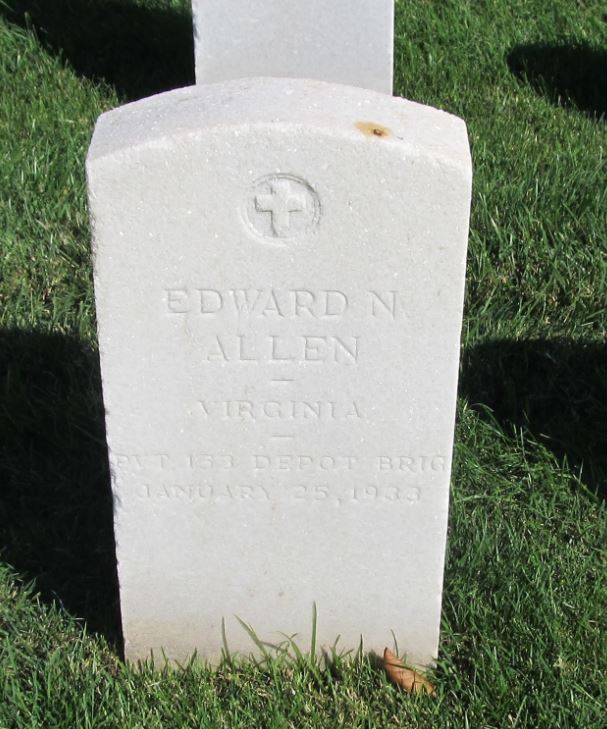
Edward N. Allen.

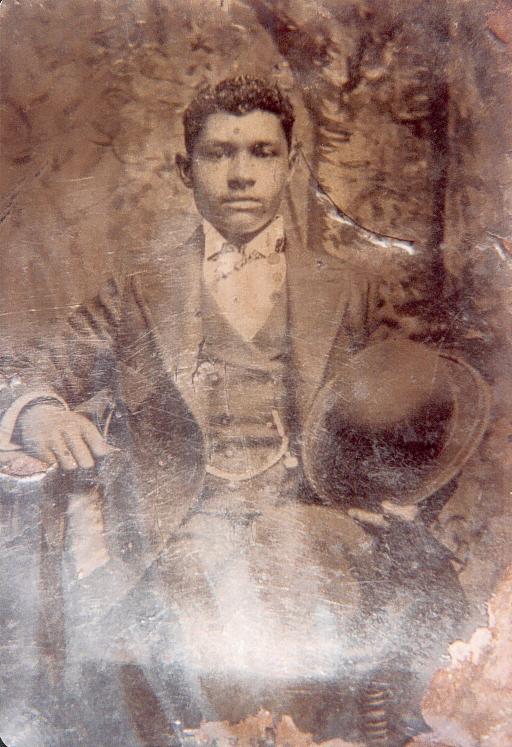
After John C. Allen‘s birth in 1876, Graham and Mary Brown Allen had four children together. Emma, their only daughter, was followed by Willie, Alexander and Edward Noble.

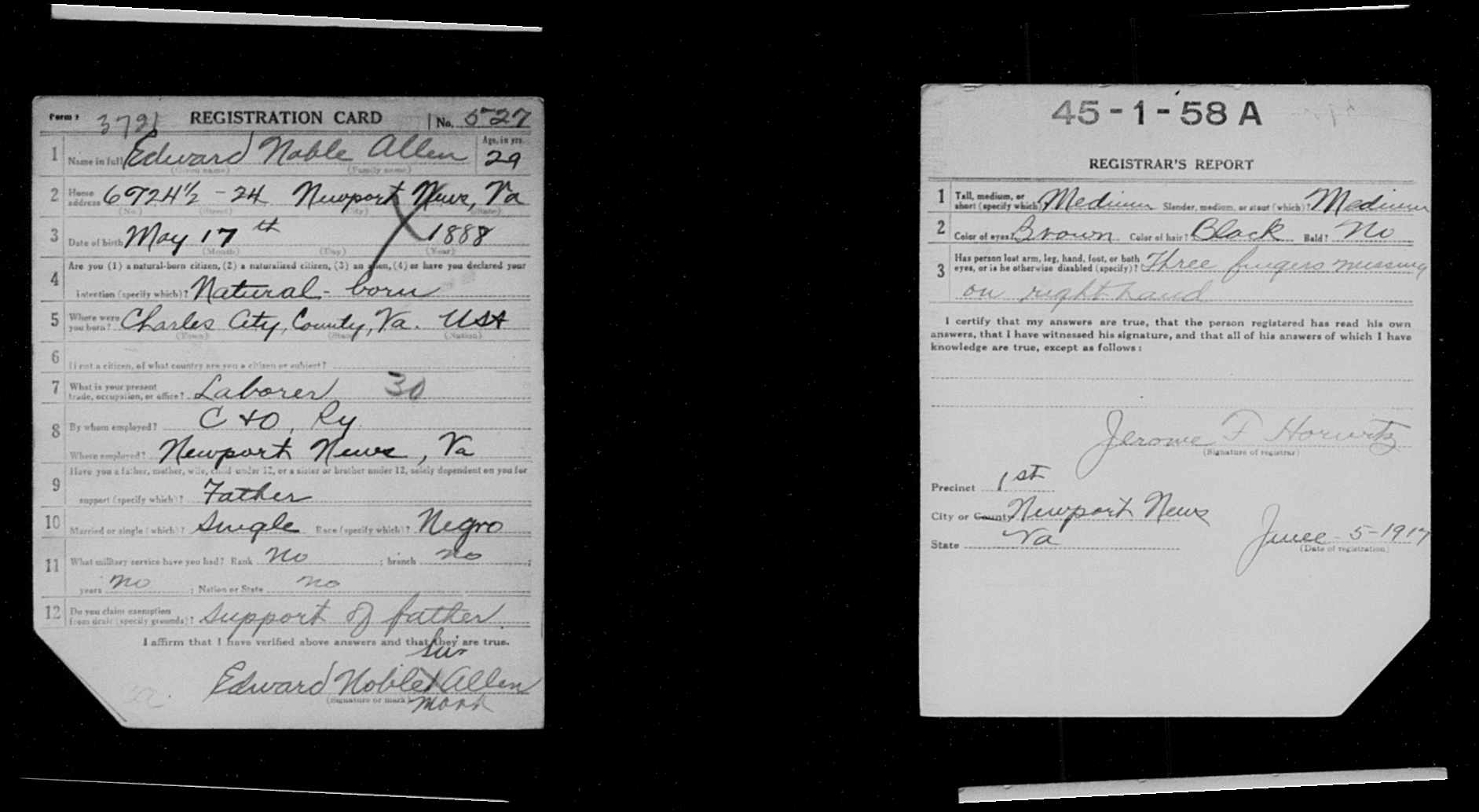
Edward N. Allen grew up in Charles City County, but followed his half-brother John to Newport News some time after 1910. He was working there as a laborer for the Chesapeake & Ohio Railroad when he registered for the draft at the outbreak of World War I. (And had had a tough life, as he reported missing three fingers on his right hand.)

ImageEdward survived the war, but his life over the next 15 years is hidden from history. He apparently never married or had children. Unless he is the Virginia-born Edward Allen that is listed as a farmhand in upstate New York in 1920, he appears in neither that nor the 1930 census. He was back in Charles City County by the early 1930s, though, and died in early 1933 at the U.S. Marine Hospital in Norfolk. He was only in his early 40’s, but beset with an old man’s diseases.

Edward_N_Allen_Death_Cert

Edward Noble Allen is buried in Hampton National Cemetery.

Image

Standard
Births Deaths Marriages, Maternal Kin, Virginia

And then there were …

It’s beyond heartbreaking, even given the terrible infant mortality rates of times.  Of Jasper and Matilda Holmes’ 11 children, only three lived to see the 20th century. Matilda herself died giving birth to her last child, who lingered a few months before slipping away. Others died in clumps, compounding the family’s grief to unimaginable intensity.

Robert, the first child, was born in 1864. He lived long enough to be recorded in the 1880 census of Charles City County, but was dead before his father’s estate opened in 1899.

Walter and Angelina, born in 1868 and 1870, died within six months of each other in 1887, felled by tuberculosis.

William and Joseph, born in 1871 and 1874, died on consecutive days in January 1875, victims of whooping cough.

Emma, born in 1876, lived long enough to marry Cornelius Jefferson in November 1899 and to give birth to son, Jesse Holmes Jefferson, the following January. (Though, oddly, she is not listed in a transfer of property to Jasper’s heirs on 30 December 1899.) She died when Jesse was an infant, however, and the boy was reared in his aunt Agnes’ family.

My great-grandmother Mary Agnes, born in 1877, lived into her 80s. Her death in 1961 came more than 60 years after the death of all but one of her siblings.

Martha, called “Mattie,” born 1879, married Jesse E. Smith, in May 1899. She received a share of her father’s estate in 1899, but died during the next decade.

Julia Ellen, born in 1882, lived the longest of all the children. She was close to 90 in 1961 when she was listed in her sister’s obituary as the sole remaining Holmes.

The last babies, unnamed infants, died at or within months of birth.  The first, a boy, died in 1880 at the age of 2 days; the second, a boy, in 1884 at the age of 6 days; and the last in 1885, weeks after his mother gave birth to him.

Standard
Maternal Kin, Photographs, Virginia

Speaking of Aunt Julia …

Here she is.

Image

Pretty much the way I remember her, though this photograph probably dates from the mid to late 1950s, ten to fifteen years before I knew her.  Her hair was always in pincurls behind the ears with a curly fluff of bang bunched up front. She always wore cotton print dresses, often with a bibbed apron. Her skin was a uniform pale, pale yellow, marshmallow soft on cheeks and upper arms, and smelling of … what? Powder? Faint perfume? My memory fails me; my mother will know.

I spent much of a summer with her when I was two, which I don’t at all recall but later Aunt Julia told me this: It is lunch time, and she has placed a biscuit on a plate before me, and as she bustles about to serve Uncle Bobby, I lay my cheek on this tiny warm pillow and fall straight into sleep.

My grandfather died long before I was born, and of his sisters and brother who lived into my childhood, she was the only one I knew. The return home from every visit to my grandmother in Newport News began with a slight jog to the left, a turn down Marshall Avenue to see Aunt Julia before we got on the road.

Standard
Maternal Kin, Other Documents, Photographs, Virginia

Julia Holmes Jackson.

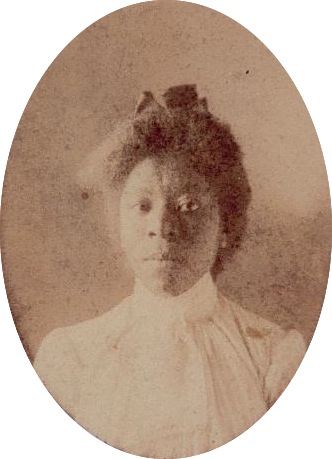
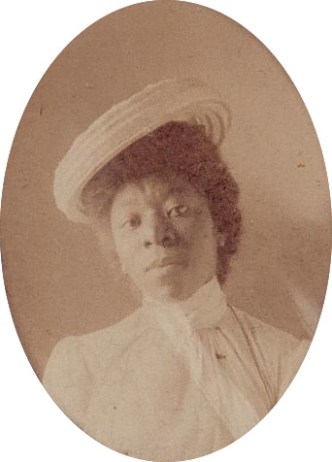
In the late 1980s, when I was in the early clutches of my genealogical addiction, I often made copies of old pictures by photographing them through a microfilter screwed onto my Canon AE1. I spent an afternoon at my great-aunt Julia Allen Maclin’s house, sifting through a box of faded sepia-toned prints and gasping with delight as she identified Holmeses and Allens. Two of the many I copied that day were small oval portraits of the same woman. In one, she faces the camera nearly head-on, her hair puffed into bouffant tied with a dark bow. In the second, she has donned a great fluffy disk of a hat and tilts her head to the right. Strong side-lighting revealed a tiny feature I recognized immediately – an epicanthic fold at the corner of her left eye. My grandfather (her nephew) had them, and my mother does, and I do, too, though mine are a mere suggestion of her prominent flaps. This was Julia Ellen Holmes, my great-grandmother’s sister and the woman for whom my great-aunt was named.

Image

Image

I don’t know a lot about Julia. Though just a child at the time, she is not listed in her parents’ household in the 1880 census of Charles City County, Virginia.  The first record of her that I’ve found is a deed of transfer filed 30 December 1899, at Charles City County Courthouse, from the estate of Jasper Holmes to Mary H. Allen and her husband John C. Allen and Martha H. Smith and her husband Jesse Smith, all of Newport News VA, and Julia E. Holmes, unmarried, of Charles City County, Jasper’s heirs at law.

Just months later, Julia (or a woman that appears to be her) is listed in the 1900 census of Manhattan, New York City, at 208 W. 72nd Street. There, Virginia-born Julia Holmes (born February 1880, which is not accurate if this is the right woman) lived in a boarding house that included three other servants, two waiters and a cook.  Headed by 39 year-old Mary A. Phillips, the tenants included blacks, whites, southerners, northerners, a Cuban and an Irishman.

(Or is this my Julia? In the 1900 census of Philadelphia, Philadelphia County, Pennsylvania: Julia Holmes, 17, Virginia-born servant, in the household of ice company treasurer Josiah A. McKee at 1838 Mount Vernon Avenue.)

The Holmes sisters sold off their father’s property over the next ten years, filing deeds of sale in 1905 and 1910. In the final transaction, on 10 Jan 1910, Mary Allen of Newport News and Julia Holmes of the City of New York, children and only heirs of Jasper Holmes (Martha Holmes Smith had died) filed a deed of transfer for property sold to James Clark for $300.

In the 1910 census of Manhattan, on Washington Square (North), Virginia-born Julia Holmes is listed as a servant in the household of Philo Hager, who worked in wholesale dry goods. By 1920, she had moved across the river to East Orange, which is where my great-aunt remembered her living. The censustaker found Julia Holmes at 1 Waters Avenue, listed as a servant in the household of B.C. Fenwick.  Her birthplace is given as New Jersey; her parents’ as Virginia; her age as 29. Only the middle statistic is correct.

I have not found Julia Holmes in either the 1930 or 1940 censuses and assumed that she died sometime before World War II. Certainly, my great-aunt never spoke of her as if she had lived a long time.

However.

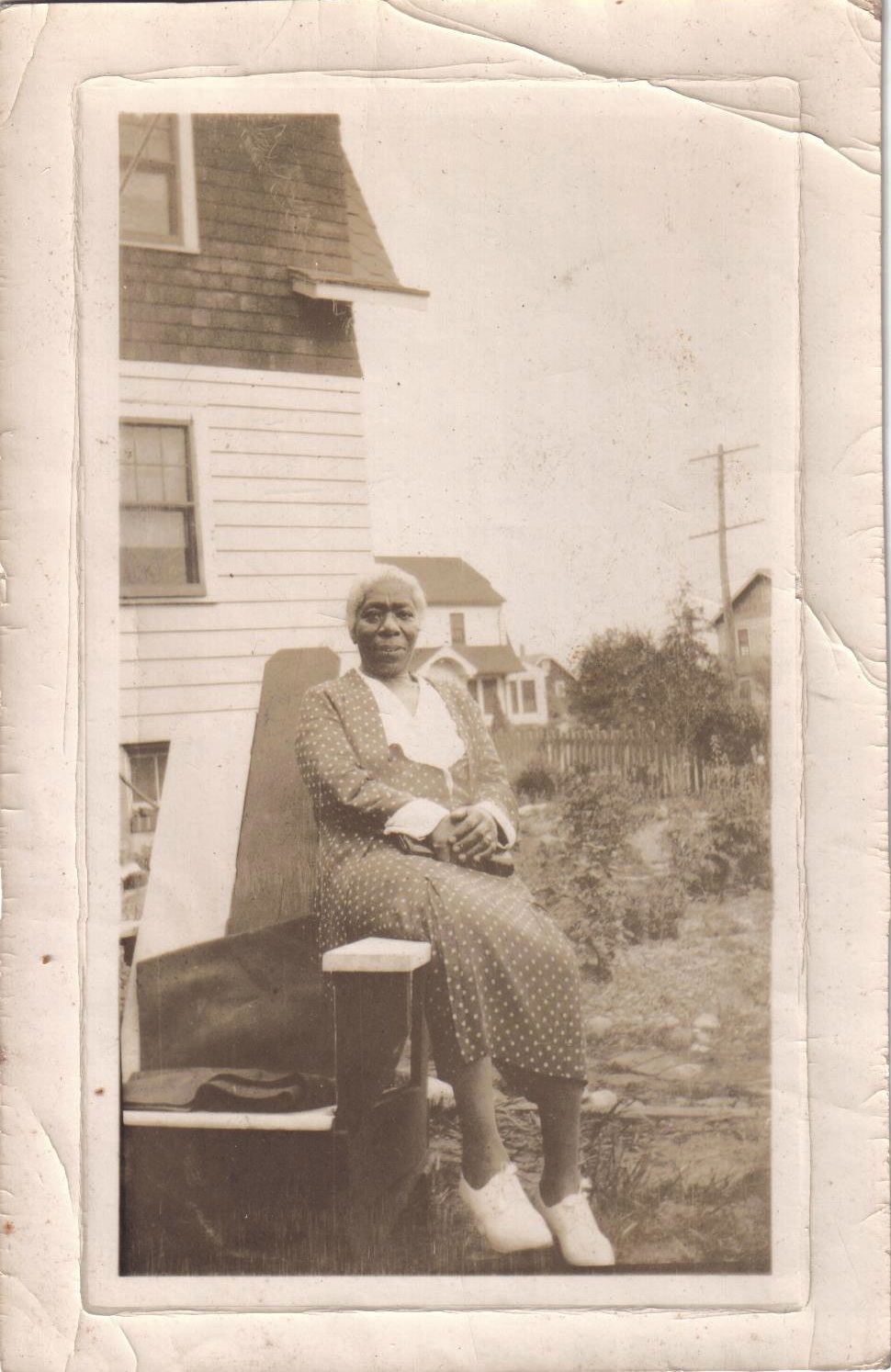
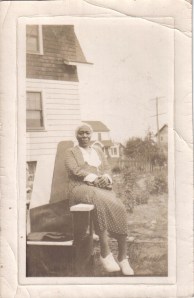
When I found my great-grandmother’s obituary in a March 1961 edition of the Daily Press, there, among the survivors, was “sister, Mrs. Julia Jackson of Orange NJ.” And then, when my cousin M., daughter of my great-aunt Nita Allen Wilkerson, sent me scans of a bunch of photos she found in an album that had belonged to Julia Allen Maclin, I found this:
Julia E Holmes?

I can’t see the flaps, but I’m certain: great-GREAT-aunt Julia.

(So, when, in fact, did she die? Where was she buried? Who was Mr. Jackson? Did she have children?)

Standard
Land, Maternal Kin, Oral History, Photographs, Virginia

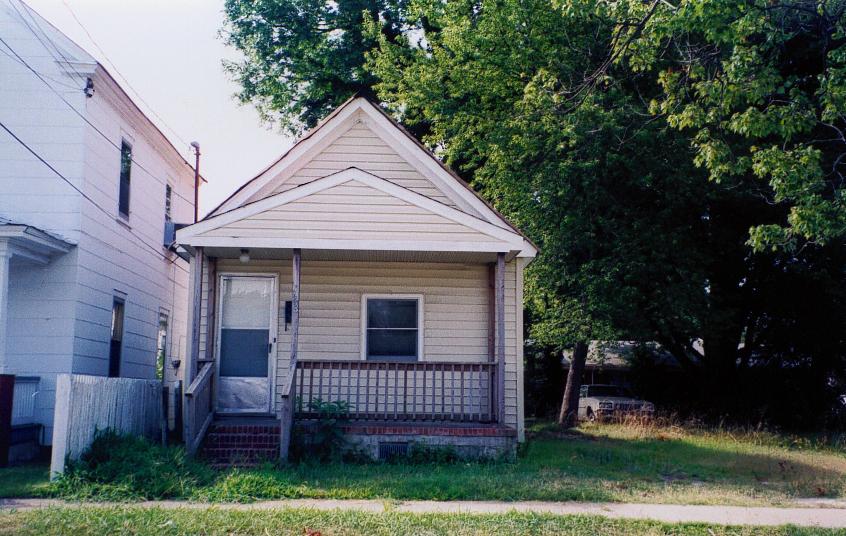
Where we lived: 748-21st Street.

My uncle: That’s where I was born and where John was born.

Me: At 748?

My uncle: That’s it.

My cousin: This crib right here?

My uncle: That’s where I was born

Me: [Laughing.] Wow.

Image

Tax records show that this tiny house — less than 800 square feet — was built around 1910. It now has two bedrooms and one bath, but the bath was undoubtedly a late addition. John C. Allen may have been the first to move a family into the dwelling; the Allens are shown there in the 1910 census of Newport News. John, who worked as a shipyard painter, reported that he owned the house subject to mortgage.

Image

By 1920, the Allens had moved just around the corner to 2107 Marshall Avenue, the house I knew in childhood as my great-aunt Julia‘s. John Allen kept 748 and rented it out until his middle son married. John C. Allen Jr. and his wife Margaret Colvert Allen lived there until their fourth child, my mother, was two weeks old.

My grandmother: I lived I don’t know how many years in Mr. Allen’s house without any electricity. And just as soon as I moved out –

Me: He had it wired?

My grandmother: He had it wired.  And one of the neighbors said she went out there in the street and laid him out.  Said, that child over there with those children, washing and ironing and working herself to death, and you wait until she leaves out of your house, your son’s house?  She said she laid him out.

——

Photograph by Lisa Y. Henderson, 2002; interviews of C. Allen and Margaret C. Allen by Lisa Y. Henderson, all rights reserved.

Standard
Births Deaths Marriages, Maternal Kin, Virginia

John C. Allen arrives.

JC Allen 1

John Christopher Allen made his way down-river to the newly established city of Newport News around 1899, a thick-set country boy with dark curly hair.  In April of that year, he had purchased ten acres in Turkey Trot from A.H. Drewry and wife, but he did not hang around to farm it. What pulled — or pushed — him out of Charles City County is not precisely clear, but he would never turn back.

va_hm_newport_news01

Newport News was a boomtown at the turn of the 20th century. The extension of the Chesapeake & Ohio Railroad down the peninsula, bringing coal from West Virginia for world-wide transport, was followed shortly by the development of the shipyard for which the city is still famous.

In June of 1900, the census taker found John Allen sharing a boarding house run by Henry Burrell with several single men.  The house was in the crowded East End, near the heart of industrial Newport News.  John was working as a shipyard laborer, and he was illiterate.  That year, on the day after Christmas, the 24 year-old son of Graham and Mary Allen, married 23 year-old Mary A. Holmes, daughter of Jasper and Matilda Holmes, at New Vine Baptist Church in Charles City County. They returned to Newport News to start their 50-plus years together.

Standard
Education, Maternal Kin, Religion, Virginia

Church home, no. 4: Zion Baptist, Newport News VA.

“The Zion Baptist Church was organized in the year 1896 under a cherry tree at its present location by a group of 13 baptized Christians who had migrated to Newport News from other areas of Virginia and the Carolinas and who had not affiliated with any local congregation.

In 1896, when the City of Newport News was in its infancy, a section of town now known as the East End was better known as “Blood Field” for its street violence. There were houses of prostitution, bars, dance halls, a saloon on every corner and gambling was a way of life.

It was after several meetings from house-to-house that the thirteen Christians concluded that there was a need for some type of religious worship in the immediate area and so 107 years later, Zion Baptist Church in the East End was set.

The first pastor called to lead the group was Rev. Moses Tynes and in 1897, the first tiny structure was built under his leadership. Most of the materials were donated by whites in the community and the labor was donated by men in the community.

In 1899, under the leadership of Rev. C. J. Crudup, the sanctuary was destroyed by fire. But despite this setback along with other difficulties, the congregation continued to grow. Rev. C. E. Jones was called to assume the responsibility of leadership in 1901 and for eleven years, Zion experienced tremendous growth, encouraging men and women to turn to Christ. Both Rev. and Mrs. Jones were actively involved in the work of the National Baptist Convention and the Lott Carey Foreign Mission Convention. In 1941, Rev. Jones’ pastorate ended as a result of a car accident after 39 years of leadership to the congregation. Rev. Joseph B. Reid became his successor and he served the church for fourteen years.”  Excerpt from “About Us,” http://www.zionbaptistonline.org/about.html

——

John C. Allen Sr. was illiterate when he arrived in Newport News about 1899.  Before long, he made his way to Zion Baptist where, under the tutelage of Rev. Charles E. Jones, he learned to read. John reared his children in the church, and his funeral service was held there in the first days of 1954.

He was a smart man, but he was not an educated man.  If he had had an education to go along with his wit, he would have been a bad boy.  I’m telling you, ‘cause he was just as smart as he could be. 

——

Interview of Margaret Colvert Allen by Lisa Y. Henderson, 8 August 1998; all rights reserved.

Standard
Births Deaths Marriages, Education, Maternal Kin, Oral History, Photographs, Virginia

Remembering Margaret Colvert Allen on her birthday.

Oh, yeah, I always liked that picture.  That was on Hampton’s administration steps.  That was a brand-new coat, child.  And it was real soft.  It was light – I don’t know what you would call it.  Light tan or something.  Anyway.  But it had a summer fur collar on it. … Who sent it to me?  Golar or Walker or some of those people sent it to me…

ImageMy grandmother would have been 105 today. When she passed away in February 2011, she was Hampton’s oldest living graduate. Her funeral service was held on a clear, cold day in the campus chapel, fitting in its reserved beauty.

—–

Interview of Margaret C. Allen by Lisa Y. Henderson, 4 November 2004; all rights reserved.

Standard
Paternal Kin, Religion, Virginia

Church home, no. 3: New Vine Baptist Church, Charles City VA

“The New Vine Baptist Church was organized in July 1870.  It all began when a few families living at Westover Plantation were holding prayer services from house to house.  Then Mr. Major Drewery,* who was the plantation owner, offered the families living there a piece of land on which to build a church. Several families, including some from Elam Baptist Church (Ruthville) and First Baptist Church (Bermuda Hundred), accepted Mr. Drewery’s offer.  They picked a spot about 600 feet from the Herring Creek, built a church and gave it the name New De Vine Baptist Church.  As the years passed, the name New De Vine was dropped and the church was given the name New Vine Baptist Church.”  — from “About Us,” www.newvinebaptist-charlescity.com/About

Image

I don’t know when the Allens first began worshiping at New Vine, but they may have been among its earliest members. Graham Allen was a preacher — was this his congregation? He is buried in an unmarked grave in the cemetery behind the church. John Allen Sr. married Mary Agnes Holmes at New Vine in 1900, and his brother-in-law Stephen Whirley was a deacon there for 47 years before his death in 1949.

[*Sidenote:  During the Civil War, at the Battle of Drewry’s Bluff in 1862, troops under the command of Augustus Harrison “A.H.” Drewry, stationed on his land high above the James River, held off the Union warships Monitor and Galena. After the war, Drewry moved across the river to Charles City County to Westover Plantation, built in the 1750s by William Byrd III.]

Standard