Births Deaths Marriages, Oral History, Paternal Kin, Photographs

Remembering Nina F. Hardy.

My parents married in 1961. When my mother arrived in Wilson shortly after, my father took her around to meet the elders who had not been able to travel to Virginia for the wedding. Along the way, they stopped at Dew’s Rest Home. As my mother stepped through the door, Aunt Nina threw up a cautionary hand: “Wait. You ain’t expecting, is you?” My mother, mortified: “No, ma’am!” “All right. ‘Cause it’s some uggggly folks in here!”

My paternal grandmother had a thousand stories about Nina — with a long I — Frances Faison Kornegay Hardy. Though she called her “aunt,” Nina in fact was her cousin. She was born March 15, 1882, probably in northern Duplin County, to John Henry Aldridge and Addie Faison. (John H. Aldridge, born 1844, was the son of John Mathew Aldridge, and first cousin of my grandmother’s grandfather, John W. Aldridge.)  She seems to have been married briefly to Joe Kornegay in 1899 in Wayne County, but I have not found her in the 1900 census. By 1910, she had made her way 40 or so miles north to Wilson and was boarding in the household of Jesse and Sarah Jacobs as “Nina Facin.” The census also shows a “Nina Facon” living and working as a servant in the household of Jeff Farrior in Wilson. Though described as white, this is almost surely Aunt Nina, who cooked and cleaned for the Farriors most of her working life. Though she and her husband lived just outside Wilson on what is now Highway 58, she was at home only on her days off.

Said my grandmother:

Aint Nina lived up over the Farrior house on Herring Avenue.  Herring’s Crossroads, whatever you call it.  And that’s where she come up there to live.  Well, the maid, as far as the help, or whoever, they stayed on the lot, where they’d have somewhere to sleep. So Aint Nina was living on Nash Road, way down there, and when we went to see her, me and Mamie would run down there five miles. She was working for Old Man Farrior then.  When she was living out in the country, she was working for white people, and so she went up to their house and cooked for them.  And when we’d go down to her house, she’d have to come from up there and cook when she get home.  So we would go and spend a day, but it would be more than likely be on her day off.  But when we had the horse and buggy, Mama drove out there once, and we went, I went with Papa with the wagon to where you grind corn to make meal, down to Silver Lake or whatever that place was down there.  Lord, them were the good old days.  

The Farriors, their back porch was closed in.  It had windows.  And had a marble floor in the back, and that stairway was on, where it was closed in on the back porch, you could go upstairs, and there was a room up there.  You couldn’t go from out of that room into the other part of the house.  You had to come back down them steps then go in the house.  And that’s where Aint Nina stayed.  I said, Lord, I wouldn’t want to have stayed up there.  And then something happen … She had to come down and go down the steps, go upstairs, I mean, and come out of the kitchen, and then go up them steps out on this porch in her room.  So she stayed up there.  Lord, I wouldn’t want to stay up there.  She get sick out there, she couldn’t get nobody.  I didn’t see no – I was up in there one time, and I went up there just to look around.  Well, she had a nice room, nice bed and chair and dresser and everything.  There was a whole set in the room where she was.  That was the only time I was up there. But I wouldn’t want to stay up there.

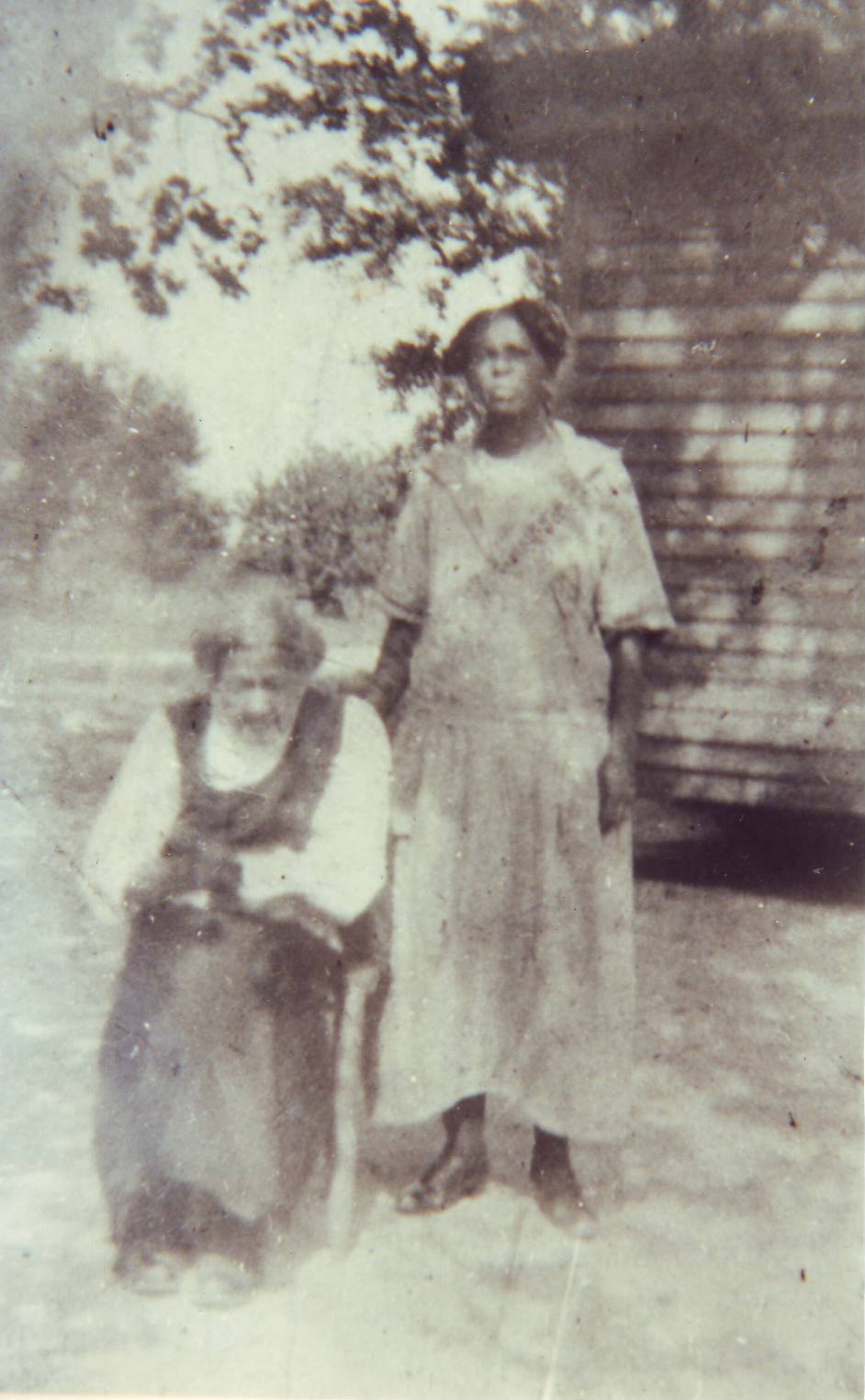
In 2004, J.M.B., a Farrior descendant, sent me copies of several photos of Aint Nina. My grandmother had described her (“She wasn’t real short.  But she was heavy built, and she had big limbs.  But she wasn’t that fat, but she just had big limbs and had a big face.”), and I had seen a couple of pictures of her before, like this one, taken in the mid-1950s with my uncle’s children:

Image

And this one,

IMG_0019

[There’s a photo booth shot that I can’t find right now. But I will.  UPDATE: I found it. 1/3/2016]

But these …
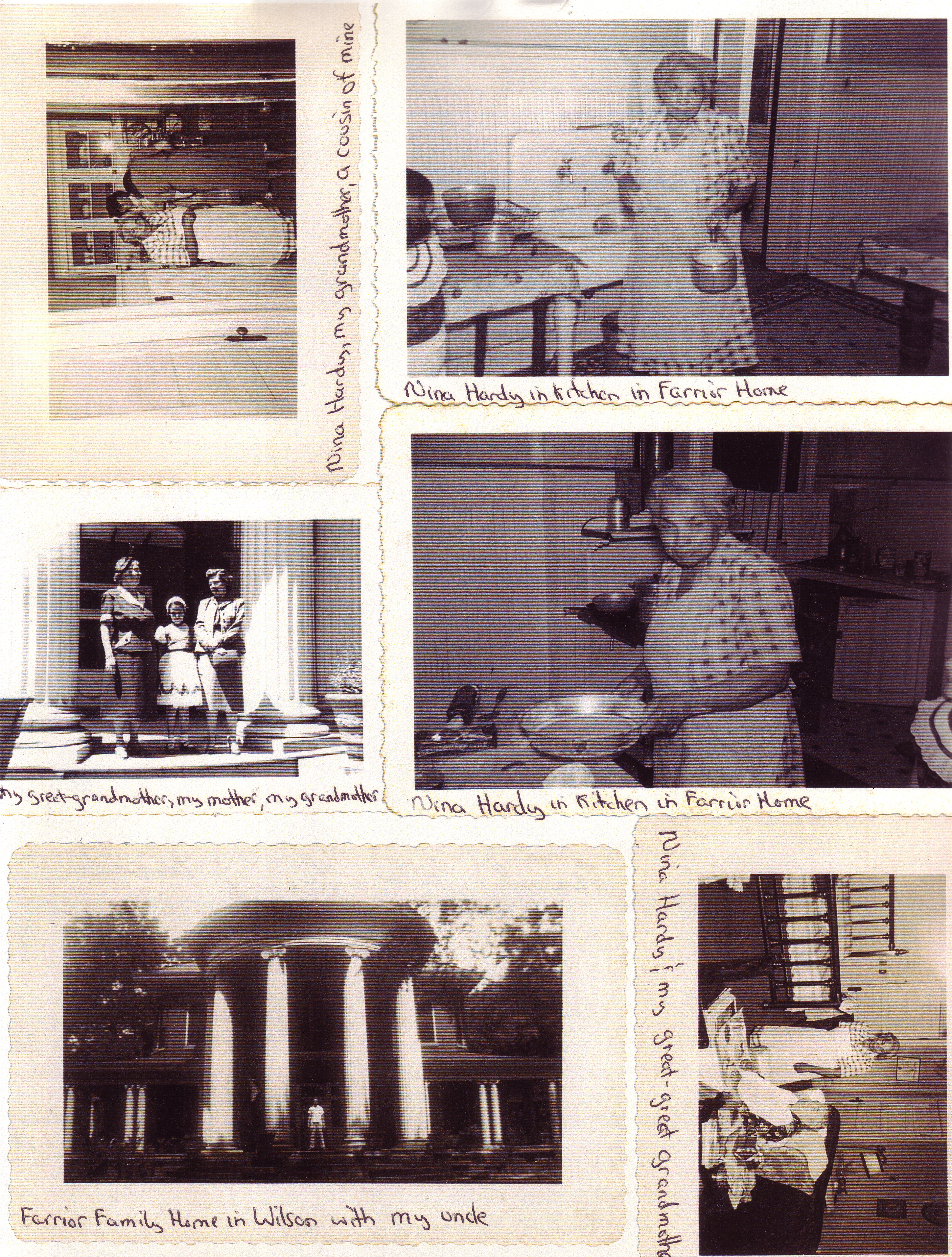
Scan10002

… these touch me. Nina at work. Nina in a kitchen with a floured pan, perhaps making biscuits, perhaps the dumplings my grandmother relished. Nina, her own legs aching, tending to whitefolks. The columned Farrior mansion, since torn down, with Nina’s little room tucked out of sight.

In 1917, Nina married Julius Hardy in Wilson township. It is likely their house that my grandmother and great-aunt visited out on Nash Road:

They had guinea chickens.  A car run over a chicken and killed it, and it kept going.  And we, me and Mamie, was going out there, and we picked up the chicken and carried it ‘round there.  And Aint Nina poured water and scald the chicken and picked it and cooked it, and we had the best time eating it.   Wont thinking ‘bout we was going out there to eat.  And so we come walking in there with that chicken, and she wanted to know, “Well, where’d you get that?”  “A car run over it, and we picked it up and brought it on over so you could cook it.”  And she said, “Yeah, it’s good.  A car just killed it?”  And it wasn’t too far from the house.  And I reckon it was one of her chickens anyhow.  Honey, she cooked that old stewed chicken, had to put pastry and vegetables in it.  Lord, we stayed out all that time, then had to come home from way out there.  But we was full. 

And her brother, his name was James Faison, lived across the street from her, and his wife, and I think the lady had been married before because they wasn’t his children.  It was two girls.  And he worked at the express, at the station.  The place was on that side, Nash Street station was over on this side.  Baggage used to come over there.  The baggage place where’d you take off the train.  That’s where you put it over on that side at that time.  And he was working over there.

Nina was a font of information about the family back in Dudley that my grandmother barely knew. Mama Sarah was impatient with questions about the past. Nina, on the other hand …

Mama never talked about her daughter Hattie.  But A’nt Nina, she would tell everything.  Mama got mad with her, said, “You always bringing up something.  You don’t know what you talking ’bout.”  So she’d go behind — Mama wouldn’t want her to tell things.  And she never did say, well, if she said, I wouldn’t have known him, but I never did ask her, who Hattie’s daddy was.  I figured he was white.  Because she looked — her hair and features, you know, white.

Even as she waited on others, Nina struggled with her health:

But she was kind of sickly, and I went up there for something.  See ‘bout her.  Carry her something.  And then when her leg was sore, and she come to stay with us.  Oh, she stayed with us a long time ‘cause she had to go to the doctor, had to be taken to the doctor with that leg.  That leg was still big.  But it was much bigger than the other one.  But it healed over.  But it was so knotty-looking, like it’d heal up and draw up in places, and it just looked so bad, and so she’d wear her dresses long.  But she had big feet!  Oooo, she had big feet.  With those big legs … And she was the one that Mama made Mamie iron her clothes on Sunday.  ‘Fore you even got to playing, had to get her clothes.  She was at Rocky Mount in the hospital with that leg.  They had operated on that leg and Mama would go every Sunday and take her clothes, bring her dirty clothes home and wash ‘em and bring them back to her.  So, Lord, we had a time with that.  And I looked at that big leg and just said, ‘Wooo….  What in the world is that?’  Looked like it just swelled up.  And I saw a lady right here in Philadelphia.  I had passed, and I seen her, and she had a great big leg.  And so by that woman having that big leg, I said, ‘Lord have mercy, I hope I don’t get that.  I wonder what’s wrong with it?  How come the swelling won’t go down in it?’  People don’t know what they’ll have to go through….  Yeah, ‘cause we went over there, and you didn’t have — it was an open sore, and it was always running.  She had to keep her foot up and had to keep the flies from on it, and so I said, well, finally it got better, but that leg healed up, it drawed up and you could tell where the sore was all on her leg.  And that leg was much bigger than the other one.  It took a long time to heal.  It was all healed up though before she died.

Image
In the photo above, taken in her last years at the rest home where she protected my young mother from a disastrous maternal impression, Nina smiles her same sweet smile despite ailing legs wrapped and swollen feet encased in split loafers.
N Hardy Death Cert
Aint Nina died 20 March 1969, just five days after her 86th birthday. Frances Sykes Goodman, granddaughter of Nina’s aunt Frances Aldridge Wynn, was the informant on her death certificate. She was buried in Rest Haven, Wilson’s black cemetery. (I’ve walked that graveyard and never seen her stone. Is her grave unmarked? If it is, and I can find it, it won’t be.)
Standard
Newspaper Articles, North Carolina, Paternal Kin

Cousin Mamie in the news.

As I’ve mentioned, for reasons unclear, my grandmother was close to her father’s first cousins, sisters Fannie Aldridge Randolph of Philadelphia, Pennsylvania, and Mamie Aldridge Abrams Rochelle of Union, South Carolina. Among my grandmother’s papers, I found cards and notes from Cousin Mamie, including this one sent in early 1980:

ALDRIDGE -- M Rochelle to H Ricks re Article

And here’s the article itself:

ALDRIDGE -- M Rochelle Article

Standard
Free People of Color, Newspaper Articles, North Carolina, Paternal Kin, Politics

Alderman and poll holder.

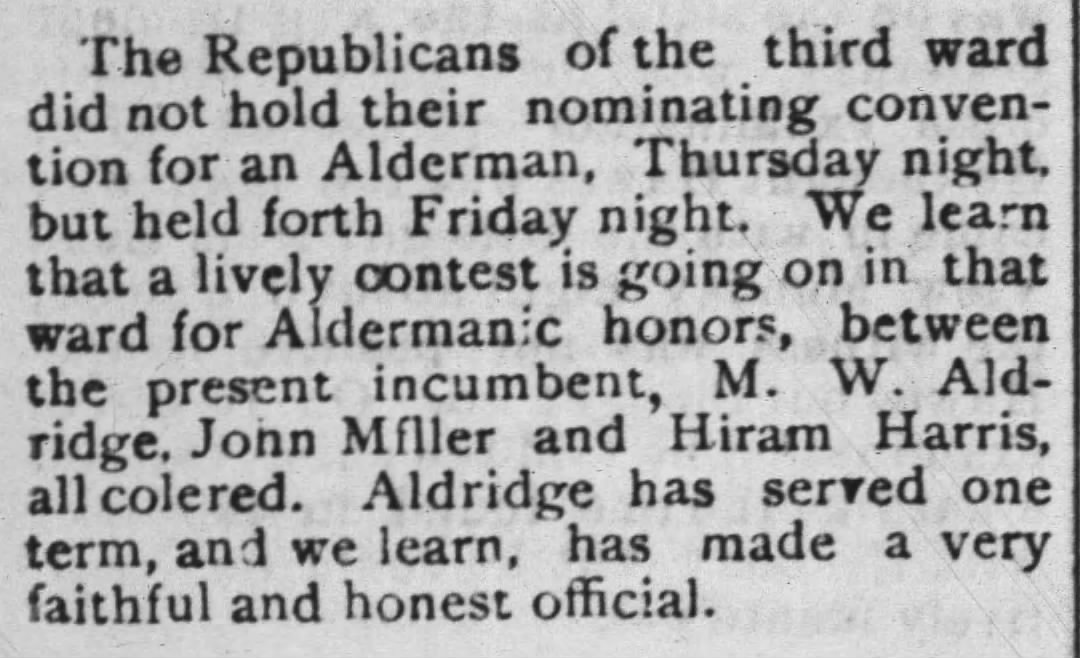
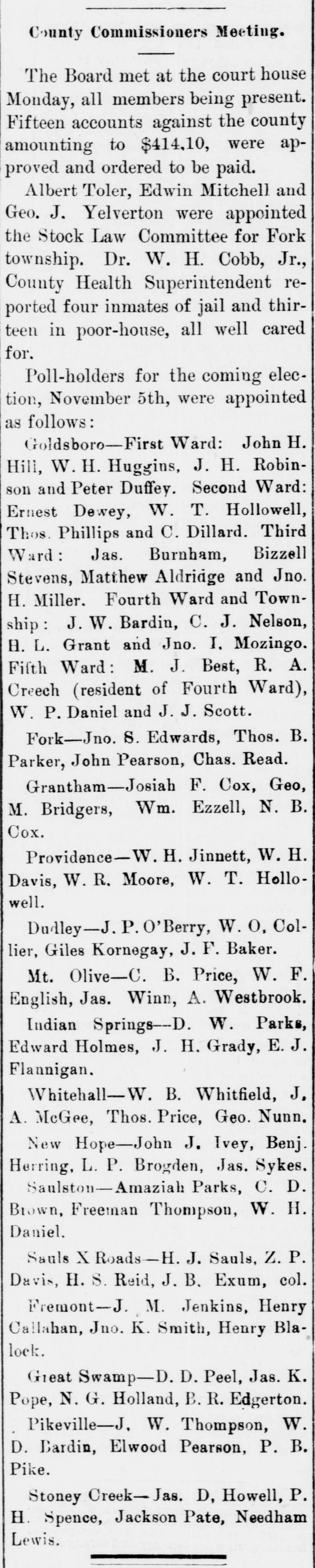
Despite the collapse of Reconstruction, African-Americans continued to participate in Wayne County’s political life through the end of the 19th century. Mathew W. Aldridge, in particular, was active in local governance, as announced in eastern North Carolina newspapers:

Wilm Msgr 4 27 1889

Wilmington Messenger, 27 April 1889.

Image

Goldsboro Headlight, 1 May 1889.

Image

Goldsboro Headlight, 8 May 1889.

Wilm Msgr 5 8 1889

Wilmington Messenger, 8 May 1889.

Image

Goldsboro Headlight, 8 October 1890.

Other notables: C[larence] Dillard (Presbyterian minister who arrived in Goldsboro in 1884, later principal of “colored school”); Bizzell Stevens (also a minister; like William S. Hagans, married into the Burnett family, a prominent free family of color in the antebellum era; later a postal clerk at Goldsboro post office); John Frank “J.F.” Baker (postmaster at the Dudley post office; married Mary Ann Aldridge, daughter of J. Matthew Aldridge; murdered); James Winn; and Henry S. “H.S.” Reid (son of Washington and Penninah Reid; member of large prominent free family of color.)

Standard
DNA, Free People of Color, North Carolina, Paternal Kin

DNA definites, no. 11: Artis & Aldridge.

  • I am descended from John W. Aldridge and his wife, Louvicey Artis Aldridge, via son J. Thomas Aldridge. Louvicey Artis’ parents were Adam Artis and Frances Seaberry Artis.
  • K.H. is also descended from John W. Aldridge and Louvicey Artis Aldridge, via daughter Nora Aldridge Henderson. At 23andme, K.H. and I show a 4.4% match, estimated as second cousins. In fact, we are first cousins, twice removed. (Calculated on the Aldridge side. We are also Henderson cousins, but much more distantly.)
  • W.H. is also descended from John W. Aldridge and Louvicey Artis Aldridge, via daughter Nora Aldridge Henderson. Ancestry estimates that we are 3rd-4th cousins; 23andme estimates 2nd cousins (2.51% match). In fact, we are second cousins, once removed. (We are also distant Henderson cousins.)
  • E.H. is also descended from John W. Aldridge and Louvicey Artis Aldridge, via daughter Nora Aldridge Henderson. At 23andme, E.H. and I show a 1.75% match, estimated as 2nd-3rd cousins. In fact, we are second cousins, once removed. (Ditto re the Henderson relationship.)
  • S.D. is also descended from John W. Aldridge and Louvicey Artis Aldridge, via daughter Nora Aldridge Henderson. Ancestry estimates that S.D. and I are 4th-6th cousins. In fact, we are third cousins. (Ditto re the Henderson relationship.)
  • G.J. is also descended from John W. Aldridge and Louvicey Artis Aldridge, via daughter Correna Aldridge Newsome. Ancestry.com estimates that we are 4th-6th cousins. (Ancestry does not provide percentage shared.)  In fact, we are 3rd cousins, once removed.
  • B.L. is descended from Josephine Artis Sherrod, daughter of Adam Artis and Amanda Aldridge Artis. Amanda Aldridge was a sister of John W. Aldridge. B.L. and I are estimated at 2nd-3rd cousins and share 1.28% on 23andme. In fact, we are 3rd cousins, once removed, on the Aldridge side, and 2nd cousins, twice removed, on the Artis.
  • A.S. is also descended from Josephine Artis Sherrod. Ancestry estimates our relationship as 4th-6th cousins. In fact, we are 3rd cousins, once removed on the Artis side, and 4th cousins on the Aldridge side.
  • H.B. is descended from Henry J.B. Artis, son of Adam Artis and Amanda Aldridge Artis. Amanda was the sister of John W. Aldridge. Ancestry.com estimates our relationship as 4th-6th cousins. In fact, we are 2nd cousins, twice removed.
  • B.J. is descended from Mattie Brewington Braswell, daughter of Joshua Brewington and Amelia Aldridge Brewington. Amelia was a sister of John W. and Amanda Aldridge. B.J. and I estimated at 3rd-5th cousins and share .37%. In fact, we are 4th cousins. B.J. also matches G.J. at Ancestry, but not S.D.
  • R.M. is descended from Mathew W. Aldridge, who was John W. Aldridge’s brother. 23andme estimated that R.M. and I are 3rd to distant cousins and share .21%. In fact, we are 4th cousins. R.M. matches all the other Aldridge-Balkcum descendants on 23andme. She also matches D.D. at .46, 3rd-5th cousins.  This is particularly interesting because the father of D.D.’s great-grandmother was said to be Jesse F. Baker, son of John Frank Baker and Mary Ann Aldridge. Mary Ann Aldridge was the daughter of John Mathew Aldridge, who I believe to have been the brother of Robert Aldridge. Assuming this to be the connection between R.M. and D.D. are, in fact, 5th cousins. (Also: D.D.’s great-grandmother and my grandmother were daughters of Bessie Lee Henderson, so she matches me, my father, sister and 1st cousin on 23andme, as well as K.H.)
  • H.A. is descended from Mary Jane Artis Artis, daughter of Adam and Lucinda Jones Artis. At 23andme, H.A. and I show a .15% match, estimated at 3rd to distant cousins. We are, in fact, 4th cousins. H.A. also matches K.H. and B.L.
Standard
Births Deaths Marriages, Free People of Color, Land, North Carolina, Other Documents, Paternal Kin, Photographs

A lot in Negro Town.

This convoluted case involves a dispute between two parties claiming title to a lot that once belonged to Needham Kennedy, Mathew W. Aldridge’s father-in-law. The ins and outs of the lawsuit are difficult to extract from the decision and, in any case, are not the most interesting aspects of the matter for me. Rather, my focus is on the evidence of relationships among Kennedy’s children (and their spouses) and the light shed on the affairs of a family that had quickly accumulated property post-slavery.

There is astoundingly little in conventional records about Needham Kennedy. I assume he was native to Wayne County, perhaps the former slave of one of several Kennedy families in the area. However, to my confusion and dismay, I have found neither him nor his family in any census records prior to 1900. Where were these landowners???

All the more important, then, is the personal information that can be gleaned from the North Carolina Supreme Court’s decision in Bradford v. Bank of Warsaw, 182 N.C. 225 (1921). The main opinion in the case gives some information, but the fullest, clearest details are set forth in a dissenting opinion. A distillation of it all:

Needham Kennedy bought a lot measuring 42 feet by 210 feet in “’Negro Town,’ a suburb of Goldsboro,” on 12 January 1870 and registered his deed six years later.  He also owned other property. Needham died intestate about 1898, leaving five children – Fannie Kennedy Aldridge, Ida Kennedy Darden, Bryant Kennedy, William Kennedy, and Levi Kennedy  – and a wife, the children’s stepmother, who died in 1908. (Their birth mother was named Patience, maiden name possibly Kennedy.)  After the stepmother’s death, the children arranged to divide the property so that William and Bryant, who lived in New Jersey, would receive cash and their sisters and Levi would divide the land. Ida was to get the contested lot (A); Fannie, lot B; and Levi, lot C.

In 1909 and 1910, William, Bryant and Levi conveyed their interest in A to Ida. The deeds from William and Bryant were not recorded until 1921, and Levi’s was lost and never recorded. On 21 March 1910, at lawyer A.C. Davis’ office, Fannie Aldridge and husband Mathew conveyed her interest in A to Ida and her interest in C to Levi.  Levi and wife and Ida Darden and her husband John conveyed their interest in B to Mathew Aldridge. These deeds were immediately probated, and Fannie, Ida and Levi took possession of their respective lots.  (Levi later sold his.)

To secure a sum of money that Ida owed Mathew, Ida gave him a mortgage on A dated 22 March 1910, which was recorded that day. Ida had received rents from A since her stepmother’s death and continued to do so until 20 May 1912. On that day, Mathew Aldridge sold the mortgaged property to Captain A.J. Brown, who recorded the deed on 11 June 1912.

Captain Brown, and later his heirs, received rents from A from the date of purchase until 27 March 1915. On that day, the heirs sold the lot to defendant Bank of Warsaw, which recorded its deed on 1 May 1916. The bank then began to receive rents.

In the meantime, on 14 July 1916, William, Bryant and Levi Kennedy conveyed their undivided 3/5 interest in lot A to J.J. Ham. The deeds were registered 24 August 1916. On 17 October 1917, Ham conveyed his interest in the lot to N.E. Bradford, who registered the deed 24 October 1917. Thus, both Bradford and the Bank claimed interests in the title to A on the basis of deeds executed by various heirs of Needham Kennedy.

My year of property law class is far behind me, and I won’t attempt to untangle the dense reasoning set forth in the majority opinion in this matter.  Suffice it to say, the Bank of Warsaw lost its appeal.

——

Fannie’s husband Mathew W. Aldridge, brother of my great-great-grandfather John, died in 1920. Seven months later, Fannie married W.D. Farmer.  (What’s the story there?) I have not found her death certificate.

Image

Eliza Balkcum Aldridge and her daughter-in-law, Fannie Kennedy Aldridge, circa 1920.

Levi Kennedy died 6 February 1940 in Goldsboro. His death certificate notes that he lived at 310 W. Pine Street, that he was a clothing merchant, and that he was married to Anna Kennedy.  He was born in 1875 in Goldsboro, and his parents were listed as Needham and Patience Kennedy. He is buried in Elmwood cemetery.

Ida Kennedy Darden Lamb died 18 December 1954 in Goldsboro. She was a widow and resided at 305 West Elm Street. She was born 18 March 1874 to “Needman” and Patience Kennedy.

I’ve been unable to trace William and Bryant Kennedy in New Jersey.

Standard
Free People of Color, Land, Newspaper Articles, North Carolina, Paternal Kin, Rights

A win for Uncle Mathew.

Image

Goldsboro Headlight, 5 March 1890.

I don’t know why Matthew W. Aldridge sued Calvin Foy, but I’ll try to find out next time I’m in Raleigh. “Little Washington” was a black neighborhood south of Pine Street and west of Virginia Street, just outside Goldsboro city limits. The community was largely lost to urban renewal projects.

Standard
Births Deaths Marriages, Migration, North Carolina, Paternal Kin, Photographs

Funeral Program Friday: Fannie Aldridge Randolph.

FP Fannie Randolph Phila PA 1_Page_1

FP Fannie Randolph Phila PA 1_Page_2

For reasons that aren’t clear to me, the Aldridges that my grandmother was closest to in her adult life were two of her father’s first cousins, daughters of  Matthew W. Aldridge, Fannie Aldridge Randolph and Mamie Aldridge Abrams Rochelle. They grew up in Goldsboro, not Dudley, and both migrated North before 1930, so I am guessing that she met them after she moved to Philadelphia in 1958.

I wish I’d probed these relationships more. Mother Dear and Cousin Fannie lived a short bus ride apart in West Philadelphia and saw each often enough that I recall visiting her house on Filbert Street and seeing her at my grandmother’s on Wyalusing during our short summer stays. I never met Cousin Mamie, but know that my grandmother visited her in Union, South Carolina, and took at least one sightseeing trip (“excursion,” as she called them) with her.

Fannie B. Aldridge left Goldsboro for Philadelphia shortly after the 1910 census was recorded. In 1913, she married Virginia-born Elisha Randolph (1875-1940) and, by 1917, when he registered for the draft, had settled into the rowhouse in the 5800 block of Filbert Street in which she would remain the rest of her life.

Here is a bad partial copy of a photograph of Matthew Aldridge’s daughters. Fannie is at right, standing behind one of her nieces.  The boy in the middle, I believe, was Elijah Randolph, her only child. Her sisters Daisy Aldridge Williams and Mamie are left and center.

Daisy Mamie Fannie Aldridge & children

And here’s Cousin Fannie as I vaguely remember her. This Polaroid dates from about 1973 and was taken in my grandmother’s kitchen. (That’s Mother Dear at right.)

Fannie Aldridge Randolph & Hattie Ricks

Standard
Births Deaths Marriages, Free People of Color, Migration, North Carolina, Other Documents, Paternal Kin, Photographs

The Randalls of Washington DC.

fannie-a-randall  George Randall

On 18 Dec 1890, Fannie Aldridge married Robert Locust in the presence of her sister Lizzie Aldridge, brother M.W. Aldridge, and Robert’s neighbor George W. Reid. Robert’s first wife, Emma Artis, had died the previous year, and it is likely that he met Fannie, who lived at the other end of Wayne County, through her family. Fannie’s sister Amanda was married to Emma’s father Adam T. Artis, and her brother John was married to Emma’s sister Louvicey Artis.

Fannie and Robert’s first two children, William Hardy and Fred Robert, were born in Wayne County. Circa 1895, the family left North Carolina for Washington DC after– it is said —  Robert and a couple of Fannie’s relatives were involved in the murder of a white man. By time Robert, Fannie, his older daughters, and their boys arrived in DC, they were no longer Locusts. Robert, in fact, assumed a whole new name, and was George R. Randall ever after. According to their grandson, in order to collect Fannie’s inheritance when her father’s estate settled in 1902, the couple had to cross over into Alexandria, Virginia, where they were not known and could safely sign documents as Robert and Fannie Locust.

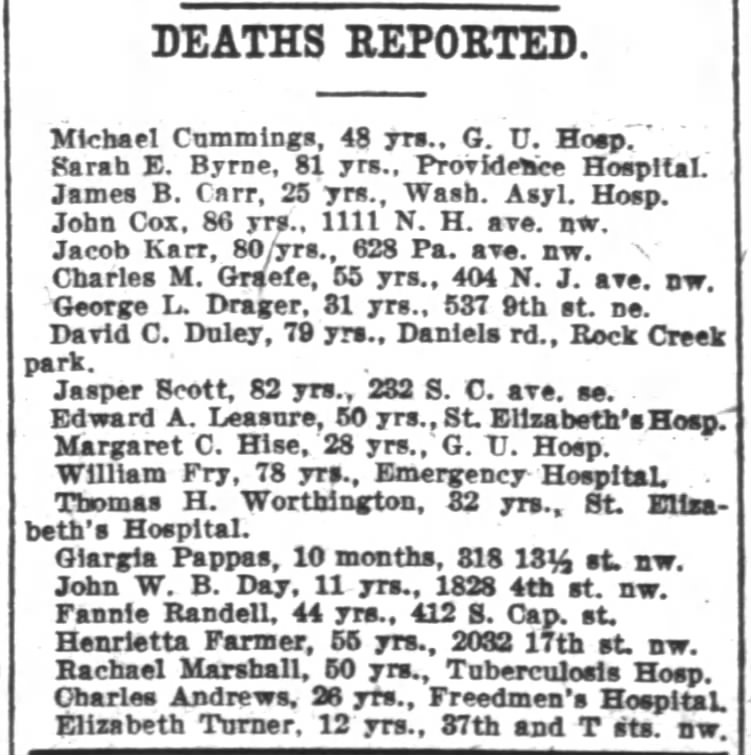
The 1900 and 1910 censuses recorded the family at 1238 Madison, then 138 B Street (no quadrant designated.) On 20 March 1917, Fannie “Randell” of 412 South Capitol Street was dead of heart disease. She was 44.

Wash Post 3 24 1917Washington Post, 24 March 1917.

In their 20 years in DC, she and Robert/George had been able to usher their children along the path to the middle class. Hardy Randall (1891-1967) went to work for the United States Postal Service. Fred R. Randall (1894-1996), a high school football standout, was a parks director. We met decorated officer Oscar Randall (1896-1985) here. Fannie Randall Dorsey (1900-1994) taught school, as did her sister Arnetta Randall (1904-1993). Edna Randall Breedlove (1909-1990) did not work after her marriage to Jesse Breedlove. George Randall died in infancy, as did two unnamed brothers.

Standard
Births Deaths Marriages, Land, Migration, Paternal Kin, Photographs

Where we lived: gentrified DC.

When she died in 1993 in Washington DC, the estate of Arnetta L. Randall, seventh of George and Fannie Aldridge Randall‘s nine children, included her home at 1377 Florida Avenue NE.

As has much of DC, Cousin Arnetta’s section of Near Northeast has undergone considerable change in the last decade. Her estate sold the house on 18 January 2001 for $12,000. Fourteen months later, it went for $135,000. Three and a half years later, the property again changed hands, this time for $191,000. Its owner held on during the real estate collapse of 2008, then sallied forth into a resurgent market in 2011. On January 25 of that year, he sold for $315,000.  The climb continued: two years later, in February 2013, the house sold for $485,000.

There is surely no part of this Arnetta Randall would have recognized. Neither the astounding amounts that have changed hands over her small two-bedroom rowhouse nor the house itself, renovated in its every nook and cranny and painted a bright yellow on its way to a half-million dollars.

Standard