Births Deaths Marriages, North Carolina, Other Documents, Paternal Kin

North Carolina death certificates: ALDRIDGE, part 1.

North Carolina did not require death certificates until 1914. The following abstracts relate to the first three generations of Aldridges whose deaths were recorded by law.

Wife of Robert Aldridge (1819-1899):

Eliza Aldridge.  Died 29 Jan 1824, Brogden, Wayne County, of influenza. Colored. Widow of Robert Aldridge.  Born 29 February 1829, Duplin County, to unknown father and “Nancy ?” Buried near Dudley.  Informant, Joseph Aldridge.

Children of George W. Aldridge (1851-??), son of Robert and Eliza Balkcum Aldridge:

Prince Albert Aldridge.  Died 15 May 1953, Wilson, of terminal uremia. Negro. Married. Plasterer. Born 11 January 1902, Wayne County, to George Aldridge and Dora Green. Buried family cemetery, Wilson County. Informant, Mrs. Annie Aldridge.

Blanchard Aldridge.  Died 4 February 1965, Fremont, Wayne County, of organic brain syndrome. Negro. Never married. Barber.  World War I veteran. Born 1 July 1897 in NC to George Aldridge and Dora Green. Buried Fremont. Informant, Reka Morrisey.

Wife and children of John W. Aldridge (1853-1910), son of Robert and Eliza Balkcum Aldridge:

Vicy Aldrich.  Died 13 Feb 1927 at 8:30 a.m.  Doctor noted “Only saw her one time, the day before she died.  Probably apoplexy.”  Colored.  Born 30 Sep 1862 in Eureka, Wayne County, to Adam T. Artis and Frances Hagans of Wayne County NC.  Widow of John Aldrich.  Buried 14 Feb 1927, Aldrich cemetery, Dudley NC.  Undertaker: Artis & Freeman, Wilson NC.   Informant,  John J. Aldridge.

Amanda Newsome.  Died 6 November 1918, Great Swamp, Wayne County, of influenza and pneumonia “contributing pregnancy & childbirth.” Colored. Married. Born 23 December 1891, Wayne County, to John Aldridge and Vicy Aldridge. Buried Dudley. Informant, Lonnie Newsome.

Lulu Aldridge.  Died 16 November 1919, Brogden, of “exhaustion from mania.” Colored. Single. Born 1884. Worked “on farm of her father.” Born Brogden township to J.W. Aldridge and Vici Artis. Buried Dudley. Informant, J.J. Aldridge.

John Aldridge.  Died 13 April 1964, Goldsboro, of acute myocardial infarction. Indian. Widower of Ora Aldridge. Retired farmer. Born 14 December 1887, Wayne County, to J.W. Aldridge and Vicy Artis. Buried Congregational cemetery. Informant, Cecelia Saunders.

Ora Bell Adridge. Died 26 April 1961, Goldsboro, of cerebral thrombosis “secondary to removal of infected gallbladder.” Colored. Married to John Aldridge. Born 22 February 1895, Wayne County, to James L. Mozingo and Bettie Johnson. Buried, church cemetery. Informant, John Aldridge.

Francis Newsome.  Died 14 March 1961, Dudley, of cerebral hemorrhage. Negro. Widow of Lonnie Newsome. Born 14 May 1887, Wayne County, to John Aldridge and Luvicey Artis. Buried New Aldridge cemetery near Gold Park Lake. Informant, Mrs. Lenora Henderson.

Lenora Christine Henderson. Died 29 November 1961, Goldsboro, of cerebral embolism. Resided Dudley. Negro. Widow of Henry L. Henderson. Born 22 August 1903, Wayne County, to John William Aldridge and Luevicey Artis. Buried Congregational cemetery. Informant, H.B. Henderson.

Matthew Aldridge (1857-1920), son of Robert and Eliza Balkcum Aldridge, and children:

Mathew Aldridge.  Died 6 May 1920, Goldsboro, of cerebral apoplexy. Colored. Married to Fanny Aldridge. Age 64 years, 2 months, 28 days. Merchant “for his own benefit.” Born Goldsboro NC to Robert Aldridge and Liazzy Borkins, both of Wayne County. Buried Elmwood cemetery. Informant, Levi Kennedy.

Daisy Williams Couch.  Died 2 Jan 1954, at home at 63 Madison Avenue, Asheville NC, of coronary thrombosis due to myocardial infarct (chronic nephritis contributing).  Negro. Married to J.C. Couch.  Born 28 Sep 1890, Goldsboro NC, to Matthew Aldridge and Fannie Kennedy.  Buried Goldsboro NC.

Children of Amanda Aldridge Artis (1860-1899), daughter of Robert and Eliza Balkcum Aldridge:

Annie Deliah Sauls. Died 1 October 1957, Stantonsburg, Wayne County, of “evidently a heart attack – had been having trouble for past twelve months with angina – she worked all day slipped off of chair and was dead when I got there.” Negro. Married to William Sauls. Born 19 July 1897, Wayne County, to Adam T. Artis Sr. and Mandy Aldridge. Buried Forte cemetery, Wayne County. Informant, Adam T. Artis.

Columbus Estelle Artis. Died 18 March 1973, Wilson, of generalized arteriosclerosis. Negro. Married to Ruby Barber. Retired undertaker. Resided 611 E. Green Street. Birn 28 August 1886 to Adam T. Artis and Manda Aldridge. Buried Rest Haven cemetery, Wilson. Informant, Mrs. Ruby B. Artis.

Lillie B. Pridgen.  Died 27 May 1935, Jason, Greene County NC, “acute dilatation of heart” secondary to “old heart disease, mittral stenosis, pregnancy, acute nephritis.”  Spouse of Chester Pridgen.  Residence, R#1, Lagrange NC.  “Housework in own home.”  Born 10 Feb 1894, Wayne County NC to Adam Artis and Amanda Aldridge.  Informant, Chester Pridgen.  Buried Greene County 29 May 1935.

June Scott Artis. Died 2 June 1973, Stantonsburg, Wilson County, of chronic myocarditis. Farmer. Black. Married to Ethel Becton. Born 23 November 1895 to Adam Artis and Mandy Aldridge. Buried Artis cemetery, Wayne County. Informant, Mrs. Ethel B. Artis.

Robert Aldridge Jr. (1866-1940), son of Robert and Eliza Balkcum Aldridge, his wife and children:

Robert Aldridge.  Died 29 August 1940, Dudley, Wayne County, or “uremia chronic nephritis.” Colored. Widower of Polly Aldridge. Age 70. Farmer on his land. Born Wayne County to Robert Aldridge of Sampson County and Eliza Baucam of Wayne County. Buried Brogden township. Informant, Paul Aldridge.

Polly Aldridge. Died 12 March 1928. Brogden, Wayne County, of arterial hypertension and valvular heart disease. Colored. Married to Robert Aldridge. Age 58. Born Wayne County to Neddham Grantham and Lucy Grantham, both of Wayne County. Buried Augustus Chapel. Informant, Robert Aldridge.

Paul Aldridge. Died 8 June 1947, Brogden, Wayne County, of pulmonary congestion and tuberculosis. Colored. Married to Eliza Aldridge. Farmer. Born 16 May 1913, Wayne County, to Robert Aldridge and Pollie Aldridge, both of Wayne County. Buried Aldridge cemetery, Wayne County. Informant, Mrs. Eliza Aldridge.

Lula Aldridge Smith.  Died 8 Apr 1966, cerebral vascular accident, NC Memorial Hospital, Chapel Hill, Orange County NC.  Resided 205 Caldwell Street, Chapel Hill NC.  Born 20 Feb 1895, Wayne County NC to Robert Aldridge and Polly Grantham.  Married to James Smith.  Buried 11 Apr 1866, Chapel Hill Memorial Cemetery.

Joseph Aldridge (1869-1934), son of Robert and Eliza Balkcum Aldridge, and children:

Joseph Aldridge.  Died 6 September 1934, Goldsboro, of cardiovascular renal disease. Resided 208 Bright Street, Goldsboro. Colored. Married to Martha Aldridge. Farmer. Age 64. Born Wayne County to Robert Aldridge of Wayne County and Eliza Barkins of Sampson County. Buried Brogden township. Informant, Allen Aldridge.

Allen Aldridge.  Died 21 November 1969, Goldsboro, of cerebrovascular thrombosis. Negro. Married to Ida Bell Evans. Resided 509 Bunche Drive. Chef. Born 2 September 1908 to Joseph Aldridge and Luberta Manley. Buried Aldridge cemetery. Informant, Mrs. Ida Bell Aldridge.


Standard
Births Deaths Marriages, Free People of Color, North Carolina, Other Documents, Paternal Kin

Chears and bee gums.

Per the “Account of the Sale of the property of Matthew Aldridg Deceased sold by Joseph Hollowell Adm. on a credit of six months, Nov 20th 1868,” his widow, Catherine Boseman (or Simmons) Aldridge, purchased five “chears”, cart wheels and an axle, two tables (one small), two beds and furniture, “one cubbard & contents,” a clock, a gun, “3 Bee Gumes & work bench,” a tub dipper, kitchen furniture, a blind mare and two beehives. Green Simmons, George Simmons and David Winn purchased tools, and “Robbert Aldridg,” who likely was Matthew Aldridge’s brother, bought the fourth and fifth beehive choices.  A note on William Carter for a $27.50 debt, due 1 January 1869, was described as doubtful.  The Application for Letters of Administration in the file notes that Aldridge’s heirs were John Henry AldridgeWm. AldridgeFrances Aldridge, Della AldridgeMary Ann AldridgeJoanna Aldridge, and James Thomas Aldridge.

William Aldridge was one of the founders of the First Congregational Church of Dudley, and Frances Aldridge Wynn and Mary Ann Aldridge Baker’s descendants were prominent members of the church for several generations. John H. Aldridge had a daughter, Nina Frances Faison Hardy, who played an important role in my grandmother’s young life. More about Aunt Nina later.

Standard
Births Deaths Marriages, North Carolina, Oral History, Paternal Kin

Her story.

Bessie Henderson has died, and her children remain.

Mamie Lee was the first child, and my grandmother was the second. And the second Hattie Mae.  The first was Sarah Henderson Jacobs’ daughter.

That’s who they named me after.  I asked them why they named me Hattie after a dead person.  “What?  You don’t like Hattie?  Well, I just thought ’twas nice.”  And after I looked at her picture, I said, “Well, she was pretty.”  Since Jack knew her, and he wanted her picture, when I come up to Philadelphia, I give him the picture.  ‘Cause they grew up together.  And his children thought she was white, wanted to know what old white girl was that.  Mama never talked about her.  But A’nt Nina, she would tell everything.  Mama got mad with her, said, “You always bringing up something.  You don’t know what you talking ’bout.”  And she never did say – well, if she said, I wouldn’t have known him, but I never did ask her – who Hattie’s daddy was.  I figured he was white.  Because she looked — her hair and features, you know, white.

Jack Henderson told my grandmother that he remembered “when she was got,” that he was nearby when it was happening, that Tom had Bessie over a barrel, literally.  Bookish and soft, James Thomas Aldridge tended his mother and younger sisters and his ailing father’s dry goods store while dreaming of a bigger and better world faraway.  He would have been a nerd if they’d had them then.  Bessie’s pregnancy changed his life:

‘Cause his mama didn’t want her son to get married.  ‘Cause he wanted to be a doctor, and so she was gon help him be one.  And if he got married and started having children, he couldn’t be a doctor.  And down there in a little town like Dudley, you had to go away from there ‘cause it wont no more than ‘bout sixth, seventh grade.  And you had to go to a larger place if you wanted to go to school. 

So the pregnancy stirred him, thrust him out toward his reveries, away from Dudley and the grey-eyed baby whose mother was soon to die.  Tom, already 24 years old but claiming to be much younger, fled to Raleigh, where he entered Shaw University’s preparatory division and exited its college eight years later on his way to Meharry Medical School.  He would become a doctor, indeed, a big-time, money-making, Cadillac-driving Saint Louis doctor, elected president of the National Medical Association in 1961.  But it’s his daughter’s story we’re telling right now, the daughter who never got past sixth grade, who never met her father ‘til she was good and grown.

Let me back up.  Sometime around 1905, Mama Sarah and her husband, a good man named Jesse A. Jacobs Jr., moved 40 miles north of Dudley to Wilson, a tobacco market bursting with new golden-leaf millionaires.  Colored folks from all over coastal Carolina, drawn to the town’s bustling opportunity, built a vibrant community on the southeast side of the railroad that cleaved the town in two. Sarah took in washing and ironing, did seasonal work at tobacco factories, and reared Jesse’s brood, who turned out largely ungrateful.  Her own daughter died in 1908, aged 14, and nobody knows why.

Meanwhile, down in Dudley, Lewis and Mag Henderson faded in their iron bedstead with only their teenaged granddaughter Bessie to manage the household.  Lucian Henderson likely farmed his parents’ reduced acreage with his own, but it was left to Bessie to cook and clean and sew and launder and do all the other relentless drudgery that needed doing.  Her mother was long dead, and there were no other close relatives nearby upon whom to rely.  Did she resent her responsibilities?   Did she chafe under the grind of pot-stirring and water-fetching and skillet-scouring and jar-slopping?  What did she want?  She was a chancey girl, a risk-taker, one who took her pleasure where she found it, even when it clamped the lid tighter on her trap.  She was a beautiful girl, but nearly unmarriageable, as she dragged her heavy belly through the spring of 1910.

Bessie gave birth to my Hattie Mae on June 6, very likely attended by the child’s grandmother, a midwife named Louvicey Artis Aldridge.  Though Vicey had forbidden a marriage between this girl and her special boy Tom, she was not altogether unmoved by her grandbaby, who looked much more Aldridge than Henderson. Vicey and her daughters played small intermittent roles in my grandmother’s early life, but there is no doubt: Sarah Henderson Jacobs was the family’s matriarch and matrix, though no children of her own lived even to adulthood. She reared Bessie’s children and kept them clothed and fed and sheltered, if not exactly loved.

Standard
Civil War, Free People of Color, North Carolina, Paternal Kin

$573.00 allowed.

Under an act of Congress approved March 3, 1871, a three-member commissioners Southern Claims Commission received, examined, and considered the claims of “those citizens who remained loyal adherents to the cause and the Government of the United States during the war, for stores or supplies taken or furnished during the rebellion for the use of the Army of the United States in States proclaimed as in insurrection against the United States.” The commissioners’ principal duties were to satisfy themselves of each claimant’s loyalty and certify the amount, nature, and value of the property taken or furnished.

The files of claimants under this act are rich with personal details, including age and place of birth; residence during the Civil War; occupation; names and ages of family members; names of neighbors; and types of crops grown and animals raised. For free people of color, these records are especially valuable, as there seldom are other sources for this type of information.

Robert Aldridge is my only known direct ancestor to file with the SCC. Indexes show that his claim was assigned number 14,758; that he asserted losses of $832.00; and that, in 1873, he was allowed $573.00 in compensation.

Some years ago, while in Washington DC, I made a beeline up Pennsylvania Avenue to the National Archives to get a look at Robert’s folder. I sat in the research room, a faint smile on my lips, heart rate slightly elevated, alert. And then: “I’m sorry. That file is missing.” Gone. And has been for years, for it was never microfilmed, and even indexes leave blank the summary of its contents.

To think of this still makes me nauseous, as Robert Aldridge is an elusive figure with murky antecedents and obscure dealings. Few of his deeds were recorded, and the extent of his landholdings is unclear. A statement to the SCC — in his own words, precious in and of itself — would have been a goldmine of information.

Standard
Births Deaths Marriages, Free People of Color, North Carolina, Paternal Kin

Robert Aldridge.

Again from “The Adam Artis Family History“:

Robert Aldridge was born in 1819, in or near Savannah, Georgia. He owned about 700 acres of land in Dudley. He ran a brick kiln, where he employed a lot of extra hands to make bricks. He was taken ill in the woods opossum hunting and never recovered. He died in 1871 at the age of 52. He had 7 or 8 brothers and sisters.

Sentence by sentence:

(1) I suppose that it is remotely possible that Robert Aldridge was born in or near Savannah, but it seems highly unlikely. More probably, as reported in the 1850 census, he was born in Duplin County NC and was the free colored son of a white woman.  An extended family of white Aldridges lived in the Duplin/Greene/Lenoir County area and at least one, Winnie Aldridge, had children of color during the right timeframe.

(2) At his death, Robert owned just under 600 acres of land near Dudley, as his estate division attests.

(3) His brick kiln was located on present-day Durham Lake Road, near the lake, which is a dammed stretch of Yellow Marsh Branch.

(4) Interesting.

(5) Actually, he died about 1899.

(6) If he did, who were they???  I am reasonably sure that John Matthew Aldridge was a brother, but that’s it.

Standard
DNA, North Carolina, Paternal Kin

DNA Definites, no. 1: Aldridge & Artis.

I’m partial to the bells and whistles at 23andme and seldom check my AncestryDNA results. Today, though – eureka! An estimated 4th cousin with a Shared Ancestor Hint, John William Aldridge.  I checked G.J.’s family tree and immediately knew exactly who she is – the granddaughter of one of my great-grandfather’s sisters. Our most recent common ancestors (MRCA) are John and Louvicey Artis Aldridge, and we’re actually 2nd cousins once removed.

Standard
Births Deaths Marriages, Education, Free People of Color, North Carolina, Other Documents, Paternal Kin

John William Aldridge.

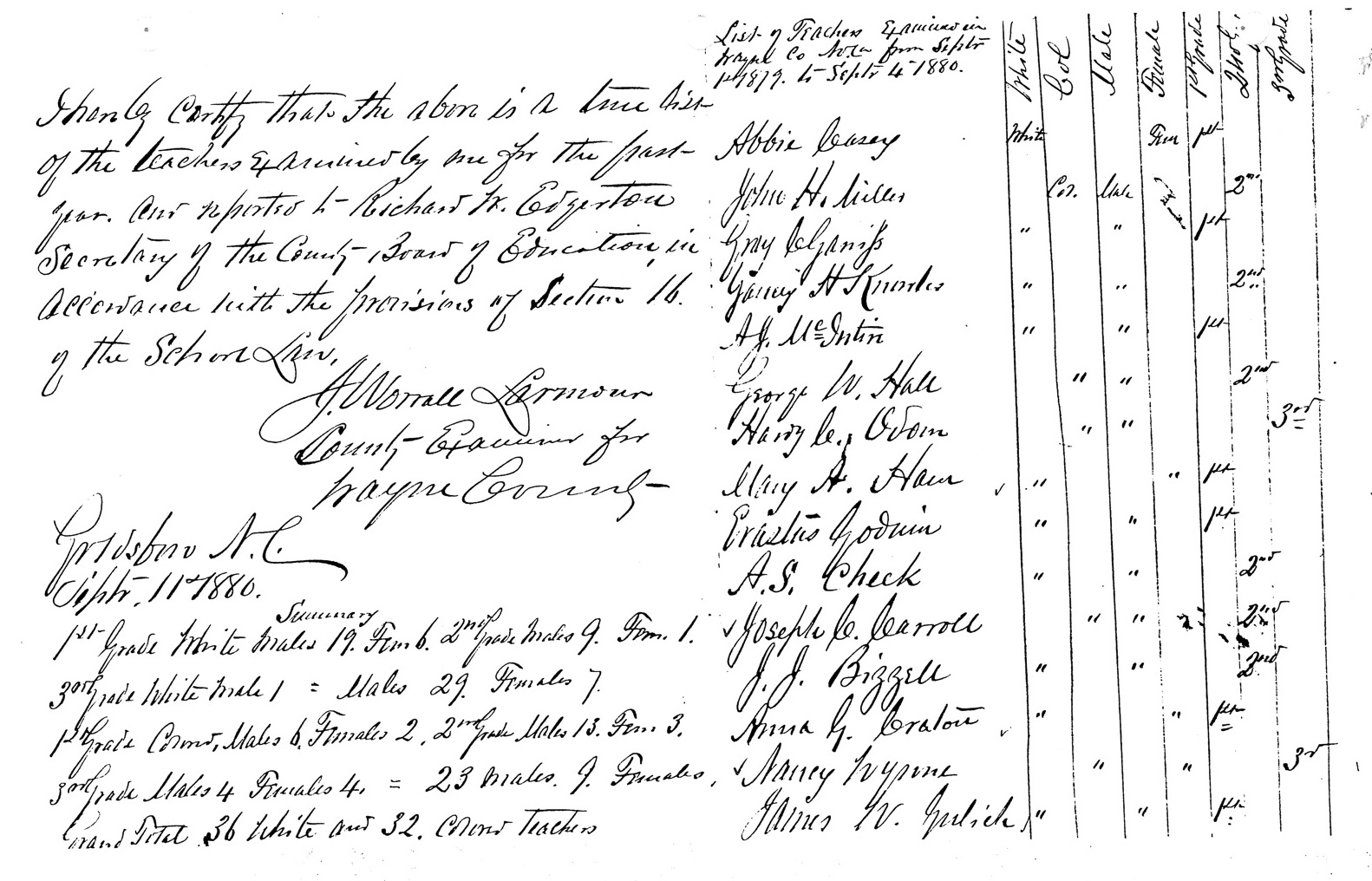
John Aldridge and his brothers George and Matthew Aldridge were hired to teach in Wayne County in the late 1870s. For reasons unknown, they were assigned to schools in the far north of the county, some 15 miles north of Dudley:


ALDRIDGE -- Aldridge_School Records

ALDRIDGE -- Aldridge_School Records 2 

From the same unsigned family history:

John Aldridge met Luvicie Artis at the school where he taught; she was one of his students. He built a 7 room house for her when they got married. John was a stout man with a reddish brown complexion and wavy black hair. He stopped teaching when he married Luvicie and started to farm and run a general store. The store was burned down in 1911. He sent his children to a private school. He died in 1910 of a congested chill. He was 58 years old when he died, and was worth about $30,000 at that time.

ALDRIDGE_--_John_Aldridge_Vicey_Artis_Marriage_License

If John was worth $30,000 when he died, it was all in realty. His personal estate was paltry:
JW Aldridge Estate Doc
Standard
DNA, Free People of Color, North Carolina, Paternal Kin

DNAnigma, no. 6.

I recognized his name immediately and shot off a message to his Ancestry.com inbox. … And then another message. … And then another one. … And still, crickets. In the meantime, I had an email from his first cousin, and I shared news of the match with her. She was excited and said she’d prod him.  Apparently, he is prod-proof.

In any case, this is another match between descendants of Adam T. Artis, with an Aldridge twist. H.B.’s great-grandfather was Henry J.B. Artis, son of Adam by his fourth wife, Amanda Aldridge, who was a daughter of Robert and Eliza Balkcum Aldridge. H.B. and I are roughly 4th cousins, which Ancestry correctly predicted.

Standard
Births Deaths Marriages, North Carolina, Oral History, Paternal Kin, Photographs

Louvicey Artis Aldridge.

Image

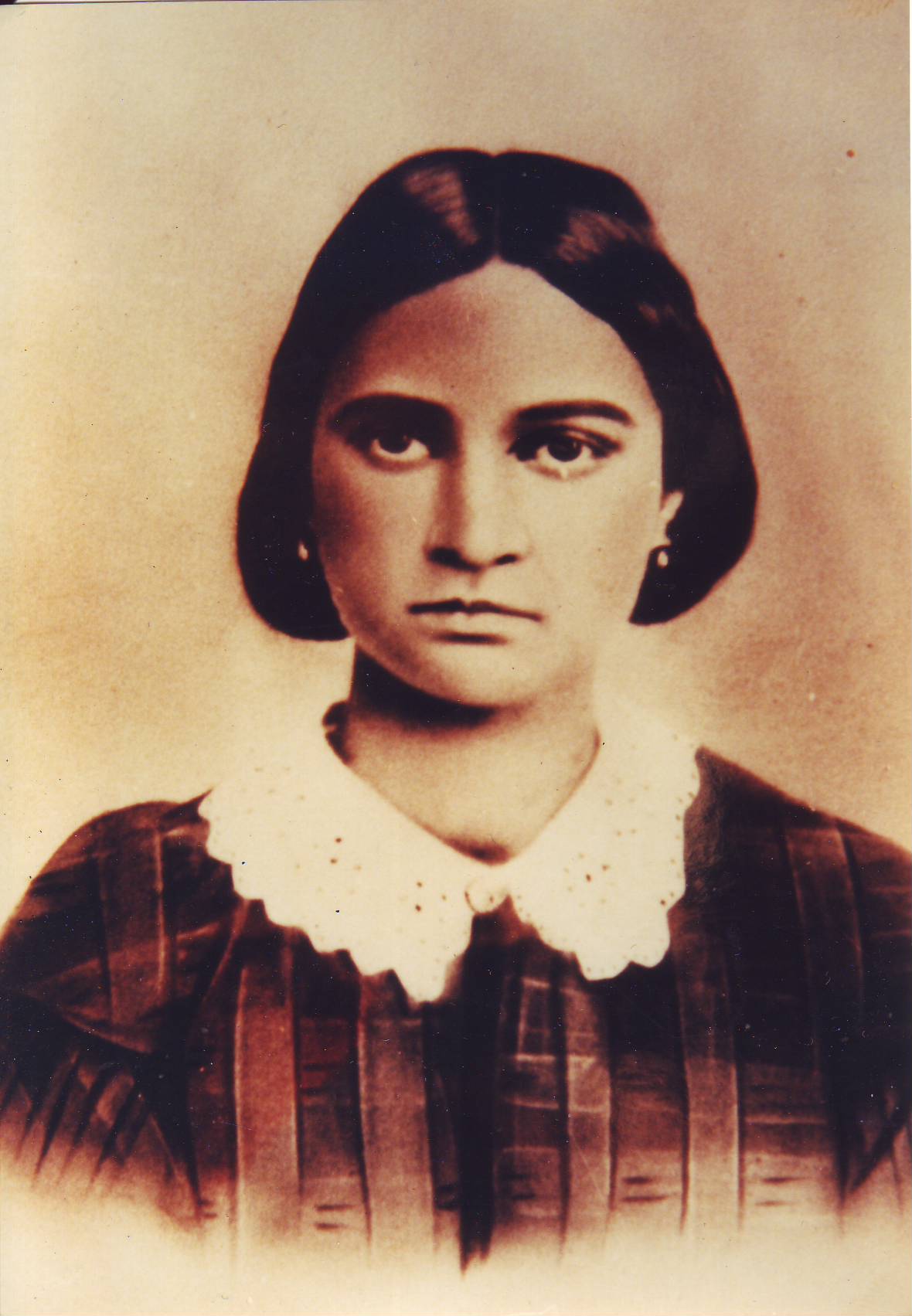
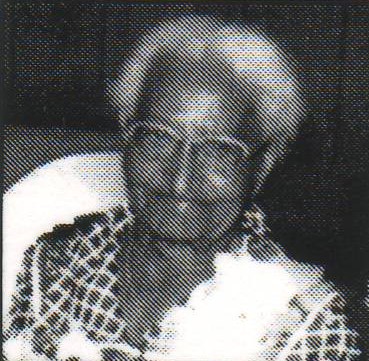
Vicey was little, rawboned-ed.  With a peaked nose, and she was more Indian color.  But she had that pretty hair.  I remember her when she used to come to Wilson.  She come up there visiting once in a while.  Vicey was, ahh ….  You remember Josephine Sherrod?  Well, she was lighter than her.  But she had that peaky nose and had nice hair.

Image

This is my grandmother’s description of her paternal grandmother, Louvicey Artis Aldridge. Josephine Artis Sherrod (in the second photo) was Louvicey’s half-sister — and niece. Their father was Adam T. Artis. After the death of Vicey’s mother, Adam married Amanda Aldridge, sister of Vicey’s husband John W. Aldridge.

Photographs in the collection of Lisa Y. Henderson. Interview of Hattie H. Ricks by Lisa Y. Henderson; all rights reserved.

Standard
Births Deaths Marriages, Oral History, Paternal Kin

When Grandma Mag died.

My grandmother was 5 years old when her great-grandmother Margaret B. Henderson died in 1915. This is what she recalled:

I remember when Grandma Mag died.  I don’t remember ‘em burying her.  But I was up to Nora’s house.  That’s how come I remember it.  Grandma Mag was living, well, she was in bed, she was sick.  I don’t remember her being up. Grandma Mag stayed down in Dudley. When she died, I was down there, and we went to Nora’s house.  And I used to ask myself, ‘Why is she in the bed all the time?’  

During Grandma Mag’s funeral, I stayed with Aunt Vicey and Nora and Beulah, the one that had the wen under her neck.  We called her A’nt Vicey, but she was my grandmama. I stayed up there with them, and I was scared to sleep in the bed by myself. So Nora told me, “Well, if you get in the back and I’ll get in the front.”  So she said, “Well, I’ll be in here right with you,” so I went on to sleep.  That’s who I slept with. 

So, I stayed up there in that house when Grandma Mag died.  I stayed up there.  And I slept in her room.  I remember that.  But I don’t remember … they didn’t let me go to the funeral, I don’t think. 

“Aunt Vicey” was Louvicey Artis Aldridge (1865-1927), her father’s mother. “Nora” and “Beulah” were Vicey’s daughters Lenora Aldridge Henderson (1902-1961) and Beulah Aldridge Carter (1893-1986).

Standard