Maternal Kin, Photographs, Virginia

Order of Moses.

 IMG_0008

Moses Hall, Charlotte Court House, Virginia.

The Grand United Order of Moses, Inc., was a small fraternal insurance society for black men and women based in rural south-central Virginia. The founder and lifelong leader of the Order of Moses was James Murray Jeffress (1873–1951), who organized the society in 1904 at his birthplace, the village of Charlotte Court House. Jeffress graduated from Hampton Institute in 1894 and Howard University divinity school in 1901. He was ordained a Baptist minister and served as principal of a public school in Charlotte County.

By 1900, white Virginians had disenfranchised blacks and had segregated schooling and public transportation. Jeffress, sometimes called “the Booker Washington of Charlotte County,” was an accommodationist who tried to make life tolerable for his fellow blacks without challenging white racists directly. Fraternal societies such as the Order of Moses offered a modicum of economic security through medical and funeral insurance. They also supplemented the churches as black organizations that whites were willing to tolerate. They were organizations in which African Americans could vote, hold office, and brighten their drab lives with the color and spectacle of regalia and ritual, impressive titles and fancy-dress parades, lodge meetings and funerals.

Even more than in other fraternal societies, a charismatic oligarch dominated the Order of Moses: Murray Jeffress. He depicted the origins of his society in quasiprophetic language. “It was in 1901 that I began having visions repeatedly. These visions consisted of a single blackboard in which was chalked the words: The Grand United Order of Moses. After the third vision, I decided that I would do something about it.” In 1904, the Order of Moses recruited 203 members, and the society received a state charter. A few years later, it acquired Moses Hall as its headquarters. Jeffress took the title “right worshipful grand leader.”

A crisis in the society occurred when a black man, presumably instigated by whites, alleged that the Order of Moses had been organized to keep African Americans from working for white people. A prominent white man squelched this rumor by offering $ 150 for evidence in its support, evidence that never materialized. For his efforts, the Order of Moses made him an honorary member.

Jeffress resented the injustice of segregation and disenfranchisement, but he considered small economic advances the only realistic goals. “Let us teach every boy and girl to build and not tear down. Teach them that being God-fearing, property-owning and debt -paying citizens is greater than being a voter or being on social equality with [a] king.” He encouraged his followers to buy farmland or learn a vocational trade.

Although Jeffress opposed urban migration, many rural black Virginians moved to northern cities. As a result, Order of Moses lodges appeared outside Virginia, mostly in Pennsylvania and New Jersey. Northern lodges unsuccessfully asked for the headquarters to be moved to Philadelphia, which they regarded as more convenient than Charlotte Court House, which at the time of Jeffress’s death had only 250 residents and neither a railroad station nor a bus stop.

The strength and the weakness of the Order of Moses was its identification with Charlotte Court House and Charlotte County. The order helped establish a high school there for black youth, provided bus transportation for the students, constructed and equipped a hospital building, and provided electrical service for the village. The order owned an auditorium that could accommodate four hundred people, an office building, and apartments for black schoolteachers. The society also owned three hundred acres of farmland worked by black sharecroppers.

As leader of the Order of Moses, Murray Jeffress became a respected figure in African American life. He was elected first vice president of the Negro Organization Society and president of the Federation of Negro Fraternal Organizations. He served a number of Baptist churches as pastor.

At the time of Jeffress’s death in 1951, the Order of Moses claimed a little more than five thousand members. Apparently, his son Wilson became the society’s new leader. How long it continued to operate is unknown. In any event, the little Order of Moses had survived into the post—World War II era, an achievement that few better-known African American fraternal societies equaled.

— Adapted slightly from Organizing Black America: An Encyclopedia of African American Associations, Nina Mjagkij, ed.

——

My grandfather’s older brother, Jasper Maxwell Allen (1904-1959), married J. Murray Jeffress’ daughter Lena P. Jeffress, settled in Charlotte Court House, and opened a dental office in Moses Hall.

IMG_0011

Photographs by Lisa Y. Henderson, July 2012.

Standard
Maternal Kin, Other Documents, Virginia, Vocation

Man of a thousand hustles.

My great-grandfather, the longshoreman, rose from the docks to become a union officer and civic leader in Newport News, Virginia. The arc of that narrative seemed long and interesting enough, but we now know that it does not quite do this hard-working man justice. In fact, in just the first decade-and-a-half of the twentieth century, John C. Allen worked a half-dozen jobs to keep his growing family comfortably fed, clothed and sheltered. The 1900 census records John’s occupation as shipyard laborer, which is more or less consistent with received wisdom. Newport News city directories, however, capture the full range of John’s hustles over the years:

1902 — Allen Jno, eating house, Ivy Ave nr 18th. John’s church, Zion Baptist, was at 20th and Ivy, at the heart of Newport News’ East End. Presumably, John owned this small and apparently short-lived restaurant and probably lived on premises. (Fifteen years later, John’s nephew Junius Allen lived at 1752 Ivy, which is at the corner of 18th Street.)

1903 — Allen Jno C, lab h 748 21st   John was probably laboring at the shipyard. 748 21st Street is the house in which my grandfather and his siblings spent their early childhood years. I need to check deeds to find out if John Sr. bought it 1902-03. My grandparents also lived here during the first five or so years of their marriage.

1910 — Allen Jno C, painter h 748 21st  John is described as a shipyard painter in the 1910 census, and he seems to have worked this job at least two years.

1911 — Allen Jno C, painter h 748 21st  

1912 — Allen Jno C, agt Am Ben Ins Co h 748 21st  Insurance agent??? John had come an impressively long way for a man who’d been illiterate when he arrived in Newport News a dozen years earlier. American Beneficial Insurance Company was a black-owned business founded in 1902 in Richmond, Virginia, by Rev. Wesley F. Graham, a Baptist minister.

1913-14 — Allen Jno C, grocer 2206 Madison av h 2107 Marshall av  Around 1913, John bought the house on Marshall Avenue in which he and his wife lived out their years, at which my parents married, and in which his daughter Julia lived and operated a beauty parlor when I was a child. The Madison Avenue grocery is a complete mystery. [Postscript, 13 April 2014: A mystery only to me, apparently. You just have to ask the right questions. After my mother read this post, she sent me a text identifying “Mama Taylor” and her husband as folks who operated a grocery that may have been her grandfather’s. Post-postscript, 19 April 2014: my Uncle C. told me that (1) Mama Taylor and her husband Johnnie lived above a grocery they operated in the 1900 block of Madison Avenue; (2) Mama Taylor was close to “her Johnnie,” my grandfather; (3) Mama Taylor was about his grandparents’ age; (4) he wondered if Mr. Taylor and John C. Allen Sr. were related, as they had similar builds and full heads of white hair; (5) at least during my uncle’s childhood, John and Agnes Allen ordered their groceries from a white-owned business in the 2100 block of Madison, not from the Taylors.]

1914-15 — Allen Jno C, clk h 2107 Marshall av  Clerk? What kind of clerk?

The 1916 and 1917 city directories revert to the 1913-14 grocer entry, but when John Allen registered for the World War I draft in 1918, he reported that he worked as a laborer for Hampton Roads Stevedoring Company. The 1918 and 1919 city directories also show him as a laborer. (Had the grocery store closed? Why? Was there better money on the docks?)

UPDATE: On 31 May 1917, J.C. Allen ran a small ad in the Newport News Daily Press announcing the liquidation via auction of his grocery store at 2206 Madison Avenue:

img (3).jpg

The 1920 census finally recorded John’s occupation as “longshoreman on piers.” (John was 45 years old in 1920, well into middle age. Unloading ships in this era was brutal work even for young men.) Subsequent city directories label him “longshoreman” (1923), “mgr International Longshoreman’s Union” (1925), “mgr Intl Longshoreman’s Locals 844 & 946 gro” (back in the grocery business, 1927).

In the 1930 census, John worked as a longshoreman for a steamship company, but is reported as a laborer in the 1931 and 1932 directories. In 1933, he’s again a manager with the union, but the 1940 censustaker described him as a longshoreman in “frt. transport.” (Incidentally, sometime in the late 1930s, he helped found Whittaker Memorial Hospital and joined its and Crown Savings Bank’s boards of directors.)

A 1953 obituary laconically notes that John C. Allen “worked for the Newport News Shipbuilding and Dry Dock Co. for about 10 years and then became a stevedore.” Ah, but he did so much more.

John Allen ca1950

John C. Allen at his son-in-law’s in yet another role — farmer. Near Jetersville, Virginia, 1940s.


Standard
Births Deaths Marriages, Maternal Kin, North Carolina, Oral History, Photographs, Virginia

Remembering Margaret Colvert Allen.

She gripped a balled handkerchief, or a tissue, in that hand almost always. You’d only notice that little finger, crooked up above the rest, when she made certain gestures, like smoothing her dress across her lap. It was a source of endless fascination when I was a child, and she would obliging turn her hand this way and that so we could get a closer look. Her pinkie finger, it was, curled permanently into a C-shape.

Here’s how it happened:

My grandmother:  Ooo, I had a lot of friends.  We had a lot of friends.  We could not visit people all in the neighborhood.  We could not go, the children came to our house.  You know, to play and all that kind of – to play ball.  We’d play ball in the evening, and they’d put me in the field because I couldn’t catch no ball on account of my finger.  [Laughs.]  I always had to go in the field.  Louise and Launie Mae were whizzes.  Louise was a terrible bad ball —  I mean, she could play some ball.  But Launie Mae was good, too.  But, honey, they’d put me out there way out there in the field where didn’t no – just as soon as I’d reach up to catch that ball that thing would knock it out.

Me:  Right. How did you hurt your finger?

My grandmother:  Ah, you know, they had windows that you’d put a stick under.

Me:  To prop them up?

My mother’s cousin: Didn’t have a sash.

My grandmother:  Yeah.  And I was in there playing and took that stick out there, and it broke something.  But anyway, Mama said she had gone to town.  That’s what they say when they went into Statesville.  And she said when she came back, Golar came out meeting her with me in her arms, and said she had on a little dress, and said she turned the dress up and blood was coming through the dress off me, you know, my finger and everything.  It scared her to death.  So they carried, she carried me to the doctor’s, and they put splints on to get it – it was broken, you know.  He put splints on.  But, see, I would pick ‘em off.

Me:  Just take it right off.

My grandmother:  Take ‘em off.  And take ‘em off.  And hold my hand like that.  [Balling her hand into a fist.]

Me:  Okay.  So that’s how it healed.  It healed closed.  How old were you then?  Real little?

My grandmother:  I guess I was little.  I don’t know how old I was.  Two, three.  I don’t know whether Launie Mae was there or not.  I know Louise was, but I don’t know ‘bout all of ‘em.  But, anyway, I was just big enough to crawl up to the window and pull the stick out.

I have many favored photos of my grandmother, and this is one of the last:

MCA

At home, in her easy chair, just back from church, with that little finger.

Remembering Margaret Colvert Allen (2 August 1908-11 February 2010).

Standard
Maternal Kin, Newspaper Articles, Photographs, Virginia

John C. Allen and Whittaker Memorial.

Sixty years today, the same day it ran his obituary, the Norfolk Journal and Guide published a photograph of my great-grandfather John C. Allen Sr., chairman of the Board of Trustees, accepting a charitable donation on behalf of  Whittaker Memorial Hospital.

ALLEN_--_Whittaker_Hospital_Receives_Check

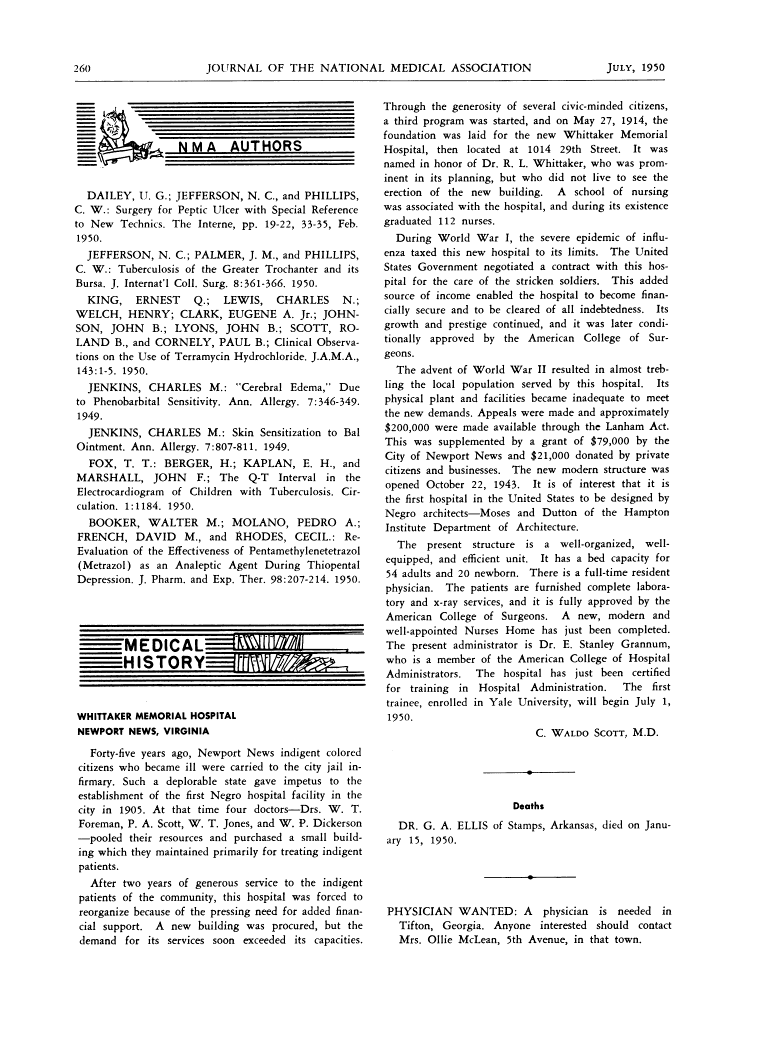
A few years earlier, the Journal of the National Medical Association printed this history of the hospital:

Image

Standard
Births Deaths Marriages, Maternal Kin, Newspaper Articles, Virginia

Remembering John C. Allen Sr. on the 60th anniversary of his death.

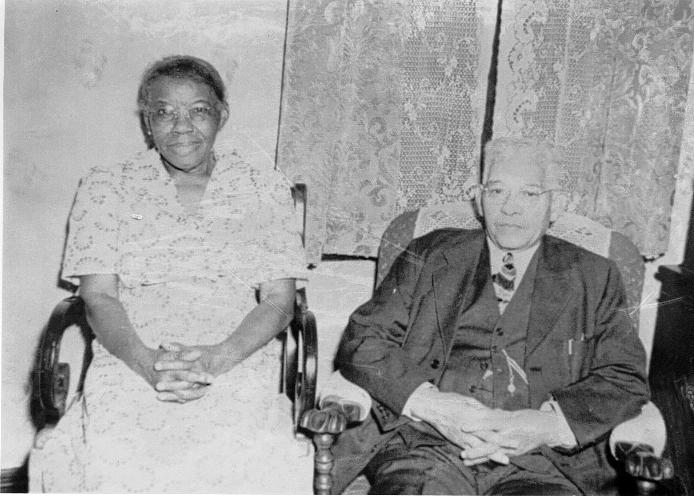
They sat rather stiffly side by side, each with hands clasped in lap. The occasion was their 50th anniversary, and granddaughter Marion captured the moment in the only photograph I have seen of them together.

50th Anniversary

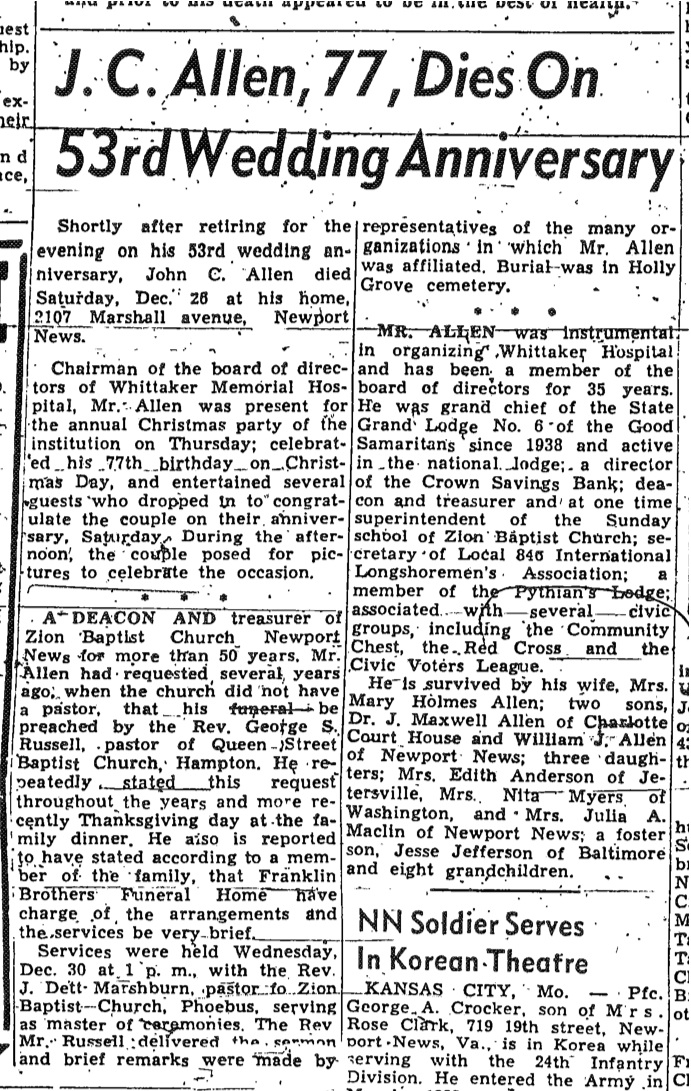
Three years later, family gathered again on the day after Christmas to pay respects to John and Mary Agnes Holmes Allen.  Papa Allen retired to bed after dinner and never woke again.

ALLEN -- JC Allen Obit Cropped

Norfolk Journal and Guide, 2 January 1954.

He was buried in Pleasant Shade cemetery in Hampton, Virginia, near the graves of his son John Jr. and daughter Marion. IMG_1275

Top photo taken by Marion Allen Christian, 1953, copy in possession of Lisa Y. Henderson; bottom photo taken by Lisa Y. Henderson, February 2011.

Standard
Births Deaths Marriages, Maternal Kin, Virginia

Mary, Mary?

Mary Brown, born about 1849 in Amelia County, Virginia, married Graham Allen in Charles City County in 1876. She and Graham and their children appear together in the 1880, 1900 and 1910 censuses. Mary Allen, born in Amelia County to James Brown and Catherine Booker, died 1 April 1916 in Charles City County. Who, then, was the 30 year-old Mary Allen whose death Graham Allen reported on 8 December 1887 in Charles City County?

Standard