Births Deaths Marriages, North Carolina, Paternal Kin

Daniel’s wife.

Who was Daniel Artis‘ wife? Or, in any case, the mother(s) of his children Clara Artis Edwards, Henry Artis, Loderick Artis, Prior Ann Artis Sauls Thompson and Mariah Artis Swinson?

That Daniel appears in the 1850 and 1860 censuses without family suggests that he was married to an enslaved woman who lived apart from him with their children, but identifying evidence is scanty:

  • I have found no records for Clara Artis Edwards that indicate her mother’s name.
  • When Henry Artis married Lena Edmundson in Greene County in 1903, he listed his parents as Daniel Artis and Eliza Artis. Henry Edwards (Clara Artis’ husband) and Marcellus Artis (Lodrick Artis’ son) were witnesses. Though his age is off by about ten years, this appears to be the right Henry. Daniel Artis registered his two-year marriage to Eliza Faircloth in 1866. Was Eliza really Henry’s mother? Or his step-mother?
  • Ditto for Loderick Artis, except: in Baalam Speight’s pension file, there is an affidavit from Lewis Harper. Harper asserted that he was Loderick Artis’ brother.
  • Nothing for Prior Ann.
  • When Mariah Artis married Jesse Swinson in Greene County in 1879, she listed Ruthy Edmundson as her mother and noted that she was living. (Is this the Ruth Edmundson, age 59, wife of Samuel Edmundson, listed in the 1880 census of Bull Head, Greene County?) Mariah’s death certificate lists her mother as unknown.
  • In the 1880 census of Bull Head, Greene County, Mariah Sauls, age 60, is listed as either Mariah Sauls Edwards or her husband Timothy Edwards’ grandmother. As Mariah Edwards was Prior Ann’s daughter, was Mariah Sauls Prior Ann’s mother?
Standard
Agriculture, Business, Land, North Carolina

“I told anybody that it was my land”; or, “Why don’t you stir it while it’s hot?”

The ninth in an occasional series excerpting testimony from the transcript of the trial in J.F. Coley v. Tom Artis, Wayne County Superior Court, November 1908.

(Tom Pig Artis’ testimony continued from here.)

CROSS EXAMINED.

I have been claiming this land all the time. I have not been listing it for taxes. Before the mortgage was given I was listing it. I have not listed it ever since 1892, ’till this last year. I listed my other property, but don’t know that listed this land. I have been mortgaging the crops on this land. I mortgaged it one year in 1893. I guess I did. To Mr. Minshew. I don’t know that I described the land in the Minshew mortgage as the land belonging to Napoleon Hagans. I don’t say I didn’t. I can’t tell the date, but I have rented some land from Hagans. Two or three years. That mortgage to Minshew was intended to cover the crops to be made on the 30 acre piece. (Defendant objects to all about mortgage.) I don’t know that I made another crop lien on that same land in 1895. I don’t remember that I made one then. I made a mortgage to Mr. Peacock in Fremont on the same land. I described the land as mine. I don’t know that I said it was known as the Hagans land. I made a crop lien to Peele & Copeland in 1906. That was to cover crops on the 30 acre piece I guess. I described it as the land known as Will Hagans land. I guess, I don’t know. I might have described it as mine. I made Peele & Copeland another crop lien in 1907 on the same land. I described it as the land known as the Will Hagans land, if its there, I expect I did. I didn’t say in that mortgage that it was my land. On April 16th 1908 I made Peele & Copeland another crop lien. I don’t know that I gave them a mortgage this year. I may have. I guess I did. If it shows it, I did. I described it as my own land. First time that I ever put a statement in a paper or that made reference to crop on this 30 acre piece, that they would be grown on my own land. On March 23rd 1908, I made a real estate mortgage on this land to Peele & Copeland for $420.00. This crop lien I made this year, and also this mortgage on this land was made after the action was made to recover the land. I rented some other land from Hagans beside the 30 acre piece. I didn’t have any of the Hagans land under rent beside the 30 acre tract last year in 1907. I had land rented off, but not the Hagans land. (This action was brought March 18th 1908.) The real estate mortgage to Peele & Copeland was given Mar. 23rd, 1908. Was served Mar. 27th 1908, and the crop lien Apr. 16th 1908.) Last year I didn’t have any of W.S. Hagans’ land rented. I cultivated only the 30 acre tract, and lived in the house on the other side. (Summons introduced by Plaintiff.) At the time Mr. Cook was negotiating about buying this land from Hagans I was cultivating the 30 acre tract, and was living across the line on the 24 acre piece. I knew that Cook was trying to buy the Calv place. I didn’t know that he was trying to buy both places then. Not until I heard from other people that he was trying to buy both places. I heard that a few days before he came up here to get the papers fixed. When I heard this news, I didn’t go see Mr. Coley. I happened to see him. I was just passing and saw him. He spoke to me first about it. He said he understood Mr. Cook was about to buy all the land about there, and mine too. He said why didn’t I let him know. He said if he had known it he would have bought some. I told him I understood they were going to fix the papers the next day. I said if he is, I am going to Goldsboro, and he said if you go, and he and Cook don’t trade, tell Hagans to send me a note. I went the next day, and I told him exactly what he told me. I carried it to him. The rumor was that he Cook was buying both places. I told Coley that if anybody got it I would rather him get it, for I didn’t think that I could get along with Mr. Cook. I didn’t have any reference to my place. I didn’t tell Coley that I didn’t mean the 30 acre piece. I told him myself. I told him I understood Mr. Cook was trying to but all the land down there, trying to buy the 30 acre piece and the 24 acre piece. I told him I was coming to Goldsboro, he asked me to speak to Hagans. I told him if anybody had to have it, I had rather for him to have it than Cook. I came and saw Hagans. I didn’t ask Hagans not to sell it to Cook. I didn’t ask him to let Coley have it. I didn’t tell him I would get along better with Coley than Cook. I didn’t say that. I don’t remember that I told Hagans I could get along better with Coley than Cook. I don’t swear, but I never told him that. I told Coley. I told Hagans what Coley said, if he and Mr. Cook didn’t trade to send him a note. Hagans and Coley did trade. They went to my place. I got in the buggy with him. Rode over to Mr. Coleys. They were talking but I don’t know what they were talking about. They were around the house. I didn’t hear a word except that Hagans would see him later, maybe some other things were said, I don’t remember. I didn’t hear how much Coley was to give him for it, not until he had bought it. Mr. Coley came, but I don’t know if he came to see me. He just passed by. He didn’t say anything about renting it. He said he never knew where these lines were, and he said he wanted me to go around and show them to him. I don’t know whether he had any deed for it or not. I went all around and showed him the lines between his and mine too. There was a fence off the line a little. He told me to take the fence and put it around the pasture. He didn’t say he wanted me to. I didn’t move the rails of the fence, because Mr. Cook saw me with my cart. He said that fence was on the line of the 30 acre place, and told me not to move it. I didn’t because Cook said it was on the line. I went to move it. This fence was on the line between the 30 acre place and Cook’s line, not between the 30 and 24 acre pieces. Mr. Coley came back at another time, and talked about renting the land. Never reached any agreement. He said Uncle Tom aren’t you going to rent it. I said “No, I never rented my land.” I told him all the time it was my land, when I was showing him the corners etc. He was Now was the time to stir while it was hot. I told him I didn’t have to rent my own land. I told anybody that it was my land. I don’t know when I told Coley first it was my land. He knew I suppose that it was my land. I told him before I went to see Hagans that it was mine. I offered to buy from Hagans an acre along the 24 acre piece. He asked me if I couldn’t get somebody else to buy the rest of it. I told him I didn’t know. I never offered to buy the 30 acre piece, in presence of Reid or anybody else, nor offered to pay any on the mortgage, but I told him I could take up the mortgage. I told him that this year, and told him so last year. This last winter. I made a mortgage to H.J. Harrell in 1895. It was intended to cover crop on the 30 acre tract. I described it as the Hagans & Ward land. I tended some land on the Ward place, the other was on the 30 acre piece. That was on the 11th of May, 1908. (Book 18, Page 180) Reason I didn’t move the fence was because Cook stopped me. I didn’t go to see Coley and tell him what Cook said. I told him about about it. I don’t remember where I told him, but I told him. I said Mr. Coley Mr. Cook said you gave him these rails, and he said no he didn’t. Cook had done moved the rails. I was aiming to have the line run. I went to have the lines turned out. I knew the fence was off the line for maybe 25 years. I never have had it run. I didn’t advise Mr. Coley to have it run. I showed Mr. Coley lines and corners, because he asked me to go around with him. I told him at the time it was my land. I didn’t tell Coley he would get Cook’s tobacco barn. I told him the line would strike the tobacco barn. It was on my side. There had been a division since then. He had alreday told me that Hagans had sold him the land, he wanted to know the land between me and him. He said, “Let’s go all around and we went with two more men. I told him it was my land. He asked me why didn’t I stir it while it was hot. He said not to let it get cold, do it now. I gave Peele & Copeland a lien on this land for $420. for supplies etc. I owed for supplies last year and for now. I have a statement of how much I owed him. He had crop lien as security last year. I paid him some. I owed him about $300 together with the mule claim and cow, they amounted to about $200 or $300. I gave him a note for $420. I bought the mule from Mr. Pat Coley. He stood for me. That was put in the Peele & Copeland mortgage. They took up my claim for Mr. Pat Coley. I gave them a mortgage for $420.

To be continued.

Standard
Births Deaths Marriages, Enslaved People, North Carolina

Collateral kin: Winnie Coley.

I’ve talked about her here and here, but now I’m a little uncertain. Were there actually two Winnie Coleys? Were the mothers of Cain and Caroline Artis and William M. Coley and Patrick, Philip and John Revis Coley different women? Here’s what I know — and conjecture — about her:

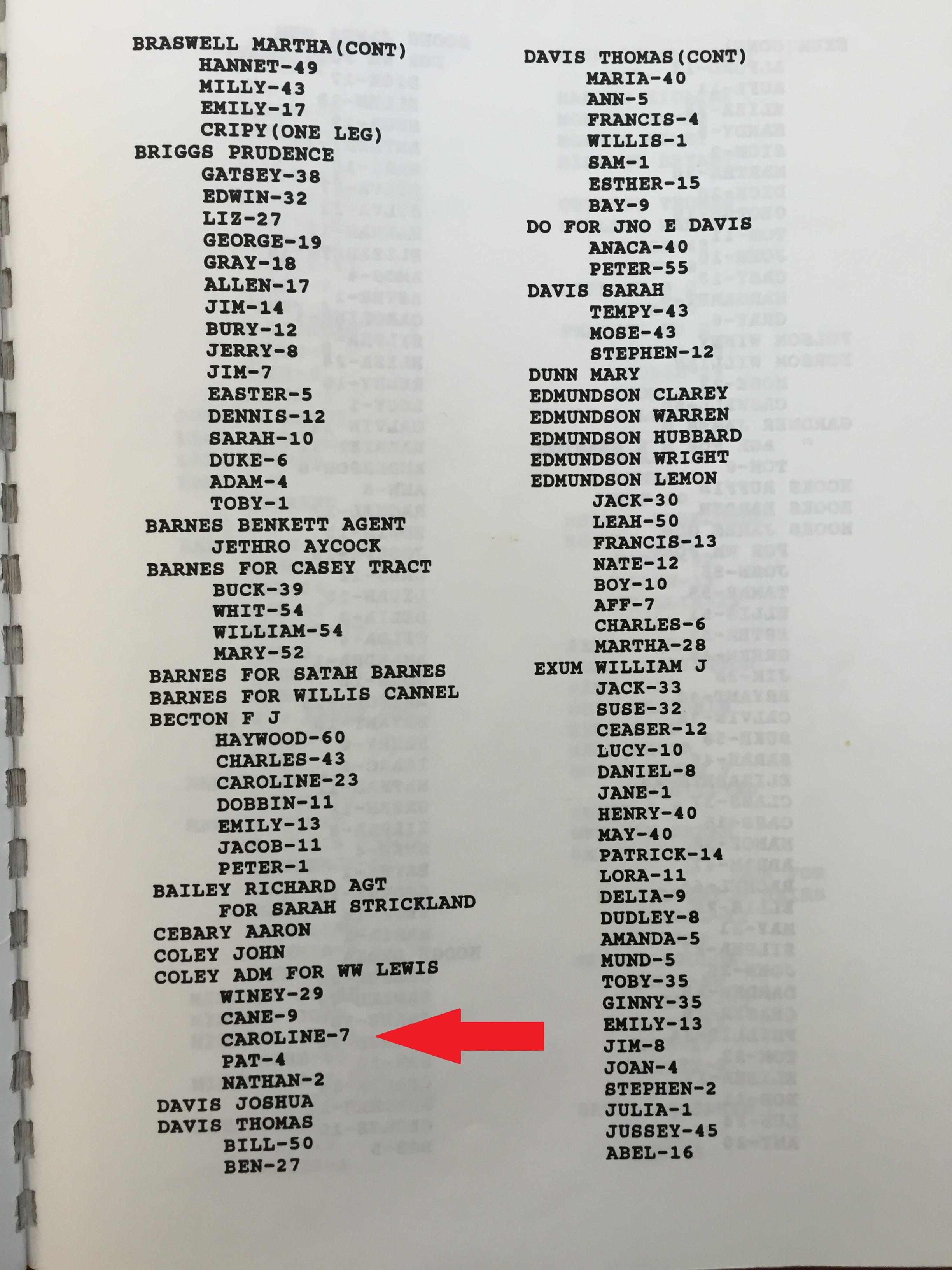
  • In 1863, North Carolina’s Confederate government levied a tax on slaveholders across the state. Tax lists survive for only a few counties. (Most deliciously for me, Rowan is one.) I have not been able to find Wayne County’s anywhere, but fortuitously — and a little suspiciously — they were abstracted in Martha Ellis Will’s Wayne County North Carolina Court House Records Four Books 1780-1896. The 1863 tax list of Davis District, shows John Coley, Administrator of Estate of W.W. Lewis, with five taxable slaves. It’s the first record of Winnie and her children:  Winey, age 29; Cane, age 9; Caroline, age 7; Pat, 4; and Nathan, 2. [Who was W.W. Lewis? Coley himself is not listed with slaves, but the 1860 slave schedule tells a different story. There he reported owning 114 men, women and children. And where were Winnie’s other children?]

 John_Coley_Adm

  • At #272 of the 1870 census of Pikeville, Wayne County, the unmarried 55 year-old John Coley heads a household of possibly related white folks. In every direction, there is evidence of his toppled fiefdom — African-Americans bearing the surname Coley. Were they related to him? To each other? How? (And the non-Coleys in the neighborhood — who among them were also John’s former slaves, men and women who’d disdained his name?) For now, a few. At #270, Trecendia Coley, 36, with Peter, 5, and Dallas Coley, 5. At #273, Winney Coley, 41, with John R., 17, Phillipp, 11, and Mack Coley, 5. At #276, Peter Coley, 50, Harret, 44, Devrah, 16, Delliah E., 15, Napolian, 14, Nicholas, 12, and Thomas V. Coley, 7. At #281, Thomas Coley, 35, Charlotte, 27, Branton, 8, Bealie, 6, Trecendia, 4, Harriett, 1.
  • On 5 May 1872, Patrick Coley, son of Peter Coley “sen.” and Winney Coley, married Debby Coley, daughter of Peter Coley and Hannah Coley in Greene County. [The 1870 mortality schedule of Wayne County records the death of 52 year-old black farmer Peter Coley of Pikeville. Was he Peter Sr.? Also, though no ages are listed on the marriage license, the 1880 and 1900 censuses show Patrick’s birth year as 1849, which is not consitent with the “Pat” listed in the 1863 tax list.]
  • On 2 Oct 1878, Richard Baker applied for a marriage license from the Wayne County Register of Deeds for Madison Artis of Wayne County, 22, colored, son of Calvin and Serena Artis, father living, mother dead, and Caroline Coley of Wayne County, age 24, colored, daughter of Adam Morris [sic, Artis] and Winny Coley, both living.  The ceremony was performed by Fred G. Becton, Justice of the Peace, on 3 Oct 1878 at Winnie Coley’s in Nahunta, before E.L. Becton, Thomas Artis, and Jonah Williams.  [Thomas Artis, son of Celia Artis, was Madison Artis’ uncle. Jonah Williams was Caroline’s uncle, Adam Artis’ brother.]
  • In the 1880 census of Pikeville, Wayne County, Winnea Coley, 71, is listed with sons Jack R., 26, Phillip, 20, and grandson Dallas Coley, 15. [71?!?! This is the same Winnie Coley listed in 1870, but her age is inexplicably 20 years off.]
  • On 5 November 1881, in Wilson County, Winnie Coley, 50, married Alex Barron, 57. The ceremony took place at minister Jessie Baker’s house in the presence of Mary Ellis, Peter Coley and Red Barnes. [Is this our Winnie? If so, she never appears elsewhere with this husband. Which Peter Coley was this?]
  • On 16 February 1882, Phillip R. Coley, 22, son of Peter Coley (dead) and Winnie Coley (living), married Ann Exum, 18, in Pikeville, Wayne County, in the presence of witnesses Christopher Coley, Gard Coley and Olin Coley. [“Grad” Coley appears in the 1870 census in household #279 as the son of Howell and Amy Coley. In 1886, Gard married Ollin Coley [Sr.]’s daughter Miranda. Their witnesses were Philip R. Coley, Dennis Coley and Christopher Coley. Christopher appears in the 1870 census of Pikeville, Wayne County, as the son of Lafayette and Julia Coley. Philip R. Coley witnessed Christopher’s 1885 marriage to Sarah Powell. Ollin Coley Jr. married Christopher’s sister Imogen in the presence of Philip R., Dennis and Christopher Coley in 1885.]
  • On 11 Apr 1888, Charles Battle applied for a marriage license for Cain Artis of Wayne County, age 35, black, son of Adam Artis and Winny Artis, both living, and Margaret Barnes of Wilson County NC, age 38, black, daughter of Sherard Edmundson, dead.  P.D. Gold, minister of the gospel, performed the ceremony on the same day at Margaret Barnes’ home in Wilson before H.G. Phillips, Henrietta Clark and Mary J. Davis.
  • On 26 February 1891, William Coley, 22, son of Napolion Hagans and Winney Hagans, of Gardner’s Township, Wilson County, married Minnie Woodard, daughter of Alfred and Sarah Woodard of Taylor’s township, Wilson. Cain Artis applied for the license and stood as a witness.
  • In the 1900 census of Wilson, Wilson County: Willie Coley, 30, wife Minnie, 30, children Effie M., 8, and James M., 6, mother Winnie Coley, 65, and sister Zilley Coley, 38. [Where was Zilley in previous censuses? Or was she, in fact, Minnie’s sister?]
  • On 21 July 1909, in Wilson, Wilson County, William Coley, 42, son of Pole Hagans and Winnie Coley, married Mary Mercer, 34, daughter of Sam and Julia Mercer. Jonah Williams, Primitive Baptist Minister, performed the ceremony at the home of W.M. Coley in Wilson.
  • Winnie is not found in the 1910 census or beyond and presumably died between 1900 and 1910.
  • On 23 March 1917, farmer Cain Artis died in Wilson County of pulmonary tuberculosis.  His death certificate reports that he was born March 1851 to Adam T. Artis and Winnie Coley, both of Wayne County NC.  Informant for the certificate was W.M. Coley of Wilson NC.
  • On 15 December 1920, Phil R. Coley died in Nahunta, Wayne County, of stomach cancer. His death certificate reports that he was born around 1861 to Peter Coley and Winnie [no last name], both of Wayne County. J.A. Coley was informant.
  • On 26 January 1928, William Coley died in Wilson County of pulmonary tuberculosis. His death certificate reports that he was born about 1867 to Pole Hagans and Winnie Coley, both of Wayne County.  Informant for the certificate was Mary Coley of Wilson NC.
  • On 3 September 1934, Jack Revis Coley died in Nahunta, Wayne County, of bladder and prostate cancer. His death certificate reports that he was born about 1850 to Peter Coley and Winnie Coley, both of Wayne County.  Informant for the certificate was Philip E. Coley of Fremont NC.
  • In summary, Winnie Coley was born about 1830 and died 1900-1910. Her children included Cain Artis (circa 1851-1917); Caroline Coley, born about 1854; John Revis “Jack” Coley (born in the early 1850s-1934); Philip R. Coley (circa 1860-1920); Patrick Coley (??-??); and William M. Coley (circa 1867-1928); and possibly Nathan Coley (circa 1861-??) and Lafayette Coley (circa 1842-1913).
  • Fun facts: Philip R. Coley’s son Philip Elmer Coley married Genetta Thompson, daughter of Celebus and Lillie Beatrice Artis Thompson. Lillie was a daughter of Adam T. Artis and a half-sister of Cain Artis. Genetta, then, married her half-uncle Cain’s half-brother’s son.
  • Fun facts, 2: William Coley’s father Napoleon was the half-brother of Frances Seaberry, who married Adam Artis. Thus, William’s half-brother Cain was also his first cousin by marriage.
Standard
Agriculture, Business, North Carolina, Paternal Kin

“They call me Tom Pig.”

The eighth in an occasional series excerpting testimony from the transcript of the trial in J.F. Coley v. Tom Artis, Wayne County Superior Court, November 1908.

Defendant introduces TOM ARTIS, who being duly sworn, testifies:

My name is Tom Artis. They call me Tom Pig. I own some land, 30 acres. (Plaintiff objects.) I have been living on the 30 acre tract of land 25 years, except one year. I mortgaged this land to Mr. Exum. (Plaintiff objects.) I don’t know about how long it was. About 25 or 30 years. (Plaintiff objects.) I don’t know what became of that mortgage. I got Hagans to take it up. (Plaintiff objects.) I don’t know who was present when I got Hagans to take it up. When Hagans agreed to take it up, Mrs. Exum, Hagans and myself were present. I own the 30 acre tract and lived on the the tract adjoining. After Hagans took up the papers, he told me that I could build on that place, or on the 24 acre piece. He said he thought it best for me to build on mine, he might die sometime, and there might be some trouble about me holding the house. I did so. He furnished the lumber, and I did the work. I decided to build on his side. After I built there I had been paying the 800 lb. of lint cotton year in and year out. (Plaintiff objects to each and every statement of the foregoing evidence.) The 800 lb. of cotton was to keep up the taxes and the interest of the money. (Plaintiff objects.) I have been paying this 800 lb. of cotton all the time. (Plaintiff objects.) I left that place one year. I left because my house got in such a bad fix, and I couldn’t stay there, and run my business like I wanted to, and I went over to Mr. Jones’. I rented the land. I rented it to Simon Exum. He gave me 950 lb. for the 30 acre place. I rented the Calv Place and the Adam Artis place. I moved back after one year at Mr. Jones’ place. I built on the Hagans place. Since then I built the piaza and shed room, to my own expense. Borrowed money from Hagans. I paid him back. He didn’t pay for the repairing of it. He furnished some shingles. Got 1/4 covered. I never asked W.S. Hagans to sell the 30 acre tract of land. I never said to Hagans in the presence of Reid or anybody else that I wanted im to sell it. I never asked anybody to buy the 30 acre tract of Hagans. Not the 30 acre tract. I had a conversation with Mr. Coley with reference to buying that land. I was talking about the Calv place. My land wasn’t brought in. The Calv place is the place I rented and lived on. That’s the land I spoke to Mr. Coley about buying from Hagans. He said if Mr. Cook and Hagans didn’t trade to send him a note. I told Hagans, he said tell him Coley, if his hands were not tied. I remember going over to Mr. Coley’s mill with Hagans. I didn’t hear any conversation bwteen Hagans and Coley with reference to buying this tract of land. They were off from me. I didn’t know what they were talking about. I heard them say when they came back to the buggy, Hagans said that he would see him again shortly. I don’t know if he said what day. Next I heard after that was that Hagans had sold it all to Mr. Coley, mine and all. I never rented the 30 acre tract of land. I know Jno. Rountree. I never asked him to go to Will Hagans and ask him to give me an opportunity of buying the 30 acre piece of land. I never said to Will Hgans, Jno. Rountree or Henry Reid, or anybody that I wanted Hagans to give me the opportunity of seeing my boys in Norfolk, so I could buy the 30 acrea piece. I asked Hagans what he would take for the acre back of my huose, of the Calv place. I told him I would buy that. His answer was, “Can you find a buyer for the other part of the Calv place.” I told him I didn’t know. He walked about his buggy house door. He said, “Uncle Tom” I can’t take what that mortgage calls for for your land, land is so much more valuable now than it was when yours was given. It passed off at that. Next I heard he had sold it to Coley.

To be continued.

——

N.B. Calvin “Calv Pig” Artis was Tom Pig Artis’ brother. He sold the Calv Pig place to Napoleon Hagans in 1879. (Tom and Calvin apparently derived their nicknames from their father Simon Pig Artis, who had been an enslaved man.)

Standard
Births Deaths Marriages, Free People of Color, North Carolina, Paternal Kin

The case for Vicey, Sylvania and Daniel Artis as siblings.

I thought I’d posted this earlier, but apparently not. Here is my case for Vicey Artis Williams, Sylvania Artis Lane and Daniel Artis as siblings.

  • Vicey Artis was born circa 1810; Sylvania Artis, circa 1820; and Daniel Artis, circa 1820.
  • None were listed in census records prior to 1850.
  • In the 1850 census, Vicey and her younger children were listed in a household between Silas Bryant and John Lane in Bull Head, Greene County.
  • In 1850, Sylvania and her younger children were listed in a household on the other side of John Lane in Bull Head.
  • In 1850, Daniel was not listed.
  • In 1853, Daniel Artis bought 125 acres of land from Silas Bryant adjacent to Bryant and John Lane.
  • In 1860, Vicey and Sylvania were listed next door to one another in Davis district, Wayne County. Six of Sylvania’s children were listed in the household of John Lane in Bull Head, Greene County, less than five miles away.
  • In 1860, Daniel was listed in the household of John Lane in Bull Head.
  • On 28 August 1866, Vicey Artis and Solomon Williams, Sylvania Artis and Guy Lane, and Daniel Artis and Eliza Faircloth registered their cohabitations before justice of the peace Henry J. Sauls, probably near present-day Eureka (then Sauls Crossroads.)
  • Vicey’s children include a daughter Jane.
  • Sylvania’s children include Jane, Daniel, and Mariah.
  • Daniel’s children include a daughter Mariah.
  • Sylvania’s oldest son Morrison Artis, born about 1837, married Vicey’s daughter Jane Artis, born about 1833, on 27 November 1862. Their children included a son Daniel.
Standard
Births Deaths Marriages, North Carolina, Other Documents, Paternal Kin

28 August 1866.

I’ve seen these cohabitation registrations many times, but I just noticed today that Vicey Artis, Sylvania Artis and Daniel Artis, whom I believe to be siblings, and their spouses all registered their marriages on the same day before the same justice of the peace, Henry J. Sauls.

williams cohab

lane cohab

dartis cohab

Did the six travel to Sauls’ home together, walking or, perhaps, in a wagon? August 28 was a Tuesday during the relative lull before fall harvesting began. Did the families celebrate?

Standard
Births Deaths Marriages, North Carolina, Other Documents, Paternal Kin

North Carolina Marriage Records.

Ancestry.com recently launched North Carolina County Marriage Records, a date collection that includes images of marriage bonds, licenses, certificates and registers from 87 counties. (Including all of mine!) I’ve already stumbled across two previously unseen records for distant cousins, aunts or uncles, and I anticipate filling in gaps with many more that I managed to overlook over the years.

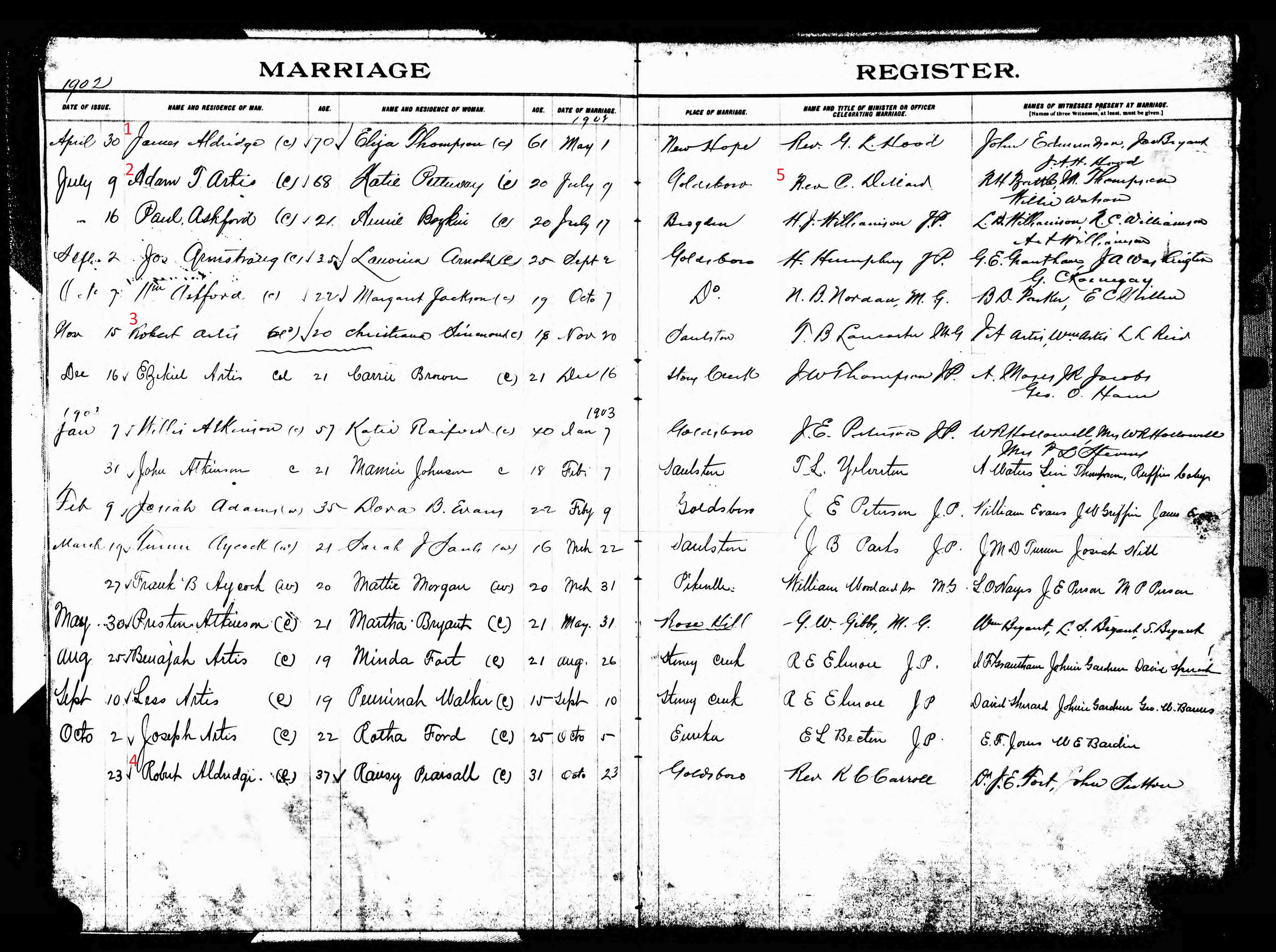
As a sample of the value of these records, here’s a single page from one Wayne County marriage register:

Wayne Marriage

1. James Aldridge, 70, married Eliza Thompson. Just about every “colored” Aldridge in 19th century Wayne County is a member of my extended family, but this one doesn’t seem to be one of mine. I can’t place a James born circa 1832. Perhaps this man came into the county from Lenoir or Duplin, which had slave-holding Aldridge families.

2. Adam T. Artis, 68, to Katie Pettiway, 20. This was my great-great-great-grandfather’s last marriage. He was actually 71, rather than 68, so Katie was more than 50 years his junior. (And her maiden name was actually Pettiford.) I’ve written about their family here. (By the way, more about their officiant, Rev. Clarence Dillard (5) here.

3. Robert Artis, 20, to Christiana Simmons, 18. Robert Artis was a son of Adam and Amanda Aldridge Artis. His witnesses may have been his cousin Jesse Anthony Artis, son of Jesse Artis, and uncle William Artis.

4. Robert Aldridge, 37, to Rancy Pearsall, 31. My great-great-grandfather John W. Aldridge‘s second youngest brother Robert finally married in 1903. He and Rancy (or Rannie) adopted a son, Bennie, born in 1908, and she died before 1916, when Robert remarried.

——

They’re not exactly brick walls, but this one data collection has revealed this and this and this and this… 

Standard
Agriculture, Land, North Carolina, Other Documents, Paternal Kin

A home for his lifetime.

The seventh in an occasional series excerpting testimony from the transcript of the trial in J.F. Coley v. Tom Artis, Wayne County Superior Court, November 1908.

Defendant introduces JESSE ARTIS who being duly sworn, testified:

I had a conversation with Tom Artis and Hagans about this land. I was working there for Hagans (Plaintiff objects) as carpenter. Tom Artis was working with me. The Old man Hagans was talking to Tom about claim which Mrs. Exum had on his land, and was telling him that he had some money at that time, and was would take it up if he wanted to, and give him a home for his lifetime. He left us, and Tom talked to me. I told him he did not know whether he would have a home all his life or not. I advised Tom to let Hagans take up the papers, and Tom did so. Hagans told me next day that if Tom should pay him 800 lb. of cotton he should stay there his life time. When he paid him his money back, the place was his. I don’t know that Tom and I are any kin. Just by marriage. We are not a member of the same Church.

CROSS EXAMINED.

When I was a carpenter ‘Pole told me all about this on his place. He took me into his confidence. I don’t know whether he told me all. He told me a good deal.

——

Jesse Artis (circa 1847-circa 1910) was a brother of my great-great-great-grandfather Adam Artis and his brother Jonah Williams, the latter of whom also testified in this trial.

Standard
Births Deaths Marriages, Migration, Newspaper Articles, North Carolina, Paternal Kin, Photographs, Virginia

Adam’s diaspora: Haywood Artis.

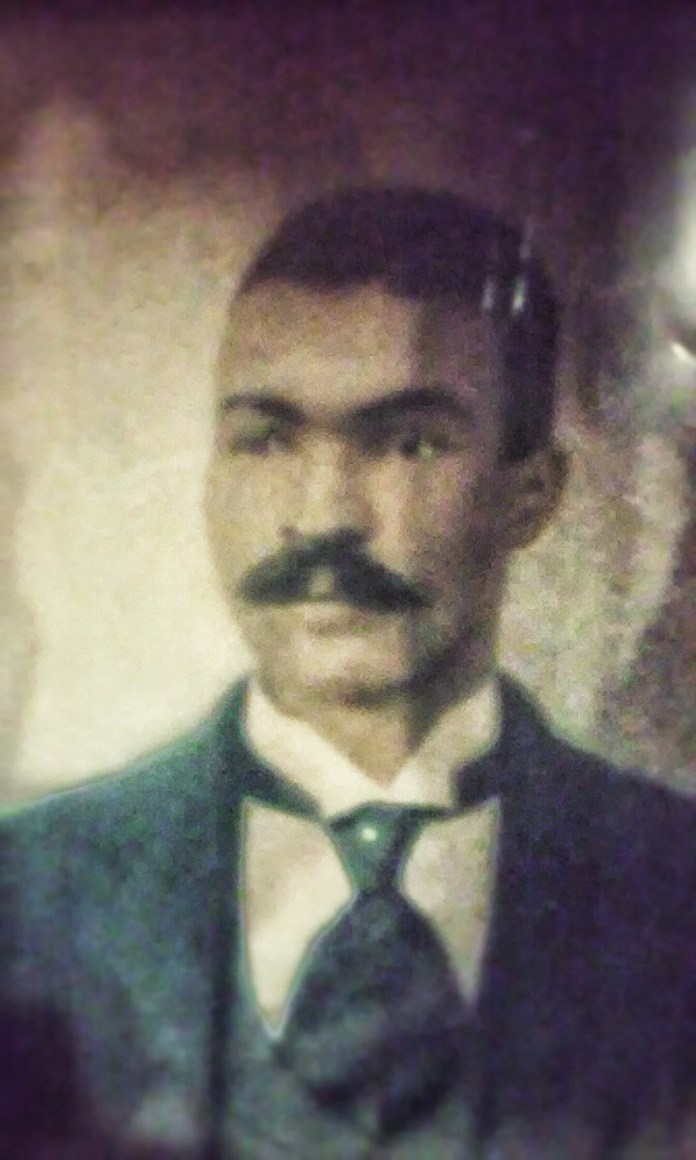
I’ve written here and here about the migration of Adam T. Artis‘ children Gus K. and Eliza to Arkansas. Though most of his 30 or so children remained in North Carolina, a few went in North. Or, at least, a little further north. One was Haywood Artis, born about 1870 to Adam and his wife Frances Seaberry Artis. He was my great-great-grandmother Vicey‘s full brother.
20150204_170518~2

                          Haywood Artis

In the 1880 census of Nahunta, township, Wayne County, North Carolina, Adam Artis, widowed mulatto farmer, is listed with children Eliza, Dock, George Anner, Adam, Hayward, Emma, Walter, William, and Jesse, and four month-old grandson Frank Artis.  (I’ve never been able to determine whose child Frank is.]

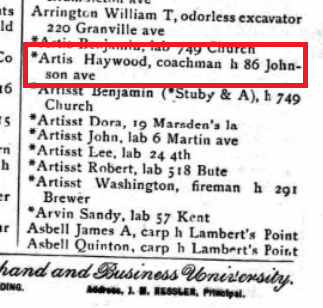
Haywood’s whereabouts over the next 15 years are unrecorded, though he was likely still living in his father’s home most of that time. However, at some point he joined the tide of migrants flowing into Tidewater Virginia, and, on 13 January 1897, in Norfolk, Virginia, Hayward Artis, age 26, born in North Carolina to A. and F. Artis, married Hattie E. Hawthorn, 23, born in Virginia to J. and E. Hawthorn. As early as 1897, Haywood began appearing in city directories for Norfolk, Virginia. Here, for example, is Hill’s City Directory for 1898:

Hartis

Haywood and Hattie and their children Bertha E., 3, and Jessie, 11 months, appeared in the 1900 census of Tanners Creek township, Norfolk County, Virginia. The family resided on Johnston Street, and Haywood worked as a porter at a jewelry store. Ten years later, they were in the same area. Haywood was working as a farm laborer, and Hattie reported four or her seven children living — Bertha, 12, Jessie, 11, Hattie, 8, and M. Willie, 2.

In the 1920 census of Monroe Ward, Norfolk, Haywood and Harriet Artis appear with children Elnora, 22, Jessie, 20, Hattie, 18, Willie Mae, 12, Haywood Jr., 8, and Charlie, 5.  Haywood was a farm operator on a truck farm, daughters Elnora and Hattie were stemmers at a tobacco factory, and son Jesse was a laborer for house builders.

By 1930, the Artises were renting a house at Calvert Street.  Heywood Artis headed an extended household that included wife Harriett, Haywood jr. (laborer at odd jobs), Charles, son-in-law Daniel Johnson (machinist for U.S. government) and his wife Hattie (bag maker at factory), cousins Henry Sample, Raymond G. Mickle, and Lois Sample, and granddaughters Mabel Johnson, 2, Olivia Washington, 15, and Lucille, 13, Bertha, 9, and Lois Brown, 6.

On 19 March 1955, Haywood Artis’ obituary appeared in the Norfolk Journal and Guide:

Haywood Artis, who has made his home in Norfolk for some 65 years, was buried following impressive funeral rites held at Hale’s funeral home March 7 with the Rev. W. H. Evans officiating.

Mr. Artis died March 4 at the home of his daughter, Mrs. Willie Mae Yancey, 2734 Beechmont avenue, after a long illness.

Mr. Artis, who was born in Goldsboro, NC, is survived by three daughters, Mesdames Elnora Brown, Hattie Johnson and Willie Mae Yancey, all of Norfolk, and a son, Hayward Jr., of New Jersey.

There are also 34 grandchildren, 33 great-grandchildren and other relatives and friends.

Interment was in Calvary Cemetery.

Thanks to B.G. for the copy of his great-great-grandfather Haywood Artis’ photograph.

Standard
Paternal Kin, Photographs

More good folks of Greene County.

Last week I joined a Facebook group called Greene County Family Researchers. It’s been just about the best thing since sliced bread. Trisha Blount-Hewitt introduced me to the group. She’s the researcher who alerted me to Bailham Speight’s Confederate pension application. Tammi L., who told me the story of Daniel Artis’ service to Christopher Lane during the Civil War, is a member of the group, as are other Lane researchers. Mike E. pointed me to a photo of Cain Sauls’ hotel, and several other group members have provided invaluable leads and resources.

Perhaps the most amazing is a photograph from the William L. Murphy Collection (#746) at Joyner Library, East Carolina University, shared by Mike E. He believes the house to have been that of Jesse B. and Henrietta Baker Murphy family. Notes with the photo date it to about 1900 and identify the African-Americans at left and right as residents of Artis Town. I can’t wait to show it to my Sauls cousins.

Murphy House Greene County

Standard