Births Deaths Marriages, Enslaved People, Free People of Color, Land, North Carolina, Paternal Kin, Photographs

Family cemeteries, no. 13: Artis Town.

We passed Edwards cemetery on the left, rounded the curve, and there, just where I suspected, was the turn-off onto a farm road leading to Artis Town cemetery. The graveyard is a rectangle of green amid bare spring fields, neatly mowed. A row of weedy trees bristles down one side, broken limbs scattered from recent storms. The oldest stones tilt sideways or sprawl toppled on their backs, but the cemetery is obviously cared for. It lies at the heart of what was once known as Artis Town, a hundred or more acres between Highway 58 and Speights Bridge Road on which lived and farmed Artises and Edwardses in every direction, descendants of Daniel Artis, who bought the land in the 1800s. There was even a racetrack here, said my cousin, where men would line up horses and buggies for weekend contests. As time went by, however, the land got “swindled down.”

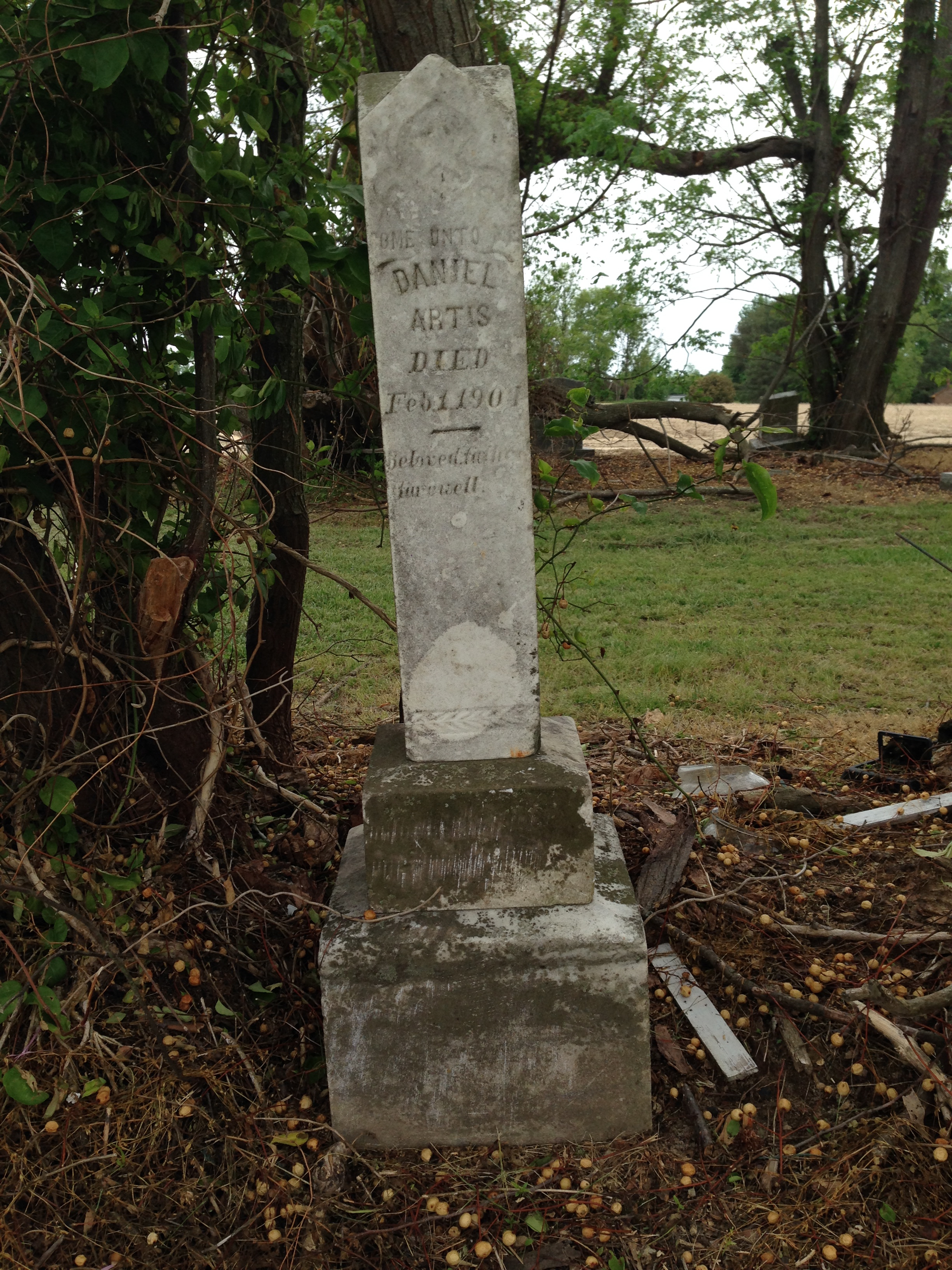
Daniel Artis’ headstone stands in a shadowy pocket underneath a chinaberry tree, the grave itself sprinkled with wrinkled yellow fruit. The small white marble obelisk is a testament to Daniel’s prosperity and the esteem in which his offspring held him.

IMG_5197

I did not locate stones for any of Daniel’s children in the graveyard, though surely some are buried there. (Daughter Clara Artis Edwards is buried in the nearby Edwards cemetery.) Many markers memorialize the deaths of descendants of Loderick Artis and Prior Ann Artis Sauls Thompson, including Loderick’s daughter Sarah Artis Speight:

IMG_5192

and son, Manceson Artis:

IMG_5210

and daughter Hannah Artis Mitchell, as well as Prior Ann’s daughter Mariah Sauls Edwards:

IMG_5195

and a host of other Saulses, Forbeses, Artises, Speights and Mitchells descended from Daniel Artis.

Photos taken by Lisa Y. Henderson, 2 May 2014.

Standard
Civil War, Enslaved People, Free People of Color, North Carolina, Oral History, Paternal Kin

Daniel was always spoken of with respect and love.

I recently received a comment from a reader in response to my posts on the Daniel Artis family. She was hesitant to contact me because her ancestor John Lane had owned slaves — quite possibly some of the people I’ve written about — but was anxious to share a story about Daniel that had been passed down in her family for 150 years. I was surprised and excited to read her message and encouraged her to get in touch. Here’s our April 28 exchange:

Hi, Tammi! Please forgive my excitement and inability to wait for your response. I’m traveling to NC next week to meet some of my newfound Sauls relatives — descendants of Daniel Artis. I’m just beside myself wondering about John Lane — whom I believe apprenticed several of Daniel’s sister Sylvania’s children and might have owned Sylvania’s husband, Guy Lane. I know you’re busy, but I hope you’ll be able to touch base soon. Thanks again!

——

Lisa, thank you for getting back to me! … Yes, apparently there were a few children apprenticed. I recall, I think, five or six on one census. The younger Daniel Artis was 17 years old on, I think, the 1860 census in my g-g-grandfather John Lane’s home. From my family’s handed down stories, the little Daniel was my g-g-g-uncle Christopher Lane’s body servant. Christopher was one of John’s sons and only about seven years older than little Daniel. So they kind of grew up together. The story is that when they both grew up Christopher went to War and Daniel was allowed to go with him as his servant because Christopher was an officer. Only officers could take a servant with them. Daniel was considered free before the war although an apprentice as you probably know. Well, Christopher was captured by the northern troops and taken to their POW camp at Fort Pulaski, Ga. He died there from dysentery. The thing that my family is grateful for is that Daniel went to the camp with Christopher and stayed with him until his death, never leaving his side. When he died, Daniel made his way back to Bull Head, NC to let Christopher’s family and his father John Lane know what happened to him. Daniel was always spoken of with respect and love for what he did for Christopher.

I thank you so much for replying to me, Lisa, because I’ve always wanted to thank his descendants for what Daniel did and for his devotion to our family in such a terrible time. I always wondered if the Daniel Artis next door who was older was related to little Daniel. I saw on the census that he owned property near John Lane, my relative. I hope this information helps some, and I wish all of his relatives happiness and blessings.

——

What a pleasure to hear from you! The Daniel you speak of was the older Daniel’s nephew. “Your” Daniel was the son of Sylvania Artis, a free woman of color, and Guy Lane, her enslaved husband. My direct ancestor, Vicey Artis, was the sister of Sylvania and Daniel the elder. Vicey also married a slave, Solomon Williams. Most of their children were apprenticed by Silas Bryant, a close neighbor of John Lane’s. Daniel the elder’s wife was enslaved, as were their children.

Thanks so much for sharing the story about Daniel the younger. I had no idea that he served in the War. I need to look in my files, but I don’t think I know much about him, though I recall that he married Eliza Faircloth. I do not know of any his descendants either. I grew up in Wilson NC, but with no knowledge of my Greene County links. During a visit home this weekend, I’m going down to Bull Head to meet some Saulses and visit Artis Town cemetery, which is where Daniel the elder was buried in 1905. I’ll keep you posted on anything I find about Daniel the younger.

If you are willing, I would love to share Daniel and Christopher’s story on my blog. I so appreciate your coming forth with this bit of history. Researching African-Americans is generally incredibly difficult, and so much lies locked away with other families. I always dream that someone will contact me just like you did!

Best wishes, keep in touch, and thanks again!

——

I’d be honored for you to use Daniel’s story, of course. I’ve also dreamed and wanted for years to find his relatives, as I mentioned, so I could thank all of them. To be honest, I don’t know if the younger Daniel was enlisted or just went along as an aide to Christopher. I’m only learning recently about the service of black troops both Confederate and Union. I don’t think Daniel was enlisted but I may be wrong. I’ve found the Saulses in many of my genealogy searches but not able to make a connection directly to the Lanes. I can’t remember if I mentioned but my genealogy research came to a brick wall with my g-g-grandfather John Lane. No one anywhere, not even Ancestry.com knows who his father was for sure. I have hints but nothing else. It’s all fascinating.

I can only imagine the difficulty there must be tracing African American genealogy, but I see DNA is being used which is great. It’s part of why I find Scuffalong so interesting. There’s so much information. I really love hearing about Vicey, Sylvania and the elder Daniel since their names have come up so often in my own research. And so happy to meet you, a descendant! Many of my Lane ancestors ended up in Wilson, NC after leaving Bull Head. I’m not sure why, but there were many there in my research including a great-grandmother of mine. Please pay my respects at the Artis Cemetery, to their memory, Lisa, when you visit it. Feel free to write me anytime, if you have any thoughts or questions or just to say hello!

——

CCLane Page 2

Christopher C. Lane enlisted in the 3rd North Carolina Infantry on 23 April 1861 at Snow Hill, Greene County. He was wounded at Gettysburg on September 1863, recuperated at home, then returned to war. He was captured 12 May 1864 at the Battle of the Wilderness, Virginia, and sent to Fort Delaware. In August, in retaliation for the Confederate Army’s imprisonment of Union officers as  human shields in Charleston, U.S. Secretary of War Edwin Stanton sent 600 Confederate officers to Morris Island, South Carolina, to serve as human shields. Lane was among them. After 45 days, the men were transferred to Fort Pulaski, Georgia, and imprisoned in dismal conditions. Christopher Lane died there on 8 December 1864.

I have found no record of Daniel Artis’ service to Christopher Lane during the Civil War, which is not surprising. He was not a soldier; he would not have enlisted. The role of body servants in the early days of the War is the subject of intense debate, and Artis’ status as a free man of color, rather than a slave, further complicates any assessment of his motives (or volition) in following Lane to war.

Many thanks to Tammi Lane for reaching out and sharing a part of Daniel Artis’ life that would otherwise be lost to his family.

——

Image found at http://www.fold3.com.

Standard
DNA, North Carolina, Paternal Kin

DNA Definites, no. 14: Artis.

Well, I’ll be….

Several months ago, I sent a share request to N.S. on 23andme because he listed Kinston NC as a family location. N.S. is a match to my cousin K.H. Though K.H. and I don’t have ancestors from Lenoir County, it’s close enough to Dudley that I thought it worthwhile to establish contact.

I was skimming through K.H.’s matches yesterday and stopped short at N.S. … Hmmm … Kinston? Speight? Could he …?

I sent a message, “Are you descended from Lemmon Speight?,” and he quickly responded that he is indeed, that Lemmon was his grandfather.

If you remember, I discovered Lemmon Speight a few weeks ago in the Civil War pension application file of Bailham Speight. Speight’s widow Hannah Sauls Speight, several friends and relatives, and Lemmon himself testified that Lemmon, Hannah’s first child, had been fathered by Loderick Artis, whom she had never married. Loderick Artis was the son of Daniel Artis, who was brother of my great-great-great-great-grandmother Vicey Artis Williams.

N.S. and K.H. share .46%, and 23andme estimated their relationship as 3rd-5th cousins. They are, in fact, 4th cousins.

[UPDATE: I was at the North Carolina State Archives last week when my phone rang with an unfamiliar number from area code 202. I stepped out to answer it and found myself talking to N.S.’ brother-in-law, the family historian. We talked in depth later that night, and he told me that the family had long known the identity of Lemmon Speight’s father, that several descendants migrated to Georgia and are holding a reunion here next year, that he himself is also a Greene County Speight, and did I know D.S.? “Are you kidding??? He lives two doors down from my parents! I’ve known him all my life!” They are both descended from Stephen and Fereby Speight and are somehow related to Mr. Kenny!  — LYH, 6 May 2014]

Standard
Agriculture, Free People of Color, Land, North Carolina, Other Documents, Paternal Kin

He never said he had any claims on the land.

The first in an occasional series excerpting testimony from the transcript of the trial in J.F. Coley v. Tom Artis, Wayne County Superior Court, November 1908. Paragraph breaks inserted for better readability.

The Plaintiff introduces W.S. Hagans, who being duly sworn testifies as follows:

I sold this land, the 30 acre, 24 acre, and the 9 1/3 acre pieces to Mr. Coley. Mr. Cook had been negotiating with me for the purchase of the 30 acre tract and the 24 acre tract. He did not want the 9 1/3 acre tract. I met Mr. Cook on several different occasions, until finally we met at Eureka one afternoon, he was considering it, and we finally decided on the deal. Mr. Cook was to give me $40.00 per acre for the the 30 acre tract, and the 24 acre tract. Before Mr. Cook did this however, he informed me that there was a missing link in the title, that he had found after investigating it. I told him that that was perfectly alright, as there had never been any question about it.

After our conference at Eureka, the day was set for me to meet him in Goldsboro, where he was to pay me the consideration, the price of the land, and I in turn to give him a deed for the land. He did not come on that day, but ‘phoned me at Fremont that he did not succeed in raising the money, but to please hold it open until tomorrow.

Early tomorrow morning, before sunrise, a bitter cold morning, the Defendant [Tom Artis] came to my house in Goldsboro. I asked him what brought him to town on such a cold morning, he said he came to bring a message from Mr. J.F. Coley, that Mr. Coley said that he wanted to buy that land, and would take all three of the tracts instead of two, said the Defendant to me, “that will be to your advantage.” The Defendant stated to me that Mr. Cook’s time was out yesterday. I expressed surprise that the Defendant should be familiar with those circumstances. Afterwards I said to the Defendant, that while Mr. Cook’s time was out yesterday, that Mr. Cook had phoned me yesterday & said he had a great effort to reach me, and finally did so asking me to hold the matter open until tomorrow. I told him that I would feel honor bound if Mr. Cook should come to me with the purchase price for the two tracts of land, to let him have it, although I would prefer selling the three tracts together. The Defendant said to me that if Mr. Cook got possession of this place that he the Defendant would not be able to stay there as Mr. Cook was a very disagreeable man to get along with. I told the Defendant that I would not deed this property to Mr. Cook, or to any one else until they made the same promise to me in reference to the Defendant’s staying where he has, that I made to my father in the presence of the Defendant.

The Defendant remained in shooting distance of me all of the day, waiting for me to see Mr. Cook that he might get from me a final message to take back to Mr. Coley. I saw Mr. Cook, and he informed me that the reason he couldn’t take it was that he had experienced great difficulty in raising that money. That money was hard. I was really glad of this, and so informed the Defendant, for I wanted to sell the three tracts if possible, together. Then I asked the Defendant to say to Mr. Coley on his return home, that I would meet him at the Defendant’s house on Friday, I think it was, but having business out there, I drove past, and got the Defendant and took him out to the Plaintiff’s place of business that was on Thursday, I went the day before the time set, and stated to the Defendant the object of my going down there, and asked him to go with me.

We went down there and Mr. Coley and I had a talk aside from the Defendant, and finally wound up in the Defendan’t presence. The conversation we had in the presence of Tom was Mr. Coley might have the three pieces of land, in consideration of $3250, and I take his paper. This was said in the Defendant’s immediate presence, he sitting on the buggy beside me. We left, the Defendant expressing himself as highly pleased that Mr. Coley had bought the three pieces of land, said he thought I had made a fine trade. He made no objection at any time to the sale of the land. He encouraged it all the while. He never intimated to me that he had any claims on this land of any kind. None whatever.

I got the land about 1899, deed of partition between my brother [Henry E. Hagans] and myself. After I got the land I rented that to the Defendant. The first year I think, I charged him 850 lb. of lint cotton, thinking all the while that my brother having acted for us both got 850 lb. for the two places, the 30 and the 24 acre lot.The Defendant informed me that my brother had been charging only 800 lb., and I agree to the 800 lb. He did not at any time when delivering this cotton say that he was paying it as interest and taxes. (Defendant objects.) He has never said anything about paying it as any way than rent. He has never mentioned taxes to me on that property. I listed that land and paid the taxes.

I had some work done on that house since I came in possession. The Defendant patched the roof and also built a porch. I do not wish to state that I had it built. I paid for the lumber. The Defendant did the work himself.

The Defendant came to my place in front of the gin house last fall, and said to me that he had understood that I was going to sell those three pieces of land down there, we called it the Tom Pig place, the Calv Pig place and the Adam [Artis] place. He said he wanted to buy the Tom Pig place or the 30 acre. He asked me if I would prefer selling it all together. I asked him what he would want to give me for the 30 acre tract piece, and he said he would give me $800.00 for it. I told him I couldn’t take that, as I had already been offered $40.00 an acre, or $2160 for the two places. He asked me to give him time that he might hear from his boys in Norfolk, that he was confident that he could raise the purchase price for the 30 acre tract, if not for it all. The Defendant and Durden Fort were present at the time. Durden Fort has since died. In payment of this land, Mr. Coley’s notes were security fort this property. Mr. Coley’s home place I think. 60 some odd acres in addition to what I sold was given as security. One note is due in January.

CROSS-EXAMINED.

Tom said to me, “I think you sold those three pieces of land well.” He said that on the buggy. Mr. Coley and I behind the barn talked about this land. He wanted to get the land for $3000. I had an idea that Mr. Coley was a pretty good trader, and wanted to get it as cheap as possible, and I told him behind the barn what three pieces I wanted to sell him them for. I didn’t have to go through any particular form, we didn’t close the thing out, we continued the conversation until we separated. The pieces of land were all understood. He said in the presence of Tom, “For the three pieces of land I will give you $3250.00.” I thought it was necessary to innumerate the three pieces so he would see what he was getting.

Tom has lived on that place ever since I had it. I don’t know to my personal knowledge if he lived off of it. I was in school at the time, or at any rate away from home. Durden Fort was present at the conversation we had. He died in the summer. I had him as a witness. I did not rent my land at the same price every year to every body, not necessarily, to some I did, some I didn’t. The reason I charged him 800 lb. was because my brother rented it to him for 800, and I thought it was all he was able to pay, and there were other considerations. There were other considerations that induced me to charge only 800 lb. of lint cotton for the land. (Plaintiff objects.) It arose out of a conversation I had with my father [Napoleon Hagans] and Tom. My father was in feeble health in 1896. He called my brother and myself under the cart shelter at the home place and said to us that he was not going to live long, and he did not know to which one of us, that is his two sons, would fall heir to that property. Tom was present. That was the land in controversy. (Plaintiff objects), but as long as the Defendant, whom he called “Pig” paid his rent, let him remain. We promised. He did not say how much rent. I did not know as far as I remember that Tom paid to my father 800 lb. of lint cotton. I don’t know. I would rather believe he did. (Plaintiff objects.)

Standard
Births Deaths Marriages, Civil War, Military, North Carolina, Other Documents, Paternal Kin

I know they were married by law.

Feverish with malaria, friends and family at his side, Baalam Speight closed his eyes a final time on 21 December 1902, free of the pain that had wracked him for years. He left a widow, Hannah Sauls Speight, and nine children, but little otherwise to show for a lifetime of hard work. Hannah and youngest son, George Speight, just 13, faced uncertain times.

Baalam Speight was born about 1840 in Greene County. In the waning days of the Civil War, he and his brother Lafayette Edwards slipped away from their plantations to make their way to Morehead City, North Carolina. There, in March 1865, they enlisted in Company H, 14th United Stated States Colored Heavy Artillery. Baalam had not yet adopted his father’s surname and joined the army as “Baalam Edwards.” He and his company served garrison duty at Fort Macon until mustered out on 11 December 1865. In 1890 and again in 1892, 1895 and 1896, Baalam applied to the U.S. government for a veteran’s pension. Though he once been a “well developed, powerful built man,” he complained of “fluttering of the heart,” muscle pains, eye disease as a result of measles, rheumatism, lumbago, deafness and “misery in the head” attributable to exposure during his military service. Several doctor’s examinations concluded, however, that Baalam’s troubles were primarily attributable to old age, and his claims were rejected.

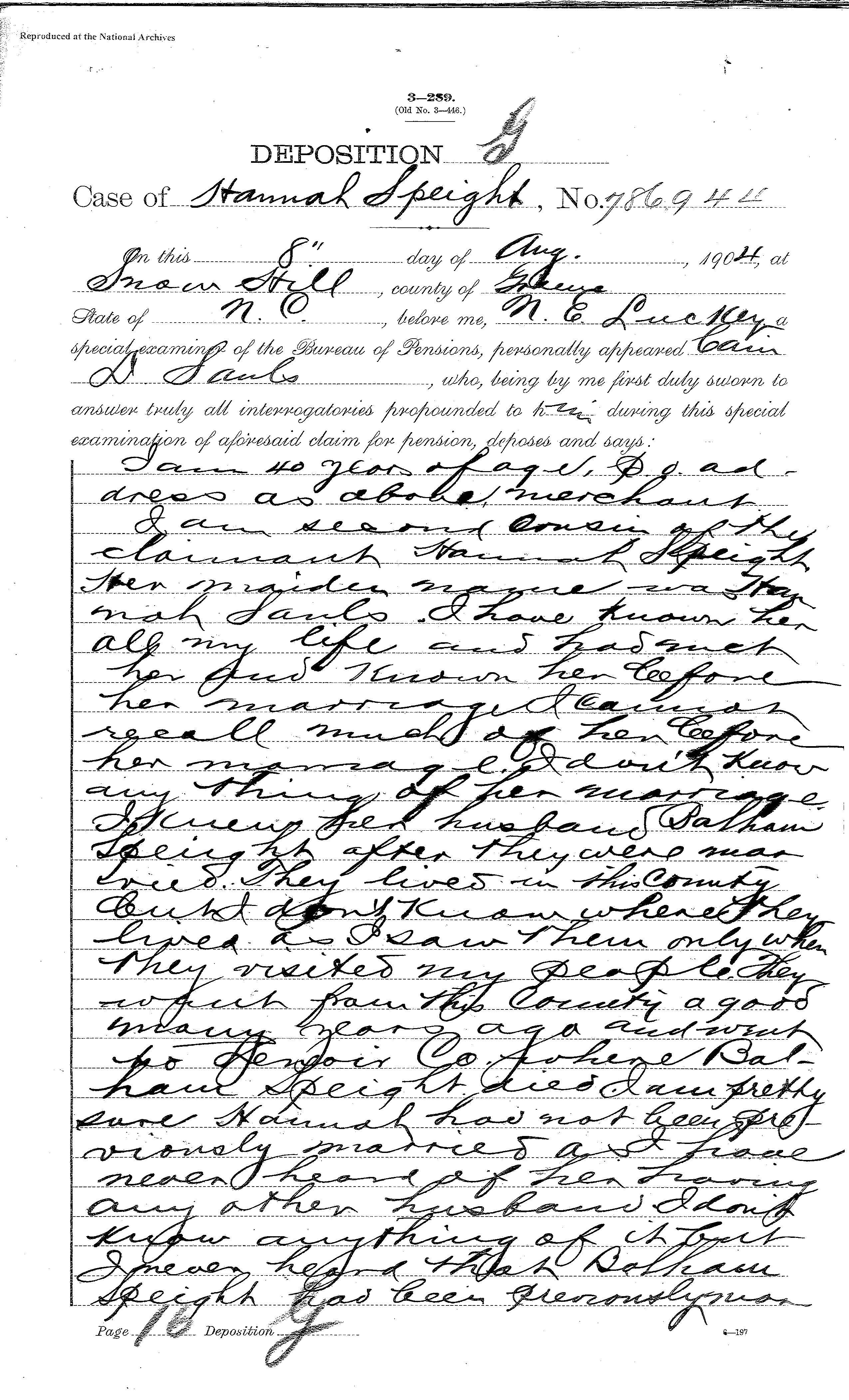
Despite Baalam’s failed attempts, Hannah Speight squared her shoulders and filed a widow’s claim in June 1903. It was assigned No. 786,944. Her burden? To prove that she and Baalam were legally married and never divorced. What might have been a straightforward task was complicated by the fact that Greene County’s courthouse had burned down with everything in it and the magistrate who had performed the ceremony was overworked and often drunk. Hannah turned to neighbors and friends to make her case, and nearly a dozen were deposed over the course of several days in August 1904. In addition to corroborating Hannah’s account of her marriage, they present a trove of personal information about the lives of Hannah and Baalam’s circle:

  • Mariah Moore – midwife; 78 years old in 1904;  lives near Kinston, Lenoir County; delivered Baalam and Hannah’s youngest son George Speight; her unnamed husband died in July 14 years ago.
  • Maria Loftin — about 62 years old, wife of Cornelius Loftin; lives near Kinston; lived on Harvey plantation at same time as Balaam Speight and recalled his marriage. “I used to patch his clothes before he was married … I was freed by Lincoln and staid on Bear Creek four years then I went to near Snow Hill on Harvey place where I met Baalam and I staid there two years.”
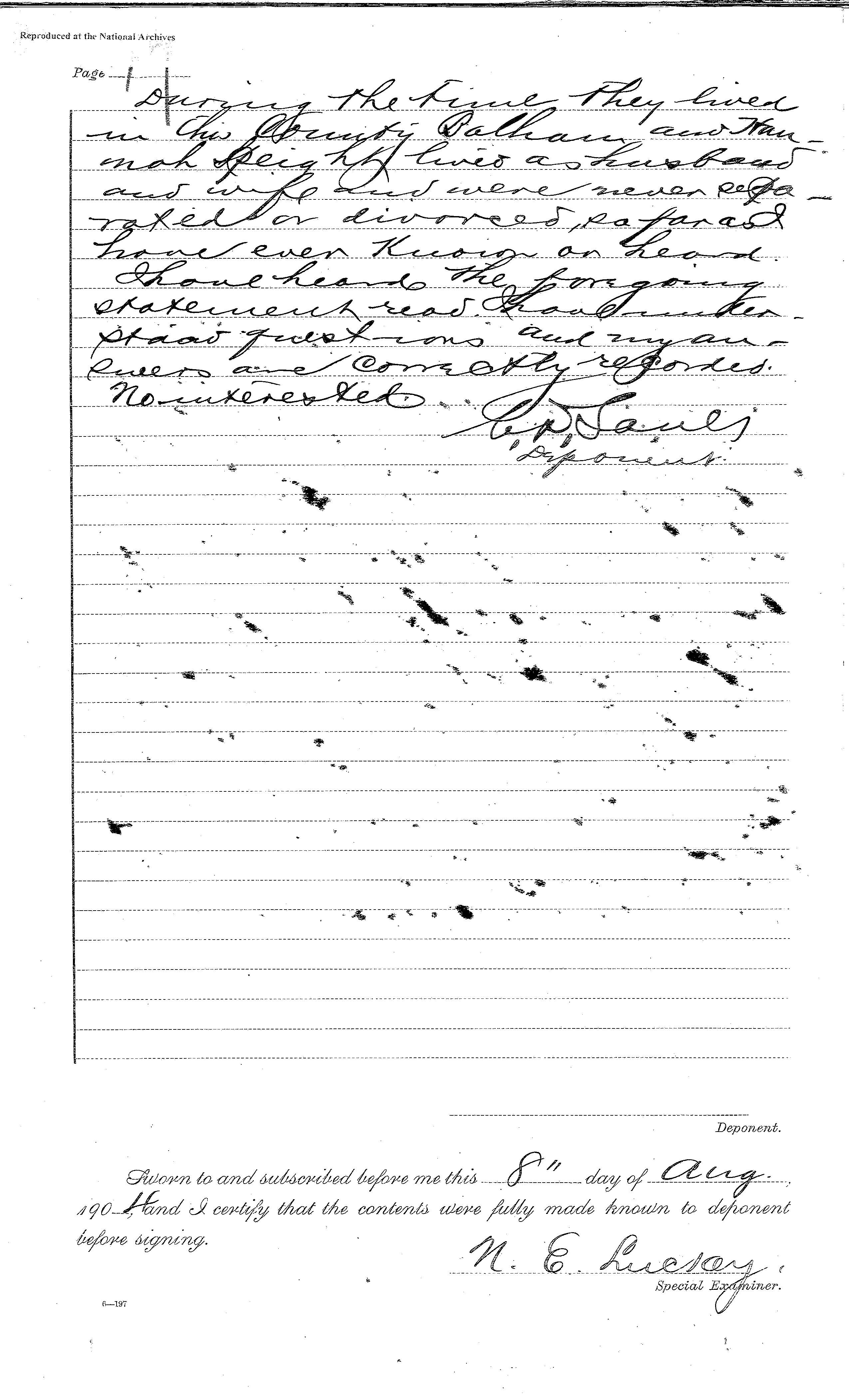
  • Cain D. Sauls – Lives in Snow Hill, Greene County NC. “I am 40 years of age … merchant. I am second cousin of the claimant Hannah Speight. Her maiden name was Hannah Sauls. I have known her all my life ….[She and Balham] lived in this county but I don’t know where they lived as I saw them only when they visited my people.” [Only witness who signed his own name. All others signed with X.]
  • Viola Edwards – Lives in Bull Head, Greene County. “I don’t know my age, am 50 or more. … Wife of LaFayette Edwards. … I lived just across the creek from [Hanna Sauls] when she married Baalam Speight. … I recollect that they were on the plantation next to the one I lived on at that time. It was the Rawls plantation …. I did not know Jennie the slave wife of Baalam Edwards ….”
  • Grace Harper – about 62 years old, wife of Lewis Harper, lives in Snow Hill. “I knew Balham Speight as a boy before he went away to go into the army. … I had known Hannah Sauls as a girl and lived in two miles of her before she married Balham Speight. … I think they had one child before they lived at Kinston … Yes Hannah had a child by Loderick Artist before her marriage to Balham Speight, but she did not marry or live with him or any other man until she married Balham. …”
  • Mary Shepard – About 70 years old, lives near Snow Hill. Widow of Marcus Shepard. “I knew [Hannah’s] aunt Becca [Best.] … They lived around here about two years after they were married and then moved away to Lenoir Co. … Baalam Speight was a brother of Fate Edwards. He was always called Baalam Speight. I think he was owned by Jim Edwards and that his father was Reddin Speight. … It seems to me that Hannah had a boy by Loderick Artist before her marriage to Baalam Speight …”
  • Lewis Harper – Lives in Snow Hill. “I am about 65 years of age … laborer…. I was born and raised in Greene County and knew Balham Speight as a boy. We lived about 3 miles apart and were right often together before he went away to go into the army. … I knew when Balham Speight was married to Hannah Sauls, it was not mighty long after the war. It may have been two or three years after. … They did not remain near Snow Hill very long until they moved to Kinston where they remained afterwards up to his death. … Hannah had a child by the man Loderick Artist a year and a half before she married Balham while she was living with her parents. … Loderick Artist was my brother and is dead.
  • LaFayette Edwards – 63 years of age, lives in Bull Head, Greene County. “I served as a corporal of Co. H, 14 U.S.C.H.A. and knew Baalam Edwards of that company; he was my brother and our father was Reddin Speight. In slave time I belonged to Ap. Edwards and he belonged to his brother Orfa Edwards. We were raised and enlisted, served and discharged together. After he came out of the army he worked in turpentine one year or so in S.C. or Georgia. … After that he came back and lived on Hill place near Kinston. But for two or three years after he came from the South he lived out near Snow Hill. He was married close to Jno. Harvey plantation to Hannah Sauls daughter of Shepard Sauls. … I know they were married by law as there was no taking up with each other in those days. … Before he married Hannah Baalam had lived with a woman named Jennie Suggs in slave time. She died while we were in the service. I did not go to the burial, but we were at Morehead City not far away when she died and heard of her death at the time.”
  • Peter Hood – 64 years old, farmer and pensioner, lives near Kinston. “I was a pvt. in Co H, 14 U.S.C.H.A. and knew Baalam Edwards. He was in my company and I was witness for him when he was trying to get pension. … He was a sort light complected spare somewhat tall man. I don’t know his height. I reckon he was about as tall as you (about 5 ft. 10 in.)”
  • Isaac Edwards alias Eddis — 67 year-old farmer. “I am not a pensioner but I served as a pvt. in Co. H, 14 U.S.C.H.A from Mch. 8, 1865 to Dec. 11, 1865. I knew a man named Baalam Edwards in my company. I had known him before we went into the army and we had both belonged to Betsy Edwards in slave time and lived not far apart. His father was Reddin Speight. He used the name of his mistress in the army and after he came out of the army he went by the name of his father Speight. … [H]e was married to a woman named Hannah Sauls. This was the first wife of Baalam Edwards except that he had a slave wife named Jennie.” “Baalam Edwards was not sick and did not get hurt in the army, except that he had mumps at Ft. Macon. He was a long slim, not very dark, dark hair and eyes. I am six feet high, he was not quite as tall as I am.”
  • Francis Williams — 70 year-old pensioner. “I was a corporal in Co. I, 14 U.S.C.H.A. and I knew Balham Speight. He was a member of my regiment.” [C.D. Sauls signed as witness.]

The testimony was satisfactory, and Hannah was granted a pension of $10/month.

A document in this pension file lists Baalam’s children as Charles, born 12 April 1870; Nancy Susan, 19 February 1872; Lizzie, 8 March 1874; Claiborn, 30 March 1876; Major, 27 September 1879; James, 8 April 1882; Franklin, 19 June 1885; Luvenia, 5 April 1887; and George Meade Speight, 26 September 1889. Census records reveal a tenth child, who was oldest. Lemon Speight’s Lenoir County death certificate lists his birthdate as 27 April 1867 — about a year-and-a-half before Baalam and Hannah married in late 1869. The certificate also names Baalam as Lemon’s father, but, as several witnesses testified, he was in fact the son of Loderick Artis.

The file reveals other tantalizing tidbits, in italics, related to my family. How were Loderick Artis and Lewis Harper brothers? On their mother’s side? Or through Loderick’s father Daniel Artis? Cain Sauls, who was Loderick’s nephew, testified that he was Hannah’s second cousin. Her parents were Rosetta Best and Sheppard Sauls. Who was Sheppard to Cain?

ARTIS -- CD Sauls Deposition_Page_1

ARTIS -- CD Sauls Deposition_Page_2

Deposition of Cain D. Sauls, 8 August 1904.

File #786944, Application of Hannah Speight for Widow’s Pension, National Archives and Records Administration. Hat tip to Trisha Blount Hewitt for pointing out the mention of Loderick Artis in Baalam Speight’s file, #988961, which is included in Hannah’s file.

Standard
Education, Newspaper Articles, North Carolina, Paternal Kin

School districts. (Colored.)


Gboro Messenger 11 19 1885 school commr

Goldsboro Messenger, 19 November 1885.

Phillip R. Coley, son of Winnie Coley, was the half-brother of Napoleon Hagans‘ son William M. Coley and Adam T. Artis‘ children Cain Artis and Caroline Coley Artis. Richard Artis was Adam T. Artis’ brother, and Simon Exum was his brother-in-law, husband of Delilah Williams Exum. Peter Coley may have been Phillip Coley’s father.


Standard
Business, Newspaper Articles, North Carolina, Other Documents, Paternal Kin

The colored people of Wilson have organized a bank.

In December 1920, five of Wilson, North Carolina’s leading African-American citizens executed a certificate of incorporation to establish the Commercial Bank of Wilson. The bank was necessary, they asserted, “to promote thrift and economy,” “to encourage agriculture and industrial enterprises,” and “to place in circulation money otherwise unavailable.” Farmer, realtor and businessman Samuel H. Vick; barber William H. Hines; school principal J. James D. Reid; funeral home operator and businessman Camillus L. Darden and physician Frank S. Hargraves — the unquestioned cream of east Wilson‘s crop — each invested in 100 shares of bank stock and, after filing the document, set about designating a president (Hines) and board of directors (J.R. Rosser, Isaac A. Shade, Cain D. Sauls, Charles S. Thomas, R.A. Worlds, John Lucas, C.S. McBrayer, J.O. Mitchell, Lee Pierce, Alfred Robinson and Judge D. Reid), and a cashier (G.W.C. Brown).

Attached to the filing are three pages listing the names of all the bank’s investors and providing information about their net worth and occupation.  Most of more than 150 shareholders — overwhelmingly African-American men — lived in Wilson or Wilson County, but adjoining counties like Wayne, Greene and Johnston were represented, as well as more far-flung cities like Durham and Elizabeth City, North Carolina.  They were farmers and contractors, merchants and ministers, teachers and barbers, with estimated worths ranging from $300 to $50,000.

Image

Image

Image

At least two of my relatives were among the bank’s investors. C.D. Sauls of Greene County, whose connection through Daniel Artis I chronicled here, was a bank officer, and his cousin Columbus E. Artis, who owned and operated a funeral business in Wilson, bought five shares.

ImageHill’s Directory of Wilson, North Carolina, 1922.

Newspapers reported the bank’s opening excitedly.

Wilm Morning Star 11 18 1920

Wilmington (NC) Morning Star, 18 November 1920.

The Independent Eliz City 2 25 1921

Elizabeth City The Independent, 25 February 1921.

E City Independent 3 4 1921Elizabeth City The Independent, 4 March 1921.

In the 1921-1922 issue of The Negro Year Book: An Annual Encyclopedia of the Negro, Monroe N. Work, editor, Commercial Bank of Wilson was listed as one of only eight black banks in the state of North Carolina, which trailed only Virginia (13) and Georgia (9) in the number of such institutions. [Sidenote: one of Virginia’s was Crown Savings Bank of Newport News, for which my great-grandfather John C. Allen served as board member.]

Alas, things fell apart. After a fire in the vault destroyed records, the State launched a criminal investigation that resulted in the closing of the bank on 4 September 1929 and the indictments of vice-president (and chief promoter) J.D. Reid and cashier H.S. Stanbank on charges of embezzlement, forgery and deceptive banking practices. As reported in the 22 February 1930 issue of the Pittsburgh Courier, the courtroom was daily packed with victimized depositors and shareholders, all of whom bore an “intense feeling of resentment against the accused….” Both were convicted and sentenced to five-year prison terms — at hard labor — but released after two years.

burlington Daily Times-News 12 22 1931

Burlington Daily Times-News, 22 December 1931.

Standard
Free People of Color, Land, North Carolina, Other Documents, Paternal Kin

100 acres on Watery Branch.

Fourteen years into their marriage, Adam and Frances Seaberry Artis purchased three tracts of land totaling about 109 acres from her half-brother, Napoleon Hagans. All three are on or near Watery Branch, an east-flowing tributary of Contentnea Creek. The first two documents are a mortgage deed and deed of sale for two tracts on the creek. The third is a deed of sale for an additional nine acres nearby. Notably, this last is land upon which Adam had lived in prior years, as it contained the graves of his first wife, Lucinda Jones Artis, and a child.

—–

North Carolina, Wayne County  }  This indenture made this the 25th day of July AD 1874, between Adam T. Artis and wife Frances of the first part, and Napoleon Hagans of the second part, and all of the County and State above written, Witnesseth that the said parties of the first part for and in consideration of the sum of one dollar in hand paid by the said party of the second part, have bargained and sold and by these presents do convey unto the said party of the second part, and his heirs two tracts or parcels situated in the County of Wayne, and bounded as follows: viz: the first tract begins at a pine on the New Road in Willie Moorings line and runs with his line North 136 poles to a stake on the main run of Watery Branch, then up and with the various courses of the branch to the mouth of a small branch, then up the various courses of said branch to a stake, then E 20 poles to said new road, then with the same to the beginning, containing Eighty eight acres, more or less: the other tract begins at a stake in Cullen West’s line, and runs South 28 ¼ poles to a stake in said line Charity Bailey’s corner, then with his line West 67 ¼ poles to a stake Wm Bailey’s corner, then with his line West, 67 ¼ poles to the beginning, containing twelve and one fourths acres more or less _

And the said parties of the first part do for themselves and their heirs forever warrant and defend title to the above land, to the said party of the second part his heirs and assigns

The condition of the above deed is such whereas the above named Adam T. Artis is indebted to the said Napoleon Hagins in the amount of Fifteen hundred dollars, purchase money for the land herein conveyed, and for which said sum the said Artis has given promissory notes for $375.00 each, and payable in the manner following viz: the first note will be due on the 1st day of January AD 1876: at the same day and date the interest on the whole amount of the purchase money ($1500.00) from Jany 1st 1875 to that date will be paid annually on the first day of January. The amount of principal paid thereon to be deducted; the second note will be due on January 1st 1877, the third on January 1st 1878; and the fourth on Jany 1st 1879, and all are subject to the conditions set forth as to the first note above mentioned.

Now if the said Artis shall pay the interest as above set forth as they come due according to their tenor, then this deed to be void otherwise to be of full force and effect.

And upon the failure of said Artis to pay said noted and interest as above set forth as they severally fall due, then it shall be in the power of said Hagins to sell the land herein described after twenty days advertisement at the Court House door in Goldsboro and four other places in Wayne County, and after deducting the whole amount due him & the expenses of sale shall pay the balance if any to the said Artis or his legal representatives.

In testimony whereof the said parties of the first part have hereunto set their hands and seals the day and date first above written.

Witness: /s/ W.T. Faircloth             Adam X Artis, Frances X Artis

[Wife’s consent omitted.]

Deed Book 37, page 72, Wayne County Register of Deeds office.

—–

State of N. Carolina, Wayne County  } This indenture made this the 25th day of July in the year of Our Lord One thousand Eight hundred and Seventy four, between Napoleon Hagins and wife Absey Hagins of the first part and Adam T. Artis of the second part, all of the County and State aforesaid Witnesseth: that we said Hagins and wife parties of the first part for and in consideration of the sum of Fifteen hundred Dollars to us in hand paid by said Adam T. Artis  the receipt and payment whereof we said parties of the first part do by these presents hereby acknowledge ourselves fully satisfied content and paid before the ensealing signing and delivery of the same have bargained sold delivered given up conveyed unto said Artis his heirs and assigns two certain pieces or parcels of land lying in said County of Wayne on the South side of Watery Branch, the first tract adjoining the lands of Wiley Moring Charity Bailey and others, bounded as follows:  Beginning at a pine on the New Road in Willie Moring’s line and runs with said line N. 136 poles to a stake on the main run of Watery Branch, then up the various courses of the run as it meanders to the mouth of a small branch, then up the run of said small branch its various courses to a stake, then East 20 poles to said New Road, then with the same to the beginning, containing Eighty eight acres, more or less:

Also one other tract purchased from Wm. Bailey and wife Celia, adjoining the lands of Charity Bailey Wm. Bailey Cullen West and others bounded as follows: Beginning at a stake in Cullen West’s line and runs South 28 ¼ poles to a stake in said line Charity Bailey’s corner, then with her line West 69 ½ poles to a stake in said West’s other line, then with said line  N 28 ¼ to a stake, Wm Bailey’s corner then with his line W 69 ½  poles to the beginning, containing 12 ¼  acres more or less _

And we said Hagans and wife Absey parties of the first part do by these presents bind ourselves our heirs executors admrs & assigns forever free claims or encumbrances whatsoever

In testimony whereof we the said Hagins and wife have hereunto set our hands and affixed our seals, the day and date first mentioned.

Witness: /s/ W.T. Faircloth             Napoleon X Hagans, Absey X Hagans

[Wife’s consent omitted.]

Deed Book 37, page 74, Wayne County Register of Deeds office.

—–

North Carolina, Wayne County  }

This Deed made this thirty first day of October 1874 by Adam Artis and his wife Frances of Wayne County, and State of North Carolina to Napoleon Hagans of Wayne County, and State of North Carolina, Witnesseth that said Adam Artis in consideration of Two hundred & seventy five /100 Dollars, to them paid by said Napoleon Hagans, the receipt of which is hereby acknowledged, have bargained and sold and by these presents do bargain, sell and convey to said Napoleon Hagans and his heirs a tract of land in Wayne County, State of N.C. , adjoining the lands Bryant Yelverton & Jesse Mincey, and others, bounded as follows: viz: — Beginning at a stake on road in Yelverton’s line and runs S. 59 E. 51 ½ poles to a light stake in Yelverton’s line then N. 61 poles to another stake on said road then S. 54 W. with said road to the beginning containing 9 ¼ acres more or less.

Reserving a graveyard on said land, now paled in in which the said Adam Artis’ first wife & one child were buried.

To have and to Hold the aforesaid tract of land and all privileges and appurtenances thereto belonging to the said Napoleon Hagans and his heirs and assigns to them only

And the said parties of the first part do for themselves and their heirs forever warrant and defend title to the above land, to the said party of the second part his heirs and assigns to their only use and behalf

And this the said Adam Artis & wife Frances, covenant that they are seized of said premises in fee and have right to convey the same in fee simple, that the same are free from all incumbrances, and that they will warrant and defend the said title to the same, against the claims of all persons whatsoever

In testimony whereof, the said Adam Artis & wife Frances have known to set their hands and seals, the day and year above written  Adam X Artis, Frances X Artis

[Wife’s consent omitted.]

Deed Book 37, page 220, Wayne County Register of Deeds office.
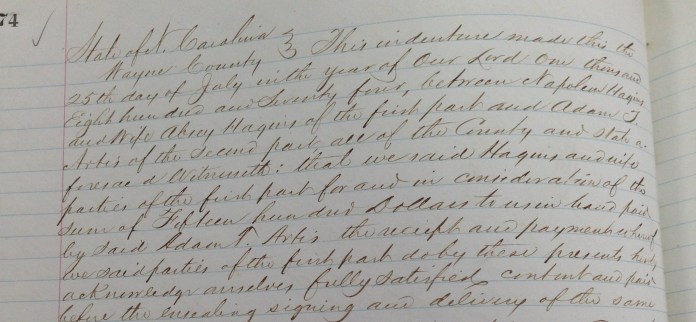
deed

Standard
Enslaved People, Free People of Color, Land, Newspaper Articles, North Carolina, Paternal Kin, Vocation

Black carpenter makes name for himself.

I’ve been pulling together a descendant chart for Daniel Artis. In part, I want to keep the names straight and, in part, I’m trying to see if I’m related to any of the other Edwardses, Saulses or Artises I grew up with. Tonight I Googled some random names from this family and up popped this, published just three days ago in Kinston.com, the on-line version of the Kinston Free Press. Andrew Sauls’ father was Isaac Sauls, son of Isaac Sauls, son of Prior Ann Artis Sauls Thompson, daughter of Daniel Artis, brother of my great-great-great-great-grandmother Vicey Artis Williams.

[Update, 7 March 2014: I emailed the Free Press journalist and two days later — yesterday — got a call from Andrew Sauls himself! He lives on land his grandfather bought in 1920 (plus 400 more); confirmed that the Artis Town sign is gone; knew M.’s grandfather, “Cousin Booker T.,” well; and promised to show me around Sauls-Edwards-Artis territory next time I’m home!  — LYH]

Standard
North Carolina, Paternal Kin

Long-lost cousins.

M. had the same first name — an unusual one in that time and place — and last initial as my first cousin. We met when I, a year too young, tagged along to my cousin’s Brownie Scout meetings. M. and I discovered that we lived down the street from one another and from then until my family moved away three years later, we were inseparable.

Several years ago, I did some basic genealogical research on M.’s mother’s family. Her grandfather was a Greene County Edwards, and I was able to trace his ancestry back to slavery. I gratified by the achievement, but nothing in what I found resonated on a personal level.

Fast forward to last week. While hunting for Artis Town, I revisited an Edwards cemetery that I first encountered five or ten years ago while driving Greene County back roads. As I noted here, this time I realized that these Edwardses were also Artises, descendants of Daniel, the brother of my great-great-great-great-grandmother Vicey Artis Williams. Standing there, mulling this over, I started thinking about M.’s family, her Edwardses, and wondering …

When I got back to my parents’ house, I hopped onto the internet. Twenty minutes, and a lot of scribbling and charting later, there it was. M.’s grandfather was the grandson of Mariah Sauls Edwards, who was the daughter of Prior Ann Artis Sauls Thompson, who was the daughter of Daniel Artis. In other words, M. is my cousin, too!

P.S. I figured all this out the day before M.’s birthday. A little present for us both.

P.P.S. An iron-clad childhood rule: “Don’t get in anybody’s car unless we have given you permission.” I broke it twice before the lesson took. The second and last time, I was about seven. I was playing down at M.’s house when her grandparents announced that they were about to ride down Greene County. I ran home to see if I could go with them. Nobody was home. I decided for myself and hopped in the car. I don’t remember much about the short visit — a white farmhouse on brick pillars standing on a slight hill, maybe? — but now I wonder. Was I visiting my own kin?

Standard