Births Deaths Marriages, Paternal Kin

Misinformation Monday, no. 2.

The second in a series of posts revealing the fallability of records, even “official” ones.

——

The “true facts”: Richard Artis Sr. was born about 1850 in Wayne or Greene County to Vicey Artis and Solomon Williams.

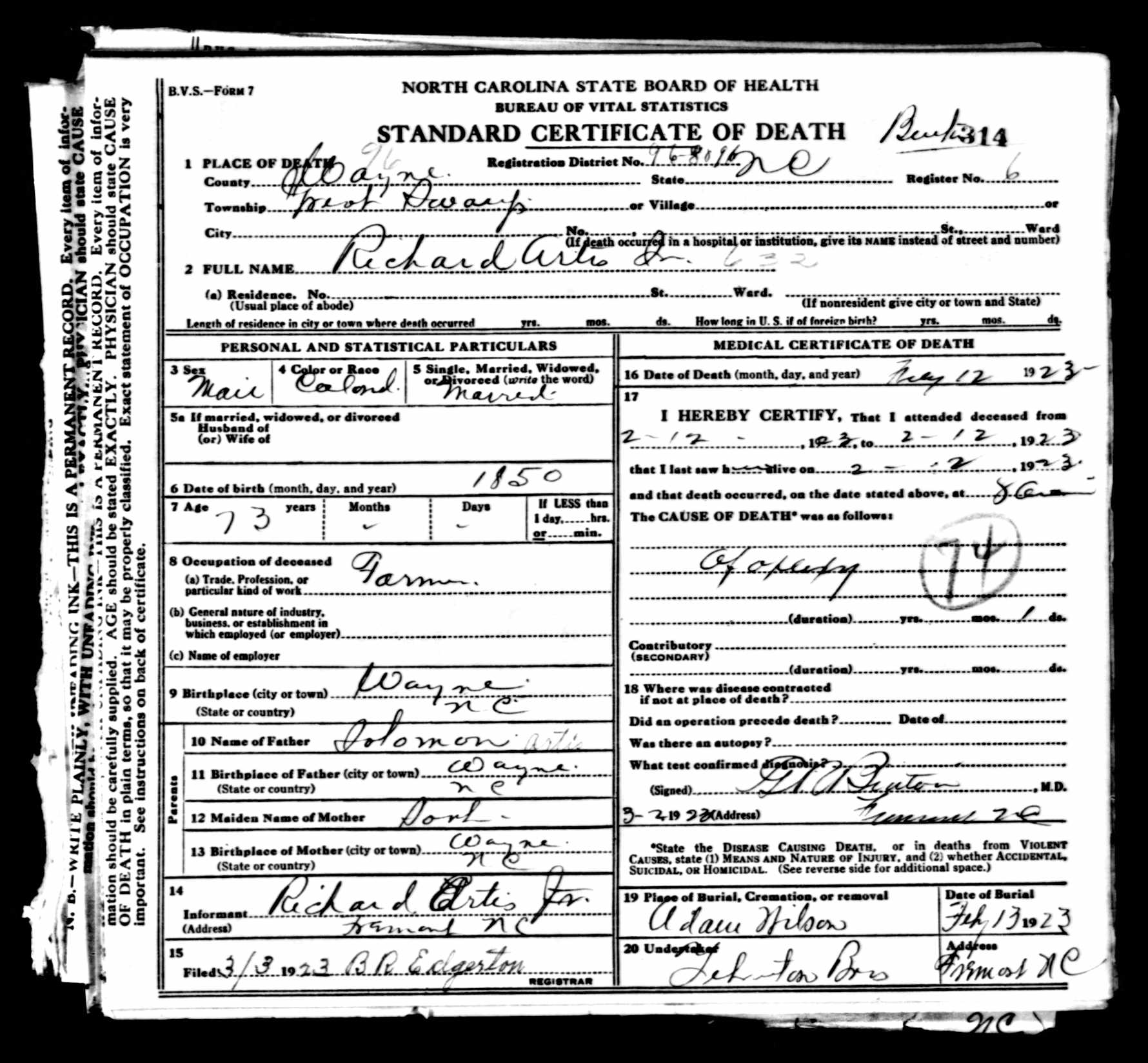
Here’s his death certificate:

NorthCarolinaDeathCertificates1909-1975ForRichardArtisJr

First of all, poor penmanship — a “bad hand,” as my grandmother would have said — will do you in. Based on that misshapen “S,” Ancestry.com has indexed this document as the death record of Richard Artis Jr.  In fact, Junior was the informant, and his “J” is unambiguous. This is Richard Senior’s death cert.

Second, Richard’s father was certainly named Solomon, but not Artis, as unhelpfully pencilled in.

Third, Richard’s mother’s name is illegible, which is just as well, as it surely does not say “Vicey Artis.”

Standard
North Carolina, Other Documents, Paternal Kin

Jonah’s apprentices.

On 24 Sept 1870,  Geo. Jno. Robinson, Probate Judge, bound to “Jonah Williams (col)” John H. Britt, Ida Britt and Cora Britt, aged 12, 10 and 6, to “live after the manner of an apprentice and servant until the said apprentice shall attain to the age of twenty-one years and until Ida & Cora shall attain the age of eighteen years”  John was to be taught trade of a farmer, and Ida and Cora that of house servant.  Williams “shall further provide said apprentices each with a new suit of clothes, six dollars in cash & a new Bible at the end of said apprenticeship.”  Williams signed the indenture with an X.*

Who were the Britts to Jonah Williams?

They are not listed in Jonah’s household in the 1870 census. Rather, Ida, 9, and Corah Britt, 6, and their mother Hannah Britt, 39, appear in the household of drayman Doctor Thompson, his wife Feribee, and daughter Lucy in Goldsboro, Wayne County.  John Britt is not found.

Ten years later, Ida Britt, 20, is listed in the Wayne County household of Jonah’s 80 year-old father, Solomon Williams. Ida and Charity Artis, 42, were described as Solomon’s “daughters.”  Charity certainly was, but Ida? It is possible, certainly, that Solomon fathered three children with Hannah Britt in the eight years prior to Emancipation and his 1866 marriage to the mother of his 11 other children, born between 1828 and 1851.  If so, the arrangement with his son Jonah might have been a way to insure their care. Solomon did not legitimate the Britts, however, as none appear in his 1883 estate records. The more likely explanation is that Ida was in the household  as a quasi-servant, and the censustaker assigned her relationship based on his assumptions. I have not found her in any record after 1880.

——

*Wayne County Apprentice Bonds, NC State Archives.

Standard
DNA, North Carolina, Paternal Kin

DNA Definites, no. 9: Hagans.

23andme characterizes K.H. as my father’s first cousin (8.11% share) and my second (4.4% share). We are related via my Henderson and Aldridge lines, and much more closely in the latter. He is, in fact, my father’s first cousin, once removed. K.H.’s mother and my father’s grandfather were siblings.

K.H. shows a distant match with W.B., but not her daughter W.M.  (My father and I show no match with either.  Nor does E.H., who is K.H.’s nephew.) W.B. and W.M. are descended from Napoleon Hagans through his son William S. Hagans. Napoleon was the half-brother of Frances Seaberry Artis (my great-great-great-grandmother and K.H.’s great-grandmother.)

Standard
Births Deaths Marriages, Paternal Kin, Photographs

Family cemeteries, no. 2: Artis & Bunch.

Image

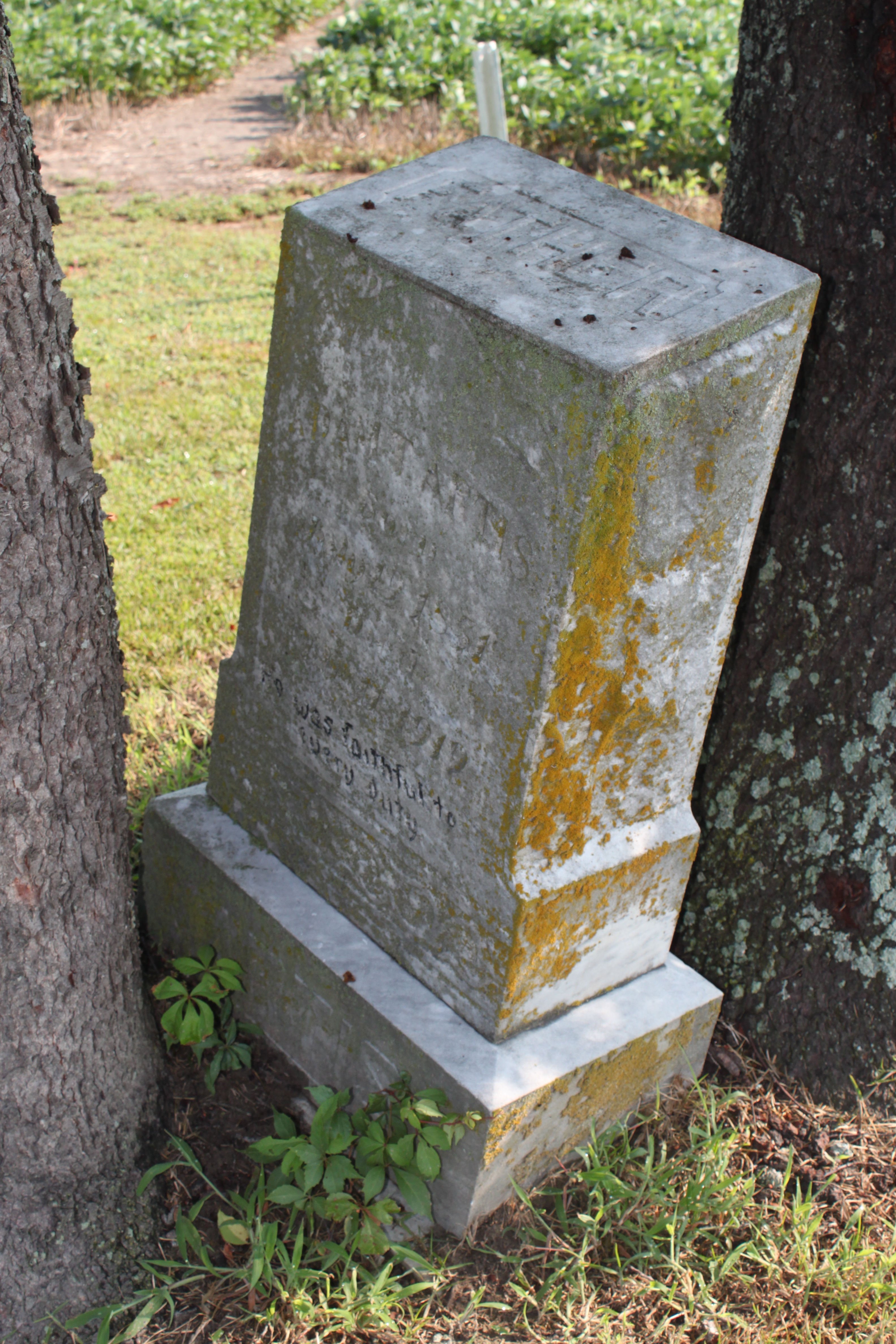
The small “Artis & Bunch” cemetery is located on Highway 222 East in Wayne County between Stantonsburg and Eureka NC on land still owned and occupied by Adam’s descendants. There are several graves, including those of Adam T. Artis (9 July 1831-11 February 1919) and his granddaughters Odessa Artis Baker and Esther Artis Bunch. (Apparently, none of Adam’s wives are buried with him.)

Image

——

Photographs taken by Lisa Y. Henderson, 2010.

Standard
Births Deaths Marriages, Free People of Color, North Carolina, Other Documents, Paternal Kin

Adam Artis’ children, part 5: Katie Pettiford.

From the “Adam Artis Family History”:

After Amanda died, Adam died Katie Pettieford of Goldsboro. They had one son, Pickney. Adam was 71 and she was 21 when they got married. Katie employed a male nurse to look after Adam. She sold off his land bit by bit.

Adam died of old age at about 100 years. His last wife, Katie, in 1923, had someone dig down to his coffin and saw off his feet. Several years later she committed suicide. She poured kerosene around a room and set it on fire.

In fact, Adam Artis married his fourth and final wife, Katie Pettiford, on 9 July 1902 in Wayne County. He was 71, as told, and she was about 20. Their only son, Alphonzo Pinkney Artis, was born in April 1903. By common account, Pinkney left home as a boy — ran away, in fact, to Baltimore. Adam died in 1919 at age 87. Katie, who remarried, died in 1940.  Her death certificate notes that she burned up inside her house, but does not mention suicide.

As for the rest, the story I’ve heard is that Katie, guilt-ridden over her abuse of Adam in his decline, grew convinced that he was haunting her from the grave. On the advice of a root doctor, she had his body exhumed and his feet cut off to keep him from walking the world.

Standard
Births Deaths Marriages, Free People of Color, Migration, Other Documents, Paternal Kin

Age 121?!?

ImageOn March 30, 1932, in Lucy, Tennessee, just north of today’s Memphis International Raceway, an old man closed his eyes a final time. His doctor described his death in an unusually detailed, almost poetic, passage: “causes due to advanced age weakening of heart muscles beats slowing down until stopping quietly but regular.” He was, according to the death certificate, 121 years old, and his name was Guy Lane.

Guy Lane?!?!

I scanned the rest of the form: farmer … living in Shelby County … born in North Carolina … son of Guy Lane … an informant named Lillie ….

My great-great-great-great-grandmother, Vicey Artis, born free in or near Wayne County around 1810, had a sister named Sylvania. Both women married enslaved men. (And their brother Daniel married an enslaved woman.) On 31 August 1866, Vicey Artis and Solomon Williams and Sylvania Artis and Guy Lane registered their decades-old cohabitations in Wayne County and thereby legalized their marriages. Old Man Guy died before 1880, but ….

Sylvania and Guy Lane’s twelve children, who used both parents’ last names, were born over the course of more than twenty years.  Morrison Artis, born 1837, was first, followed by Mary Artis (1839), Jane Lane Sauls (1842), Daniel Artis (1843), Mitchell Lane (1845), Mariah Artis (1846), Guy Lane Jr., Penny Lane (1850), Dinah Lane (1851), Julie Lane Sutton (1853), Washington Lane (1855) and Alford Lane (1859).

In 1869, Guy Lane Jr. married Dinah Dew in Wayne County. They appear together in the 1870 and 1880 censuses and had at least six children: Ora, Moses, Lizzie, William, Mary S., Milton F. Lane, and a girl. By 1900, though, Guy and his family are nowhere to be found in North Carolina. Instead, they surface 800 miles due west, just outside Memphis. (Had they been Exodusters sidetracked on the way to Arkansas?)  Guy had a new wife, of four years — Eliza, born in Tennessee — but his youngest two children, Milton and Guy Jr. (actually III), both born in NC, were with him. In 1910, on the Memphis & Shakerag Road, 60 year-old Guy and Eliza Lane are listed with eight year-old daughter Lilly. Both reported that they had been married twice, and Eliza reported that only one of her nine children was living. In the 1920 census, the couple are living with Lillie and her husband Robert Burnett. Guy continued to work as a farmer, and his age is reported as 78. Ten years later, in 1930, Guy and Liza are living alone again, and his age has leapt inexplicably to 114. By time he died in 1932, Guy had gained another seven years.

The credible evidence suggests that cousin Guy Lane, in fact, was born about 1848, making him a more reasonable 84 years old when his heart slowed down until stopping quietly. He is not forgotten.

Standard
Births Deaths Marriages, North Carolina, Paternal Kin, Photographs

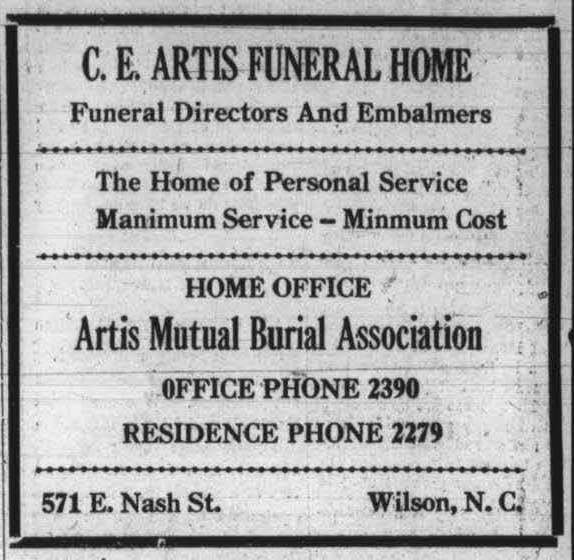
The Home of Personal Service.

Columbus Estell “C.E.” Artis was born in 1886 near Eureka, Wayne County NC to Adam T. Artis and his fourth wife, Amanda Aldridge Artis. Census records and city directories show that he tried his hand at a number of businesses, including grocery stores and “eating houses.” The 1915 directory of the town of Wilson NC described him as an undertaker, but it’s not clear for whom he worked or if he owned his own business at that time. He spent several years in Washington DC during and after World War I, but a 1922 newspaper article makes references to Batts Brothers and Artis as local undertakers, and the 1925 Wilson city directory carries this entry:

ARTIS & FLANAGAN (CE Artis, WE Flanagan) funeral directors 563 E Nash phone 1183

Here’s Artis’ business  described in 1979 in National Register of Historic Places Inventory — Nomination Form for  “East Wilson Business Area,” Wilson Central Business and Tobacco Warehouse Historic District:

One of only two black funeral directors in Wilson, Columbus Estelle Artis (1886- 1973) had this modest, one-story, three-storefront building [at 567-571 East Nash Street] erected in 1922. His funeral business occupied the 571 store until the mid 1950s when he retired and closed his business; the other two stores have always been used for rental purposes, except for a brief period from ca 1945 until ca 1951 when Artis expanded his funeral home into the 569 store. The stuccoed brick structure has narrow stores at 567 and 569 that contain a simple door and a large adjacent display window, both of which have transoms of clear glass. The store at 571 East Nash Street has a central door with flanking display windows, also with transoms. Unfortunately, all of the windows and three of the window transoms have been boarded up. The blind northwest elevation originally abutted the drug store occupied by Darcey D. Yancy during the 1940s and 1950s; this building was razed in the mid 1960s. The rear elevation of the Artis building has a one central door per store. The southeast elevation wall is adjacent to the Jackson Chapel First Missionary Baptist Church, which has maintained offices of the Artis building since 1980.

(Historic designation notwithstanding, Jackson Chapel tore down the buildings in the 1990s to make way for a church expansion and parking lot.)

C.E. Artis’ distinctive, wide-nibbed, angular cursive — r’s slashed diagonally — appears on hundreds of Wilson and Wayne County death certificates.  Like James Guess in Goldsboro, with whom he competed to some extent, C.E. Artis was often called upon to bury his kin, including several of his siblings. Among the funerals he conducted were:

Vicy Aldrich, 13 Feb 1927.  Buried Aldrich cemetery, Dudley NC.  Daughter of Adam and Frances Seaberry Artis, Vicey Artis Aldridge was C.E.’s half-sister.

+ Baby Jacobs, 22 Apr 1928.  Buried Rountree cemetery, Wilson. Unnamed stillborn son of Hattie Mae Jacobs, who was the granddaughter of Vicey A. Aldridge.

+Napoleon Artis, 9 Sep 1928.  Buried family cemetery, Wayne County.  Son of C.E.’s half-brother Walter S. Artis, who was son of Adam and Frances Seaberry Artis.

Jane Sauls, 16 Dec 1928. Buried Union Grove cemetery, Wayne County. Daughter of Sylvania Artis Lane, who was sister of C.E.’s grandmother Vicey Artis Williams.

+ Mable Barnes, 18 Apr 1929.  Buried family cemetery, Wayne or Wilson County. Daughter of C.E.’s brother Robert E. Artis.

+ Ivery Artis, 24 Jul 1930.  Buried Wayne County. Son of Morrison Artis, who was first cousin of C.E.’s father Adam T. Artis.  Also, Morrison’s first wife, Jane Artis, was Adam’s sister.

+ Alberta Artis, 9 Jun 1931.  Buried Wayne County.  Granddaughter of C.E. Artis’ paternal aunt Delilah Williams Exum.

+ Lucinda Artis, 23 Jun 1931.  Buried Wayne County.  Widow of C.E.’s uncle Jesse Artis.

+ Susiannah Artis, 11 Sept 1931.  Buried Wayne County.  Widow of C.E.’s uncle Richard Artis.

+ Leslie Exum, 4 Jul 1934.  Buried Wayne County.  Grandson of C.E.’s half-brother Jesse Artis, son of Adam and Frances Seaberry Artis. Leslie’s wife Beulah Artis Exum was daughter of C.E.’s half-brother, William M. Artis.

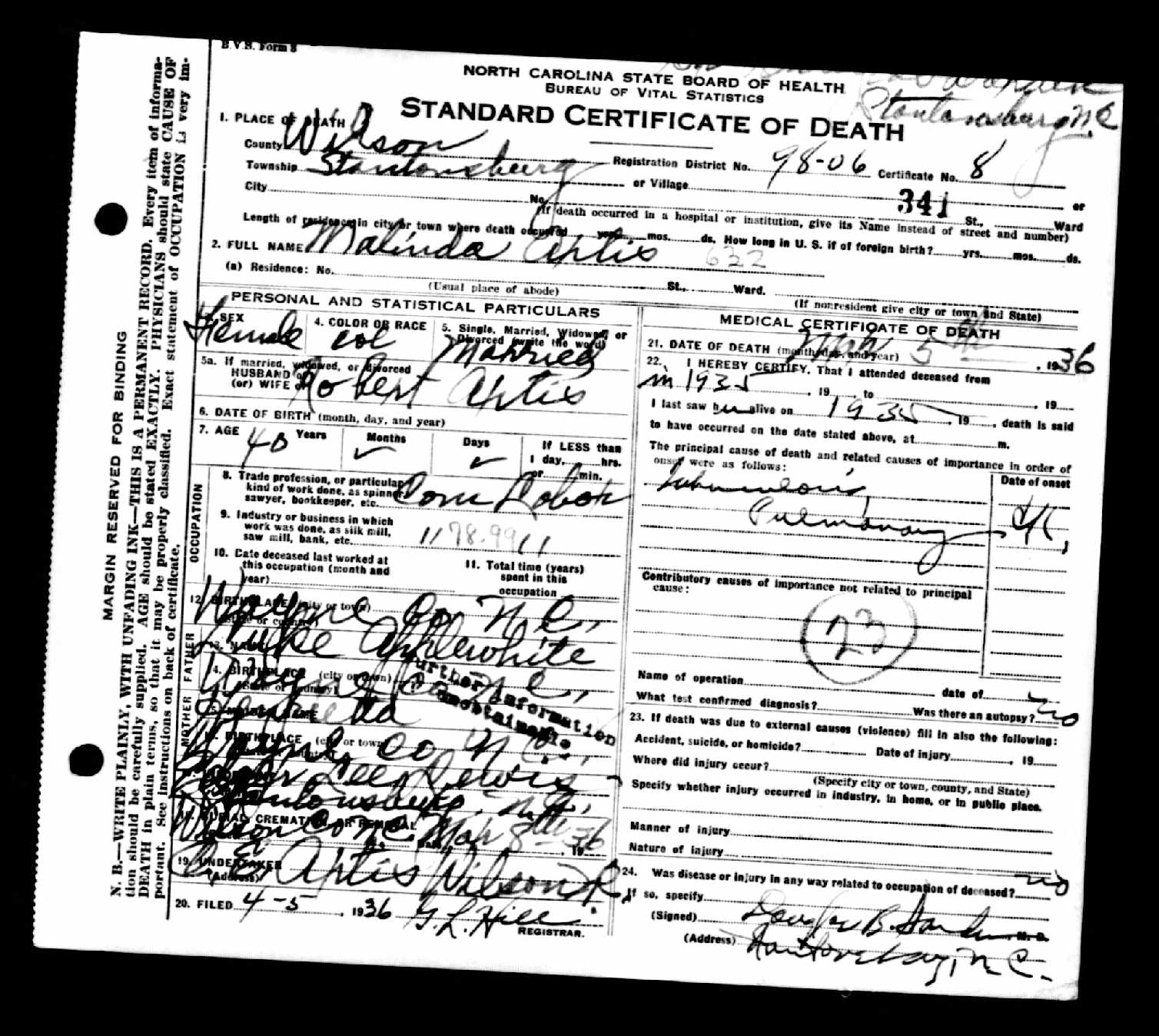
+ Malinda Artis, 5 Mar 1936.  Buried Wilson County.  Second wife of C.E.’s brother Robert Artis.

malinda artis

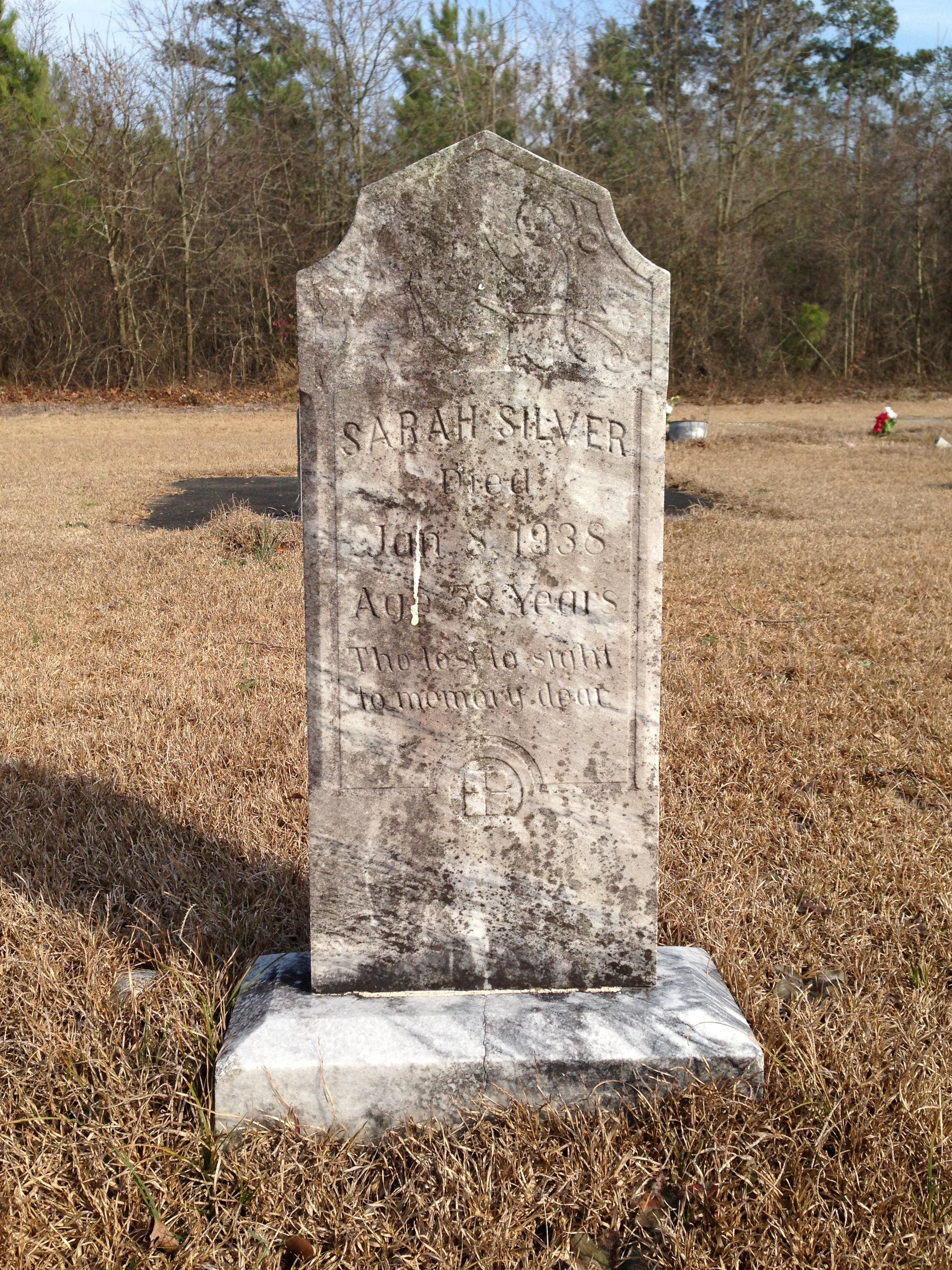
+ Sarah Jacobs Silver, 8 Jan 1938. Buried Wayne County [in fact, in the Congregational Church cemetery].  Silver’s great-niece Hattie Henderson (alias Jacobs) was the granddaughter of C.E.’s half-sister Louvicey Artis Aldridge.  Silver also lived on Elba Street in Wilson NC, around the corner from C.E.’s Green Street home.

IMG_1651

+ Viola Artis, 1 Feb 1938.  Buried Wayne County.  Granddaughter of C.E.’s brother Henry J.B. Artis.

+ William Wilson, 5 Mar 1939.  Buried Wilson County. Grandson of C.E.’s aunt, Zilpha Artis Wilson.

+ Delilah Exum, 18 Jul 1939.  Buried Wayne County.  C.E.’s father’s sister.

+ Julius Artis Jr., 18 Dec 1939. Buried Wilson County.  Grandson of C.E.’s brother Henry J.B. Artis.

+ Katie Artis King, 22 June 1940.  Buried family cemetery, Wayne County.  C.E.’s stepmother, his father Adam’s last wife.

+ John G. Reid, 29 Dec 1941. Buried Turners Swamp cemetery, Wayne County.  Husband of C.E.’s first cousin, Emma Artis Reid, daughter of Richard Artis Sr.

+ Ada Dixon Sauls, 28 January 1945. Buried Baptist church cemetery, Snow Hill. Wife of C.E.’s cousin, Cain D. Sauls.

+ Liberty P. Artis, 10 Jul 1945.  Buried family cemetery, Wilson County.  Son of C.E.’s brother Robert.

+ William Artis, 28 Sep 1945.  Buried “family (Seabury)” cemetery, Wayne County.  C.E.’s half-brother, son of Adam T. Artis and Frances Seaberry Artis.

+ Scott Artis, 6 Apr 1947.  Buried Red Hill cemetery, Wayne County. Son of  Morrison Artis, son of Sylvania Artis Lane, who was C.E.’s grandmother’s sister.

+ Bettie Reid, 2 Dec 1947.  Buried family cemetery, Wayne County.  Elizabeth “Bettie” Wilson Reid was C.E.’s first cousin.  Her mother, Zilpha Artis Reid, was Adam Artis’ sister.

+ Solomon Shearard, 6 Feb 1948.  Buried Rest Haven cemetery, Wilson.  Husband of C.E.’s sister Josephine.  Name generally spelled “Sherrod.”

+ Annie Marie Cooper, 16 Oct 1948.  Buried Rest Haven cemetery, Wilson.  Daughter of C.E.’s youngest sister Alberta.

+ Annie C. Best, 4 Jan 1949.  Buried Rest Haven cemetery, Wilson. Daughter of C.E.’s half-brother Jesse.

+ Minnie Belle Artis, 4 Apr 1950.  Buried family cemetery, Wilson County.  Daughter of C.E.’s brother Robert.

+ Walter Scott Artis, 25 Jun 1951.  Buried Fort cemetery, Wayne County.  C.E.’s half-brother, son of Adam and Frances Seaberry Artis.

+ Noah Artis, 16 May 1952.  Buried family cemetery, Wilson County.  C.E.’s half-brother, son of Adam and Lucinda Jones Artis.

Pages from index

The Carolina Times, 19 September 1942.

Standard
Births Deaths Marriages, North Carolina, Paternal Kin

Adam Artis’ children, part 4: Amanda Aldridge.

When Frances Seaberry Artis died in 1878, Adam Artis was left with no fewer than 11 children under the age of 18. Despite this brood, his relative wealth made him an attractive widower. He soon remarried, and he didn’t have to go far to do it. In November 1880, less than a year after his daughter Louvicey wed John W. Aldridge, Adam Artis married John’s sister, Amanda A. Aldridge.

Adam and Amanda Aldridge Artis’ children included:

Louetta Artis, born 1881, seems to have died in young adulthood. No record of any marriage has been found.

Robert Elder Artis, born 1883, was probably named after his maternal grandfather, Robert Aldridge. He was farmer in the Pikeville area of northern Wayne County and married three times, to Christana Simmons, Malinda Applewhite and Amanda Long. His children included Eva Mae, Robert Arzell, Mabel Irene, Challie, Adam, Edgar Lee, Etta Christine, Georgia, Nora and Maggie Artis.

Columbus Estell Artis, born 1886, was called “C.E.” For 30 years, he operated a funeral home in Wilson NC and was counted among the most prosperous of the town’s African-American citizens. He married twice, to Ada Diana Adams and Ruby Barber, and had at least one child, Naomi.

Josephine Artis, born 1887, was the longest and last living of all of Adam’s children. She married Solomon Sherrod in 1907 and settled in Wilson in the 1920s. Their children were: Booker T. Sherrod, Alliner Sherrod Davis, Jarvis Estelle Sherrod, Doretta Elizabeth Sherrod Davis, Leonard Oscar Sherrod, Minnie Bell Sherrod Parker, Solomon Conton Sherrod Jr., Harriet Sherrod, Amanda Bell Sherrod, Flora Annie Lee Sherrod Simms, Beulah Olivia Sherrod Williams and Elmer Lee Sherrod.  Josephine Sherrod died 8 April 1988, a month before her 101st birthday.

June Scott Artis, born 1889, farmed in the Stantonsburg area of Wilson County, not far from his father’s lands near Eureka, Wayne County. He married Ethel Pearl Becton and had four children, James Brody Artis, Edgar Joel Artis, Amanda Bell Artis Jones, and Gladys L. Artis. June Scott died in June 1973, less than three months after his brother C.E.

Lillie Beatrice Artis, born 1891, married three times in her short life — to Celebus Thompson, McDaniel Whitley and Chester Pridgen. Her children included Genetta Thompson, Wheeler Thompson, Columbus Whitley, Sampson Whitley, Floyd Marvin Whitley, Walter Andrew Whitley, Robert Whitley, William Jessie Whitley, Wilhelmena Pridgen and Mildred Beatrice Pridgen.  Lillie died in 1935 of heart issues complicated by pregnancy.

Henry J.B. Artis, born 1894, married Laurina House. His father Adam is buried in a small plot on land still owned by J.B.’s descendants. His children were Lillie Odessa Artis Baker, Julius House Artis, Roosevelt Artis, Columbus Estelle Artis II, Henry J.B. Artis Jr., Esther Artis Bunch, Jesse C. Artis, Mae H. Artis, Dorena Artis, and James Lacey Artis.  J.B., too, died in 1973, a month before his brother C.E.

Annie Deliah Artis, born 1897, married Wiley Hodges, then William Sauls. She had no known children and died in 1957.

Amanda Aldridge Artis died a few days after the birth of daughter Amanda Alberta Artis in 1899. Josephine Artis Sherrod, then about 12, told me that she discovered her mother’s lifeless body. John and Louvicey Artis Aldridge — the child’s uncle in one direction and half-sister in another — took in the infant to rear with their large brood. Alberta married James W. Cooper and had several children. She died in Wilson NC in 1985.

Standard
North Carolina, Other Documents, Paternal Kin, Rights

The right to vote?

This soft-backed composition book, deposited at the North Carolina State Archives in Raleigh, records the names of “colored” residents of Nahunta township, Wayne County, who paid poll taxes in the late summer of 1912. Paying such taxes was a prerequisite to vote in North Carolina, but few of these men actually registered, and probably fewer voted.  (The women, of course, could not have voted under any circumstance.) The first two pages overflow with my kinsmen, Artises (including Adam T., his sons, grandsons, brothers and nephews) and a couple of Aldridges (both sons of George W. Aldridge.)

Pages from Colored_Poll_Tax_1912

Pages from Colored_Poll_Tax_1912-2Pages from Colored_Poll_Tax_1912-3

Standard
Births Deaths Marriages, North Carolina, Other Documents, Paternal Kin

No error.

I was tying up loose ends, so to speak, checking an online database for death certificates of cousins in distant lines. Several Artises married Reids, who were another free family of color from northeastern Wayne County, and a number settled in Wilson County in the early 20th century.

Allen T. Reid was a great-grandson of Zilpha Artis Wilson, sister of my great-great-great-grandfather Adam T. Artis. I started jotting notes from his death certificate — born 1919, married, World War II veteran — then pulled up short. Died 9 Dec 1949 at Central Prison in Raleigh? Of “asphyxiation by court order of the State of North Carolina”?  My cousin was executed?

I quickly found the decision of the North Carolina State Supreme Court in State v. Reid, 230 N.C. 561, 53 S.E.2d 849 (1949), an appeal from Allen Reid’s conviction for burglary with intent to rape (a white woman.) It’s longish, I know, but please read it:

——

Supreme Court of North Carolina

State v. Reid, No. 76, June 16, 1949.

Appeal from Superior Court, Wilson County.  W.H.S. Burgwyn, Special Judge.

Criminal prosecution tried upon indictment charging defendant with the crime of burglary in the first degree.

When the case was called for trial, and before the trial jury was chosen, sworn or impaneled, counsel for the defendant filed a motion challenging the array of petit jurors, upon the ground of disproportionate representation of Negroes on petit juries in Wilson County, and long, continuous and systematic exclusion of Negroes from petit juries solely and wholly on account of their race and color, contrary to the laws of the State of North Carolina and the United States.

The defendant offered evidence in an effort to sustain his challenge to the array of petit jurors. Upon the evidence produced by counsel for defendant, the Court found as a fact that the officers whose duty it was to prepare the jury list and draw the panels of veniremen to be summoned by the Sheriff of Wilson County ‘from which petit jurors were drawn, have not selected and summoned jurors for the December 6 Term, 1948, in violation of G.S. of 1943, Chapter 9, Sections 1, 2, 3 and/or 9, and the Constitution and Laws of the United States, with the unlawful and avowed purpose of discriminating against persons of the Negro race; and that there is no evidence before the Court to show that the said officers have been systematically and continuously, over a long period of years, excluding Negroes from said juries in said county solely on account of their race or color; to the contrary, it has been effectively shown that there are the names of Negroes in the jury boxes of Wilson County, and that one member of that race was drawn and served as a member of the Grand Jury which returned the Bill of Indictment in this case, and that four or five members of the colored race were drawn for the special venire and summoned for the purpose of the trial of this case.‘ Whereupon the Court overruled the motion, and the defendant excepted. Exception No. 15.

It is disclosed by the evidence that Mr. and Mrs. James Barnes, at the time the alleged crime was committed, were living in a ground floor apartment, at 204 Park Avenue, in the City of Wilson.

The night of the alleged crime Mr. Barnes was in Washington, D. C., and Mrs. Barnes retired in the early morning of 2 September, 1948; no other member of the family or guests being in the apartment at the time. About 2:30 a. m., she was awakened by someone placing a hand on her shoulder. She was on an antique bed about three and a half feet high. The person who touched her was on the far side of the bed and when she realized that the hand was on her shoulder, she immediately got off the bed away from the person. The person grabbed her wrists and ordered her to be quiet and not to scream. She asked the person who he was, and he replied, ‘Never mind who I am.‘ She asked him how he entered the room and he said, ‘That’s all right; I got in here.‘ The prosecuting witness managed to free her right wrist after several minutes. The person then ordered her to get back on the bed. She asked him what he wanted. He stated that he wanted to commit an act, which would have been, if accomplished, a crime against nature. He also said to her several times: ‘If you scream, you know what I have.‘ She told him to leave and he told her if she would just get back on the bed it wouldn’t take long. She would not get back on the bed and he began twisting her left wrist. She testified that she realized something had to be done, and she yelled for Mrs. Mayo, the lady in whose home the apartment is located. The person then jumped out the bedroom window, head first. Mrs. Barnes further testified she did not know who the party was, except her assailant was a male person; that when she went to bed the window in her bedroom was approximately two-thirds raised; that there was a screen in the window which hooked into the side of the window and it was in good condition when she retired.

Mrs. Sarah Mayo testified that when she heard Mrs. Barnes scream ‘Sarah,‘ she immediately got out of bed, called her son and went into Mrs. Barnes’ apartment, and found her at the telephone. She noticed that the screen was cut but did not see anyone leave the house.

A witness who lived next door to Mrs. Mayo testified she was reading in bed and heard Mrs. Barnes scream about 2:30 a.m.; that she looked but did not see anyone but heard ‘footsteps running.‘ She then heard a car start.

A member of the Police Department of the City of Wilson, in response to a call, went to the Barnes apartment. He examined the window and found that the screen outside the window had been cut all the way from the top to the bottom with some sharp instrument. He found two razor blades just underneath the window on the outside. The razor blades were ‘Treet‘ blades. He also found a paper wrapping that goes on razor blades. Shortly thereafter police officers found a wrecked Chevrolet car on the railroad track of the Norfolk & Southern Railroad, four blocks from the Barnes apartment. In the car the officers found a wrapping from a ‘Treet‘ razor blade, which was on the floorboard of the front seat. The wrecked car belonged to the father of the defendant. The father testified the defendant took the car on the night of September 1st, and said he wanted to go to a show; that he did not see the car any more until it was pulled in after the wreck. The husband of the prosecuting witness testified he had never used ‘Treet‘ blades, and had no such blades in his home.

Between 8:30 and 8:45 on the morning of 2 September, 1948, A. J. Hayes, Jr., the identification officer of the Wilson Police Department, who was found by the Court to be a fingerprint expert, went to the Barnes apartment and made an investigation for fingerprints. He testified that on the inside of the window through which the entrance to the Barnes apartment had been made, he found a fingerprint on the lower right-hand corner of the window sill and bottom section of the window; and he photographed the fingerprint. At the trial this witness, and two other witnesses who are with the State Bureau of Investigation and were qualified as fingerprint experts, compared the fingerprint found in the Barnes apartment with fingerprints of the defendant made after his arrest in Norfolk, Va., on 25 October, 1948, and each one of them testified that the fingerprint found on the window sill on the inside of the Barnes apartment was identical with the fingerprint of the right index finger of the defendant.

The defendant offered no evidence.

From a verdict of guilty of burglary and sentence of death by asphyxiation, the defendant appeals and assigns error.

Attorney General Harry M. McMullan and Assistant Attorneys General Ralph M. Moody and T. W. Bruton, for the State.

Herman L. Taylor, Raleigh, and C. J. Gates, Durham, for defendant. 

DENNY, Justice.

The exception to the failure of the Court to sustain defendant’s challenge to the entire array of petit jurors is not brought forward, as required by the Rules of this Court, Rule 28. However, the defendant discusses the exception at some length in his brief. Consequently, we have considered the exception and find it without merit.

His Honor’s findings of fact are supported by the evidence and are conclusive on appeal, since the exception presents no reviewable question of law. G.S. s 9-14; State v. Davenport, 227 N.C. 475, 42 S.E.2d 686; State v. Lord, 225 N.C. 354, 34 S.E.2d 205; State v. DeGraffenreid, 224 N.C. 517, 31 S.E.2d 523; State v. Wall, 211 N.C. 487, 191 S.E. 232; State v. Cooper, 205 N.C. 657, 172 S.E. 199; State v. Daniels, 134 N.C. 641, 46 S.E. 743. The question raised has been considered in a number of recent cases before this Court and no useful purpose would be served by a further discussion of the subject here. See State v. Speller, 230 N.C. 345, 53 S.E.2d 294; State v. Speller, 229 N.C. 67, 47 S.E.2d 537; State v. Brunson, 229 N.C. 37, 47 S.E.2d 478; State v. Koritz, 227 N.C. 552, 43 S.E.2d 77, certiorari denied 332 U.S. 768, 68 S.Ct. 80, 92 L.Ed. 354, and a rehearing denied 332 U.S. 812, 68 S.Ct. 106, 92 L.Ed. 390; and the cases cited.

Exception No. 16 is brought forward in the brief, but no argument is made or authority cited in support thereof, hence it will be considered as abandoned. Rules of Practice in the Supreme Court, Rule 28, 221 N.C. 546.

The defendant moved for judgment as of nonsuit at the close of the State’s evidence, on the ground that while the bill of indictment charges the defendant with burglarious entry with the felonious intent to ravish and carnally know Mrs. James Barnes, forcibly and against her will, the evidence he contends, tends to show only an intent to commit a crime against nature, condemned by G.S. s 14-177. 

The conduct of the defendant in breaking and entering the bedroom of the prosecutrix in the night-time, and under the circumstances disclosed by the evidence, indicates the extent to which he was willing to go to accomplish his purpose. He might have preferred and intended to commit a crime against nature, or his statement in that respect might not have been indicative of his actual intent. We think the evidence was sufficient to carry the case to the jury under the allegations contained in the bill of indictment, and it was for the jury to determine, under all the circumstances, whether or not the defendant had the ulterior criminal intent at the time of the breaking and entering, to commit the felony charged in the bill of indictment. State v. Allen, 186 N.C. 302, 119 S.E. 504; State v. Boon, 35 N.C. 244, 57 Am.Dec. 555. 

The trial judge charged the jury on the defendant’s contention in this respect, and instructed the jury to acquit the defendant if it found as a fact that the defendant entered the home of the prosecuting witness with the intent to commit a crime against nature and not with the intent to commit rape, as alleged by the State in the bill of indictment.

In State v. Boon, supra, Pearson, J., in speaking for the Court, said: ‘The evidence of the intent charged is certainly very slight, but we cannot say there is no evidence tending to prove it. The fact of the breaking and entering was strong evidence of some bad intent; going to the bed and touching the foot of one of the young ladies tended to indicate that the intent was to gratify lust. And the hasty retreat without any attempt at explanation, as soon as the lady screamed, was some evidence that the purpose of the prisoner, at the time he entered, was to gratify his lust by force. It was, therefore, no error to submit the question to the jury. Whether the evidence was sufficient to justify a verdict of guilty is a question about which the Court is not at liberty to express an opinion.‘

In the instant case, it is clear the defendant wanted the prosecutrix to know he would resort to other means if she screamed. Whether he had the intent to commit the crime of rape, as charged, or the intent to commit a crime against nature, at the time of breaking and entering, was a question of fact to be determined by the jury.

Evidence as to the conduct of the defendant after breaking and entering may be considered by the jury in ascertaining the intent of the accused at the time of the breaking and entering. But where there is a breaking and entering into a dwelling house of another, in the night-time, with the intent to commit a felony therein, the crime of burglary is consummated, even though the accused person by reason of unexpected resistance or the outcry of his intended victim, may abandon his intent to commit the felony. State v. Hooper, 227 N.C. 633, 44 S.E.2d 42; State v. Allen, supra; State v. McDaniel, 60 N.C. 245; State v. Boon, supra.

Exceptions 65 and 67 are directed to the refusal of the Court below to grant the defendant’s motion for judgment as of nonsuit, challenging the sufficiency of the evidence to warrant its submission to the jury.

The appellant is relying largely on the case of State v. Minton, 228 N.C. 518, 46 S.E.2d 296, where the defendant’s fingerprint was found upon broken glass from the front door of a store that had been unlawfully entered. That case is distinguishable from the present one. The defendant in the Minton case was lawfully in the store in the afternoon of the day on which the crime was committed, and he may have made the fingerprint at that time.

We must keep in mind that a motion for judgment as of nonsuit in a criminal prosecution is properly denied if there is any competent evidence to support the allegations of a bill of indictment; and all the evidence tending to sustain the allegations in the bill of indictment upon which a defendant is being tried, will be considered in a light most favorable to the State, and the State is entitled to every reasonable inference to be drawn therefrom.  State v. Braxton, 230 N.C. 312, 52 S.E.2d 895; State v. Gentry, 228 N.C. 643, 46 S.E.2d 863; State v. Webb, 228 N.C. 304, 45 S.E. 2d 345; State v. Hough, 227 N.C. 596, 42 S.E.2d 659; State v. Ewing, 227 N.C. 535, 42 S.E.2d 676; State v. McKinnon, 223 N.C. 160, 25 S.E.2d 606; State v. Brown, 218 N.C. 415, 11 S.E.2d 321. Here the defendant was never lawfully in the apartment of the prosecutrix, and the presence of his fingerprint on the inside of the window sill in the sleeping quarters of the prosecutrix, when considered with the other evidence, was sufficient to carry the case to the jury.

The defendant has abandoned the remaining sixty-seven exceptions set out in the record.

The exceptions brought forward and argued in the defendant’s brief fail to show any prejudicial error in the trial below.

No error.

——

A few comments:

(1) First degree burglary was a capital crime in North Carolina until 1974.

(2) And then there was this:
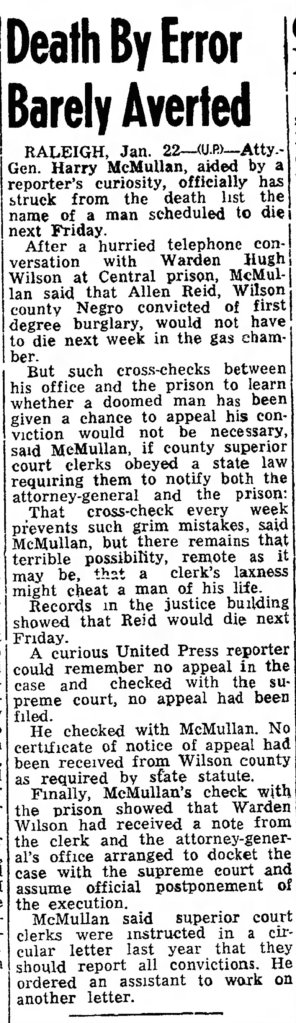
Stville Landmark 22 Jan 1949 Statesville Daily Record, 22 January 1949.

Allen Reid’s lawyers, Herman L. Taylor of Raleigh and C.J. Gates of Durham, were African-American. They appealed his case to the United States Supreme Court, which denied cert.

(3) In 1949, “death by asphyxiation” meant the gas chamber.  According to the Statesville Daily Record, on 9 December, Allen Reid, 30, entered the chamber with Audie Lee Brown, 27, convicted of murder. They were seated side-by-side, and “the deadly cyanide pellets dropped at 10:02 a.m. EST.” After the gas cleared, prison officials executed Monroe Medlin, 23. Reid took 13 minutes to die; Brown, a minute less; and Medlin, a minute less than that. The other men on death row moaned “Rock of Ages” as the three took their last walk.

(4) My father was 15 when Allen Reid was executed. He recalls that the belief on the east side of the tracks was that Reid was in a clandestine relationship with Mrs. James Barnes. I found this report, written by a Reid cousin of Allen Reid, online.  I haven’t figured out yet what was appended to. It confirms my father’s recollection and my hunch that Allen Reid’s service in World War II had some bearing on the situation in which he found himself. It also contains unsurprising commentary on North Carolina’s uneven application of the death penalty for this particular crime (and, of course, in general.)

Standard