Births Deaths Marriages, Enslaved People, Maternal Kin, North Carolina, Oral History, Other Documents

Lucinda Cowles, also known as Lucinda Nicholson.

I give and bequeath to my beloved son Thomas A. the following Negroes to wit Carlos Nelson Lucinda and Joe.

——

On 19 Nov 1850, James Nicholson wrote out his last will and testament. Two days later, before he could sign it, he slipped into death.  The document was registered 19 Jun 1852 in Will Book 4, page 666 at the Iredell County Register of Deeds Office. Nicholson’s only heirs were his widow Mary Allison Nicholson and sons Thomas A. and John M. Nicholson.  James left Thomas 185 acres and John 242 acres and gave them a 75-acre mill tract in common.  Mary Nicholson received slaves Milas, Dinah, Jack, Liza and Peter; John received slaves Elix, Paris and Daniel; and Thomas received the four named above.  In addition, James bequeathed Thomas and John slaves Manoe, Armstrong, Manless, Calvin and Soffie jointly.

Thomas A. Nicholson put Lucinda to work in his home preparing meals and otherwise caring for his family. As Thomas’ son James Lee Nicholson grew to adulthood, he took increasing notice of the woman who cooked his suppers, laundered his shirts and emptied his slops. In 1861, she gave birth to his first child, a daughter that she named Harriet Nicholson. Lucinda and Harriet remained in Thomas Nicholson’s household till Emancipation, when they were provided with a small house and other support.

As the story goes, Harriet did not learn her father’s identity until her mother Lucinda revealed it on her deathbed. Lee Nicholson passed away when Harriet was 10 years old, leaving a widow and two small boys. Lucinda may have died even earlier, as she has not been found in the 1870 census. She had one other child, a son named William H. Nicholson, whose father was Burwell Carson. Based on information supplied by Harriet, William’s death certificate lists Lucinda’s maiden name as Cowles. We know nothing else about her life.

Standard
Enslaved People, Letters, North Carolina, Paternal Kin

Some of that set.

“Dear Lisa,” he wrote. “I read with interest your letter of October 31….”

Image

I was new at research and utterly clueless about where to start looking for information about slave forebears when I reached out to the late, great Hugh B. Johnston, Wilson County’s pre-eminent historian and genealogist. I was thrilled to receive his prompt reply. The letter was brief, but encouraging, and though I’d hoped for a complete and annotated report that left no end loose, I was confident that a breakthrough loomed just around the bend.

Unfortunately, here I am, nearly 27 years later, with the same fundamental questions burning:

  1. Was Rachel Barnes the daughter of Willis Barnes, or his step-daughter as the 1880 census indicates?  If the latter, who was her father?
  2. Did Willis Barnes belong to Joshua Barnes?
  3. Was Toney Eatman, a free man of color from Nash County, Willis’ father? Was Annie Barnes Eatman his mother?
  4. Was Cherry Battle‘s first name actually Charity?
  5. Did she belong to Amos J. Battle?
Standard
Enslaved People, Maternal Kin, North Carolina

Juda’s children.

As noted earlier, Elizabeth Kilpatrick’s will seems to establish that Juda, an enslaved woman born perhaps in the 1790s, was the mother of at least two children, the Dave and Lucinda specifically referred to in Kilpatrick’s will. Under its terms, Dave’s ownership passed to son Robert Kilpatrick and Lucinda’s to daughter Mary Kilpatrick. Elizabeth’s estate file shows that her administrator sold Negroes Juda ($50.00), Matthew ($425.00) and John ($200.00) on 29 August 1829 and “Negro Kesy” for $74.75 on 30 October 1830. (Their buyers are not listed.) Assuming that Kesy, Matthew and John are the “children not disposed of” in the will, Juda was the mother of at least five children.  Only Lucinda can be further accounted for.

In 1834, Mary Kilpatrick sold Lucinda and her children Alice, 3, and John, 1, to Samuel and John W. McNeely. John disappears from the record. However, Alice, known as “Allie,” bore at least one son, Joseph Archy, and probably several other children, including Alexander, Stanhope and Mary. All – save Alice, who perhaps had died – appear in J.W. McNeely’s Confederate tax assessment in 1863.

Lucinda herself gave birth to two more sons, Julius, about 1838, and Henry W., in 1841. Julius’ father is unknown, but appears to have been a black man. Henry’s father was John Wilson McNeely himself.

Standard
Enslaved People, Land, North Carolina, Paternal Kin, Photographs

A thousand acres between creek and swamp.

Kinchen Taylor’s estate papers include two plats. One laid off his widow Mary Blount Taylor’s dower. The second divided his remaining land into two large parcels:

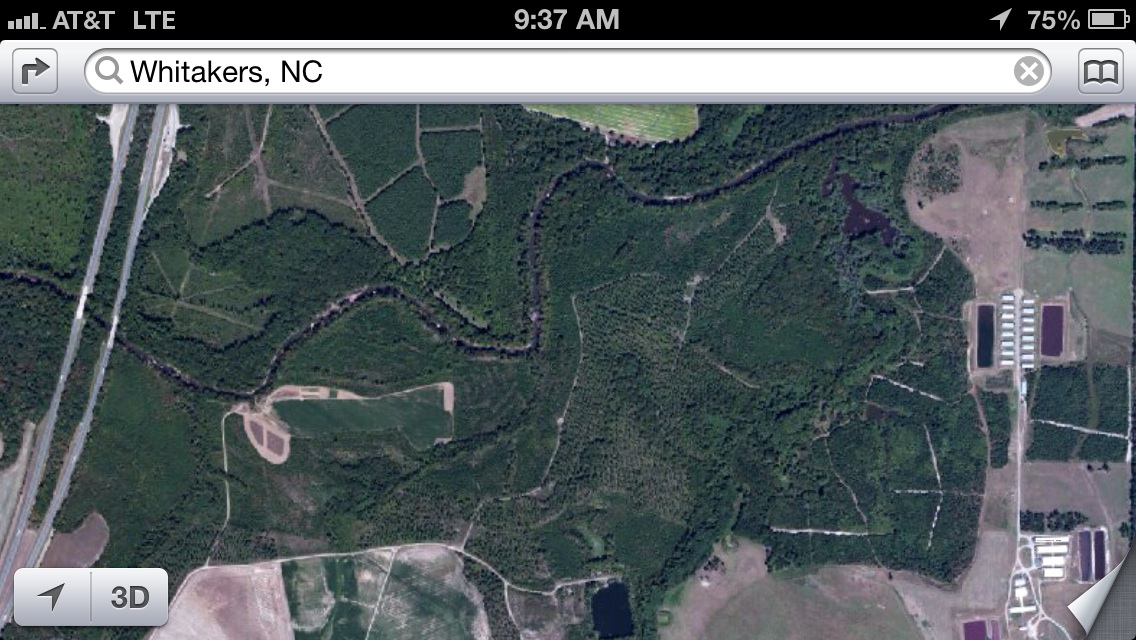
ImageIn some ways, Taylor’s old lands have not changed dramatically. Pine forest and tilled fields still predominate the landscape; far northern Nash County remains rural. Nonetheless, Taylor and enslaved workers like Green and Fereby, who walked and worked it intimately, might be pressed to recognize his property.

Image

I-95 — a far cry from the path shown in the plat — roars with traffic just west of Taylor’s acreage, hauling truckers and tourists from Maine to Florida. If you tilt your head sharply to the right, you’ll see that Fishing Creek, crawling across the top of the screen, still follows the same general course. Beaver Dam Swamp, however, has been dammed just below its confluence with the creek, forming a small body called Gum Lake. The watercourse of the swamp, probably largely drained, is barely detectable as an undulating line of taller vegetation angling southwest from the pond. Lost somewhere in its tangle of canes and catbrier is the Old Mill shown on the plat.

On the other side of Beaver Dam swamp, to the far right of the Google Map view, is an industrial hog farm, identifiable by the white structures with adjacent dark lozenges — barns holding up to 2500 hogs a piece and the lagoons that capture the stupendous quantities of waste they produce. This perhaps would have startled Kinchen Taylor most, as his hogs would have been free-range until time for fattening. (And it should startle you, too, as this is huge, nasty business.)

The file of Kinchen Taylor (1853), Nash County, North Carolina Estate Files 1663-1979, https://familysearch.org, original, North Carolina State Archives;

Standard
Births Deaths Marriages, Enslaved People, Maternal Kin, North Carolina, Other Documents

Cohabitation as man and wife.

COLVERT -- Walker Colvert Rebecca Parks CohabitationIn March 1866, in order to ratify marriages and legitimate children, the North Carolina General Assembly passed an Act directing Justices of the Peace to collect and record in the County Clerk’s office the cohabitations of former slaves. Freedmen who did not record their marriages by September, 1866, faced misdemeanor charges. Stragglers rushed the courthouse that August, and on the 25th Walker Colvert and Rebecca Parks traveled the 12 miles or so from Eagle Mills to stand in line. They declared that they had been together for 13 years and named three children, John, Elvira and Lovenia. (There should also have been a son Lewis, the youngest — and who in the world is Lovenia? I have found no trace of her.)

Walker, fifty-ish at the time, was my great-great-great-grandfather. He was born in Culpeper County, Virginia, then passed, like a bedframe or milk cow, from one Colvert to another and into Iredell County, North Carolina. Rebecca was not his first wife, and his age suggests earlier children, names and fates unknown. My grandmother, who died in 2010 at age 101, knew and remembered Rebecca. And, like that, a link across five generations.

Standard
Enslaved People, Maternal Kin, North Carolina, Other Documents

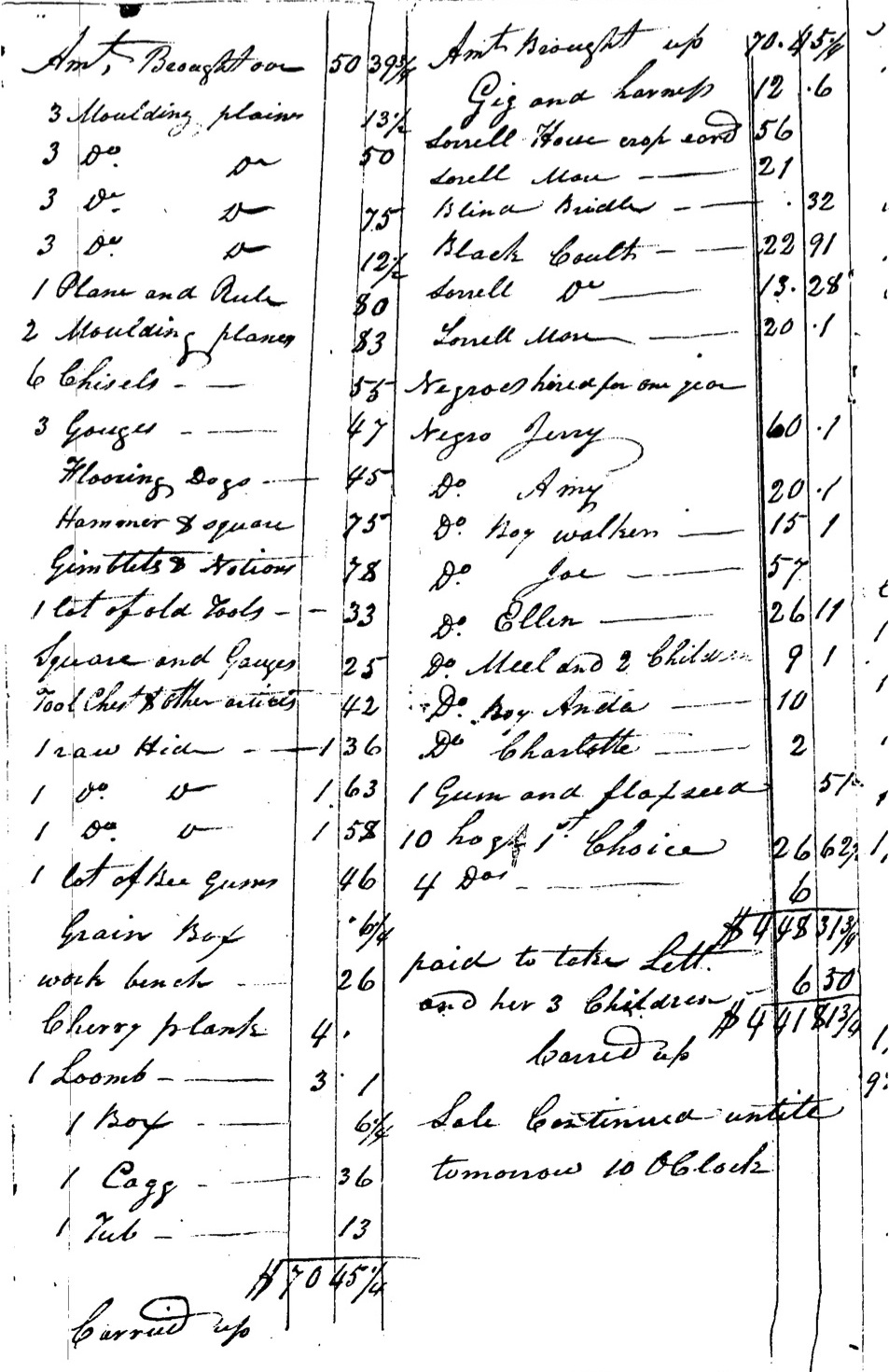
6 chisels, a hammer & square, a grain box, a sorrell mare, 10 hogs and …

Inventory of the estate of John Alpheus Colvert, Iredell County, North Carolina, 1827.

ImageImage

On the second page, in the second column, are “Negroes hired for one year,” that is, slaves leased to neighbors to earn money for Colvert’s estate. “Boy Walker” was about eight years old. That he was listed without his mother suggests that he was an orphan, though he may have been kin to the others who appear in this list. Walker had arrived in North Carolina only two or three years before, passed to John Colvert from the estate of John’s father Samuel. When John’s died, his son William I. Colvert inherited Walker. William was even younger than his own slave, however, and Walker was likely hired out until the boy came of age.

Standard
Civil War, Enslaved People, Maternal Kin, North Carolina, Other Documents

Total value: $7,600.

1863

Rowan County, North Carolina, 1863. The Civil War is dragging on, and the Rebs need money. In 1861, the Congress of the Confederate States of America had passed a statute authorizing a tax (at 50 cents per $100 valuation) to help finance the war effort. Taxable property included real estate, slaves, merchandise, stocks, securities, and money, and later agricultural products and anything else they could think of. In the 1863 assessment, for the first time, the North Carolina General Assembly required taxpayers to list their slaves by name. Assessments for only eight counties survive. Rowan is one of them.

Look in the bottom left corner. J.W. McNeely identified his seven slaves for the tax assessor, who duly recorded: Lucinda, age 47, value $750. Julius, 25, $1500. Henry, 22, $1500. Archy, 14, $1200. Mary, 13, $1000. Stanhope, 11, $900. And Sandy, 12, $950. Total valuation of Lucinda, her sons, and grandchildren: $7600. Remember Alice, the 3 year-old that Sam and J.W. McNeely bought with Lucinda? She was Archy’s mother, and Mary, Stanhope and Sandy were probably her children, too. Alice herself is gone — dead or sold — and John is not listed, though that seems to be oversight. Julius was born a few years after the McNeelys purchased his mother. His father is unknown, but was probably an enslaved man on a neighboring farm. Henry, though, was John Wilson McNeely’s boy. His only child, in fact. And worth exactly $1500.

Standard
Enslaved People, North Carolina, Other Documents, Paternal Kin

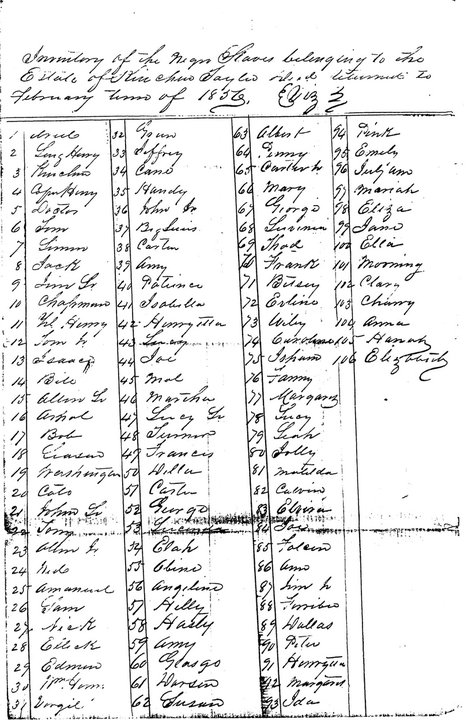
Kinchen Taylor’s inventory.


179360_500865558526_505368526_6215658_5475447_n

Nash County, North Carolina, 1856. An inventory of the slaves of Kinchen Taylor, deceased. Number 32 is Green. Number 88 is his wife Ferribee; and 89, 90 and 91, their oldest children. Most of Kinchen Taylor’s slaves were divided among his children, but two lots of slaves were sold. Green and Ferribee and their children were included in one of those lots, and it is not clear to whom they went, or if they went together. However, in 1870, in the first post-Emancipation census, they are listed in southern Edgecombe county as an intact family: Green Taylor, 52, his wife Phebe, 55, and children and grandchildren Dallas, 19, Christiana, 15, Mckenzie, 13, Mike, 9, and Sally Taylor, 1. Henry Michael “Mike” Taylor was my great-grandfather.

The file of Kinchen Taylor (1853), Nash County, North Carolina Estate Files 1663-1979, https://familysearch.org, original, North Carolina State Archives.

Standard
Births Deaths Marriages, Enslaved People, Maternal Kin, Newspaper Articles, North Carolina, Virginia

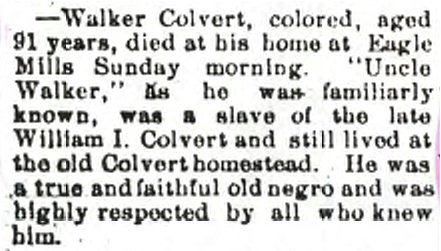
The death of Walker Colvert.

Image

Born in Culpeper County, Virginia; bundled up with chairs and kegs and sundry and shipped to North Carolina after his first master died; reared with his future master, the William I. Colvert noted; husband to his beloved Rebecca; father of three, or maybe four (or more likely more); a middle-aged man when freedom came; a farmer who got a toehold and kept it long enough to pass it on. In the February 5, 1905, edition of the Statesville Landmark, a brief acknowledgement of the death of Walker Colvert, “a true and faithful old negro.” I feel some kind of way about the description, but I didn’t have to live in 19th century North Carolina, and I will not judge. (Him, anyway.)


Standard
Enslaved People, Maternal Kin, North Carolina, Other Documents

How we came to be McNeelys.

Image

Rowan County, North Carolina, 1819. Widow Elizabeth Kilpatrick is close to death. Her daughter Mary is to receive “one feather bed and all my beds clothing of every kind, all my dresser furniture, my chest, one pot, one dutch oven, one pot rack” and “my negro girl named Lucinda.”

Don’t forget Lucinda. She’s my great-great-great-grandmother, and you’ll see her again. And Juda? In paragraph 5? Probably Lucinda’s mother. “All her children (not disposed of)” suggests that Dave, who went to Robert Kilpatrick, and Lucinda, were Juda’s disposed-of children. Who were the others?

Image

Rowan County, North Carolina, 1834. Mary Kilpatrick files a deed for the sale of “one negro woman named Lucinda aged about twenty years one negro child named Alice aged three years and one negro child named John aged between one and two years,” plus a few other sundries to Samuel and John W. McNeely, who are father and son. This is the Lucinda that Mary Kilpatrick inherited from her mother in 1819. Remember John Wilson McNeely. You’ll see him again, too.

Image

Rowan County, North Carolina, 1843. Samuel McNeely‘s will. To his beloved son John W. McNeely, he leaves “a negro woman named Lucinda and all her offspring.” Lucinda, then, may have been the only slave Samuel ever bought, and she returned his investment handsomely.

One of Lucinda’s offspring was Henry W. McNeely, whose father was the very John W. McNeely who owned him.  Henry, my grandmother Margaret Colvert Allen‘s maternal grandfather, was born in 1841 in western Rowan County and died in Statesville, North Carolina, in 1906.

Standard