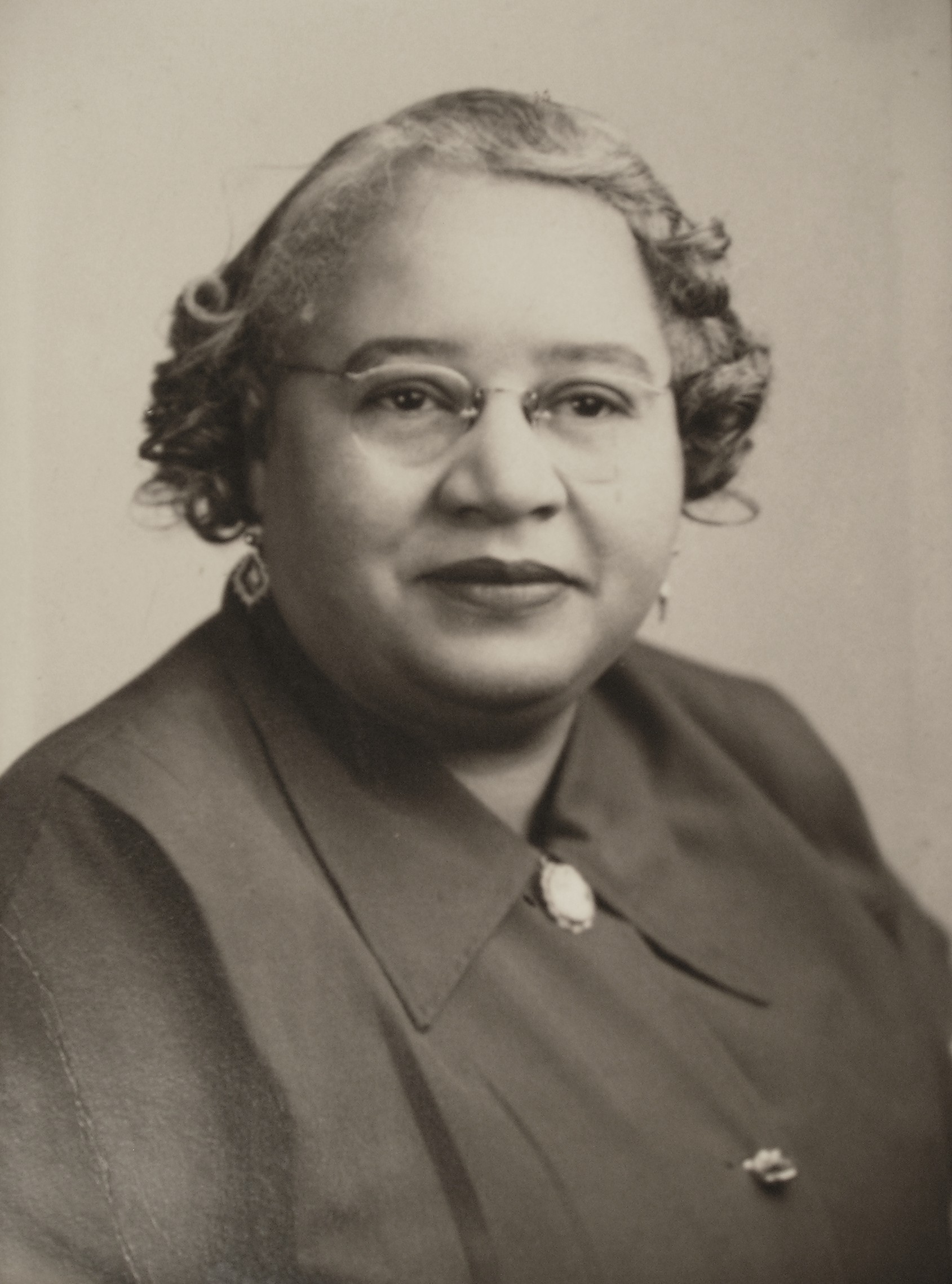
Maternal Kin, North Carolina, Oral History

Grandma Becky.

I was stunned to learn that my grandmother had known her great-grandmother. “I didn’t know you knew her.” “Yes, indeed.”

She was a little, brown-skinned woman, had beautiful hair.  She was short.  Even shorter than I am.  Tiny.  And she used to keep us when Papa and Mama would go away, maybe for the day or overnight.  She’d always come down and keep us.  And, boy, we’d have a ball, ‘cause she’d let us do anything.  Our mother used to have a closet full of canned goods, you know.  Blackberries and dewberries and apples and all kinds of stuff.  And, honey, Grandma Becky would let us go in there and eat up a whole jar of peaches.  She just let us do anything.  We were crazy about her.

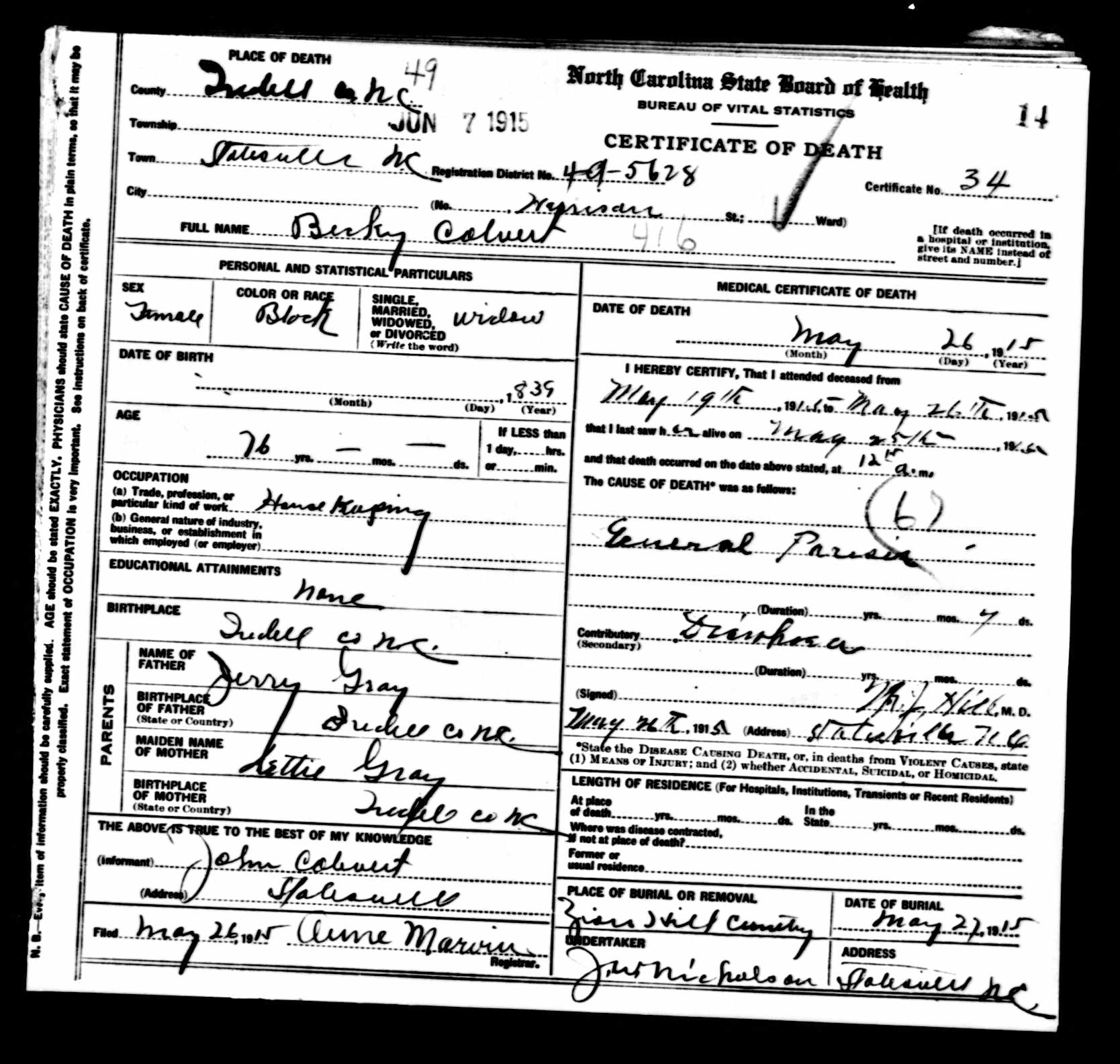
Rebecca Parks Colvert was born about 1839, probably in Iredell County NC. Her death certificate reports her parents as Jerry and Lettie Gray — probably the Jerry and Lett listed in the 1827 inventory of John A. Colvert’s estate. Becky was about 14 when she married Walker Colvert, and the couple probably lived apart until Emancipation. The 1860 slave schedule of Iredell lists ten slaves belonging to Walker’s owner W.I. Colvert, but none appear to be Becky or her children. (Was she owned by a Parks, one of John A. Colvert’s kin?) She reared Walker’s son John, and her own children Elvira and Lovina and Lewis, and then Walker’s grandson Lon. After her husband’s death in 1905, she left their farm north of town in Union Grove township and moved into Statesville.

Becky Colvert died 26 May 1915 at the Harrison Street home of her stepson John W. Colvert. She was about 76 years old.

NorthCarolinaDeathCertificates1909-1975ForBeckyColvert

Interview with Margaret C. Allen by Lisa Y. Henderson; all rights reserved.

Standard
DNA, Maternal Kin, North Carolina

DNA Definites, no. 4.5: Simonton.

Ten years or more ago, before repeated bad brushes with poison ivy wore me out, I was a member of the Georgia Native Plant Society. Atlanta’s economy was booming, subdivisions were sprouting like nutgrass, and GNPS was dashing across the city, rescuing ferns and trillium from the bulldozer’s scrape. I showed up for the last time at a site just southwest of the city, trailing plastic bags and a shovel. The owner of the parcel stopped by, and I stopped dead when I heard her name. “Simonton?” I said. “Your family wouldn’t be from Iredell County, North Carolina, would they?” She confirmed that they were, adding that they descended from a Theophilus Simonton. I laughed and exclaimed, “Hey! We’re probably distant cousins! I think I’m descended from him, too!” Small world, we agreed, and she went on her way.

A couple of months ago, my mother got a new match on 23andme — “M. Simonton.” Simonton! I contacted her and quickly established that she is descended from Theophilus Simonton of Ireland, then Lancaster County, Pennsylvania, then Iredell County NC. M. told me that her sister lived in Georgia and, on a hunch, I did a quick search of my Family Tree Maker tree. There — the very same M. Simonton and her sister S., who was indeed the woman whose family land I’d scoured for crane’s foot geraniums and astilbe.

——

My line of descent from Theophilus Simonton, who died in 1757: Magdelene Simonton > Theophilus Allison > Thomas Allison > Mary Allison > Thomas Nicholson > J. Lee Nicholson > Harriet Nicholson > Lon Colvert > Margaret Colvert > my mother. M. and S.’s line of descent from Theophilus: Robert Simonton > Adam Simonton > Abner Simonton > Albert Simonton > Adam Simonton > William Simonton > their father.

Standard
Births Deaths Marriages, Enslaved People, Maternal Kin, North Carolina, Other Documents

Cohabitation as man and wife.

COLVERT -- Walker Colvert Rebecca Parks CohabitationIn March 1866, in order to ratify marriages and legitimate children, the North Carolina General Assembly passed an Act directing Justices of the Peace to collect and record in the County Clerk’s office the cohabitations of former slaves. Freedmen who did not record their marriages by September, 1866, faced misdemeanor charges. Stragglers rushed the courthouse that August, and on the 25th Walker Colvert and Rebecca Parks traveled the 12 miles or so from Eagle Mills to stand in line. They declared that they had been together for 13 years and named three children, John, Elvira and Lovenia. (There should also have been a son Lewis, the youngest — and who in the world is Lovenia? I have found no trace of her.)

Walker, fifty-ish at the time, was my great-great-great-grandfather. He was born in Culpeper County, Virginia, then passed, like a bedframe or milk cow, from one Colvert to another and into Iredell County, North Carolina. Rebecca was not his first wife, and his age suggests earlier children, names and fates unknown. My grandmother, who died in 2010 at age 101, knew and remembered Rebecca. And, like that, a link across five generations.

Standard
Births Deaths Marriages, Maternal Kin, Newspaper Articles, North Carolina, Other Documents

A colored man of rare powers of mind.

Harriet pursued him, my grandmother said. Relentlessly. Followed him to Ohio to make her case for marriage. Certainly, that she, a widow in her early 40s, found (or allowed herself to become) pregnant suggests an impetus for her plans. Still, Thomas Alonzo “T.L.” Hart was not easily swayed. Their only child Bertha Mae was born in 1902 and not until December 1904 did he apply for a marriage license at the Iredell County Courthouse.

Alonzo was born about 1866 to Ephraim and Caroline Hart. Little is known about the years before he married Harriet Nicholson Tomlin. My grandmother asserted that he was a non-practicing lawyer, but no record has been found of his education or training.  In the late 1890s, he moved briefly to Ohio; a visit home was nearly disastrous:

——

Alonzo Hart, colored, who formerly lived here but has recently been in residence in Toledo, Ohio, was arrested yesterday on a warrant sworn out by Mr. O.P. Sowers, the latter charging him with having his purse and $90 in cash which he lost on Monday, December 26th.  Hart deposited $100 in cash with Justice White for his appearance at the trial which is set for to-morrow.  The defendant is represented by Mr. H.P. Owen and the plaintiff by Mr. L.C. Caldwell.  Mr. Sowers is positive that he lost his purse on the sidewalk in front of the Cooper block on Center Street.  It is said that Hart was present at the time and as he has been pretty flush with cash since then he is suspected of having picked it up.  — Statesville Landmark, 6 Jan 1899.

——

But:

At Alonzo Hart’s trial for theft, the witness testified that Hart was not the man, “and as there was no other evidence against him, [Hart] was discharged, Mr. Sowers paying the costs.” — Statesville Landmark, 11 Jan 1899.

Despite his ignominious arrest, Hart remained in Iredell County, farming in Shiloh township while his sister Etta kept house. A couple of years after marrying Harriet, he again made the local newspaper:

Alonzo Hart, colored, was severely injured Sunday night by Will Stevenson, colored, in a fight in the Poplar Branch neighborhood.  Hart received several severe cuts about the body and one on the neck.  The cause of the trouble is unknown.  A warrant for Stevenson is in the hands of the police. — Statesville Landmark, 18 Sep 1906.

——

Fifteen years later, Hart helped prevent a lynching by negotiating the surrender of a black man wanted for killing a white man:

BOB BENSON SURRENDERS.

“Slayer of Robert Dishman Surrenders to Alonzo Hart, Colored, and Sends for the Sheriff — Others Capture Benson Before the Sheriff Arrives on the Scene and Take Him to Lincolnton — Now in the Mecklenburg Jail”

Working on clues set forth by Alonzo Hart, colored, Bob Benson was captured late yesterday evening by Messrs George Ayers, Fred Claywell, Pam Morrow, Vance Jenkins and Everett Wilkinson.

Lacking only a few hours of being a fugitive from justice a week, Bob Benson, who assaulted and killed Robert Dishman is today resting behind bars in the Mecklenburg county jail, where was taken to escape possible violence.  Thus ended one of the most thrilling searches for a criminal in the history of the county.

Friday during the search on Third creek, near Morrison’s store, Alonzo Hart came to Sheriff Alexander and asked the sheriff if he should find Benson and turn him over to the sheriff would there be any violence.  Upon receiving the sheriff’s promise that he would keep Benson from violence and see that he received justice, Hart said he would do all in his power to get in touch with Benson and have him give him up to the sheriff.

Early Sunday morning between 6 and 7 o’clock Benson came to the home of Hart, which is south of Hoyt Morrison’s store, wearing only a shirt and an old sack tied around his loins, and begged Hart for something to eat and a chance to rest.  According to Hart, Benson said he had been lying in a thicket near Third creek during the search Friday night and Saturday, and had more than one time heard searching parties passing near him so close that he could plainly understand their conversation.

Throughout the day, Sunday, Hart persuaded Benson that it was best for him to give up to the officers, which Benson agreed to do provided he was turned over to the officers, who would take care of him.  About 5 o’clock yesterday afternoon Hart came to town after the sheriff and was seen by some of the party who captured Benson, who surmised Hart was in town on business concerning Benson, and went immediately to Hart’s home, where they captured Benson in one of the rooms of the house.

Benson was carried by his captors to the Lincoln county jail last night.  Early this morning Sheriff Alexander had Benson moved to the Mecklenburg County jail at Charlotte, so as to be doubly sure of his safety.

It was just one week ago yesterday evening, about 8 o’clock, on the Chipley Ford road, six miles north of Statesville, that Bob Benson, a negro, dealt Robert Dishman, white, a blow, or blows, on his head with a stick or other weapon, that resulted in Dishman’s death about 30 hours later at the Carpenter-Davis hospital.  It was a week ago today that the searchers for Benson assumed the proportion of a posse.  A few officers and others had begun the search soon after the killing.

Probably the search for a criminal in no other case in Iredell county has attracted more interest than has been evidenced in the Benson case.  Reports which came to the officers and the posse kept this interest alive.

After the crime he is alleged to have committed Benson lost himself in the neighborhood of his home and in the neighborhood of his victim for the first night of his get-away.  The earlier hours of the day following the crime brought some reports of his having been seen.  Late the same afternoon came the report that up to that time had had the semblance of assurance — someone had seen him making his way from woods to woods in the country around the pump station.  It was then that the crowd assumed the proportion of a posse and it was on this clue that the bloodhounds were introduced and initiated.  They struck a trail and followed it to the right house but the wrong person.  The search continued that night, dissipating other reports of Benson’s whereabouts.  The same program was gone over day after day and night after night.

The all night man hunt was without reward Thursday.  Benson had not been seen since he was shot at about 4:30 o’clock that afternoon, near the home of Mr. D.L. Raymer.

The bloodhounds were brought from Salisbury about 7 o’clock that night and were placed where Benson was last seen, but did not hit a trail durng the night.  — Statesville Landmark, 26 Sep 1921.

——

THE BOB BENSON REWARD.

Attorney Z.V. Long Will Share Burden of a Decision in This Matter to Iredell Superior Court.

No decision yet has been reached in paying the reward of $300 [illegible] by the County and $200 by the [illegible] for the apprehension of Bob Benson, colored, who killed Robert Dishman and who has been convicted and sentenced to electrocution.

Two claims are offered for the reward, one by Alonzo Hart, colored, whose home Benson went and [illegible] until a number of white men went and got him and took him to the Lincolnton jail, while Hart was in town looking for Sheriff Alexander to report Benson’s presence at his house.

The matter of determining proper disposition of the reward was left to County Attorney Z.V. Long.  Since it has become apparent that an amicable settlement can not be made this way, the matter will be left to Iredell Superior court to say how and to whom the reward shall be paid.  — Statesville Landmark, 5 December 1921.

——

Harriet Nicholson Tomlin Hart died in 1924. When Alonzo Hart’s sister died four years later, the Landmark breathlessly reported every detail of the disposition of her sizeable estate, worth about $81,000 in 2013 dollars.

Margaret Richardson Leaves Will Disposing of $6,000 Estate

The will of the late Margaret Richardson, colored, which has been filed with the Clerk of Superior Court John L. Milholland for probate, provides for the distribution of the estate, estimated to have a value of $6,000, as follows:

The farm, one mile north of Statesville, is given to a sister, Lula Loyd; two acres laid off the northern end of the farm, adjoining the lands of J.C. Duke, and the city pump station, to Gilmer Walker; all the rest of the land and personal property to be sold and the cash distributed as follows: $10 to Mollie Alexander of Wilkes County; $10 each to Florence Camp and Minnie Brawley, both of Toledo, Ohio; $100 to Alonzo Hart of Iredell county; $25 to Zion Methodist church, colored, on South Center street; $25 to Broad Street Presbyterian church, colored; $25 to John Adkins, of Winston-Salem; $300 to Lula Loyd; $100 to Preston Smith of Virginia; $200 to Alonzo Loyd and the rest of the property to be divided equally among Lula Loyd, Bertha May Hart, Mollie Alexander, Florence Camp, Minnie Brawley, Earl Smith, and Rebecca Bailey.  Mr. John A. Scott, Jr., is designated as executor of the will. — Statesville Landmark, 19 Mar 1928.

——

At the end of the following year, Thomas Alonzo Hart succumbed to tuberculosis at a Hoke County sanatorium. His final appearance in the Landmark was a respectful and laudatory one:

FUNERAL SERVICE FOR ALONZO HART.

Will Be Held Sunday Afternoon from Centre Presbyterian Church — Was Respected Colored Citizen

Funeral services for Alonzo Hart, 63, well known colored man, whose death occurred Tuesday at State Sanatorium, where he had been a patient for a short time, will be held from Center presbyterian church Sunday, December 22, at 2:30 o’clock in the afternoon.  Interment will follow in the cemetery there.  The surviving members of the family are one daughter, two step-sons and four sisters.

Alonzo Hart, by his extraordinary habits of frugality and industry, had accumulated a considerable estate.  Although living in an age of speedy travel, he held on to an older and slower method of transportation, his regular visits to town having been made in his buggy, drawn by his faithful, dependable mule.  He was a colored man of rare powers of mind, having a valuable library and keeping fully informed on the events of the day by reading newspapers and periodicals.  A unique Iredell citizen has passed to his reward. — Statesville Landmark, 19 Dec 1929.

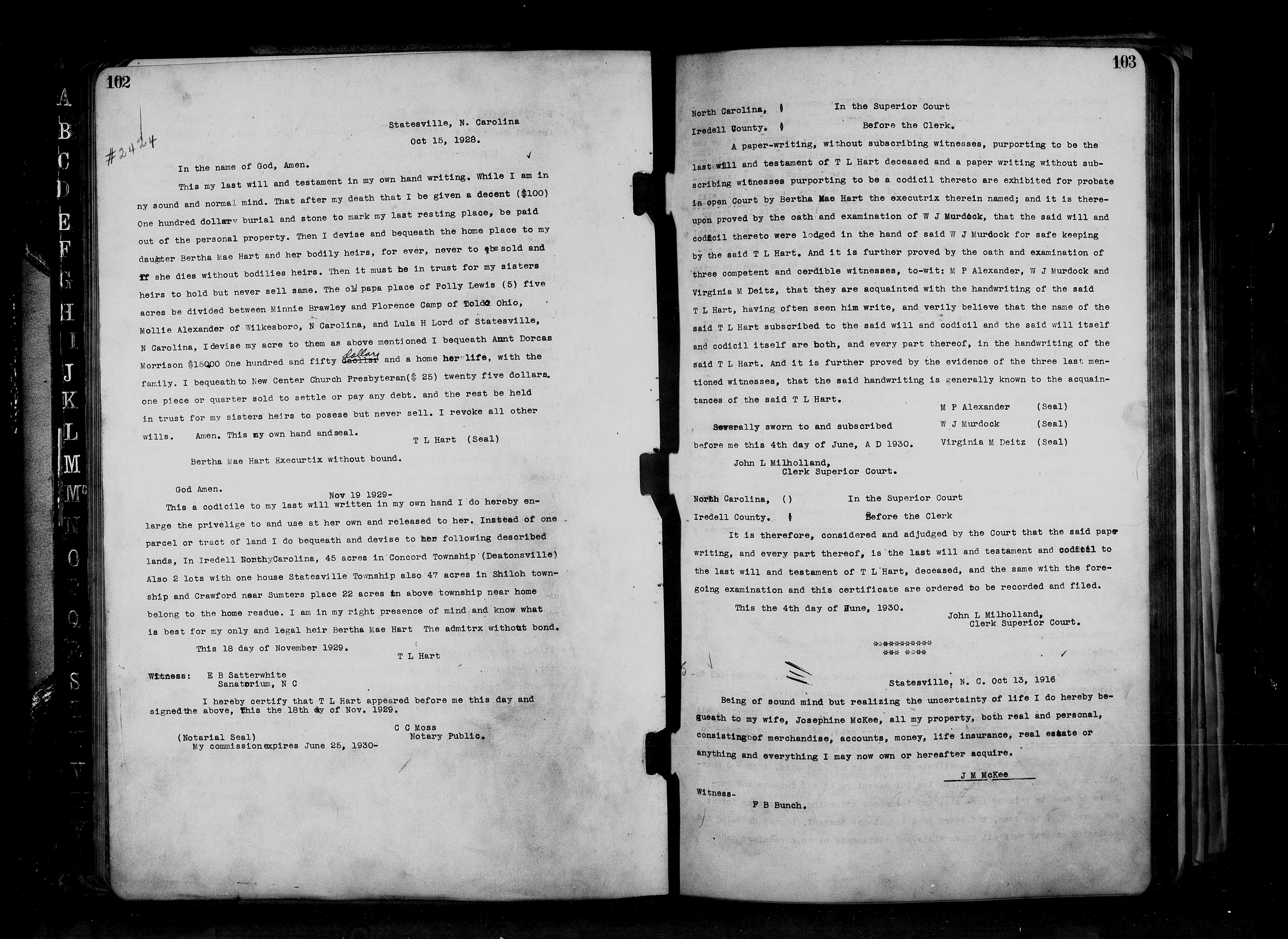
His will confirms Hart’s prosperity and reveals as well his deep ties to his family:
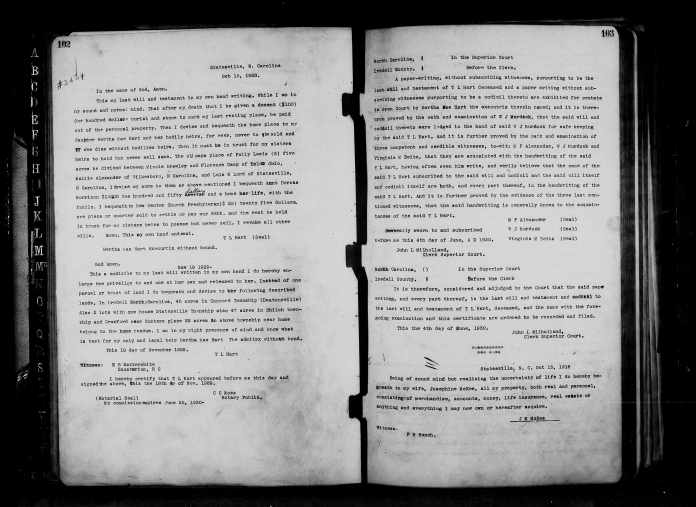
TL Hart Will

Standard
Births Deaths Marriages, Maternal Kin, Newspaper Articles, North Carolina, Oral History

Introducing Martha McNeely.

My grandmother had the sweetest memories of her mother’s mother, Martha Margaret Miller McNeely.Image

In the 1920s, Martha McNeely left Statesville for Bayonne, New Jersey, where her daughter Emma McNeely Houser had settled, followed by several siblings. She settled a few blocks in from the river at 87-A West Sixteenth Street, a 1920 duplex that is still occupied. Said my grandmother:

I went up there one summer from Hampton and worked, and she would let me help her in the kitchen and everything like that, and so I told her, I said, “I’ll cut the corn.”  And she said, “Baby, you can’t cut no corn.  You can’t cut my corn.”  And I said, “Yes, I can, too.”  She said, “I’m sure you can’t, but if you insist, let me see you cut it.”  So I cut the ear of corn like Mama had done, you know.  And she said, “Mmph.  Your mammy taught you.”  [Laughs.]  I didn’t ever forget that.  “Your mammy taught you.”  I said, “Yes, she did.”

And the same story, another time:

… She was so sweet and — I said, “Grandma, now, I can cut the corn.” And she liked to cook. She didn’t think anybody could cook but her. I said, “I can cut the corn for you.” She said, “Honey, you can’t cut no corn for me.” I said, “Yes, I can, too.” And so she said, “well, I’ll let you try it,” she said, “to get rid of you.” So I cut this corn down. She would split the grain, split the grain, and then you cut the top of the grain off, and you cut the second one off, and then you scrape it. And when I did this first ear, she said, “Hmph! Your mammy must have taught you!” “She did.”

When my great-great-grandmother died in 1934, two newspapers marked her passing.  On June 16th, the Bayonne Times announced:

“McNEELY – Martha, at her residence, 87A West Sixteenth street, on Saturday, June 16, 1934, beloved mother of Mrs. Emma Houser, Mrs. Carrie Colvert, Miss Minnie McNeely, John and Edward.  Notice of funeral later.”

Two weeks later, the New York Age informed readers that:

“Mrs. MARTHA McNEELY, one of the older residents of our city, died at her home on Saturday.  Her body was taken to Statesville, N.C. for burial.  Funeral service was preached by Rev. W. Atkinson at Wallace Temple.”

Photo of Martha M. McNeely in the collection of Lisa Y. Henderson.

Standard
Enslaved People, Maternal Kin, North Carolina, Other Documents

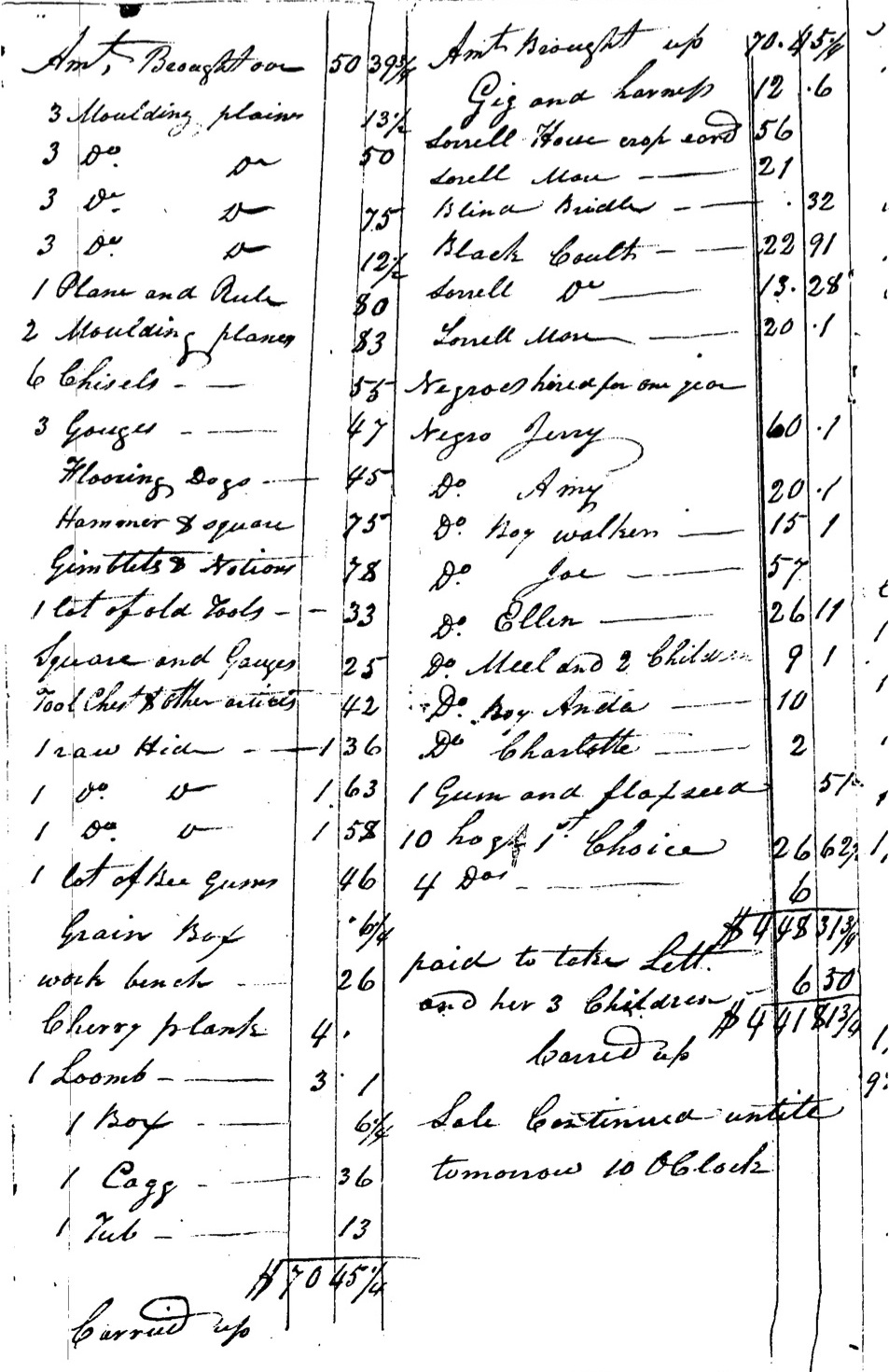
6 chisels, a hammer & square, a grain box, a sorrell mare, 10 hogs and …

Inventory of the estate of John Alpheus Colvert, Iredell County, North Carolina, 1827.

ImageImage

On the second page, in the second column, are “Negroes hired for one year,” that is, slaves leased to neighbors to earn money for Colvert’s estate. “Boy Walker” was about eight years old. That he was listed without his mother suggests that he was an orphan, though he may have been kin to the others who appear in this list. Walker had arrived in North Carolina only two or three years before, passed to John Colvert from the estate of John’s father Samuel. When John’s died, his son William I. Colvert inherited Walker. William was even younger than his own slave, however, and Walker was likely hired out until the boy came of age.

Standard
Births Deaths Marriages, Enslaved People, Maternal Kin, Newspaper Articles, North Carolina, Virginia

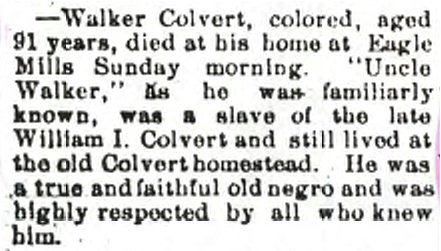
The death of Walker Colvert.

Image

Born in Culpeper County, Virginia; bundled up with chairs and kegs and sundry and shipped to North Carolina after his first master died; reared with his future master, the William I. Colvert noted; husband to his beloved Rebecca; father of three, or maybe four (or more likely more); a middle-aged man when freedom came; a farmer who got a toehold and kept it long enough to pass it on. In the February 5, 1905, edition of the Statesville Landmark, a brief acknowledgement of the death of Walker Colvert, “a true and faithful old negro.” I feel some kind of way about the description, but I didn’t have to live in 19th century North Carolina, and I will not judge. (Him, anyway.)


Standard
Maternal Kin, Newspaper Articles, North Carolina, Oral History

Aunt Bert shot a white man.

Damage Suit Asks $25,000

Suit for $25,000 personal damages has been filed by James L. Warren against Odessa Waddell Williams, executrix of the estate of the late Bertha Mae Murdock, in Iredell Superior Court.

Warren contends in his company that he suffered the damages when Bertha Mae Murdock allegedly shot him in a restaurant near here March 28, 1944, prior to her death.

According to Warren’s complaint, she allegedly shot him while he was visiting at Bill Bailey’s Barbecue Stand four miles west of here. He claims she was a co-partner in that firm at the time.

Warren says that, as result of the alleged shooting, his leg had to be amputated.

Statesville Record & Landmark, 16 December 1955.

—–

OLYMPUS DIGITAL CAMERA

I’ve been looking for an article like this for years, and I don’t know how I missed this one. Still, I’m hoping to find something from 1944, the year Bertha Mae Hart Murdock, daughter of Harriet Nicholson Hart, shot James Warren.

Here’s the version of events my family tells: Aunt Bert married a scandalous man who ran a roadhouse out in the country catering to white folks looking for a little liquor with their barbecue. A patron said something to her one day, and maybe got fresh, and she pulled a pistol and shot him. (There was no “allegedly” about it.) She was convicted and sent to the state women’s prison in Raleigh, where she served as cook for the governor before her release.

Photo of Bertha M. Murdock in collection of Lisa Y. Henderson.

Standard
Births Deaths Marriages, Maternal Kin, Other Documents

She is now with child.

Image

During a recent trip to the North Carolina State Archives, I discovered documents related to an Iredell County bastardy action — State v. John Colvert, colored. Harriet Nicholson had been examined by county officials and found to be pregnant. She named John Colvert as the child’s father and, on 26 January 1874, a warrant was issued to force him into court. In May, John Colvert, with Alfred Dalton and Peter Allison giving bond, agreed to “maintain” the child, i.e. pay child support.

I was aware that Harriet and John were not married when their son Lon was born. Indeed, they never married. In an unusual turn for the era, the child was given his father’s last name and was reared by John’s father and stepmother, Walker and Rebecca Colvert. However, the date of the bastardy action struck me. First, in January 1874, Harriet was only 13 years old. (John was 23.) Second, Lon always gave his birth year as 1875. (June 10, to be exact. Belated shout-out.) Was he in fact born a year earlier in 1874? Could Harriet’s condition have been detected early enough for her to been hauled into court in January? Or was Lon Harriet’s second pregnancy, the first having resulted in a stillbirth or infant death?

My grandmother never mentioned an older child. Perhaps she never knew of one. Harriet married Abner Tomlin a couple of years after Lon’s birth and of their several children only one, Harvey Golar Tomlin, lived long enough for my grandmother to know. Her last child, Bertha Mae Hart, was born in 1904 of her second marriage.

Standard
Births Deaths Marriages, Maternal Kin, Newspaper Articles, North Carolina, Oral History, Photographs

It was our aunt, screaming and crying.

Image

Hattie Hart Dead.

Hattie Hart, colored, wife of Alonzo Hart, died Thursday night at 9:30 o’clock at her home, death occurring at the age of 63 and resulting from a stroke of apoplexy.  The funeral took place at the Center Methodist Church at 3 o’clock in the afternoon.  — The Landmark, Statesville NC, 2 Jun 1924.

—–

This is how my grandmother recalled the death noted above:

“She was subject to high blood pressure, and she had this attack on this day, and we all had to go out there.  It was me — Louise was in Jersey — and it was Launie Mae, Mama and Papa.  And I think Golar went, too.  Anyway, I know we all went out there, and she was sick for a few days and then she died.  But the day that she died, we had gone to the store.  Some old country store, and we had to go a long ways, but we could see down the road, you know. So we went on down the road and when we came back, there were some people who lived across the pasture in some houses that belonged to Mr. Hart.  (That was the step-grandfather — stepfather of Papa.) He owned all these houses, and we saw these people running across the street, and Launie Mae said, “Lord, there’s something happening!” and I said, “There sure is.”  And the closer we got, the more we kept hearing this noise, you know?  And it was our aunt, screaming and crying, you know, ‘cause Grandma had passed.”

——

Photo of Harriet Nicholson Tomlin Hart in collection of Lisa Y. Henderson.

Standard