Births Deaths Marriages, Maternal Kin, North Carolina, Religion

Church home, no. 5: A.R. Presbyterian, Statesville NC.

The Associate Reformed Presbyterian church is a blending of two groups that began in Scotland in the early 1700s. The Associate Presbyterians and the Reformed Presbyterians migrated to America as a result of religious and political upheaval in Britain. The two churches merged in 1782 to form what is now known as the ARP church.

After the Civil war, Associate Reformed Presbyterians from Amity (now New Amity), New Perth and New Sterling Churches moved to Statesville. On August 7, 1869, a meeting was held in Stockton hall to organize the First Associate Reformed Presbyterian Church of Statesville. About 15 people were present at this first meeting, and Reverend W. B. Pressly was chosen as pastor as well as Elders R.R. White, A.M. Walker, George White and John Patterson.

After meeting in the Iredell County Courthouse for a short period, the early church shared the Presbyterian sanctuary for about six years. In 1875, Colonel S.A. Sharpe and other interested friends donated labor and materials to build the first church.

Reverend W. B. Pressly served as pastor until his death November 25, 1883. After several ministers had supplied the pulpit for brief periods, Reverend D. G. Caldwell served as pastor from 1885 to 1891. In 1892, Reverend J. H. Pressly, then a student at Erskine Seminary, accepted the call to this pastorate and served this church for 54 years.

During the pastorate of Dr. Pressly, First ARP Church made several significant steps. The church built a manse in 1897. In 1900, a new sanctuary was built, replacing the first structure and in 1902 the session approved the establishment of a second church in south Statesville. Out of this decision came the organization and building of Pressly Memorial Church in 1907. — Excerpt from http://firstarpchurch.us/about-us/

——

Lon W. Colvert and Carrie McNeely were married in 1906 at A.R. Presbyterian Church. Rev. J.H. Pressly officiated, and he and his wife signed the marriage license as witnesses. My grandmother said that Carrie’s father Henry McNeely was a “big” Presbyterian — it was the denomination of his Scotch-Irish forebears — though Carrie joined the Episcopal church. I’ve contacted First ARP for information about their early membership rolls and will post the results.
Standard
Births Deaths Marriages, Maternal Kin, Newspaper Articles, North Carolina, Oral History, Photographs

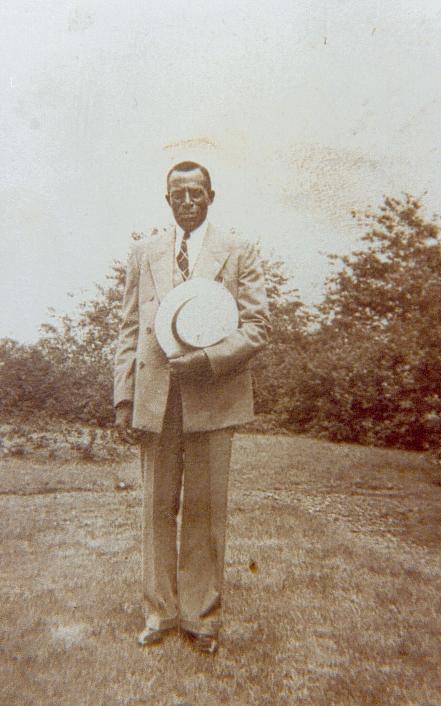
Edward Murray McNeely.

My mother’s brother went to World War I. Not Uncle John and Uncle Luther.  Oh, they were old.  Old men.  They went to the Spanish-American War.  Edward went to World War I — 

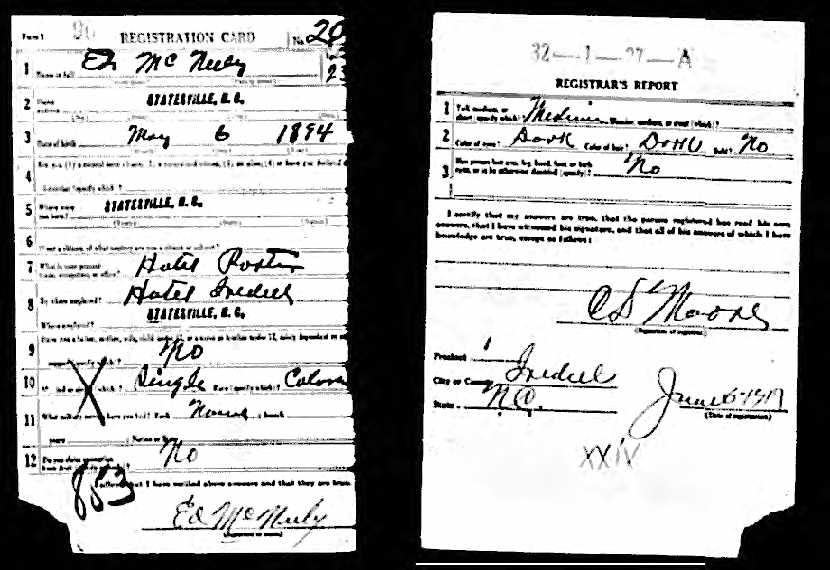
ed mcneely draft card

Yeah.  If he went.  ‘Cause he was the laziest man, dodged everything.  Running all the time.  The ladies were just crazy about him.  He had to leave Statesville.  He went to Asheville and, too ….  They were just about to lynch him because of, you know, these women running after him.  He went to New York.  I think he married two or three women up there.  [I laugh.]  Honey, he was sharp as a tack.  Lord, Lisa, that was one good-looking man.  Tall.  Like Carey.  And he was sharp.  I remember when I went to New York from Hampton to work, went to Jersey from Hampton to work.  He carried me to New York.  First time I had ever been to New York, and he carried me to New York to this Elks Club.  He was a big-time Elk, you know.  And those men swore that I was not his niece, that I was somebody else.  And they said, “Man, you know that’s….”  And I liked to dance with them, you know, and all.  And I would just go with him – I mean, I didn’t go there a lot of times, but I might have went two, three times, but he would take me to that Elks Club.  And he would never let me have anything to drink.  He would drink some wine or something like that.  But he would take me, and one time when I was in New York — Wardenur and I, he used to take us.

McNEELY -- Edward McNeely


Edward Murray McNeely, born 15 June 1894, was the youngest of Henry and Martha McNeely’s sons. He married Lucille Tomlin in 1910 in Statesville and worked as a bellhop in a local hotel. He and Lucille had a son, Quincy Edward McNeely, in late 1910. When the marriage broke up, the boy and his mother moved to Asheville and were lost to the rest of the family. (Or to my grandmother, his first cousin, in any case.) Ed McNeely was in fact inducted into the Army in 1917, but I have no details of his service. By the late 1920s, he had migrated north to join his mother and several siblings in and around Bayonne, New Jersey. In 1942, he registered for the “Old Man’s Draft” and reported his address as 344 Grand Avenue, Brooklyn. (A two-story brownstone in Clinton Hill worth $1 million today. He also gave his height as  5’11, some considerable inches shorter than my cousin Carey.) When he died on 28 September 1950, Edward was living at 454 Avenue C in Bayonne and was married to Delphine Peterson McNeely. Two days later, the Statesville Daily Record published this tragic report:

“Double Funeral Service Planned”

Double funeral services will be conducted for brother and sister here Monday.

Lizzie Long, who burned to death when her home on Bingham Street was almost completely destroyed by fire Thursday morning, will be buried with her brother who died that night in New York.  The brother, Edward McNeeley, a veteran of World War I, died in Veterans hospital, Staton [sic] Island, upon hearing the news of his sister’s death.  His body will be returned here Monday morning and services will be conducted jointly for them at 2:30 p.m. Monday.  Burial will be in Belmont cemetery.  

The funeral will be conducted by Rev. Spurgeon Frost at Rankintown Congregational church.

Photo of Edward McNeely in collection of Lisa Y. Henderson. Interview of Margaret C. Allen by Lisa Y. Henderson, all rights reserved.
Standard
Births Deaths Marriages, Land, Maternal Kin, North Carolina, Other Documents

Jule McNeely leaves a toehold.

I did not doubt that Henry and Julius McNeely were brothers, but here is proof-positive: Julius died widowed, childless and intestate, and his sole heirs were Henry’s children.Image“Jule” McNeely’s thin estate file, opened in 1913 in Rowan County Superior Court, is devoted to the distribution of his tiny plot of farmland to John, Luther, Emma, Addie, Carrie, Ed, Litha, Janie, Lizzie and Minnie McNeely as tenants in common. When Addie died in the middle of matters, a guardian was appointed for her children, “Ardenia” [actually, Ardeanur], 14, and James Smith, 9. At issue: “Beginning at a stone on D.S. Cowan’s line, and runs S. two degrees W 7.10 chains to a stone thence; N. 85 degrees W. 3.50 chains to a stone, thence; N. 2 degrees E. 6.50 chains to a stone on Cowan’s line, thence; E. to the beginning, containing two and a half acres more or less.” “The above land is the old Jule McNeely place, lying just east of Mount Ulla in Rowan County, and” — despite its tininess — “is a very desirable lot.” The heirs’ attorney petitioned for the sale of the lot, noting that it was too small to be advantageously divided or to justify continued possession by so many heirs, all of whom lived in Iredell County except Emma and her husband Ervin Houser of Bayonne, New Jersey. The petition was granted, and at auction on April 21, 1917, Carrie’s husband Lon W. Colvert placed the highest bid at $80.

[Sidenote: Before I found this file, I did not know that (1) Lizzie McNeely was first married to Watt Kilpatrick; (2) when Addie McNeely Smith died; or (3) Lon Colvert owned property in Rowan County, much less property that had belonged to his wife’s late uncle.]

Standard
Civil War, Maternal Kin, North Carolina, Other Documents

I will henceforth faithfully support, protect and defend.

The war is over. The Union has won. There is nothing to do but accept it and move on. Two months after the Surrender, his enslaved son now free, John W. McNeely swore his allegiance to the United States.ImageHalf-way across the country, in Iron County, Missouri, William B. McNeely had not waited for the war to end and beat his brother to the punch by nine months.Image

[Sidenote: Compare the W, M and N in John and William’s signatures. They clearly learned to write from the same instructor.]

Oath of Allegiance. Union Provost Marshals’ File of Papers Relating to Individual Claims, National Archives and Records Administration.

Standard
Maternal Kin, Newspaper Articles, North Carolina

Uncle Julius gets bamboozled.

MILL BRIDGE, April 5.

Mr. Editor: — One day last week a well dressed gentleman of color, wearing a flashy, gold looking watch chain, with checks on the First National Bank of New York for $2500, put in his appearance at the house of Julius McNeely, one of our most trustworthy, hard-working darkies. Jule being of a hospitable nature did what he could to make his visitor comfortable. The said gentleman of color represented himself as Mr. Ed. Brown, a relative of Margaret (Jule’s wife), having left this country twenty-three years ago, that he had been in the U.S. Army and Navy, traveled over the world, made plenty of money and was now traveling in the interest of the Western Colored Emigration Society; he gave glorious descriptions of California and offered to furnish transportation free to all who would go with him to the land of milk and honey. Jule and Margaret listened with delight to the many wonderful stories he told of the outside world, and on last Friday morning prepared his breakfast and went to the field to work, leaving him reposing in bed. When lo! Upon returning they found he had skipped, taking with him Jule’s new double-barrel breach-loading shot gun that cost $25, a gold ring belonging to the school marm, worth $10, 50 cents in wash and a pint of Jule’s medicinal whiskey. He made his way to Cleveland, bought a ticket to Statesville with the stolen half dollar and boarded the 12 o’clock train with the gun and ring. Julius is sorrowing, and offers to pay $10 or any amount above that he can raise to anybody who will “cotch dat nigger devil.”

Said negro is of small stature, copper or ginger cake colored with a broad scar on the left side of his neck, a black spot on the upper part of his nose between his eyes and a mole on one of his cheeks. He is between 38 and 40 years of age and his hair is slightly mixed with gray. He was raised at Davidson College and came in the possession of Mrs. Kate Barnes, Dr. Kerr’s niece. He ran away from Charlotte, where his mother now lives, for stealing, and had been staying about Salisbury with Wylie Dodge and Harriet Brown previous to his coming out here. He left this neighborhood in 1866, at which time he was in the employ of a writer. He stole a gold watch from Mrs. Ray and sold it to William Stockton, of Salisbury. The watch was recovered, but Ed. Was not heard of since until he turned up at Julius McNeely’s, last week. He is a professional rogue, and the local papers will please hand him around.    J.T. RAY.

The Carolina Watchman, Statesville, 11 April 1889.

Standard
Enslaved People, Maternal Kin, North Carolina

Juda’s children.

As noted earlier, Elizabeth Kilpatrick’s will seems to establish that Juda, an enslaved woman born perhaps in the 1790s, was the mother of at least two children, the Dave and Lucinda specifically referred to in Kilpatrick’s will. Under its terms, Dave’s ownership passed to son Robert Kilpatrick and Lucinda’s to daughter Mary Kilpatrick. Elizabeth’s estate file shows that her administrator sold Negroes Juda ($50.00), Matthew ($425.00) and John ($200.00) on 29 August 1829 and “Negro Kesy” for $74.75 on 30 October 1830. (Their buyers are not listed.) Assuming that Kesy, Matthew and John are the “children not disposed of” in the will, Juda was the mother of at least five children.  Only Lucinda can be further accounted for.

In 1834, Mary Kilpatrick sold Lucinda and her children Alice, 3, and John, 1, to Samuel and John W. McNeely. John disappears from the record. However, Alice, known as “Allie,” bore at least one son, Joseph Archy, and probably several other children, including Alexander, Stanhope and Mary. All – save Alice, who perhaps had died – appear in J.W. McNeely’s Confederate tax assessment in 1863.

Lucinda herself gave birth to two more sons, Julius, about 1838, and Henry W., in 1841. Julius’ father is unknown, but appears to have been a black man. Henry’s father was John Wilson McNeely himself.

Standard
Maternal Kin, Newspaper Articles, North Carolina, Politics

The friends of prohibition.

Mt. Ulla.

A meeting of the friends of prohibition was held at Wood Grove, Mt. Ulla Township, on the 4th instant. W.L. Kistler. Esq., was called to the chair and Rev. J. G. Murray, col. was elected secretary. The object of the meeting was explained by Dr. S.W. Eaton. The following resolution was offered by J.T. Ray and unanimously adopted after appropriate remarks from Rev. J.G. Murray and other.

Whereas, In consideration of the evil of Intemperance, caused by the sale and use of intoxicating liquors upon society, which promotes crime and other known vices, and thereby increasing taxation upon the citizens for the suppression, and also entailing injury in some or other upon all classes and conditions of our fellow men, Therefore

Resolved, That we do hereby heartily approve of the action of our County Commissioners in refusing to grant license for the retailing of intoxicating liquors to be used as a beverage in Rowan County.

Upon motion the chairman and secretary were requested to appoint a committee for permanent organization to meet on Saturday the 11th inst., at 3 o’clock, P.M.

The committee for permanent organization are as follows: White – S.A. Lowrance, D.M. Barrier, J.C. Gillespie, J.T. Ray, J.K. Goodman, S.C. Rankin, S.F. Cowan, J.M. Harrison, M.A. File, R. Lyerly, J.K. Graham, Esq.  Colered – W.W. Kilpatrick, Ransom Miller, Henry McNeely, Andy Gillespie, Amos Foster, George Miller, R.A. Kerr, James Rankin, Julius McNeely, Silas Gillespie, Gabriel Kerr.

Upon motion the meeting adjourned to meet on Saturday the 11th inst., at 3 o’clock, P.M.   W.L. KISTLER, Ch’m. J.G. MURRAY, Sec.

The Carolina Watchman, Salisbury NC, 9 June 1881.

ImageWood Grove, Rowan County, Library of Congress Prints and Photographs Division.

——

Henry McNeely and his half-brother Julius McNeely were joined on the committee by Henry’s brother-in-law George Miller and his wife Martha’s brother-in-law Ransom Miller.

Standard
Civil War, Maternal Kin, North Carolina, Other Documents, Rights

The first registration.

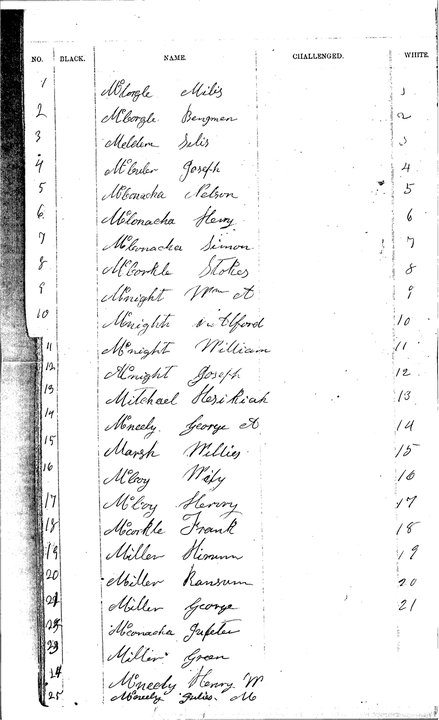
voter reg

Rowan County, North Carolina, 1866. The war is over. The 14th and 15th Amendments have not yet passed, but the county’s hopeful freedmen have come out en masse to register to vote, perhaps under the auspices of the Freedmen’s Bureau. Among them, my great-great-grandfather Henry W. McNeely, his half-brother Julius McNeely, and his future in-laws Ransom, George and Green Miller. Henry’s father John W. McNeely, Confederate allegiance renounced and U.S. citizenship restored, was also there — his world upside down.

Standard
Enslaved People, Maternal Kin, North Carolina, Oral History

Henry W. McNeely.

My grandmother said he looked a bit like a poet. Or so she was told:

See, I never did know Grandpa Henry. I didn’t know him.  He died just as Louise was born. Mama had just had Louise, and it was real hot and all, and they told her she couldn’t go to the funeral because it was so warm and she would take cold.  But I didn’t know him. 

And:

Mama said he looked just like Walt Whitman.  You know, he was, his father was white. I don’t know who his mother was. I don’t know if she was mulatto or what.  But anyway, he was really light.  And he lived on the same farm as his daddy.  And he provided him, he provided for him as if he was his own child.

White child, that is.

Henry W. McNeely was 22 years old the year his father reported to the tax assessor that he was worth $1500. The tax list is his first named appearance in the record, and documentation of his life is relatively scarce thereafter. He registered to vote in Rowan County in 1868 and appears in his mother’s household in Atwell township, Rowan County, in the 1870 census.  (He was described as a schoolteacher. Had his father taught him to read while he was enslaved? Or was he a quick learner in a Reconstruction school?) In 1872, he married 18 year-old Martha Miller and, in a daring gesture, named Wilson McNeely as his father on the license. The register of deeds did not blink and dutifully noted that all parties, except Wilson, were colored.
Image

[Sidenote: “Louise” was Mary Louise Colvert Renwick, my grandmother’s sister, born in 1906. — LYH]

——

Interview of Margaret C. Allen by Lisa Y. Henderson; all rights reserved.

Standard