Births Deaths Marriages, Maternal Kin, Newspaper Articles, Photographs, Virginia

Marion Allen Lomans.

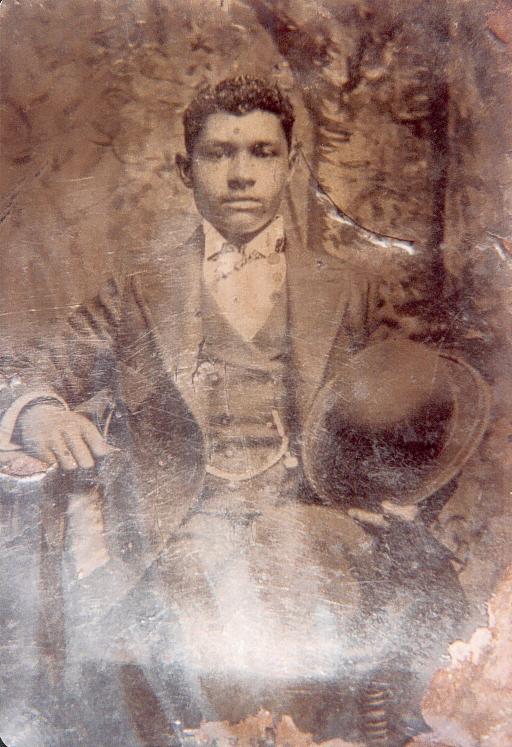
She was the aunt for whom my aunt was named. She was a teacher. She married late and had no children. And she died when my mother was small. That was about all I knew about my grandfather’s oldest sister, Marion Ellen Allen Lomans.

My uncle let me copy a scarred and badly tinted photo:

Marion Lomans

She looked like an Allen sister, but I was no less mystified. (Frankly, other than Aunt Julia, they were all a bit mysterious — how did I never meet Aunt Edith?  Or Aunt Nita until I was an adult? Or even Uncle Buster, who lived right in Newport News?)

And then M., my mother’s first cousin, sent this picture, which charmed me to no end — Aunt Marion and her students at John Marshall School:

Marion Allen & class

And then I found her obituary:

MA_Lomans_Obit_Daily_Press_15_Apr_1942

Virginian Pilot, 15 November 1942.

And so I learned a few more things: that, despite her marriage to Mr. Lomans, a World War I veteran whom she had married “recently” and whose Christian names were actually Gillespie Garland, she was still living at home at the time of her death. That she was a member of the United Order of Tents (a secretive charitable organization founded by black women in the mid-19th century) and the Good Samaritans (another?). That she taught for only six years. That Aunt Tee — that’s Edith — was unmarried and living in New York City when Marion died.  That Marion died at Whittaker Memorial Hospital, an institution that her father served as a board member.  That she was buried from Zion Baptist,  the church that nurtured her father. Still, who was she?

Standard
Births Deaths Marriages, Maternal Kin, Oral History, Photographs, Virginia

Mary Agnes Holmes Allen.

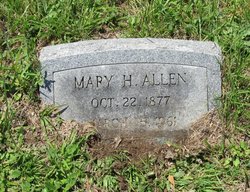
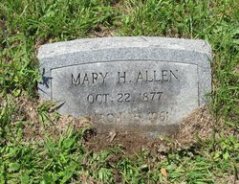
Her headstone is wrong. Mary Agnes Holmes was born October 15, 1877 — not October 22 — on the R.L. Adams’ plantation in Charles City County, Virginia. Her parents were tenant farmers there, and Agnes was one of a handful of Jasper and Matilda Holmes‘ children to survive to adulthood.

Agnes’ mother died when she was about 8 years old, and her father apparently did not remarry. Jasper Holmes was an ambitious man and managed to purchase several small plots of farmland upon which he supported his family in a degree of comfort. The Holmeses may have attended New Vine Baptist Church and, if so, that is likely where Agnes met John C. Allen.

There is an ugly story told about their marriage: John had quickly established himself as an eligible bachelor in Newport News’ East End, and his appeal was heightened — in the standards of the day — by his light skin and wavy hair. When he brought his new bride home shortly after Christmas 1900, his neighbors, peeking through curtains, were shocked to see a plain, broad-featured, brown-skinned woman step from the carriage. (Agnes herself was not immune to such prejudices, and her color-struck notions would reverberate among her offspring.)

Image

During the early years of her marriage, Agnes did “day’s work” as a housemaid. I did not know this. I had assumed that she was always a housewife, which is a reflection of my failure to understand just how my great-grandparents were able to achieve the middle-class respectability that marked their lives by the middle of the 20th century. (Not to mention how they maintained their dignity on the climb.)

Me:  Now, his mama didn’t ever work, did she?

My grandmother:  Who?  Indeed, she did work.

Me:  Like, outside the home?

My grandmother:  Yeah, during the late years, she didn’t, but she worked outside the home ‘cause she told me one time she walked across the bridge, ‘cross 25th Street bridge, and said it was snowing and ice, and the ice froze on the front of her coat.  And I never shall forget, she worked for a lady, and this lady had a small child.  And she asked her would she wash the child’s sweaters.  Sweaters that the baby had.  And she took and said, “Asking me to do all kinds of extra work like that,” and said, “You know what I did?”  Said, “I washed the sweater in hot water, and then I put it in cold water.  When I got through with it, it was ‘bout big as my fist.”  I said, “How can [whispering, inaudible.]”  And she knew it –

Cousin N: Was gon shrink up.

My grandmother:  And I said, “Oh, my God, that is awful!”  And it was.  Anyway, she told me that.  She said, “I washed it all right for her, and I put it in hot water, as hot as I could find, and then put it in cold water.  When I got through with it, couldn’t nothing wear it.”

By the time my mother and her siblings were children, Mary Agnes Allen had assumed the domestic role I’d always imagined her in — at home on Marshall Avenue, among Tiffany lamps and lace antimacassars, preparing roast beef to serve on Blue Willow china to a husband just home from this board meeting or that union affair. Her grandchildren speak of her ambivalently, aware of the casually cruel distinctions she drew among them, but unable to name any particular misdeed.

Me:  Well, was Mary Agnes mean to y’all or what?

My mother:  She was not to me, that I remember.  I don’t know what this was about.  Ahh … maybe it was that she was not friendly.  Maybe she wont like Grandma Carrie, joking and saying little funny stuff.  I don’t know.  I don’t know what it was.

Her grandchildren — at least, her son John’s offspring — felt that lack of warmth acutely. Though their 35th Street home was only a mile away from hers, Mary Agnes Allen does not feature much in the stories of their childhood. (Nor, frankly, does John Allen Sr.)  In her later years, she left Newport News to live with her daughter Edith Allen Anderson in Jetersville, Amelia County, Virginia. The photo below, I’m guessing, was taken shortly before her move. And seems to reveal a softer side.

Image

Mary Agnes Holmes Allen died March 15, 1961, just two months before my mother married in the sideyard at Marshall Avenue.  A brief obituary ran in the Daily Press on the 17th, noting that she was a member of Armenia Tent No. 104 and the Court of Calanthe. She was survived by three daughters, a son, a “foster son” (actually, her nephew), a sister, and, most curiously, “12 grandchildren and 10 great-grandchildren.” In fact, she had ten grands and no more than three great-grands.
Image

Interviews by Lisa Y. Henderson, all rights reserved.  Photographs in collection of Lisa Y. Henderson.

Standard
Maternal Kin, Oral History, Virginia

Mystery sister.

In the early 1940s, my uncle recently said, a mysterious woman appeared at his grandparents’ house. My uncle alone was there because he stayed with them sometimes during the school year; his aunt Marion was his teacher. In the manner of the day, no one bothered to introduce a child to an adult, but he gathered that the woman was Papa Allen’s sister. This was a surprise to him, as he had not known his grandfather to have any such relatives. The woman looked much like Papa, with very light skin. He never saw her again, and whether she ever returned he cannot say.

Who was this woman? She was not Emma Allen Whirley, John Allen‘s younger half-sister, who was not light-skinned and probably was dead by 1940. Could she have been Nannie, the 5 year-old listed in Graham and Mary Allen‘s household in the 1880 census of Charles City County? Nannie’s birth predated Graham and Mary’s marriage, and it is not clear which is her parent. Her pale skin suggests that Mary was her mother, and her father was, perhaps, the same white man that begot John. No other record of her has been found.  She may have been the mother of Junius and Milton Allen, the grandsons recorded with Graham and Mary in the 1900 census, but I suspect that they were born to Emma before her marriage. Otherwise, if Nannie is the woman who appeared on Marshall Avenue just before the outbreak of World War II, she has eluded detection in the record.

Standard
Births Deaths Marriages, Maternal Kin, Military, Other Documents, Photographs, Virginia

Edward N. Allen.

After John C. Allen‘s birth in 1876, Graham and Mary Brown Allen had four children together. Emma, their only daughter, was followed by Willie, Alexander and Edward Noble.

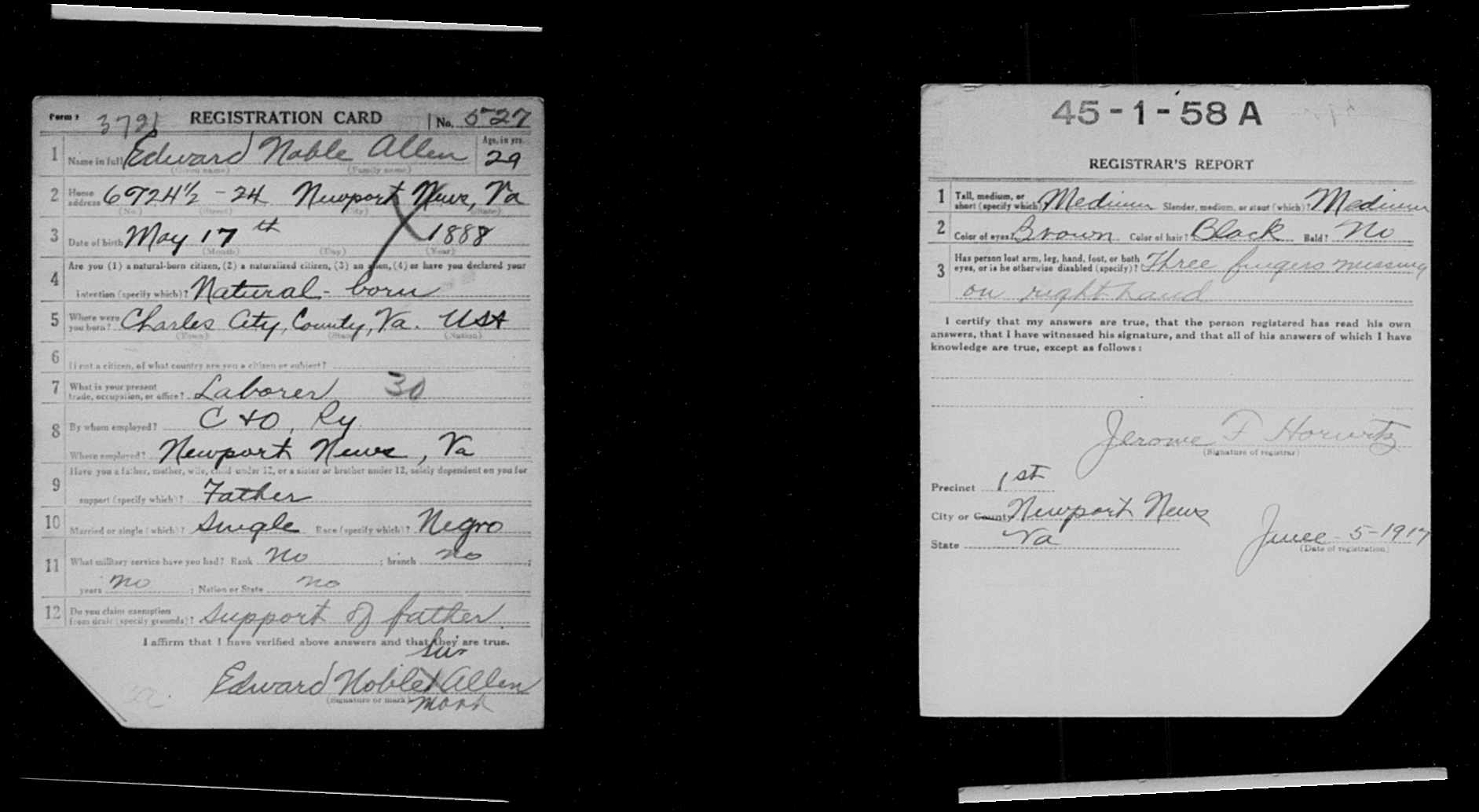
Edward N. Allen grew up in Charles City County, but followed his half-brother John to Newport News some time after 1910. He was working there as a laborer for the Chesapeake & Ohio Railroad when he registered for the draft at the outbreak of World War I. (And had had a tough life, as he reported missing three fingers on his right hand.)

ImageEdward survived the war, but his life over the next 15 years is hidden from history. He apparently never married or had children. Unless he is the Virginia-born Edward Allen that is listed as a farmhand in upstate New York in 1920, he appears in neither that nor the 1930 census. He was back in Charles City County by the early 1930s, though, and died in early 1933 at the U.S. Marine Hospital in Norfolk. He was only in his early 40’s, but beset with an old man’s diseases.

Edward_N_Allen_Death_Cert

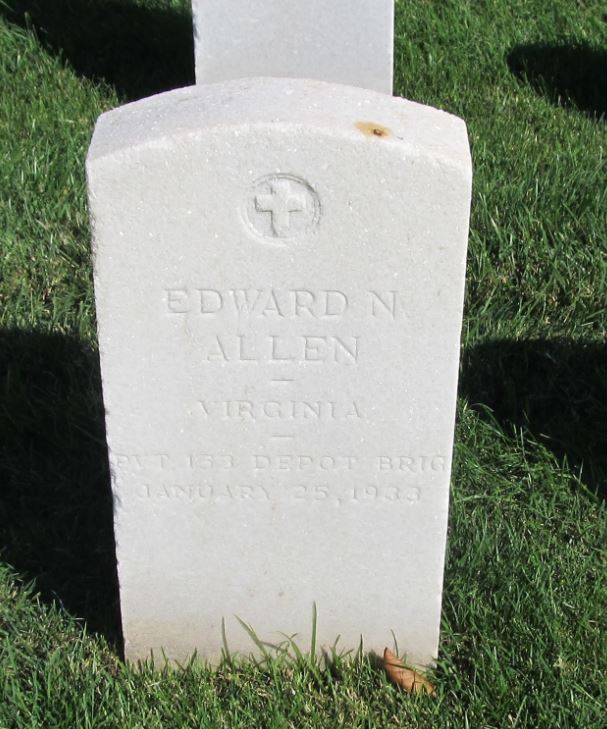
Edward Noble Allen is buried in Hampton National Cemetery.

Image

Standard
Maternal Kin, Photographs, Virginia

Speaking of Aunt Julia …

Here she is.

Image

Pretty much the way I remember her, though this photograph probably dates from the mid to late 1950s, ten to fifteen years before I knew her.  Her hair was always in pincurls behind the ears with a curly fluff of bang bunched up front. She always wore cotton print dresses, often with a bibbed apron. Her skin was a uniform pale, pale yellow, marshmallow soft on cheeks and upper arms, and smelling of … what? Powder? Faint perfume? My memory fails me; my mother will know.

I spent much of a summer with her when I was two, which I don’t at all recall but later Aunt Julia told me this: It is lunch time, and she has placed a biscuit on a plate before me, and as she bustles about to serve Uncle Bobby, I lay my cheek on this tiny warm pillow and fall straight into sleep.

My grandfather died long before I was born, and of his sisters and brother who lived into my childhood, she was the only one I knew. The return home from every visit to my grandmother in Newport News began with a slight jog to the left, a turn down Marshall Avenue to see Aunt Julia before we got on the road.

Standard
Land, Maternal Kin, Oral History, Photographs, Virginia

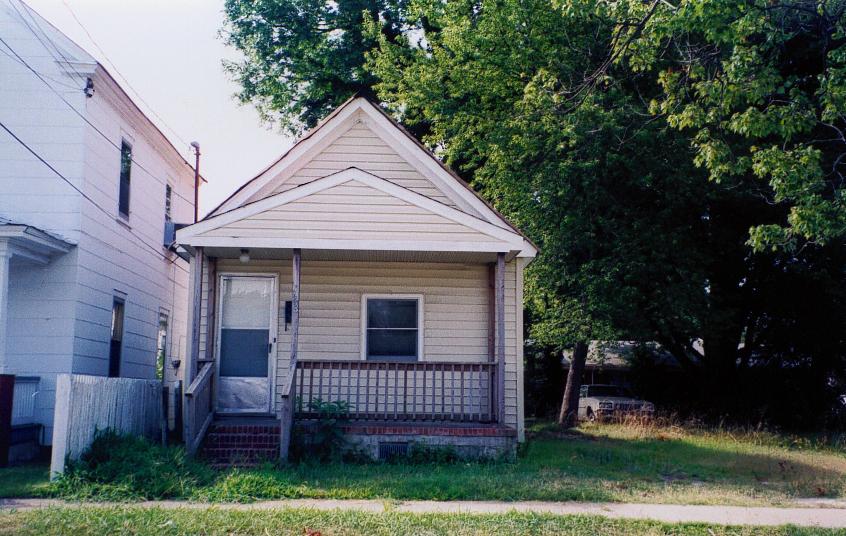
Where we lived: 748-21st Street.

My uncle: That’s where I was born and where John was born.

Me: At 748?

My uncle: That’s it.

My cousin: This crib right here?

My uncle: That’s where I was born

Me: [Laughing.] Wow.

Image

Tax records show that this tiny house — less than 800 square feet — was built around 1910. It now has two bedrooms and one bath, but the bath was undoubtedly a late addition. John C. Allen may have been the first to move a family into the dwelling; the Allens are shown there in the 1910 census of Newport News. John, who worked as a shipyard painter, reported that he owned the house subject to mortgage.

Image

By 1920, the Allens had moved just around the corner to 2107 Marshall Avenue, the house I knew in childhood as my great-aunt Julia‘s. John Allen kept 748 and rented it out until his middle son married. John C. Allen Jr. and his wife Margaret Colvert Allen lived there until their fourth child, my mother, was two weeks old.

My grandmother: I lived I don’t know how many years in Mr. Allen’s house without any electricity. And just as soon as I moved out –

Me: He had it wired?

My grandmother: He had it wired.  And one of the neighbors said she went out there in the street and laid him out.  Said, that child over there with those children, washing and ironing and working herself to death, and you wait until she leaves out of your house, your son’s house?  She said she laid him out.

——

Photograph by Lisa Y. Henderson, 2002; interviews of C. Allen and Margaret C. Allen by Lisa Y. Henderson, all rights reserved.

Standard
Births Deaths Marriages, Maternal Kin, Virginia

John C. Allen arrives.

JC Allen 1

John Christopher Allen made his way down-river to the newly established city of Newport News around 1899, a thick-set country boy with dark curly hair.  In April of that year, he had purchased ten acres in Turkey Trot from A.H. Drewry and wife, but he did not hang around to farm it. What pulled — or pushed — him out of Charles City County is not precisely clear, but he would never turn back.

va_hm_newport_news01

Newport News was a boomtown at the turn of the 20th century. The extension of the Chesapeake & Ohio Railroad down the peninsula, bringing coal from West Virginia for world-wide transport, was followed shortly by the development of the shipyard for which the city is still famous.

In June of 1900, the census taker found John Allen sharing a boarding house run by Henry Burrell with several single men.  The house was in the crowded East End, near the heart of industrial Newport News.  John was working as a shipyard laborer, and he was illiterate.  That year, on the day after Christmas, the 24 year-old son of Graham and Mary Allen, married 23 year-old Mary A. Holmes, daughter of Jasper and Matilda Holmes, at New Vine Baptist Church in Charles City County. They returned to Newport News to start their 50-plus years together.

Standard
Education, Maternal Kin, Religion, Virginia

Church home, no. 4: Zion Baptist, Newport News VA.

“The Zion Baptist Church was organized in the year 1896 under a cherry tree at its present location by a group of 13 baptized Christians who had migrated to Newport News from other areas of Virginia and the Carolinas and who had not affiliated with any local congregation.

In 1896, when the City of Newport News was in its infancy, a section of town now known as the East End was better known as “Blood Field” for its street violence. There were houses of prostitution, bars, dance halls, a saloon on every corner and gambling was a way of life.

It was after several meetings from house-to-house that the thirteen Christians concluded that there was a need for some type of religious worship in the immediate area and so 107 years later, Zion Baptist Church in the East End was set.

The first pastor called to lead the group was Rev. Moses Tynes and in 1897, the first tiny structure was built under his leadership. Most of the materials were donated by whites in the community and the labor was donated by men in the community.

In 1899, under the leadership of Rev. C. J. Crudup, the sanctuary was destroyed by fire. But despite this setback along with other difficulties, the congregation continued to grow. Rev. C. E. Jones was called to assume the responsibility of leadership in 1901 and for eleven years, Zion experienced tremendous growth, encouraging men and women to turn to Christ. Both Rev. and Mrs. Jones were actively involved in the work of the National Baptist Convention and the Lott Carey Foreign Mission Convention. In 1941, Rev. Jones’ pastorate ended as a result of a car accident after 39 years of leadership to the congregation. Rev. Joseph B. Reid became his successor and he served the church for fourteen years.”  Excerpt from “About Us,” http://www.zionbaptistonline.org/about.html

——

John C. Allen Sr. was illiterate when he arrived in Newport News about 1899.  Before long, he made his way to Zion Baptist where, under the tutelage of Rev. Charles E. Jones, he learned to read. John reared his children in the church, and his funeral service was held there in the first days of 1954.

He was a smart man, but he was not an educated man.  If he had had an education to go along with his wit, he would have been a bad boy.  I’m telling you, ‘cause he was just as smart as he could be. 

——

Interview of Margaret Colvert Allen by Lisa Y. Henderson, 8 August 1998; all rights reserved.

Standard
Maternal Kin, Photographs, Virginia

John C. Allen Jr.

Image

If he were living, he would be 107. I never knew him. My mother barely did; he died when she was 10; he is a mythological figure. His children speak of him reverentially, wistfully, with smiles. His widow sometimes spoke of him with a tinge of anger, a sense of abandonment that simmered low. He is a wraith made more so by her timeless solidity at our family’s core. Her light had only just begun to dim when she left us in 2010; she was 101. He was 41– younger than the youngest of his grandchilden. Frozen in 1948 — a slight, brown-skinned man with swayback legs and a small smile. My little ears are his. The tiny flaps at the inner corners of my eyes. The flare-ups of inner darkness. Who was he? Why?

Standard
Maternal Kin, Photographs, Virginia, Vocation

Look at that.

John Allen on Aberdeen worksite

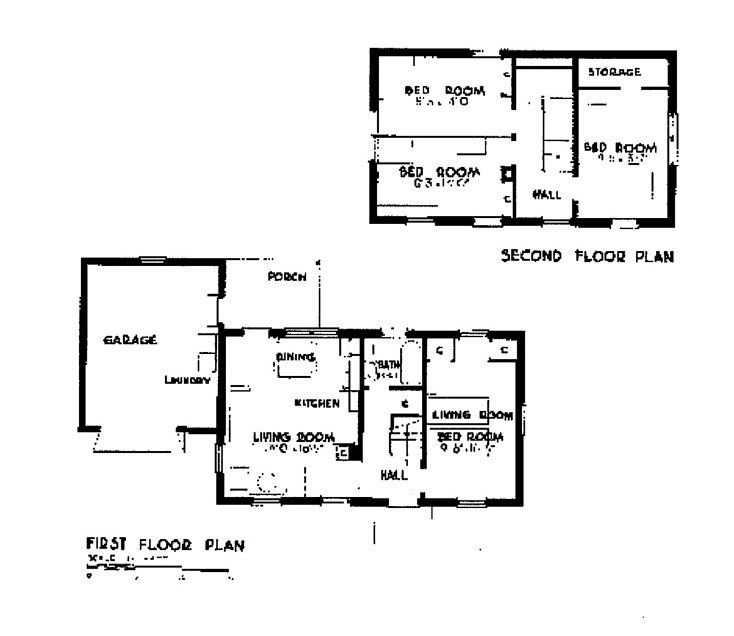
I rode through Aberdeen Gardens two or three times while I was in Newport News. “By Negroes, for Negroes” reads the historical marker near the school. Boxy, red-brick houses counterposed in neat lines along streets named for community heroes. My grandfather John C. Allen Jr. was a drywall supervisor during their construction in the late 1930s. Though he disdained the building standards, he briefly moved his family into one of the duplexes when my mother was three weeks old. Semi-furnished. A chicken coop out back. A vegetable garden. By 1940, the family was gone, into the two-story house on 35th Street that my grandmother called home until she died. There’s a rose alongside the porch that still blooms where my grandfather planted it, and he passed in 1948. This house is the most constant edifice of the whole of my life. My Gibraltar. Upstairs, my grandmother slept in the double bed that they brought with them from Aberdeen, along with a squat chest and a nightstand. Solid oak in a simple Shaker style. “Not a drawer sags to this day,” she told me, marveling. She pulled one precariously far out. “Look at that.” I gently tested its solidity. I laughed.

aberdeen

Above, John C. Allen (third from right) and his drywall crew at Aberdeen Gardens, circa 1937, and floor plan of Aberdeen Gardens home.

Standard