Births Deaths Marriages, Maternal Kin, Newspaper Articles, North Carolina, Oral History

Aunt Bert, as reported.

So, the conversation started with talk of Bill Bailey’s barbecue joint. Which was also a dance hall.  Which, though it was right up the road, was, as my grandmother put it, “strictly off-limits” to her and her sisters. “We couldn’t stand him,” she said, because “he did everything illegal and got away with it.” He had a great big stomach and was “trashy,” but his steaks pulled the best of Iredell County’s partying white folks.  And he was married to my grandmother’s Aunt Bert.

Me:  Now, she wound up … She shot somebody, or something, didn’t she?

My grandmother:  Yeah, she shot somebody.  She shot a white man.

My mother’s first cousin, N.:  What he do?  Slap her?  What did he do?  He did something to her.

My grandmother:  I don’t know what he did to her.  But maybe … seems like to me he kicked her.

N:  And she shot him.

My grandmother:  And she shot him.

N.: They had to take his leg off.

[Pause.]

Me:  Oh.  Well, good for Bert.

When I wrote about this before, I was looking for newspaper coverage of the incident, thinking that a black woman shooting a white man in North Carolina in 1944 had to have galvanized the public. Well, sure enough, the Statesville Record & Landmark covered every step of ensuing criminal trial, though in a considerably less salacious manner than I might have expected.  The headlines pretty much tell the tale:

James Warren, Merchant Marine Home on Leave, Seriously Shot. Mae Bailey, Colored, Held in County Jail Charged with Shooting. 29 March.
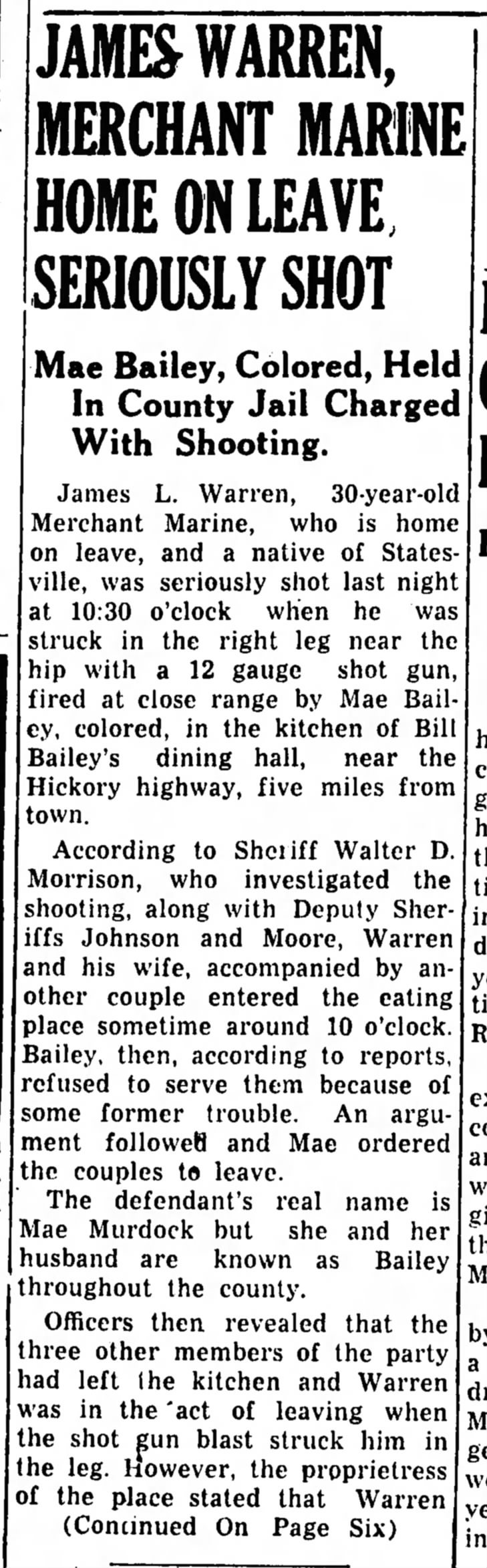
Warren Shot 3 29 44Warren shot contd

Warren Holding Own, But Will Not Be Out of Danger For Week.  30 March.

James Warren’s Leg Amputated.  3 April.

James L. Warren Is Better But Not Yet Out of Danger.  6 Apr.

Mae Bailey Freed from Jail Today, Hearing May 8th.  11 April.

May Postpone Murdock Trial.  29 April.

Warren Removed to the Naval Hospital at Portsmouth, Va.  1 May.

M. Murdock Trial Postponed Until Monday, June 12.  8 May.

James Warren Starts Civil Action Against Murdocks for $25,000.  11 May.
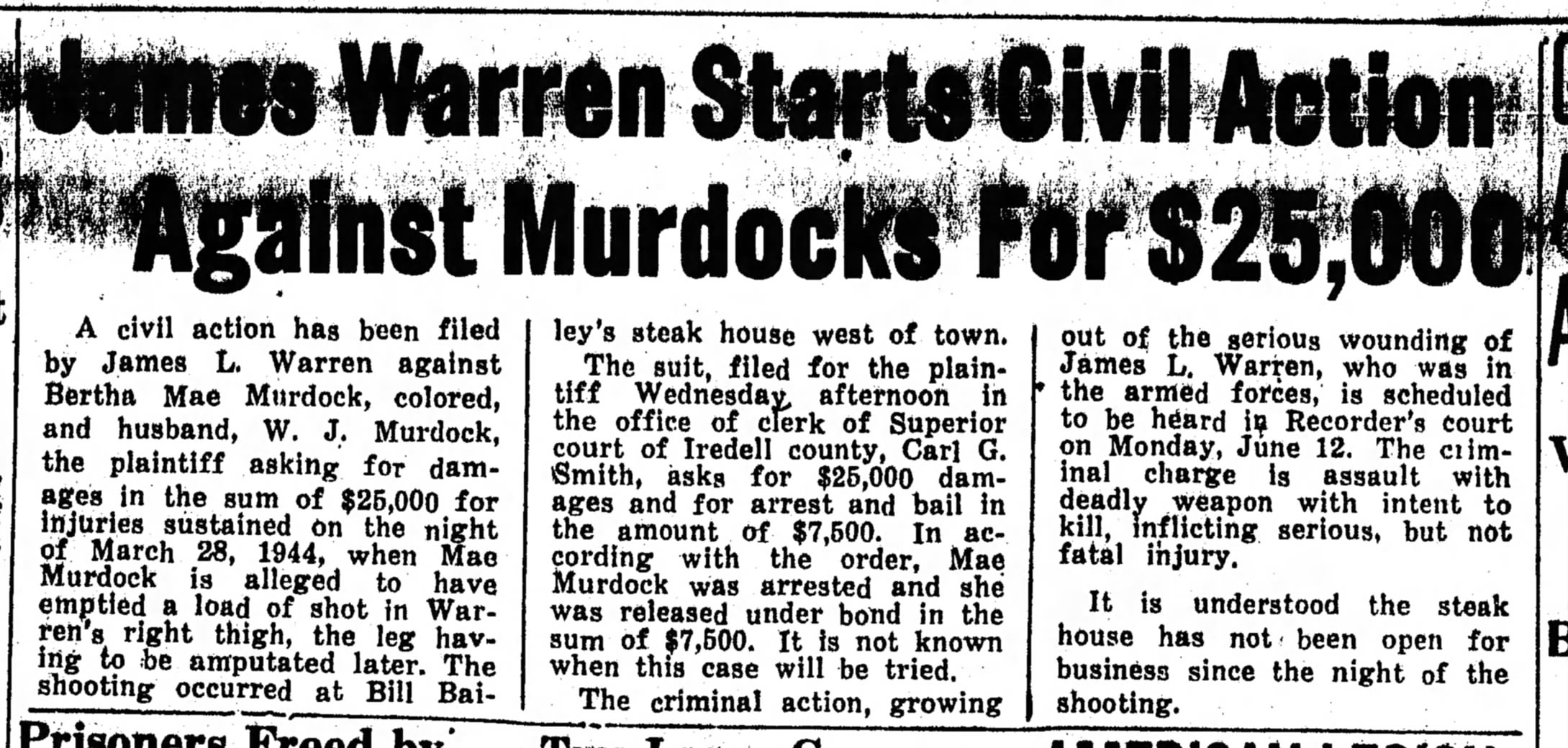
Murdock Civil Action 11 May 44 R and L

Mae Murdock Case Continued to August.  25 May.

Judge Bobbitt to Superior Court Preside August, Case of Mae (Bailey) Murdock Will Not Be Tried At This Term.  29 July 1944.

Murdock Trial Definitely Set For November 6, Warren is Able to Leave Hospital.  6 September.

Prosecuting Witness May Not Visit Scene of Shooting. 9 October.

Mae Murdock is Bound to Court Under $5000 Bond. 16 October.

Case Hinges on Warren’s Action Before Shooting, Testimony Rapidly Nearing Completion.  9 November.

Murdock Woman is Convicted. 13 November.
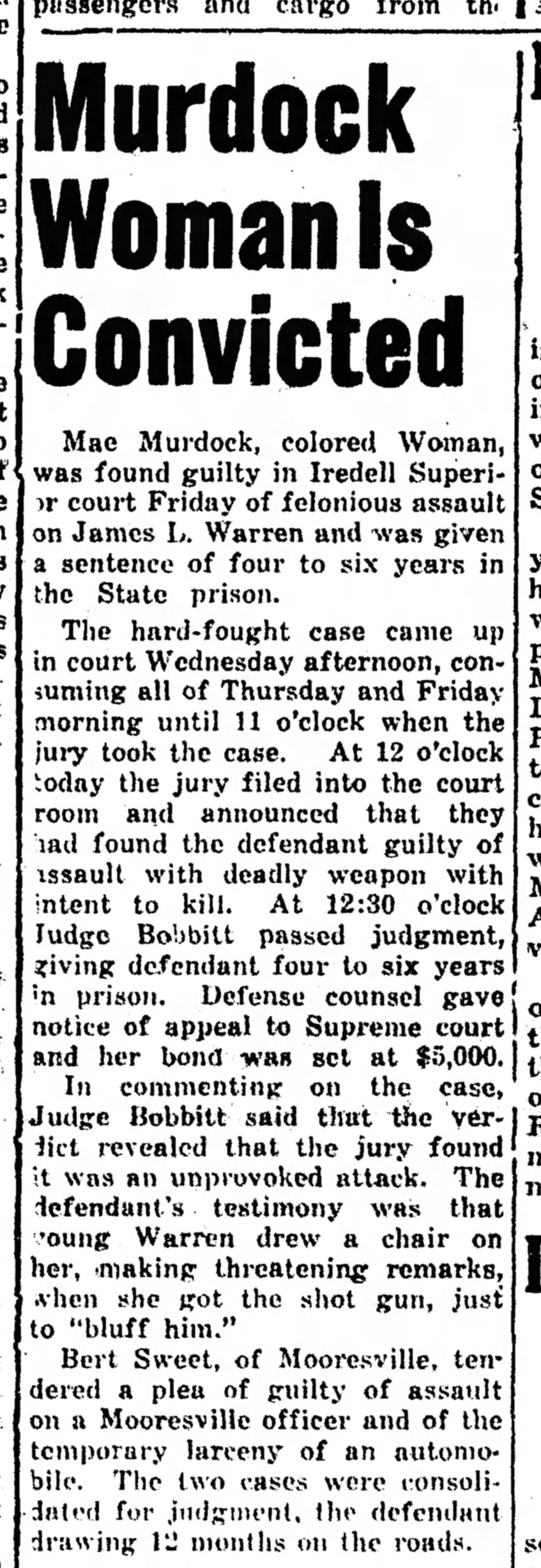
Conviction 13 Nov 1944

Murdock Case to Go to State Supreme Court.  14 November.

$25,000 Law Suit Against Murdock Woman Continued.  14 November.

Aunt Bert served her time at the state women’s prison in Raleigh and returned to Statesville after to pass her few remaining years.  She had  possessed considerable wealth after her father’s death in 1929, but lost much of it while she was away. My family maintains that William “Bill Bailey” Murdock had entrusted whites to help hide his shady assets, and they betrayed him after Bert shot one of their own.

Bert died in 1955. The Landmark ran her death notice without comment or reference to the incident for which she had been infamous just ten years earlier.

Bert Murdock Obit 26 May 1955 Record and Landmark


Interview of Margaret C. Allen by Lisa Y. Henderson; all rights reserved.
 

Standard
Births Deaths Marriages, Maternal Kin, Migration, Newspaper Articles, North Carolina, Oral History, Photographs

Finding J.T.

My grandmother’s favorite cousin was her Aunt Lethea’s son, “Jay” or “J.T.”:

My grandmother:  I had a cousin named Jay.  Aunt Lethea’s son.  She died and left three sons.  James –

Me:  Charles.

My grandmother:  Charles.  And Jay.

Me:  Okay.  J.T.

My grandmother:  Mm-hmm.  And Jay stayed with Aunt Min ‘cause Aunt Min reared him after Aunt Lethea died.  And he was at this same house with Aunt Minnie and Grandma.  Let’s see.  It was Aunt Min and Grandma and Uncle Luther and Jay and I.  We were all in the same house during the summer that I worked up there.  And Jay and I used to have a good time.  Oh, he was so nice.  He would, the first time I rode on a rollercoaster, he took me.  And we used to have a good time.  He was really nice.  He was a nice person.

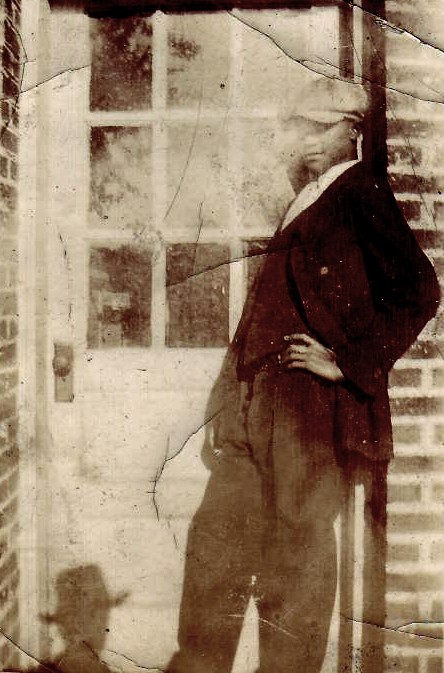
McNEELY -- Jay McNeely in doorway

Jay had two brothers, William and Charles. In the 1910 census of Statesville, Iredell County, I found three boys, William, 5, James, 3, and Charlie McNeeley, 2, living in the household of Sam and Mary Steelman and described as their grandsons. I identified these children, correctly I believe, as Elethea McNeely‘s children.  I also guessed that Charlie Steelman, listed in the household, was their father.  If he was, he and Lethea never married. Instead, in 1920, she wed Archie Weaver, a man my grandmother spoke of with vitriol.

My grandmother: Jay’s daddy had TB, and he just gave it to them.  And his mother and Jay.  But he lived years and years and years after both of them died.

Me: The father did?  

My grandmother: [Inaudible] give them all this stuff.  Oh, I could not stand him. She was my special aunt because she had boys, and she didn’t have any girls.  And she just took me over her house, you know, and let me do things that girls did, you know. 

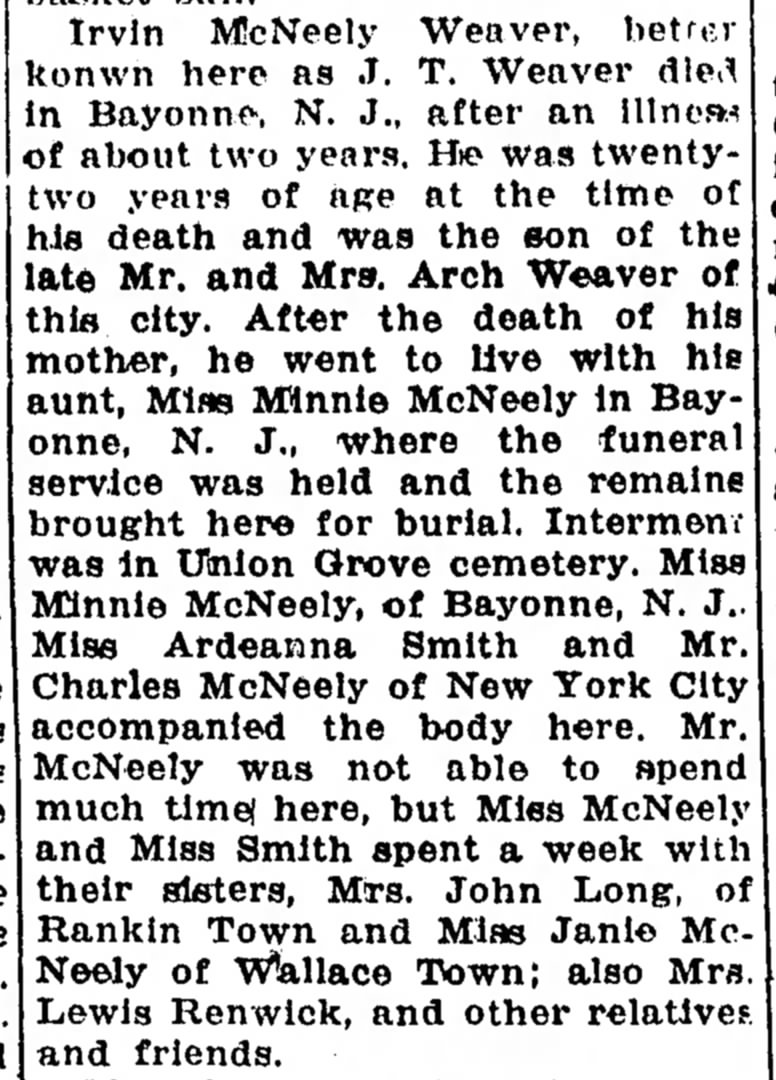
I was unable to find James McNeely, whom I believed to be “Jay,” in any other record. I knew Jay was reared by his aunt, Minnie McNeely, and died young of the same dread illness that killed his mother, but I was never able to find a trace of him. That changed last night, when I stumbled upon his death announcement in the 15 December 1933 issue of the Statesville Record & Landmark:

Image

As Grandma Carrie so memorably said, “Well, I’ll be damn.”  Here was J.T., as last. Not James McNeely — much younger, in fact — but Irvin McNeely Weaver. (The same “mysterious” Irving McNeely listed in the 1930 census in Martha McNeely‘s Bayonne household. He was described as her nephew, rather than her grandson, and I jotted in my notes: “Who is this???”) My grandmother was married and living in Newport News, Virginia, at the time of his death, and is not among his named survivors. Ardeanur Smith was his cousin, not his aunt, and Charles McNeely was his brother. Mrs. John Long was his aunt Lizzie McNeely Long, and Mrs. Lewis Renwick was his cousin Louise Colvert Renwick.

McNEELY -- McNeely Cousins

The first photo is Jay as a boy, perhaps around the time he moved to Bayonne. The second, taken in Bayonne circa 1928, shows Jay with his first cousins Ardeanur Smith, Margaret Colvert and Wardenur Houser, and an unknown girl seated in front. The last is Jay, alone, perhaps not long before he died.

McNEELY -- Jay McNeely near pole

——

This is just one of many, many times that I’ve found something that one or the other of my grandmothers would have been “tickled” to see. They both lived good, long lives — to 90 and 101 — but I would have kept them with me always if I could.

Interview of Margaret C. Allen by Lisa Y. Henderson; all rights reserved. Photos in the collection of Lisa Y. Henderson.
Standard
Births Deaths Marriages, Maternal Kin, Newspaper Articles, North Carolina, Oral History, Photographs

She was smart, and she was musical.

Image

FINALS AT COLORED SCHOOL.

Statesville Colored Graded School Closed Tuesday Night with a Very Creditable Performance.

The closing exercises of the Statesville graded school were held Tuesday night in the new building. Before the exercises began at 8.30, a representative of this paper had the pleasure of looking thru the building and inspecting the most creditable exhibits of the work accomplished by the pupils of the second, third, fourth, fifth, sixth and seventh grades. The exhibit showed surprising skill in drawing, sewing, fancy needle work and other forms of handiwork.

When the exercises began, the auditorium and two adjoining school rooms were filled, and the good order maintained was a noticeable feature.  The opening chorus and duet by members of the graduating class were much appreciated by the audience.

“Resolved: That girls are more expensive to raise than boys,” was the subject of the debate discussed in an interesting manner by Eugene Harris and Harry Chambers, on the affirmative, and Guy B.Golden and Jettie M. Davidson, on the negative.

GRADUATING EXERCISES.

Class History.      Buster B. Leach

Class Prophecy.   Annie B. Headen

Class Poem.      Willie D. Spann

Solo — ‘Be Still, O Heart.’   Thomas R. Hampton

Class Will.   Maurie Dobbins

Valedictory.    Louise Colvert

Class Song – ‘Fealty’

CLASS ROLL.

Mary Louise Colvert, Maurie Catherine Dobbins, Lillian Gennetta Moore, Willie DeEtte Spann, Buster Brown Leach, Annie Bell Headen, Thomas Richard Hampton, Eloise Earnestine Bailey.  

Class Motto – We Learn Not for School, But for Life.

The colored people of Statesville take great pride in their school.  They have a modern school building, steam heated and supplied with the latest equipment, something which very few towns and cities of the State have provided for its colored population.  C.W. Foushee, the principal, has proven himself to be a good school man.  He is assisted by eight teachers.

— Statesville The Landmark, 7 June 1923.

Image

Louise went up to New Jersey and finished high school.  They didn’t have a black high school in Statesville.  They just had tenth grade.  And she went to Jersey and finished high school in Jersey and then took a course in teacher’s education somewhere.  I don’t know whether it was Winston-Salem or Salisbury.  And then she taught at – Louise played an organ, I mean, she could play the piano. Yeah, she was just as smart as she could be.  And she not only could teach, but she was musical. And she had heard she could get a job anywhere because she could do that.  And I know Golar used to teach school, but Louise would do her commencement exercise for her.  She would, Louise would do that, and they would have concerts.  Not concerts, but the whole county would compete.  And Golar’s thing would always bring a group of children, ‘cause Louise would teach them, you know. I don’t know, I can’t remember the name of that place.  But she had a school out there.  Williams Grove. And Louise used to do all the playing for that school, and they would ask her to prepare them for the thing. They had these county somethings.  But it involved the whole county.  The schools were all over Iredell County.  And they would come together, and they would, it would be a big march, and then they would meet somewhere in particular, and then they would compete with the groups of singers and everything like that.  And, child, when Louise started that stuff, when she started teaching, she had groups singing – young people and the older people, and then Golar would take her to her school and get her to teach her children.

Happy birthday, Aunt Louise.
Mary Louise Colvert Renwick (6 October 1906-15 September 1989)
——

Interview of Margaret C. Allen by Lisa Y. Henderson; all rights reserved. Photographs in the collection of Lisa Y. Henderson. 

Standard
Maternal Kin, North Carolina

The Lost Ones, no. 1.

  • Lena Tomlin and siblings. Harriet Nicholson reported to the census taker in 1910 that only three of her nine children were living. Those three were Lon W. Colvert, H. Golar Tomlin and Bertha Hart. The six deceased children were most likely all Tomlins (though it is possible that Harriet gave birth to another Colvert child in 1874.) Census records reveal the name of one, Milas Tomlin, who was born circa 1877. Newspaper articles from 1896 disclose a daughter, Lena Tomlin. And that’s it. My grandmother’s sister Launie Mae told me that several of Harriet and Abner Tomlin’s children drowned. It is good an explanation as any.
  • Lovenia Colvert and Elvira Colvert Morgan. Walker Colvert and Rebecca Parks’ cohabitation registration listed three children – John, Elvira and Lovenia. I have never found another reference to Lovenia Colvert. (Was she a relative who went west?) Her sister Elvira, however, left a slight record.  Though she does not appear in her parents’ household in the 1870 census, in 1874, when she was about 14, Elvira married Richard Morgan, son of Richard Madison and Hilda Morgan. In the 1880 census, Richard and Viree Morgan are listed in Eagle Mills, Iredell County, sharing a household with 20 year-old Squire Gray. By 1900, the Morgans (and Squire Gray, separately) were living in Asheville at 281 S. Main Street. Richard worked as a saloon servant, and Elvira reported that she’d had no children. This is the last record I have found for her.
Standard
Births Deaths Marriages, Maternal Kin, Newspaper Articles, North Carolina, Photographs

Death of a colored man.

“Death of Colored Man.”

John Colvert, aged 70 years, a respected colored man, died Thursday night at his home on Green Street.  Funeral arrangements have not been made as he has relatives in the west who will attend.

Statesville Landmark, 10 Oct 1921.

This, of course, is John Walker Colvert, son of Walker Colvert. But who in the world were the “relatives in the west”???  His mysterious sisters and their progeny? And what was “the west”?  Ohio? Missouri? California?

IMG_2081

John Colvert was buried in Green Street cemetery, a square, three-acre concavity surprisingly devoid of markers in the heart of black Statesville. His and his wife Addie’s tombstones stand at the edge of South Elm Street, near that of his daughter Selma, and they are the only Colvert grave markers I have been able to locate.

Standard
Births Deaths Marriages, Maternal Kin, Newspaper Articles, North Carolina, Oral History

Elizabeth. And Elizabeth.

Henry McNeely had two Lizzies.

The first Elizabeth McNeely appears as a 13 year-old in Henry’s household in the 1870 census of Rowan County. In a letter written in 1987, my grandmother explained that the girl was abandoned at her father’s doorstep. (Before Emancipation, or after?) He reared her, but I know nothing further about her.

My grandmother’s earliest memory involved the second Elizabeth McNeely, who was Henry’s oldest daughter with Martha Miller McNeely. My grandmother recalled riding on a train from Statesville to Winston-Salem to visit her mother’s sister.

Me: Which sister was that?

My grandmother: Lizzie.

Me: It was like a day trip, or y’all went for —

My grandmother: I don’t remember. You know, I was kind of young.

Me: Yeah. Yeah. You were what? Like, two?

My grandmother: Yeah. I think two. Somebody said I wouldn’t, I couldn’t possibly remember, but I do. I do because, you know, it looked like the trees were going like that. [Moves her hand across her face quickly.] ‘Round and ’round. And I was sitting up in the window. I know I was looking out the window. And that was one of my first memories.

This Elizabeth McNeely was born in 1877. In 1900, she married William Watt Kilpatrick in Statesville, and I discovered JUST TODAY, via their license, that her full name was Margaret Lougene Elizabeth McNeely. The marriage seems not to have been a happy one:

CUT AT A CHURCH FESTIVAL.

One Negro in Jail and Another Under Bond – Cases in the Local Courts.

Watt Kilpatrick was before Justice Carlton Wednesday for wife-beating and was fined $5 and the cost.

Statesville Landmark, 21 September 1906.

At the time of the 1910 census, around the time my grandmother went by train to visit, the couple were living in Oldtown, Forsyth County. Seven years later, when Watt registered for the World War I draft, he gave his address as 17 Roanoke in Winston-Salem and reported working as a shape puller at R.J. Reynolds Tobacco Company. Lizzie “Patrick” was listed as his next of kin, but resided in Statesville. When the censustaker returned in 1920, Watt was sharing a house with another woman, and Lizzie was not to be found.

On 1 February 1923, the Statesville Landmark posted this notice:

SUPERIOR COURT ADJOURNS.

… Elizabeth Kilpatrick, colored, was granted a divorce from Watt Kilpatrick.

Four months later, she married John Long. She spent the rest of her life in Iredell County.

In 1950, Lizzie Long died in a housefire. Beyond the basic tragedy of her death, there is something unsettling about this account of the “accident.”

Image

Statesville Landmark, 28 September 1950.

(My grandmother would have expressed a tart opinion about what happened, but I didn’t know to ask her.) Whatever the case, the shock of Lizzie’s death sent her youngest brother into cardiac arrest, and the family had to bury two McNeelys that September.

Standard
Maternal Kin, Newspaper Articles, North Carolina, Vocation

The colored fire company.

Members of the colored fire company of Statesville left yesterday for Oxford to attend the State tournament. Among those who went were F.F. Chamber, vice president of the State association; J.P. Chambers, first foreman and J.H. Gray second foreman of the local company; J.A. Brown, Clarence Carlton, W.G. Kimbrough, Jim Dalton, Luther McNeely, J.W. Byers, S.Y. Allison, J.P. Murphy and Smith Byers.

Statesville Landmark, 20 August 1912.

Standard
Education, Maternal Kin, North Carolina

Morningside School.

Statesville’s Morningside School had its beginnings in the two-roomed Colored Free School, which opened in 1891. Maggie Sellars and Alma J. Carter shared teaching duties. The following year and additional room was added, and the instructional staff expanded to five. In 1915, a mysterious fire consumed the original building, and for the next six years children attended classes in nearby churches and fraternal halls. In 1921, a new eight-classroom facility on Green Street near Garfield opened, with Charles W. Foushee as principal. This building was known as Morningside School. Within two years, booming enrollment demanded expansion to seven elementary grades and two high school. Tenth and eleventh grades were added in 1928, and the school was accredited in 1930. After desegregation in 1965, Morningside became an elementary school and, in 1971, its name was changed to Alan D. Rutherford School.

Margaret at school 002

Margaret at school

These photographs were probably taken shortly before the Colored Free School burned down. In the first, my grandmother is second from right on the second row from the top. Her sister Launie Mae is first in the third row from the top. In the second photo, my grandmother is seated last on the third row from the top.

Text adapted from materials produced for Morningside Alumni Association — 2002 Reunion, Statesville NC, 31 August 2002. Photos in the collection of Lisa Y. Henderson.

Standard
Land, Maternal Kin, North Carolina, Oral History

Land along the railroad.

Me: What did, why did Grandpa Henry come to Statesville? Was he a farmer? What did he do?

My grandmother: I don’t know. I really don’t know.

Me: He was from Rowan County.

My grandmother: He certainly didn’t have no farm in Statesville. It seems to me he had a big, big lot  of land where they had this house. Where they built this house. But it was near a railroad, and trains — cinders from the trains fell on the house and burnt it.

——

On 21 Dec 1903, G.M. Austin and wife J.A. Austin sold H.W. McNeely of Iredell County a parcel bounded as follows: “Beginning at a stake 300 feet from Bettie Van Pelts S.E. corner and 50 feet from the center of Rail Road, and running N. 10 degrees E. 200 feet to a stake then S. 11 W. 200 feet to a stake 50 feet N of the center of the Rail Road, then N 79 degrees W. 100 feet to the beginning also 1/2 acres adjoining the above lot, and known as the J.V. Houston land it being same land sold for taxes by M.A. White by deed from T.Y. Cowper.” McNeely paid $164.

Extract from interview of Margaret C. Allen by Lisa Y. Henderson; all rights reserved.

Standard
Births Deaths Marriages, Maternal Kin, North Carolina, Religion

Church home, no. 5: A.R. Presbyterian, Statesville NC.

The Associate Reformed Presbyterian church is a blending of two groups that began in Scotland in the early 1700s. The Associate Presbyterians and the Reformed Presbyterians migrated to America as a result of religious and political upheaval in Britain. The two churches merged in 1782 to form what is now known as the ARP church.

After the Civil war, Associate Reformed Presbyterians from Amity (now New Amity), New Perth and New Sterling Churches moved to Statesville. On August 7, 1869, a meeting was held in Stockton hall to organize the First Associate Reformed Presbyterian Church of Statesville. About 15 people were present at this first meeting, and Reverend W. B. Pressly was chosen as pastor as well as Elders R.R. White, A.M. Walker, George White and John Patterson.

After meeting in the Iredell County Courthouse for a short period, the early church shared the Presbyterian sanctuary for about six years. In 1875, Colonel S.A. Sharpe and other interested friends donated labor and materials to build the first church.

Reverend W. B. Pressly served as pastor until his death November 25, 1883. After several ministers had supplied the pulpit for brief periods, Reverend D. G. Caldwell served as pastor from 1885 to 1891. In 1892, Reverend J. H. Pressly, then a student at Erskine Seminary, accepted the call to this pastorate and served this church for 54 years.

During the pastorate of Dr. Pressly, First ARP Church made several significant steps. The church built a manse in 1897. In 1900, a new sanctuary was built, replacing the first structure and in 1902 the session approved the establishment of a second church in south Statesville. Out of this decision came the organization and building of Pressly Memorial Church in 1907. — Excerpt from http://firstarpchurch.us/about-us/

——

Lon W. Colvert and Carrie McNeely were married in 1906 at A.R. Presbyterian Church. Rev. J.H. Pressly officiated, and he and his wife signed the marriage license as witnesses. My grandmother said that Carrie’s father Henry McNeely was a “big” Presbyterian — it was the denomination of his Scotch-Irish forebears — though Carrie joined the Episcopal church. I’ve contacted First ARP for information about their early membership rolls and will post the results.

Standard