
Among the supplies the Wayne County Commissioners bought in 1884 to feed residents of the county poorhouse was $22 worth of corn from Napoleon Hagans.

Goldsboro Messenger, 14 August 1884.
Among the supplies the Wayne County Commissioners bought in 1884 to feed residents of the county poorhouse was $22 worth of corn from Napoleon Hagans.
Goldsboro Messenger, 14 August 1884.
Back in December, I went on a hunt for Artis cemeteries in the Eureka area. One that I found, just south of the others, holds the remains of William M. Artis and his family. Today, while I was sorting old documents, I ran across William’s death certificate. His place of birth, which I’ve surely read a hundred times, seized my eye:

“Family (Seabury)”? Was this graveyard originally the resting place of William’s maternal great-grandfather, Aaron Seaberry, who died just after 1910? Are there other Seaberrys here, including William’s mother Frances Seaberry Artis? (Who was erroneously referred to as Frances Hagans above. “Hagans” was her mother’s maiden name and the surname of her half-brother Napoleon Hagans. William’s age is off, too. He was 70 when he died.)
My grandmother has been gone more than 13 years, and there are still days that I think, “Gahh! Mother Dear would be so tickled to hear this!” Yesterday was one of them.
After my Carter collateral kin post last week, my cousin C.J. posted the photos of the Carter brothers on her Facebook page. (Her great-grandfather was Milford Carter Sr.) Her grandfather’s first cousin D.C. responded, mentioning that he is a son of Johnnie Carter. I pounced. After a couple of email exchanges last week, I called D.C. yesterday. I clarified for him who my grandmother was and what her relationship was to Lucian Henderson. Not only did D.C. know who Uncle Lucian and Aunt Susie were, he was born in their house! Presumably the Carters moved in after Lucian’s death in 1934, but Johnnie and his wife Atha cared for both Lucian and Susie in their declining years. Susie died around 1940, and four years later the family sold the house and moved a few miles southeast to Clinton. The house eventually burned down, but was rebuilt in the same spot in essentially the same form. My grandmother had loved visiting her great-uncle Lucian’s house, and her warm memories of her time there inspired the name of this blog.
Several years ago, the late Mae Brewington Marks of Dudley sent me a photo of a house near the intersection of Sleepy Creek Road and Emmaus Church Road that she believed to have been Lucian Henderson’s. (Where is that picture???) She was right. I’d been a little skeptical because it looks too new to have been Lucian and Susie Henderson’s home. D.C.’s explanation and confirmation made my day.
One of the most rewarding results of my decades of genealogical sleuthing has been the development of a deep connection with many of my Carter cousins, descendants of Milford and Beulah Aldridge Carter. My grandmother talked often of the Carter family, to which she was connected both via the Aldridges and “Papa” Jesse Jacobs, who was Milford Carter’s uncle.
The Carters looked ‘bout like white folks. I didn’t really know all of ‘em. I think it was nine of them boys. The three I knew was Milford and Johnnie and Harold, I think. They used to come to Wilson, but the older one [Willoughby] didn’t come up. But Milford, Harold — the two youngest ones come over and stayed with Annie Bell [Jacobs Gay, Papa’s daughter.] Johnnie – and Freddie, too. When I’d go to Uncle Lucian’s, they lived not too far from there. But I never went to their house. I think Harold was the youngest one. ‘Cause that’s the one came to Wilson, and Albert, Annie Bell’s husband, got him a job down to the station driving a cab. And he got his own car, and he was down there for a long time. Harold. He’s the youngest one. Carter. All of them was great big.
There were indeed nine Carter brothers — Willoughby (1880), Ammie (1881), Freddie (1890), Milford (1893), Granger (1895), Lippman (1898), John Wesley (1899), Harold (1903) and Richard (1906) — plus a sister Florence (1887). (Florence’s son William Homer Camp Jr. married Onra L. Henderson, Beulah A. Carter’s niece and my grandmother’s double cousin.) The brothers were born in Sampson and Wayne Counties to Archie Marshall (or Marshall Archie) Carter and Margaret Frances Jacobs, sister of Jesse A. Jacobs Jr. Marshall Carter (1860-1926) was the son of William and Mary Cox Carter of Sampson County. (My grandmother also spoke of Marshall’s sister, Virginia Ann “Annie” Carter, who married Hardy Cox and was a close friend of “Mama” Sarah Henderson Jacobs Silver.) William Cox (1833- ca. 1875) was the son of Michael Carter (ca. 1805-ca. 1875) and his wife, Patience.
As attached as Papa was to my grandmother, he did not take her with him on visits home to Dudley, very likely in deference to the feelings of his nephew’s wife Beulah, who had little use for the child her brother Tom fathered out of wedlock.
When Papa was living, he used to go to Dudley down there to the mill where they ground corn and all down there. They’d carry him around down there on horse and buggy, wagon, whatever it was. He was their uncle. Their mama’s brother. He’d go there every once in a while. But he didn’t never say nothing ‘bout taking me down there with him. I guess ‘cause Beulah, Milford’s wife, was my daddy’s sister, but she was kind of cool toward me. And he know he wasn’t gon carry Mamie. So we didn’t never get to go down there with him.
Early in their marriage, Beulah and Milford Carter lived in Wilson in a small house on Green Street whose yard touched those of Milford’s uncle and first cousin Annie Bell. The Carters’ second child, son Dewey Belvin, who died before his second birthday, was born during their short stay there.
Beulah stayed in Cora Miller’s house there on Green Street. A little house down there ‘cross from where we were staying, first house behind the church, near ‘bout on the corner there. And she and Milford were there.
After a few years shifting between Wayne to Duplin Counties, Milford moved his family north to Coatesville, Pennsylvania, and then New York City — first Brooklyn, then Queens — where he pursued a long career as a chef.

Milford E. Carter, during his time as a chef at H. Hicks & Son, 30 West 57th Street, New York City.
Freddie, Freddie was the one that went to Atlanta for a year and day. Moonshine. And Johnnie was fat. And rosy. Like, you know, like if somebody say like, seeing a baby and say that it was “oh so fat, look like you pinch they cheek the blood pop out?” And just fair, and just that red look.
Johnnie Carter was also the brother that cared for my grandmother’s great-uncle, J. Lucian Henderson, and his wife Susan Henderson in their final infirmity. In June 1934, John W. Carter was named administrator and sole legatee of Lucian’s estate. Johnnie and his family lived near Lucian just west of Dudley, but I am not sure of the genesis of their close relationship.
The Carter boys was always nice. They come up here, come to stay with Annie Bell, Papa’s youngest daughter. They wasn’t here at the same time. They was driving cabs. So they used to come over all the time. I went with Harold down to Dudley once ‘cause he was going and coming back that same day. See, Uncle Lucian was sick, so I went down with him and come back.

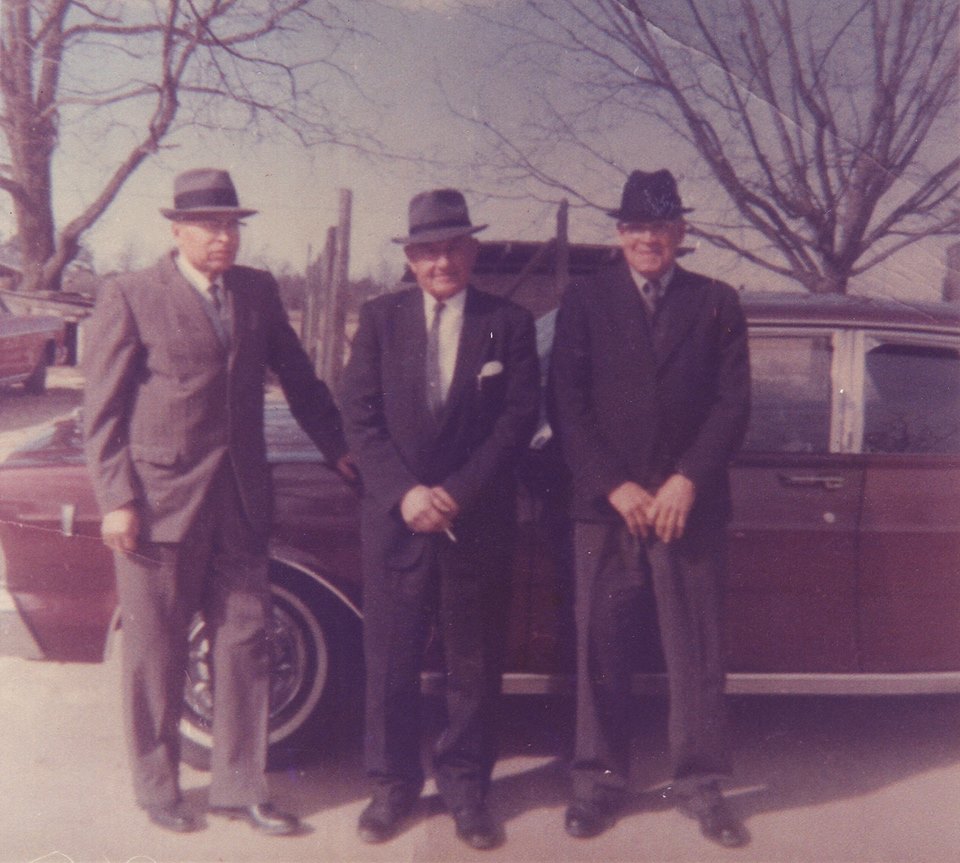
Top: John, Ammie, Wesley (a cousin), Richard, Granger, Richard Jr. and Harold Carter; bottom: Milford, John and Harold Carter; both 1955. Copies of photos courtesy of Dorothy Carter Blackman and Daniel M. Carter.
Interview of Hattie H. Ricks by Lisa Y. Henderson; all rights reserved.
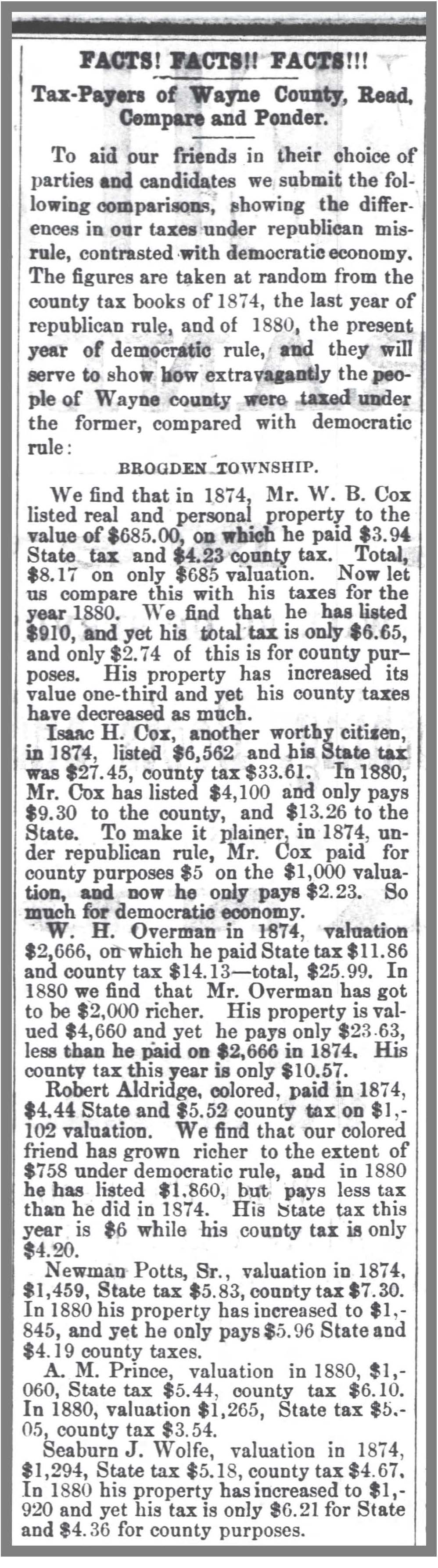
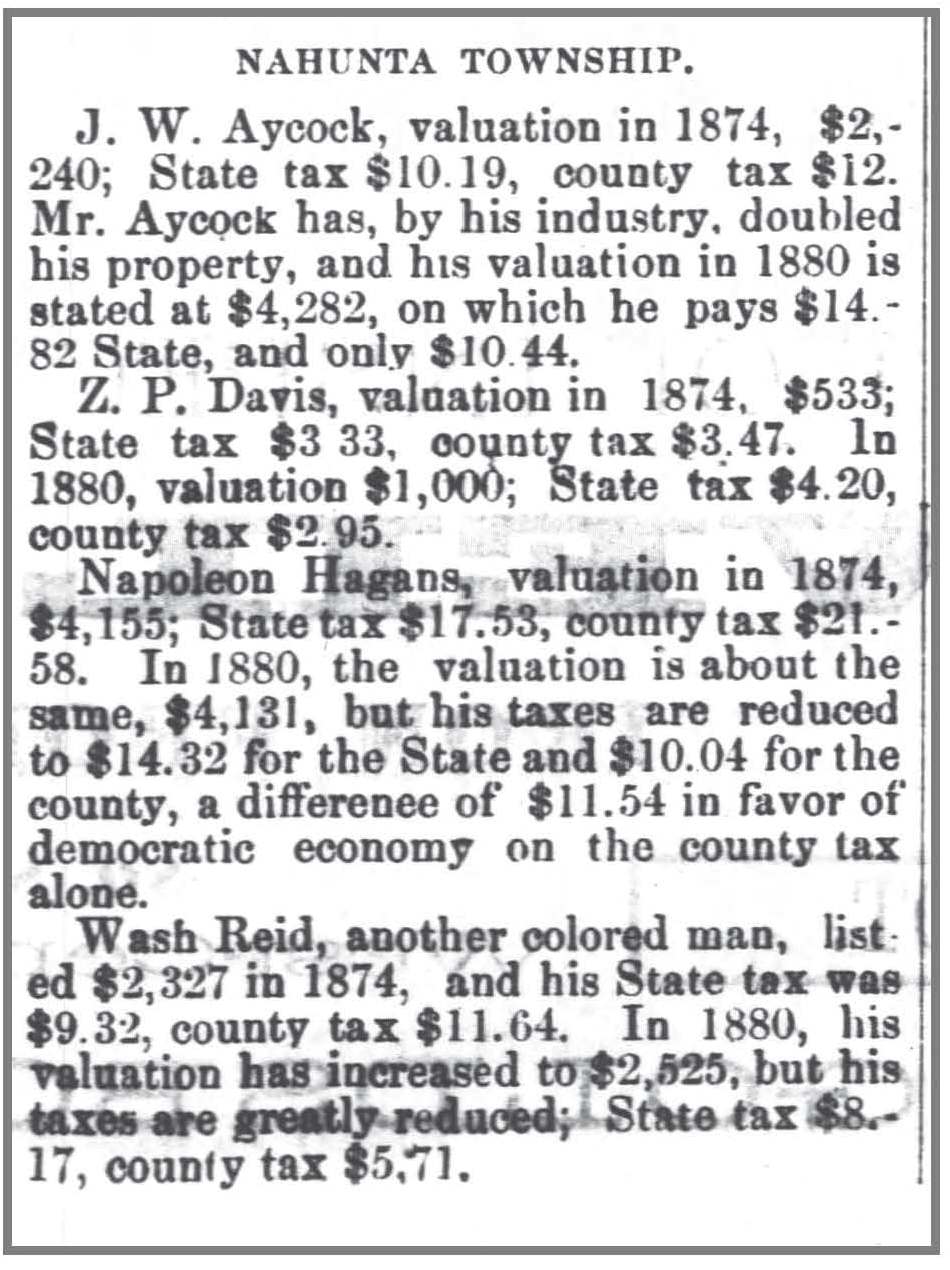 Goldsboro Messenger, 21 October 1880.
These propaganda pieces are part of a single article published to demonstrate that the rising tide of Democratic rule had floated all boats as land values increased while taxes fell. (In other words, the end of Republican rule meant more money in the pocket, as well as a foot on the neck of African-Americans.)
Two of the “colored friends” noted were my kin — my great-great-great-grandfather Robert Aldridge and Napoleon Hagans, the brother of my great-great-great-grandmother Frances Seaberry Artis. (And Washington Reid’s nephews William and Henry Reid, sons of John Reid, married Adam Artis’ niece Elizabeth Wilson and daughter Cora Artis, respectively.) Aldridge, Hagans and Reid (as well as Artis, Frances’ father Aaron Seaberry and Betty’s father John Wilson) were all prosperous free-born farmers.
An expanded version of the 47-children article that ran in the Statesville Landmark (and, indeed, all over North Carolina):

Wilmington Messenger, 3 January 1906.
I still don’t know more than 25 or so of Adam Artis‘ children (which is gracious plenty) and don’t believe there were many more than that. But if he didn’t have 80+ grandchildren by 1906, he certainly had many, many more than that before all was said and done. (As always, I ignore the snark, but what is a “typical southern darkey”?)
On 1902, George W. Aldridge and his siblings received their shares of their father’s landholdings just north of Dudley, Wayne County. Three years later, George lost his at sheriff’s sale:
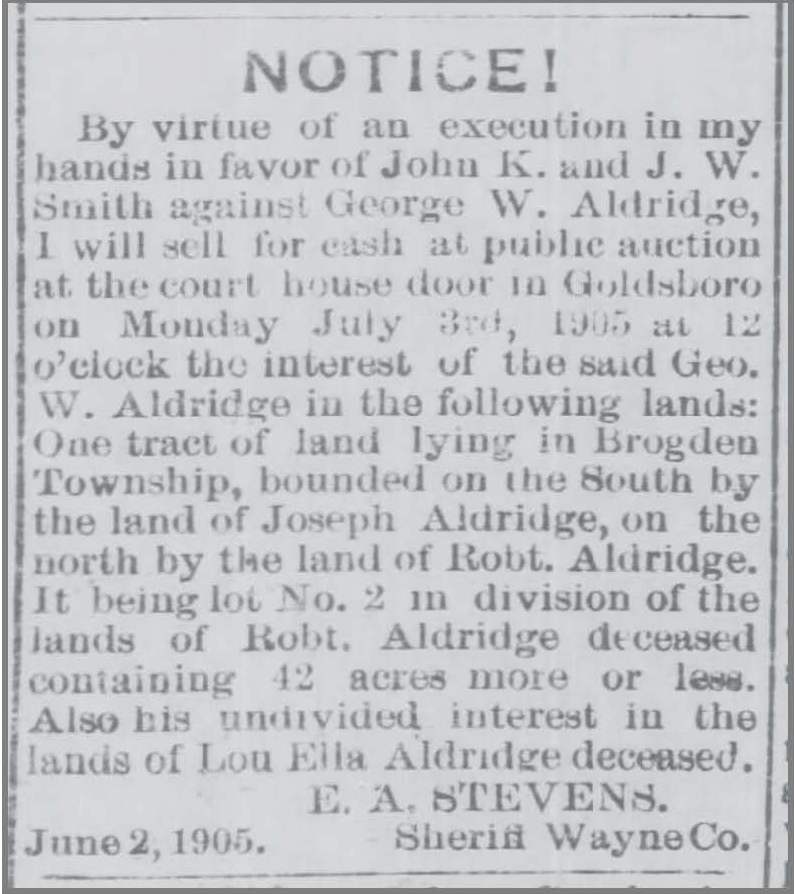
Goldsboro Weekly Argus, 15 June 1905.
Form of the estimate and assessment of agricultural products agreed upon by the assessor and tax-payer, and the value of the portion thereof to which the government is entitled, which is taxed in kind, in accordance with the provisions of Section 11 of “an Act to lay taxes for the common defence and carry on the government of the Confederate States,” said estimate and assessment to be made as soon as the crops are ready for market.
Cured Fodder Quantity of gross crop. — 1000 Tithe or one-tenth. – 100 Value of one-tenth. — $3.00
I, Mathew Aldridge of the County of Wayne and State of North Carolina do swear that the above is a true statement and estimate of all the agricultural products produced by me during the year 1863, which are taxable by the provisions of the 11th section of the above stated act, including what may have been sold of consumed by me, and of the value of that portion of said crops to which the government is entitled. /s/ Mathew X Aldridge
Sworn to and subscribed to before me the 3 day of December 1863, and I further certify that the above estimate and assessment has been agreed upon by said Mathew Aldridge and myself as a correct and true statement of the amount of his crops and the value of the portion to which the government is entitled. /s/ J.A. Lane, Assessor.
Confederate Papers Relating to Citizens or Business Firms, 1861-1865, National Archives and Records Administration.
The myth goes something like this: John Frank Baker was the first black man elected to Congress from Wayne County. He never made it to Washington, assassinated as he attempted to board a train north for his swearing-in.
Something about this didn’t sit right with me.
Wayne County was part of the so-called Black Second, the Congressional district that encompassed most of northeast North Carolina’s majority-black counties during Reconstruction and into the early 20th century. The history of African-American political activity in the district is extensive and well-documented, and I couldn’t recall having read of Baker. A Google search quickly refreshed my recollection. North Carolina voters sent four black Congressmen to Washington in the nineteenth century: John Adams Hyman of Warren County (1875-1877), James Edward O’Hara of Enfield (1883-1887), Henry Plummer Cheatham of Littleton (1889-1893), and George Henry White of Tarboro (1897-1901). No Baker.
As his headstone reveals, J. Frank Baker died 20 March 1897, the same month that George H. White was sworn into the 55th Congress, having defeated white Democratic incumbent Frederick A. Woodard of Wilson. [Sidenote: My junior high school was named for Woodard.] Clearly, Frank Baker was never elected to Congress. Why, then, was he killed?
To call newspapers of the era racist is to say “the sky is blue.” Articles about African-Americans were condescending and mocking at best, derogatory and vicious most times. Objectivity was not a hallmark of journalism in the late 19th century in general, but if their names appeared in the local paper, African-Americans could generally expect the worst. Notwithstanding this general bleak picture, when consumed with a grain of salt, early newspapers can be an invaluable source of otherwise unrecorded information about black Americans.
Frank Baker’s murder was covered in detail in the Goldsboro Headlight and the Weekly Argus, the rival newspapers operating in Wayne County at the time. Even before his death, however, his fiery advocacy seized the attention of the white community. This story was picked up by papers across the country:
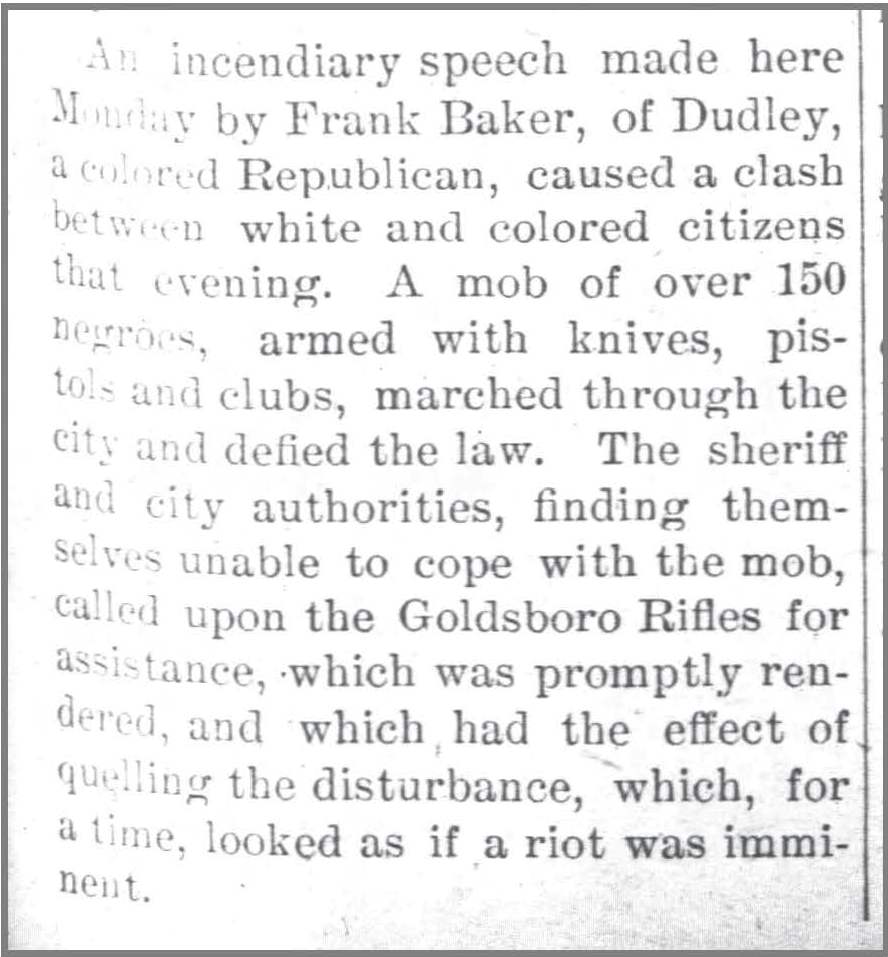
Goldsboro Headlight, 5 November 1896.
I don’t know what Baker was speaking about or why his words touched off such a response — if, in fact, “150 negroes” actually took the streets like this. It is clear, though, that he was a powerful and polarizing figure in Wayne County. And four months later he was dead. A Raleigh newspaper broke the story:
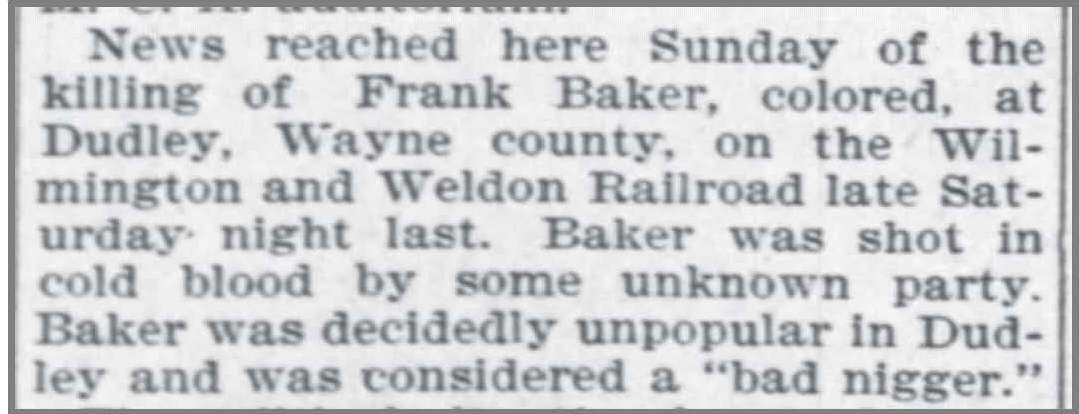
Raleigh Daily Tribune, 24 March 1897.
The tone set, the Goldsboro papers picked up the report:
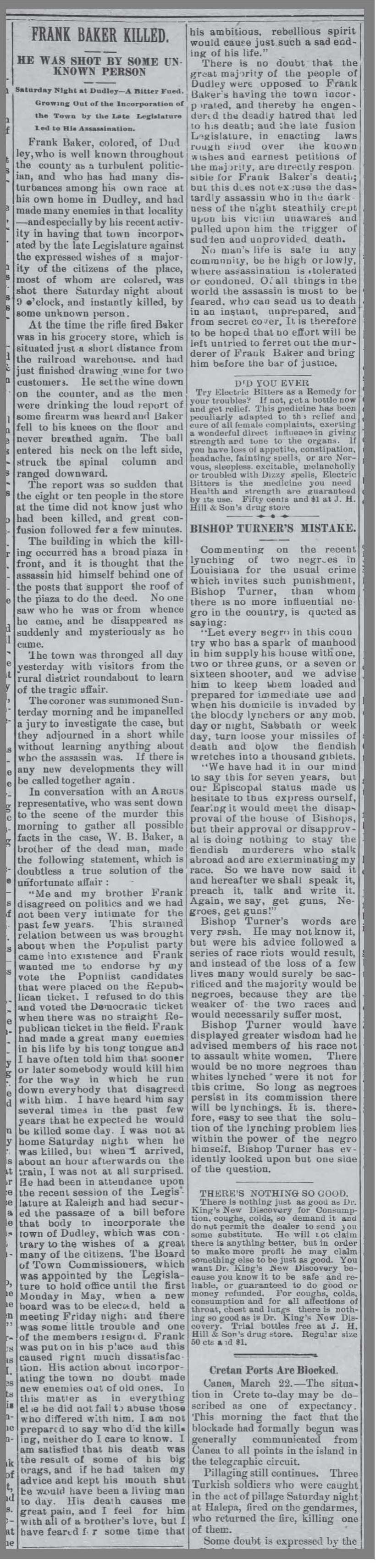 Goldsboro Weekly Argus, 25 March 1897.
Assuming that the basic description of the murder is correct, we learn that Baker was not boarding a train when he was killed. Rather, he was minding customers at his grocery store, located near the railroad warehouse in Dudley. (The Headlight reported that the store belonged to Ira W. Hatch.) He was shot at fairly close range, but a room full of people saw nothing. Nonetheless, a wholly unbelievable statement attributed to his brother, W.B. Baker, placed the responsibility for Frank’s death on his own head. The reporter then emphasizes the “deadly hatred” that Baker engendered among his neighbors by insisting on legislation incorporating the town of Dudley. [Sidenote: don’t you have to love Bishop Henry McNeal Turner?]

Goldsboro Weekly Argus, 29 April 1897.
A month later, the wheels of justice were spinning uselessly, as newspapers indignantly proclaimed the innocence of two white men implicated — but not actually charged — in the crime. A week after W.B. Bowden’s good name was cleared, J. Will Grady was released when the “facts of his innocence were established.” On 27 May 1897, the Headlight tersely noted that the governor of North Carolina had offered a reward for the capture of Frank Baker’s killers. That’s the last I’ve found on the subject.
John Frank Baker was born about 1845. I don’t know much about his early life, but in 1879 he married Mary Ann Aldridge, daughter of J. Matthew and Catherine Boseman Aldridge, and likely first cousin to my great-great-grandfather John W. Aldridge. Frank Baker was not a Congressman. Nonetheless, he made his mark in Wayne County as an African-American politician capable of stirring the masses and willing to take on unpopular causes in an era in which even voicing opinions was a daring undertaking. He is not forgotten.
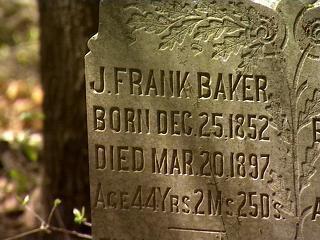
——
Photo from Baker article posted at http://www.wral.com/news/local/story/116365/.


Elder Elias Lewis “E.L.” Henderson (1880-1953) of Saint Mark Church of Christ, Saulston, Wayne County, son of James H. and Frances Sauls Henderson. Cousin ‘Lars’ birthday was May 24.
 Scuffalong: Genealogy.