Births Deaths Marriages, Enslaved People, Free People of Color, Land, Newspaper Articles, Paternal Kin

Six acres on the south side of the road.

Goldsboro_Messenger_3_10_1884_Sol_Wms_estate_debtors_notice

Goldsboro Messenger, 10 March 1884.

 Gboro Messenger 9 11 1884 Wms v Artis

Goldsboro Messenger, 11 September 1884.

Solomon Williams‘ son (and estate administrator) Jonah Williams placed these notices in a local newspaper. Solomon’s six acres could not be meaningfully divided among the eight children that survived him. Ruffin Bridge is another name for Peacock’s Bridge, which spans Contentnea Creek on the Wilson-Greene Counties border. It is not at all clear to me, however, which road would have been regarded as the road from Goldsboro to the bridge.

Standard
Newspaper Articles, North Carolina, Other Documents, Paternal Kin

The hoe penetrated to the tissue of the brain.

Image

Goldsboro Headlight, 16 August 1900.

I don’t which Winn this is, but I am certain the Aldridge is my great-grandfather’s brother, John J. Aldridge. Here’s his World War I draft registration card, filed 17 years after this article was published:

JJAldridge WW1

(I’ve always wondered about the “skull broken about 12 years ago.”) Johnnie Aldridge not only recovered, but lived another 64 years after his horrific injury.

John J Aldridge

John J. Aldridge (1887-1964), son of John W. and Louvicey Artis Aldridge.

Standard
Free People of Color, Land, North Carolina, Other Documents, Paternal Kin

Either of us do promise to pay.

G Winn Note_Page_2

On demand the first day of January 1848 we or Either of us do promise to pay John Lewis the Admr for ayres of urban Lewis decd it being for the Sum of thirty dollars and fifty cents it for Rent of the land belonging to W. Husted lying on the East side of the Railroad Joining James Kelly this January 29th 1847   Gray X Winn, Levi Winn, Adam X Greenfield  Test Obed Brock

This promissory note is listed in John Lewis‘ inventory of his father Urban’s perishable and personal property. Via Joseph Buckner Martin, Urban Lewis of Wayne County is my great-great-great-great-great-great-grandfather. (He was Buck’s father Lewis Martin‘s mother Eliza Lewis Martin‘s father.) Gray Winn, Levi Winn and Adam Greenfield were prosperous free men of color and the ancestors of many of my Henderson cousins, though not my own.


Standard

It could stand some hard pruning, and the music is awfully jaunty, and if there’s any mention of slaves at all, I missed it. (After all, this is a plantation tour.) Needless to say, I might have done this differently. Nonetheless, for the light it sheds on the larger community in which my ancestors lived, I hold my tongue and present.

Land, North Carolina, Oral History, Other Documents, Paternal Kin, Photographs

The lots.

Said my grandmother:

And Johnnie [Aldridge], he called me, and I was working to the hospital. And he called me and told me, at least he called the hospital and wanted to speak to me: “Well, if you want to see your daddy – you said you ain’t never seen him before – come down here. He’s down here now. So, don’t let him know I told you.” [Laughs.] So, I went down – I said, well, I’m gon go down there and see Silas Cox ‘bout selling the lots where Grandma Mag’s house was on. So, I got off. So, I got Mr. Fisher to take me down there. I said, “Mm, I wanna see that man.”

Image

My grandmother inherited two lots in Dudley from Sarah Henderson Jacobs Silver, her great-aunt and foster mother. (Because she had been informally adopted by Sarah and her husband Jesse Jacobs, my grandmother used the surname Jacobs until adulthood, when she reverted to Henderson.)

Mama had the lot where the house was, where Grandma Mag lived. Had that house built for her. The house they was staying in was up by the railroad, was just about to fall down. Somewhere down up there by where the Congregational Church is. And she built that house down there next to Babe Winn. I don’t think it was but one room. The porch, one room, and a little shed kitchen, a little, small, like a closet almost, and had the stove in it. Then had a stove in the room where she was, one of them round-bellied stoves where you take the top off and put wood in it. I remember that. And Sis Winn, her name was Annie, and she had a daughter, and she named her Annie after her. So they called the mother Sis, and they called the daughter Annie. And they were living in the house right next to her, Grandma Mag’s house. As I can remember. And after Grandma Mag died, the old preacher stayed in there and burnt it up.

I posted a query to my cousins:

Can someone tell me if the Dudley VFD was at its present location in the 1960s? I’m trying to figure out where two lots were on a 1967 plat. The plat mentions NC Secondary Road 1120 (which seems to run east-west), Simmons Street (abandoned) and Walnut Street (abandoned). James Newkirk and William Newkirk owned land on either side of where the fire station was on 1120. Thank you!

No luck.

Dudley Volunteer Fire Department is now on Highway 117 Alternate, south of its intersection with O’Berry Road.  A Google search revealed that O’Berry was formerly known as Secondary Road 1120, so I now know that the fire department has moved around the corner.  My father recalled that his mother’s lots were just west of the intersection, behind Silas Cox’s feed silos.

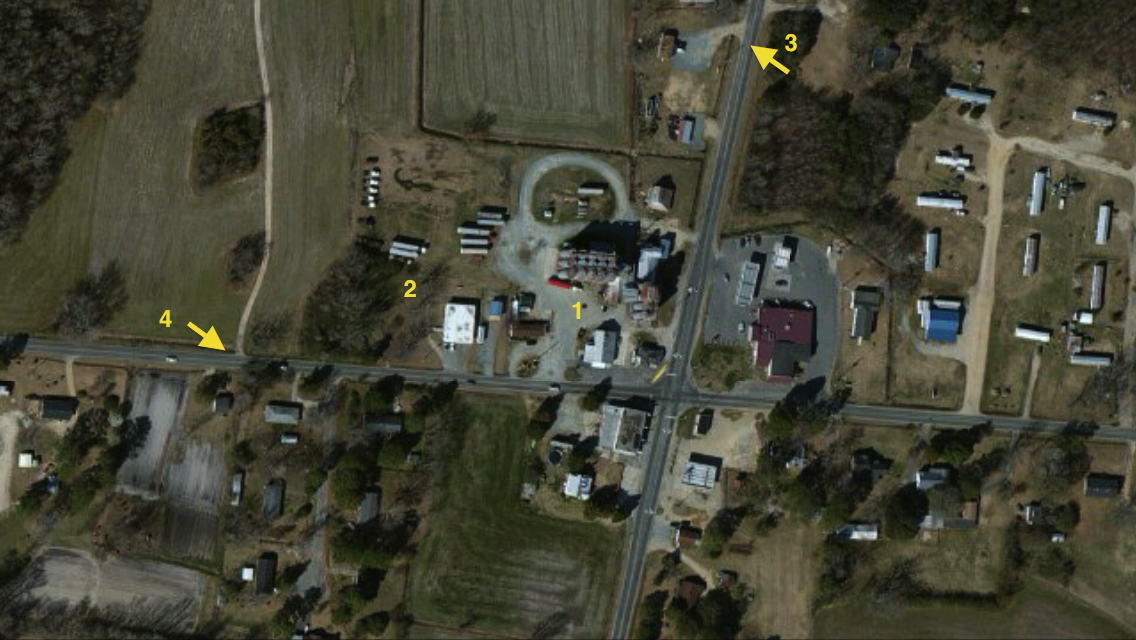
Here’s an aerial view of Dudley today: dudley intersection

Other than Road 1120/O’Berry Road at (4), there’s not much of anything that matches the plat. However, with the clue about the (1) feed or fertilizer silos, I’ve identified (2) as the approximate location of Grandma Mag’s house and the lots. (3) is Highway 117 Alternate.

My grandmother finally sold her lots in the late 1960s, ending more than 90 years of land ownership in Dudley by my line of Hendersons.

——

Interviews of Hattie Henderson Ricks by Lisa Y. Henderson; all rights reserved. 

Standard
Births Deaths Marriages, North Carolina, Paternal Kin, Photographs

In memoriam: Joseph F. Barfield (1933-2014).

 JFB

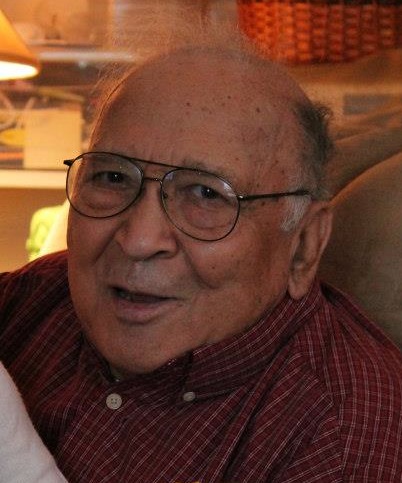
Joseph Franklin Barfield, son of Walter and Katie Kornegay Barfield, died 12 April 2014 in Fayetteville, North Carolina. Cousin Joseph was born in 1933 near Mount Olive, Wayne County, North Carolina, and served honorably in the United States Army. He is survived by his wife and loving children, grandchildren and great-grandchildren, as well as a sister and brother.

joseph & alton

Joseph F. Barfield and Alton H. Barfield, who passed almost exactly one year before his older brother.

——

Top photo courtesy of Richard J. Barfield; bottom photo courtesy of Jerilyn James Lee, with thanks to Alicia Barfield.

Standard
Agriculture, Business, Newspaper Articles, North Carolina, Paternal Kin

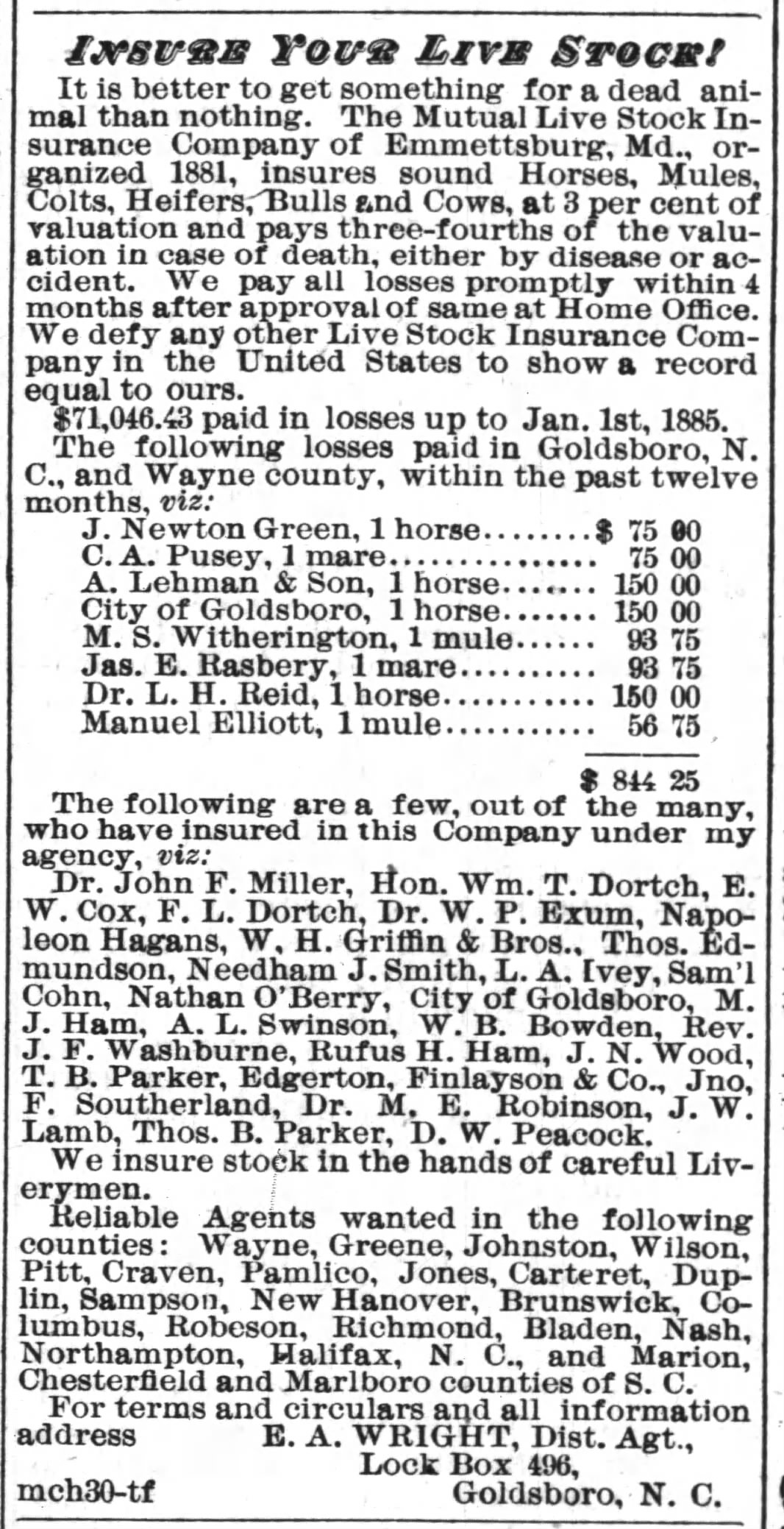
It is better to get something than nothing.


Image

Goldsboro Messenger, 30 March 1885.

Apparently, Napoleon Hagans was a big believer in insurance. The Insurance Press compiled life insurance claims paid out on a weekly basis, state by state. In the 9 September 1896 issue, the sole listing for North Carolina was: Fremont, Napoleon Hagans, $5000 — the payment he received after his wife Appie Ward Hagans’ death.

Standard
Agriculture, Free People of Color, Land, North Carolina, Other Documents, Paternal Kin

He never said he had any claims on the land.

The first in an occasional series excerpting testimony from the transcript of the trial in J.F. Coley v. Tom Artis, Wayne County Superior Court, November 1908. Paragraph breaks inserted for better readability.

The Plaintiff introduces W.S. Hagans, who being duly sworn testifies as follows:

I sold this land, the 30 acre, 24 acre, and the 9 1/3 acre pieces to Mr. Coley. Mr. Cook had been negotiating with me for the purchase of the 30 acre tract and the 24 acre tract. He did not want the 9 1/3 acre tract. I met Mr. Cook on several different occasions, until finally we met at Eureka one afternoon, he was considering it, and we finally decided on the deal. Mr. Cook was to give me $40.00 per acre for the the 30 acre tract, and the 24 acre tract. Before Mr. Cook did this however, he informed me that there was a missing link in the title, that he had found after investigating it. I told him that that was perfectly alright, as there had never been any question about it.

After our conference at Eureka, the day was set for me to meet him in Goldsboro, where he was to pay me the consideration, the price of the land, and I in turn to give him a deed for the land. He did not come on that day, but ‘phoned me at Fremont that he did not succeed in raising the money, but to please hold it open until tomorrow.

Early tomorrow morning, before sunrise, a bitter cold morning, the Defendant [Tom Artis] came to my house in Goldsboro. I asked him what brought him to town on such a cold morning, he said he came to bring a message from Mr. J.F. Coley, that Mr. Coley said that he wanted to buy that land, and would take all three of the tracts instead of two, said the Defendant to me, “that will be to your advantage.” The Defendant stated to me that Mr. Cook’s time was out yesterday. I expressed surprise that the Defendant should be familiar with those circumstances. Afterwards I said to the Defendant, that while Mr. Cook’s time was out yesterday, that Mr. Cook had phoned me yesterday & said he had a great effort to reach me, and finally did so asking me to hold the matter open until tomorrow. I told him that I would feel honor bound if Mr. Cook should come to me with the purchase price for the two tracts of land, to let him have it, although I would prefer selling the three tracts together. The Defendant said to me that if Mr. Cook got possession of this place that he the Defendant would not be able to stay there as Mr. Cook was a very disagreeable man to get along with. I told the Defendant that I would not deed this property to Mr. Cook, or to any one else until they made the same promise to me in reference to the Defendant’s staying where he has, that I made to my father in the presence of the Defendant.

The Defendant remained in shooting distance of me all of the day, waiting for me to see Mr. Cook that he might get from me a final message to take back to Mr. Coley. I saw Mr. Cook, and he informed me that the reason he couldn’t take it was that he had experienced great difficulty in raising that money. That money was hard. I was really glad of this, and so informed the Defendant, for I wanted to sell the three tracts if possible, together. Then I asked the Defendant to say to Mr. Coley on his return home, that I would meet him at the Defendant’s house on Friday, I think it was, but having business out there, I drove past, and got the Defendant and took him out to the Plaintiff’s place of business that was on Thursday, I went the day before the time set, and stated to the Defendant the object of my going down there, and asked him to go with me.

We went down there and Mr. Coley and I had a talk aside from the Defendant, and finally wound up in the Defendan’t presence. The conversation we had in the presence of Tom was Mr. Coley might have the three pieces of land, in consideration of $3250, and I take his paper. This was said in the Defendant’s immediate presence, he sitting on the buggy beside me. We left, the Defendant expressing himself as highly pleased that Mr. Coley had bought the three pieces of land, said he thought I had made a fine trade. He made no objection at any time to the sale of the land. He encouraged it all the while. He never intimated to me that he had any claims on this land of any kind. None whatever.

I got the land about 1899, deed of partition between my brother [Henry E. Hagans] and myself. After I got the land I rented that to the Defendant. The first year I think, I charged him 850 lb. of lint cotton, thinking all the while that my brother having acted for us both got 850 lb. for the two places, the 30 and the 24 acre lot.The Defendant informed me that my brother had been charging only 800 lb., and I agree to the 800 lb. He did not at any time when delivering this cotton say that he was paying it as interest and taxes. (Defendant objects.) He has never said anything about paying it as any way than rent. He has never mentioned taxes to me on that property. I listed that land and paid the taxes.

I had some work done on that house since I came in possession. The Defendant patched the roof and also built a porch. I do not wish to state that I had it built. I paid for the lumber. The Defendant did the work himself.

The Defendant came to my place in front of the gin house last fall, and said to me that he had understood that I was going to sell those three pieces of land down there, we called it the Tom Pig place, the Calv Pig place and the Adam [Artis] place. He said he wanted to buy the Tom Pig place or the 30 acre. He asked me if I would prefer selling it all together. I asked him what he would want to give me for the 30 acre tract piece, and he said he would give me $800.00 for it. I told him I couldn’t take that, as I had already been offered $40.00 an acre, or $2160 for the two places. He asked me to give him time that he might hear from his boys in Norfolk, that he was confident that he could raise the purchase price for the 30 acre tract, if not for it all. The Defendant and Durden Fort were present at the time. Durden Fort has since died. In payment of this land, Mr. Coley’s notes were security fort this property. Mr. Coley’s home place I think. 60 some odd acres in addition to what I sold was given as security. One note is due in January.

CROSS-EXAMINED.

Tom said to me, “I think you sold those three pieces of land well.” He said that on the buggy. Mr. Coley and I behind the barn talked about this land. He wanted to get the land for $3000. I had an idea that Mr. Coley was a pretty good trader, and wanted to get it as cheap as possible, and I told him behind the barn what three pieces I wanted to sell him them for. I didn’t have to go through any particular form, we didn’t close the thing out, we continued the conversation until we separated. The pieces of land were all understood. He said in the presence of Tom, “For the three pieces of land I will give you $3250.00.” I thought it was necessary to innumerate the three pieces so he would see what he was getting.

Tom has lived on that place ever since I had it. I don’t know to my personal knowledge if he lived off of it. I was in school at the time, or at any rate away from home. Durden Fort was present at the conversation we had. He died in the summer. I had him as a witness. I did not rent my land at the same price every year to every body, not necessarily, to some I did, some I didn’t. The reason I charged him 800 lb. was because my brother rented it to him for 800, and I thought it was all he was able to pay, and there were other considerations. There were other considerations that induced me to charge only 800 lb. of lint cotton for the land. (Plaintiff objects.) It arose out of a conversation I had with my father [Napoleon Hagans] and Tom. My father was in feeble health in 1896. He called my brother and myself under the cart shelter at the home place and said to us that he was not going to live long, and he did not know to which one of us, that is his two sons, would fall heir to that property. Tom was present. That was the land in controversy. (Plaintiff objects), but as long as the Defendant, whom he called “Pig” paid his rent, let him remain. We promised. He did not say how much rent. I did not know as far as I remember that Tom paid to my father 800 lb. of lint cotton. I don’t know. I would rather believe he did. (Plaintiff objects.)

Standard
Education, Newspaper Articles, North Carolina, Paternal Kin

School districts. (Colored.)


Gboro Messenger 11 19 1885 school commr

Goldsboro Messenger, 19 November 1885.

Phillip R. Coley, son of Winnie Coley, was the half-brother of Napoleon Hagans‘ son William M. Coley and Adam T. Artis‘ children Cain Artis and Caroline Coley Artis. Richard Artis was Adam T. Artis’ brother, and Simon Exum was his brother-in-law, husband of Delilah Williams Exum. Peter Coley may have been Phillip Coley’s father.


Standard
Land, North Carolina, Paternal Kin, Politics, Rights

Poll holder — in Fremont???

Image

Wilmington Messenger, 3 April 1889.

John W. Aldridge was born in northern Sampson County and grew up near Dudley in southern Wayne County. In the late 1870s, he and his brother George taught at a school near Fremont, in northern Wayne County, where John met and married his wife Louvicey Artis in 1879. I had always assumed that the couple immediately returned to Dudley to raise their family and establish a farm and later a general store. However, this announcement clearly shows that John Aldridge was a firmly entrenched resident of the Fremont district as late as 1889. (In hindsight, this would explain why the Aldridges do not appear in Congregational Church records in the 1880s and 1890s.) When did the family return to Dudley? John and his brothers George and Matthew purchased land together in the 1870s. I’ve never looked at these deeds in detail, but clearly need to do so. Are there other traces of John Aldridge’s tenure in north Wayne?

Standard