Enslaved People, Maternal Kin, North Carolina

McNeelys enumerated.

Perhaps he ticked them off on his fingers: “One female, aged 24 to 36. … One female, under ten years of age. … Three males, all under ten….” The enumerator for the 1840 federal census of Rowan County dutifully recorded the information that Samuel McNeely provided, inking in  small numerals in the appropriate column under “SLAVES.” The adult female was Lucinda. The female child was her daughter Alice, and two of the males were her sons John and Julius. It is likely that the third boy was also Lucinda’s, as Samuel was not likely to have purchased a small child and Alice was too young to bear children.

Samuel died in 1843 and, under the terms of his will, son John W. McNeely inherited slaves Lucinda and her offspring. In the 1850 slave schedule, John reported owning eight slaves: a 34 year-old black female [Lucinda]; a 19 year-old black female [Alice]; a 17 year-old black male [John]; a 14 year-old black male [the third boy above, name unknown]; a 12 year-old black male [Julius]; a 9 year-old mulatto male [Henry, Lucinda’s son by John W. McNeely]; a 2 year-old mulatto male [Joseph Archy, Alice’s son]; and a 1 year-old black female [probably Alice’s daughter Mary].

In 1860, John W. McNeely reported only seven slaves: a 44 year-old black female [Lucinda]; an 11 year-old black female [Mary]; a 22 year-old black male [Julius]; a 19 year-old mulatto male [Henry]; a 12 year-old mulatto male [Archy]; a 9 year-old black male [Alexander “Sandy,” who was probably Alice’s son]; and a 7 year-old black male [John Stanhope, who was probably Alice’s son.]  The same seven appear, by name finally, in the 1863 Confederate tax valuation. [A vexatious question: Where was John Rufus in 1860 and 1863? When he married in 1866, he reported John W. McNeely as his former owner. Had he in fact spent his final years of servitude under a different master?]

And then came freedom. In the 1870 census of Atwell township, Rowan County, at household #294: Lucinda McNeely, age 54, domestic servant; Henry McNeely, 29, school teacher; Joseph A. McNeely, 22, farm laborer; and Elizabeth McNeely, 13, “attends school.” [According to my grandmother, this Elizabeth was Henry’s daughter, abandoned by her mother at his doorstep.] At #295: Julius McNeely, 32, farm laborer; wife Mary McNeely, 25, “keeps house”; and nephews Alex’r McNeely, 17, farm laborer; and John S. McNeely, 18, farm laborer. [On the other side, at #292: John W. McNeely, 63, and wife Mary, 63, and at #293: Henry W. McNeely, 35; wife Nancy E., 24; and children Margaret, 3, and John W., 1. This Henry W. McNeely, son of James H. McNeely, was John W.’s cousin, though the exact relationship is unclear.]

Standard
Enslaved People, Free People of Color, Land, Newspaper Articles, North Carolina, Paternal Kin, Vocation

Black carpenter makes name for himself.

I’ve been pulling together a descendant chart for Daniel Artis. In part, I want to keep the names straight and, in part, I’m trying to see if I’m related to any of the other Edwardses, Saulses or Artises I grew up with. Tonight I Googled some random names from this family and up popped this, published just three days ago in Kinston.com, the on-line version of the Kinston Free Press. Andrew Sauls’ father was Isaac Sauls, son of Isaac Sauls, son of Prior Ann Artis Sauls Thompson, daughter of Daniel Artis, brother of my great-great-great-great-grandmother Vicey Artis Williams.

[Update, 7 March 2014: I emailed the Free Press journalist and two days later — yesterday — got a call from Andrew Sauls himself! He lives on land his grandfather bought in 1920 (plus 400 more); confirmed that the Artis Town sign is gone; knew M.’s grandfather, “Cousin Booker T.,” well; and promised to show me around Sauls-Edwards-Artis territory next time I’m home!  — LYH]

Standard
North Carolina, Paternal Kin

Long-lost cousins.

M. had the same first name — an unusual one in that time and place — and last initial as my first cousin. We met when I, a year too young, tagged along to my cousin’s Brownie Scout meetings. M. and I discovered that we lived down the street from one another and from then until my family moved away three years later, we were inseparable.

Several years ago, I did some basic genealogical research on M.’s mother’s family. Her grandfather was a Greene County Edwards, and I was able to trace his ancestry back to slavery. I gratified by the achievement, but nothing in what I found resonated on a personal level.

Fast forward to last week. While hunting for Artis Town, I revisited an Edwards cemetery that I first encountered five or ten years ago while driving Greene County back roads. As I noted here, this time I realized that these Edwardses were also Artises, descendants of Daniel, the brother of my great-great-great-great-grandmother Vicey Artis Williams. Standing there, mulling this over, I started thinking about M.’s family, her Edwardses, and wondering …

When I got back to my parents’ house, I hopped onto the internet. Twenty minutes, and a lot of scribbling and charting later, there it was. M.’s grandfather was the grandson of Mariah Sauls Edwards, who was the daughter of Prior Ann Artis Sauls Thompson, who was the daughter of Daniel Artis. In other words, M. is my cousin, too!

P.S. I figured all this out the day before M.’s birthday. A little present for us both.

P.P.S. An iron-clad childhood rule: “Don’t get in anybody’s car unless we have given you permission.” I broke it twice before the lesson took. The second and last time, I was about seven. I was playing down at M.’s house when her grandparents announced that they were about to ride down Greene County. I ran home to see if I could go with them. Nobody was home. I decided for myself and hopped in the car. I don’t remember much about the short visit — a white farmhouse on brick pillars standing on a slight hill, maybe? — but now I wonder. Was I visiting my own kin?

Standard
Free People of Color, North Carolina, Other Documents, Paternal Kin, Photographs, Rights

Jurors and judges of election.

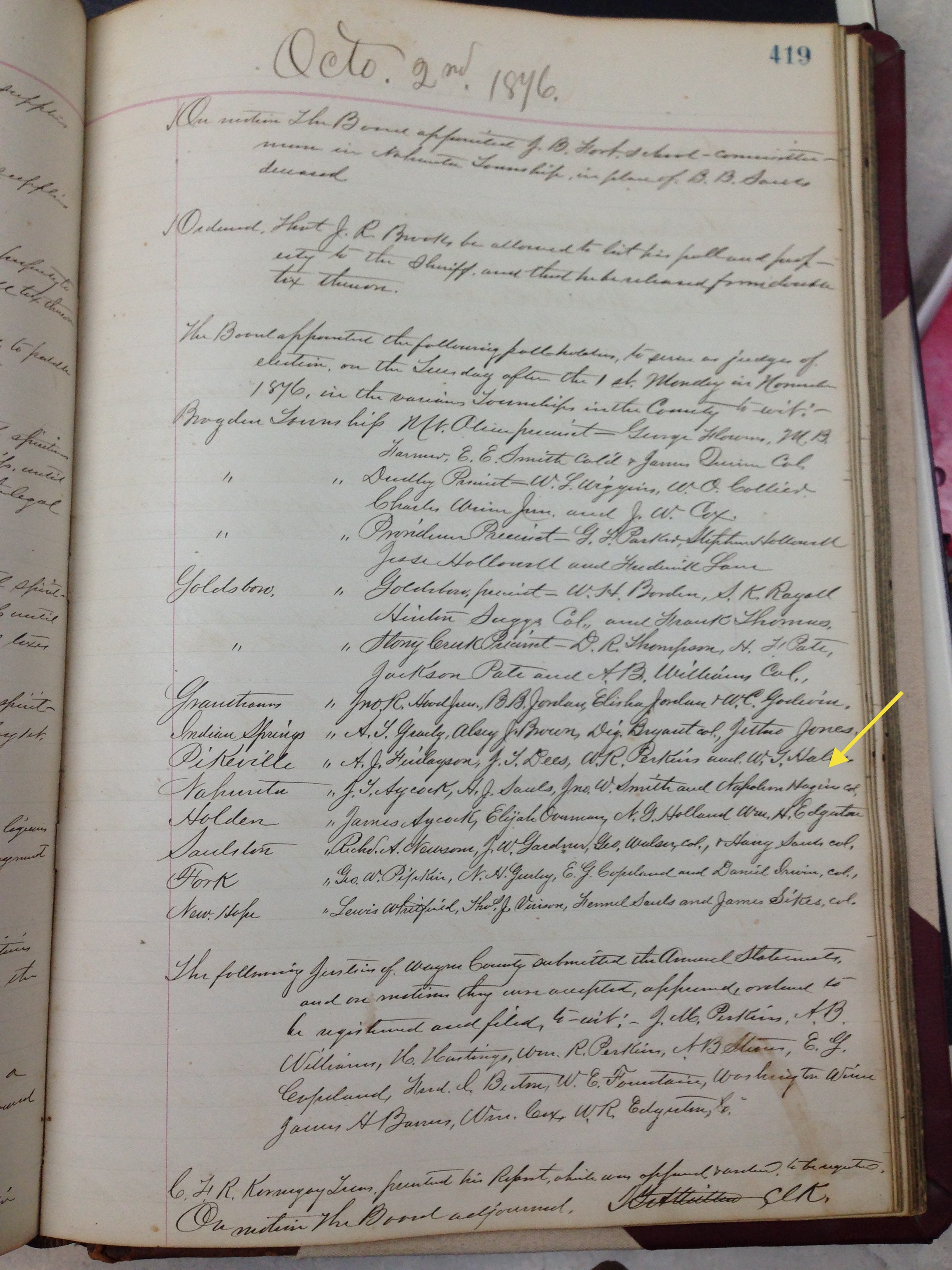
As tax-paying landowners, many African-American men in Wayne County, North Carolina, in the 1870s were called alongside white men to fulfill their civic duties. Here are two entries from Superior Court Minute Book 2:

ImageNapoleon Hagans of Nahunta township was appointed a judge of elections.

ImageMy great-great-great-grandfather Lewis Henderson drew jury duty for the first week of the next term of the superior court.

Superior Court Minute Book 2, Wayne County Register of Deeds Office, Goldsboro, North Carolina.

Standard