DNA, North Carolina, Paternal Kin

DNA Definites, no. 16: Henderson.

Hard on the heels of my first Henderson match* comes another.

K.H.’s family tree shows that he or she is a descendant of Susan Henderson Wynn, half-sister of my great-great-great-grandfather Lewis Henderson. I’ve reached out to the woman who administers K.H.’s account — bizarrely, she’s someone who reached out to me a year or ago about some Artis research she was doing for a friend — to confirm the connection.

*By this, I mean a Henderson who is not also an Aldridge. They are my double-cousins, and much closer on the Aldridge side.


Standard
Maternal Kin, Migration, Newspaper Articles, North Carolina, Vocation

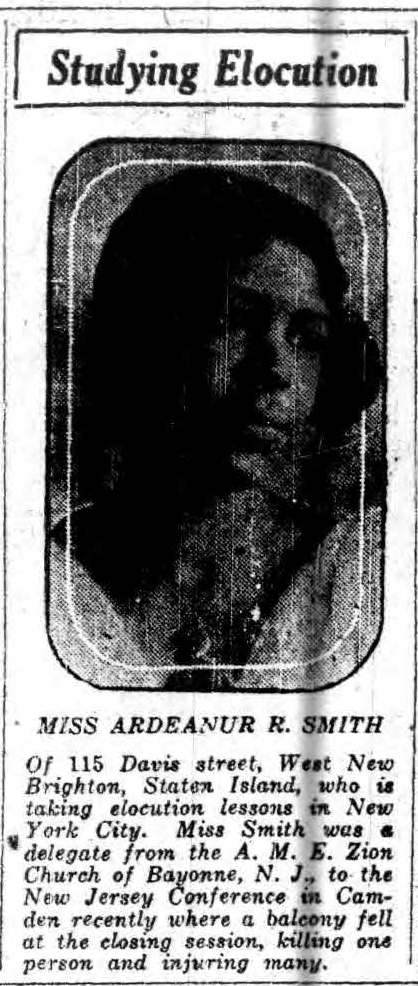
Ardeanur, elocutionist.

 Pitt_Courier_6_2_1928_Ardeanur_Smith

Pittsburgh Courier, 2 June 1928.

This brief blurb intrigues me any number of ways:

(1) Ardeanur R. Smith? This is the first I’ve seen of a middle initial for Cousin Ardeanur.

(2) Smith? My grandmother said Ardeanur married somebody she ran off with when she was a teenager. However, every mention of her I’ve found dating before 1947 — and she is elusive in official records — names her as Smith, her maiden name. In her uncle John McNeely’s 1947 obituary, she’s a Hart for the first time. I have no idea what Mr. Hart’s first name was, where they married, or how long they stayed that way.

(3) Elocution? This may absolutely be a function of me failing to ask the right questions, but, as much as I heard about Wardenur playing the organ on the radio, I never heard my grandmother speak of Ardeanur’s singing or speaking career.

(4) And who was Ardeanur’s publicist that he or she managed to get her name and photo in the Pittsburgh Courier? And not for the last time.

(5) Staten Island?

(6) “Where a balcony fell at the closing session”?!?!?

Standard
Migration, Newspaper Articles, North Carolina, Paternal Kin

That glorious climate of Arkansas.

Perhaps this sheds some light on Gus Artis and his sister Eliza Artis Everett‘s migration to Arkansas from North Carolina well after the Exoduster era:

Goldsboro_Headlight_11_6_1889_Arkansas_migrantsGoldsboro Headlight, 6 November 1889.

On 27 November 1889, the Wilson Mirror reprinted a Goldsboro Argus piece that described Williams and Herring as “railroad hirelings and speculators.” “However much the desire should be divided among our people — and by this we mean the white people — for the negro to exodus this country or remain, the solid, stubborn truth shall not be kept from the poor, deluded, half-informed negro, that this is his home, the climate of his nature; that our people are the most tolerant and generous in the world; and his best friends, and that, therefore, he should stay right here where his associations date back through the centuries; where his faults, and there are many (but who of us is without faults?) are borne with from custom; where his privileges as a free citizen are unquestioned and untrammeled, and where his destinies are linked by law with the whites, who, under a Democratic administration, have for twenty years paid 90 per cent. of his government and education, while he has furnished 90 per cent. of the crime and ignorance of the State.”

Best friends, indeed.

The 20 December 1889 issue of the Wilmington Messenger chimed in the mockery, noting that “Peg leg Williams and Silas Herring have not dissolved copartnership. Peg leg is now in [Goldsboro], and he and Silas are as active as bees in inducing the “coons” of this section to leave their homes of peace and plenty here, to go the far off miasmatic lands of the West, there to die like cattle with the black tongue.”

Robert “Peg-Leg” Williams is memorialized in 100 Americans Making Constitutional History: A Biographical History, edited by Melvin I. Urofsky. Described as the most famous and successful of Southern “emigrant agents, Mississippi-born Williams, a Civil War veteran, assisted 16,000 African-Americans in leaving North Carolina in the wake of discriminatory labor laws passed in 1889.

*Kizzy Herring Herring, who applied for her husband’s Civil War pension from Lonoke County, Arkansas, was another who left Wayne County for the West. So, I suspect was Guy Lane, Jr., son of Guy and Sylvania Artis Lane, who decamped from Wayne County to Memphis, Tennessee, sometime between 1880 and 1900. Did he just not quite make it to Arkansas? Or did he double back to the city after deciding that Arkansas did not suit?

Standard
Education, Maternal Kin, Newspaper Articles, North Carolina

David C. McNeely’s erratum.

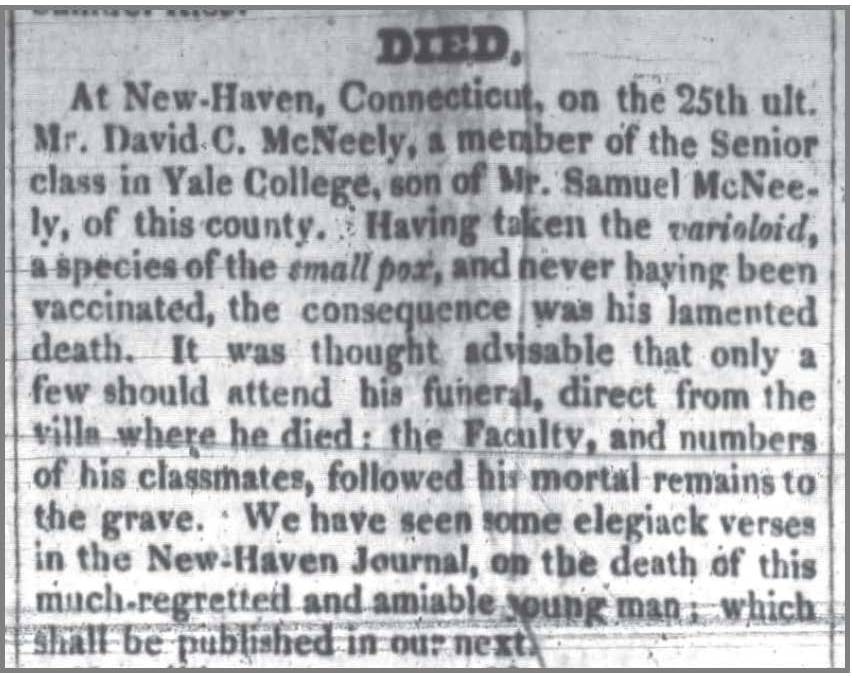
Eons ago, one of the first documents I found related to my great-great-great-grandfather John Wilson McNeely‘s family was an 1828 obituary for his brother David C. McNeely, a student at Yale College.

Western_Carolinian_4_22_1828_death_of_David_McNeely

Western Carolinian, 22 April 1828.

Wow, I marveled. There could not have been many Scotch-Irishmen from the backwoods of Piedmont North Carolina studying at Yale at that time.  What a terrible loss this must have been for John and his family. I entered David’s name into my Family Tree Maker tree alongside Samuel McNeely’s other children William and Acenith (or Acintha).

And then the other day, I found this:

Western_Carolinian_4_29_1828_David_McNeely_correction

Western Carolinian, 29 April 1828.

Oh. … Okay. … So all my sentiments hold — except the loss to John. David was not Samuel McNeely‘s son after all, but James McNeely’s.

If there was one James McNeely in Rowan County in the first quarter of the 19th century, there were a dozen, and I have been singularly unsuccessful at teasing apart and differentiating them. Evidence shows that Samuel and his son John W. had close relationships with several James. However, the will of Samuel’s father John McNeely (1724-1801) lists no heir named James, only John, Alexander and Samuel and their sister Ellinor McNeely Bell. It is past time that I pull together a chart or a list or a something that summarizes links I’ve found among these McNeelys and may reveal previously unnoticed clues.


Standard
North Carolina, Other Documents, Paternal Kin

Eureka! … Not.

I was flipping through an old notebook and came across this abstract of entries in the 1912-1913 city directory of Wilson, North Carolina:

Taylor, Bertha, laundress, h 114 w Lee

Taylor, Greenman, h Stantonsburg rd nr Rountree av

Taylor, Hennie, dom, h 114 w Lee

Taylor, Jordan, lab, h Stantonsburg rd nr Rountree av

Taylor, Mack, driver, h 114 w Lee

Taylor, Mattie, laundress, h 114 w Lee

Taylor, Robert, barber, h 114 w Lee

Taylor, Roderick, barber Paragon Shaving Parlor, h 114 w Lee

The house at 114 West Lee Street belonged to my great-grandfather Michael (“Mike,” not “Mack”) Taylor. Bertha, Hennie, and Mattie were his younger daughters. Roderick was his only son. Jordan and Greeman, over on Stantonsburg Road, were Mike’s niece Eliza’s husband and son. But who in the world was Robert Taylor?

Robert … Robert … An epiphany! Of course! This was Robert Perry, son of Mike’s wife Rachel‘s sister Centha Barnes Perry! The boy grew up in Mike and Rachel’s household and quite naturally he was sometimes known as Robert Taylor! … Right?

Well, perhaps, but this is not him. Robert Perry was only 9 years old in 1912. Not only would a child not have been plying a trade at that age, he would not be counted among the adults included in a city directory. (Even Rachel was omitted, as “dependent” homemakers did not make the cut either.)

So, who was this Robert Taylor who both lived in Mike Taylor’s house and worked in the same trade as Mike’s son Roderick?

Census records do not show an African-American Robert Taylor in all of Wilson County in the 1900 or 1910 censuses. In 1920, however, there is Robert Taylor, age 36, a laborer, with wife Mary G., age 29, living at 611 Green Street. Now this is really puzzling.

Two years earlier, when Roderick Taylor registered for the World War I draft, he stated his birth year as 1883, his occupation as barber, and his address as 611 East Green Street. There is no “Roderick Taylor” listed in the 1920 census, but in 1930, at 610 [sic, house numbers shifted in the early 1920s] Green Street, there is barber Roderick Taylor, 45, wife Mary J., 39, and three children.

While it is conceivable that there were both a Robert Taylor and Roderick Taylor of the same age, living in the same houses, with wives of the same name and age, and working in the same profession, it seems unlikely. Rather, in an era in which “Roderick” was rare name, an inattentive census taker or canvasser might easily have heard “Robert” when making his inquiries. Absent further independent evidence that a Robert Taylor existed, I conclude that Roderick’s doppelgänger is a figment of error.

Standard