North Carolina, Oral History, Paternal Kin

It felt like a weight fell off of her.

Papa asked Mama would she come back ‘cause the café wasn’t doing nothing, and she’d put all her money out, so she told Papa she’d come back home. And she come back, and, I don’t know, she seemed kind of puny and sickly. Papa said, “Well, a old man came here and he said he – Well, you come back just like the man said.” And she said, “What man?” And he said, “Well, somebody told me, said go out there and see somebody called a rootworker,” or, well, he didn’t call it rootwork, but see some person like that. And said maybe he could make her come back. And he said — well, I don’t know what he paid him, but anyway, he said he gave him stuff and told him to bore a hole in a tree on the north side and put that stuff in it and take and put a corkscrew in it. To make it stay in there. And for him to, I think he told me, for him to wet on it for nine mornings or something like that, and she would come back. Well, she come back, and she said, “Well, how come you didn’t take the mess out?” Well, he was arguing about it, saying something about it, and what I did, I got the ice pick. And went out there to – we had a peach tree and a apple tree. It was in the apple tree, and I went out there and looked around sure enough it was a corkscrew, great big one ‘bout like that there, stuck up in there, and I took that icepick and picked it out. And it come out this little trashy stuff in this cloth. And it was part of Mama’s underclothes. [We laugh.] And I think it come off – you know at that time they had a lot of lace and stuff — and one of them little pieces cut off where was the lace was up there, and he wrapped it up and put in that…. Least the man fixed it for him and told him how to bury it in the hole. And Mama, and I don’t know whether it was so or not, but she said when that stuff come out of that hole, felt like a weight fell off of her. I’ll never forget that thing. And the tree died. So, I said I don’t know whether it killed the tree, but it didn’t kill her. And Mama told me if that thing stayed there long enough [inaudible] in that mess, she’d a died.

For a scholarly in-depth study of hoodoo and root work, see Katrina Hazzard-Donald’s Mojo Workin’: The Old African American Hoodoo System.

Interview of Hattie H. Ricks by Lisa Y. Henderson; all rights reserved.

Standard
Free People of Color, North Carolina, Other Documents, Paternal Kin, Religion

Jonah Williams and the Turner Swamp Primitive Baptist Association.

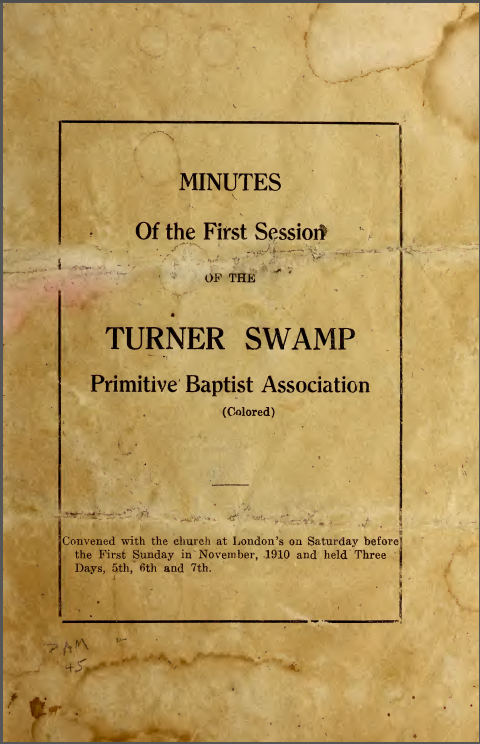
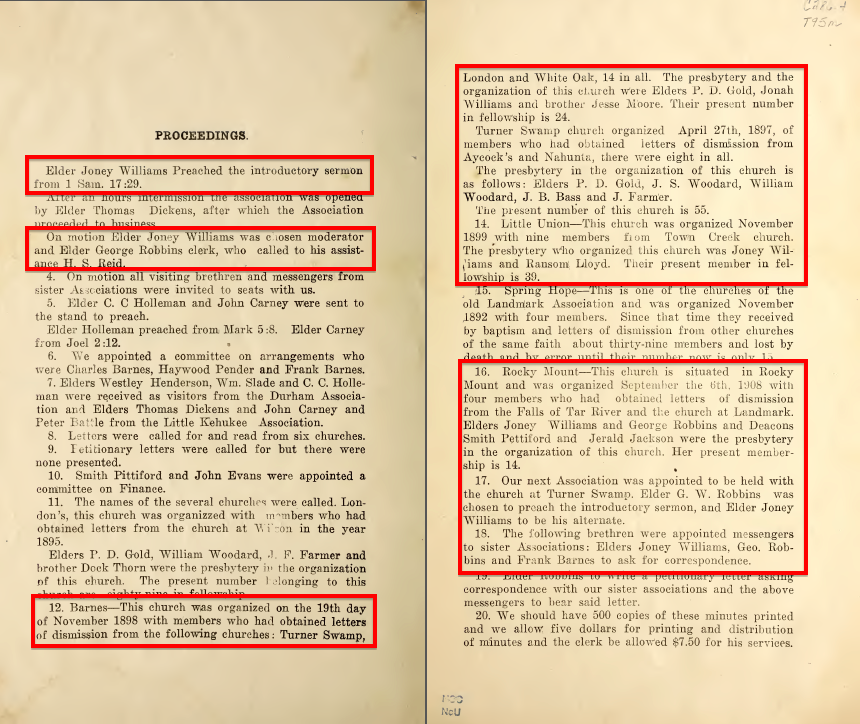
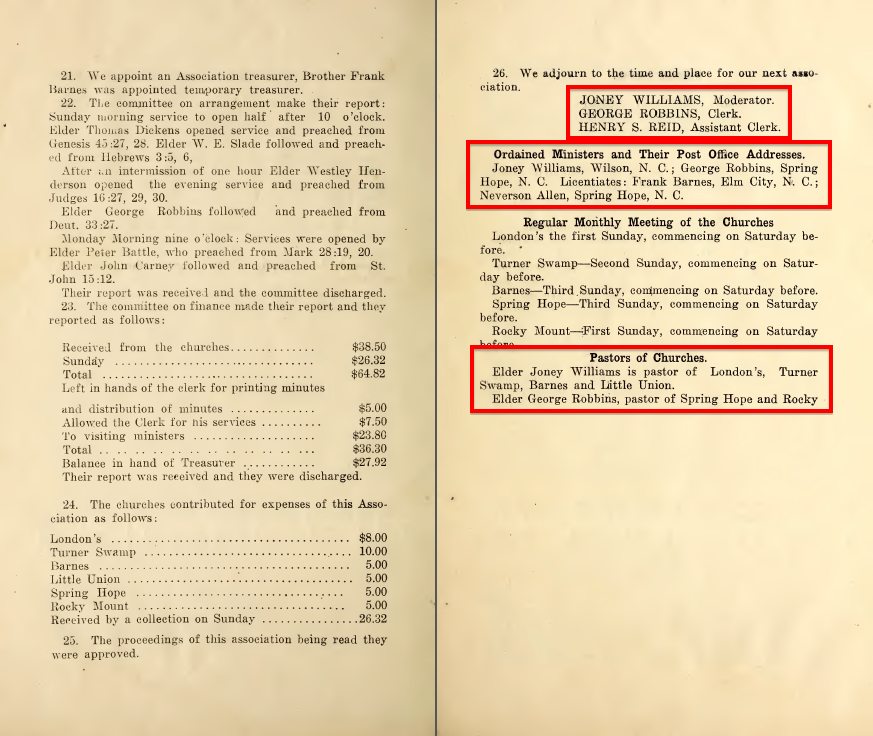
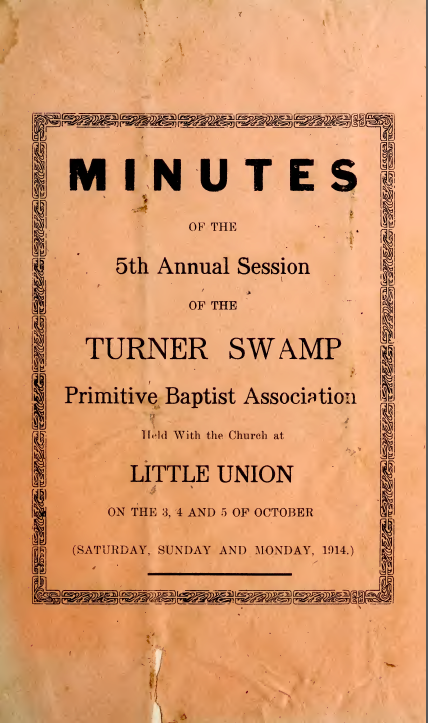
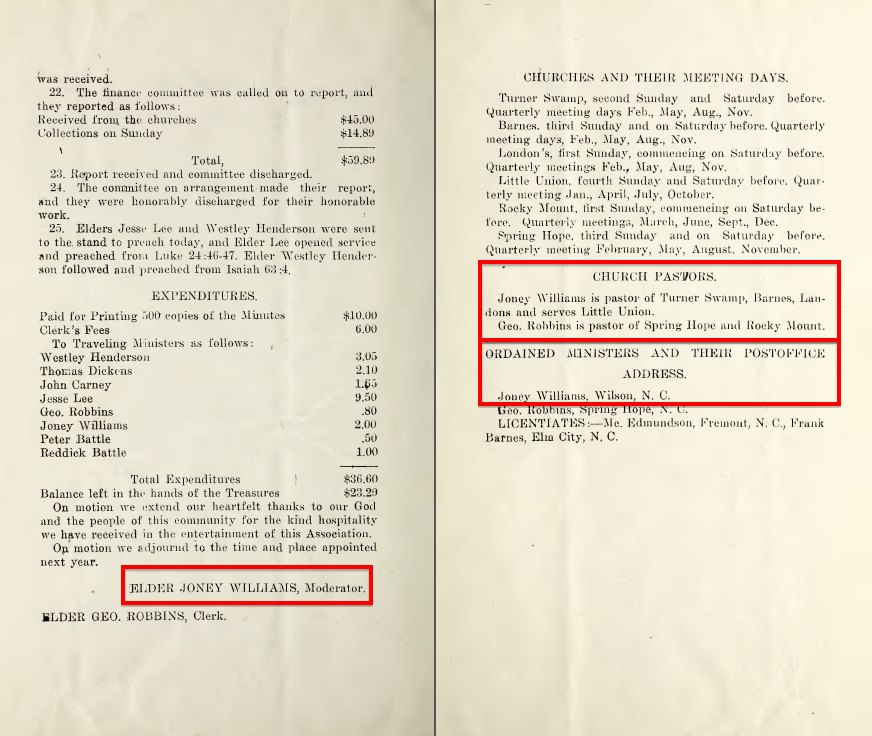
I’ve blogged often about Jonah Williams, prominent farmer, respected preacher, and brother of my great-great-great-grandfather Adam T. Artis. I was pleased, then, to find copies of the minutes of the early annual sessions of the Turner Swamp Primitive Baptist Association, which oversaw several churches that Jonah helped establish and/or lead. Jonah participated in five sessions before his death in 1915, and the minutes of two survive. I’ve extracted pages from those documents here.

JWms Turner Swamp 1

London’s Church was just north of the town of Wilson (in what would now be inside city limits.) The church is most closely associated with London Woodard, an enslaved man who was purchased by his free-born wife, Penny Lassiter. Just after the Civil War, London founded an African-American Baptist church, which seems to have been the precursor to the London’s Church organized under the Primitive Baptist umbrella in 1897.

As shown below, Jonah was involved in the establishment of nearly every church in the Turner Swamp Association, including Turner Swamp (1897), Barnes (1898), Little Union (1899), and Rocky Mount (1908). Turner Swamp still meets at or near its original location just north of Eureka in Wayne County. Barnes is likely Barnes’ Chapel Church, now located at 1004 Railroad Street in Wilson. [CORRECTION: Barnes Chapel was close to Stantonsburg, in southwest Wilson County.] I had never heard of Little Union church, but a Google search turned up a list of churches within 15 miles of “Bel-Air Forest (subdivision), North Carolina,” Little Union among them. (Which is a little spooky because that’s the neighborhood in which I grew up and I didn’t input that reference point.) Unfortunately, the site’s map is blank. However, another search disclosed a recent obituary that referred to the decedent’s efforts to rebuild Little Union Primitive Baptist Church in Town Creek, North Carolina. I have not been able to find current references to Rocky Mount Primitive Baptist Church.

Screen Shot 2015-01-06 at 6.37.15 PM

Screen Shot 2015-01-06 at 6.37.53 PM

Jonah moved from the Eureka area about 10 miles north to Wilson in the late 1890s. Though I knew of his association with Turner Swamp, I was not aware until finding this document that he had also been pastor at London, much less two other churches.

Screen Shot 2015-01-06 at 6.38.53 PM

Screen Shot 2015-01-06 at 6.39.13 PM

Romans 7:4 — Wherefore, my brethren, ye also are become dead to the law by the body of Christ; that ye should be married to another, even to him who is raised from the dead, that we should bring forth fruit unto God.

Screen Shot 2015-01-06 at 6.40.05 PM

Screen Shot 2015-01-06 at 6.40.21 PM

The approximate locations of the churches in Turner Swamp Primitive Baptist Association. Top to bottom: Rocky Mount, Little Union, London’s, Barnes’ and Turner Swamp. As the crow flies, the distance from Rocky Mount to Eureka, where Turner Swamp is located, is about 30 miles.

TS Ass map

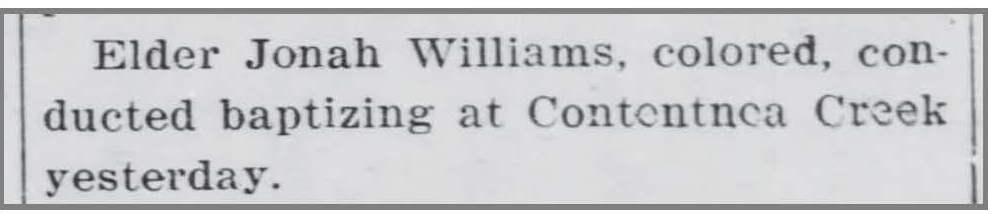
This news brief probably made reference to baptisms Jonah conducted at London Church, which stood a few miles from the south bank of Contentnea Creek.

WDT_6_6_1911_J_Williams_baptizing_at_Contentnea_Creek

Wilson Daily Times, 6 June 1911.

Standard
Births Deaths Marriages, Maternal Kin, North Carolina

Ida Colvert Stockton … Stockton.

My great-grandfather, Lon W. Colvert, had four half-sisters — Selma, Ida May, Lillie and Henrietta. Selma died of “exhaustion from severe burns” when my grandmother was 8 years old. Ida May and Lillie remained in Statesville all their long lives. My grandmother of course knew them, but there is a disconnect somewhere in there that I can’t quite pinpoint. Why were there no extended Colvert relatives at our early family reunions (when many were still alive), as there were extended McNeely kin? Why didn’t my mother know her grandfather’s people? It is perhaps as simple as my grandmother and her sisters being closer to their mother’s large family in childhood, especially given their father’s relatively early death. Over the years — my grandmother left Statesville for good in 1932 — these patterns persisted, solidified and were passed down. Perhaps. It seems odd to me though. Lon’s sisters were roughly the same age as his oldest set of children, and Ida May’s oldest children were roughly the same age as Lon’s youngest. The families lived in close proximity in south Statesville. What was up….?

I have blogged quite a bit about Henrietta Colvert — the aunt my grandmother knew best — who was one of North Carolina’s early African-American registered nurses. I have tracked Henrietta across the arc of her career, which happened to unfold in my hometown of Wilson, North Carolina, almost 200 miles east of Statesville. She left Wilson sometime after World War II, and I have intermittent glimpses of her whereabouts prior to her death in Roanoke, Virginia, in 1980. What of the other sisters though? I’ll start with Ida May.

Though John W. Colvert and Myra Hampton began their relationship in the late 1880s, they did not marry until 1905. Ida, their first child, was born about 1887, and three more daughters followed in short order. None of the family, however — not John, not Addie, nor their girls — are found in the 1900 census.

A lot happened in the next decade though. The 1910 census of Statesville, Iredell County, at 214 Garfield Street, shows Ida M. Stockton, a 25 (actually, 23ish) year-old widow with one of three children living sharing a household with her brother-in-law Eugene Stockton, 37 and married, her brother-in-law Jesse Stockton, and her son John, 1.  Ida was a laundress, Eugene a tobacco roller at a tobacco factory, and Jesse, an odd job laborer.  This arrangement would not ordinarily raise eyebrows, but — widow?  Wasn’t Eugene Stockton Ida’s husband??? Why is he listed as her brother-in-law?  The birth certificates of all her children, including John, list Eugene as their father. Had Ida previously been married to one of Eugene’s brothers? (Census and death records identify several, including Arthur (born circa 1875), Fred (1885), Jakey (1887), Jesse Lee (1889), and David (1891).) If so, I have not found evidence of a license. And if not Ida, to whom was Eugene married in 1910?

That last question turns out to be pretty easily answered. On 24 June 1903, Eugene Stockton, son of Henry and Alice Stockton, married Ella Cowan, daughter of Peter and Clementine Cowan in Iredell County. I have found no evidence that the couple had any children. In the spring of 1912, their divorce suit, styled Eugene Stockton vs. Ella Stockton, was listed several times in the court calendar published in the Statesville Sentinel. By 1918, when Eugene registered for the World War I draft, he listed his sister Gertrude Stockton as his next of kin.

Ida’s children were John Walker Stockton (1910), Lillie Mae Stockton (1911), Sarah Eliza Stockton (1912), Alonzo Pinkney Stockton (1917),  Winnifred Josephine Stockton (1919), and Eugene A. Stockton (1924). As noted above, the birth certificates of all list Eugene as their father. (In sooth, though, all the children except Eugene had delayed birth certificates, i.e. certificates registered well after the birth of the child in question.)

Nothing had changed by time the enumerator arrived to record the 1920 census. At 214 Garfield Street in Statesville, Eugene Stockton, 46, is listed as the head of a household that included his sister Flossie Tomlin, 23, grandchild Annie L., 5 months, sister-in-law Ida M. Stockton, 33, and grandchildren Lilly M., Sarah E., Alonzo P., and Winnifred.  Eugene was employed as a tobacco factory laborer, Flossie as a teacher, and Ida as a laundress. Who made this up? The census taker, or a self-conscious Ida May? She is still listed as Eugene’s in-law, despite their apparent decade-long relationship, and Lillie, Sarah, Alonzo and Winnifred are identified as his grandchildren.  Eugene’s sister Florence “Flossie” Stockton Tomlin, was married to Harvey Golar Tomlin, who was the half-brother (on the maternal side) of Ida Mae’s half-brother (on the paternal side) Lon W. Colvert.  Accordingly, Annie L. Tomlin was Eugene’s niece, not his granddaughter. (In a separate listing in 1920, in Statesville’s “suburbs”: Jessie Stockton, 28, sister Flossie Tomlin, 25, niece Anna L. Tomlin, 4 months, and brother-in-law Havey Tomlin.)

Finally, as her mother’s had been, Ida May’s steadfastness was rewarded.  On 8 July 1922, Eugene Stockton, 49, son of Henry and Adley Stockton, and Ida May Stockton, 35, daughter of John and Adeline Colvert, were married by Z.A. Dockery, M.G., at “Eugene’s house” before Bessie Abernathy and E.A. Abernathy.

In the 1930 census, the family at last is listed openly: Eugene Stockton, 57, wife Ida M., 45, and children John, 20, Lily M., 18, Sara, 17, Alonzo, 12, Winifred, 11, and Eugene Jr., 6.

STOCKTON -- Eugene&Ida Stockton

Eugene and Ida May C. Stockton, probably the early 1940s.

Eugene Stockton died 26 February 1944 in Statesville. Ida May Colvert Stockton Stockton outlived him by more than 20 years. On 23 August 1967, she passed away a week after suffering a stroke.
Sville_R_amp_L_8_26_1967_IM_Stockton_obit

Statesville Record & Landmark, 26 August 1967.

Photo courtesy of A. S. Barton.

Standard
Uncategorized

52 Ancestors in 52 Weeks: 1. Fresh start.

I tried the “52 Ancestors” challenge in 2014.

I failed.

I mean, I surely blogged about more than 52 relatives last year, but the constraints of the weekly format didn’t really work for me, and I faded out after posting four. This year’s challenge is a bit different. Each week is themed. As Amy Johnson Crow explained:

“The vast majority of people who responded the survey I did a few weeks ago said that they would like to continue with optional weekly themes. So, we’re going to give it a try. The weekly themes are strictly optional. They are meant to give you some ideas on who to focus on. (Isn’t choosing the week’s ancestor often the hardest part?!)

The themes are going to be general — one might even say “ambiguous.” I’m doing that on purpose. I’m hoping to inspire, rather than dictate.”

I’m picking up the gauntlet again, though I’m cheating a bit at the outset. The theme for the first week in January is “Fresh Start.” This is it.

Standard
Enslaved People, Land, Maternal Kin, North Carolina

38 acres.

So, I found this deed today on the Iredell County Register of Deeds’ site:

Screen Shot 2015-01-03 at 11.07.21 AM

A number of things strike me:

  • John Walker Colvert never registered a deed for this or any other property. Neither did his father Walker Colvert.
  • The property bordered that of John Greenberry “J.G.” Colvert, a son of William I. Colvert, who had been Walker and John Walker’s master.
  • “For further description and title, see deed of G.W. Mullis to G.B. Morgan. Also see will of Walker Colvert — Will Book 6 at page 483.” George W. Mullis was the father of Daniel A. Mullis, one of the witnesses to Walker’s will.
  • Though the deed was not registered until 1904, Mullis sold the 38 acres for $250 to Gabriel B. Morgan on 2 April 1863. Lying in the northeast corner of the Richardson tract on Hunting Creek, the parcel was bounded as follows: “Beginning at a hickory thence South (58) fifty-eight poles to a stone thence near south [sic] a conditional line 114 (one hundred & fourteen) poles to two oaks near a branch, then north to Beatys line thence East with said line to the beginning containing thirty eight acres more or less….” (Deed Book 30, page 234)
  • In the 1870 census, Walker reported owning $100 of real property. It is not clear when he bought the 38 acres, presumably from Morgan.  He is listed in Union Grove township, just west of Eagle Mills township in Iredell County. His close neighbor is Beeson Baty, presumably of the “Beaty’s line” named in the deed.
  • Walker made his will in 1901; it was probated in 1905. Walker’s widow Rebecca was his primary beneficiary, but everything passed to John after her death in 1915.
  • As an aside, Walker and Rebecca’s daughter Elvira married Richard Morgan, son of Richard Madison and Hilda Morgan, in 1874. Had Richard and his mother belonged to G.B. Morgan?
  • P.P. mentioned that D.A. Mullis lived in the vicinity of Mullis Road and Zion Liberty Road. I’ve marked that intersection with the left-most arrow on the map below. As the deed described, this area is near Hunting Creek, which crawls across the middle of the image, and is at the eastern edge of Union Grove township. The second arrow marks the point at which I photographed the creek from the Eagle Mills Road bridge. The third points in the direction of Nicholson Mill. As the crow flies, the map depicts an area no more than a couple of miles wide.

Screen Shot 2015-01-04 at 1.56.36 PM


Standard
Maternal Kin, North Carolina, Paternal Kin

Blog blessings.

  • On October 23, I blogged about connecting with D.J., a descendant of my great-great-great-grandparents Adam T. Artis and Robert and Mary Eliza Balkcum Aldridge via Lillie Bell Artis Thompson McDaniel Pridgen (1891-1935). A month and a half later, quite separately, I heard from P.M. via this blog. P.M. is also descended from Lillie Bell, though from her marriage to Celebus Thompson. (D.J. is from her second marriage, to McDaniel Whitley.) To my surprise, P.M.’s great-grandmother, Lillie Bell’s daughter Genetta Thompson, married Phillip Elmer Coley, a grandson of Winnie Coley. In her short life, Lillie Belle had twelve or so children. Many migrated north to New York and New Jersey, though, and I had not been able to trace them forward. So glad Scuffalong is bridging that gap!

Genetta Thompson Coley

Genetta Thompson Coley.

  • Just after Christmas, P.P. commented on “All of my possessions to have and to hold,” which featured by great-great-great-grandfather Walker Colvert‘s will. She identified Daniel Mullis, one of the witnesses to the document, as her ancestor. P.P. not only lives in the Eagle Mills area, she’s an avid genealogist and local history buff, she’s my cousin! Her great-grandmother Rebecca Ann Nicholson Barnard was a sister of my great-great-great-grandfather James Lee Nicholson. P.P. has a lifetime of knowledge about northeastern Iredell County and has volunteered to help me in any way possible. Two things she’s already shared: (1) The Welch-Nicholson house didn’t just fall down from age and neglect. It was torched by hooligans out on arson spree. This was back, probably, in the 1980s, not very long after the house achieved historic register status. (2) “Cowles” is pronounced COLES.
  • Around the same time I heard from P.P., I received a message from P.W. She’d been talking to her grandmother about family history, jotted down some names, Googled them, and immediately found “Where we lived: 114 West Lee Street.” To my amazement, she is a descendant of Madie Taylor Barnes, who migrated to New York City during the Great Depression and lost touch with her North Carolina family. I’m looking forward to talking to P.W.’s grandmother soon.
  • And then today: M.S. left a comment noting that her great-great-great-grandfather baptized my great-great-great-grandfather James L. Nicholson in 1842, and she’s a descendant of John A. Colvert, an owner of my great-great-great-grandfather Walker Colvert!

Photo courtesy of Patricia Smith Muhammad.

Standard
Uncategorized

You will find something.

“… there is a vast mass of things in the world, and the act of creation that cuts through them divides the things that might have happened from those that did. … I did and do believe, after all that I’ve seen and done, that if you project yourself into the mass of things, if you look for things, if you search, you will, by the very act of searching, make something happen that would not otherwise have happened, you will find something, even something small, something that will certainly be more than if you hadn’t gone looking in the first place, if you hadn’t asked your grandfather anything at all. … There are no miracles, no magical coincidences. There is only looking, and finally seeing, what was always there.”

and

“I told her that I, too, was interested in facts, of course, that we had started out on this long series of journeys because we wanted to find the facts. But I said that because of what we’d heard on our trips, I’d also become extremely interested in stories, in the way that the stories multiplied and gave birth to other stories, and that even if these stories weren’t true, they were interesting because of what they revealed about the people who told them. What they revealed about the people who told them, I said, was also part of the facts, the historical record.”

— Daniel Mendelsohn, Lost: The Search for Six of Six Million

——

Yesterday, New Year’s Eve, Scuffalong:Genealogy had its best day ever — more than 400 views. In no small way because of your support, I start 2015 renewed and reinvigorated in my quest to find and share my stories. Thank you.

Standard