
As discussed here, in 1900, Doctor T. “Dock” Simmons went in with his father Montraville to purchase 138 acres in Noble township, Cass County.
Things did not go well.
On 9 June 1901, the Logansport Pharos-Tribune reported “Trouble on Watts Farm: Father and Son Cannot Agree on Conducting Affairs.” Dock and Montraville argued as Dock was preparing to take his “best girl” to church. A few days later, Dock proposed to “go and leave the farm forever, giving his father his interest, if he would allow him to take his team [of three horses] away.” “To this the father objected, but the son, tired as he says of the unpleasant conditions that have prevailed on the farm for some time, was determined to leave, and in spite of his father’s threats, hitched up a team and drove to town.” Montraville jumped on a horse, passed Dock on the way into Logansport, and went to the police station. As Dock passed, a police officer ordered him to come in. He and his father then agreed to drop the matter and went back to the farm. Barely two hours later, Dock re-appeared at the station “with a bleeding head and a lump on his cheek” and accused his father of hitting him with a rock. He did not to press charges, however, and the police advised him to go home and “patch up the matter as best he could.” “It is likely that young Simmons will sue for the division of the property which consists of 140 acres.” He apparently did not. A 9 June 1905 Pharos-Tribune article reported that the Watts farm owned and operated by Montraville, Dock and Montraville Simmons Jr. had been sold at sheriff’s auction to satisfy a $3000 judgment against “the Simmons people.” Somehow, though, they got the land back.
On 26 August 1901, Dock Simmons and Fannie Gibson were married by a Justice of the Peace in Logansport.

Logansport Pharos-Tribune, 26 August 1901.
The couple made their home in town, away from Dock’s bullying father, as on 26 September the Logansport Daily Report briefly mentioned that Fannie was very sick at their Park Avenue home. Two months later, on 15 August, Dock was horribly scalded by steam from a blown-out traction engine while working at the farm with his brother (probably Edward). A newspaper article mentioned that Dock, who lived on Helm Street, was confined to his father’s home with terrible burns. A different paper, the Logansport Daily Report, said he lived on “Lockwood street, West Side,” a statement that lines up with the 1905 Logansport city directory: w[est] s[ide] Lockwood 1 [block] s[outh] Melbourne av.”

In the 1910 census, Dock and Fannie appear at yet another address: 57 Seybold Street. However, on 6 January of that year, the Pharos-Tribune reported that Fannie had broken her arm in a fall in her yard “two miles west of the city on the Wabash river road.” And on 28 May, when Dock was robbed by a female highwayman, the Daily Tribune described him as a Dunkirk resident. Then on 7 February 1911, in describing an accident in which Dock was knocked from his wagon by a streetcar, the Pharos-Tribuine gave his address as Park Street. It is not until about 1920 that the Simmonses’ address achieves regularity at 129 Seybold Street.
What is going on here??? Were Fannie and Dock really bouncing around Logansport every few months? No, and a modern map of Logansport helps explain. The oldest section of town, shown here underlying the city’s name, formed at the junction of the Eel and Wabash Rivers. The area across the Eel from the city’s point was known as its West Side. This neighborhood, at A, is informally bounded by the old Vandalia railroad tracks. Market Street is the major thoroughfare shown snaking across the city. It becomes West Market as it crosses west over the Eel. (The spot marked B is approximately where Dock was robbed by the Lady Bandit.) Dunkirk, shown here at C, is an unincorporated community just west of the city. (The Simmons’ farm was a few miles beyond Dunkirk.)

Here’s a closer look at the west side of the West Side. All the streets named as habitats for Dock and Fannie Simmons — Helm Street, Lockwood Street, Park Avenue, Seybold Street, and Wabash River Road (now West Wabash Avenue) — form a two-block rectangle. It’s possible that they occupied several houses in these blocks before finally settling at 129 Seybold, but it’s more likely that the inconsistencies were the result of the use of a street name to designate an area, rather than a precise address, and they were in the same house the whole time.

Dock and Fannie seem to have lived at 129 Seybold until the end of their days, and the house, built about 1900, remains home to a Logansport family.
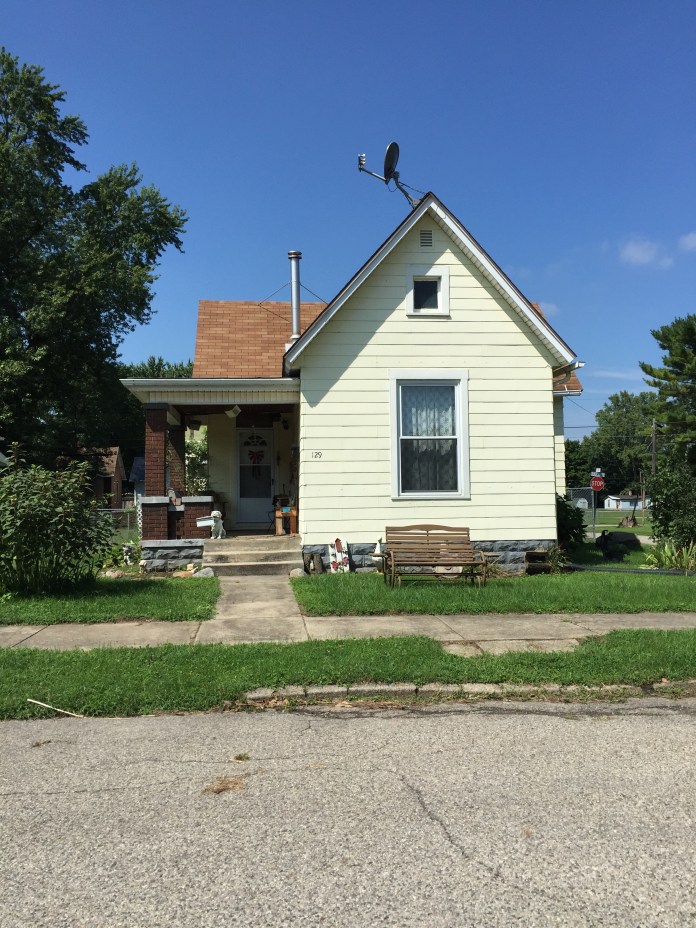
Photograph by Lisa Y. Henderson, August 2016.



 Scuffalong: Genealogy.