Births Deaths Marriages, Migration, Paternal Kin, Photographs

Family cemeteries, no. 19: Mount Hope cemetery, Logansport, Indiana.

IMG_9558

LPT 11 3 1951 F simmons

Logansport Pharos-Tribune, 3 November 1951.

Screen Shot 2016-09-02 at 9.12.37 PM

Logansport Press, 11 November 1951.

Fifty years after they married, Dock Simmons buried his beloved wife Fannie at Mount Hope cemetery at the northern edge of Logansport. The week after her death, her sisters joined him in publishing thanks to all who had expressed condolences for their loss. The notice is my last glimpse of Dock.

My first thought when I found the headstone above was: “How sad. There was no one left — no siblings, no children — to etch in Dock’s death date.” My second: “Wait. Is Dock even buried here?”

Curiously, I have not been able to find Dock’s death certificate. He does not appear to have died in Indiana, whose death certificates are available online through 2011. Where, then? Did he spend his last years with one of Fannie’s sisters? (The Simmonses had sheltered Fannie’s mother and brother.) Perhaps with her nieces or nephews? (He had only one, Harold.)

I sent an inquiry to Mount Hope and received an immediate response from its sexton: “I am sorry to say that there is no indication that Doc Simmons is here.”

Standard
Newspaper Articles, Paternal Kin

Montraville’s mayhem.

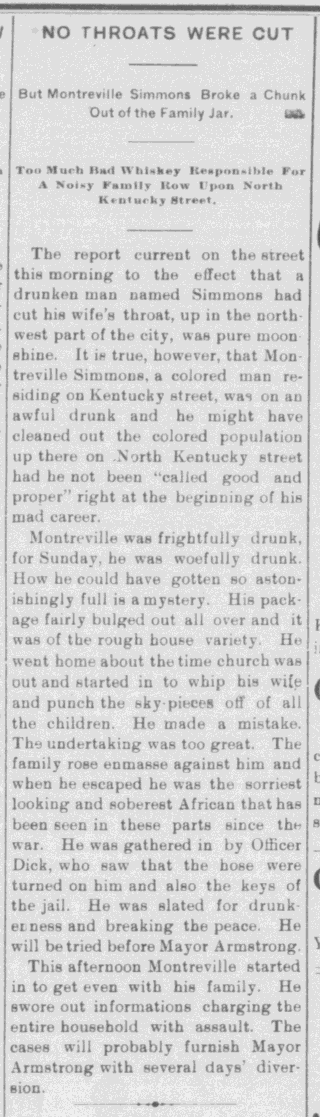
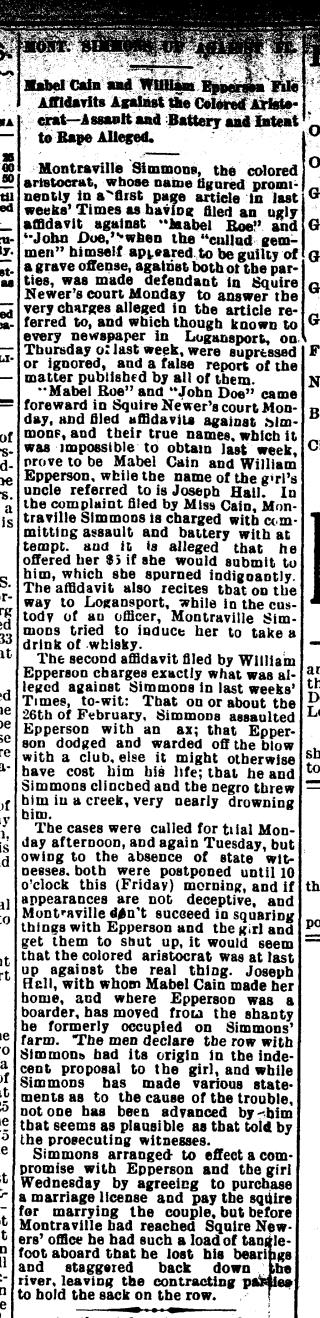
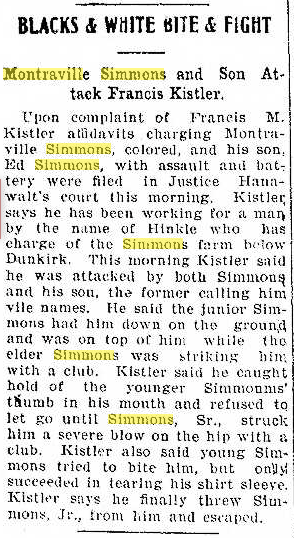
I generally view with skepticism lurid newspaper accounts of Negro malfeasance, but it’s hard to ignore the cumulative record of Montraville Simmons’ outrageousness. He beat his wife and children, he seduced his neighbors’ women, he piled up lawsuits.

Here’s a smattering of not even ten years’ worth of Montraville’s mayhem:

  • In which a drunken Montraville whipped his wife Anna Henderson Simmons (but did not slit her throat) and punched his children, and they rose en masse to beat him back. After his arrest, Montraville pressed charges against his whole family for assault.

KDT 11 13 1899

Kokomo Daily Tribune, 13 November 1899.

  • In 1901, remember, he hit son Dock Simmons in the head with a rock.
  • In which, long story short: Joseph Hall was a tenant living on Simmons’ farm. Mabel Cain was his niece, and William Epperson was her boyfriend. Montraville allegedly offered Cain $5 for sex. (This, apparently, is the assault and battery with attempt to rape.) Epperson was outraged; he and Montraville fought with ax and club; and Montraville threw Epperson into a creek, nearly drowning him. On the way to court, while in custody, Montraville tried to get Cain to drink some whisky. Later, he offered to squash the matter by paying for a marriage license for Cain and Epperson. He got drunk, however, forgot his promise, and went home.

L Times 3 7 1902

Logansport Times, 7 March 1902.

  • (First, there’s the mention that Montraville was recently a “prominent figure in the colored circles of Ervin Township,” suggesting that he did live in the Bassett settlement during his time in Howard County.) Charles Baker worked for Montraville, and he and his wife Ollie Perkins Baker shared the Simmons’ home. Having noticed that his wife was on extra friendly terms with Montraville and his sons, Charles decided to move back to Logansport. Ollie initially refused, then relented and “kissed the Simmons boys” (who were men in their twenties) as they left. The next day, Ollie insisted on returning to the farm, and Charles finally agreed. He and Montraville began drinking, and the inevitable argument broke out. Ollie took Montraville’s side, grabbed Charles’ gun, and hid it under a mattress. Montraville threatened Charles with a length of wagon wheel, and Charles grabbed his gun and smashed the butt into Montraville’s head. Ollie was screaming to Montraville, “Kill him!,” and Charles ran out of the house when a Simmons son snatched the gun from him. Ollie refused to leave with him. Montraville’s version of events was more laconic: he was in bed, Charles started beating Ollie, Montraville protested, and Charles knocked him in the head.

KDT 1 9 1903

Kokomo Daily Tribune, 9 January 1903.

  • In which a white laborer named Francis Kinstler filed assault and battery charges alleging that Montraville and Ed Simmons called him vile names and attacked him. Kistler bit Ed’s thumb, and Montraville clubbed him in the hip. After tearing Ed’s shirt with his teeth, Kinstler escaped.

LPT 7 24 1907

Logansport Pharos-Tribune, 24 July 1907. 

  • Montraville and Edward were acquitted.

LPT 7 27 1907

Logansport Pharos-Tribune, 27 July 1907.

  • As mentioned here, in 1908 Montraville’s second (or third) wife Emily charged him with beating her for breaking a beer-filled mug.
  • And then there was white-collar crime. Montraville mortgaged fifty acres of growing corn for $250. Except he didn’t have any corn growing. This article recounts the tale of Montraville’s tumble from rumored wealth to a “rocky” life.

KDT 5 19 1908

Kokomo Daily Tribune, 19 May 1908.

  • Later that summer, a Logansport paper elaborated on Montraville’s downfall to homelessness, wifelessness and penury.

LDT 8 23 1908

Logansport Daily Tribune, 23 August 1908.


Standard
Land, Newspaper Articles, Paternal Kin, Photographs

Indiana Chronicles, no. 3: Dock Simmons’ Logansport.

As discussed here, in 1900, Doctor T. “Dock” Simmons went in with his father Montraville to purchase 138 acres in Noble township, Cass County.

Things did not go well.

On 9 June 1901, the Logansport Pharos-Tribune reported “Trouble on Watts Farm: Father and Son Cannot Agree on Conducting Affairs.” Dock and Montraville argued as Dock was preparing to take his “best girl” to church. A few days later, Dock proposed to “go and leave the farm forever, giving his father his interest, if he would allow him to take his team [of three horses] away.” “To this the father objected, but the son, tired as he says of the unpleasant conditions that have prevailed on the farm for some time, was determined to leave, and in spite of his father’s threats, hitched up a team and drove to town.” Montraville jumped on a horse, passed Dock on the way into Logansport, and went to the police station. As Dock passed, a police officer ordered him to come in. He and his father then agreed to drop the matter and went back to the farm. Barely two hours later, Dock re-appeared at the station “with a bleeding head and a lump on his cheek” and accused his father of hitting him with a rock. He did not to press charges, however, and the police advised him to go home and “patch up the matter as best he could.” “It is likely that young Simmons will sue for the division of the property which consists of 140 acres.” He apparently did not.  A 9 June 1905 Pharos-Tribune article reported that the Watts farm owned and operated by Montraville, Dock and Montraville Simmons Jr. had been sold at sheriff’s auction to satisfy a $3000 judgment against “the Simmons people.” Somehow, though, they got the land back.

On 26 August 1901, Dock Simmons and Fannie Gibson were married by a Justice of the Peace in Logansport.

PT 8 26 1901

Logansport Pharos-Tribune, 26 August 1901.

The couple made their home in town, away from Dock’s bullying father, as on 26 September the Logansport Daily Report briefly mentioned that Fannie was very sick at their Park Avenue home.  Two months later, on 15 August, Dock was horribly scalded by steam from a blown-out traction engine while working at the farm with his brother (probably Edward). A newspaper article mentioned that Dock, who lived on Helm Street, was confined to his father’s home with terrible burns. A different paper, the Logansport Daily Report, said he lived on “Lockwood street, West Side,” a statement that lines up with the 1905 Logansport city directory: w[est] s[ide] Lockwood 1 [block] s[outh] Melbourne av.”

1905 Dock

In the 1910 census, Dock and Fannie appear at yet another address: 57 Seybold Street. However, on 6 January of that year, the Pharos-Tribune reported that Fannie had broken her arm in a fall in her yard “two miles west of the city on the Wabash river road.” And on 28 May, when Dock was robbed by a female highwayman, the Daily Tribune described him as a Dunkirk resident. Then on 7 February 1911, in describing an accident in which Dock was knocked from his wagon by a streetcar, the Pharos-Tribuine gave his address as Park Street. It is not until about 1920 that the Simmonses’ address achieves regularity at 129 Seybold Street.

What is going on here??? Were Fannie and Dock really bouncing around Logansport every few months? No, and a modern map of Logansport helps explain. The oldest section of town, shown here underlying the city’s name, formed at the junction of the Eel and Wabash Rivers. The area across the Eel from the city’s point was known as its West Side.  This neighborhood, at A, is informally bounded by the old Vandalia railroad tracks. Market Street is the major thoroughfare shown snaking across the city. It becomes West Market as it crosses west over the Eel. (The spot marked B is approximately where Dock was robbed by the Lady Bandit.) Dunkirk, shown here at C, is an unincorporated community just west of the city. (The Simmons’ farm was a few miles beyond Dunkirk.)

IMG_9555

Here’s a closer look at the west side of the West Side. All the streets named as habitats for Dock and Fannie Simmons — Helm Street, Lockwood Street, Park Avenue, Seybold Street, and Wabash River Road (now West Wabash Avenue) — form a two-block rectangle. It’s possible that they occupied several houses in these blocks before finally settling at 129 Seybold, but it’s more likely that the inconsistencies were the result of the use of a street name to designate an area, rather than a precise address, and they were in the same house the whole time.

IMG_9554

Dock and Fannie seem to have lived at 129 Seybold until the end of their days, and the house, built about 1900, remains home to a Logansport family.
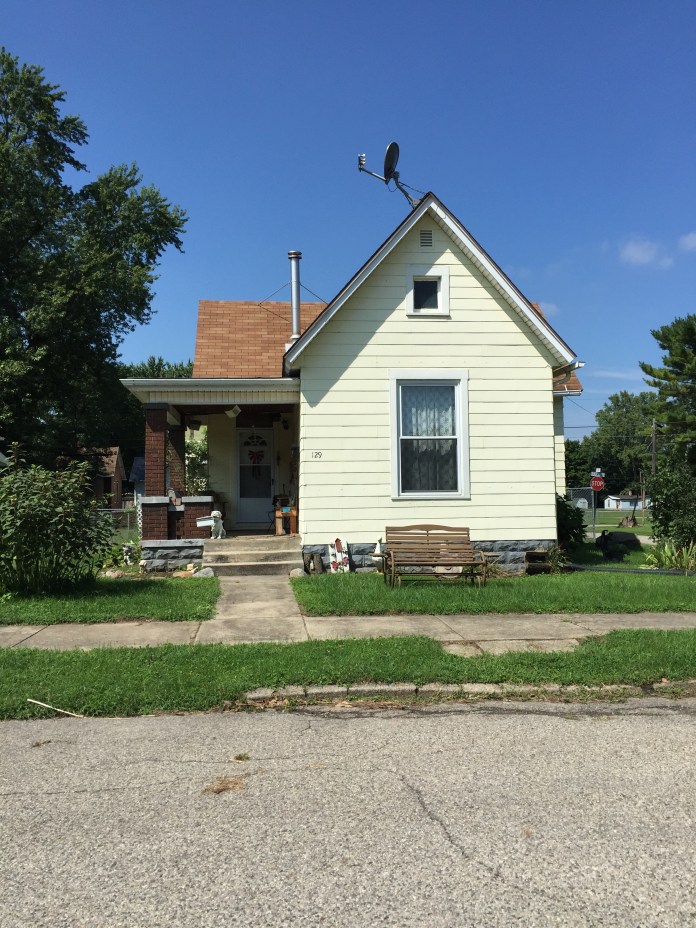
IMG_9466.jpg

Photograph by Lisa Y. Henderson, August 2016.


Standard
Births Deaths Marriages, Newspaper Articles, Other Documents, Paternal Kin

The devoted son.

Edward, the youngest of Montraville and Anna Henderson Simmons‘ children, died 11 April 1936, another victim of tuberculosis.

Koko Trib 4 13 1936 Ed SImmons obit

Kokomo Tribune, 13 April 1936.

A few observations:

  • Edward Simmons was born about 1883. His obituary states that he had “lived in Kokomo since seven years of age.” This was not literally true. He was listed in the 191o census of Eel township, Cass County, as a 20 year-old living with his father Montraville, 63. I take this actually to mean then that he and his family arrived in Kokomo (or Howard County) from Canada when he was 7, i.e. about 1890.
  • Second Baptist Church is a successor to Free Union Baptist Church in the Bassett settlement. From Second Baptist’s website: “In the year of 1887 the Freewill Baptist Church, meeting in the Bassett Settlement, under the leadership of Rev. Richard Bassett disbanded. Its members met with Rev. W. A. Stewart and members of the First Baptist Church of Kokomo. They organized the Second Missionary Baptist Church as we know it today. Services were held in the third ward school on the corner of North Lafountain and Richmond Streets. By the end of November of that year the Second Baptist Church, known as a Missionary Church, had been constitutionally established. The First Missionary Baptist Church made contributions to foreign missions on behalf of Second Baptist. Rev. Richard Bassett served as pastor of Second Baptist Church a short time and he was known throughout the state as an organizer of churches.  He was elected to the State Legislature in 1892, being only the third black to be elected to his position.”
  • Edward’s body lay for viewing in his home for almost a day before his burial at Crown Point cemetery. I assume that his headstone and plot were pre-purchased as his plot is nearly beside previous wife Belle’s grave and their stones are of identical make and engraving style.
  • Speaking of wives, this: “Mr. Simmons was devoted to his mother and father, and remained unmarried until both of them died.” … And then he married and married and married some more.
  • First wife: On 25 February 1915, Edward Simmons married Mary E. Jones in Kokomo. On 21 January 1919, Mary Simmons died of influenza in Kokomo. Her death certificate reports that she was born 2 August 1875 in North Carolina to George Taylor and an unknown mother and was married to Edward Simmons.
  • Second wife: On 28 July 1919, Edward Simmons married Cora White in Kokomo. In the 1920 census of Kokomo, Howard County, at 721 Waugh Street, Edward Simmons, 38, laborer at Globe Range Company; wife Cora, 40; and lodger Roger Jones, 17. On 18 February 1923, Martha Cora Simmons died of myocarditis in Kokomo. Her death certificate reports that she was born 26 April 1878 in Kentucky to Jacob Bushaw and Martha Heardin and buried in Jeffersonville, Indiana.
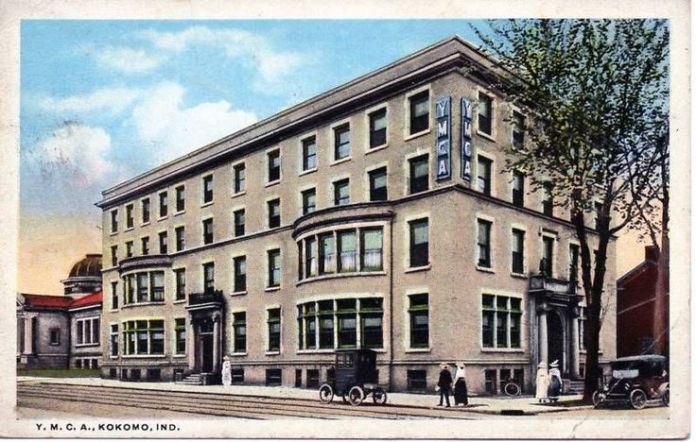
  • Third wife: In the 1930 census of Kokomo, at 800 E. Dixon Drive (owned and valued at $1150) were Edward Simmons, 42, janitor at Y.M.C.A., and wife Belle, 45. [Not to be mistaken in records for bank president Edward Simmons (1859-1945) and wife, Belle George Simmons, who were white.] Bell Simmons died 17 July 1933 at Sipe Theatre in Kokomo of chronic myocarditis. Her death certificate reports that she lived at the Y.M.C.A. at 200 E. Walnut and was born in Ohio to unknown parents. She was buried at Crown Point.

Koko Trib 7 18 1933

Kokomo Tribune, 18 July 1933.

ab9286eb777ccb85c0c15c48cdd022ef

  • Fourth wife: I don’t know exactly when Edward married Cecilia Gilbreath, but it happened during the narrow window between Belle’s and Edward’s deaths in 1933 and 1936. She and Edward had no children. Per Celie’s son Joe L. Gilbreath’s death certificate, filed in Kokomo in 1979, her maiden name was Silvers. Joe was born in Texas, but I know nothing of his mother’s early years..

Koko Trib 4 10 1937 Ed Simmons memorial

Kokomo Tribune, 10 April 1937.

  • “Tenie” was the nickname of Susan Simmons Bassett.
  • How many ways was the other sister’s name spelled? Monsie, Moncy, Muncie, Muncey?
Standard