Births Deaths Marriages, Newspaper Articles, North Carolina, Paternal Kin, Virginia

Aunt Lizzie, found.

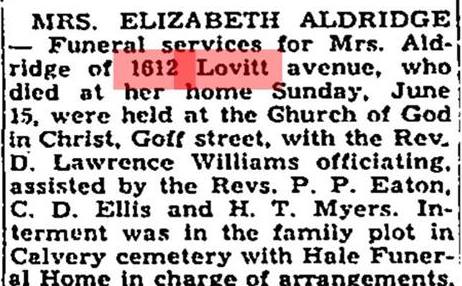
Cousin B.J., my partner in all things Aldridge, sent me this clipping a few days ago from the 28 June 1952 edition of the Norfolk New Journal and Guide:
13510539_994583317329928_755399815_n

1612 Lovitt Avenue was the house in which Tilithia Brewington King Godbold Dabney had lived in her latter years. Who was this Elizabeth Aldridge? And who was in the family plot?

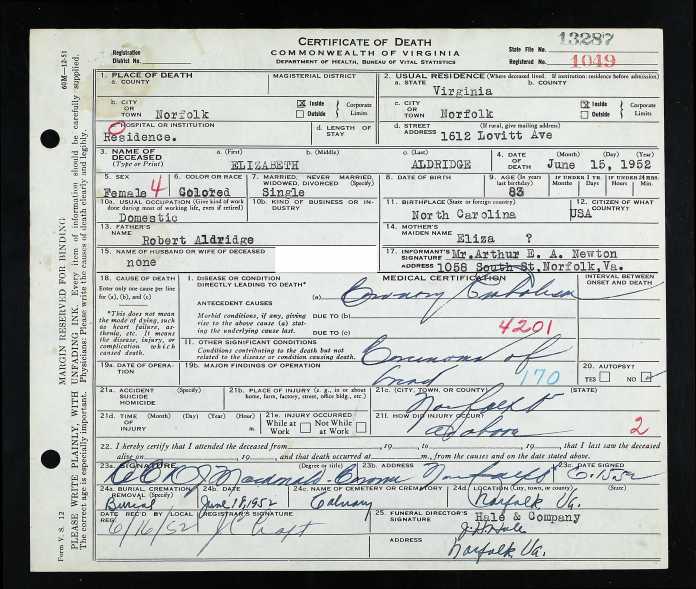
We quickly suspected that this was Lizzie Aldridge, sister of my great-great-grandfather John W. Aldridge and B.J.’s great-great-grandmother Amelia Aldridge Brewington, but knew little of Lizzie’s whereabouts as an adult. I’d wondered if our Lizzie was this woman, found in the 1900 census of Norfolk, Norfolk County, Virginia: North Carolina-born  dressmaker Lizzie Aldridge, 30, shared a household with a boarder, William Hendricks, 36, a divorced day laborer. So there was some precedent to the speculation that Lizzie had migrated to Norfolk. But why the “Mrs.”? We don’t know for sure, but quickly determined that this death announcement was definitely for Lizzie Aldridge, daughter of Robert and Mary Eliza Balkcum Aldridge, and she seems to have been the longest-lived of their children. In other words, Elizabeth Aldridge was Tilithia Dabney’s aunt.

In the 1870 census of Brogden township, Wayne County:  Robt. Aldridge, farmer, with wife Eliza, and children George, 18, John, 17, Amelia, 14, Mathew D., 13, David S., 12, Amanda, 10, Ella, 9 Eliza, Robert and Joseph, 7 months, plus farmhand Isham Gregory.

In the 1880 census of Brogden township, Wayne County: Robt. Aldridge, wife Elizar, and children Matthew, Sloan, Amanda, Louella, Lizzie, Robert, Joseph, and Fannie.

By 1898, Lizzie (and, it appears, her teenaged nephew Zebedee, John’s oldest son, and her sister Louella) had migrated to Norfolk, Virginia. Here are their listings in the city directory:

Screen Shot 2016-06-25 at 8.41.18 AM

In the 1900 city directory, Louella remains at 100 Henry, but Zebedee, working as a fireman, is living with his aunt at 17 Nicholson. Nonetheless, as noted above the census taken that year showed Lizzie sharing a household only with a boarder.

On 4 July 1902, Wayne County Superior Court set off a dower and partitioned Robert Aldridge’s land  among his wife and heirs. With Lot No. 10, Lizzie Aldridge received 32 acres on the Wilmington & Weldon Railroad and Stoney Run Branch valued at $193. (Louella, referred to as Louetta, received a similar share, but two years later it was divided among her siblings when she died without heirs.)

In the 1904 Norfolk city directory, Lizzie is at 17 Nicholson, but in 1906, she is listed at 100 Henry. As “Elizabeth Aldridge,” she is living at 100 Henry in the 1907 and 1908 directories, too.

In the 1910 census of Norfolk, Virginia: Elizabeth Aldridge is listed as the keeper of a lodging house at 100 Henry Street. She had nine lodgers, all born in North Carolina, and one of whom, 22 year-old Jessie Baker, may have been Jesse Frank Baker, son of Lizzie’s first cousin Mary Ann Aldridge Baker.

Per city directories, as early as 1913, Lizzie Aldridge was living at 852 Henry in Norfolk.

In the 1920 census of Monroe Ward, Norfolk, Virginia: at 852 Henry Street, Elizabeth Aldridge, 49, keeper of a lodging house, headed a household that included her 7 year-old adopted son Elisha Newton and eight lodgers aged 16 to 20, all North Carolina-born and working as longshoremen or, in one instance, a fireman on a boat.

In the 1930 census of Norfolk, Virginia: in rented quarters at 940 1/2 Hanson Avenue, 60 year-old laundress Elizabeth Aldridge, her adopted son Arther E. Newton, 18, and a boarder named Mack Rice, a longshoreman. Elizabeth claimed to be a widow who first married at age 21.

In the 1940 census of Norfolk, Virginia: at 938 1/2, Elizabeth Aldridge, 70, was herself a lodger in a household headed by Lena Forekey.
43006_162028006055_0155-00016

As for the “family plot,” B.J. discovered the following (probably partial) list of Aldridge family members buried together in Norfolk’s Calvary cemetery: Elizabeth Aldridge, Section 22, Block 22, Lot 182, Space SW 0 06/15/1952; John Dabney, Section 22, Block 22, Lot 182, Space W CTR 0 12/29/1974; Tilithia Dabney, Section 22, Block 22, Lot 182, Space NW 0 11/24/1965; and Arthur Newton, Section 22, Block 22, Lot 182, Space SE 0 09/09/1979.
 

Standard
Business, Migration, Newspaper Articles, Paternal Kin, Photographs, Virginia, Vocation

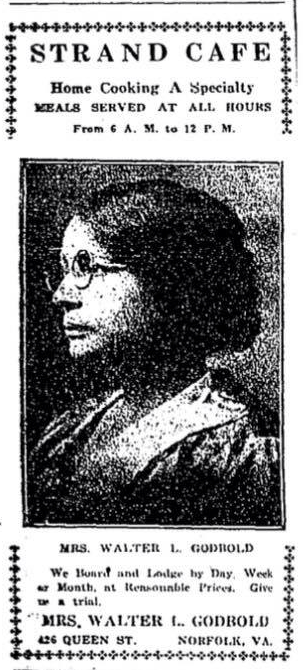
Home-cooking a specialty.

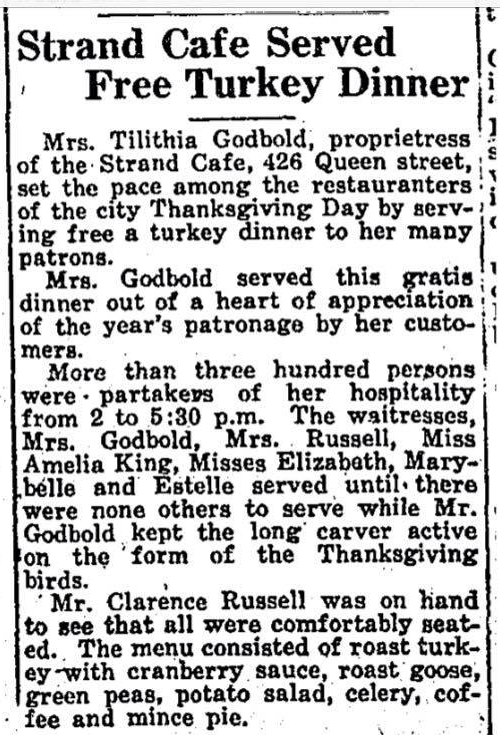
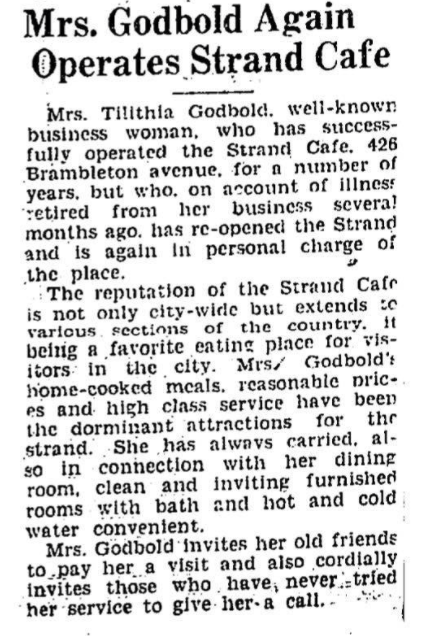
I’ve written of Cousin Tilithia Brewington King Godbold Dabney here and here. Her restaurant in Norfolk, the Strand Cafe, made a deep impression on my grandmother, who laughingly recalled waiting tables there on childhood visits and being dazzled by Cousin Tilithia’s menu offerings.

Thanks to B.J., great-granddaughter of Tilithia’s sister Mattie Brewington Braswell, who found these Norfolk Journal & Guide articles, we now know more about the cafe:

Screen Shot 2016-06-04 at 12.10.21 PM

12 March 1921.

Screen Shot 2016-06-04 at 12.10.51 PM

9 December 1922.

Screen Shot 2016-06-04 at 12.11.44 PM

28 May 1927.

Standard
Newspaper Articles, Photographs, Virginia

Newport News Jacks and Jills.

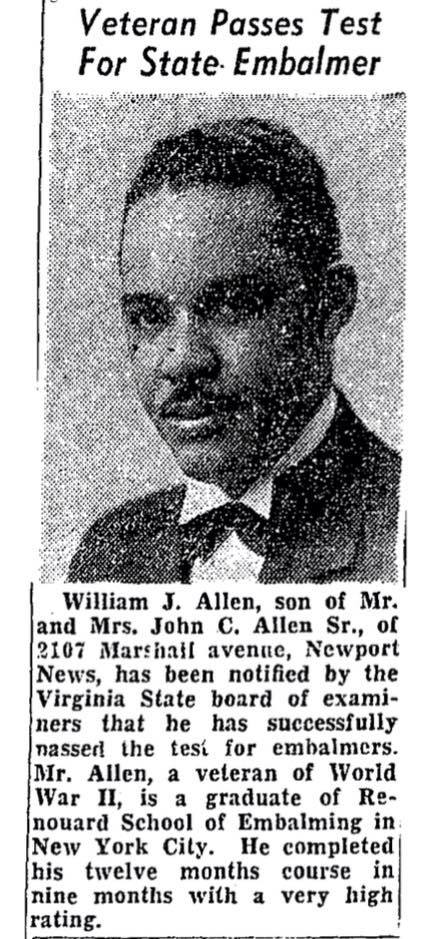
My Aldridge cousin Barbie Jones has access to an archive of early editions of the Norfolk Journal & Guide, an African-American newspaper. All morning, she’s been pelting me with gems pulled from the pasts of both my Aldridge-Brewington family and my mother’s close family in Newport News. Here’s the first — stay tuned!

13330275_982527888535471_1191334261_n

Norfolk Journal & Guide, 20 March 1948.

All five of my grandparents’ children, just three days before my mother’s birthday.

Standard
Births Deaths Marriages, Enslaved People, Free People of Color, North Carolina, Paternal Kin

Collateral kin: the Rickses.

Both of my grandfathers died long before I was born. In 1958, however, my paternal grandmother married Jonah Catellus Ricks and moved to Philadelphia with him. He died just before I turned three, but I am told I was fiercely attached to him.

Ricks 001

Hattie Henderson Ricks and Jonah C. Ricks, Philadelphia, circa 1957.

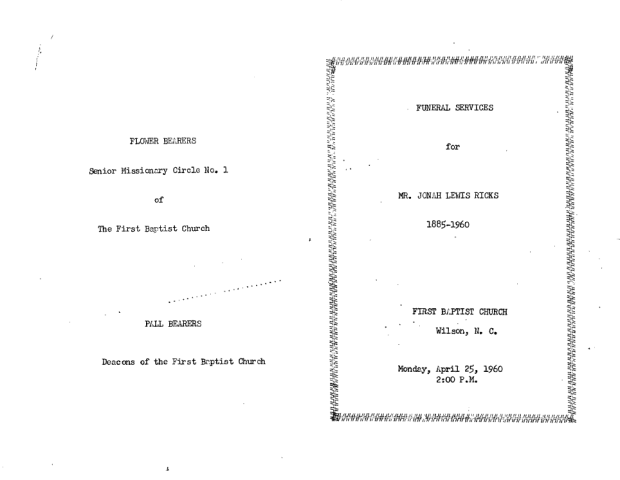
Among the cache of funeral programs my grandmother left is a trove memorializing services for Granddaddy Ricks’ people, many of whom migrated to Philadelphia with him. His father, Jonah Lewis Ricks, lived in Philly for a time, but returned to North Carolina in late adulthood and died in Wilson in 1960.

Jonah L. Ricks was born near Bailey, Nash County, in 1885. His mother, Nancy Jones Ricks, was born about 1865 in western Wilson County to Jacob and Milly Powell Jones, both born into free families of color. (Jacob was a grandson of Bethana Jones.) Jonah’s father was Joseph Ricks.

img_9343-copy

Jonah L. Ricks, Wilson, 1953.

Joseph’s death certificate, filed in Nash County in 1949, asserts that he was born about 1876 in Nash County to Square [sic] and Nicey Ricks. However, the censuses of 1900, 1910, 1920 and 1930 consistently list 1860 as his birth year.

What follows is a summary of research I conducted to pierce the veil of slavery and shed light on Joseph Ricks’ family just before and after Emancipation.

Initially, I was unable to find either Joseph Ricks or his parents in the 1870 and 1880 censuses. However, I had found a Kinchen R. Ricks (1858-1915) whose Nash County death certificate listed his parents as Squire Ricks and Nicie Braswell, so I looked for him instead. In the 1880 census of Jackson township, Nash County, 22 year-old Kenchin Ricks appears as a servant in the household of Marmaduke Ricks. Next door is this household: Sqare Perry, wife Nicy, and their children, including 18 year-old Joseph. I went back ten years to 1870 to find, in Chesterfield township, Nash County: Esqire Perry, 52, wife Nicey, 47, and children Primus, 22, Willie, 18, Mary J., 16, Rebecca, 13, Kinchen, 11, Joseph, 9, Robert, 8, and Matilda, 6. Also sharing the household were Judy Finch, 19, and her 7 month-old Nancy, and Sham Freeman, 63, Silva, 58, Mary, 25, and Rosa Freeman, 18. Thus I determined that Joseph Ricks was known as Joseph Perry as a child.  His parents were known as Squire and Nicey Perry and, I later determined, all of his siblings except brother Kinchen retained the surname Perry.

Squire Perry was born circa 1815, according to census records. His wife Nicey was born circa 1824. As neither appears in censuses earlier than 1870, I assumed that both were born slaves. I consulted Timothy Rackley’s volumes on Nash County estate divisions and slave cohabitations and discovered records of the division of the estate of Clabourn Finch, which was conducted 18 December 1849.  Finch’s property, which included slaves Jacob, Benjamin, Squire, Sam, Henry, Gilbert, Adam, Primus, and Nicy and her child, was divided among his heirs.  Squire, valued at $550, went to Finch’s daughter Betsy and her husband Jacob Strickland.  Nicy and child, valued at $700, went to Finch’s daughter Nicy and her husband Marmaduke Ricks. Thus, the family was divided during the last decade and a half of slavery.

007384015_00939

Page from the estate of Clabourn Finch, Nash County, 1849. The enslaved people distributed to his heirs at November Term of court differ slightly from those listed in this inventory.

The 1850 slave census of Nash County shows Jacob Strickland as the owner of four slaves and Marmaduke Ricks as the owner of ten. The 1860 slave census of Sullivants township, Nash County, lists him as the owner of 18 slaves.

Among post-Emancipation Nash County cohabitation records, I discovered that, on 19 August 1866, Esquire Strickland and Nicey Ricks registered their 22-year marriage with a Nash County Justice of the Peace.  At the time they reunited, each was using the surname of his or her most recent former owner. By the 1870 census, however, as noted above, Squire had settled upon Perry.

It is probably not coincidence that another of Clabourn Finch’s daughters, Ann C., was married to a Perry. Clabourn Finch’s slaves were divided among his children at his death and may have been further sold or traded within the family. At present, Squire’s reason for choosing Perry rather than Ricks or Strickland is not clear, nor is the basis for Joseph Ricks’ report on his brother Kinchen’s death certificate that their mother’s maiden was Braswell. Similarly, the reason that two of their sons, Kinchen and Joseph, reverted to Ricks is unclear.

screen-shot-2016-05-29-at-6-27-34-pm

screen-shot-2016-05-29-at-6-27-52-pm

Original photographs and funeral program in my possession. Federal population schedules; North Carolina Certificates of Death filed in Nash and Wilson Counties; Timothy W. Rackley, Nash County North Carolina Division of Estate Slaves & Cohabitation Record 1862-1866; Rackley, Nash County North Carolina Division of Estate Slaves 1829-1861; North Carolina Wills and Estates, 1665-1998 [database on-line], http://www.ancestry.com.

Standard
DNA, North Carolina, Paternal Kin

New Ancestor Discovery, no. 2: Irvin and Sabra Fisher Sessoms.

Actually, Stephen Grant and his wife Marie Celina Armand were New Ancestor Discoveries 1 and 2, per http://www.ancestry.com. I talked about Stephen here. (Though I may share ancestry with her husband, Marie Celina I’ve discounted as a blood relative because she was of French descent.) Irving Sessoms and his wife, Sabra Jane Fisher, then, are NADs 3 and 4. Neither name speaks to me, but they were from Sampson County, North Carolina – like my Aldridge and Balkcum ancestors – so I’m intrigued.

Screen Shot 2016-04-24 at 8.43.12 PM

Here’s what may or may not be true about Irvin Sessoms:

  • He was the son of Blake Sessoms (1781-1841) and Rachel [last name unknown] (1792-1880).
  • He was born 22 April 1817 in Sampson County.
  • He married Sabra Fisher in about 1835.
  • They had nine children: Molcey Jane Sessoms Grice (1845-1894), Uriah Sessoms (1846-1925), Susanah Sessoms McGrossen (1848-1889), William Henry Sessoms (1850-1930), Elizabeth Sessoms (1852-1874), Gilead Sessoms (1854-1867), Lucinda Sessoms (1856-1927), Minson M. Sessoms (1859-1940), and Andrew J. Sessoms (1861-1905).
  • He died 1862 in Little Coharie township, Sampson County.

Here’s what may or may not be true about Sabra Jane Fisher:

  • She was the daughter of Sanders Fisher (1793-1876) and Sophia Butler (1792-??).
  • She was born 29 September 1821 in Sampson County.
  • She died 11 September 1903 in Roseboro, Little Coharie township, Sampson County.

Observations:

  • The “circle” of DNA testers linked to Irvin and Sabra has five members, plus me. I match two of them — E.K. (an estimated 4th cousin), who is descended from their son Andrew J. Sessoms, and J.S. (estimated 5th cousin), descended from daughter Lucinda Sessoms. (I also match an estimated 4th cousin called “KnowThyPast” in common with both E.K. and J.S. I don’t know how I match KTP, but I thought it was via Van Pools on my mother’s side, which is not helpful here.) The other three in the circle: B.M. (descended from son William Henry), J.W. (descended from son Andrew), and A.L. (descended from son Minson.)
  • A passel of Aldridge/Balkcums have tested at Ancestry, but I seem to be the only one linked to the Sessomses. This could mean I’m totally off base with my speculation about my connection to them. Or, maybe it means that the link is specifically via my great-great-great-grandmother Margaret Balkcum Henderson, who likely had a different father than her sister, my great-great-great-grandmother Mary Eliza Balkcum Aldridge. Still, if this were the case, I might expect my Margaret-descended cousins H.K., L.G., and sibling set J.H., L.H. and M.C. to link to the Sessomses. They don’t.
  • Irvin Sessoms and Sabra Fisher Sessoms were contemporaries of my ancestors Robert Aldridge, Eliza Balkcum Aldridge and Margaret Balkcum Henderson. Thus, Irvin and Sabra could not have the direct ancestors of any of them.
  • Maybe “Molcey Jane” was a name with common currency in early 18th century Sampson County. It stood out for me though. There were three Molcey/Malseys among Eliza and Margaret’s (believed) Balkcum kin. The first was Malsey Lee Balkcum (1820-1889), wife of John Balkcum, whom I believe to have been a half-brother to Eliza Balkcum Aldridge and Margaret Balkcum Henderson. The second was Malsey Jane Balkcum Knowles, born about 1852 to Lemuel and Jemima Rackley Balkcum. Lemuel was, I believe, another half-brother to Eliza Balkcum Aldridge and Margaret Balkcum Henderson. The third was Malsey Alice Balkcum, born about 1855 to John and Malsey.


Standard
Military, Newspaper Articles, Other Documents, Paternal Kin, Photographs

Cpl. Adam Artis, 366th Infantry.

I recently received an email from James Pratt, whose father, Charles A. Pratt, was in the Army’s 366th Infantry from the time it was organized at Fort Devens, Massachusetts, in 1941 until it disbanded in Italy in 1945. Pratt is retired and has devoted considerable time to researching the 366th.

“I had the opportunity to spend two days in Tuscany,” he wrote, “where the 366th is still remembered fondly by the citizens. In Sommocolonia, the townspeople have started a small museum about the ŒBuffalo soldiers. I went to the American cemeteries in Florence and Nettuno and took photos of all the grave markers for the nearly 120 men of the 366th who are buried in Italy.”  Pratt is trying to match the markers with photos of the soldiers and wants to do the same for the more than 130 soldiers of the 366th who were buried across the United States.

Gibbs-Ithaca Journal-reduced

Ithaca Journal, 19 December 2015.

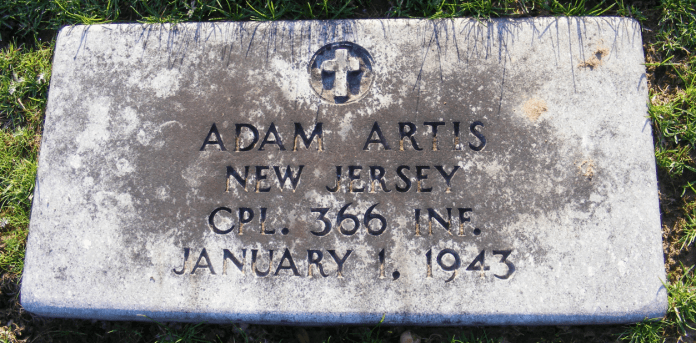
One of the 366th soldiers was Adam Artis, who enlisted in New Jersey, but was born in North Carolina. “Adam … lost his life while training in the U.S. He died on January 1, 1943.” Pratt is trying to find additional information about Adam Artis. He believes he had a son, Adam Artis Jr., who graduated from High School in East Orange, New Jersey, but has not been able to locate him.

The Artis branch of my family tree holds at least seven Adam Artises, including our patriarch Adam Toussaint Artis (1831-1919). If 366th Adam is one of ours, he is likely Adam, son of Adam T.’s son Robert E. Artis and his wife, Christana Simmons Artis. That Adam was born in 1913 near Black Creek, Wilson County. He appears in his parents’ household in the 1920 and 1930 censuses of Wilson County, but not thereafter. On 16 April 1941, Adam Artis, born in 1913 in North Carolina, enlisted in the Army in Newark, Essex County, New Jersey. (His brother Robert Arzell Artis, born 1908, appears in the 1940 census of Newark as an unmarried restaurant cook.) That Adam is buried in Glendale cemetery in Bloomfield, Essex County.

AArtis grave

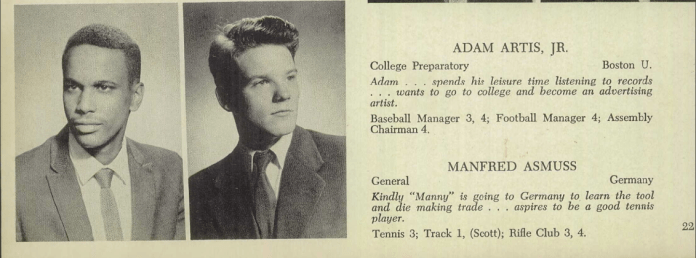
If this Adam had a son Adam Artis Jr., he may be the one born in 1942 whose senior portrait appears in the 1960 East Orange High School yearbook.

Screen Shot 2016-04-18 at 7.40.14 PM

He is listed as a student in the 1961 Boston, Massachusetts, city directory and in later directories as a teacher in Cambridge and Boston city schools. Here he is in a booklet titled “The Boston Plan for Excellence in the Public Schools,” published in 1989.

Screen Shot 2016-04-18 at 7.17.12 PM

This blog about William Monroe Trotter Elementary School mentions that it was the second magnet school in the U.S., and a comment enthuses about the plays Adam Artis produced. His impact also shines through in a testimonial posted by a former student on the blog, http://www.myblackteacher.net. Adam Artis Jr. is surely retired by now, but it is not clear to me whether he is still living. If he is, perhaps Scuffalong will reach him.

U.S. School Yearbooks, 1880-2012 [database on-line], http://www.ancestry.com.

Standard
DNA, Maternal Kin, North Carolina

DNA Definites, no. 24: Nicholson.

Two more Nicholson matches at Ancestry DNA.

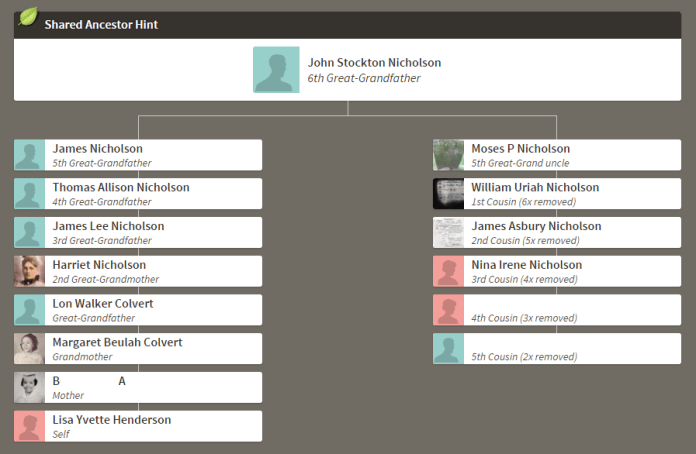
The first is with T.L. His ancestor Moses P. Nicholson migrated to Indiana in the 1830s, long before my great-great-grandmother Harriet Nicholson was born. T.L. has no other Iredell County lines, underscoring the unlikelihood that our match is through some other line.

Nich Hint

The second is R.H., who also matches T.L. R.H. is descended from a first-cousin marriage between grandchildren of both of John S. Nicholson‘s wives, as am I.

RHuey1

RHuey2

Unfortunately, Ancestry has a hard time interpreting matching trees that involve multiple spouses and fathers and sons with the same names, and these charts are not quite right.

Standard
Education, Maternal Kin, Other Documents

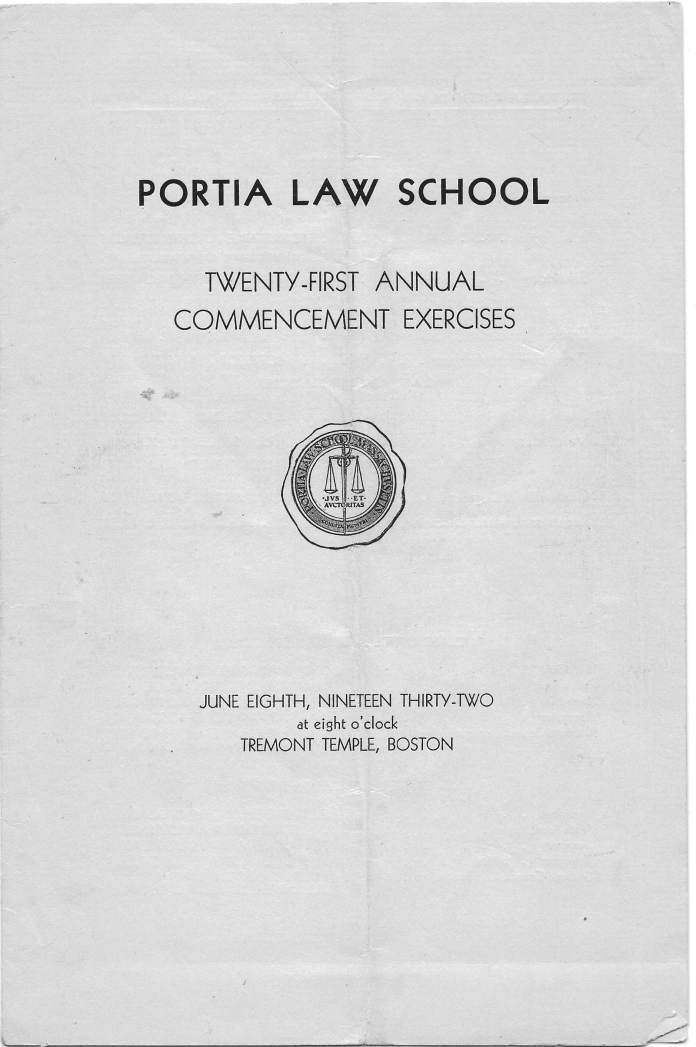
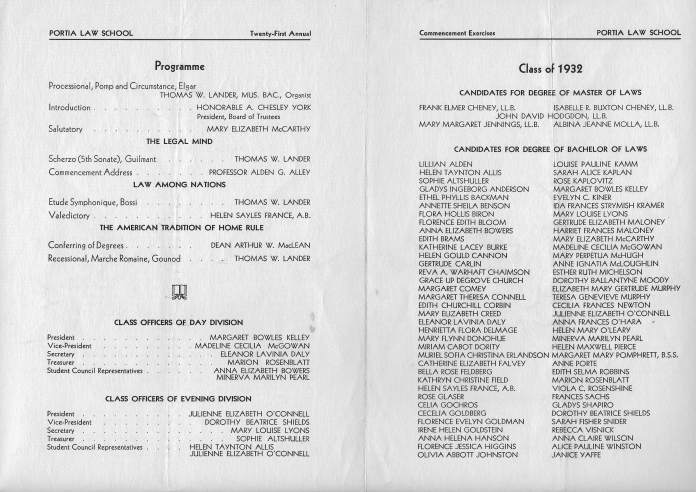
Candidates for degree of Bachelor of Laws.

Tailored to women from working-class families, Portia Law School was founded in Boston, Massachusetts, in 1908.  Sensitive to the financial and time pressures these women faced, it offered part-time enrollment as well as the high school and college-level courses required to prepare students for legal studies. During the Great Depression, Portia Law School began opening up its programs to male students. The candidates for the Bachelor of Laws in the Class of 1932, however, were all female. And cousin Evelyn C. Kiner was one.

Portia Law School

Portia Law School 2

Portia Law School continues today as New England School of Law.

Many thanks to Peggy King Jorde and Peggy King Jorde Archive for sharing this document.

Standard