
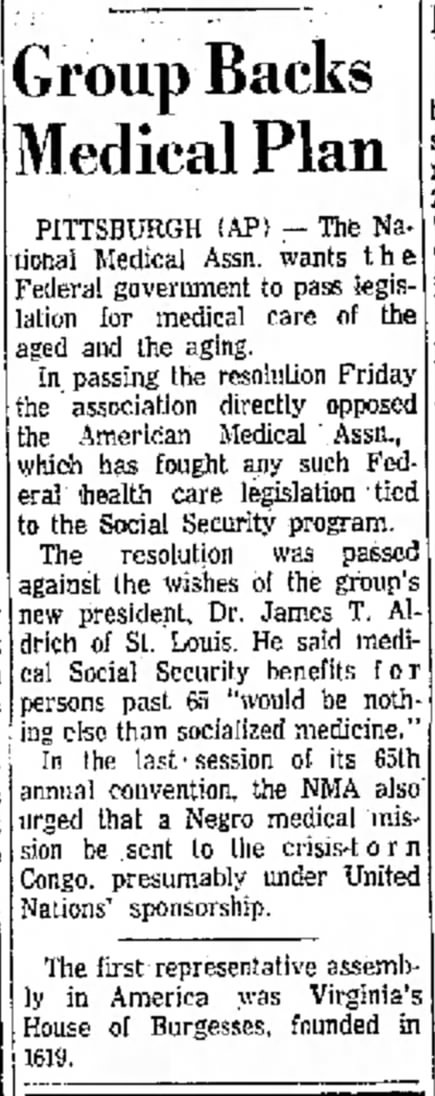
Well, damn.
Dr. James T. Aldrich [born Aldridge] was my great-grandfather. Never mind what it says below, he was born in 1886.
 Journal of the National Medical Association, November 1959.
Well, damn.
Dr. James T. Aldrich [born Aldridge] was my great-grandfather. Never mind what it says below, he was born in 1886.
Journal of the National Medical Association, November 1959.
Thinking of my mother and remembering my grandmothers with love and gratitude this day.
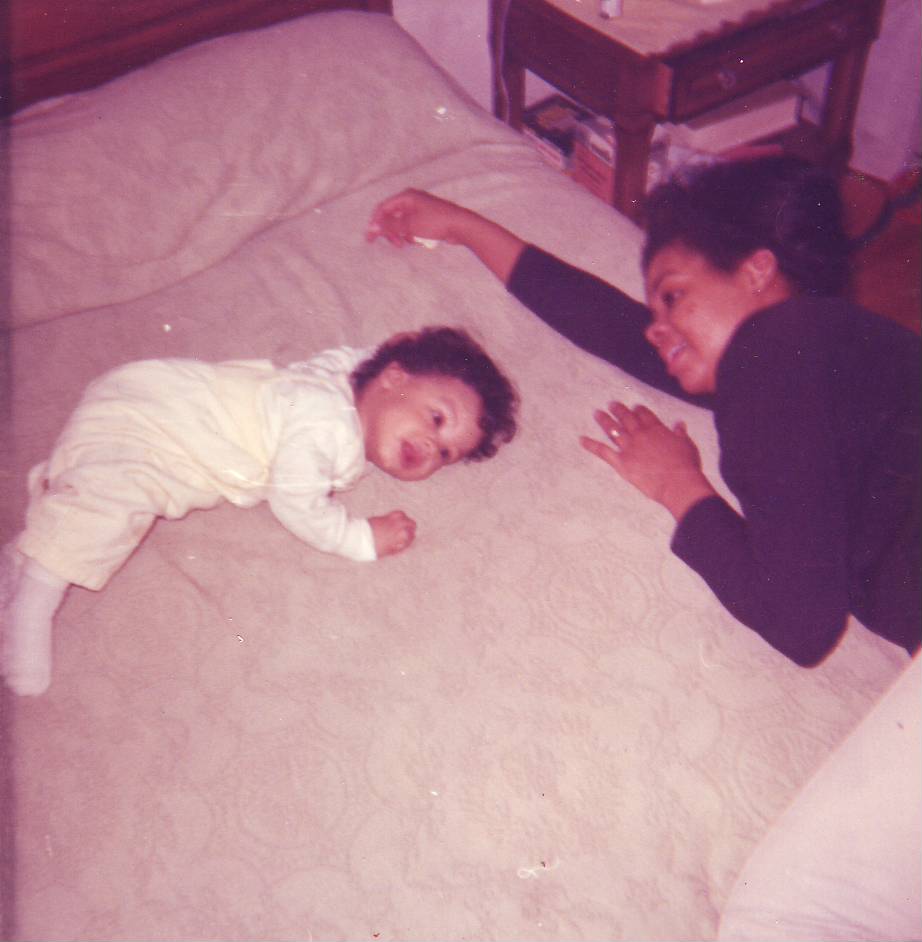
My mother and me.
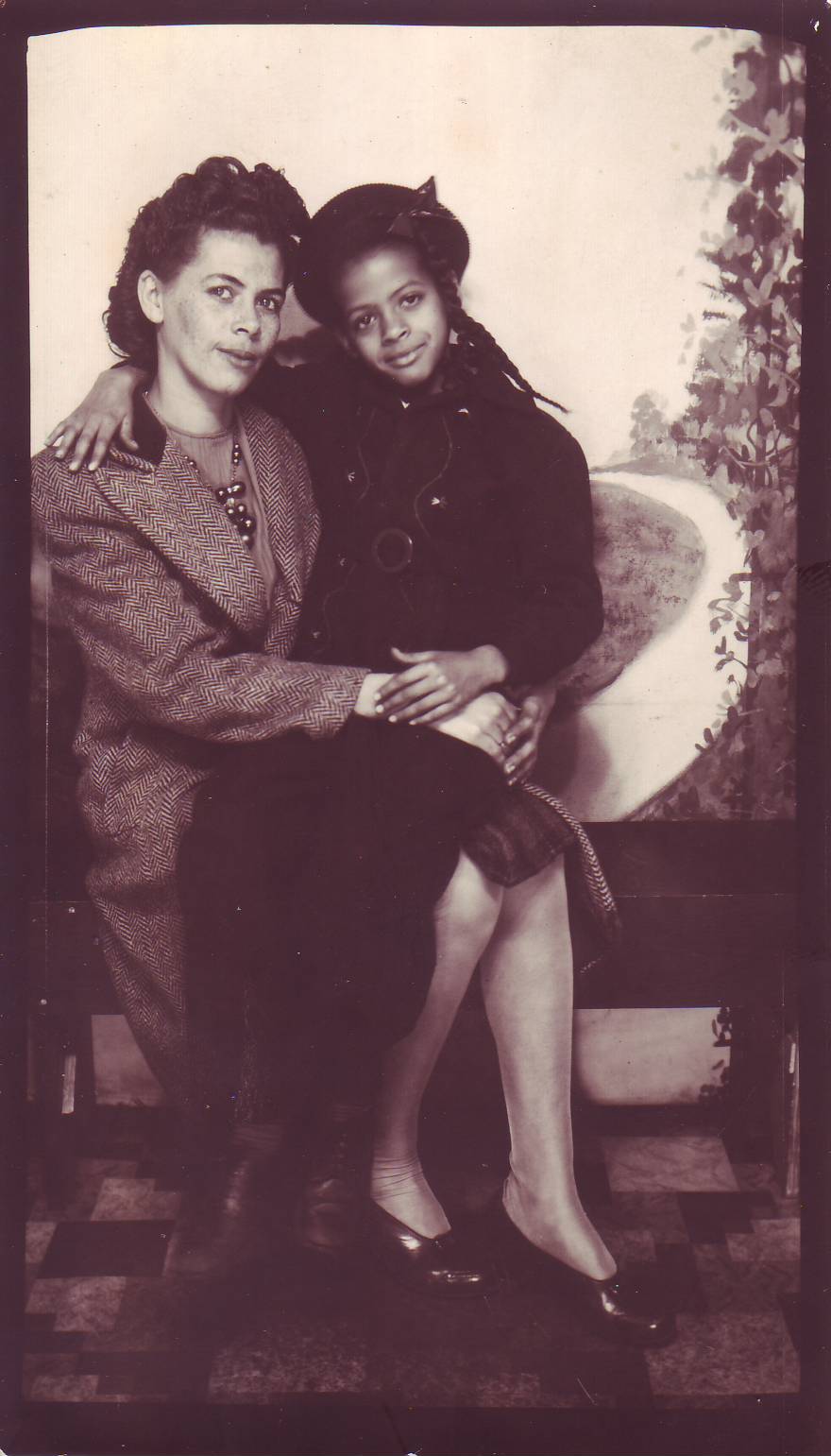
My father’s mother and his sister, circa 1942.
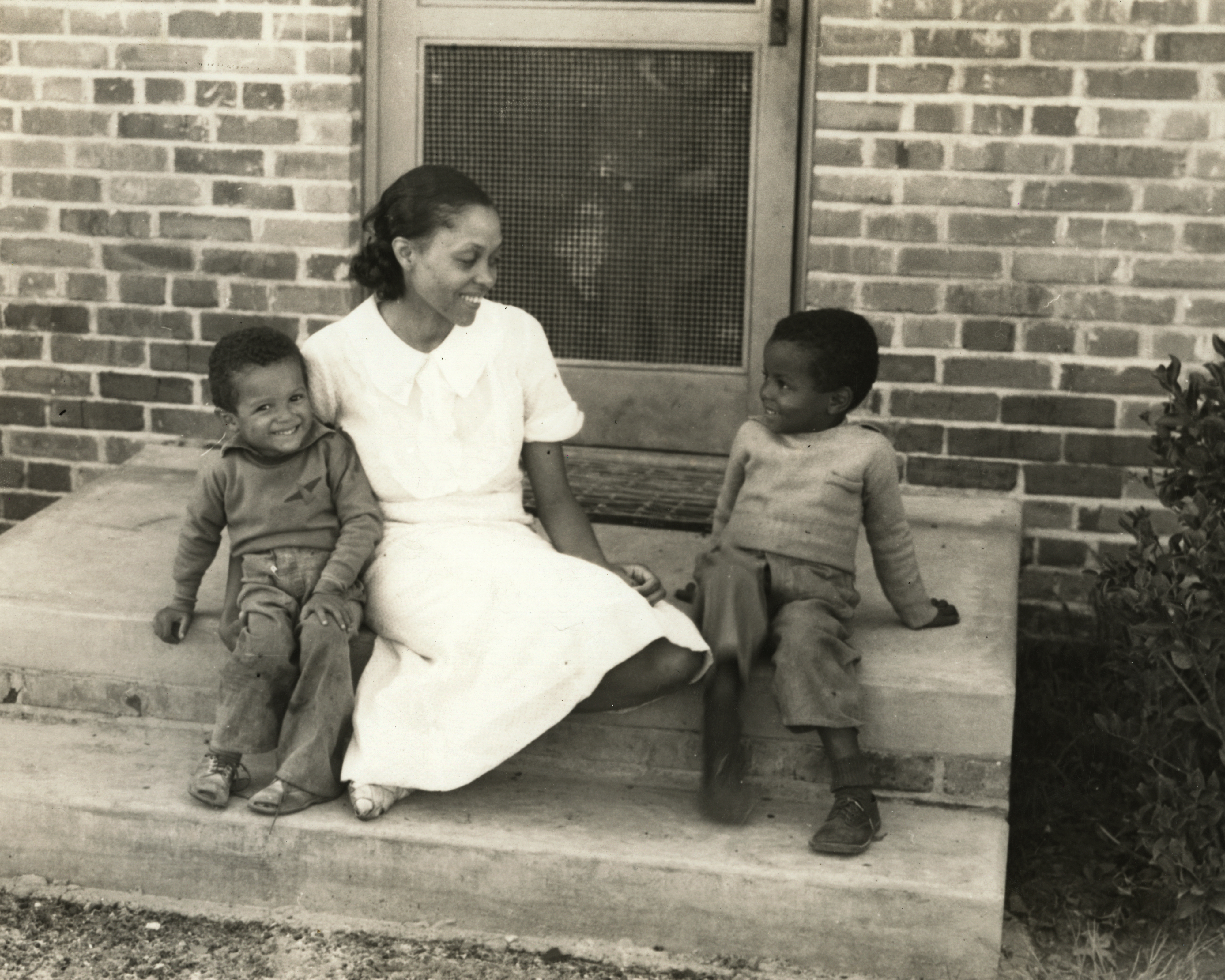
My mother’s mother and her brothers, circa 1938.
——
Sidenote: I first saw the last photo in a magazine article about Aberdeen Homes, a late New Deal housing project in Hampton, Virginia. My grandfather worked as a construction supervisor at the site and moved his young family into one of the first apartments. I finally tracked this photo down in the photo archives of the Virginia State Library.

Moses Hall, Charlotte Court House, Virginia.
The Grand United Order of Moses, Inc., was a small fraternal insurance society for black men and women based in rural south-central Virginia. The founder and lifelong leader of the Order of Moses was James Murray Jeffress (1873–1951), who organized the society in 1904 at his birthplace, the village of Charlotte Court House. Jeffress graduated from Hampton Institute in 1894 and Howard University divinity school in 1901. He was ordained a Baptist minister and served as principal of a public school in Charlotte County.
By 1900, white Virginians had disenfranchised blacks and had segregated schooling and public transportation. Jeffress, sometimes called “the Booker Washington of Charlotte County,” was an accommodationist who tried to make life tolerable for his fellow blacks without challenging white racists directly. Fraternal societies such as the Order of Moses offered a modicum of economic security through medical and funeral insurance. They also supplemented the churches as black organizations that whites were willing to tolerate. They were organizations in which African Americans could vote, hold office, and brighten their drab lives with the color and spectacle of regalia and ritual, impressive titles and fancy-dress parades, lodge meetings and funerals.
Even more than in other fraternal societies, a charismatic oligarch dominated the Order of Moses: Murray Jeffress. He depicted the origins of his society in quasiprophetic language. “It was in 1901 that I began having visions repeatedly. These visions consisted of a single blackboard in which was chalked the words: The Grand United Order of Moses. After the third vision, I decided that I would do something about it.” In 1904, the Order of Moses recruited 203 members, and the society received a state charter. A few years later, it acquired Moses Hall as its headquarters. Jeffress took the title “right worshipful grand leader.”
A crisis in the society occurred when a black man, presumably instigated by whites, alleged that the Order of Moses had been organized to keep African Americans from working for white people. A prominent white man squelched this rumor by offering $ 150 for evidence in its support, evidence that never materialized. For his efforts, the Order of Moses made him an honorary member.
Jeffress resented the injustice of segregation and disenfranchisement, but he considered small economic advances the only realistic goals. “Let us teach every boy and girl to build and not tear down. Teach them that being God-fearing, property-owning and debt -paying citizens is greater than being a voter or being on social equality with [a] king.” He encouraged his followers to buy farmland or learn a vocational trade.
Although Jeffress opposed urban migration, many rural black Virginians moved to northern cities. As a result, Order of Moses lodges appeared outside Virginia, mostly in Pennsylvania and New Jersey. Northern lodges unsuccessfully asked for the headquarters to be moved to Philadelphia, which they regarded as more convenient than Charlotte Court House, which at the time of Jeffress’s death had only 250 residents and neither a railroad station nor a bus stop.
The strength and the weakness of the Order of Moses was its identification with Charlotte Court House and Charlotte County. The order helped establish a high school there for black youth, provided bus transportation for the students, constructed and equipped a hospital building, and provided electrical service for the village. The order owned an auditorium that could accommodate four hundred people, an office building, and apartments for black schoolteachers. The society also owned three hundred acres of farmland worked by black sharecroppers.
As leader of the Order of Moses, Murray Jeffress became a respected figure in African American life. He was elected first vice president of the Negro Organization Society and president of the Federation of Negro Fraternal Organizations. He served a number of Baptist churches as pastor.
At the time of Jeffress’s death in 1951, the Order of Moses claimed a little more than five thousand members. Apparently, his son Wilson became the society’s new leader. How long it continued to operate is unknown. In any event, the little Order of Moses had survived into the post—World War II era, an achievement that few better-known African American fraternal societies equaled.
— Adapted slightly from Organizing Black America: An Encyclopedia of African American Associations, Nina Mjagkij, ed.
——
My grandfather’s older brother, Jasper Maxwell Allen (1904-1959), married J. Murray Jeffress’ daughter Lena P. Jeffress, settled in Charlotte Court House, and opened a dental office in Moses Hall.

Photographs by Lisa Y. Henderson, July 2012.
All week, I was pressed. Wave after wave of thunderstorms had been crashing over eastern North Carolina, tornadoes swirling in their wake. The rain didn’t stop until the night before I flew in, and I knew that Contentnea Creek floods early and often. Friday dawned bright and blue though. I headed down Highway 58, excitement brimming like the sheets of water standing in fields on both sides of the pavement. Though several roads around Stantonsburg were still closed, my path was clear, and I pulled into the Saulses’ driveway at the stroke of 10 A.M.
Cousin Andrew Sauls is a reserved man, but welcoming and friendly, and he and his wife, Cousin Jannettie, put me quickly at ease. They were curious about my connection to Daniel Artis and the Saulses, and as I began to explain about Vicey and Sylvania and Adam T., we realized that he had known many of “my” Artises as a young man. In addition to farming hundreds of acres northwest of Snow Hill, his father, Isaac Sauls Jr., bought, rehabbed and sold farms, was a skilled carpenter, and operated several businesses. In 1947, after a short-lived stint operating a funeral home in Snow Hill, Isaac bought a saw mill, refurbished it, and began cutting lumber the following year. Cousin Andrew started working there as a ten year-old and recalled that the factory made good money for more than 20 years because there was a high demand for raw lumber. In those days, he said, “I didn’t know nair black person had a brick house in Greene County. Nor hardly any white ones.” People needed lumber for home repairs and to build tobacco barns and other out buildings. Though most of the Saulses’ customers were white, they also sold to many black farmers in Greene and surrounding counties, including Les, William and Walter Artis in Wayne County. Brothers William and Walter were sons of Adam T. and Frances Seaberry Artis, and Leslie, son of Napoleon Artis, was their nephew. (William, Walter and Napoleon were brothers of my great-great-grandmother, Louvicey Artis Aldridge. All were grandchildren of Vicey Artis Williams, who was Daniel Artis’ sister.) Cousin Isaac recalled Les as one of the richest black men in Wayne County, and the first he knew of to own a Cadillac. He laughed as he recounted hauling a load of lumber to Walter Artis as a 17 year-old and being offered some liquor. Isaac Sauls Jr. also operated a “stick mill” that cut tobacco sticks for farmers during the summer months.
After a while, Cousin Andrew’s only surviving sibling, sister Hattie, who lives nearby in the “home house,” joined us and chimed in as Andrew talked about their father’s and grandfather’s achievements. He has an astounding memory and reeled off the dates and details of land purchases dating back ninety years to his father’s first acquisition of 57 acres for $400 in 1924. Today the family owns about 440 acres, which it leases to another farmer. When I mentioned his great-uncle Cain “C.D.” Sauls‘ involvement with an African-American bank in Wilson, he astonished me by exclaiming, “I remember my daddy talking about that! It went under. I think he said it was Stanback and Reid.” [And sure enough, J.D. Reid and H.S. Stanback were the bank officers convicted of the fraud that led to the bank’s failure.]
According to Cousin Andrew, in 1929, Isaac Sauls Jr. leased land to the state for the erection of a Rosenwald school. That school served African-American students in the area from 1930 until 1959. When it closed, Cousin Isaac bought the building and converted it into a house in which his son William lived until his death. The structure now stands a few hundred feet north of Cousin Andrew’s house. [Here for National Register of Historic Places nomination form for another Rosenwald school in Greene County.]

Cousin Hattie spoke of C.D. Sauls’ ownership of several businesses in Snow Hill, including a hotel and a funeral home. She was not sure if he was a formally educated man, but he appeared to be. He was on personal terms with Booker T. Washington and traveled to Tuskegee Institute to speak on occasion. He also owned shares in a cotton mill in Concord, North Carolina. (This would have been the ill-fated Coleman Manufacturing Company.) He apparently occasionally contibuted a column to a newspaper in Kinston, and she promised to send me a copy of an article. Later, when I mentioned that my mother had taught at North Greene Elementary School for a few years when she first came to North Carolina, Cousin Hattie asked if she knew Annie Edwards Moye, who’d taught there for 45 years. (Annie Moye was a descendant of Clara Artis Edwards, daughter of Daniel Artis.) I didn’t know the answer at the time, but soon learned that my mother in fact had commuted to Greene County with Mrs. Moye and other teachers who lived in Wilson!
Neither his father nor his grandfather had much education, said Cousin Andrew, but they were smart and shrewd and skilled and able to form strong business relationships on the strength of their word. Isaac Sr., born at the start of the Civil War to the enslaved daughter of a free-born, land-owning man and his enslaved wife, was a master carpenter who began to accumulate land at an early age and passed his drive and determination on to his children. One hundred and fifty years later, his gift shines in his grandson Andrew.

Cousin Andrew and me at Artis Town cemetery, 2 May 2014.
Lucinda McNeely‘s son John Rufus McNeely and Emeline Atwell registered their 11-year cohabitation in 1866. John and Emeline’s youngest son, born in 1873, was Rufus Alexander McNeely. He died in 1964.

This photo of Rufus is attached to the Ancestry.com public family tree of jeromemurray128. I’ve reached out unsuccessfully several times with offers to share information about the McNeelys. Perhaps he’ll see this post and get in touch. In the meantime, I hope he won’t mind me sharing this wonderful snapshot!
My father: Let’s go back to when I remember when we moved to 1109 Queen Street. When I was about six years old. And we had what they call a shotgun house. Three rooms. Front room, middle room, and a kitchen. And to get to the kitchen, you had to go out on the back porch and come through. Now there were some people who had a door cut in between the middle room and the kitchen, so you wouldn’t have to go out on the back porch. But they said if you cut that door somebody in your family would die. [Laughs.] So we wouldn’t cut the door. All of us slept in the middle room. See, we did have a bed in the front room later on, but first we slept in the middle room. And we had, like, what they called a day bed. You pull it out. And me, Lucian, and Jesse slept in that bed. And Hattie Margaret and Mama slept in the other bed. And then we had a laundry heater in the middle. We had to make fires every night. Go out –
Me: Laundry heater?
My father: Yeah, well, it was what you’d call a space heater. Laundry heater.
Me: Oh. Okay.
My father: — that you put, well, we used coal. Some people were afraid to use coal because it would get so hot it would turn red. And, you know, sparks would fly and sometimes things would catch on fire. And that’s what we used to heat the iron to iron clothes, too. You’d put ‘em on top of that stove. But we had to make fires every morning. Had to get up. And we had linoleum in there, so the floor’d be cold. So when you walk around you had to walk on your heels when – [we start laughing] – you get up out the bed and go out and get the wood. And then, you know, we had that little slop jar up under the big bed. You had get up to go — then, see, that house didn’t have a bathroom. So the bathroom was outside — the bathroom sat in between the two houses. And you had just a stool. And that stool had a big water tank on the top. And so when you lift the lid up, it would flush. So that was for 1109 and the one right beside it. Probably just had a little partition between. It was probably 1107, and that’s where the Davises, Miss Alliner [Alliner Sherrod Davis, daughter of Solomon and Josephine Artis Sherrod, and actually a cousin], she lived right there at 1107. And then we had the water outside, and it was at her house. So there were two houses that had one toilet and one spigot. So we would go out there and get the water and stuff like that.
Me: And so you said you remember moving in there?
My father: Yeah, we moved from off Elba Street. ‘Cause we moved at night. You know when your stuff a little shaky…. [Laughs.] Somebody come by, it’d be dark, with all your stuff on the truck. And I remember I had a little hat, and it blew off on Green Street [laughs], and I couldn’t stop to get my hat. ‘Cause it was dark when we moved. And that was when I was probably in the first grade. I think it was 1940 when we moved around there in all those little endway houses. C.C. Powell owned the houses, and I don’t know how much we were paying, but we weren’t paying a whole lot. Behind the outhouse, we had built up like a little shed, like. Used to keep pigeons in there. Everybody had pigeons. The ones that go off – we’d see in the movies the ones that take little messages and all. So everybody would have pigeons. And then we had a little, I guess it was a garden. We had a victory garden in the back. I had to take a hoe and a shovel and dig up the backyard. Turn it over. Then Mama would go out there and make some rows and plant tomatoes and stringbeans and squash and stuff like that, and we used that to eat. Now, when I was growing up, at that time, we didn’t have no money. I went to school, all the way through almost, some days I’d go and didn’t have a penny. Not one penny. In my pocket. Not one penny. … And the icebox, it was a little small icebox, and you’d take the ice and put it in the top, and then there was a little hole so when the ice’d melt, it would run down. You’d have to have a little water container underneath. You’d have to empty that everyday. If not, the water would run out on the floor, out on the back porch. And it would always be so clear and just cold, but we had to go to the ice house, and the ice house was out there on Herring Avenue. And I would ride the bicycle out there to get it.

This house was one of a row of six identical shotgun houses on Queen Street built circa 1925. I took this dim Polaroid image sometime in the very early 1980s, and they were torn down not long after.

My father, age about 10, sitting outside a house on Queen Street. I’m guessing it’s 1107 because the door is on the opposite side of the house. Otherwise, the houses were identical.
——
Interview of R.C. Henderson by Lisa Y. Henderson; all rights reserved.
We passed Edwards cemetery on the left, rounded the curve, and there, just where I suspected, was the turn-off onto a farm road leading to Artis Town cemetery. The graveyard is a rectangle of green amid bare spring fields, neatly mowed. A row of weedy trees bristles down one side, broken limbs scattered from recent storms. The oldest stones tilt sideways or sprawl toppled on their backs, but the cemetery is obviously cared for. It lies at the heart of what was once known as Artis Town, a hundred or more acres between Highway 58 and Speights Bridge Road on which lived and farmed Artises and Edwardses in every direction, descendants of Daniel Artis, who bought the land in the 1800s. There was even a racetrack here, said my cousin, where men would line up horses and buggies for weekend contests. As time went by, however, the land got “swindled down.”
Daniel Artis’ headstone stands in a shadowy pocket underneath a chinaberry tree, the grave itself sprinkled with wrinkled yellow fruit. The small white marble obelisk is a testament to Daniel’s prosperity and the esteem in which his offspring held him.
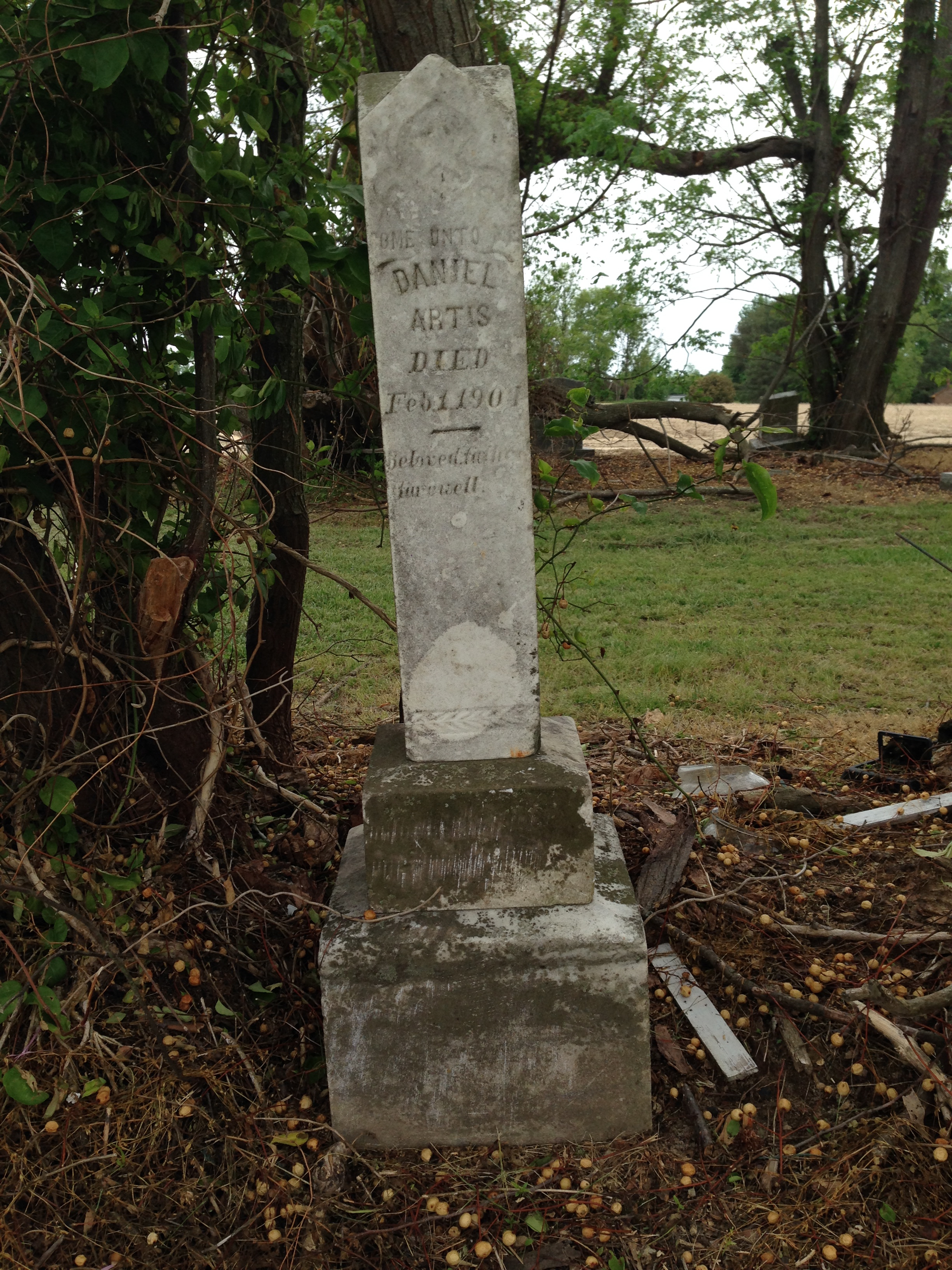
I did not locate stones for any of Daniel’s children in the graveyard, though surely some are buried there. (Daughter Clara Artis Edwards is buried in the nearby Edwards cemetery.) Many markers memorialize the deaths of descendants of Loderick Artis and Prior Ann Artis Sauls Thompson, including Loderick’s daughter Sarah Artis Speight:

and son, Manceson Artis:

and daughter Hannah Artis Mitchell, as well as Prior Ann’s daughter Mariah Sauls Edwards:

and a host of other Saulses, Forbeses, Artises, Speights and Mitchells descended from Daniel Artis.
Photos taken by Lisa Y. Henderson, 2 May 2014.
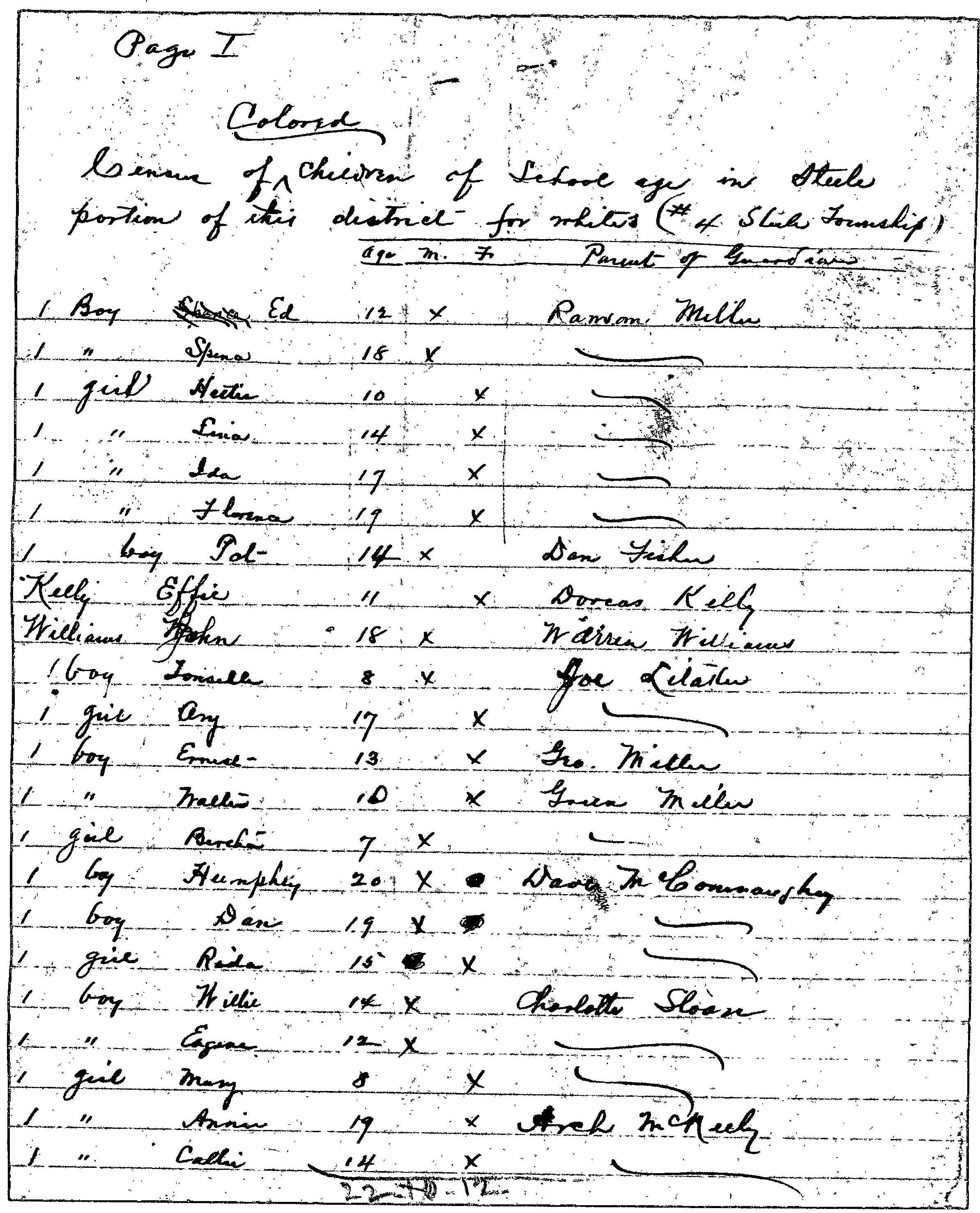

Thirty-five years after Emancipation, the Miller-McConnaughey and McNeely families were still clustered in western Rowan County, working small farms that they owned or rented. Education was a prized advantage, and many children in the neighborhood completed at least a few years. This school census, taken in 1900, lists all school-aged children in a household, though there is no way to tell if the children actually attended.
The six youngest children of Ransom and Mary Ann McConnaughey Miller are listed: Florence A., Ida L., Margaret Lina, Spencer Lee, Hattie A., and Thomas Eddie Miller.
Green and Grace Adeline Miller Miller‘s household included Walter, 10, and Bertha, 7. Both children were listed as the couple’s grandchildren in the 1900 census. Bertha Todd was the daughter of Green and Adeline’s daughter Margaret Miller and Alfred Todd. I don’t know who Walter Kerr’s parents were, but it seems likely that his mother was either Margaret or Mary Caroline Miller.
George Miller, by then in his mid-60s, is listed with a 13 year-old boy named Ernest. This appears to be the Earnest Hilliard listed in his household in the 1900 census and described as a grandson. Was he Maria Miller’s son?
Finally, Arch McNeely, nephew of Martha Miller McNeely‘s husband Henry W. McNeely, is listed with four of his children, Ann J., Callie, Julius L.A., and Mary E. McNeely.
Copy of document from School Records, Rowan County Records, North Carolina State Archives.

This only looks like a Civil War ruin. In reality, Saint Agnes Hospital closed in the early 1960’s, after Raleigh’s Wake Medical Center integrated. Saint Agnes trained generations of African-American nurses, including my great-great-aunt, Henrietta Colvert.

From the Annual Catalogue of St. Augustine’s School, Raleigh, N.C., A Normal School and Collegiate Institute For Colored Students of Both Sexes, Thirty-Third Session, 1911-12.

This is what happens when you throw things away. You get new maps, shiny and updated, with all the latest roads. And all the old place names gone. My mother has the 1993 edition of DeLorme Mapping’s North Carolina Atlas & Gazetteer, and there is Artis Town.
 Scuffalong: Genealogy.