
- Lena Tomlin and siblings. Harriet Nicholson reported to the census taker in 1910 that only three of her nine children were living. Those three were Lon W. Colvert, H. Golar Tomlin and Bertha Hart. The six deceased children were most likely all Tomlins (though it is possible that Harriet gave birth to another Colvert child in 1874.) Census records reveal the name of one, Milas Tomlin, who was born circa 1877. Newspaper articles from 1896 disclose a daughter, Lena Tomlin. And that’s it. My grandmother’s sister Launie Mae told me that several of Harriet and Abner Tomlin’s children drowned. It is good an explanation as any.
- Lovenia Colvert and Elvira Colvert Morgan. Walker Colvert and Rebecca Parks’ cohabitation registration listed three children – John, Elvira and Lovenia. I have never found another reference to Lovenia Colvert. (Was she a relative who went west?) Her sister Elvira, however, left a slight record. Though she does not appear in her parents’ household in the 1870 census, in 1874, when she was about 14, Elvira married Richard Morgan, son of Richard Madison and Hilda Morgan. In the 1880 census, Richard and Viree Morgan are listed in Eagle Mills, Iredell County, sharing a household with 20 year-old Squire Gray. By 1900, the Morgans (and Squire Gray, separately) were living in Asheville at 281 S. Main Street. Richard worked as a saloon servant, and Elvira reported that she’d had no children. This is the last record I have found for her.
Author Archives: Lisa Y. Henderson
Where we lived: 748-21st Street.
My uncle: That’s where I was born and where John was born.
Me: At 748?
My uncle: That’s it.
My cousin: This crib right here?
My uncle: That’s where I was born.
Me: [Laughing.] Wow.
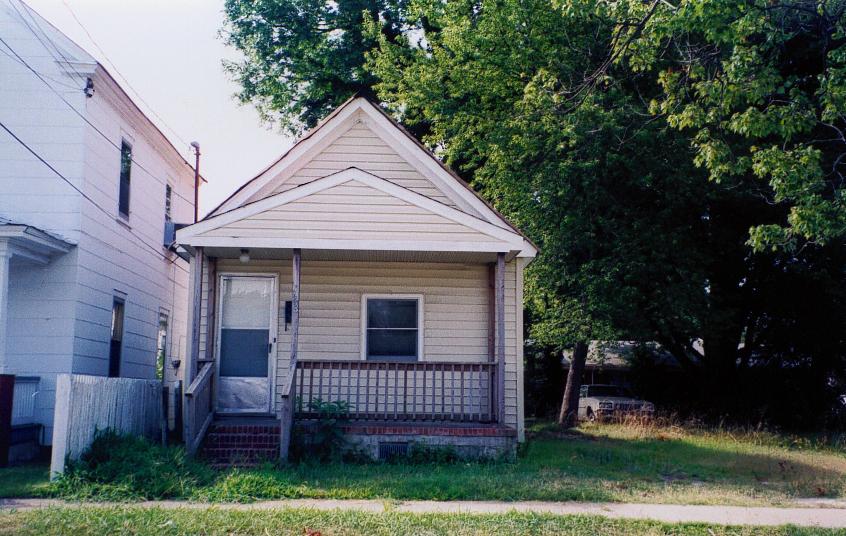
Tax records show that this tiny house — less than 800 square feet — was built around 1910. It now has two bedrooms and one bath, but the bath was undoubtedly a late addition. John C. Allen may have been the first to move a family into the dwelling; the Allens are shown there in the 1910 census of Newport News. John, who worked as a shipyard painter, reported that he owned the house subject to mortgage.

By 1920, the Allens had moved just around the corner to 2107 Marshall Avenue, the house I knew in childhood as my great-aunt Julia‘s. John Allen kept 748 and rented it out until his middle son married. John C. Allen Jr. and his wife Margaret Colvert Allen lived there until their fourth child, my mother, was two weeks old.
My grandmother: I lived I don’t know how many years in Mr. Allen’s house without any electricity. And just as soon as I moved out –
Me: He had it wired?
My grandmother: He had it wired. And one of the neighbors said she went out there in the street and laid him out. Said, that child over there with those children, washing and ironing and working herself to death, and you wait until she leaves out of your house, your son’s house? She said she laid him out.
——
Photograph by Lisa Y. Henderson, 2002; interviews of C. Allen and Margaret C. Allen by Lisa Y. Henderson, all rights reserved.
Coley v. Artis.
At the heart of Wayne County Superior Court proceedings stemming from the suit in J.F. Coley v. Tom Artis (1908) was a dispute over 30 acres of land. Thomas “Tom Pig” Artis began renting the property in 1881 from W.J. Exum. In 1892, Exum’s widow Mary sold it to Napoleon “Pole” Hagans. In 1896, after Napoleon’s death, the land passed to his sons Henry and William S. Hagans, and in 1899 Henry sold his interest to his brother. In 1908, William S. Hagans sold the 30 acres to J.F. Coley. Coley filed suit when Tom Artis laid claim to it, arguing that Napoleon had sold it to him. Tom claimed that the 800 lbs. of cotton he tendered to Napoleon Hagans (and later, his son William) was interest on a mortgage, but William Hagans and other witnesses maintained that the payment was rent.
The trial transcript is replete with testimony revealing the personal relationships among witnesses. Tom Artis testified that he rented the “Adam Artis place.” William Hagans testified that his father was in feeble health in 1896 when he called him and Henry together “under the cart shelter” to tell them he would not live long and did not know to whom the land would fall. William testified that Pole asked them to let “Pig” stay on as long as he paid rent, and they promised to do so. Tom Franks testified that “Pole was a first-rate business man.” Jonah Williams, Adam Artis’ brother, testified that he borrowed money from Napoleon to open a brickyard in the spring of 1893 and had preached his funeral. He also noted that “Tom married my sister [Loumiza Williams Artis, who was deceased by time of this trial]. He is not a member of my church. I turned him out. He is a Primitive Baptist. I preached Napoleon Hagans’ funeral.” Jesse Artis, another of Adam Artis’ brothers, testified that he had worked on Hagans’ property as a carpenter for 18 years and noted, “I don’t know that Tom and I are any kin, just by marriage.” John Rountree testified that he was a tenant renting from Hagans on thirds. Simon Exum, Delilah Artis‘ husband, testified: “I am no kin to Tom [Artis] as far as I know, except by Adam. His first wife was my wife’s sister.” H.S. Reid testified that he was Tom Artis’ son-in-law.
The court found for Coley and against Artis.
——
Thomas Artis was a son of a free woman of color, Celia Artis, and her enslaved husband, Simon Pig. Though, ultimately, nearly all free colored Artises are descended from a common ancestor in southside Virginia, by the late 1800s knowledge of these remote links had faded. There were dozens of Artis families in Wayne County during the antebellum period, and the relationships between them are unknown. Celia Artis was a close neighbor of Adam Artis, but the families apparently did not regards themselves as kin. Still, they were inextricably intertwined. The Artises, Haganses and Reids had been neighbors in the Eureka area for generations. Celia Artis and Henry S. Reid’s grandmother Rhoda Reid were the wealthiest free women of color in the county. Adam Artis married Napoleon Hagans’ half-sister Frances Seaberry. Adam’s sister Loumiza married Tom Artis, as noted above. Henry S. Reid, son of Washington and Penninah Reid, married Tom Artis’ daughter. Henry’s first cousin Henry Reid, son of John and Mozana Hall Reid, married Adam Artis’ daughter Georgianna Artis. Adam Artis’ son William Marshall Artis and grandson Leslie Artis married Tom Artis’ nieces, Etta and Minnie Diggs. And on and on.
Documents found in file of the Estate of Thomas Artis (1911), Wayne County, North Carolina Estate Files, 1663-1979, familysearch.org
The disappearing Taylors.
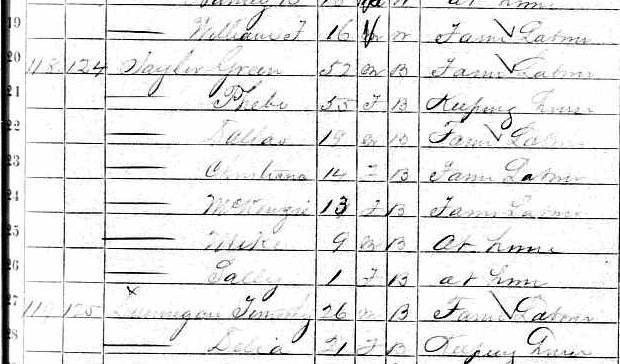
Sometime between the dissolution of their former master’s estate in 1856 and the arrival of the census taker in the early summer of 1870, Green and Fereby Taylor found their way to Lower Town Creek township (now the Pinetops area), Edgecombe County. In that year, their household included four children – Dallas, 19; Christiana, 14; Mckenzie, 13; Mike, 9; and Sally Taylor, 1. There is no sign of the older children – Peter and Henrietta – who had been listed with Fereby in the division of Kinchen Taylor’s slaves. Ten years later, Dallas and Mike had left, but Christiana, Kinsey and Sarah, as well grandchildren Nannie, 5, Carrie, 1, Lizzie, 8, Louisa, 5, and Isaiah Taylor, 2, remained at home. Of all these folk, only Mike Taylor has been found post-1880.
[Update: see this.]
Early going.

My best guess is that I drafted this little chart in the late 1980s, the era in which I was seeking refuge from law school studies in dim microfilm reader rooms. I am struck by several things. Most depressingly: I have identified exactly THREE additional ancestors since I laid this chart aside in favor of genealogy software sometime in the early ‘90s. (And have lost two — both of my grandmothers – which is the most genuinely distressing observation.) The other: the mistakes and missing info.
On the green side:
(1) Lewis Henderson’s mother was Patsey Henderson;
(2) Lewis’ wife was Margaret Balkcum and my current thinking on her mother’s name is Nancy Balkcum;
(3) Frances Seaberry was indeed a Seaberry, and her mother was Levisa Hagans;
(4) Mary Eliza Balkcum’s mother’s name was Nancy Balkcum;
(5) Bessie Henderson’s father was not William D. Martin, but his brother Joseph Buckner “Buck” Martin; and
(6) Robert Aldridge died circa 1899;
(7) Mike Taylor’s name was Henry Michael (or Michael Henry) Taylor;
(8) Mike Taylor’s mother was named Fereby Taylor.
On the red:
(1) Mary Brown’s parents were James Brown and Catherine Booker;
(2) Jasper Holmes died around 1898;
(3) Walker Colvert died in 1905;
(4) James Lee Nicholson’s mother was Rebecca Clampett Nicholson Nicholson – she married her first cousin;
(5) Harriet Nicholson’s mother was Lucinda Cowles; and
(6) Henry McNeely died in 1906 and his wife Martha Miller McNeely in 1934.
Her story.
Bessie Henderson has died, and her children remain.
Mamie Lee was the first child, and my grandmother was the second. And the second Hattie Mae. The first was Sarah Henderson Jacobs’ daughter.
That’s who they named me after. I asked them why they named me Hattie after a dead person. “What? You don’t like Hattie? Well, I just thought ’twas nice.” And after I looked at her picture, I said, “Well, she was pretty.” Since Jack knew her, and he wanted her picture, when I come up to Philadelphia, I give him the picture. ‘Cause they grew up together. And his children thought she was white, wanted to know what old white girl was that. Mama never talked about her. But A’nt Nina, she would tell everything. Mama got mad with her, said, “You always bringing up something. You don’t know what you talking ’bout.” And she never did say – well, if she said, I wouldn’t have known him, but I never did ask her – who Hattie’s daddy was. I figured he was white. Because she looked — her hair and features, you know, white.
Jack Henderson told my grandmother that he remembered “when she was got,” that he was nearby when it was happening, that Tom had Bessie over a barrel, literally. Bookish and soft, James Thomas Aldridge tended his mother and younger sisters and his ailing father’s dry goods store while dreaming of a bigger and better world faraway. He would have been a nerd if they’d had them then. Bessie’s pregnancy changed his life:
‘Cause his mama didn’t want her son to get married. ‘Cause he wanted to be a doctor, and so she was gon help him be one. And if he got married and started having children, he couldn’t be a doctor. And down there in a little town like Dudley, you had to go away from there ‘cause it wont no more than ‘bout sixth, seventh grade. And you had to go to a larger place if you wanted to go to school.
So the pregnancy stirred him, thrust him out toward his reveries, away from Dudley and the grey-eyed baby whose mother was soon to die. Tom, already 24 years old but claiming to be much younger, fled to Raleigh, where he entered Shaw University’s preparatory division and exited its college eight years later on his way to Meharry Medical School. He would become a doctor, indeed, a big-time, money-making, Cadillac-driving Saint Louis doctor, elected president of the National Medical Association in 1961. But it’s his daughter’s story we’re telling right now, the daughter who never got past sixth grade, who never met her father ‘til she was good and grown.
Let me back up. Sometime around 1905, Mama Sarah and her husband, a good man named Jesse A. Jacobs Jr., moved 40 miles north of Dudley to Wilson, a tobacco market bursting with new golden-leaf millionaires. Colored folks from all over coastal Carolina, drawn to the town’s bustling opportunity, built a vibrant community on the southeast side of the railroad that cleaved the town in two. Sarah took in washing and ironing, did seasonal work at tobacco factories, and reared Jesse’s brood, who turned out largely ungrateful. Her own daughter died in 1908, aged 14, and nobody knows why.
Meanwhile, down in Dudley, Lewis and Mag Henderson faded in their iron bedstead with only their teenaged granddaughter Bessie to manage the household. Lucian Henderson likely farmed his parents’ reduced acreage with his own, but it was left to Bessie to cook and clean and sew and launder and do all the other relentless drudgery that needed doing. Her mother was long dead, and there were no other close relatives nearby upon whom to rely. Did she resent her responsibilities? Did she chafe under the grind of pot-stirring and water-fetching and skillet-scouring and jar-slopping? What did she want? She was a chancey girl, a risk-taker, one who took her pleasure where she found it, even when it clamped the lid tighter on her trap. She was a beautiful girl, but nearly unmarriageable, as she dragged her heavy belly through the spring of 1910.
Bessie gave birth to my Hattie Mae on June 6, very likely attended by the child’s grandmother, a midwife named Louvicey Artis Aldridge. Though Vicey had forbidden a marriage between this girl and her special boy Tom, she was not altogether unmoved by her grandbaby, who looked much more Aldridge than Henderson. Vicey and her daughters played small intermittent roles in my grandmother’s early life, but there is no doubt: Sarah Henderson Jacobs was the family’s matriarch and matrix, though no children of her own lived even to adulthood. She reared Bessie’s children and kept them clothed and fed and sheltered, if not exactly loved.
$573.00 allowed.
Under an act of Congress approved March 3, 1871, a three-member commissioners Southern Claims Commission received, examined, and considered the claims of “those citizens who remained loyal adherents to the cause and the Government of the United States during the war, for stores or supplies taken or furnished during the rebellion for the use of the Army of the United States in States proclaimed as in insurrection against the United States.” The commissioners’ principal duties were to satisfy themselves of each claimant’s loyalty and certify the amount, nature, and value of the property taken or furnished.
The files of claimants under this act are rich with personal details, including age and place of birth; residence during the Civil War; occupation; names and ages of family members; names of neighbors; and types of crops grown and animals raised. For free people of color, these records are especially valuable, as there seldom are other sources for this type of information.
Robert Aldridge is my only known direct ancestor to file with the SCC. Indexes show that his claim was assigned number 14,758; that he asserted losses of $832.00; and that, in 1873, he was allowed $573.00 in compensation.
Some years ago, while in Washington DC, I made a beeline up Pennsylvania Avenue to the National Archives to get a look at Robert’s folder. I sat in the research room, a faint smile on my lips, heart rate slightly elevated, alert. And then: “I’m sorry. That file is missing.” Gone. And has been for years, for it was never microfilmed, and even indexes leave blank the summary of its contents.
To think of this still makes me nauseous, as Robert Aldridge is an elusive figure with murky antecedents and obscure dealings. Few of his deeds were recorded, and the extent of his landholdings is unclear. A statement to the SCC — in his own words, precious in and of itself — would have been a goldmine of information.
DNA Definites, nos. 2, 3, 4, 5 and 6.
- H.A. is descended from Mary Jane Artis Artis, daughter of Adam and Lucinda Jones Artis.
- H.B. is descended from Henry J.B. Artis, son of Adam and Amanda Aldridge Artis. (We have two lines of connection — Artis and Aldridge.)
- M.S. is descended from Theophilus Simonton, my great-great-great-great-great-great-great-great-grandfather. She is, by far, the most remote match I have, and I’m astounded that that little stretch of DNA has persisted across 300+ years.
- E.H. and I share two lines of descent, from James Henderson and from John and Louvicey Artis Aldridge. On the Henderson side, we are 3rd cousins, twice removed (or a little less, as we descend from different wives of James Henderson.) On the Aldridge side, 2nd cousins, once removed. 23andme estimated our relationship as 2nd to 3rd cousins.
- G.P. and I are descended from two daughters of Urban Lewis and his wife Susan Casey Lewis — Susan Marinda Lewis Potts and Eliza Lewis Martin. Ancestry DNA estimates us as 4th cousins; we are actually 3rd, thrice removed. I also have an Ancestry match with “ead43,” who is descended from Susan Casey Lewis’ brother, William Casey. Estimated at 5th-8th cousins, we are 5th, twice removed. I also match D.P., a close cousin of G.P., but on a different chromosome. FTDNA identifies yet another cousin, K.S., who matches G.P. and I on the same stretch of DNA on chromosome 9. She is a descendant of a Lewis from Wake County NC, but does not know how he links to Urban Lewis, who was the son of William T. Lewis and Sarah Utley Lewis of Dobbs (later Wayne) County.
Napoleon Hagans’ house.

Around the time he testified before the US Senate, Napoleon Hagans had this house built below the south bank of Aycock Swamp, near Fremont in northern Wayne County. It remains occupied and is featured in J. Daniel Pezzoni and Penne Smith’s Glimpses of Wayne County, North Carolina: An Architectural History (1998):
“The house, a single-pile center-hall-plan dwelling, has retained much of its charming original hip-roofed front porch, now supported by replacement square columns. Windows are surmounted by moulded peaked arch surrounds. … One original single-shouldered exterior end chimney was plastered; the other was replaced by a concrete-block flue. …”
A stone monument marking the graves of Napoleon and his wife Apsilla Ward Hagans stands in a cornfield about one hundred yards west of the house.
Photo by Lisa Y. Henderson, December 2010.
She would always bring him something.
My grandmother: My grandmother used to always bring him something down, she’d come down sometimes Sunday afternoon or Saturday night.
My aunt: Grandma Allen?
My grandmother: No, no, no, no, no. My daddy.
Me: Harriet.
My grandmother: She would always bring him something. In the springtime, when there’d be strawberries and rhubarb, she used to make strawberry pie with rhubarb in ’em. And she would make three or four and stack ’em like that. And cut all the way down. And she would always bring that to Papa.
Margaret C. Allen on this family’s stack pie legacy.
——
Interview of Margaret C. Allen by Lisa Y. Henderson; all rights reserved.
 Scuffalong: Genealogy.