DNA, Maternal Kin

DNAnigma, no. 5: Crazy coincidence.

Ten, fifteen years ago, I was immersed in the fascinating family tree of one of my best friends, who has roots in New Orleans and the River Parishes. One of her lines is Darensbourg, and I sought collaboration from several researchers who were also trying to tease out clues that linked the famille de couleur libre with the German-Swedish Karl Friedrich D’Arensbourg, leader of Louisiana’s early 18th century German settlements upriver from New Orleans. In particular, I corresponded heavily with M. Darensbourg, translating from the French several documents that she unearthed in her persistent sleuthing. After a couple of years, the trail went cold, and we gradually lost contact.

Not long after my 23andme results posted, I received an excited message from M., who believed that we’d found confirmation of our mutual descent from D’arensbourg. I was even more stunned though, because I’m not a descendant at all. I reminded her that I’d been researching for someone else, and: “This is a just a little too unreal, M.!! I’m guessing that we are linked on your mother’s side? I see you have VA and NC lines, which is where my family largely is from. I have NO Louisiana ancestry at all, though have found two RF matches to Creoles. Undoubtedly the link is someone “sold down river” in the terrible slave trade.”

M., my mother and I share a smallish stretch of chromosome 8. Neither my maternal uncle nor his first son inherited. As of right now, we don’t have the first clue to our connection.

Standard
Births Deaths Marriages, Free People of Color, North Carolina, Oral History, Paternal Kin, Photographs

Papa Jesse.

Bessie died when I was eight months old.  And Mama Sarah took me as a baby and brought me to Wilson.  And her husband was the only papa I knew.  His daughters all disliked me being there, but I loved him and he loved me.  But they all just said he loved me better than he did them, and I wont nothing no kin to him.  But when you take a child that’s with you all the time, and every Sunday you send to the store to get you some oil to wash your feet … just nobody but me there.  Nobody but Mama, Papa, and me.  Mamie wasn’t even there then.  She was down in Dudley with Grandma Mag.  And so, I guess he just learned to love me.  And he told me, if I wanted to stay with him, I could stay, and if he didn’t have but one biscuit, he’d divide it and give me one half and he’d have the other half.  And that way I wanted to go with him ‘cause Mama’d fuss all the time.  She was always talking, got to be doing something.  And so I wanted to follow him.  And so I went with him everywhere. 

In late 1895, the freshly widowed Jesse Adams Jacobs Jr. married Sarah Daisy Henderson in Dudley, Wayne County. He brought children as young as a year old to the marriage, and she brought a daughter, a niece and a nephew. Around 1905, Jesse, Sarah, his youngest children and her nephew Jesse Henderson joined the flow of farm dwellers to Wilson, then entering into its golden era as the World’s Largest Tobacco Market. A couple of years later, when Sarah’s niece, Bessie Henderson, died, Jesse and Sarah took in her small children, the younger of which was my grandmother.

Jesse&Sarah Jacobs

Jesse was born in 1856 in Sampson County to Jesse Jacobs Sr., a prosperous free colored farmer, and his wife Abigail. Many of Jesse and Abigail’s modern descendants are members of the Coharie Native American tribe. Others, like Jesse Jr.’s descendants, identify as African-American.

Jesse A. Jacobs bought a small house at 303 Elba Street in 1908. Over the years, he worked as a hostler and a janitor and for extra cash farmed small plots of land he rented on the edge of town. My grandmother was his constant companion.

And so I wanted to follow him.  And so I went with him.  Up there to First Baptist Church, help him dust the seats, and he’d run the sweeper and all that kind of stuff.  And when he was over to another school up there, the college.  He used to be janitor to the college.  And then he had the school out there at Five Points.  Winstead School out there at Five Points.  And I would be the one at all those places.  Go cut Professor Coon’s grass, I’d be right with him. And then, out to Five Points. I went out there – I was in school ‘cause I run all the way from up the school, came by the house, get me a bite to eat and run from there to clean to Five Points School where was out there – white folks.  And sweep up that whole building by myself.  Papa’s down there in the field, up there by – uh, what is the people be putting them … they had chains on their legs and had the white stripes – convicts.  It was a place up there.  And I’d go ‘round there and sweep that whole building up by myself.  Papa was gon get me a bicycle so I could ride over there.  ‘Cause, see, he had the horse and wagon, and so he was already over there, and he had been there by where the pigpen was down by that little stream, that little ditch.  And I’d come back on the wagon at night with him.  But while he was plowing, ‘cross the street over there where he had a acre of cotton.  And while he was working, plowing that garden where was on the side, Professor Coon let him have whatever he put in it.  He would buy all the stuff to go in the ground, if Papa would just work it.  So he’d plant that, and then me and Mamie had to get up two o’clock in the morning, go down there and pick up potatoes.  Light night.  It’d be so bright you could see ‘em. He’d plow it up, turn that ground over, and all them old potatoes down there, put ’em in baskets, and what we couldn’t see ‘fore it got real daylight, we had to go out there and pick ‘em up when it got day. 

My grandmother’s young life was difficult, and she carried scars of hurt and disappointment even into the years that I knew her. But her voice always softened when she spoke of her adored Papa, the single source of unconditional love in her childhood.

I used to brush Papa’s hair.  He didn’t have much. Take one of them soft brushes, hand brushes.  Two of ‘em, he brought ‘em from New York.  He brought the brushes home, and I was always messing with his hair.  And I’d get the brush and hold it on one side and part it off and brush it down.  It was real soft.  And near ‘bout all of it come off where was on top.   And I was always asking a nickel, a penny:  “What, ain’t you got some change in your pocket?  I want to go the store.”  So I was feeling his legs, feeling for pennies or nickels up there.  So I said, want to know if he’d give me a nickel, or give me a penny, or whatever it is.  So he run his hand in his pocket, a penny or a nickel or whatever, he’d give it to me.  I’d go on to the store, and he said, “Wait.  Wait a minute.”  He had to have tobacco.  So then he’d give me a dollar.  And he told me to go down to the store down, right down there from our house.  Old Man Bell’s store, the white man that run the store.  “Get me a quarter.  Don’t spend it all.”  It’s three sections or four sections on a plug of tobacco.  And they cut into it where the cracks is, and it sells for so much.  And so I’d go down there to the store and get it and come back and give it to him. 

——

Original photo of Jesse and Sarah H. Jacobs on their wedding day in the collection of Lisa Y. Henderson. Edited excerpts from interviews of Hattie H. Ricks by Lisa Y. Henderson; all rights reserved.

Standard
Births Deaths Marriages, Maternal Kin, Virginia

John C. Allen arrives.

JC Allen 1

John Christopher Allen made his way down-river to the newly established city of Newport News around 1899, a thick-set country boy with dark curly hair.  In April of that year, he had purchased ten acres in Turkey Trot from A.H. Drewry and wife, but he did not hang around to farm it. What pulled — or pushed — him out of Charles City County is not precisely clear, but he would never turn back.

va_hm_newport_news01

Newport News was a boomtown at the turn of the 20th century. The extension of the Chesapeake & Ohio Railroad down the peninsula, bringing coal from West Virginia for world-wide transport, was followed shortly by the development of the shipyard for which the city is still famous.

In June of 1900, the census taker found John Allen sharing a boarding house run by Henry Burrell with several single men.  The house was in the crowded East End, near the heart of industrial Newport News.  John was working as a shipyard laborer, and he was illiterate.  That year, on the day after Christmas, the 24 year-old son of Graham and Mary Allen, married 23 year-old Mary A. Holmes, daughter of Jasper and Matilda Holmes, at New Vine Baptist Church in Charles City County. They returned to Newport News to start their 50-plus years together.

Standard
Education, Maternal Kin, Religion, Virginia

Church home, no. 4: Zion Baptist, Newport News VA.

“The Zion Baptist Church was organized in the year 1896 under a cherry tree at its present location by a group of 13 baptized Christians who had migrated to Newport News from other areas of Virginia and the Carolinas and who had not affiliated with any local congregation.

In 1896, when the City of Newport News was in its infancy, a section of town now known as the East End was better known as “Blood Field” for its street violence. There were houses of prostitution, bars, dance halls, a saloon on every corner and gambling was a way of life.

It was after several meetings from house-to-house that the thirteen Christians concluded that there was a need for some type of religious worship in the immediate area and so 107 years later, Zion Baptist Church in the East End was set.

The first pastor called to lead the group was Rev. Moses Tynes and in 1897, the first tiny structure was built under his leadership. Most of the materials were donated by whites in the community and the labor was donated by men in the community.

In 1899, under the leadership of Rev. C. J. Crudup, the sanctuary was destroyed by fire. But despite this setback along with other difficulties, the congregation continued to grow. Rev. C. E. Jones was called to assume the responsibility of leadership in 1901 and for eleven years, Zion experienced tremendous growth, encouraging men and women to turn to Christ. Both Rev. and Mrs. Jones were actively involved in the work of the National Baptist Convention and the Lott Carey Foreign Mission Convention. In 1941, Rev. Jones’ pastorate ended as a result of a car accident after 39 years of leadership to the congregation. Rev. Joseph B. Reid became his successor and he served the church for fourteen years.”  Excerpt from “About Us,” http://www.zionbaptistonline.org/about.html

——

John C. Allen Sr. was illiterate when he arrived in Newport News about 1899.  Before long, he made his way to Zion Baptist where, under the tutelage of Rev. Charles E. Jones, he learned to read. John reared his children in the church, and his funeral service was held there in the first days of 1954.

He was a smart man, but he was not an educated man.  If he had had an education to go along with his wit, he would have been a bad boy.  I’m telling you, ‘cause he was just as smart as he could be. 

——

Interview of Margaret Colvert Allen by Lisa Y. Henderson, 8 August 1998; all rights reserved.

Standard
Births Deaths Marriages, Land, Maternal Kin, North Carolina, Other Documents

Jule McNeely leaves a toehold.

I did not doubt that Henry and Julius McNeely were brothers, but here is proof-positive: Julius died widowed, childless and intestate, and his sole heirs were Henry’s children.Image“Jule” McNeely’s thin estate file, opened in 1913 in Rowan County Superior Court, is devoted to the distribution of his tiny plot of farmland to John, Luther, Emma, Addie, Carrie, Ed, Litha, Janie, Lizzie and Minnie McNeely as tenants in common. When Addie died in the middle of matters, a guardian was appointed for her children, “Ardenia” [actually, Ardeanur], 14, and James Smith, 9. At issue: “Beginning at a stone on D.S. Cowan’s line, and runs S. two degrees W 7.10 chains to a stone thence; N. 85 degrees W. 3.50 chains to a stone, thence; N. 2 degrees E. 6.50 chains to a stone on Cowan’s line, thence; E. to the beginning, containing two and a half acres more or less.” “The above land is the old Jule McNeely place, lying just east of Mount Ulla in Rowan County, and” — despite its tininess — “is a very desirable lot.” The heirs’ attorney petitioned for the sale of the lot, noting that it was too small to be advantageously divided or to justify continued possession by so many heirs, all of whom lived in Iredell County except Emma and her husband Ervin Houser of Bayonne, New Jersey. The petition was granted, and at auction on April 21, 1917, Carrie’s husband Lon W. Colvert placed the highest bid at $80.

[Sidenote: Before I found this file, I did not know that (1) Lizzie McNeely was first married to Watt Kilpatrick; (2) when Addie McNeely Smith died; or (3) Lon Colvert owned property in Rowan County, much less property that had belonged to his wife’s late uncle.]

Standard
Births Deaths Marriages, Education, Maternal Kin, Oral History, Photographs, Virginia

Remembering Margaret Colvert Allen on her birthday.

Oh, yeah, I always liked that picture.  That was on Hampton’s administration steps.  That was a brand-new coat, child.  And it was real soft.  It was light – I don’t know what you would call it.  Light tan or something.  Anyway.  But it had a summer fur collar on it. … Who sent it to me?  Golar or Walker or some of those people sent it to me…

ImageMy grandmother would have been 105 today. When she passed away in February 2011, she was Hampton’s oldest living graduate. Her funeral service was held on a clear, cold day in the campus chapel, fitting in its reserved beauty.

—–

Interview of Margaret C. Allen by Lisa Y. Henderson, 4 November 2004; all rights reserved.

Standard
Civil War, Maternal Kin, North Carolina, Other Documents

I will henceforth faithfully support, protect and defend.

The war is over. The Union has won. There is nothing to do but accept it and move on. Two months after the Surrender, his enslaved son now free, John W. McNeely swore his allegiance to the United States.ImageHalf-way across the country, in Iron County, Missouri, William B. McNeely had not waited for the war to end and beat his brother to the punch by nine months.Image

[Sidenote: Compare the W, M and N in John and William’s signatures. They clearly learned to write from the same instructor.]

Oath of Allegiance. Union Provost Marshals’ File of Papers Relating to Individual Claims, National Archives and Records Administration.

Standard
Letters, North Carolina, Paternal Kin

I pray for the whole family.

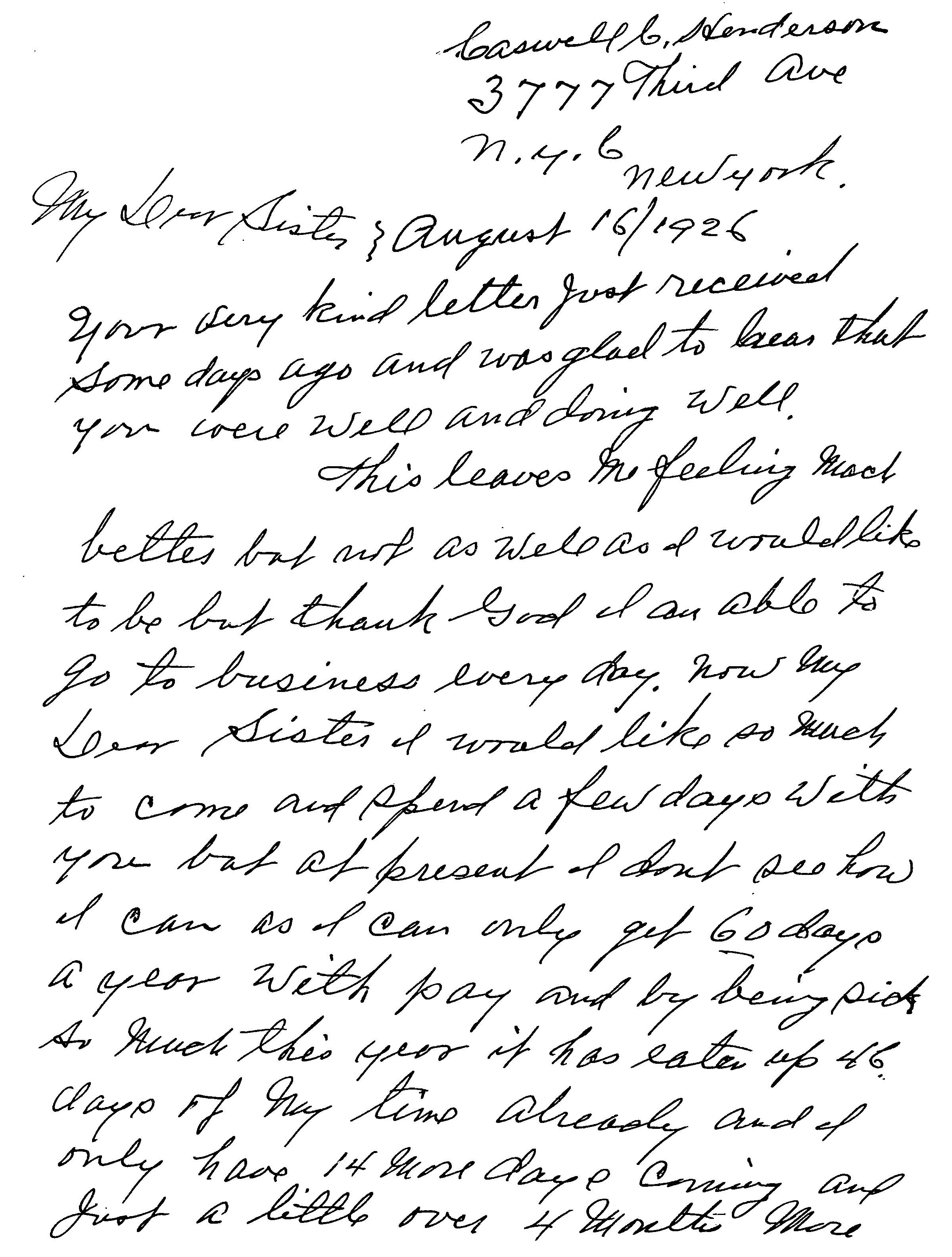
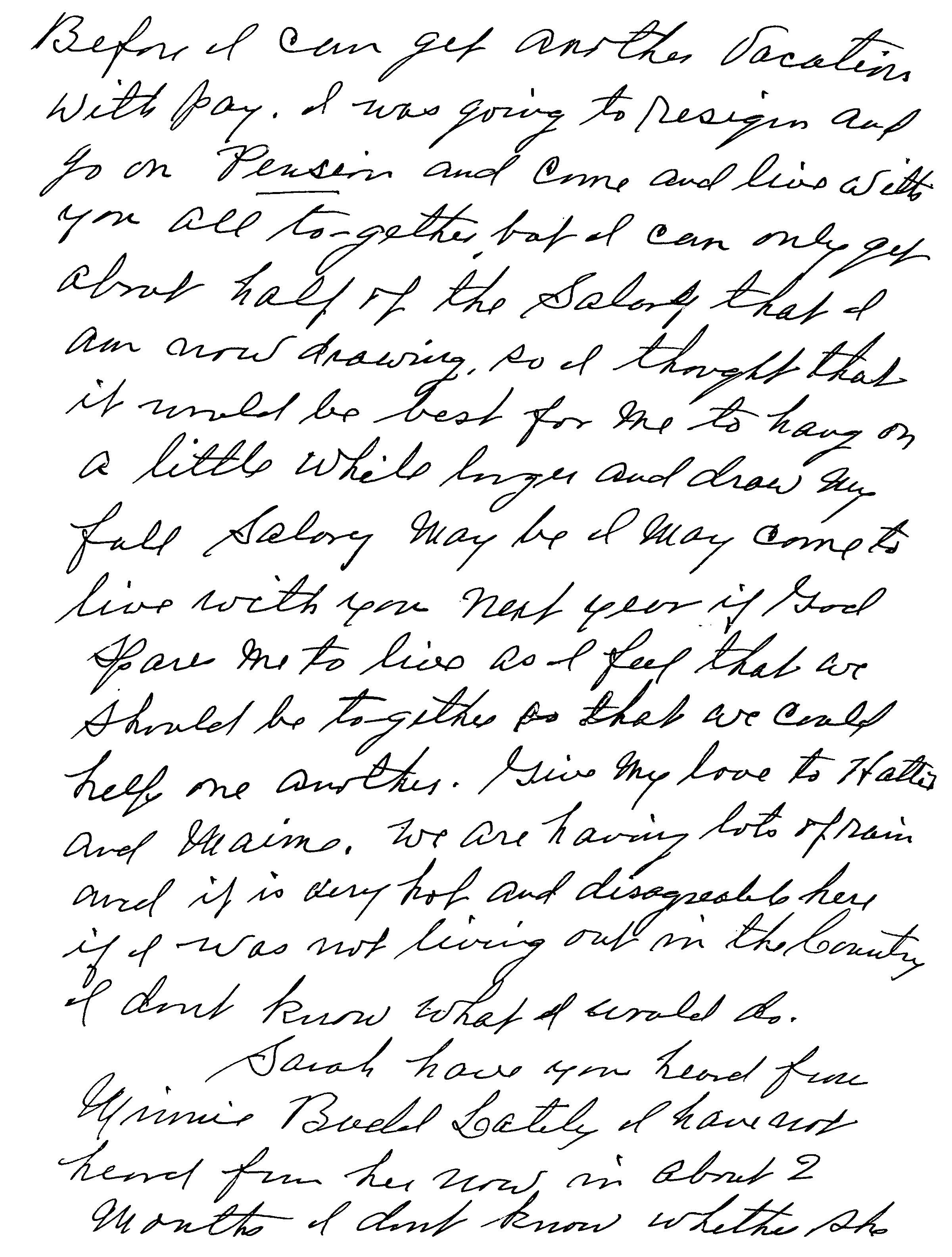
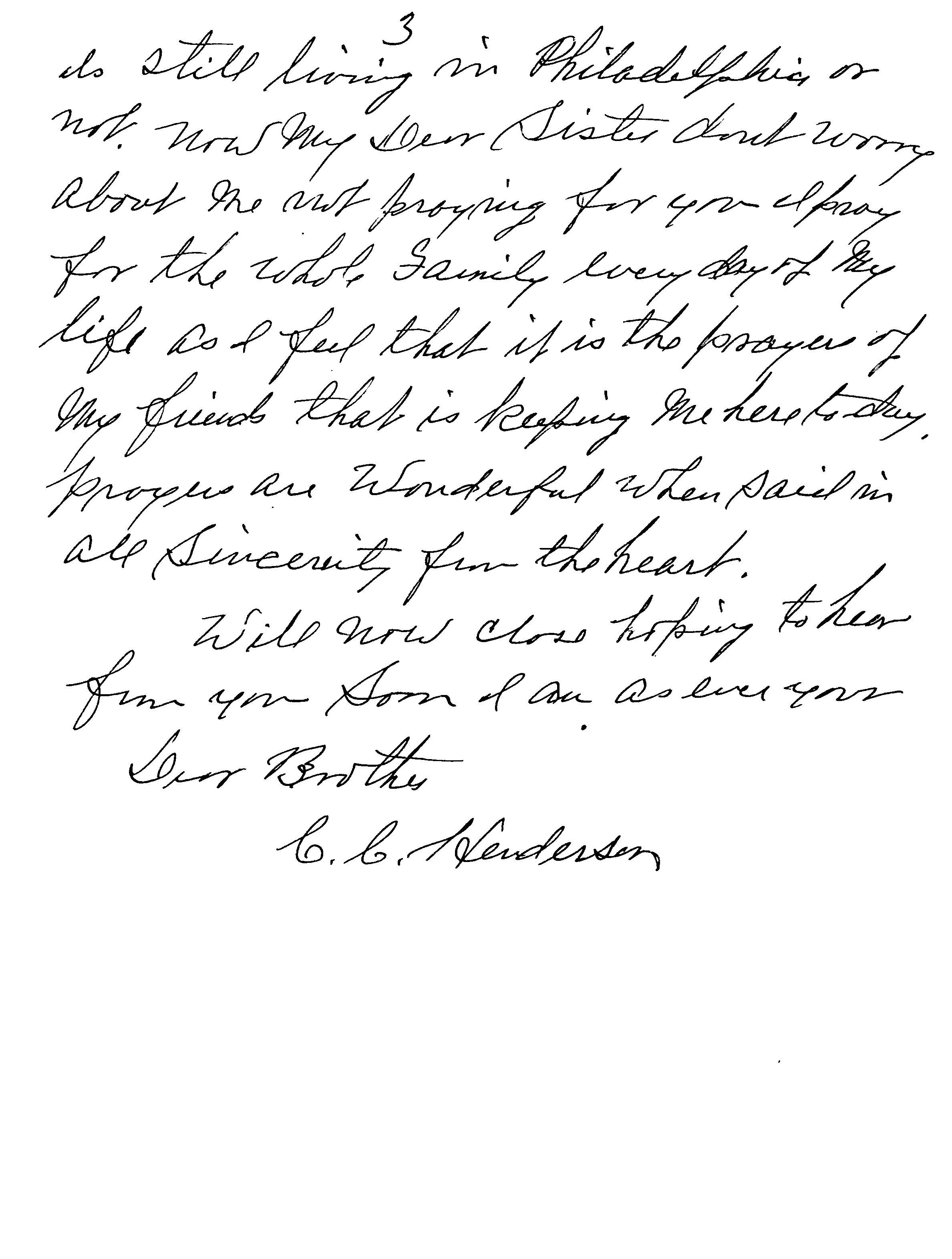
A few months after my grandmother passed away in January 2001, my father, mother, sister and I converged on her little rowhouse at 5549 Wyalusing Avenue, Philadelphia, to clean it out. In a drawer of a large steel desk in the basement, I found a packet of papers. In them, a letter I’d never known existed, from my great-great-grandmother Loudie‘s brother Caswell C. Henderson to their sister, Sarah H. Jacobs Silver, who reared my grandmother. ImageImageImage

Though he does not say so directly, Caswell seems to have been responding to the news of the death of Sarah’s husband in early July. She has asked him to come home, for a visit or perhaps permanently, but he cannot, pleading health and finances. He is hopeful, though, that soon they will be together to “help one another.” He expresses the importance of his family (if not his wife, who garners no mention) by sending greetings to his great-nieces and inquiring after Minnie Simmons Budd, daughter of his and Sarah’s deceased sister Ann Elizabeth Henderson Simmons. Of course, while “prayers are wonderful when said in all sincerity from the heart,” the prayers of his friends could not keep Caswell forever, and he died 16 January 1927.

Standard
Maternal Kin, North Carolina, Oral History

Grandma Becky.

I was stunned to learn that my grandmother had known her great-grandmother. “I didn’t know you knew her.” “Yes, indeed.”

She was a little, brown-skinned woman, had beautiful hair.  She was short.  Even shorter than I am.  Tiny.  And she used to keep us when Papa and Mama would go away, maybe for the day or overnight.  She’d always come down and keep us.  And, boy, we’d have a ball, ‘cause she’d let us do anything.  Our mother used to have a closet full of canned goods, you know.  Blackberries and dewberries and apples and all kinds of stuff.  And, honey, Grandma Becky would let us go in there and eat up a whole jar of peaches.  She just let us do anything.  We were crazy about her.

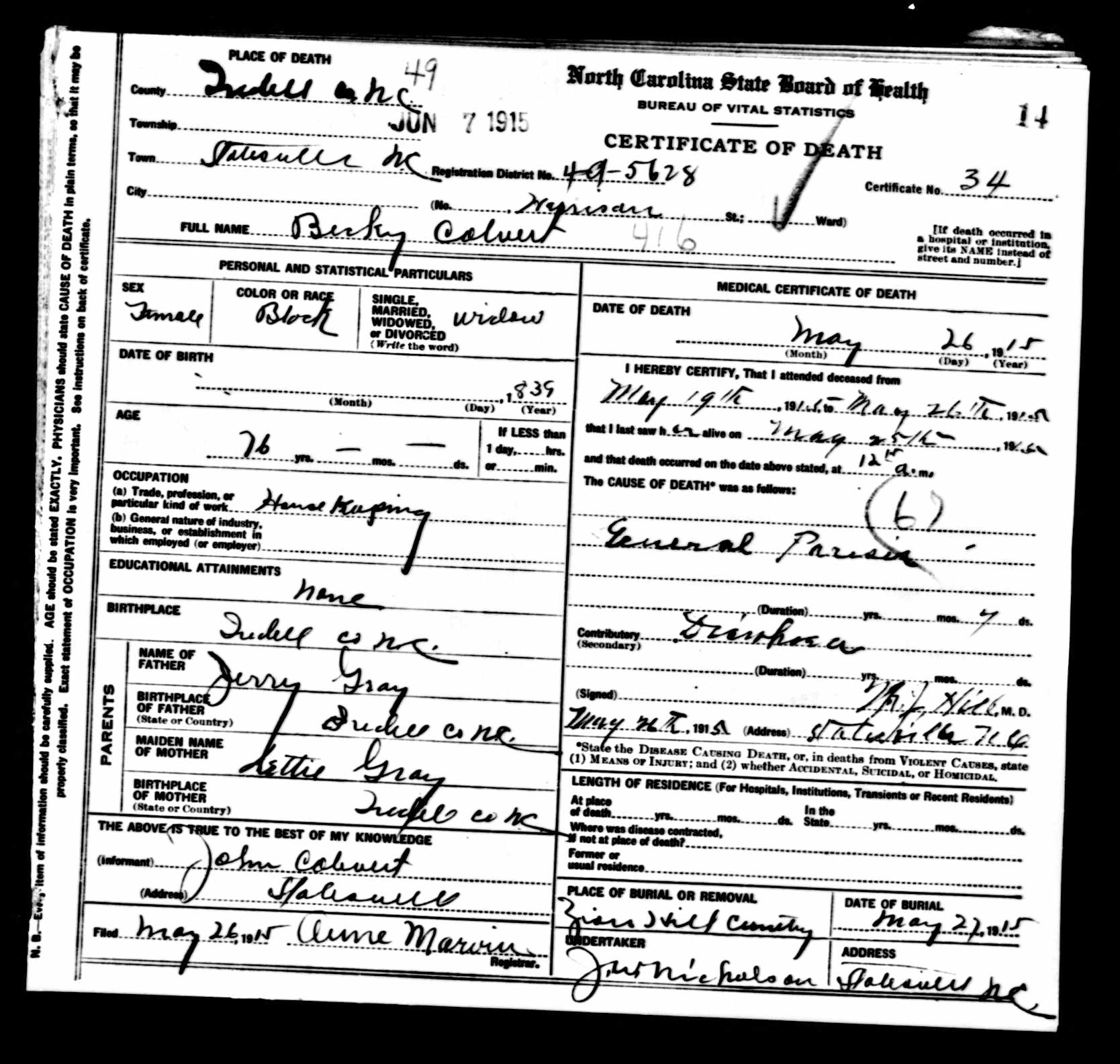
Rebecca Parks Colvert was born about 1839, probably in Iredell County NC. Her death certificate reports her parents as Jerry and Lettie Gray — probably the Jerry and Lett listed in the 1827 inventory of John A. Colvert’s estate. Becky was about 14 when she married Walker Colvert, and the couple probably lived apart until Emancipation. The 1860 slave schedule of Iredell lists ten slaves belonging to Walker’s owner W.I. Colvert, but none appear to be Becky or her children. (Was she owned by a Parks, one of John A. Colvert’s kin?) She reared Walker’s son John, and her own children Elvira and Lovina and Lewis, and then Walker’s grandson Lon. After her husband’s death in 1905, she left their farm north of town in Union Grove township and moved into Statesville.

Becky Colvert died 26 May 1915 at the Harrison Street home of her stepson John W. Colvert. She was about 76 years old.

NorthCarolinaDeathCertificates1909-1975ForBeckyColvert

Interview with Margaret C. Allen by Lisa Y. Henderson; all rights reserved.
Standard