Maternal Kin, North Carolina, Oral History, Religion

Church home, no. 2: Holy Cross Mission, Statesville NC.

Me: Where did y’all go to church?

Margaret Colvert Allen: We were Episcopalians.

Me: What was — was the church in Statesville? What was it called?

MCA: Holy Cross Mission.

Me: It was a black church?

MCA: Mm-hmm.

Me: Oh, okay. And y’all participated —

MCA: Everybody but Papa.

My mother: What was Papa?

MCA: He was a late bloomer. [Laughs.] He didn’t join the church ’til he was about … oh, near 50, something like that. No, it wasn’t that late. About 40, I guess. Like all people who join church late like that, they are fanatics when they finally do, and that’s the way he was. But in the meantime, you see, we had been going with Mama to church. Went to Sunday school, we went to eleven o’clock service, then we went back again at four. And, when he joined church, he joined another church his mother belonged to. Which was an AME Zion church. And we had to go to that church, too.

Me: Plus the Episcopal church???

MCA: We had to go to his church at night. It was all right, ’cause we didn’t mind. That was an outlet.

Image

“Trinity Episcopal Church was organized as The Chapel of the Cross in 1858. The congregation built a church on Walnut Street in 1875 to serve its 25 members and took the name Trinity Church. The Walnut Street church stands today and is the Quaker Meeting House. Holy Cross Church, Statesville’s African-American Episcopal congregation, was formed in 1887. The Holy Cross congregation held services on Washington Avenue in a building which is no longer standing. After nearly 100 years the congregations of these churches merged. Ground was broken on the plot of land on North Center Street at Henkel Road on June 18, 1967, beginning construction of the church building that is home to our parish today. The Blessing of Trinity Episcopal Church was held September 28, 1968.” — From “Parish History,” http://www.trinityepiscopalstatesville.org/church.html#history

Interview of Margaret C. Allen, 8 August 1999, Newport News VA; all rights reserved.

Standard
Maternal Kin, Newspaper Articles, North Carolina

Uncle Julius gets bamboozled.

MILL BRIDGE, April 5.

Mr. Editor: — One day last week a well dressed gentleman of color, wearing a flashy, gold looking watch chain, with checks on the First National Bank of New York for $2500, put in his appearance at the house of Julius McNeely, one of our most trustworthy, hard-working darkies. Jule being of a hospitable nature did what he could to make his visitor comfortable. The said gentleman of color represented himself as Mr. Ed. Brown, a relative of Margaret (Jule’s wife), having left this country twenty-three years ago, that he had been in the U.S. Army and Navy, traveled over the world, made plenty of money and was now traveling in the interest of the Western Colored Emigration Society; he gave glorious descriptions of California and offered to furnish transportation free to all who would go with him to the land of milk and honey. Jule and Margaret listened with delight to the many wonderful stories he told of the outside world, and on last Friday morning prepared his breakfast and went to the field to work, leaving him reposing in bed. When lo! Upon returning they found he had skipped, taking with him Jule’s new double-barrel breach-loading shot gun that cost $25, a gold ring belonging to the school marm, worth $10, 50 cents in wash and a pint of Jule’s medicinal whiskey. He made his way to Cleveland, bought a ticket to Statesville with the stolen half dollar and boarded the 12 o’clock train with the gun and ring. Julius is sorrowing, and offers to pay $10 or any amount above that he can raise to anybody who will “cotch dat nigger devil.”

Said negro is of small stature, copper or ginger cake colored with a broad scar on the left side of his neck, a black spot on the upper part of his nose between his eyes and a mole on one of his cheeks. He is between 38 and 40 years of age and his hair is slightly mixed with gray. He was raised at Davidson College and came in the possession of Mrs. Kate Barnes, Dr. Kerr’s niece. He ran away from Charlotte, where his mother now lives, for stealing, and had been staying about Salisbury with Wylie Dodge and Harriet Brown previous to his coming out here. He left this neighborhood in 1866, at which time he was in the employ of a writer. He stole a gold watch from Mrs. Ray and sold it to William Stockton, of Salisbury. The watch was recovered, but Ed. Was not heard of since until he turned up at Julius McNeely’s, last week. He is a professional rogue, and the local papers will please hand him around.    J.T. RAY.

The Carolina Watchman, Statesville, 11 April 1889.

Standard
Births Deaths Marriages, Oral History, Paternal Kin

When Grandma Mag died.

My grandmother was 5 years old when her great-grandmother Margaret B. Henderson died in 1915. This is what she recalled:

I remember when Grandma Mag died.  I don’t remember ‘em burying her.  But I was up to Nora’s house.  That’s how come I remember it.  Grandma Mag was living, well, she was in bed, she was sick.  I don’t remember her being up. Grandma Mag stayed down in Dudley. When she died, I was down there, and we went to Nora’s house.  And I used to ask myself, ‘Why is she in the bed all the time?’  

During Grandma Mag’s funeral, I stayed with Aunt Vicey and Nora and Beulah, the one that had the wen under her neck.  We called her A’nt Vicey, but she was my grandmama. I stayed up there with them, and I was scared to sleep in the bed by myself. So Nora told me, “Well, if you get in the back and I’ll get in the front.”  So she said, “Well, I’ll be in here right with you,” so I went on to sleep.  That’s who I slept with. 

So, I stayed up there in that house when Grandma Mag died.  I stayed up there.  And I slept in her room.  I remember that.  But I don’t remember … they didn’t let me go to the funeral, I don’t think. 

“Aunt Vicey” was Louvicey Artis Aldridge (1865-1927), her father’s mother. “Nora” and “Beulah” were Vicey’s daughters Lenora Aldridge Henderson (1902-1961) and Beulah Aldridge Carter (1893-1986).

Standard
Free People of Color, Letters, North Carolina, Paternal Kin

The case for Eliza Balkcum Aldridge.

Image

She is obviously a very old woman, stooped and twisted, but with a full head of silvery hair pulled into a loose bun. Her daughter-in-law stands to one side, hand resting protectively on the back of her chair. The only known photographs of Mary Eliza Balkcum Aldridge, two of them, were taken the same day near the end of her long life.

The basic outline of Eliza’s life is established. According to her death certificate, she was born 29 February 1829 in Duplin County. She married Robert Aldridge around 1850, but no marriage license has been found for them. Eleven of her children lived to adulthood. She ran the domestic side of a farmer’s household and slipped out to deliver babies when called upon. She inherited 53 acres from her husband’s estate, but spent her last years in the households of her youngest sons, Robert and Joseph.

The details of her early life are less clear, but I believe she was born to an unorthodox white woman named Nancy Balkcum. Here’s the case:

  • About 30 years ago, a cousin prepared an unannotated family history (apparently based on oral tradition) that notes “Robert [Aldridge] married Eliza Bayscin in 1850.  Eliza was born in Johnson [sic] County, North Carolina in 1830.  She had two sisters, Mary and Maggie.”  Everything in this document must be taken with a grain of salt — it borders on the hagiographic and is very romantic — but the basic story seems to be rooted in fact.
  • In the 1850 census of Sampson County, a 21 year-old named Elizabeth Balkcum appears in the household of Lemuel Balkcum.  Elizabeth does not appear to be his spouse. She is listed last in the household, after minor children. As I’ll explain in another post, Lemuel Balkcum was the grandson of Hester Balkcum, and most likely the son of Nancy Balkcum. Though her name is slightly off, I believe “Elizabeth” is Eliza.
  • In 1854, Nancy Balkcum’s will was probated in Sampson County Court of Pleas and Quarter Sessions. Her legatees were “daughter Margaret Balkcum,” “two daughters Eliza and Mary,” and “son Harman.” (This matches the Mary and Maggie in the family history above, and I am certain its writer never saw Nancy’s will.)
  • In the 1860 census of Newton Grove, Sampson County, Mary E. Aldridge appears with her husband Robert and children. This is the only reference to her as “Mary E.” In subsequent censuses — 1870 and 1880 in Brogden township, Wayne County; 1900 in Providence township, Wayne County; and again in 1910 and 1920 in Brogden township — she is called Eliza Aldridge.
  • Eliza’s son Matthew Aldridge died in 1920 in Goldsboro, Wayne County.  His death certificate lists his mother as “Lizzie Borkem.”
  • Eliza Aldridge died 29 January 1924 of influenza.  She was just short of 95 years old. Eliza’s son Joseph did not know Eliza’s father, but gave her mother’s name as “Nancy.”
  • Son Joseph Aldridge died in 1934 in Wayne County. His death certificate lists his mother as “Eliza Barkin” of Sampson County.
  • Son Robert Aldridge died in 1940 in Wayne County. His death certificate lists his mother as “Eliza Baucom” of Wayne County.
Standard
Births Deaths Marriages, Free People of Color, North Carolina, Paternal Kin, Photographs

James Henderson’s children, part 1: the Skipps.

James Henderson had two sets of children. His first set bore the surname Skipp in childhood, when they were apprentices, and these facts suggest that James and their mother were not married. Son James Henry’s death certificate gives his mother’s name as Sallie Henderson. Was she instead Sallie Skipp?  Skipp is rare name in Onslow County, but a free man of color named William Skipp headed a household in 1820. Her father, perhaps?

The children of James Henderson and “Sallie Skipp”:

Lewis Henderson married Margaret Balkcum, a free woman of color from Sampson or Duplin County.  The family settled near Dudley, in southern Wayne County, and in 1870 Lewis and Mag became founding members of the Congregational Church.  By 1880, Lewis was growing corn, wheat and cotton on about 150 acres.  He and Mag had nine children, but descendants of only two, Ann Elizabeth and Loudie, remain today. Lewis died 12 July 1912.

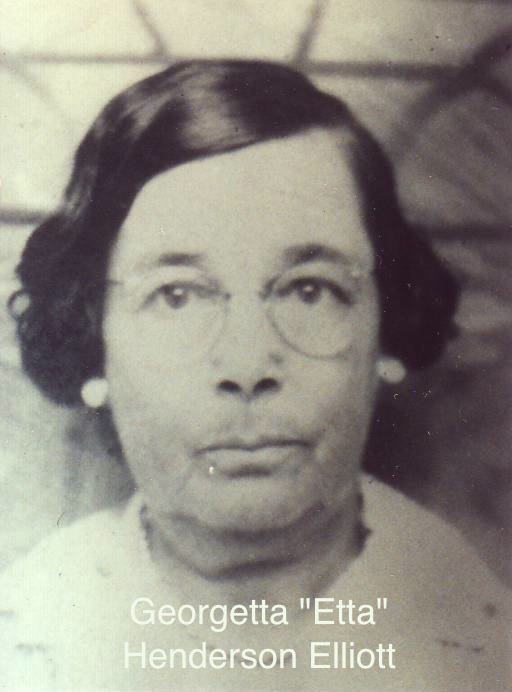
James Henry Henderson’s first child, Carrie Faison, was born about 1869 to Keziah Faison.  Soon after, James married Frances Sauls and settled in Wayne County as tenant farmers.  James and Frances’ children were Mary Ella Henderson (1867-??), Elizabeth Henderson (1869-??), Nancy Henderson (1873-??), Amelia Henderson Braswell (1877-1914), Elias L. Henderson (1880-1953), James Ira Henderson (1881-1946), Lewis Henderson (1885-1932), and Georgetta Henderson Elliott (1889-1972).  In 1900, James married Laura Roberts. Though James’ modern heirs descend from only a few of his children, Lewis, Georgetta “Etta,” and Elias, they comprise the largest sub-branch of the family. James died 21 June 1920 in Duplin County.

Mary E Henderson Text

Amelia Henderson 001 Text

Elias L Henderson Text

Georgetta Henderson 001 Text

Mary Henderson seems to have died in childhood.

Eliza Henderson moved to Sampson County with her rest of her family, but has not been found after the 1860 census.

Standard
Enslaved People, Maternal Kin, North Carolina

Juda’s children.

As noted earlier, Elizabeth Kilpatrick’s will seems to establish that Juda, an enslaved woman born perhaps in the 1790s, was the mother of at least two children, the Dave and Lucinda specifically referred to in Kilpatrick’s will. Under its terms, Dave’s ownership passed to son Robert Kilpatrick and Lucinda’s to daughter Mary Kilpatrick. Elizabeth’s estate file shows that her administrator sold Negroes Juda ($50.00), Matthew ($425.00) and John ($200.00) on 29 August 1829 and “Negro Kesy” for $74.75 on 30 October 1830. (Their buyers are not listed.) Assuming that Kesy, Matthew and John are the “children not disposed of” in the will, Juda was the mother of at least five children.  Only Lucinda can be further accounted for.

In 1834, Mary Kilpatrick sold Lucinda and her children Alice, 3, and John, 1, to Samuel and John W. McNeely. John disappears from the record. However, Alice, known as “Allie,” bore at least one son, Joseph Archy, and probably several other children, including Alexander, Stanhope and Mary. All – save Alice, who perhaps had died – appear in J.W. McNeely’s Confederate tax assessment in 1863.

Lucinda herself gave birth to two more sons, Julius, about 1838, and Henry W., in 1841. Julius’ father is unknown, but appears to have been a black man. Henry’s father was John Wilson McNeely himself.

Standard
Agriculture, Enslaved People, Land

Visceral touches.

Although the Smithsonian’s National Museum of African American History and Culture, under construction in Washington, will exhibit slave quarters recovered from South Carolina, they will lack visceral touches like the Whitney Plantation’s relentless humid heat and distant trains.  — Eve M. Kahn, “A Restored Louisiana Plantation and Its Lifeblood,”  New York Times, July 26, 2013.

This is cute writing, but it is also truth. I stood shakily at the edge of a North Carolina tobacco field one July, the sun like a ball-peen hammer on the crown of my head, and wept when a horsefly ripped a divot from my forearm. It is humbling, and terrifying, to consider the everyday of the lives of my ancestors, and nothing quite drives the imagination like one’s own acute physical discomfort.

Standard
DNA, Maternal Kin, North Carolina

DNA Definites, no. 4.5: Simonton.

Ten years or more ago, before repeated bad brushes with poison ivy wore me out, I was a member of the Georgia Native Plant Society. Atlanta’s economy was booming, subdivisions were sprouting like nutgrass, and GNPS was dashing across the city, rescuing ferns and trillium from the bulldozer’s scrape. I showed up for the last time at a site just southwest of the city, trailing plastic bags and a shovel. The owner of the parcel stopped by, and I stopped dead when I heard her name. “Simonton?” I said. “Your family wouldn’t be from Iredell County, North Carolina, would they?” She confirmed that they were, adding that they descended from a Theophilus Simonton. I laughed and exclaimed, “Hey! We’re probably distant cousins! I think I’m descended from him, too!” Small world, we agreed, and she went on her way.

A couple of months ago, my mother got a new match on 23andme — “M. Simonton.” Simonton! I contacted her and quickly established that she is descended from Theophilus Simonton of Ireland, then Lancaster County, Pennsylvania, then Iredell County NC. M. told me that her sister lived in Georgia and, on a hunch, I did a quick search of my Family Tree Maker tree. There — the very same M. Simonton and her sister S., who was indeed the woman whose family land I’d scoured for crane’s foot geraniums and astilbe.

——

My line of descent from Theophilus Simonton, who died in 1757: Magdelene Simonton > Theophilus Allison > Thomas Allison > Mary Allison > Thomas Nicholson > J. Lee Nicholson > Harriet Nicholson > Lon Colvert > Margaret Colvert > my mother. M. and S.’s line of descent from Theophilus: Robert Simonton > Adam Simonton > Abner Simonton > Albert Simonton > Adam Simonton > William Simonton > their father.

Standard
Maternal Kin, Newspaper Articles, North Carolina, Politics

The friends of prohibition.

Mt. Ulla.

A meeting of the friends of prohibition was held at Wood Grove, Mt. Ulla Township, on the 4th instant. W.L. Kistler. Esq., was called to the chair and Rev. J. G. Murray, col. was elected secretary. The object of the meeting was explained by Dr. S.W. Eaton. The following resolution was offered by J.T. Ray and unanimously adopted after appropriate remarks from Rev. J.G. Murray and other.

Whereas, In consideration of the evil of Intemperance, caused by the sale and use of intoxicating liquors upon society, which promotes crime and other known vices, and thereby increasing taxation upon the citizens for the suppression, and also entailing injury in some or other upon all classes and conditions of our fellow men, Therefore

Resolved, That we do hereby heartily approve of the action of our County Commissioners in refusing to grant license for the retailing of intoxicating liquors to be used as a beverage in Rowan County.

Upon motion the chairman and secretary were requested to appoint a committee for permanent organization to meet on Saturday the 11th inst., at 3 o’clock, P.M.

The committee for permanent organization are as follows: White – S.A. Lowrance, D.M. Barrier, J.C. Gillespie, J.T. Ray, J.K. Goodman, S.C. Rankin, S.F. Cowan, J.M. Harrison, M.A. File, R. Lyerly, J.K. Graham, Esq.  Colered – W.W. Kilpatrick, Ransom Miller, Henry McNeely, Andy Gillespie, Amos Foster, George Miller, R.A. Kerr, James Rankin, Julius McNeely, Silas Gillespie, Gabriel Kerr.

Upon motion the meeting adjourned to meet on Saturday the 11th inst., at 3 o’clock, P.M.   W.L. KISTLER, Ch’m. J.G. MURRAY, Sec.

The Carolina Watchman, Salisbury NC, 9 June 1881.

ImageWood Grove, Rowan County, Library of Congress Prints and Photographs Division.

——

Henry McNeely and his half-brother Julius McNeely were joined on the committee by Henry’s brother-in-law George Miller and his wife Martha’s brother-in-law Ransom Miller.

Standard
Enslaved People, Land, North Carolina, Paternal Kin, Photographs

A thousand acres between creek and swamp.

Kinchen Taylor’s estate papers include two plats. One laid off his widow Mary Blount Taylor’s dower. The second divided his remaining land into two large parcels:

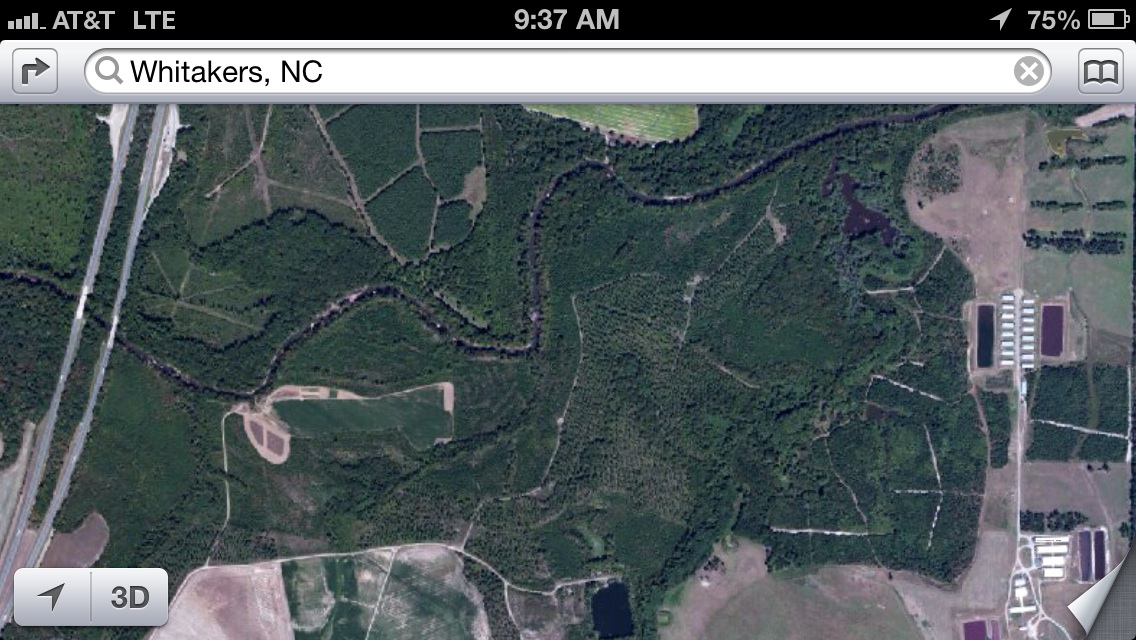
ImageIn some ways, Taylor’s old lands have not changed dramatically. Pine forest and tilled fields still predominate the landscape; far northern Nash County remains rural. Nonetheless, Taylor and enslaved workers like Green and Fereby, who walked and worked it intimately, might be pressed to recognize his property.

Image

I-95 — a far cry from the path shown in the plat — roars with traffic just west of Taylor’s acreage, hauling truckers and tourists from Maine to Florida. If you tilt your head sharply to the right, you’ll see that Fishing Creek, crawling across the top of the screen, still follows the same general course. Beaver Dam Swamp, however, has been dammed just below its confluence with the creek, forming a small body called Gum Lake. The watercourse of the swamp, probably largely drained, is barely detectable as an undulating line of taller vegetation angling southwest from the pond. Lost somewhere in its tangle of canes and catbrier is the Old Mill shown on the plat.

On the other side of Beaver Dam swamp, to the far right of the Google Map view, is an industrial hog farm, identifiable by the white structures with adjacent dark lozenges — barns holding up to 2500 hogs a piece and the lagoons that capture the stupendous quantities of waste they produce. This perhaps would have startled Kinchen Taylor most, as his hogs would have been free-range until time for fattening. (And it should startle you, too, as this is huge, nasty business.)

The file of Kinchen Taylor (1853), Nash County, North Carolina Estate Files 1663-1979, https://familysearch.org, original, North Carolina State Archives;

Standard